
Tower Mounted Amplifier Market Share, Growth & Forecast by 2034
Coverage: by Type (Single Band, Multi Band); Application (Telecommunication, Industrial) , and Geography (North America, Europe, Asia Pacific, and South and Central America)
- Status : Data Released
- Report Code : TIPRE00011148
- Category : Electronics and Semiconductor
- No. of Pages : 150
- Available Report Formats :


- Last update date : October 16, 2026


2025 Market Size
US$ 6.83 Bn
Base year value
2034 Forecast
US$ 13.63 Bn
Projected by 2034
CAGR 2026-2034
7.98 %
Growth rate
Addressable Market
US$ 92.02 Bn
(2026-2034)
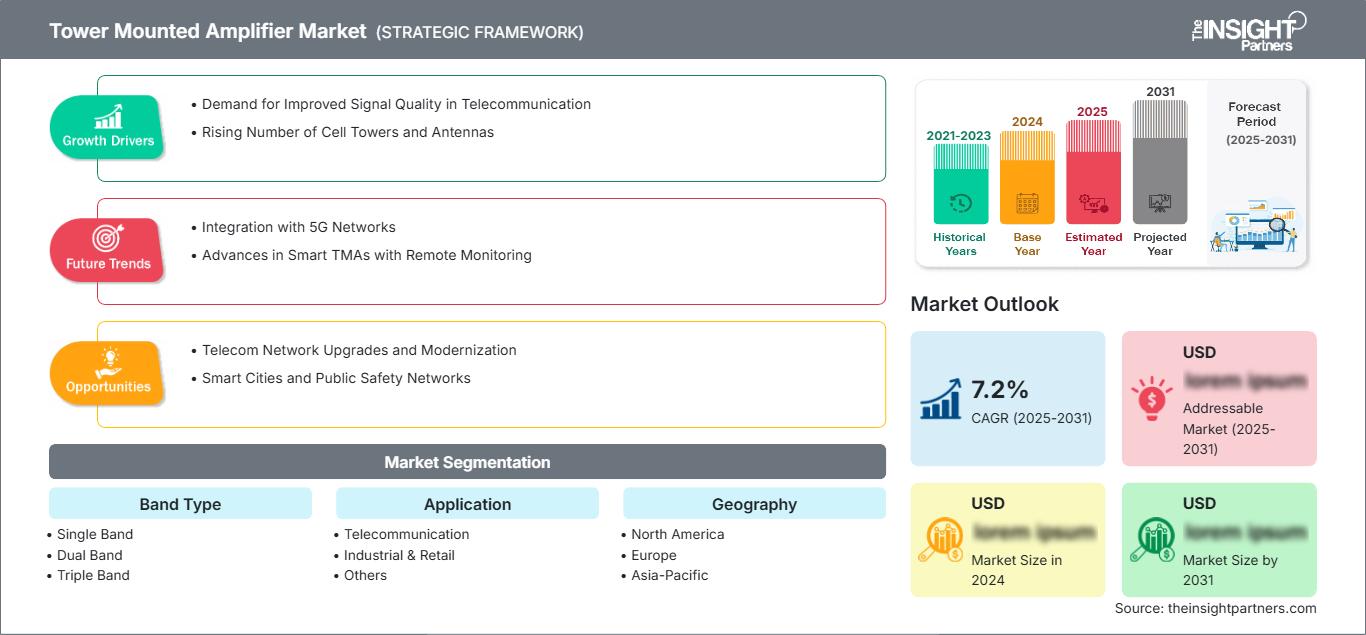
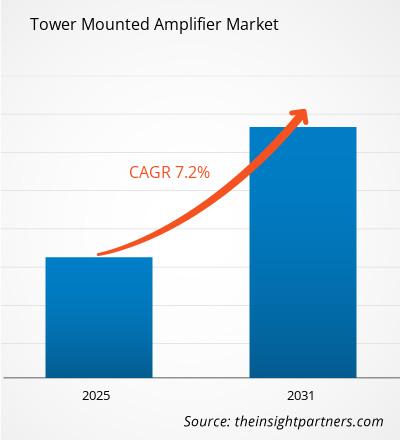
The Tower Mounted Amplifier Market is expanding as mobile operators invest in radio access network capacity, uplink performance, and spectrum efficiency. The market was valued at US$ 6.83 Billion in 2025 and is projected to reach US$ 13.63 Billion by 2034, registering a CAGR of 7.98% during 2026–2034. Demand is supported by continued 4G and 5G network modernization, antenna densification, multi-band deployments, and the need to compensate feeder losses while improving receiver sensitivity at communication sites.
North America remains an important deployment environment as operators modernize existing macro sites and expand coverage for higher-capacity mobile services. The regional market is projected to register a ~7% CAGR through 2034, supported by network densification, multi-band spectrum utilization, rural coverage programs, and replacement of legacy radio infrastructure. Demand also benefits from tower upgrades that seek better uplink reliability without requiring complete site reconstruction.
Tower Mounted Amplifier Market Assessment and Insights
Regional Outlook
- North America: ~31% of the global Tower Mounted Amplifier Market share in 2025 | ~7% CAGR through 2034. Market position: North America represents a mature, high-value deployment base, supported by extensive cellular infrastructure, network modernization, multi-band radio requirements, rural coverage expansion, and continued investment in improving uplink performance across existing tower sites.
- US: ~70% of North American market revenue in 2025 | ~7% CAGR through 2034. Market position: The US represents the largest national demand center in North America, supported by nationwide 5G expansion, dense macro-site infrastructure, spectrum aggregation, public-safety communications, and operator efforts to increase capacity without proportionally expanding tower footprints.
- Europe: ~25% of the global market in 2025 | ~7% CAGR through 2034. Market position: Europe has a mature installed base and sustained modernization requirements. Germany is the leading country in Europe, while the UK, France, Italy, and Spain contribute through 5G upgrades, spectrum refarming, network sharing, and coverage improvement programs.
- Asia Pacific: ~35% of the global market in 2025 | ~9% CAGR through 2034. Market position: Asia Pacific is the fastest-growing region, supported by extensive mobile subscriber bases, rapid 5G deployment, dense urban traffic, and infrastructure expansion. China is the leading country in Asia Pacific, with Japan, South Korea, India, and Australia adding specialized demand.
Segment Outlook
- Telecommunication: ~82% Share in 2025 | ~8% CAGR through 2034. Market position: Telecommunication leads because TMAs are primarily deployed on cellular base stations to improve uplink sensitivity, compensate feeder losses, extend practical coverage, and support multi-band network modernization across established and expanding mobile networks.
- Industrial & Retail: ~12% Share in 2025 | ~10% CAGR through 2034. Market position: Industrial & Retail is the high-growth main segment as private wireless networks, enterprise connectivity, warehouses, campuses, logistics facilities, and large retail environments increasingly require dependable uplink performance and localized wireless coverage.
Competitive Coverage
Amphenol Antenna Solutions, Comba Telecom Systems Holdings Limited, CommScope Inc., Communication Components Inc., Filtronic plc, Kaelus, Kathrein-Werke KG, Telefonaktiebolaget LM Ericsson, TESSCO Technologies, Inc., Westell Technologies, Inc.
Methodology
The Insight Partners follows Data Collection & Secondary Research, Primary Research, Data Analysis, and Data Triangulation & Final Review to validate market estimates and insights.
Source: The Insight Partners' analysis based on proprietary research, government publications, company annual reports, investor presentations, industry databases, and expert interviews.
The evolution of the technology in the Tower Mounted Amplifier Market involves the transition from basic low-noise amplification systems into fully-integrated antenna-line assemblies suitable for use in multi-band and multi-operator environments. The recent TMAs compensate for the loss in signal strength when signals travel through air and line between antennas and radios, increase the sensitivity of receivers and help operators retain coverage without increasing radio power. The integration of antenna-control interfaces, improvements in filtering, environmental protection and packaging has made installations easier too. All this becomes increasingly important in view of the fact that operators deploy multiple frequency layers in existing towers.
From the future perspective, the investments in the networks will focus on architectures requiring higher spectral efficiency, increased uplink capacity, and flexible site design. New markets in the Asia Pacific region, Middle East and selected Latin American countries build new mobile infrastructure, while mature markets modernize and optimize their sites. The energy efficient radios, 5G Advanced technology, network sharing, and spectrum aggregation can be among the factors affecting TMA specifications.
Tower Mounted Amplifier Market Report Scope
| Report Attribute | Details |
|---|---|
| Market size in 2025 | US$ 6.83 Billion |
| Market Size by 2034 | US$ 13.63 Billion |
| Global CAGR (2026 - 2034) | 7.98% |
| Historical Data | 2021-2024 |
| Forecast period | 2026-2034 |
Tower Mounted Amplifier Market Analysis
Demand in the Tower Mounted Amplifier Market is supported by mobile carriers, tower firms, network equipment providers, and wireless network infrastructure integrators. Typical value chains include suppliers of RF components, filters, amplifiers, antenna systems, radios, distributors, system integrators, and telecommunication services. The competitive aspects in the supplier industry include noise figure, gain, linearity, isolation, environmental robustness, frequency compatibility, and interfacing with antenna control systems.
Supply chain in the Tower Mounted Amplifier Market is moving toward multi-band solutions since the operators want to reduce equipment at limited tower sites. Thus, the focus for the engineering of the product is small housing, temperature considerations, low insertion loss, lightning protection, and compatibility with various radio and antenna designs. Supply needs will differ geographically since mature networks have a need for equipment that can replace existing installations while new 5G installations may require antenna and radio combined.
Competition in the Tower Mounted Amplifier Market involves large telecommunications equipment vendors in partnership with RF and antenna systems vendors. Amphenol Antenna Solutions, Comba Telecom Systems Holdings Limited, CommScope Inc., and Telefonaktiebolaget LM Ericsson compete within wireless infrastructure portfolios. Communication Components Inc., Filtronic plc, Kaelus, Kathrein-Werke KG, and Westell Technologies Inc. compete in specialized RF and antenna-line products. TESSCO Technologies Inc. is traditionally involved in the wireless infrastructure distribution environment and is currently part of the larger WESCO distribution platform.
Investments in the Tower Mounted Amplifier Market are becoming increasingly focused on solutions that simplify sites and provide better RF performance. Expansion of the Ericsson’s 2026 product portfolio reflects the industry trend towards improved uplink performance, multi-band radios, and energy-efficient networking infrastructure. Strategic positioning for TMA vendors thus includes compatibility with changing radio architectures, qualifications with operators, certification across multiple geographies, and the ability to serve replacement and new build applications.
● REPORT CUSTOMIZATION
Tailor This Report To Align With Your Specific Business Requirements
This report can be customized to align precisely with your business objectives, scope, and target markets. Customization options include tailored segmentation, geography, competitive analysis, and strategic insights to support informed decision-making.
Customize This Report →WHAT YOU CAN ADJUST
- ● Segmentations
- ● Geography
- ● Competitive Analysis
- ● Language Preferences
Tower Mounted Amplifier Market: Strategic Insights
Regional Insights
North America Tower Mounted Amplifier Market
The Tower Mounted Amplifier Market report shows that North America accounted for ~31% of the global market in 2025 and is expected to register a ~7% CAGR through 2034. The area is well served by an existing cellular tower infrastructure and the addition of 5G capability. Multi-band solutions have become popular among operators who seek to increase spectrum usage without creating a new installation site. TMAs are needed where feeder losses, tower design, or the nature of coverage makes the uplink a concern.
The United States is the key demand driver, thanks to the existing infrastructure, including macro-cells, rural connections, and network updates. In Canada, mobile networks will undergo upgrades and expanded coverage of remote communities. Mexico is another source of demand as operators upgrade 4G and 5G capabilities. Suppliers with capabilities in antennas, RF filtering, and wireless infrastructure can satisfy demand for both replacement of equipment and new installations, while TMA suppliers can meet specific carrier needs.
U.S. Tower Mounted Amplifier Market
The US represented ~70% of North American market revenue in 2025 and is projected to grow at a ~7% CAGR through 2034. The extensive nature of the nation’s cellular network provides frequent occasions for replacement, growth, spectrum extension, and optimization of the equipment installed. The use of TMAs becomes important in cases where operators require enhanced uplink performance and where there is no need for civil works to make changes to the current towers.
Some of the competition in this market comes from Amphenol Antenna Solutions, CommScope Inc., Communication Components Inc., Filtronic plc, Kaelus, Telefonaktiebolaget LM Ericsson, and Westell Technologies, Inc. Applications are not only for the traditional cellular networks but also for public safety and enterprise wireless. Increased traffic, rural network needs, carrier aggregation, and multiband radio installations call for multiple frequency operation of equipment while keeping noise and linearity at a minimum.
Europe Tower Mounted Amplifier Market
Europe represented ~25% of the global market in 2025 and is projected to register a ~7% CAGR through 2034. The region has a mature cellular infrastructure base, making replacement, modernization, and spectrum-layer additions important demand mechanisms. Germany is the leading country in Europe, supported by extensive mobile infrastructure and continuing network modernization. The UK is also significant as operators consolidate infrastructure and expand 5G capacity, while France benefits from ongoing 5G and rural coverage investment.
Germany’s already well-established network infrastructure provides room for performance enhancement at existing macro sites, especially where extra layers of spectrum have to be added without making significant changes to the structure. The French market has high urban demand along with nationwide coverage needs, hence there is scope for the use of multiband RF equipment. The Italian market is driven by network modernization and infrastructure sharing, and the Spanish market is moving towards widespread 5G Advanced network deployment. For instance, in 2026, Ericsson and MasOrange deployed advanced 5G RAN systems in 20 Spanish cities.
The regulatory focus in Europe on connectivity, spectrum management, and energy efficiency affects purchasing decisions. Hence, TMA vendors must not only compete on performance but also size, interoperability, robustness, and compatibility with new antenna and radio technologies.
APAC Tower Mounted Amplifier Market
The Tower Mounted Amplifier Market forecast indicates that APAC accounted for ~35% of the global market in 2025 and is projected to grow at a ~9% CAGR through 2034, making it the fastest-growing region. China leads in Asia Pacific region owing to extensive mobile network infrastructure and network upgrades. Japan and South Korea focus on high-performance 5G capabilities, whereas India focuses on building up mobile infrastructure in both rural and urban regions.
Australia plays an important role through its emphasis on large coverage area requirements and infrastructure upgrade needs. High-density network traffic in the major cities of Asia makes a requirement for equipment that would be able to handle multiple frequency layers as well as improve uplink capability. Policy backing on digital infrastructure, 5G deployment, industrial connectivity, and rural broadband is also in place. The 2026 partnership between Ericsson and SoftBank in Japan is an example.
Middle East & Africa Tower Mounted Amplifier Market
The Middle East & Africa market is projected to register a ~8% CAGR through 2034. Saudi Arabia and the UAE are important demand centers because telecom operators are investing in advanced mobile infrastructure, enterprise connectivity, smart-city applications, and high-capacity networks. South Africa provides a substantial installed cellular base and ongoing network modernization requirements.
Of all countries in MEA, Saudi Arabia is the leader in terms of infrastructure investments and 5G rollouts to drive the market. UAE represents a good market opportunity for high-end wireless communications systems both in urban and enterprise scenarios. Geographical diversification of coverage requirements in South Africa presents an opportunity for devices with better uplink capability at current sites. Other MEA markets present long-term market opportunities for mobile network operators to extend and modernize their networks through infrastructure and investment.
Segmentation Analysis
Band Type
Band configuration determines how effectively TMAs can accommodate operators' spectrum strategies and tower constraints. Single-band systems remain relevant for targeted network layers and replacement requirements, while dual-band and triple-band configurations provide greater equipment consolidation. As operators add spectrum and seek to reduce equipment footprint, multi-band architectures are increasingly important to deployment economics and site optimization.
- Single Band: Single-band TMAs remain important for dedicated frequency layers, legacy-network replacement, and applications where a single spectrum allocation requires optimized uplink amplification. Their simpler architecture can support straightforward maintenance and targeted coverage enhancement.
- Dual Band: Dual-band solutions provide greater flexibility where operators operate two frequency layers from the same location. They can reduce equipment duplication and simplify tower installations while supporting network modernization involving multiple generations or spectrum bands.
- Triple Band: Triple-band TMAs address increasingly complex spectrum configurations by consolidating amplification functions within constrained tower environments. Their strategic value rises where operators combine several bands and prioritize reduced site footprint and installation complexity.
Application
Application is the principal demand determinant because TMA requirements vary with network architecture, traffic density, coverage objectives, and equipment environment. Telecommunication remains the dominant application and is expected to register a ~8% CAGR through 2034. Industrial & Retail is projected to grow faster at ~10% as private wireless networks and enterprise connectivity expand.
- Telecommunication: Telecommunications operators use TMAs to compensate feeder losses, improve base-station receiver sensitivity, strengthen uplink performance, and support coverage. The segment benefits from 4G replacement, 5G expansion, multi-band deployment, and optimization of existing macro-cell sites.
- Industrial & Retail: Industrial and retail environments increasingly deploy dedicated or private wireless connectivity for automation, logistics, inventory, worker communications, and customer services. TMA-related demand can arise where indoor or campus radio systems require stronger uplink performance and reliable coverage.
- Others: Other applications encompass specialized wireless environments where receiver sensitivity, coverage, and RF reliability are important. Demand depends on project-specific communications requirements and can include public-safety or mission-critical infrastructure.
Opportunity Snapshot
| Application | Revenue Contribution | Trend Tag | Adoption Stage |
| Telecommunication | High | 5G Densification | Mature |
| Industrial & Retail | Medium | Private Wireless | Scaling |
| Others | Low | Mission Critical | Emerging |
Tower Mounted Amplifier Market Growth Drivers and Impact Analysis
Expansion of Multi-Band 4G and 5G Infrastructure
Operators are adding spectrum layers while seeking to increase capacity from existing tower locations. Multi-band radio architectures create more demanding RF paths because several frequencies must operate with appropriate isolation, gain, linearity, and interference control. TMAs can improve receiver sensitivity by compensating losses between the antenna and radio, allowing operators to optimize uplink performance without relying exclusively on higher transmitter power. The impact is strongest in mature networks where tower locations are valuable and additional site construction can be costly or constrained. Equipment suppliers that support several frequency combinations can therefore address replacement, capacity expansion, and network modernization simultaneously. This driver also encourages compact designs that minimize tower loading and installation complexity.
Rising Requirement for Better Uplink Performance
The growth of cloud applications, video traffic, connected devices, industrial communications, and interactive services increases the importance of reliable uplink performance. Network users increasingly transmit high-volume data rather than simply consume downlink content, placing greater pressure on the radio receiver path. TMAs directly address this issue by placing low-noise amplification close to the antenna, reducing the effect of feeder losses before the signal reaches the base-station receiver. The resulting improvement can support wider practical coverage and more consistent service quality. For operators, this mechanism can be attractive when improving the existing radio chain is more practical than undertaking extensive site redevelopment. It also supports performance optimization in difficult coverage environments.
Modernization of Existing Cellular Tower Infrastructure
A large installed base of cellular sites provides a continuing replacement and upgrade opportunity. As operators introduce newer radios, spectrum combinations, and antenna configurations, associated RF components may require modernization to maintain interoperability and performance. TMA demand consequently extends beyond greenfield 5G construction. Replacement projects can require weather-resistant housings, updated control interfaces, improved isolation, and compatibility with new frequency combinations. Suppliers that can integrate amplifier, filtering, monitoring, and antenna-control functions have opportunities to participate in broader site modernization programs. This driver also favors vendors with established operator approvals because network operators generally seek predictable installation, testing, and maintenance procedures when upgrading equipment across large installed bases.
Tower Mounted Amplifier Market Future Trends
Integration of Intelligent Antenna-Line Monitoring
The Tower Mounted Amplifier Market trends indicate that future TMA architectures are likely to become more closely integrated with intelligent antenna-line management. Operators increasingly need visibility into site performance, alarms, gain conditions, and equipment health as network complexity rises. Combining amplification with monitoring and standardized control interfaces can help reduce maintenance effort and improve fault identification. The trend is also connected to the broader movement toward automated network operations, where software increasingly manages radio resources and site performance. TMA suppliers can respond by developing equipment capable of remote configuration, condition reporting, and interoperability with network-management systems. Such capabilities may become particularly valuable in distributed and multi-operator networks where technicians need to diagnose equipment without repeated physical tower visits.
Compact High-Performance Solutions for Spectrum-Constrained Sites
As operators deploy additional frequency layers, physical space and tower loading become increasingly important design considerations. Future products are therefore likely to emphasize higher functional density rather than simply higher amplification. Compact multi-band architectures, improved filtering, thermal optimization, and lighter enclosures can allow operators to add capabilities without proportionally increasing equipment volume. This trend is relevant to both mature markets with constrained sites and rapidly expanding markets where operators want scalable infrastructure. Developments in RF semiconductor technology can further support efficiency and linearity improvements. Over time, product differentiation is likely to shift toward the combined value of RF performance, size, weight, energy use, remote management, and compatibility with evolving antenna systems.
Tower Mounted Amplifier Market Opportunities
Enterprise and Private Wireless Network Expansion
Enterprise connectivity creates an opportunity beyond traditional public mobile infrastructure. Manufacturing plants, logistics hubs, ports, warehouses, campuses, utilities, and large retail environments increasingly require dependable wireless connectivity for operational applications. Private 5G and other dedicated wireless architectures can create localized requirements for stronger RF performance, especially across large or structurally complex facilities. Suppliers can target this opportunity through compact, application-specific amplifier solutions that integrate with private-network radios, distributed antenna systems, and enterprise coverage architectures. Partnerships with system integrators can be particularly valuable because enterprise buyers often procure complete connectivity solutions rather than individual RF components. The opportunity is strongest where wireless reliability has a direct relationship with automation, worker communications, asset tracking, or operational continuity.
Localized Manufacturing and Regional Supply Partnerships
Regional production and supply partnerships can create opportunities as telecommunications infrastructure programs expand across Asia Pacific, the Middle East, and other emerging markets. Local procurement requirements, shorter lead times, regional certifications, and operator-specific frequency combinations can influence supplier selection. Manufacturers can improve market access by establishing local assembly, engineering support, distributor relationships, and technical service capabilities. Strategic partnerships with antenna vendors and radio-system providers can also improve qualification opportunities because TMAs are often evaluated as part of a broader RF chain. The commercial opportunity therefore extends beyond product sales into customization, integration, maintenance, and replacement services. Suppliers that combine global RF expertise with regional execution capabilities can address varied deployment requirements more effectively.
Recent Developments
- October 2023: Filtronic introduced a 48-port Tower Top Amplifier (TTA) designed to strengthen critical communications infrastructure by improving signal performance and coverage. The solution is engineered for high-density multi-carrier and multi-band applications, supporting communications networks that require reliable and efficient tower-top amplification. The launch expands Filtronic’s portfolio of critical communications solutions and addresses the requirements of complex wireless infrastructure deployments.
- February 2026: Telefonaktiebolaget LM Ericsson introduced AI-ready radios, antennas, and RAN software designed around higher uplink performance, energy efficiency, and AI-driven network requirements. The announcement is relevant to the TMA ecosystem because stronger uplink performance increases the importance of the complete receive path between antennas and radios, including antenna-line components.
- May 2026: Nokia launched a suite of application-optimized optical networking solutions designed to address the increasing connectivity and capacity requirements of AI-driven networks. The portfolio includes new coherent optical solutions and a compact, multi-fiber optimized in-line amplifier. Nokia stated that the solutions can improve network efficiency, reduce total cost of ownership by up to 70%, and enable operators to deliver up to 40 times more services within the same footprint.
Frequently Asked Questions

- Comprehensive Market Sizing and Forecast Analysis
- Detailed Segmentation Analysis
- In-Depth Market Dynamics Assessment
- Regional and Country-Level Insights
- Competitive Landscape and Company Benchmarking
- Strategic Business Intelligence
Recent Reports
Testimonials

The Insight Partners provided valuable market intelligence that supported our global go-to-market strategy. Their team was professional, responsive, and attentive to our feedback, providing thoughtful analysis and helpful methodological clarifications throughout the project.
Junmo Kim Chief Financial Officer (CFO), Enertech Co., Ltd.
The Insight Partners' SCADA System Market report is comprehensive, with valuable insights on current trends and future forecasts. The team was highly professional, responsive, and supportive throughout. We are very satisfied and highly recommend their services.
RAN KEDEM Partner, Reali Technologies LTDs
I requested a report on a very specific software market and the team produced the report in a few days. The information was very relevant and well presented. I then requested some changes and additions to the report. The team was again very responsive and I got the final report in less than a week.
JEAN-HERVE JENN Chairman, Future Analytica
We worked with The Insight Partners for an important market study and forecast. They gave us clear insights into opportunities and risks, which helped shape our plans. Their research was easy to use and based on solid data. It helped us make smart, confident decisions. We highly recommend them.
PIYUSH NAGPAL Sr. Vice President, High Beam Global
The Insight Partners delivered insightful, well-structured market research with strong domain expertise. Their team was professional and responsive throughout. The user-friendly website made accessing industry reports seamless. We highly recommend them for reliable, high-quality research services
YUKIHIKO ADACHI CEO, Deep Blue, LLC.
This is the first time I have purchased a market report from The Insight Partners.While I was unsure at first, I visited their web site and felt more comfortable to take the risk and purchase a market report.I am completely satisfied with the quality of the report and customer service. I had several questions and comments with the initial report, but after a couple of dialogs over email with their analyst I believe I have a report that I can use as input to our strategic planning process.Thank you so much for taking the extra time and making this a positive experience.I will definitely recommend your service to others and you will be my first call when we need further market data.
JOHN SUZUKI President and Chief Executive Officer, Board Director, BK Technologies
I wish to appreciate your support and the professionalism you displayed in the course of attending to my request for information regarding to infectious disease IVD market in Nigeria. I appreciate your patience, your guidance, and the fact that you were willing to offer a discount, which eventually made it possible for us to close a deal. I look forward to engaging The Insight Partners in the future, all thanks to the impression you have created in me as a result of this first encounter.
DR CHIJIOKE ONYIA MANAGING DIRECTOR, PineCrest Healthcare Ltd.Reason to Buy
- Informed Decision-Making
- Understanding Market Dynamics
- Competitive Analysis
- Identifying Emerging Markets
- Customer Insights
- Market Forecasts
- Risk Mitigation
- Boosting Operational Efficiency
- Strategic Planning
- Investment Justification
- Tracking Industry Innovations
- Aligning with Regulatory Trends





 Get Free Sample for