
Tubing Spools Market Share, Growth & Demand by 2034
Coverage: by Type (Single Tubing, Dual Tubing); Application (Onshore, Offshore) , and Geography (North America, Europe, Asia Pacific, and South and Central America)
- Status : Data Released
- Report Code : TIPRE00008042
- Category : Manufacturing and Construction
- No. of Pages : 150
- Available Report Formats :


- Last update date : October 16, 2026


2025 Market Size
US$ 1.43 Bn
Base year value
2034 Forecast
US$ 2.28 Bn
Projected by 2034
CAGR 2026-2034
5.29 %
Growth rate
Addressable Market
US$ 16.80 Bn
(2026-2034)
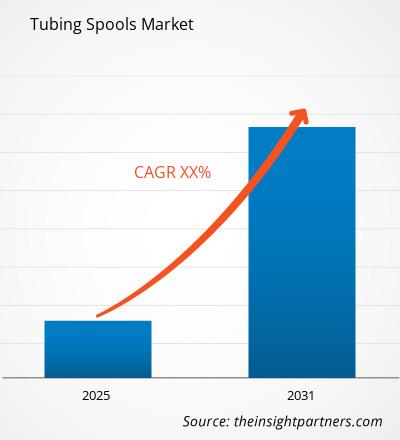
The Tubing Spools Market covers equipment used to support, seal, and suspend tubing strings within wellhead assemblies during drilling, completion, production, and workover operations. The global market was valued at US$ 1.43 Billion in 2025 and is projected to reach US$ 2.28 Billion by 2034, expanding at a CAGR of 5.29% during 2026–2034. Demand is shaped by well construction activity, mature-field intervention, pressure-management requirements, and the continuing deployment of engineered wellhead systems across onshore and offshore assets.
North America remains an important demand center as unconventional development, well servicing, completion activity, and replacement of installed wellhead equipment sustain procurement requirements. The regional Tubing Spools Market is modeled to expand at ~5% CAGR through 2034, supported by active drilling and intervention programs, high installed well populations, and demand for pressure-rated equipment suited to complex completion configurations. Suppliers are also emphasizing reliability, shorter installation time, and compatibility with increasingly sophisticated well-control architectures.
Tubing Spools Market Assessment and Insights
Regional Outlook
- North America: ~39% of the global Tubing Spools Market share in 2025 | ~5% CAGR through 2034. Market position: North America holds the largest regional position because of its extensive producing-well base, active unconventional operations, mature well-servicing ecosystem, and established demand for standardized and high-pressure wellhead equipment. Replacement and intervention activity further support recurring demand.
- US: ~82% of North American market revenue in 2025 | ~5% CAGR through 2034. Market position: The US represents the principal North American demand center, supported by shale and tight-oil development, workover activity, pressure-control requirements, and a broad supplier network serving onshore basins and increasingly complex completion programs.
- Europe: ~24% of the global market in 2025 | ~4% CAGR through 2034. Market position: Europe represents a mature market characterized by selective upstream investment, brownfield optimization, and offshore asset management. The UK and Norway provide strong offshore demand, while Germany, France, Italy, and Spain contribute through industrial and specialized energy applications.
- Asia Pacific: ~23% of the global market in 2025 | ~7% CAGR through 2034. Market position: Asia Pacific is the fastest-growing region, supported by upstream investment, expanding domestic energy production, offshore developments, and modernization of wellhead infrastructure. China is the leading country in Asia Pacific, with India and Southeast Asian producers adding incremental demand.
Segment Outlook
- Onshore: ~72% Share in 2025 | ~5% CAGR through 2034. Market position: Onshore applications lead because tubing spools are widely incorporated into conventional and unconventional wellhead systems, while large installed well populations generate recurring replacement, completion, workover, and pressure-control requirements.
- Offshore: ~28% Share in 2025 | ~6% CAGR through 2034. Market position: Offshore applications have a higher growth outlook because new subsea and platform developments require engineered pressure-control systems capable of operating under demanding environmental and loading conditions, while brownfield offshore assets require integrity-driven replacement and intervention.
Competitive Coverage
CCSC Petroleum Equipment LTD CO., Delta Corporation, Integrated Equipment, Jiangsu Sanyi Petroleum Equipment Co., Ltd., JMP Petroleum Technologies, Inc., MSP/DRILEX, Shanghai Shenkai Petroleum & Chemical Equipment Co., Ltd., Weir PLC, TSC, UZTEL S.A.
Methodology
The Insight Partners follows Data Collection & Secondary Research, Primary Research, Data Analysis, and Data Triangulation & Final Review to validate market estimates and insights.
Source: The Insight Partners' analysis based on proprietary research, government publications, company annual reports, investor presentations, industry databases, and expert interviews.
The development of wellhead components has become more and more oriented towards the pressure integrity, modularity, safety of operations, and compatibility with evolving completion configurations. Wellhead spool assemblies are interfaces that allow pressure containment of the system, as well as integration of tubing suspension and seal components within the wellhead system. Improvements in pressure-rated design, materials used, machining accuracy, sealing technology, and sensors' availability have increased applicability of these devices in high-pressure and complex well environments. Furthermore, digital wellhead systems, integrating pressure and temperature sensors with remote monitoring and control systems, minimize manual intervention during operations.
In terms of future prospects, the level of differentiation of investments according to geography and type of wells is expected to grow. Opportunities in Asia Pacific include domestic developments and offshore explorations, while certain Middle Eastern countries are investing in production facilities and redevelopment of existing fields. The demand in North America will depend more on drilling intensity, workovers, and installation base updates. Regulations oriented towards well integrity, pressure containment, emission management, and safety of workers motivate producers to use equipment with reliable sealing features and easy-to-inspect solutions. This creates an environment of competition based on engineering, qualification, supply reliability, customization, and service support.
Tubing Spools Market Report Scope
| Report Attribute | Details |
|---|---|
| Market size in 2025 | US$ 1.43 Billion |
| Market Size by 2034 | US$ 2.28 Billion |
| Global CAGR (2026 - 2034) | 5.29% |
| Historical Data | 2021-2024 |
| Forecast period | 2026-2034 |
Tubing Spools Market Analysis
The major source of demand for the equipment is oil and gas operators, drilling contractors, wellhead providers, completions experts and service firms that need the equipment that would allow them to suspend tubing and keep its pressure integrity. The value chain includes such processes as sourcing of materials, forgings/castings/machining, heat treating, manufacturing, seals assembly, pressurization testing, certification, distribution, installation and after-sales services. Equipment design depends on its pressure rating, bore design, temperature, size of casing and tubing and other factors.
Factors that affect supply in the Tubing Spools Market include manufacturing capacity, metallurgical processes, machining skills, qualification standards and equipment production capability in line with operator specific designs. In general, standardized equipment allows cost-efficient production, while equipment design for high pressure operations requires better control. Delivery schedules matter since well completion and workover programs work according to strictly planned schedules. Hence, manufacturers having quality control system, regional inventory, engineering services and after sales services have better chances to satisfy their demand.
The competition in the Tubing Spools Market consists of global engineering companies, manufacturers of specialized wellhead equipment, regional manufacturers of petroleum equipment, and integrated manufacturers of oil field technology. Delta Corporation, JMP Petroleum Technologies, MSP/DRILEX, UZTEL S.A., and Integrated Equipment operate in the specialized markets of pressure-control and wellhead equipment, while Jiangsu Sanyi Petroleum Equipment Co., Ltd., CCSC Petroleum Equipment LTD CO., and Shanghai Shenkai Petroleum & Chemical Equipment Co., Ltd. increase the coverage in Asia for engineering and manufacturing. Weir PLC and TSC have wider industrial and offshore operations that could complement the requirements of wellhead equipment.
Strategies for investment in the Tubing Spools Market are increasingly becoming based on qualification of products, automation of manufacturing processes, engineering customized solutions, digital monitoring, and geographic service coverage. The operators require equipment that would lower the complexity of installation and facilitate the operation intervals, while the equipment suppliers seek ways to improve manufacturing consistency and reduce lead time. As a result, competitive advantage is shifting from mere supply of components towards integrated technical solutions, life cycle services, inspection ability, and engineering solutions based on the application.
● REPORT CUSTOMIZATION
Tailor This Report To Align With Your Specific Business Requirements
This report can be customized to align precisely with your business objectives, scope, and target markets. Customization options include tailored segmentation, geography, competitive analysis, and strategic insights to support informed decision-making.
Customize This Report →WHAT YOU CAN ADJUST
- ● Segmentations
- ● Geography
- ● Competitive Analysis
- ● Language Preferences
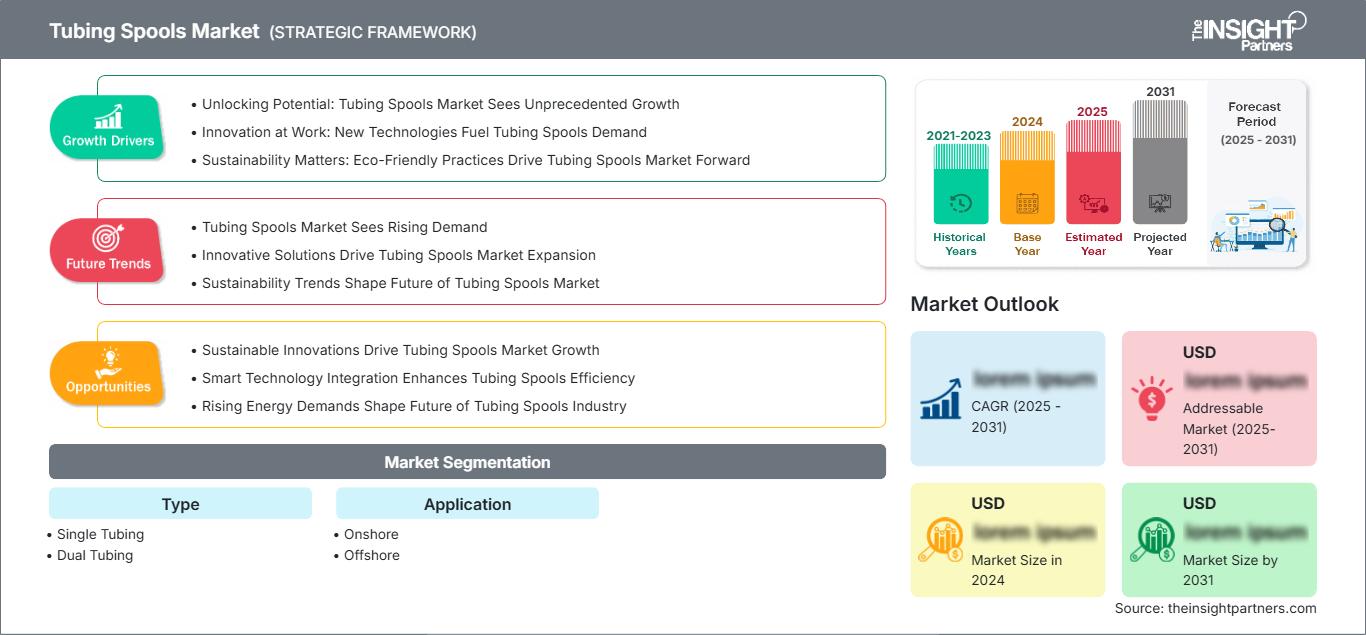
Tubing Spools Market: Strategic Insights
Regional Insights
North America Tubing Spools Market
The Tubing Spools Market forecast shows that North America accounted for ~39% of the global market in 2025 and is modeled to expand at ~5% CAGR through 2034. These include the presence of a large number of producing wells, drilling and completion infrastructure, and ongoing workover operations. On one side, the United States is responsible for the majority of demand, whereas Canada supports demand by providing conventional production, oil sand infrastructure, and well servicing. In addition, demand is not driven only by new wells, as mature fields need tubing replacement, wellhead repairs, pressure control equipment, and well intervention equipment.
In terms of the supply side in the Tubing Spools Market, the region has a large number of established oilfield equipment manufacturers, machining capabilities, as well as distributors and service centers. Furthermore, unconventional wells create additional needs for pressure-rated equipment and completion designs that would be capable of dealing with challenging conditions. Finally, operators are interested in efficient installation and reliable equipment, since downtime may seriously influence economic efficiency of the well. Until 2034, the market will be mostly influenced by drilling, refracturing, workover operations, production improvement, and wellhead replacement.
U.S. Tubing Spools Market
The US represented ~82% of North American Tubing Spools Market revenue in 2025 and is modeled to expand at ~5% CAGR through 2034. This positioning is determined by the magnitude of oil and gas extraction within the country’s onshore basins where the need for drilling, completion, workover and maintenance programs arises regularly. The need for pressure management in unconventional wells adds another justification for the use of engineered tubing spool assemblies.
There are various competing businesses in the market, which consist of manufacturers of wellheads and general oilfield equipment. This equipment is applicable in cases of well construction and production operations where tubing suspension and pressure management is needed. Another source of demand for the products is the intervention operations carried out in matured wells where the need to upgrade or replace pressure management equipment arises.
Europe Tubing Spools Market
Europe represented ~24% of the global Tubing Spools Market in 2025 and is modeled to grow at ~4% CAGR through 2034. The area is mature, and therefore, demand is driven by the development of brownfields, offshore maintenance, selectivity of explorations, and replacement of obsolete equipment used at the wellheads. United Kingdom and Norway are the important offshore markets owing to their presence of North Sea offshore assets and focus on improving efficiency of the production processes. Germany, France, Italy, and Spain make their contributions through less intensive upstream operations and industrial engineering networks in the energy sector.
United Kingdom continues to be an important country in Europe owing to its offshore assets and high number of producing mature fields. Norway is helping in driving the demand for the products due to its offshore projects and well intervention and asset integrity programs. Germany, France, Italy, and Spain have more selective upstream engagements and thus the requirements of the customers are more project-based.
Across the region, the Tubing Spools Market is increasingly connected with life-extension strategies. Operators managing mature offshore assets need equipment capable of maintaining pressure integrity while minimizing intervention time and logistical disruption. Suppliers with inspection, refurbishment, customization, and engineering support can therefore address both new-build and replacement demand. The European market is expected to remain comparatively mature, with growth depending more on offshore redevelopment and equipment modernization than on large-scale expansion of drilling activity.
APAC Tubing Spools Market
Asia Pacific represented ~23% of the global Tubing Spools Market in 2025 and is modeled to grow at ~7% CAGR through 2034, making it the fastest-growing region. China is the leading country in Asia Pacific, supported by its extensive domestic petroleum industry and equipment-manufacturing ecosystem. India, Australia, Japan, and South Korea add demand through upstream activity, offshore engineering, energy infrastructure, and industrial supply chains.
China and India are particularly important because domestic production and energy-security objectives encourage continued investment in upstream assets. Australia contributes through offshore and LNG-linked projects, while Japan and South Korea provide advanced engineering and offshore supply-chain capabilities. Regional policy emphasis on domestic energy supply and infrastructure modernization supports equipment procurement, while localization of manufacturing can reduce lead times and improve service availability. Growth therefore combines new well development with replacement and modernization of existing pressure-control equipment.
Middle East & Africa Tubing Spools Market
The Middle East & Africa market is modeled to expand at ~6% CAGR through 2034. Saudi Arabia represents a leading country in the Middle East & Africa market where upstream capacity expansion, mature-field optimization, and large-scale oilfield infrastructure sustain demand for wellhead and pressure-control equipment. The UAE also contributes through offshore development and field-service capabilities, while South Africa and other African producers provide smaller but project-driven opportunities.
Energy production remains the principal demand foundation. Operators require dependable tubing suspension and pressure containment across new wells, workovers, production optimization programs, and brownfield projects. In the Gulf, large operators can favor qualified suppliers with strong engineering, testing, and regional service capabilities. Across Africa, procurement can be more sensitive to project timing, logistics, local content requirements, and availability of technical support. These factors make regional distribution and field-service capabilities important competitive considerations.
Segmentation Analysis
Type
The Type segment differentiates equipment according to tubing configuration and wellhead requirements. Single tubing remains widely used because of its relatively straightforward configuration and broad compatibility with conventional production arrangements. Dual tubing supports wells requiring separate tubing paths and more complex production or completion configurations. Selection is influenced by well architecture, pressure conditions, completion strategy, intervention requirements, and operator preferences. The Type segment is modeled to expand at ~5% CAGR through 2034 as suppliers improve pressure integrity, configuration flexibility, and integration with modern wellhead systems.
- Single Tubing: Single tubing is widely deployed in conventional and unconventional well configurations where one primary tubing string is required. Its established installation practices, broad equipment compatibility, and suitability across numerous onshore applications support consistent replacement and new-well demand.
- Dual Tubing: Dual tubing serves more complex completion arrangements where separate tubing strings support differentiated production or operational requirements. Demand is more application-specific, but the configuration provides flexibility for wells requiring multiple flow paths and controlled production strategies.
Application
Application represents the principal demand split between onshore and offshore operations. Onshore applications account for the larger installed base because tubing spools are incorporated across extensive conventional and unconventional well populations. Offshore equipment faces stricter requirements related to pressure, corrosion, environmental exposure, installation logistics, and reliability. The Application segment is modeled to expand at ~5% CAGR through 2034, with offshore demand developing more rapidly as operators invest in offshore production, field redevelopment, and asset integrity.
- Onshore: Onshore applications benefit from extensive producing-well populations and recurring drilling, completion, workover, and replacement requirements. Procurement emphasizes standardized interfaces, pressure integrity, installation efficiency, and compatibility with existing wellhead assemblies across conventional and unconventional operations.
- Offshore: Offshore applications require engineered equipment capable of maintaining pressure integrity under demanding environmental conditions. Demand is closely associated with platform and subsea development, brownfield intervention, asset life extension, and stringent inspection and qualification requirements.
Opportunity Snapshot
| Application | Revenue Contribution | Trend Tag | Adoption Stage |
| Onshore | High | Well Intervention | Mature |
| Offshore | Low | Offshore Redevelopment | Scaling |
Tubing Spools Market Growth Drivers and Impact Analysis
Expansion of Well Intervention and Mature-Field Optimization Programs
Mature oil and gas fields require continuous intervention to maintain production, replace aging components, manage pressure, and extend productive life. Tubing spools are directly relevant to these activities because wellhead assemblies must maintain structural support and pressure containment when tubing strings are installed, replaced, or reconfigured. As operators seek additional output from existing assets rather than relying exclusively on greenfield developments, equipment replacement and workover programs become an important source of demand. This mechanism is particularly relevant in North America, Europe, and the Middle East, where extensive installed well populations create recurring equipment requirements. Suppliers that provide compatible replacement products, engineering support, inspection, and rapid delivery can benefit from this recurring demand cycle.
Increasing Requirements for High-Pressure and Complex Well Completions
The technical complexity of modern wells is increasing pressure-management requirements across drilling, completion, stimulation, and production activities. High-pressure environments require wellhead components with dependable sealing, structural integrity, dimensional accuracy, and verified pressure ratings. Tubing spools form an important interface within this pressure-control architecture and must remain compatible with casing heads, tubing hangers, valves, and production trees. The impact is visible in the development of engineered equipment for unconventional and technically demanding wells, where operating conditions can differ materially from conventional production. Manufacturers with advanced machining, material selection, pressure-testing, and quality-assurance capabilities can address higher-specification procurement requirements and improve their position in technically demanding projects.
Modernization of Wellhead Systems and Operational Safety Requirements
Operators increasingly prioritize equipment that supports reliable well control, efficient installation, inspection, and operational monitoring. Modern wellhead systems can incorporate pressure and temperature sensors, remote monitoring, hydraulic actuation, and improved sealing arrangements, creating demand for components compatible with increasingly integrated architectures. Tubing spools therefore participate in a broader modernization cycle rather than functioning solely as passive mechanical components. Safety requirements also encourage operators to use qualified equipment with traceable manufacturing and testing processes. For suppliers, this creates opportunities to differentiate through engineering documentation, digital integration, certification support, and lifecycle services. The resulting demand mechanism favors manufacturers capable of combining mechanical performance with system-level compatibility and dependable field support.
Tubing Spools Market Future Trends
Integration of Digital Monitoring With Pressure-Control Equipment
The Tubing Spools Market trends show that tubing spool systems are likely to become more closely integrated with digital wellhead architectures as operators seek earlier visibility into pressure, temperature, valve status, and equipment condition. Sensor-enabled wellhead systems can transmit operating information to centralized monitoring environments, supporting condition-based intervention and reducing dependence on manual inspections. The trend is particularly relevant to offshore and remote assets where physical access is expensive and operational disruptions can be significant. Future product development is therefore likely to focus on interfaces that accommodate sensing, diagnostics, remote monitoring, and data integration without compromising pressure containment. For manufacturers, digital compatibility can become a differentiating feature alongside conventional specifications such as pressure rating, bore size, materials, and sealing performance.
Greater Emphasis on Modular and Application-Specific Wellhead Configurations
The future Tubing Spools Market is expected to move toward more modular equipment architectures that allow components to be configured for different casing, tubing, pressure, and completion requirements. Modular design can reduce engineering duplication, simplify inventory management, and shorten installation timelines while still permitting application-specific customization. This approach is particularly relevant for operators managing diverse well portfolios across multiple fields. Suppliers can benefit by standardizing interfaces and manufacturing platforms while retaining the ability to tailor pressure ratings, materials, dimensions, and connection arrangements. Such modularity can also support refurbishment and replacement programs because compatible components can be selected without redesigning an entire wellhead system.
Tubing Spools Market Opportunities
Localization of Manufacturing and Technical Support in Emerging Upstream Markets
Emerging upstream markets provide opportunities for manufacturers that can establish regional production, assembly, distribution, or technical-support capabilities. Local availability can reduce transportation time, simplify procurement, and improve responsiveness during drilling and workover programs. China, India, Southeast Asia, and selected Middle Eastern markets are particularly relevant because domestic energy-security priorities and upstream infrastructure investment can generate recurring equipment requirements. Localization can also help suppliers address country-specific certification, content, and service expectations. The opportunity extends beyond manufacturing because regional engineering centers, spare-parts inventories, pressure-testing facilities, and field-service teams can strengthen customer relationships. Companies pursuing this strategy can combine standardized global product platforms with locally adapted delivery and support models.
Lifecycle Services for Replacement, Inspection, and Wellhead Upgrades
A substantial commercial opportunity exists in lifecycle services associated with installed wellhead equipment. Operators managing mature wells require inspection, refurbishment, component replacement, pressure testing, configuration changes, and engineering support throughout asset life. Suppliers can use installed-base knowledge to provide replacement components and upgrade packages while minimizing operational disruption. This approach creates revenue opportunities beyond initial equipment sales and can strengthen customer retention through recurring service relationships. Offshore assets offer particularly relevant opportunities because intervention logistics and downtime costs increase the value of dependable planning and technical support. Suppliers that combine original-equipment expertise with field service, documentation, testing, and rapid component availability can address a broader share of the lifecycle expenditure associated with wellhead systems.
Recent Developments
- August 2026: SLB announced a contract with Brunei Shell Petroleum to support production restoration from shut-in wells across multiple offshore fields. The integrated scope includes subsurface evaluation, engineering, intervention, monitoring, metering, and offshore execution. The development demonstrates continued activity around mature offshore assets and supports demand for integrated well and production technologies.
- March 2025: Innovex announced the first installation of its VXTe subsea tree and tubing hanger system on the Ewing Bank 953 well in the Gulf of Mexico. The announcement specifically states that the technology eliminates the additional cost and time associated with a tubing head spool, as well as multiple trips associated with tubing-hanger and tree orientation.
- December 2025: Shanghai Shenkai Petroleum & Chemical Equipment Co., Ltd. completed a directed share placement that raised RMB 220 million to support strategic development in offshore oil and gas equipment and AI-driven digital oilfield services. The capital allocation connects conventional petroleum-equipment capabilities with offshore and digital technology development, reinforcing the broader shift toward integrated oilfield solutions.
Frequently Asked Questions

- Comprehensive Market Sizing and Forecast Analysis
- Detailed Segmentation Analysis
- In-Depth Market Dynamics Assessment
- Regional and Country-Level Insights
- Competitive Landscape and Company Benchmarking
- Strategic Business Intelligence
Recent Reports
Testimonials

The Insight Partners provided valuable market intelligence that supported our global go-to-market strategy. Their team was professional, responsive, and attentive to our feedback, providing thoughtful analysis and helpful methodological clarifications throughout the project.
Junmo Kim Chief Financial Officer (CFO), Enertech Co., Ltd.
The Insight Partners' SCADA System Market report is comprehensive, with valuable insights on current trends and future forecasts. The team was highly professional, responsive, and supportive throughout. We are very satisfied and highly recommend their services.
RAN KEDEM Partner, Reali Technologies LTDs
I requested a report on a very specific software market and the team produced the report in a few days. The information was very relevant and well presented. I then requested some changes and additions to the report. The team was again very responsive and I got the final report in less than a week.
JEAN-HERVE JENN Chairman, Future Analytica
We worked with The Insight Partners for an important market study and forecast. They gave us clear insights into opportunities and risks, which helped shape our plans. Their research was easy to use and based on solid data. It helped us make smart, confident decisions. We highly recommend them.
PIYUSH NAGPAL Sr. Vice President, High Beam Global
The Insight Partners delivered insightful, well-structured market research with strong domain expertise. Their team was professional and responsive throughout. The user-friendly website made accessing industry reports seamless. We highly recommend them for reliable, high-quality research services
YUKIHIKO ADACHI CEO, Deep Blue, LLC.
This is the first time I have purchased a market report from The Insight Partners.While I was unsure at first, I visited their web site and felt more comfortable to take the risk and purchase a market report.I am completely satisfied with the quality of the report and customer service. I had several questions and comments with the initial report, but after a couple of dialogs over email with their analyst I believe I have a report that I can use as input to our strategic planning process.Thank you so much for taking the extra time and making this a positive experience.I will definitely recommend your service to others and you will be my first call when we need further market data.
JOHN SUZUKI President and Chief Executive Officer, Board Director, BK Technologies
I wish to appreciate your support and the professionalism you displayed in the course of attending to my request for information regarding to infectious disease IVD market in Nigeria. I appreciate your patience, your guidance, and the fact that you were willing to offer a discount, which eventually made it possible for us to close a deal. I look forward to engaging The Insight Partners in the future, all thanks to the impression you have created in me as a result of this first encounter.
DR CHIJIOKE ONYIA MANAGING DIRECTOR, PineCrest Healthcare Ltd.Reason to Buy
- Informed Decision-Making
- Understanding Market Dynamics
- Competitive Analysis
- Identifying Emerging Markets
- Customer Insights
- Market Forecasts
- Risk Mitigation
- Boosting Operational Efficiency
- Strategic Planning
- Investment Justification
- Tracking Industry Innovations
- Aligning with Regulatory Trends





 Get Free Sample for