
Turbidity Meters Market Size, Growth & Demand by 2034
Coverage: by Type (Portable, Stationary); End-user (Water and Sewage Treatment, Food and Beverage, Pharmaceuticals, Oil and Gas, Power Plants, Pulp and Paper, Others) , and Geography (North America, Europe, Asia Pacific, and South and Central America)
- Status : Data Released
- Report Code : TIPRE00010579
- Category : Electronics and Semiconductor
- No. of Pages : 150
- Available Report Formats :


- Last update date : October 30, 2026


2025 Market Size
US$ 402.31 Mn
Base year value
2034 Forecast
US$ 526.9 Mn
Projected by 2034
CAGR 2026-2034
3.04 %
Growth rate
Addressable Market
US$ 4,218.23 Mn
(2026-2034)
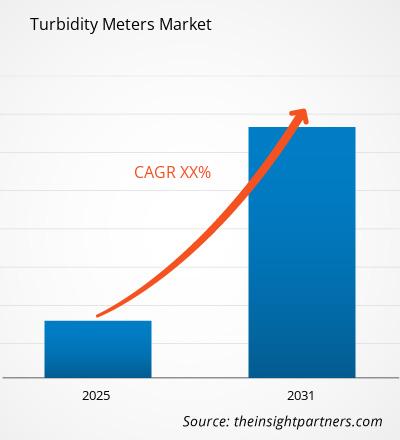
The global Turbidity Meters Market was valued at US$ 402.31 Million in 2025 and is projected to reach US$ 526.9 Million by 2034, expanding at a 3.04% CAGR from 2026 to 2034. The market covers instruments used to quantify suspended particles and water clarity across municipal treatment, industrial processing, laboratories, and field applications. Demand is closely linked to water-quality monitoring, treatment-process control, compliance requirements, and the need for reliable measurements across portable and stationary operating environments.
North America remains an important mature demand center, supported by established drinking-water and wastewater infrastructure, regulatory monitoring, and continued investment in treatment modernization. The regional Turbidity Meters Market Size is estimated to expand at ~3% CAGR through 2034, supported by replacement of aging analytical equipment, increasing process automation, and demand for accurate measurements that can be integrated into laboratory, plant, and field workflows. Growing emphasis on water infrastructure resilience also supports recurring instrument replacement and calibration requirements.
Turbidity Meters Market Assessment and Insights
Regional Outlook
- North America: ~26% of the global market in 2025 | ~3% CAGR through 2034. Market position: North America represents a mature regional market supported by extensive municipal treatment infrastructure, regulatory monitoring, industrial water applications, and replacement demand for laboratory and process instruments.
- US: ~80% of North American market revenue in 2025 | ~3% CAGR through 2034. Market position: The US is the largest country market in North America, supported by municipal water-quality monitoring, wastewater treatment modernization, industrial applications, and established laboratory testing practices.
- Europe: ~27% of the global market in 2025 | ~3% CAGR through 2034. Market position: Europe has a mature analytical-instrument base and established water-quality requirements. Germany leads the regional market, followed by significant demand from the UK, France, Italy, and Spain.
- Asia Pacific: ~34% of the global market in 2025 | ~4% CAGR through 2034. Market position: Asia Pacific is the largest and fastest-growing regional market, supported by expanding water treatment capacity, industrialization, municipal infrastructure development, and increasing adoption of digital water-quality monitoring.
Segment Outlook - Portable: ~61% Share in 2025 | ~3% CAGR through 2034. Market position: Portable instruments lead because they support field sampling, treatment-plant inspections, environmental monitoring, and rapid troubleshooting. Their mobility allows operators to perform measurements across multiple sampling points without dedicated installation.
- Stationary: ~39% Share in 2025 | ~4% CAGR through 2034. Market position: Stationary systems have a higher growth outlook as treatment operators increasingly favor continuous monitoring, automated process control, and integration of turbidity measurements with plant supervisory and data-management systems.
Competitive Coverage
Emerson Electric Co., Teledyne FLIR LLC, Hach Company, Hanna Instruments, Mettler-Toledo International Inc., OMEGA Engineering, Inc., Palintest Limited, Thermo Fisher Scientific Inc., Tintometer GmbH, Xylem Inc.
Methodology
The Insight Partners follows Data Collection & Secondary Research, Primary Research, Data Analysis, and Data Triangulation & Final Review to validate market estimates and insights.
Source: The Insight Partners' analysis based on proprietary research, government publications, company annual reports, investor presentations, industry databases, and expert interviews.
The development of turbidity measuring techniques has progressed from initial optical measurement towards high-accuracy electronic instruments that can measure in a precise and repeatable manner, as well as have capabilities for data storage and connectivity to the measurement process. Modern instruments are becoming capable of working according to various measurement standards and are designed specifically to meet certain applications, whereas optical improvements can solve problems associated with low-level measurements where minor changes may be signs of filter performance.
In future, the growth of demand will likely come from water infrastructure spending in Asia-Pacific as well as from the need for modernization of the developed markets. Water municipalities will have to perform accurate measurements of turbidity during the whole process of filtration and disinfection, whereas industries will be using it to monitor process and waste water, control product quality and protect their equipment. Digital connection will enhance the value proposition of the instruments due to its capability to connect measurements with facility logs, calibration history and alarms.
Turbidity Meters Market Report Scope
| Report Attribute | Details |
|---|---|
| Market size in 2025 | US$ 402.31 Million |
| Market Size by 2034 | US$ 526.9 Million |
| Global CAGR (2026 - 2034) | 3.04% |
| Historical Data | 2021-2024 |
| Forecast period | 2026-2034 |
Turbidity Meters Market Analysis
The development of the Turbidity Meters Market is associated with the necessity for reliable water quality measurements at the stages of drinking water supply, sewage treatment, and industrial activities. Changes in turbidity help to detect the filtration issues, variability of the initial water quality, any contamination or unstable work of the treatment process. Thus, the demand arises from public utilities, laboratories, plant owners, environmental testing companies, and industrial companies. The value chain consists of optical components, detectors, electronics, calibration standards, manufacturing of the devices, distribution, installation, calibration, maintenance, and analysis.
The supply characteristics depend on technical requirements for measurement environment. Portable meters are characterized by durability, battery power, simple sampling and portability, while stationary meters provide continuous operation, stable optical system, automatic cleaning, communication capabilities, and ability to integrate into the plant automation systems. Laboratory instruments take the middle place between portable and stationary meters in terms of technical requirements: high accuracy, repeatability and standardization. Supply differentiation is based on optics, calibration processes, data handling and communication capabilities.
According to the Turbidity Meters Market Report, there is a fragmented competitive landscape, including wide-range analytical instrument makers and specialist water quality vendors. Hach Company continues to be an important player in portable, laboratory, and online turbidity meters. Thermo Fisher Scientific Inc. competes via its Orion analytical line of products. Xylem Inc. combines water technology and monitoring applications. Hanna Instruments and Palintest Limited focus on water testing tools, whereas Tintometer GmbH targets analytical and water quality application segments. Mettler-Toledo International Inc., Emerson Electric Co. and OMEGA Engineering, Inc. offer wider instrumentation options serving industrial and laboratory customers.
Funding flows towards innovations, which enable connectivity of measurement, decrease maintenance needs, enhance optical stability, and enable compatibility with existing methods used in regulations. Also, vendors are promoting their tools based on total ownership cost, making it easier to calibrate the instruments, improve data transfer, and prolong operating intervals. As a result, competitive advantage is moving towards full workflow of measurement. It is possible to create recurrent revenue stream opportunities for vendors combining instruments, reagents, calibrations, software, and technical services.
● REPORT CUSTOMIZATION
Tailor This Report To Align With Your Specific Business Requirements
This report can be customized to align precisely with your business objectives, scope, and target markets. Customization options include tailored segmentation, geography, competitive analysis, and strategic insights to support informed decision-making.
Customize This Report →WHAT YOU CAN ADJUST
- ● Segmentations
- ● Geography
- ● Competitive Analysis
- ● Language Preferences
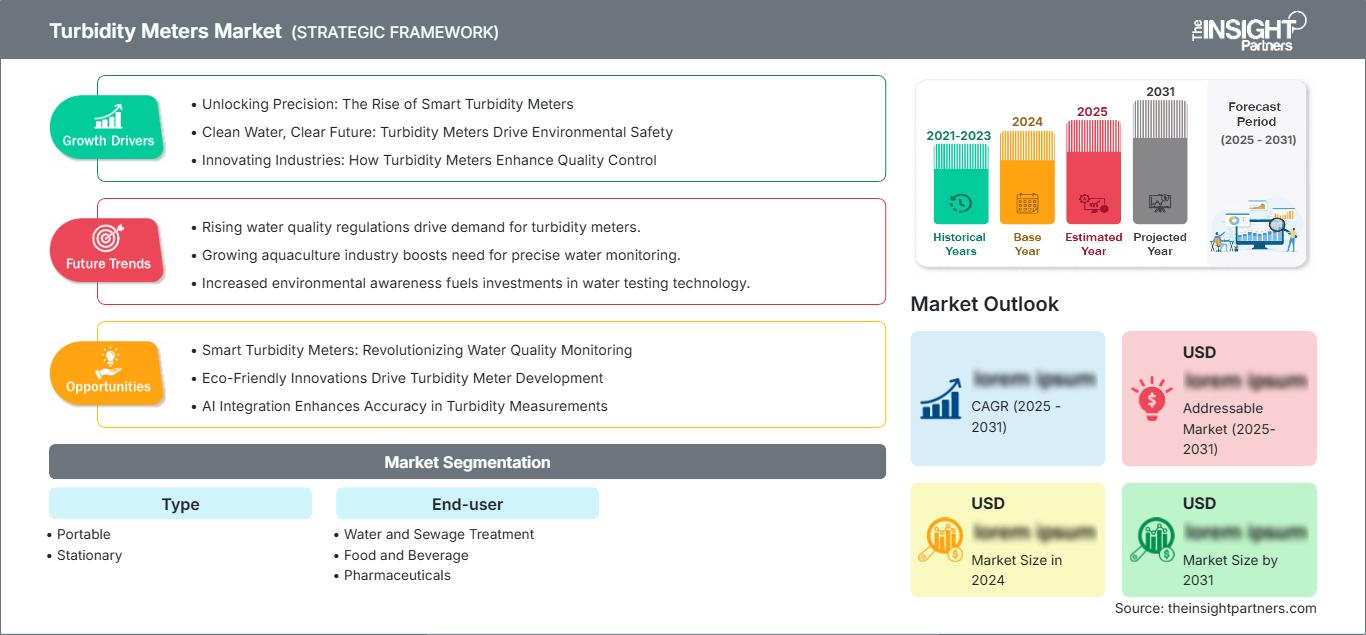
Turbidity Meters Market: Strategic Insights
Regional Insights
North America Turbidity Meters Market
The North America had a Turbidity Meters Market share of ~26% in 2025 and is projected to grow with a ~3% CAGR up to 2034. The region is characterized by advanced drinking water and sewage infrastructure as well as laboratory analysis routines. Municipal utilities need turbidity measurements for filtration performance and water quality monitoring, while companies install meters in process water and sewage treatment processes. The necessity for accurate and documented instruments is driven by the regulatory requirements.
The US is the dominant regional market, while Canada supplies through its municipal treatment, environmental monitoring, and industrial water handling. The replacement of old meters is one of the key drivers, as users prefer more connectivity, easier data storage, maintenance-free devices, and compatibility with current test methods. Stationary meters become more relevant in large treatment facilities, as the continuous measurements help to identify fast changes in filtration or processes.
U.S. Turbidity Meters Market
The US represented approximately ~80% of North American market revenue in 2025 and is projected to grow at ~3% CAGR through 2034. Municipal drinking-water systems form a major demand base because turbidity is used to evaluate treatment and filtration performance. Wastewater facilities, environmental laboratories, food processors, pharmaceutical manufacturers, and industrial plants add diversified demand. The market therefore includes both compliance-oriented instruments and meters used for operational process optimization.
Hach Company, Thermo Fisher Scientific Inc., Emerson Electric Co., OMEGA Engineering, Inc., and other established instrumentation suppliers participate across laboratory, portable, and process applications. Demand increasingly favors instruments that simplify calibration, preserve measurement records, and transfer results electronically. Stationary systems are particularly relevant for larger facilities requiring continuous process visibility, while portable instruments remain essential where samples are collected from multiple locations. Replacement cycles and infrastructure modernization provide a stable base for equipment demand.
Europe Turbidity Meters Market
Europe represented ~27% of the global Turbidity Meters Market in 2025 and is expected to expand at ~3% CAGR through 2034. Germany is the leading country in Europe, supported by its substantial industrial base, established water infrastructure, and strong analytical-instrument ecosystem. The UK has consistent demand from municipal water operators, laboratories, and industrial users. France combines municipal treatment requirements with food, beverage, pharmaceutical, and industrial applications, while Italy and Spain generate demand from water treatment, environmental monitoring, and process industries.
Germany's industrial manufacturing base creates demand beyond municipal applications, including pharmaceutical, food and beverage, chemical, and process-water monitoring. The UK market places strong emphasis on reliable water-quality measurement across utilities and laboratory environments. France has opportunities in municipal and industrial water management, while Italy's water infrastructure modernization and industrial applications provide a diversified customer base. Spain similarly benefits from water-stress considerations and the need for efficient treatment and monitoring systems.
European buyers increasingly evaluate measurement accuracy, regulatory-method compatibility, calibration stability, and lifecycle support together. Portable meters remain important for field testing, while stationary instruments are increasingly used where operators need continuous monitoring and automated process intervention. Local suppliers and multinational analytical companies compete through application expertise, instrument reliability, and service networks, making technical support an important purchasing consideration.
APAC Turbidity Meters Market
APAC held ~34% of the global Turbidity Meters Market in 2025 and is projected to expand at ~4% CAGR through 2034, making it the fastest-growing regional market. China is the leading country in Asia Pacific, supported by extensive municipal and industrial water-treatment activity. Japan and South Korea have mature analytical and industrial ecosystems, while India is expanding water infrastructure and monitoring capacity. Australia contributes through municipal, environmental, mining, and industrial water applications.
China's large treatment and manufacturing base supports broad instrument demand, while India benefits from expanding potable-water and wastewater infrastructure. Japan and South Korea emphasize high-quality industrial and municipal monitoring, and Australia has strong applications in resource industries and decentralized water management. Regional growth is increasingly supported by process automation, digital monitoring, water reuse, and the need for reliable measurement in expanding treatment facilities.
Middle East & Africa Turbidity Meters Market
The Middle East & Africa market is projected to grow at ~4% CAGR through 2034. Saudi Arabia is the leading country in the Middle East & Africa market where desalination, municipal water infrastructure, industrial development, and water-quality monitoring support instrument demand. The UAE also has substantial applications across desalination, municipal treatment, and industrial facilities, while South Africa contributes through established municipal and industrial water systems.
Water scarcity and dependence on treatment infrastructure make reliable monitoring strategically important across the region. Desalination plants require measurement of water quality at multiple treatment stages, while wastewater reuse creates additional monitoring requirements. South Africa provides a different demand profile centered on municipal systems, mining, industrial processing, and environmental applications. Rest of MEA demand remains concentrated around major water projects, industrial facilities, and infrastructure modernization.
Segmentation Analysis
Type
Type segment in the Turbidity Meters Market is divided into Portable and Stationary instruments. The Turbidity Meters Market scope within this segment covers field-oriented meters and permanently installed or process-oriented systems used for continuous or repeated measurement. Type selection depends on sampling frequency, required mobility, measurement environment, process integration, maintenance practices, and whether the buyer needs discrete testing or continuous visibility.
- Portable: Portable meters have broad application across field sampling, treatment-plant inspections, environmental testing, and industrial troubleshooting. Their compact format, battery operation, and ability to measure at multiple locations make them important where fixed instrumentation is impractical.
- Stationary: Stationary meters support continuous or frequent monitoring at defined process points. They are strategically important for automated treatment control, filtration monitoring, alarm generation, and integration with supervisory systems where operators need rapid visibility of changing water conditions.
End-user
End-user segment in the Turbidity Meters Market demand is projected to expand at ~3% CAGR through 2034, with purchasing patterns varying according to water-quality requirements and process complexity. Municipal treatment remains an important application base, while industrial sectors use turbidity measurement for process control, wastewater compliance, quality assurance, and equipment protection. The breadth of applications supports demand for instruments with different ranges, optical configurations, and connectivity capabilities.
- Water and Sewage Treatment: Treatment plants use turbidity measurement to monitor source water, clarification, filtration, and treated-water quality. This remains a core application because changes can provide early indications of process instability or filtration performance issues.
- Food and Beverage: Food and beverage facilities use turbidity testing for process water, ingredient quality, wastewater management, and sanitation-related monitoring. Instruments must support repeatable testing within production environments where water quality can influence product and process consistency.
- Pharmaceuticals: Pharmaceutical facilities require controlled water systems and analytical procedures with strong repeatability. Turbidity measurement supports quality assurance and process monitoring where low-level particulate changes can be operationally significant.
- Oil and Gas: Oil and gas facilities apply turbidity measurement to produced water, wastewater, process streams, and water treatment systems. Rugged instruments and reliable measurements are important where samples can contain variable particulate loads and challenging process conditions.
- Power Plants: Power plants use water-quality monitoring across cooling, treatment, boiler-related systems, and wastewater operations. Turbidity instruments help identify suspended solids and treatment changes, supporting process control and equipment protection.
- Pulp and Paper: Pulp and paper facilities generate water streams with varying solids content and require monitoring across process and wastewater systems. Turbidity measurement supports treatment optimization, process consistency, and environmental-control activities.
Opportunity Snapshot
| End-user | Revenue Contribution | Trend Tag | Adoption Stage |
| Water and Sewage Treatment | High | Filtration Control | Mature |
| Food and Beverage | Medium | Process Quality | Mature |
| Pharmaceuticals | Medium | Purity Monitoring | Scaling |
| Oil and Gas | Medium | Produced Water | Mature |
| Power Plants | Medium | Cooling Water | Mature |
| Pulp and Paper | Low | Effluent Control | Scaling |
Turbidity Meters Market Growth Drivers and Impact Analysis
Increasing Focus on Drinking-Water Safety and Treatment Performance
Turbidity remains a practical operational indicator because changes in suspended particles can signal problems in source water, clarification, filtration, or distribution systems. Water suppliers therefore require dependable instruments capable of detecting changes quickly enough to support corrective action. This creates recurring demand across laboratory verification, portable field testing, and continuous process monitoring. The commercial impact is particularly strong where utilities are modernizing treatment processes and require measurement equipment that can provide reliable records for operational and regulatory purposes. As water-quality management becomes more data-driven, instrument buyers are also considering connectivity, calibration workflows, measurement stability, and ease of maintenance alongside optical performance. This broadens the addressable opportunity from simple replacement instruments to integrated measurement solutions.
Expansion of Industrial Water Reuse and Process Monitoring
Industrial facilities are increasingly focused on controlling water consumption, improving wastewater treatment, and increasing reuse of process water. These changes create additional measurement points because water quality must be assessed before and after treatment stages and before water is returned to production processes. Turbidity meters can help operators identify solids carryover, filtration problems, and treatment changes without waiting for slower laboratory procedures. Food and beverage, pharmaceutical, power, pulp and paper, and oil and gas facilities therefore provide diversified industrial demand. The market impact is an expansion in the number of applications requiring reliable measurement, particularly where process continuity and equipment protection make rapid detection of water-quality changes commercially important.
Automation of Water Treatment and Analytical Workflows
Water-treatment facilities are increasingly connecting analytical instruments with plant automation, laboratory information systems, and digital maintenance processes. Turbidity meters can contribute to these architectures by supplying continuous measurements, alarms, historical data, and verification results. Automated data capture reduces dependence on manual transcription and allows operators to identify changes faster. This driver is particularly relevant to stationary instruments but also influences portable systems as buyers increasingly expect digital data transfer and traceability. The market effect is a gradual shift in purchasing criteria from measurement capability alone toward connectivity, interoperability, cybersecurity, serviceability, and data quality. Vendors that address the complete workflow can therefore participate in both initial equipment procurement and subsequent modernization.
Turbidity Meters Market Future Trends
Connected Instruments and Automated Data Traceability
Connected turbidity instruments are expected to become more common as utilities and industrial facilities seek to integrate analytical results into broader water-management systems. Wireless connectivity, electronic calibration records, cloud-enabled data transfer, and instrument health information can reduce manual documentation and improve traceability. Future platforms may increasingly combine measurement results with sampling location, operator information, calibration status, and historical trends. This development can improve quality assurance while reducing administrative effort. For stationary installations, connected instruments can feed control systems directly, whereas portable devices can synchronize field results with centralized databases. The resulting Turbidity Meters Market trends will favor equipment that treats measurement data as an operational asset rather than an isolated test result.
Higher-Precision Optics and Lower-Maintenance Measurement
Instrument development is likely to focus on optical stability, improved low-level sensitivity, automatic cleaning, simplified calibration, and reduced measurement variability. These features address a key operational challenge: turbidity readings can be affected by sample handling, optical contamination, bubbles, calibration condition, and instrument maintenance. Suppliers are therefore developing systems that reduce operator intervention while maintaining measurement consistency. Higher-precision instruments will remain particularly relevant for drinking-water and pharmaceutical applications, while ruggedized systems will serve industrial and field environments. Over time, buyers are likely to evaluate instruments increasingly on measurement reliability over the complete operating cycle rather than headline sensitivity alone, supporting premium demand for systems that reduce maintenance and data-quality risks.
Turbidity Meters Market Opportunities
Modernization of Municipal Monitoring Networks
Municipal water systems provide an attractive opportunity for suppliers that can combine portable, laboratory, and stationary turbidity measurement into coordinated monitoring programs. Modernization can involve replacement of legacy meters, installation of continuous monitoring points, digitization of calibration records, and integration with supervisory platforms. Suppliers can strengthen their position by offering standardized workflows across plant and field instruments, reducing the training burden for operators and improving comparability between measurements. The opportunity extends beyond equipment sales because utilities require calibration standards, replacement parts, maintenance, verification, and technical support. Suppliers with established service networks can therefore build recurring relationships with water utilities while supporting gradual technology upgrades rather than relying solely on large one-time equipment purchases.
Advanced Monitoring for Emerging Water Infrastructure
Asia Pacific and selected Middle Eastern markets provide opportunities to deploy modern turbidity monitoring alongside newly constructed treatment infrastructure rather than retrofitting older systems. New facilities can incorporate fixed instruments, digital communications, automated alarms, and centralized data management from the design stage. This creates opportunities for suppliers that engage early with engineering firms, EPC contractors, utilities, and industrial project developers. The Turbidity Meters Market Forecasts indicate that incremental demand will increasingly come from infrastructure expansion and process modernization rather than from a simple increase in standalone field testing. Partnerships with local integrators can help suppliers address installation, commissioning, training, calibration, and after-sales requirements in geographically dispersed projects.
Recent Developments
- November 2025: AlpHa Measurement Solutions, LLC (AlpHa), a leader in the liquid sensing technology segment of the test and measurement space, today announced the launch of its new TU90 Turbidity Sensor Portfolio. In expanding its optical sensing portfolio, AlpHa Measurement Solutions is proud to introduce the OEM-ready TU90 Turbidity Sensor Portfolio. This portfolio features fully customizable in-line, submersible, and sonde-cartridge style sensors. Built on a laser-based 90° scatter method and fully compliant with ISO 7027, the TU90 provides precise turbidity readings up to 5000 NTU with built-in temperature sensor compensation. The TU90 features market-leading low-range accuracy with a ±1 % error in the 0–100 NTU range.
- September 2025: HORIBA Advanced Techno, Co., Ltd. (“HORIBA Advanced Techno”) is pleased to announce the launch of the LAQUA-TB220, a new portable turbidity meter and the latest addition to the renowned LAQUA series of comprehensive water quality analyzers. Since developing Japan’s first glass electrode pH meter in 1950, HORIBA has continuously delivered innovative water quality measurement solutions utilizing its proprietary technologies. The new LAQUA-TB220 is the series’ first portable turbidity meter. It enables measurements in a wide range of environments, including wastewater and drainage management, as well as the quality control of food, beverages, and other items in laboratories.
- July 2025: Palintest has introduced the next generation in turbidity measurement: the all-new Turbidity Expert. This state-of-the-art instrument is designed to deliver unparalleled clarity through accuracy, simplicity, and connectivity. Designed for professionals in water management applications, including drinking water, distribution networks, and industrial and environmental testing, the Turbidity Expert offers unmatched reliability for accurate, timely decision-making.
Frequently Asked Questions

- Comprehensive Market Sizing and Forecast Analysis
- Detailed Segmentation Analysis
- In-Depth Market Dynamics Assessment
- Regional and Country-Level Insights
- Competitive Landscape and Company Benchmarking
- Strategic Business Intelligence
Recent Reports
Testimonials

The Insight Partners provided valuable market intelligence that supported our global go-to-market strategy. Their team was professional, responsive, and attentive to our feedback, providing thoughtful analysis and helpful methodological clarifications throughout the project.
Junmo Kim Chief Financial Officer (CFO), Enertech Co., Ltd.
The Insight Partners' SCADA System Market report is comprehensive, with valuable insights on current trends and future forecasts. The team was highly professional, responsive, and supportive throughout. We are very satisfied and highly recommend their services.
RAN KEDEM Partner, Reali Technologies LTDs
I requested a report on a very specific software market and the team produced the report in a few days. The information was very relevant and well presented. I then requested some changes and additions to the report. The team was again very responsive and I got the final report in less than a week.
JEAN-HERVE JENN Chairman, Future Analytica
We worked with The Insight Partners for an important market study and forecast. They gave us clear insights into opportunities and risks, which helped shape our plans. Their research was easy to use and based on solid data. It helped us make smart, confident decisions. We highly recommend them.
PIYUSH NAGPAL Sr. Vice President, High Beam Global
The Insight Partners delivered insightful, well-structured market research with strong domain expertise. Their team was professional and responsive throughout. The user-friendly website made accessing industry reports seamless. We highly recommend them for reliable, high-quality research services
YUKIHIKO ADACHI CEO, Deep Blue, LLC.
This is the first time I have purchased a market report from The Insight Partners.While I was unsure at first, I visited their web site and felt more comfortable to take the risk and purchase a market report.I am completely satisfied with the quality of the report and customer service. I had several questions and comments with the initial report, but after a couple of dialogs over email with their analyst I believe I have a report that I can use as input to our strategic planning process.Thank you so much for taking the extra time and making this a positive experience.I will definitely recommend your service to others and you will be my first call when we need further market data.
JOHN SUZUKI President and Chief Executive Officer, Board Director, BK Technologies
I wish to appreciate your support and the professionalism you displayed in the course of attending to my request for information regarding to infectious disease IVD market in Nigeria. I appreciate your patience, your guidance, and the fact that you were willing to offer a discount, which eventually made it possible for us to close a deal. I look forward to engaging The Insight Partners in the future, all thanks to the impression you have created in me as a result of this first encounter.
DR CHIJIOKE ONYIA MANAGING DIRECTOR, PineCrest Healthcare Ltd.Reason to Buy
- Informed Decision-Making
- Understanding Market Dynamics
- Competitive Analysis
- Identifying Emerging Markets
- Customer Insights
- Market Forecasts
- Risk Mitigation
- Boosting Operational Efficiency
- Strategic Planning
- Investment Justification
- Tracking Industry Innovations
- Aligning with Regulatory Trends





 Get Free Sample for