
Turbine Air Filtration Market Growth, Demand & Size by 2034
Coverage: By Type (Intake systems, Static air filters, Cartridge filters, Compact filters, Pulse filters, Panel filters, Pre-cleaning filters); Application (Diesel and Gas Engines, Gas Turbines, Generators and Utility Buildings, Large Industrial Air Compressors, Nuclear Power Plants) , and Geography (North America, Europe, Asia Pacific, and South and Central America)
- Status : Data Released
- Report Code : TIPRE00017740
- Category : Electronics and Semiconductor
- No. of Pages : 150
- Available Report Formats :


- Last update date : October 16, 2026


2025 Market Size
US$ 2.2 Bn
Base year value
2034 Forecast
US$ 3.9 Bn
Projected by 2034
CAGR 2026-2034
6.60 %
Growth rate
Addressable Market
US$ 27.63 Bn
(2026-2034)
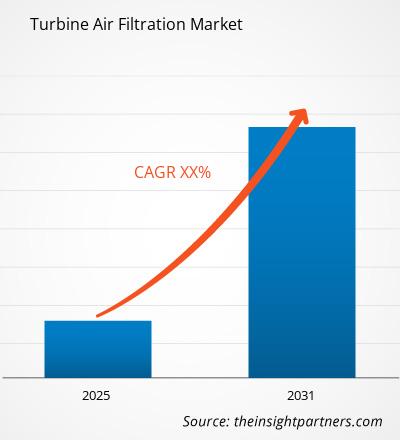
The Turbine Air Filtration Market was valued at US$ 2.2 Billion in 2025 and is projected to reach US$ 3.9 Billion by 2034, expanding at a CAGR of 6.60% during 2026–2034. Demand is supported by the need to protect turbines, engines, compressors, and power-generation equipment from dust, moisture, salt, corrosive gases, and fine particulate contamination. Increasing emphasis on equipment availability, operating efficiency, maintenance optimization, and reliable power generation is encouraging investment in higher-efficiency intake and filtration systems across industrial and utility applications.
North America represents a mature demand center, with replacement activity, gas-fired generation, industrial infrastructure, and stringent equipment-protection requirements supporting continued adoption. The region is estimated to expand at ~6% CAGR through 2034. Increasing deployment of gas turbines in flexible power-generation applications, aging installed equipment requiring filtration upgrades, and demand for solutions adapted to extreme environmental conditions are supporting the regional outlook.
Turbine Air Filtration Market Assessment and Insights
Regional Outlook
- North America: ~34% of the global market in 2025 | ~6% CAGR through 2034. Market position: North America represents the largest regional market, supported by an extensive installed base of gas turbines, industrial compressors, generators, and power infrastructure. Replacement demand and filtration upgrades reinforce its established position.
- US: ~78% of North American market revenue in 2025 | ~6% CAGR through 2034. Market position: The US is the leading country in North America, with substantial gas-turbine capacity, industrial facilities, data-intensive electricity demand, and widespread aftermarket requirements for intake filtration and equipment protection.
- Europe: ~29% of the global market in 2025 | ~5% CAGR through 2034. Market position: Europe is a mature filtration market, with Germany as the leading country in Europe. The UK, France, Italy, and Spain contribute through power generation, industrial processing, environmental standards, and replacement of installed filtration equipment.
- Asia Pacific: ~27% of the global market in 2025 | ~8% CAGR through 2034. Market position: Asia Pacific is the fastest-growing region, driven by industrialization, expanding electricity infrastructure, manufacturing capacity, and turbine installations. China is the leading country in Asia Pacific, followed by Japan, South Korea, India, and Australia.
Segment Outlook
- Gas Turbines: ~47% Share in 2025 | ~7% CAGR through 2034. Market position: Gas turbines account for the largest application position because filtration directly influences compressor cleanliness, corrosion protection, maintenance intervals, and operating performance. Utility and industrial turbine operators increasingly use advanced intake systems to address demanding ambient conditions.
- Generators and Utility Buildings: ~8% Share in 2025 | ~8% CAGR through 2034. Market position: This application has a high-growth outlook because distributed generation, backup power, critical infrastructure, and utility modernization require reliable air filtration. Higher equipment availability requirements are encouraging upgrades from conventional filters to higher-efficiency systems.
Competitive Coverage
American Air Filter Company Inc., Camfil AB, Capstone Turbine Corporation, Donaldson Company Inc., Freudenberg Filtration Technologies SE & Co. KG, GE Energy, Koch Filter Corporation, MANN+HUMMEL Air Filtration, Nordic Air Filtration A/S, Shinwa Corporation
Methodology
The Insight Partners follows Data Collection & Secondary Research, Primary Research, Data Analysis, and Data Triangulation & Final Review to validate market estimates and insights.
Source: The Insight Partners' analysis based on proprietary research, government publications, company annual reports, investor presentations, industry databases, and expert interviews.
As turbine filtration has evolved, it has transitioned from a simple particulate control process to one that includes advanced intake systems that combine effectiveness, minimal pressure drop, moisture removal, service life, and protection of equipment. Filtration systems increasingly include advanced design techniques such as synthetic media, extended surfaces, coalescing, nanofibers, and pre-filtration according to particular applications. The reason behind this is that erosion, fouling, corrosion, and air flow control are critical during operation of turbines. As a result, turbine operators tend to analyze filtration systems as a way of managing equipment performance and not just as consumables.
From a future perspective, investments will be diversified according to geography based on growth of electricity demand, industrial capacity, and flexibility needs of generation in developing countries. The region of Asia Pacific has significant potential for new construction and filtration replacement, the Middle East needs filtration systems that can handle dust and heat, whereas Europe needs filtration systems that focus on performance and environmental criteria. The use of digital monitoring, engineering packages, and life cycle services has broadened the scope of procurement decisions.
Turbine Air Filtration Market Report Scope
| Report Attribute | Details |
|---|---|
| Market size in 2025 | US$ 2.2 Billion |
| Market Size by 2034 | US$ 3.9 Billion |
| Global CAGR (2026 - 2034) | 6.60% |
| Historical Data | 2021-2024 |
| Forecast period | 2026-2034 |
Turbine Air Filtration Market Analysis
The growth of the Turbine Air Filtration market is highly associated with the environment in which the rotating machinery operates. Large volumes of ambient air are used in gas turbines, thus the efficiency of filtration is critical for preventing contamination of compressors resulting in fouling, erosion, corrosion, and loss of air volume. The ecosystem consists of filter media manufacturers, component suppliers, system integrators, OEMs, engineering contractors, utilities, industrial firms, and aftermarket distributors. Replacement needs and refurbishment of turbines and environmental systems drive the market.
The supply chain is influenced by the demands for high-efficiency media, durability, humidity stability, low pressure drop, and compatibility with existing intake designs. Thus, the suppliers compete through media design, pleat pattern, sealing, prefilters, coalescing and services. Coastal and desert plants need different filtration systems than temperate industrial sites. This makes application engineering and local sourcing more relevant. Standardized filters make the aftermarket competitive, whereas customized intake systems enable differentiation of suppliers.
The competitive environment is made up of diversified air-filtration manufacturers, specialized filter suppliers for the industrial segment, companies involved in turbine technology, and application-specific manufacturers. Camfil AB, American Air Filter Company Inc., Donaldson Company Inc., Freudenberg Filtration Technologies SE & Co. KG, Koch Filter Corporation, and MANN+HUMMEL Air Filtration participate in engineered air-filtration applications. Nordic Air Filtration A/S and Shinwa Corporation add more to specialization in filter supplies, while GE Energy and Capstone Turbine Corporation link filtration needs with turbines and power generation technologies.
Innovation in this area now focuses on development of filtration technology that does not compromise high-pressure drop. Manufacturing capabilities and technical services for faster response time of replacement are also becoming a priority of suppliers. Positioning in the market is thus determined by access to installed base, engineering capabilities, media technology, retrofit capabilities, environmental experience, and ability to offer total intake solution. Suppliers with capabilities in prefiltration, final filtration, moisture separation, monitoring, and replacement are better positioned to cover the life cycle of the turbine.
● REPORT CUSTOMIZATION
Tailor This Report To Align With Your Specific Business Requirements
This report can be customized to align precisely with your business objectives, scope, and target markets. Customization options include tailored segmentation, geography, competitive analysis, and strategic insights to support informed decision-making.
Customize This Report →WHAT YOU CAN ADJUST
- ● Segmentations
- ● Geography
- ● Competitive Analysis
- ● Language Preferences
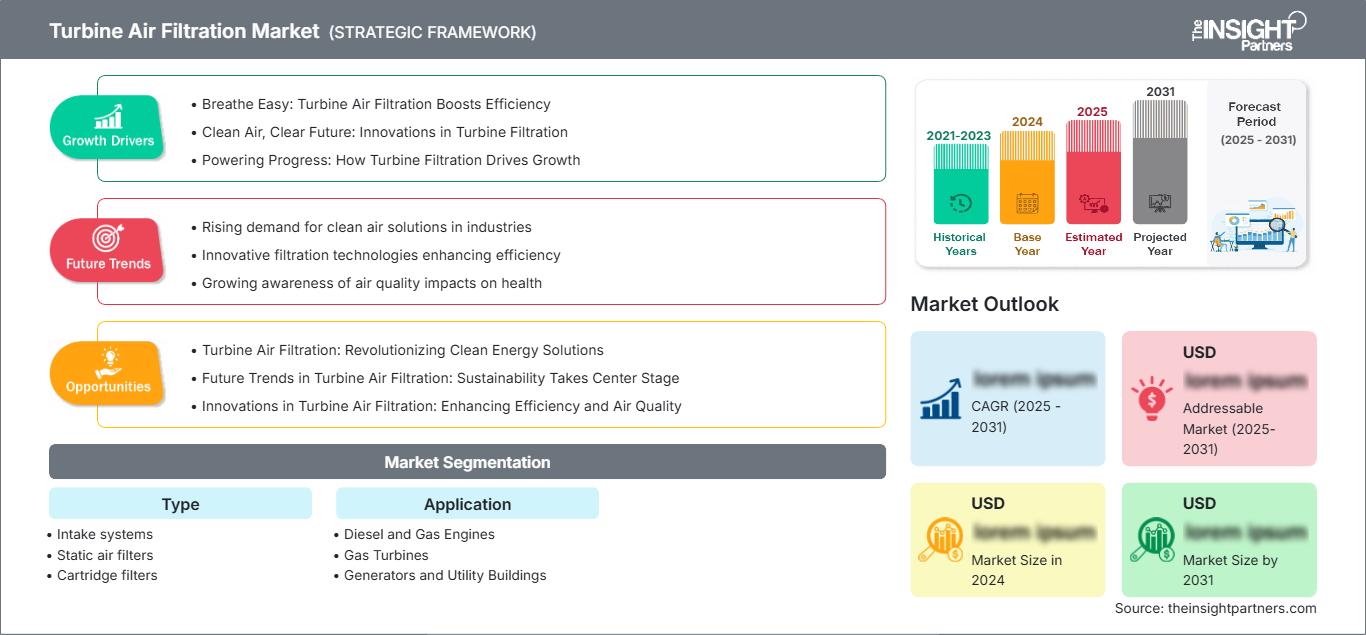
Turbine Air Filtration Market: Strategic Insights
Regional Insights
North America Turbine Air Filtration Market
North America accounted for ~34% of the global market in 2025 and is projected to expand at ~6% CAGR through 2034. The area also enjoys the advantage of having a significant number of gas turbines and industrial power equipment, along with their substantial aftermarket needs. The US represents the majority of demand in the region due to its need for intake filtration for natural gas plants, industry, infrastructure, and distributed power systems. Canada makes its contribution through power generation and industries with high demands on resources, and Mexico presents market opportunities related to developing its industrial and energy infrastructure.
Environmental variability is one of the key factors that influence the choice of a particular brand. Coastal plants have issues with salt and moisture, while inland plants can be affected by dust, particulates, or extreme temperatures. Increasingly, the filtration systems are evaluated in terms of total cost of ownership rather than just initial price, focusing on such factors as pressure drop, frequency of replacement, longevity, and protection of the turbines.
U.S. Turbine Air Filtration Market
The US represented ~78% of North American market revenue in 2025 and is expected to grow at ~6% CAGR through 2034. The size of this segment is influenced by the high level of gas turbine use in utility and industrial plants, as well as the demand for generators, compressors, and power generation units. Today larger projects analyze the issue of intake filtration depending on the local environment, machine operation cycles, and availability requirements.
American Air Filter Company Inc., Donaldson Company Inc., Koch Filter Corporation, GE Energy, and other leading companies offer an opportunity to participate in turbine and industrial filtration projects. Today gas turbines are still one of the key demand areas, while generators and utility buildings become more important due to the rising need for reliable electricity supply in critical applications. The US market provides opportunities for after-market sales such as replacement filters, retrofit kits, and advanced media.
Europe Turbine Air Filtration Market
Europe represented ~29% of the global market in 2025 and is projected to expand at ~5% CAGR through 2034. Germany is the strongest economy of Europe, backed by its industrial sector, power generation capacity, filtration systems, and manufacturing base. The UK has power generation and industrial installations that sustain demand for filtration. France has the advantage of having a well-developed electricity generation system and industrial installations. Italy's contribution is through manufacturing and distributed industrial power generation needs. Spain has its strengths in power generation and industrial uses.
Efficiency of lifecycle, performance environment, filtration, and maintenance have become key priorities of European buyers. As a result, the suppliers are forced to manufacture media with reduced pressure drops, extended service life, moisture handling capability, and better efficiency. The installed base of mature equipment creates a good opportunity for replacement. Modernization initiatives present the opportunity for engineering enhancements. Suppliers like Freudenberg Filtration Technologies SE & Co. KG, Camfil AB, MANN+HUMMEL Air Filtration, among others, are benefiting from the technical filtration ecosystem of the region.
APAC Turbine Air Filtration Market
Asia Pacific accounted for ~27% of the global market in 2025 and is forecast to expand at ~8% CAGR through 2034, making it the fastest-growing region. China is the leading country in Asia Pacific, supported by industrial production, electricity infrastructure, and extensive manufacturing activity. Japan and South Korea contribute through advanced industrial facilities, while India offers substantial demand from expanding power and industrial infrastructure. Australia provides additional requirements from resource-intensive and remote power-generation environments.
Regional demand is shaped by new capacity additions and replacement of filtration systems in established facilities. Dust, humidity, coastal exposure, and industrial particulate loads increase the need for application-specific filtration. Industrial policy, infrastructure investment, and electricity-demand growth support the deployment of turbines and generators, while suppliers increasingly localize production and technical support to serve diverse operating environments.
Middle East & Africa Turbine Air Filtration Market
The Middle East & Africa market is projected to expand at ~7% CAGR through 2034. Saudi Arabia is the leading country in the Middle East & Africa based on the concentration of power infrastructure, industrial investment, and large-scale energy facilities. The UAE also represents a significant demand center, particularly for power and industrial installations operating in hot, dusty, and coastal environments. South Africa contributes through industrial and utility applications.
Regional filtration requirements are strongly influenced by desert dust, high temperatures, humidity, salt exposure, and continuous-duty power generation. These conditions increase the importance of robust prefiltration, moisture management, and high-efficiency final filters. Infrastructure expansion and industrial diversification create opportunities for both new installations and replacement systems. In Africa, mining and resource-intensive operations can also require engineered filtration for generators and industrial equipment, while Middle Eastern utilities increasingly prioritize reliable turbine operation and maintenance-cost control.
Segmentation Analysis
Type
The Type segment is projected to expand at ~6% CAGR through 2034. Demand spans complete intake systems and individual filtration stages, reflecting differences in turbine configuration, operating environment, contaminant loading, and maintenance strategy. Buyers increasingly combine prefiltration with high-efficiency final stages to balance protection and pressure drop. Cartridge, compact, pulse, and panel formats serve different equipment architectures, while static systems remain important where straightforward replacement and established housing compatibility are priorities.
- Intake systems: These provide integrated protection at the turbine air-entry point and are strategically important where operators require coordinated control of particulate, moisture, and airflow conditions. System-level designs are particularly relevant for large power-generation and industrial installations.
- Static air filters: Static filters serve applications requiring dependable continuous filtration without active cleaning mechanisms. Their established architecture supports straightforward maintenance and replacement, particularly in facilities with predictable contaminant loads and standardized intake configurations.
- Cartridge filters: Cartridge formats provide high filtration surface area within compact assemblies. They are strategically important where equipment operators require efficient particulate capture, retrofit flexibility, and convenient replacement across industrial and power-generation applications.
- Compact filters: Compact filters address installations where available space is constrained while filtration performance remains important. Their configuration supports applications seeking lower footprint, manageable handling, and compatibility with modern intake-system designs.
- Pulse filters: Pulse filters support applications exposed to substantial particulate loading by enabling cleaning-oriented operation. They are particularly relevant where maintaining airflow and extending filter service intervals are important to equipment availability.
- Panel filters: Panel filters provide a practical filtration stage for diverse air-intake configurations. Their standardized formats and straightforward servicing make them useful in prefiltration and applications where operating conditions allow periodic replacement.
- Pre-cleaning filters: Pre-cleaning filters reduce the contaminant burden reaching downstream filtration stages. They are strategically valuable in dusty or humid environments because they can extend final-filter service life and help stabilize turbine intake conditions.
Application
The Application segment is projected to grow at ~7% CAGR through 2034. Gas turbines represent the largest demand center because filtration directly influences turbine protection and operating performance. Generator and utility applications are expanding as dependable power becomes increasingly important. Industrial compressors, diesel and gas engines, and nuclear facilities contribute differentiated requirements based on contaminant type, equipment sensitivity, safety expectations, and operating continuity.
- Diesel and Gas Engines: Engine intake filtration supports combustion equipment exposed to dust and airborne particulates. Demand is linked to equipment reliability, engine protection, maintenance intervals, and operating conditions across industrial and power-generation applications.
- Gas Turbines: Gas turbines represent the central application because large volumes of ambient air enter the compressor. Effective filtration helps control fouling, corrosion, erosion, and airflow restriction, making filtration selection an important operating-cost and reliability consideration.
- Generators and Utility Buildings: These installations require dependable filtration to protect generators and associated equipment from airborne contaminants. Demand is supported by backup power, distributed generation, critical infrastructure, and utility modernization.
- Large Industrial Air Compressors: Compressor filtration protects rotating and downstream components from particulate contamination while helping maintain airflow performance. Industrial plants use these systems where compressed-air availability and equipment uptime are closely connected to production continuity.
- Nuclear Power Plants: Nuclear facilities require highly controlled air filtration because reliability, contamination management, and safety are critical. Specialized filtration requirements create a technically demanding application with stringent qualification and maintenance expectations.
Opportunity Snapshot
| Application | Revenue Contribution | Trend Tag | Adoption Stage |
| Diesel and Gas Engines | Medium | Engine Protection | Mature |
| Gas Turbines | High | Turbine Uptime | Mature |
| Generators and Utility Buildings | Medium | Critical Power | Scaling |
| Large Industrial Air Compressors | Medium | Process Reliability | Mature |
| Nuclear Power Plants | Low | Safety Filtration | Mature |
Turbine Air Filtration Market Growth Drivers and Impact Analysis
Increasing Gas-Turbine Utilization and Reliability Requirements
Gas turbines require substantial volumes of clean intake air, making filtration performance directly relevant to compressor and turbine operation. Dust, salt, moisture, and fine particles can contribute to fouling, erosion, and corrosion, creating pressure for operators to maintain effective filtration throughout the equipment lifecycle. As power systems use flexible generation to complement variable renewable resources, turbine availability and rapid operational readiness become increasingly important. This supports spending on replacement filters, prefiltration, moisture separation, and upgraded intake systems. The commercial impact extends beyond new equipment because the installed turbine base generates recurring aftermarket demand. Suppliers that can demonstrate lower pressure drop, longer service intervals, and environmental resilience can capture replacement and retrofit spending from operators seeking to control maintenance costs without compromising equipment protection.
Expansion of Industrial and Critical Power Infrastructure
Industrial facilities, utility buildings, backup-generation installations, and large compressors depend on filtration to maintain equipment reliability in environments with varying contaminant loads. Expansion of manufacturing, data-intensive infrastructure, processing facilities, and critical services increases the installed base of equipment requiring dependable air management. Turbine and generator operators increasingly consider filtration part of reliability planning because filter loading can influence airflow, maintenance frequency, and equipment condition. This creates demand for filtration systems that can be selected according to site-specific conditions rather than standardized solely by equipment size. Suppliers can benefit through engineered retrofit programs, replacement contracts, and filtration packages designed for continuous-duty applications. The resulting demand is particularly relevant to facilities where unplanned equipment downtime has significant operational consequences.
Demand for Higher-Efficiency Filtration Under Challenging Environments
Coastal, desert, tropical, and heavily industrialized environments expose turbines and other rotating equipment to different combinations of salt, humidity, dust, fine particles, and corrosive contaminants. These conditions increase the need for filtration architectures that combine prefilters, high-efficiency final filters, and moisture-management stages. Operators are therefore shifting attention toward filtration performance under real operating conditions rather than relying solely on nominal efficiency specifications. The impact is visible in specialized products for coastal turbines, high-dust installations, and facilities exposed to extreme weather. This driver also supports higher-value filtration solutions because environmental resilience can reduce maintenance interventions and protect expensive rotating equipment. Vendors with application engineering capabilities can consequently differentiate beyond basic filter replacement.
Turbine Air Filtration Market Future Trends
Integration of Smart Filtration and Condition-Based Maintenance
Filtration systems are increasingly positioned within broader asset-management strategies. Future solutions are expected to place greater emphasis on monitoring differential pressure, filter loading, moisture conditions, airflow behavior, and replacement requirements. Instead of replacing filters solely according to fixed schedules, operators can increasingly align maintenance with actual operating conditions. This approach can reduce unnecessary replacement while lowering the risk of excessive pressure drop or inadequate filtration. Digital service platforms can also connect filter performance with turbine operating data, allowing maintenance teams to identify deteriorating intake conditions earlier. The trend is particularly relevant for large power-generation fleets where many installations operate under different environmental conditions. Suppliers that combine filtration hardware with monitoring and lifecycle services can therefore move toward more recurring, data-enabled customer relationships.
Low-Pressure-Drop and Sustainable Filter Media Development
Future filtration development is expected to focus simultaneously on particle-capture efficiency, airflow performance, service life, material efficiency, and end-of-life considerations. Lower pressure drop can reduce the airflow penalty associated with filtration, while advanced media structures can increase dust-holding capacity without requiring proportionally larger equipment. Manufacturers are also examining recycled materials, improved media utilization, lighter structures, and designs that simplify disposal. These developments are relevant because filtration represents a recurring operating requirement across large installed equipment bases. Sustainability requirements are therefore becoming connected to lifecycle economics rather than treated as a separate purchasing criterion. The trend should encourage suppliers to provide performance data covering energy implications, service intervals, material composition, and lifecycle performance alongside conventional filtration specifications.
Turbine Air Filtration Market Opportunities
Retrofit Programs for Aging Turbine and Generator Installations
A substantial commercial opportunity exists in upgrading filtration systems installed on older turbines, generators, compressors, and utility equipment. Existing installations may have been designed around historical environmental assumptions or earlier filter technologies, creating opportunities to improve filtration performance without replacing the underlying rotating equipment. Retrofit programs can involve higher-efficiency final filters, improved prefiltration, moisture separation, redesigned sealing, or modifications intended to reduce pressure drop. Suppliers can target sites where operating conditions have changed because of increased dust, coastal exposure, higher utilization, or altered maintenance strategies. Service providers can further differentiate through site assessment, airflow analysis, filter selection, installation, and performance monitoring. This creates an attractive aftermarket model because customers can pursue incremental equipment improvements while avoiding the capital requirements associated with complete turbine replacement.
Application-Specific Filtration for Emerging Power and Industrial Hubs
Emerging industrial and power-generation hubs offer opportunities for filtration suppliers that can tailor systems to local environmental conditions. Asia Pacific, the Middle East, and selected African markets combine industrial expansion with operating environments that may include high dust, humidity, salt, or temperature extremes. Rather than deploying uniform filtration specifications, operators increasingly require solutions designed around site-specific contaminant profiles and equipment duty cycles. Suppliers can establish stronger positions through local engineering teams, regional manufacturing, inventory availability, and partnerships with turbine service providers. Complete packages that combine prefilters, final filters, moisture control, housings, and replacement services can address procurement complexity while supporting lifecycle contracts. Localization also reduces delivery times and can improve responsiveness during unplanned maintenance events.
Recent Developments
- May 2026: MANN+HUMMEL GmbH launched its Global Technology & Innovation Center in Tumkur, Karnataka, positioning India as a major engineering and innovation hub for filtration technologies. The facility combines research laboratories, testing infrastructure, digital engineering, and data analytics, strengthening regional development capabilities for industrial filtration and supporting broader global product development.
- May 2026: Donaldson Company, Inc. completed its acquisition of Facet Filtration, expanding its filtration portfolio into mission-critical fuel and fluid applications and increasing exposure to power generation and other durable end markets. The transaction strengthens Donaldson's broader filtration platform and aftermarket positioning, illustrating continued consolidation around complementary filtration technologies and recurring replacement applications. -
- September 2025: Freudenberg Filtration Technologies announced the launch of the Viledon gMaxx cassette filter and Viledon GTS 12 conical-cylindrical pulse-jet filter cartridges for demanding turbomachinery applications. The new filters incorporate a waterproof PTFE membrane supplied through a collaboration with W. L. Gore & Associates. The filtration technology is designed to protect gas turbines and other turbomachinery operating in environments exposed to moisture, salt, fog, mist, and rain, helping reduce contamination, corrosion, and premature component wear.
Frequently Asked Questions

- Comprehensive Market Sizing and Forecast Analysis
- Detailed Segmentation Analysis
- In-Depth Market Dynamics Assessment
- Regional and Country-Level Insights
- Competitive Landscape and Company Benchmarking
- Strategic Business Intelligence
Recent Reports
Testimonials

The Insight Partners provided valuable market intelligence that supported our global go-to-market strategy. Their team was professional, responsive, and attentive to our feedback, providing thoughtful analysis and helpful methodological clarifications throughout the project.
Junmo Kim Chief Financial Officer (CFO), Enertech Co., Ltd.
The Insight Partners' SCADA System Market report is comprehensive, with valuable insights on current trends and future forecasts. The team was highly professional, responsive, and supportive throughout. We are very satisfied and highly recommend their services.
RAN KEDEM Partner, Reali Technologies LTDs
I requested a report on a very specific software market and the team produced the report in a few days. The information was very relevant and well presented. I then requested some changes and additions to the report. The team was again very responsive and I got the final report in less than a week.
JEAN-HERVE JENN Chairman, Future Analytica
We worked with The Insight Partners for an important market study and forecast. They gave us clear insights into opportunities and risks, which helped shape our plans. Their research was easy to use and based on solid data. It helped us make smart, confident decisions. We highly recommend them.
PIYUSH NAGPAL Sr. Vice President, High Beam Global
The Insight Partners delivered insightful, well-structured market research with strong domain expertise. Their team was professional and responsive throughout. The user-friendly website made accessing industry reports seamless. We highly recommend them for reliable, high-quality research services
YUKIHIKO ADACHI CEO, Deep Blue, LLC.
This is the first time I have purchased a market report from The Insight Partners.While I was unsure at first, I visited their web site and felt more comfortable to take the risk and purchase a market report.I am completely satisfied with the quality of the report and customer service. I had several questions and comments with the initial report, but after a couple of dialogs over email with their analyst I believe I have a report that I can use as input to our strategic planning process.Thank you so much for taking the extra time and making this a positive experience.I will definitely recommend your service to others and you will be my first call when we need further market data.
JOHN SUZUKI President and Chief Executive Officer, Board Director, BK Technologies
I wish to appreciate your support and the professionalism you displayed in the course of attending to my request for information regarding to infectious disease IVD market in Nigeria. I appreciate your patience, your guidance, and the fact that you were willing to offer a discount, which eventually made it possible for us to close a deal. I look forward to engaging The Insight Partners in the future, all thanks to the impression you have created in me as a result of this first encounter.
DR CHIJIOKE ONYIA MANAGING DIRECTOR, PineCrest Healthcare Ltd.Reason to Buy
- Informed Decision-Making
- Understanding Market Dynamics
- Competitive Analysis
- Identifying Emerging Markets
- Customer Insights
- Market Forecasts
- Risk Mitigation
- Boosting Operational Efficiency
- Strategic Planning
- Investment Justification
- Tracking Industry Innovations
- Aligning with Regulatory Trends





 Get Free Sample for