
Ultracapacitor Market Size, Trends & Demand by 2034
Coverage: By Power Type (Less than 10 volts, 10V-25V, 25V-50V, 50V-100V, Above 100V); Application (Consumer Electronics, Automotive and Transportation, Industrial, Energy, Others) , and Geography (North America, Europe, Asia Pacific, and South and Central America)
- Status : Data Released
- Report Code : TIPRE00010132
- Category : Electronics and Semiconductor
- No. of Pages : 150
- Available Report Formats :


- Last update date : October 30, 2026


2025 Market Size
US$ 4.54 Bn
Base year value
2034 Forecast
US$ 25.04 Bn
Projected by 2034
CAGR 2026-2034
20.90 %
Growth rate
Addressable Market
US$ 118.67 Bn
(2026-2034)
The Ultracapacitor Market revenue is projected to rise from US$ 4.54 Billion in 2025 to US$ 25.04 Billion by 2034, expanding at a CAGR of 20.90% during 2026–2034. The market covers high-power electrochemical storage devices deployed for rapid charge acceptance, burst-power delivery, voltage stabilization, regenerative-energy capture, and short-duration backup across transportation, industry, energy systems, and electronics.
North America is expected to record an ~18% CAGR through 2034 as electrified transport, grid modernization, and high-density computing increase demand for fast-response storage. The Ultracapacitor Market size in the region is supported by domestic power-electronics engineering, resilient data-center infrastructure, and procurement of hybrid battery-ultracapacitor architectures that reduce peak loads and extend battery service life.
Ultracapacitor Market Assessment and Insights
Regional Outlook
- North America: ~34% of the global market in 2025 | ~18% CAGR through 2034. Market position: The region ranks first, supported by data-center power quality, advanced vehicle programs, rail modernization, and a well-developed ecosystem for high-reliability electronic components.
- US: ~82% of North American market revenue in 2025 | ~19% CAGR through 2034. Market position: The US leads North America through concentrated innovation, defense and aerospace demand, utility modernization, and adoption of pulse-power systems in computing, commercial vehicles, and industrial automation.
- Europe: ~29% of the global market in 2025 | ~20% CAGR through 2034. Market position: Europe combines mature rail and automotive demand with expanding localized production; Germany leads, while the UK, France, Italy, and Spain broaden mobility and grid applications.
- Asia Pacific: ~31% of the global market in 2025 | ~24% CAGR through 2034. Market position: Asia Pacific is the fastest-growing region as China, Japan, and South Korea scale electronics and electrified mobility, while India and Australia increase industrial and energy-system deployment.
Segment Outlook
- Application: ~68% Share in 2025 | ~22% CAGR through 2034. Market position: Application leads because buyers procure complete storage functions for vehicles, industrial equipment, energy assets, and electronics rather than selecting devices solely by voltage class.
- Power Type: ~32% Share in 2025 | ~19% CAGR through 2034. Market position: Growth reflects migration toward higher-voltage modules and modular balancing systems that simplify integration into traction, industrial ride-through, grid support, and backup-power architectures.
Competitive Coverage
CAP-XX Limited, Eaton Corporation plc, Ioxus, Inc., LS Mtron Ltd., Maxwell Technologies, Inc., Panasonic Holdings Corporation, Skeleton Technologies GmbH, Supreme Power Solutions Co., Ltd., VINATech Co., Ltd., Yunasko Ltd.
Methodology
The Insight Partners follows Data Collection & Secondary Research, Primary Research, Data Analysis, and Data Triangulation & Final Review to validate market estimates and insights.
Source: The Insight Partners' analysis based on proprietary research, government publications, company annual reports, investor presentations, industry databases, and expert interviews.
From discreet low voltage cells, product architecture is transitioning to a well-balanced set of modules, hybrid batteries, and custom packs with internal controls. Traditional activated carbon electric double layer architectures are still key, with graphene-enabled electrodes, lithium-ion capacitors, optimized electrolytes, and reduced resistance interconnects helping increase both the energy and power density available. The production process is becoming more automated, particularly in areas of electrode coating, cell winding, forming, and module testing. Vendors are also geographically localizing their capacity to reduce qualification times and risk from any supply chain disruptions closer to their automotive, rail, grid, and data center customers.
During the timeframe until 2034, the emphasis for capital spending will shift to include capacity development in the Asian Pacific region, resilience requirements in Europe, and power quality solutions in North America. The requirement for energy harvesting systems as opposed to wastage will arise due to public transport electrification, renewable energy incorporation, and efficiency requirements. The demand from new markets in India, Southeast Asia, Gulf, and Latin America will depend on integrator capability and lifecycle economics.
Ultracapacitor Market Report Scope
| Report Attribute | Details |
|---|---|
| Market size in 2025 | US$ 4.54 Billion |
| Market Size by 2034 | US$ 25.04 Billion |
| Global CAGR (2026 - 2034) | 20.90% |
| Historical Data | 2021-2024 |
| Forecast period | 2026-2034 |
Ultracapacitor Market Analysis
Growth in the Ultracapacitor Market results from a growing gap between rapid power pulses and the slow energy output characteristics of batteries. Benefits like regenerative braking, motor start, robotics, renewables, and AI computing loads favor quick charge and durability in cycles. Customers are now weighing the benefits of avoiding oversized batteries, less frequent battery replacements, and energy capture over simply the cost of the ultracapacitor unit.
The value chain consists of porous carbon and graphene raw material providers, aluminum foils, electrolytes, separators, cell manufacturers, balancers, packs assembly, and equipment OEMs. Supply risks are often lower than those in lithium-based storage technologies, though uniformity in performance, purity of the electrolyte, sealing, and thermal tests remain critical challenges. It is no wonder then that qualification process may take considerable time in transport and safety applications.
Ultra-Capacitors market analysis reveals a highly fragmented landscape, with global players of electrical components industry co-existing with material and cell technology focused companies. Eaton Corporation plc and Panasonic Holdings Corporation have extensive sales channels and engineering expertise in components, while Skeleton Technologies GmbH, CAP-XX Limited, VINATech Co., Ltd., and Yunasko Ltd. compete with their form factor, material base, and specialized power performance.
Investments are being made into automated production facilities, curved graphene and hybrid technology, software control systems and OEM co-engineering. Maxwell Technologies, Inc., LS Mtron Ltd., Ioxus, Inc., and Supreme Power Solutions Co., Ltd. develop application specific product portfolios. The strategic strength in this segment is going to be in proven cycle life, energy efficiency of the systems, certification, manufacturing scalability and integration with power electronics.
● REPORT CUSTOMIZATION
Tailor This Report To Align With Your Specific Business Requirements
This report can be customized to align precisely with your business objectives, scope, and target markets. Customization options include tailored segmentation, geography, competitive analysis, and strategic insights to support informed decision-making.
Customize This Report →WHAT YOU CAN ADJUST
- ● Segmentations
- ● Geography
- ● Competitive Analysis
- ● Language Preferences
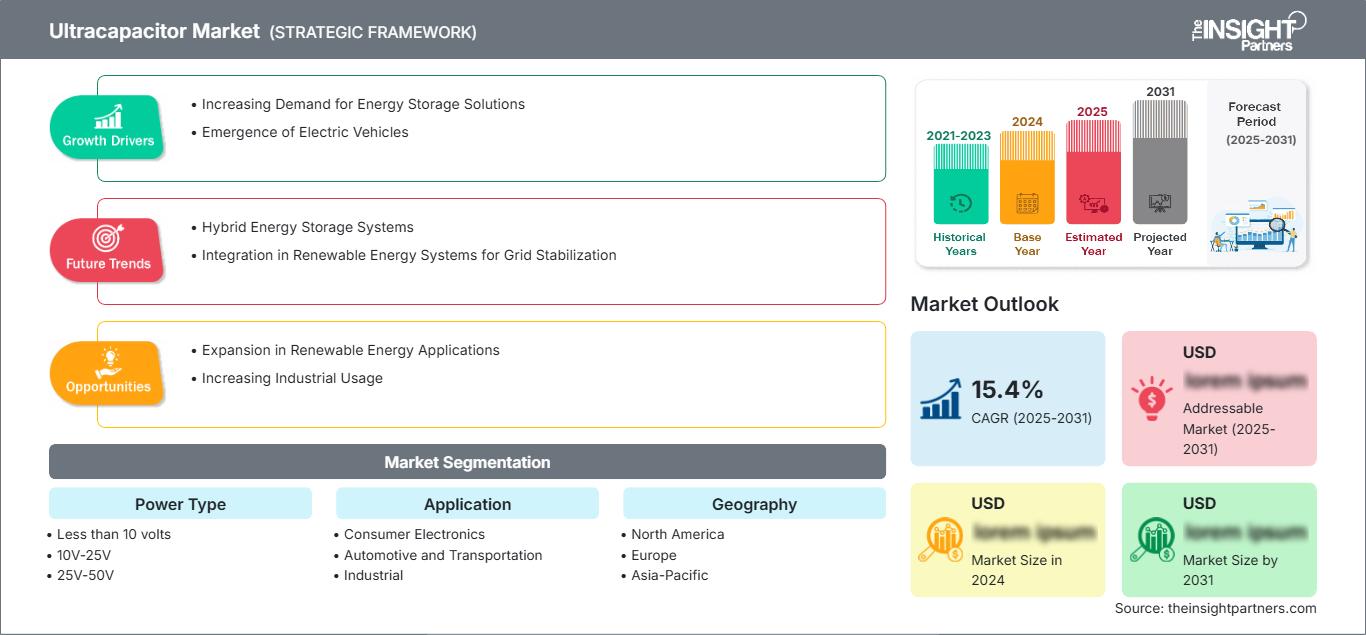
Ultracapacitor Market: Strategic Insights
Regional Insights
North America Ultracapacitor Market
North America is modeled to expand at an ~18% CAGR through 2034. Utility infrastructure upgrade, fleet electrification, industry automation, and dense computational processes require millisecond backup power supply. This area also has the advantage of experienced system integrators who will be able to combine ultracapacitors with batteries, fuel cells, and power converters for peak reduction, safe shutdown, and voltage regulation.
Adoption of the market has moved beyond replacing individual components to design an innovative hybrid energy storage system. Data centers need fast response to load fluctuations, while railways, trucks, and military equipment need reliable cold start and charge-discharge durability. North America Ultracapacitor Market share is maintained through reliability requirements, life cycle cost knowledge, and premium system qualification readiness.
U.S. Ultracapacitor Market
The US represents ~82% of North American revenue in 2025 and is expected to grow at an ~19% CAGR through 2034. Domestic demand includes applications such as hyperscale computing, grid, heavy vehicles, aerospace, military, and industrial automation. Investment in power quality offers applications for short-term power sources to help transition between disturbances and generators or batteries taking up longer-duration loads.
Supplier/Integrator availability facilitates applications such as Maxwell Technologies, Inc., Eaton Corporation plc, Ioxus, Inc., and Skeleton Technologies GmbH. Vehicles are starting to evaluate ultracaps for e-latches, start-stop applications, regenerative braking, and board-net stabilization. Industries value maintenance savings and ride-through capabilities, thus module reliability is an important buying factor.
Europe Ultracapacitor Market
Europe accounts for ~29% of global Ultracapacitor Market in 2025 and is projected to advance at an ~20% CAGR through 2034. Electrification, balancing of renewable power grids, industrial decarbonization, and demanding efficiency standards favor their adoption. Germany is the dominant player in Europe, owing to the country’s strong automotive engineering sector, power electronics know-how, and novel localized manufacturing of ultracapacitors. The European purchasing rationale places emphasis on longevity, energy harvesting, and provenance of materials.
The UK provides prospects in railway, aerospace, grid services, and electronic industries. In France, urban transportation projects are combined with energy infrastructure and the needs of industrial automation, while Italian industries of manufacturing machinery provide opportunities related to burst power and ride through. Spanish renewable power infrastructure implementation makes faster frequency response and converter support more interesting options. Despite the differences in scale, all of them can serve as avenues to achieving modularity of such systems complementing battery technology.
Europe-based suppliers in the Ultracapacitor Market are gearing up through products with low use of critical materials, localized manufacturing, and pack certification. Skeleton Technologies GmbH is increasing its manufacturing in Germany, while automotive and transportation equipment manufacturers are looking to reduce battery stress and increase energy recovery. Business success will rely on proving cost-saving benefits and control integration with existing traction, grid, and industrial automation systems.
APAC Ultracapacitor Market
Asia Pacific holds ~31% of global revenue in 2025 and is the fastest-growing region, with an ~24% CAGR through 2034. China is the largest Asian Pacific nation owing to its EVs, railways, electronics, and industrial manufacturing capacity. Japan and South Korea provide high-quality raw materials, capacitors, and vehicle qualification capabilities.
The development of India's demand through its metro systems, renewable energy integration, and industrial automation capabilities is evident, as is that of Australia through its mining, remote power, and grid resiliency applications. Electrification policies and localized supply chain can speed up the process of qualification. Although scale manufacturing can lower cell costs, consistency needs to be maintained.
Middle East & Africa Ultracapacitor Market
The Middle East & Africa market is expected to grow at an ~17% CAGR through 2034. Saudi Arabia and the UAE are the leading commercial centers in the Middle East & Africa for grid modernization, smart infrastructure, transport electrification, and data-center investment. Harsh temperatures increase the value of robust, low-maintenance pulse-power systems.
South Africa creates demand through mining equipment, renewable integration, and power-quality needs, while the Rest of MEA remains project-led. Adoption will depend on distributor support, systems engineering, and lifecycle-cost proof. Hybrid storage can address generator starting, crane energy recovery, voltage stabilization, and short-duration backup without substituting for energy-focused batteries.
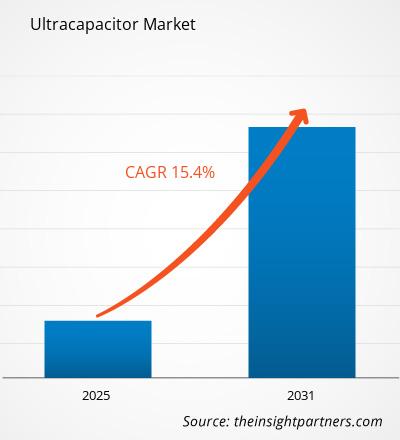
Segmentation Analysis
Power Type
The Power Type segment is projected to expand at an ~19% CAGR during 2026–2034. Selection depends on cell voltage, module configuration, balancing circuitry, discharge profile, and equipment safety requirements. The Ultracapacitor Market scope spans compact low-voltage electronics through high-voltage traction and grid modules. Higher-voltage assemblies command greater system value, while standardized lower-voltage cells remain essential for embedded backup and pulse-power designs.
- Less than 10 volts: Compact cells and packs serve memory backup, wireless sensors, smart meters, wearables, and battery-assisted electronics. Demand favors low leakage, thin form factors, predictable pulse delivery, and compatibility with energy-harvesting circuits.
- 10V-25V: This class supports industrial controls, robotics, access systems, small mobility platforms, and embedded ride-through. It balances manageable integration complexity with sufficient voltage for short peak loads and controlled shutdown.
- 25V-50V: Modules address light electric vehicles, telecom equipment, material handling, and automation. Buyers emphasize balancing accuracy, low equivalent series resistance, vibration tolerance, and easy pairing with battery-based DC architectures.
- 50V-100V: Demand comes from larger industrial drives, UPS subsystems, commercial-vehicle auxiliaries, and renewable-power converters. Certified enclosures, thermal monitoring, and modular serviceability make this range strategically important for integrators.
- Above 100V: High-voltage banks target rail traction, heavy vehicles, grid services, cranes, and high-power industrial recovery. The category requires sophisticated controls and insulation but offers strong value where repeated braking or load transients occur.
Application
Application is the largest main segment, with ~68% share in 2025 and an ~22% CAGR during 2026–2034. Automotive and transportation demand anchors volume through regenerative braking, start-stop, voltage stabilization, and auxiliary power. Industrial, energy, and electronic uses broaden revenue diversity. Adoption accelerates where high cycle frequency, fast response, temperature resilience, and avoided battery replacement outweigh higher upfront component cost.
- Consumer Electronics: Thin cells support wearables, cameras, handheld terminals, smart locks, trackers, and energy-harvesting devices. Strategic value lies in handling radio pulses, protecting batteries, and enabling graceful shutdown within constrained product envelopes.
- Automotive and Transportation: This application concentrates demand across passenger vehicles, buses, trucks, rail, and material handling. Ultracapacitors capture braking energy, deliver acceleration bursts, stabilize electrical networks, and improve cold-start reliability.
- Industrial: Factory automation, cranes, robotics, actuators, UPS equipment, and process controls use rapid-response storage for peak shaving and ride-through. Long cycle endurance supports lower maintenance in high-utilization environments.
- Energy: Grid converters, wind turbines, solar systems, microgrids, and distributed resources use ultracapacitors for frequency response, pitch control, smoothing, and bridging. The segment benefits from higher renewable penetration and power-quality investment.
Opportunity Snapshot
| Application | Revenue Contribution | Trend Tag | Adoption Stage |
| Consumer Electronics | Medium | Pulse Power | Scaling |
| Automotive and Transportation | High | Brake Recovery | Scaling |
| Industrial | High | Factory Ride-through | Mature |
| Energy | Medium | Grid Stability | Scaling |
| Others | Low | Specialty Backup | Emerging |
Ultracapacitor Market Growth Drivers and Impact Analysis
Electrified Mobility Expands High-Power Storage Demand
The charging and discharging cycles for electrified transportation generate a repetitive series of power events which are often poorly managed by batteries. An ultracapacitor quickly absorbs energy from regenerative braking and discharges it on acceleration to minimize the peak load placed on the battery. The application range includes buses, commercial transport, metro trains, cranes, and forklifts used in frequent stop-and-go operations. Growth potential is greatest where operators consider total cost of ownership since energy regeneration and less battery replacement will compensate for the increased system cost. The automotive approval process is stringent so suppliers have to offer vibration tolerance, reliable aging characteristics, safety data, and balance capability.
Grid Volatility Raises the Value of Millisecond Response
The demand for fast frequency response and voltage control is increased due to renewable generation, inverter based generation, and variable industrial loads. The response time of ultracapacitors is much faster compared to generators and they can work together with batteries to deal with short periods of energy provision, whereas batteries provide long-duration energy provision. In this way, there is no waste of resources and it is possible to design hybrid systems of storage with different power and energy demands. Pitch control of wind turbines, converter ride-through, microgrids, and power quality at substations are application areas. The market influence depends on market values, standards of interconnection, and integration abilities.
Automation and AI Infrastructure Create New Pulse Loads
Robotics, automated warehouses, semiconductor equipment, and AI data centers create sharp, repetitive power changes. Conventional backup systems are designed mainly for outages, whereas ultracapacitors can stabilize sub-second disturbances, recover mechanical energy, and bridge the interval before generators or battery systems respond. In factories, this supports safe shutdown, reduced nuisance trips, and smaller peak-power components. In computing infrastructure, high-density accelerators increase the importance of rack-to-grid power quality. Suppliers can capture value by combining cells, converters, controls, diagnostics, and service agreements. Adoption will favor solutions with validated response time, low loss, compact packaging, and integration into DC architectures, rather than standalone cells without system-level performance guarantees.
Ultracapacitor Market Future Trends
Hybrid Storage Becomes Software-Defined
Ultracapacitor Market trends will increasingly center on software-controlled hybrid systems that allocate rapid power events to ultracapacitors and sustained energy demand to batteries or fuel cells. Predictive controls can use load history, temperature, state of health, and electricity tariffs to optimize dispatch. This architecture may reduce battery oversizing while extending useful life, but it requires interoperable controls and transparent degradation models. Suppliers that expose diagnostic data and support digital twins will be better positioned for fleet, factory, and data-center deployments. By 2034, competitive differentiation is likely to move from cell specifications toward certified system efficiency, adaptive controls, and demonstrated savings across the complete operating cycle.
Advanced Carbon Materials Improve Form-Factor Economics
Electrode development will target higher usable energy density without sacrificing power, cycle life, or safety. Curved graphene, engineered activated carbon, pseudocapacitive materials, and hybrid lithium-ion capacitor designs can expand the addressable space between conventional capacitors and batteries. Manufacturing progress in coating uniformity, dry processing, electrolyte stability, and automated quality control will determine whether laboratory gains translate into reliable volume products. Thin prismatic cells will benefit connected electronics, while high-current cylindrical cells and modules will strengthen transport and grid applications. The commercial winners will balance material performance with yield, supply security, recyclability, and qualification cost rather than pursuing energy density in isolation.
Ultracapacitor Market Opportunities
Localized High-Voltage Module Platforms
Manufacturers can build regional module platforms above 100V for rail, heavy vehicles, cranes, and grid converters. Ultracapacitor Market Forecasts support investment in configurable cabinets that combine standardized cells, balancing electronics, contactors, cooling, and remote diagnostics. Local assembly reduces lead times and allows adaptation to regional certification, connector, and service requirements. Attractive projects will have frequent cycling, measurable recovered energy, and costly downtime. Suppliers should prioritize reference installations with transparent lifecycle data, then scale through power-electronics and transport integrators. Long-term service, refurbishment, and state-of-health monitoring can create recurring revenue beyond initial hardware sales.
Fast-Response Power for Emerging Data Centers
New AI and cloud campuses in North America, Europe, Asia Pacific, and the Gulf provide an opportunity to engineer ultracapacitor systems for rack-level smoothing, DC-bus stabilization, and generator bridging. The value proposition is not long-duration backup; it is rapid response, high cycle tolerance, and lower stress on batteries and upstream grid connections. Vendors should partner early with UPS manufacturers, electrical contractors, and data-center designers because architecture decisions precede equipment procurement. Demonstrating energy-loss reduction, fault behavior, thermal safety, and compatibility with high-voltage DC systems will be essential. Modular products that scale from rack to facility can shorten qualification and deployment cycles.
Recent Developments
- September 2026: LiCAP Technologies – launched a rack-level ultracapacitor energy storage system designed for AI data centers. The system provides millisecond response to AI workload transients, voltage disturbances, and short-duration power events, while supporting bridge power and improving power quality.
- August 2026: ABB – introduced an ultracapacitor energy storage solution for data centers in Ireland to support compliance with the EirGrid MPID345 grid code. The modular system combines ultracapacitors, grid-forming power conversion, and digital controls to provide millisecond grid support and restore demand following voltage disturbances.
- March 2026: LiCAP Technologies – expanded its manufacturing operations with a new 40,500-square-foot facility in Sacramento and introduced a dedicated ultracapacitor system assembly line. The expansion is intended to scale production for grid stabilization, data centers, and other energy storage applications, supported by LiCAP’s Activated Dry Electrode technology.
Frequently Asked Questions

- Comprehensive Market Sizing and Forecast Analysis
- Detailed Segmentation Analysis
- In-Depth Market Dynamics Assessment
- Regional and Country-Level Insights
- Competitive Landscape and Company Benchmarking
- Strategic Business Intelligence
Recent Reports
Testimonials

The Insight Partners provided valuable market intelligence that supported our global go-to-market strategy. Their team was professional, responsive, and attentive to our feedback, providing thoughtful analysis and helpful methodological clarifications throughout the project.
Junmo Kim Chief Financial Officer (CFO), Enertech Co., Ltd.
The Insight Partners' SCADA System Market report is comprehensive, with valuable insights on current trends and future forecasts. The team was highly professional, responsive, and supportive throughout. We are very satisfied and highly recommend their services.
RAN KEDEM Partner, Reali Technologies LTDs
I requested a report on a very specific software market and the team produced the report in a few days. The information was very relevant and well presented. I then requested some changes and additions to the report. The team was again very responsive and I got the final report in less than a week.
JEAN-HERVE JENN Chairman, Future Analytica
We worked with The Insight Partners for an important market study and forecast. They gave us clear insights into opportunities and risks, which helped shape our plans. Their research was easy to use and based on solid data. It helped us make smart, confident decisions. We highly recommend them.
PIYUSH NAGPAL Sr. Vice President, High Beam Global
The Insight Partners delivered insightful, well-structured market research with strong domain expertise. Their team was professional and responsive throughout. The user-friendly website made accessing industry reports seamless. We highly recommend them for reliable, high-quality research services
YUKIHIKO ADACHI CEO, Deep Blue, LLC.
This is the first time I have purchased a market report from The Insight Partners.While I was unsure at first, I visited their web site and felt more comfortable to take the risk and purchase a market report.I am completely satisfied with the quality of the report and customer service. I had several questions and comments with the initial report, but after a couple of dialogs over email with their analyst I believe I have a report that I can use as input to our strategic planning process.Thank you so much for taking the extra time and making this a positive experience.I will definitely recommend your service to others and you will be my first call when we need further market data.
JOHN SUZUKI President and Chief Executive Officer, Board Director, BK Technologies
I wish to appreciate your support and the professionalism you displayed in the course of attending to my request for information regarding to infectious disease IVD market in Nigeria. I appreciate your patience, your guidance, and the fact that you were willing to offer a discount, which eventually made it possible for us to close a deal. I look forward to engaging The Insight Partners in the future, all thanks to the impression you have created in me as a result of this first encounter.
DR CHIJIOKE ONYIA MANAGING DIRECTOR, PineCrest Healthcare Ltd.Reason to Buy
- Informed Decision-Making
- Understanding Market Dynamics
- Competitive Analysis
- Identifying Emerging Markets
- Customer Insights
- Market Forecasts
- Risk Mitigation
- Boosting Operational Efficiency
- Strategic Planning
- Investment Justification
- Tracking Industry Innovations
- Aligning with Regulatory Trends





 Get Free Sample for