
Ultrafast Recovery Rectifier Market Demand, Size & Forecast by 2034
Coverage: By Type (1 A or Below, 1.1 A to 2 A, 2.1 A to 4 A, 4.1 A to 10 A, 10.1 A to 20 A, 20.1 A to 30 A, Above 30 A); Application (Public Transport, Electronic Products, Industrial Manufacture, Communications Industry, Others) , and Geography (North America, Europe, Asia Pacific, and South and Central America)
- Status : Data Released
- Report Code : TIPRE00017185
- Category : Electronics and Semiconductor
- No. of Pages : 150
- Available Report Formats :


- Last update date : October 30, 2026


2025 Market Size
US$ 2.39 Bn
Base year value
2034 Forecast
US$ 3.9 Bn
Projected by 2034
CAGR 2026-2034
5.59 %
Growth rate
Addressable Market
US$ 28.51 Bn
(2026-2034)
The Ultrafast Recovery Rectifier Market was valued at US$ 2.39 Billion in 2025 and is projected to reach US$ 3.9 Billion by 2034, registering a CAGR of 5.59% from 2026 to 2034. The market covers ultrafast recovery rectifiers classified by current rating and deployed across public transport, electronic products, industrial manufacture, and the communications industry. Demand is shaped by the need for efficient high-frequency switching, reduced reverse-recovery losses, compact power-conversion architectures, and reliable operation in increasingly power-dense electronic systems.
In North America, the Ultrafast Recovery Rectifier Market size is supported by established power-electronics manufacturing, industrial automation, transportation electrification, and replacement demand for higher-efficiency rectification components. The region is expected to expand at a modeled CAGR of ~5% through 2034, supported by continued investment in compact power supplies, industrial converters, telecommunications infrastructure, and transportation power systems.
Ultrafast Recovery Rectifier Market Assessment and Insights
Regional Outlook
- North America: ~28% of the global market in 2025 | ~5% CAGR through 2034. Market position: North America maintains a substantial mature-market position, supported by industrial electronics, transportation systems, communications infrastructure, and established semiconductor supply chains. Demand increasingly favors compact, efficient rectifiers for higher-frequency switching architectures.
- US: ~79% of North American market revenue in 2025 | ~5% CAGR through 2034. Market position: The US represents the principal North American demand center, supported by electronics manufacturing, industrial power conversion, transportation electrification, and communications equipment. Design activity increasingly emphasizes thermal efficiency, switching performance, and smaller packages.
- Europe: ~24% of the global market in 2025 | ~5% CAGR through 2034. Market position: Europe has a mature industrial electronics base, with Germany representing the leading country in Europe. Automotive electronics, industrial automation, energy conversion, and transportation modernization sustain demand for efficient recovery rectifiers.
- Asia Pacific: ~38% of the global market in 2025 | ~7% CAGR through 2034. Market position: Asia Pacific is the largest regional market and the fastest-growing region, supported by electronics production, semiconductor manufacturing, industrial automation, transportation electrification, and expanding power-conversion requirements across China, Japan, South Korea, and India.
Segment Outlook
- Industrial Manufacture: ~34% Share in 2025 | ~6% CAGR through 2034. Market position: Industrial manufacture leads because rectifiers are integral to power supplies, converters, motor-control systems, factory equipment, and industrial power-management architectures. High switching frequency and thermal-performance requirements encourage replacement of slower rectification technologies.
- Public Transport: ~17% Share in 2025 | ~7% CAGR through 2034. Market position: Public transport has the highest growth outlook as rail electrification, traction power systems, auxiliary converters, and electric transportation platforms require efficient power conversion. Component qualification and reliability requirements also support higher-value rectifier adoption.
Competitive Coverage
Central Semiconductor Corp., Diodes Incorporated, Littelfuse, Inc., Microchip Technology Inc., NXP Semiconductors, onsemi, ROHM CO., LTD., STMicroelectronics, Vishay Intertechnology, Inc., WeEn Semiconductors
Methodology
The Insight Partners follows Data Collection & Secondary Research, Primary Research, Data Analysis, and Data Triangulation & Final Review to validate market estimates and insights.
Source: The Insight Partners' analysis based on proprietary research, government publications, company annual reports, investor presentations, industry databases, and expert interviews.
The Ultrafast Recovery Rectifier market has moved from traditional discrete rectifiers towards solutions designed for switching frequencies, reverse recovery charge, conduction loss, and power density improvements. Silicon rectifiers are now available in small surface mount and power modules, with differentiation in these products based more on the balance between forward voltage, recovery speed, thermal properties, surge handling capability, and electromagnetic characteristics. Present day product offerings range from switching power supplies, PFC sections, DC-DC converters, freewheeling applications, automotive electronics and power conversion.
The future depends upon geographic growth in the manufacture of electronics, industrial automation, transport electrification and power architecture efficiencies. The Asia Pacific region is likely to gain share of any increase in demand through the growth of electronics and power conversion manufacturing capacity, with Europe and North America continuing to be key markets for robust and specialized rectifiers. Regulatory focus on energy efficiency further drives design engineers to minimize switching losses and thermal management.
Ultrafast Recovery Rectifier Market Report Scope
| Report Attribute | Details |
|---|---|
| Market size in 2025 | US$ 2.39 Billion |
| Market Size by 2034 | US$ 3.9 Billion |
| Global CAGR (2026 - 2034) | 5.59% |
| Historical Data | 2021-2024 |
| Forecast period | 2026-2034 |
Ultrafast Recovery Rectifier Market Analysis
Ultrafast Recovery Rectifier Market growth is highly correlated with the development of switched-mode power supplies, PFC circuits, industrial converters, motor control systems, transport electronics, and telecommunications infrastructure. Ultrafast devices decrease the energy of the reverse recovery process in switching, enabling designers to run converters at higher switching frequency or to minimize losses at current switching frequency. It becomes especially significant when there are some constraints such as heat dissipation limitation, PCB size limitation, EM interference considerations, or just need for increased efficiency. Specifications of products are more and more focused on trade-off between recovery time and forward voltage as well as surge resistance.
Value chain includes manufacturing of silicon wafers and epitaxy, diode manufacturing, metallizing, packaging, testing, qualifying, distribution, and OEM assembly. Dynamics of supply depends on silicon wafer supply, assembling capacity, package technology availability, qualifying considerations, and ability to provide many variants of current and voltage ratings. Companies with extensive portfolio can address markets from small current electronic products to large current industrial converters. Surface mount package becomes increasingly strategic because smaller package allows power conversion designers to increase device density without proportional increase of the board size.
According to Ultrafast Recovery Rectifier Market Report, the competition revolves around electrical performance, packaging, qualification, reliability, and application engineering. STMicroelectronics provides ultrafast devices in low and high-current packages, such as those designed for PFC, energy recovery, boost, and tough switching operations. Vishay Intertechnology, Inc. focuses on its FRED Pt technologies and packages that serve commercial, industrial, automotive, and high-power applications. Diodes Incorporated and Littelfuse, Inc. also have their product lines covering fast switching, low leakage, high surge capability, and converter applications.
The focus of strategic investment is increasingly on smaller packages, thermal considerations, qualification for automotive applications, and devices that can provide low switching losses at higher frequencies. Microchip Technology Inc. provides ultrafast rectifiers for high-reliability applications, including military-qualified components, while others cater to automotive and industrial needs with AEC-Q qualification and special packaging considerations. It thus follows that competitive positioning is based not only on electrical characteristics of the devices but also on production volume, design-in capabilities, qualification coverage, distribution network, and ability to customize devices for particular voltage and current applications.
● REPORT CUSTOMIZATION
Tailor This Report To Align With Your Specific Business Requirements
This report can be customized to align precisely with your business objectives, scope, and target markets. Customization options include tailored segmentation, geography, competitive analysis, and strategic insights to support informed decision-making.
Customize This Report →WHAT YOU CAN ADJUST
- ● Segmentations
- ● Geography
- ● Competitive Analysis
- ● Language Preferences
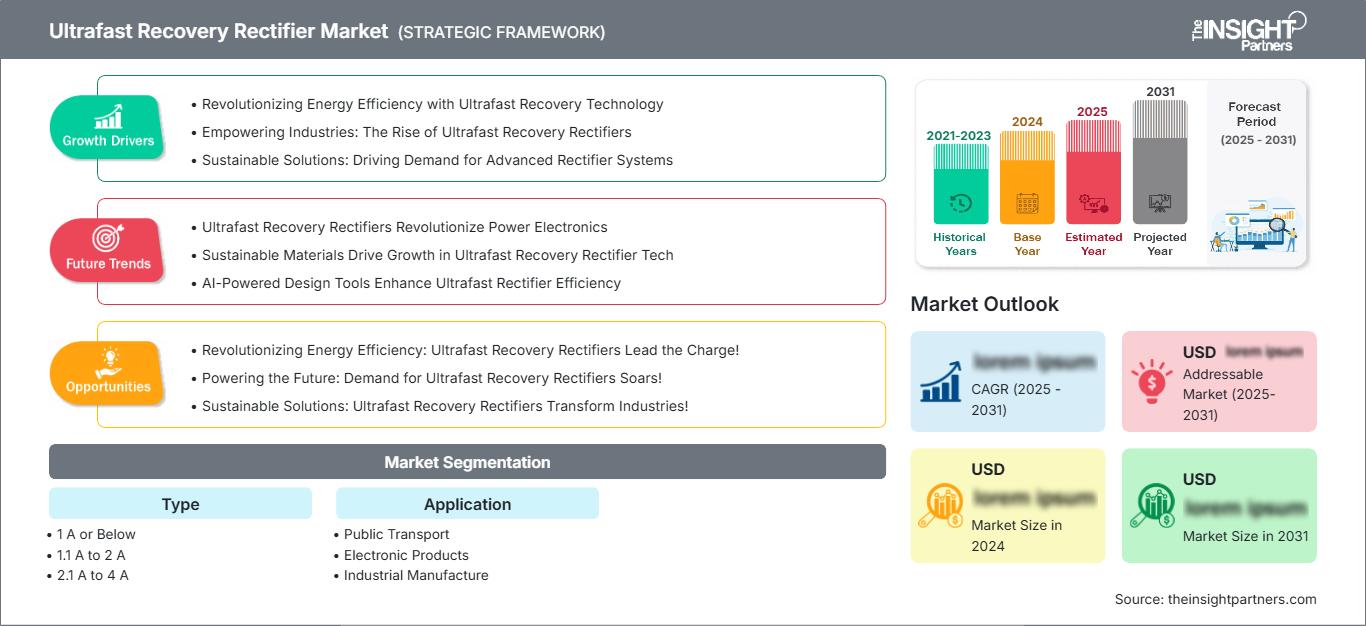
Ultrafast Recovery Rectifier Market: Strategic Insights
Regional Insights
North America Ultrafast Recovery Rectifier Market
North America represented ~28% of the Ultrafast Recovery Rectifier Market in 2025 and is projected to register a CAGR of ~5% through 2034. The region benefits from an established semiconductor ecosystem and extensive use of power electronics in industrial machinery, communications systems, transportation equipment, aerospace electronics, and high-performance computing infrastructure. Demand is particularly relevant where designers must balance switching efficiency, thermal dissipation, and reliability.
America comprises almost 79% of market revenue in North America and continues to be the major consumer in the region. Automation in industries, power systems, communication systems, and transportation system will lead to constant demand for discrete rectifiers. The choice of products is trending towards surface mounting products and products with controlled recovery capabilities. Contributions from Canada and Mexico include manufacturing of industries, assembling electronics, and transportation equipment. Growth in the region will continue to be consistent without being application specific.
U.S. Ultrafast Recovery Rectifier Market
The US accounted for ~79% of North American Ultrafast Recovery Rectifier Market Share in 2025 and is expected to expand at a CAGR of ~5% through 2034. The country has a broad base of industrial equipment manufacturers, electronics developers, transportation suppliers, and communications infrastructure providers. This creates demand across both high-volume standard components and application-specific rectifiers requiring stringent reliability and thermal characteristics.
Firms like Central Semiconductor Corp., Diodes Incorporated, Littelfuse, Inc., Microchip Technology Inc., and Vishay Intertechnology, Inc. have a range of products that cater to their US-based clientele. This includes demand from applications such as switch mode power supplies and DC-DC converters to industrial motor controls, communication systems, and transportation electronics. The market is driven by investments in the production capability and robustness of the semiconductor supply chain domestically, which has encouraged the qualification of several supplier options by OEMs.
Europe Ultrafast Recovery Rectifier Market
Europe represented ~24% of the global Ultrafast Recovery Rectifier Market in 2025 and is expected to grow at a CAGR of ~5% through 2034. Germany is the leading country in Europe, supported by its large industrial manufacturing base, automotive electronics ecosystem, automation capabilities, and power-conversion equipment production. France also contributes through transportation, industrial systems, energy infrastructure, and electronics applications, while the UK maintains demand from communications, industrial equipment, and specialized electronics.
Italy and Spain add demand through industrial machinery, transportation systems, consumer electronics, and energy-related equipment. Across the region, designers are increasingly concerned with efficiency, thermal performance, compact form factors, and reliability under demanding operating cycles. This favors ultrafast devices in PFC, inverter, freewheeling, and converter applications.
European demand is also shaped by the transition toward electrified transportation and more efficient industrial systems. Automotive-grade qualification, high-temperature operation, and smaller package formats are increasingly relevant to design decisions. The region therefore remains a mature market in which incremental growth is more closely associated with technology replacement, equipment modernization, and increased power density than with first-time adoption.
APAC Ultrafast Recovery Rectifier Market
Asia Pacific accounted for ~38% of the global Ultrafast Recovery Rectifier Market in 2025 and is expected to record a CAGR of ~7% through 2034, making it the fastest-growing region. China is the leading country in Asia Pacific, supported by large electronics manufacturing, industrial equipment production, transportation electrification, and extensive power-electronics supply chains.
Japan and South Korea contribute through advanced electronics, automotive systems, industrial automation, and semiconductor manufacturing, while India is expanding its electronics and industrial production base. Australia provides a smaller but relevant demand base through infrastructure and specialized power systems. Regional growth is reinforced by localization of electronics manufacturing, increasing converter deployment, and greater use of compact high-efficiency power supplies.
Middle East & Africa Ultrafast Recovery Rectifier Market
The Middle East & Africa region is expected to record a CAGR of ~5% through 2034. Saudi Arabia is the leading country in the Middle East & Africa based on the concentration of industrial development, infrastructure investment, and power-system modernization. The UAE also represents an important market through communications, infrastructure, logistics, and advanced building systems.
South Africa contributes through industrial manufacturing, transportation, mining-related equipment, and power infrastructure, while the rest of MEA remains fragmented. Demand is increasingly connected with industrial automation, telecommunications, distributed power systems, and infrastructure modernization. The region's opportunity profile is consequently more project-driven than replacement-driven, with system integrators and distributors playing important roles in product adoption.
Segmentation Analysis
Type
Type segmentation in the Ultrafast Recovery Rectifier Market classifies demand by current rating, ranging from 1 A or Below through Above 30 A. Current requirements influence package selection, thermal design, surge capability, and converter architecture. Industrial and transportation systems generally require higher-current devices, while electronic products frequently prioritize compact, low-current components.
- 1 A or Below: This range serves compact electronic circuits, auxiliary power supplies, signal-related power stages, polarity protection, and low-power switching applications. Its strategic importance is supported by high component counts and demand for space-efficient surface-mount packages.
- 1.1 A to 2 A: Devices in this range address moderate-load converters, compact power supplies, consumer electronics, and communications equipment. Buyers typically balance forward-voltage performance, recovery speed, thermal behavior, and package dimensions.
- 2.1 A to 4 A: This range supports power supplies, industrial control electronics, inverter stages, and medium-load conversion circuits. It offers a practical current level for designs requiring greater power handling without moving to large power packages.
- 4.1 A to 10 A: These devices are important for industrial converters, PFC circuits, motor-control systems, and higher-power electronic products. Thermal performance and surge capability become increasingly important as operating power rises.
- 10.1 A to 20 A: Demand is concentrated in industrial power conversion, transportation electronics, high-power supplies, and inverter-related applications. Package construction and heat dissipation become central considerations in component qualification.
- 20.1 A to 30 A: This range serves higher-power industrial and transportation systems where current-handling capability must be combined with controlled recovery characteristics. Robust packaging and thermal cycling performance influence purchasing decisions.
- Above 30 A: High-current devices are used in demanding power-conversion architectures, industrial equipment, and transportation systems. Their strategic role is associated with high-power rectification, thermal management, surge tolerance, and system reliability.
Application
Application segmentation includes Public Transport, Electronic Products, Industrial Manufacture, and Communications Industry. The Ultrafast Recovery Rectifier Market scope within these applications spans rectification, boost, freewheeling, energy recovery, and power-conversion functions.
- Industrial Manufacture is the largest main segment, with a CAGR of ~6% from 2026 to 2034. Industrial equipment uses rectifiers throughout motor-control systems, switch-mode power supplies, automation equipment, converters, welding systems, and factory power electronics. Demand is sustained by equipment modernization, higher operating frequencies, and efficiency requirements. Manufacturers increasingly select devices based on the complete switching and thermal profile rather than current rating alone.
- Public Transport is the high-growth main segment, with a CAGR of ~7% from 2026 to 2034. Rail traction, auxiliary power systems, onboard converters, and electrified transportation equipment require reliable high-frequency power conversion. The segment's growth is associated with electrification programs, rolling-stock modernization, compact converter architectures, and increasing attention to energy efficiency and thermal management.
- Electronic Products remains a major application category because power supplies, adapters, consumer electronics, computing equipment, and embedded systems use discrete rectification throughout their power-conversion stages. Demand favors compact surface-mount devices with low losses and controlled recovery characteristics.
- Communications Industry uses ultrafast rectifiers in power supplies, DC-DC converters, backup-power equipment, networking hardware, and infrastructure electronics. Growth is linked to increasing power density and reliability requirements in communications systems, where thermal management and efficient conversion are important for continuous operation.
Opportunity Snapshot
| Application | Revenue Contribution | Trend Tag | Adoption Stage |
| Public Transport | Medium | Rail Electrification | Scaling |
| Electronic Products | High | Compact Power | Mature |
| Industrial Manufacture | High | Factory Automation | Mature |
| Communications Industry | Medium | Power Density | Scaling |
Ultrafast Recovery Rectifier Market Growth Drivers and Impact Analysis
Higher Switching Frequency Requirements
Increasing switching frequency in power-conversion systems creates direct demand for rectifiers capable of recovering rapidly while limiting switching losses. As converter designers increase operating frequency, reverse-recovery behavior becomes more consequential because stored charge can increase losses, thermal stress, and electromagnetic disturbances. Ultrafast recovery devices address this requirement by shortening recovery intervals and supporting efficient operation in boost, PFC, freewheeling, and other switching circuits. The market impact extends beyond individual component replacement because faster rectification can enable smaller magnetic components, reduced cooling requirements, and greater power density at the system level. This makes device selection increasingly connected to the overall efficiency target of the converter rather than treated as an isolated semiconductor specification.
Power Density and Thermal Management
Power-density requirements are encouraging manufacturers to develop rectifiers that combine compact packages with lower conduction and switching losses. Smaller industrial controllers, communications equipment, transportation electronics, and consumer power supplies have less physical space available for heat dissipation, increasing the value of efficient rectification. Current product portfolios show a clear emphasis on low-profile packages, thermal performance, high-temperature operation, and reduced reverse-recovery charge. Vishay, for example, introduced 200 V FRED Pt ultrafast rectifiers in a low-profile package in 2026, illustrating the connection between package miniaturization and electrical performance. The resulting demand favors suppliers capable of integrating die technology, packaging, and thermal engineering rather than competing solely on nominal current ratings.
Electrification of Transportation Systems
Transportation electrification creates additional demand for efficient discrete power semiconductors in traction support systems, onboard power conversion, auxiliary supplies, charging equipment, and electronic control architectures. Ultrafast rectifiers can serve applications where switching efficiency and controlled recovery are important, particularly in high-frequency converter stages. Automotive-qualified product portfolios demonstrate the increasing relevance of higher temperature capability, compact packaging, and qualification standards. Public transport adds another demand pathway through rail modernization and electrified mobility infrastructure. The market impact is therefore broader than passenger vehicles alone, because power conversion requirements appear across onboard and infrastructure equipment. Suppliers that combine robust electrical performance with qualification, long product lifetimes, and design support can address more stringent transportation procurement requirements.
Ultrafast Recovery Rectifier Market Future Trends
Package-Level Integration and Lower Profile Designs
Ultrafast Recovery Rectifier Market trends are increasingly moving toward package designs that reduce footprint while preserving thermal and electrical performance. Low-profile surface-mount packages, copper-clip construction, wettable flanks, and improved thermal paths can allow designers to place power devices closer together while maintaining manufacturability. This direction is especially relevant for compact power supplies, communications hardware, automotive electronics, and industrial controllers. Future product differentiation is likely to place greater emphasis on the interaction between silicon performance and package parasitics. Manufacturers will increasingly optimize recovery characteristics, thermal impedance, mechanical dimensions, and automated assembly compatibility as a combined design proposition. Such developments can expand the addressable application base by allowing ultrafast rectifiers to enter systems previously constrained by board area or thermal limitations.
Application-Specific Silicon Performance
Future development is expected to focus more strongly on application-specific optimization rather than a single universal ultrafast rectifier architecture. PFC, resonant converters, hard-switched converters, freewheeling stages, automotive power systems, and high-power industrial equipment impose different requirements on forward voltage, recovery softness, reverse-recovery charge, surge current, and thermal behavior. STMicroelectronics already distinguishes product families according to converter frequency and switching requirements, illustrating the importance of this optimization approach. As converter architectures diversify, manufacturers can increasingly differentiate devices through tailored trade-offs, qualification grades, package structures, and design-support resources. This trend should encourage deeper collaboration between semiconductor suppliers and OEM engineering teams during component selection and qualification.
Ultrafast Recovery Rectifier Market Opportunities
Localized Supply for High-Volume Electronics Production
Ultrafast Recovery Rectifier Market Forecasts indicate an opportunity for suppliers to strengthen regional manufacturing, packaging, distribution, and qualification capabilities in high-volume electronics markets. Asia Pacific's large electronics production base creates a natural environment for localized supply of discrete power components, particularly where customers seek shorter lead times, second-source availability, and application engineering support. Suppliers can capture value by combining standardized rectifier families with regionally available packaging and logistics. Local technical support can further accelerate design-in activity because engineers often require detailed switching, thermal, and reliability information before approving power components. The opportunity is therefore not limited to wafer fabrication. Assembly, testing, distribution, reference designs, and technical support can all contribute to stronger regional positioning.
Transportation and Industrial Qualification Platforms
A second opportunity lies in building dedicated product platforms for transportation and industrial customers that require long operating lifetimes, predictable supply, and formal qualification. These customers generally evaluate more than price, considering thermal cycling, surge behavior, package robustness, electrical consistency, and documentation. Suppliers can respond through automotive-grade and industrial-grade product families, extended longevity programs, application-specific reference designs, and standardized qualification data. The approach can reduce design-in friction and increase the likelihood that a device is adopted across multiple equipment generations. Investment in engineering validation and qualification infrastructure can therefore create differentiation in markets where component reliability and supply continuity are as important as nominal switching performance.
Recent Developments
- April 2026: Vishay Intertechnology, Inc. introduced 16 200 V FRED Pt ultrafast rectifiers in the DFN6546A package, covering 6 A to 15 A ratings. The devices use a low-profile 6.5 mm x 4.6 mm package with a typical height of 0.88 mm and include commercial and AEC-Q101-qualified versions for industrial and automotive applications.
- February 2026: STMicroelectronics updated its 600 V ultrafast diode simulation resources to support product development around its ultrafast rectifier portfolio. The company maintains active devices covering PFC, boost, energy recovery, power supplies, and high-frequency switching applications, reinforcing the role of simulation support in power-device design and qualification.
- April 2025: WeEn Semiconductors announced a 2000 V high-voltage rectifier series designed to reduce conduction losses and improve thermal performance for renewable-energy storage and EV fast-charging applications. The company reported a 5% reduction in forward voltage and a 20% improvement in thermal resistance versus competing solutions for the announced series.
Frequently Asked Questions

- Comprehensive Market Sizing and Forecast Analysis
- Detailed Segmentation Analysis
- In-Depth Market Dynamics Assessment
- Regional and Country-Level Insights
- Competitive Landscape and Company Benchmarking
- Strategic Business Intelligence
Recent Reports
Testimonials

The Insight Partners provided valuable market intelligence that supported our global go-to-market strategy. Their team was professional, responsive, and attentive to our feedback, providing thoughtful analysis and helpful methodological clarifications throughout the project.
Junmo Kim Chief Financial Officer (CFO), Enertech Co., Ltd.
The Insight Partners' SCADA System Market report is comprehensive, with valuable insights on current trends and future forecasts. The team was highly professional, responsive, and supportive throughout. We are very satisfied and highly recommend their services.
RAN KEDEM Partner, Reali Technologies LTDs
I requested a report on a very specific software market and the team produced the report in a few days. The information was very relevant and well presented. I then requested some changes and additions to the report. The team was again very responsive and I got the final report in less than a week.
JEAN-HERVE JENN Chairman, Future Analytica
We worked with The Insight Partners for an important market study and forecast. They gave us clear insights into opportunities and risks, which helped shape our plans. Their research was easy to use and based on solid data. It helped us make smart, confident decisions. We highly recommend them.
PIYUSH NAGPAL Sr. Vice President, High Beam Global
The Insight Partners delivered insightful, well-structured market research with strong domain expertise. Their team was professional and responsive throughout. The user-friendly website made accessing industry reports seamless. We highly recommend them for reliable, high-quality research services
YUKIHIKO ADACHI CEO, Deep Blue, LLC.
This is the first time I have purchased a market report from The Insight Partners.While I was unsure at first, I visited their web site and felt more comfortable to take the risk and purchase a market report.I am completely satisfied with the quality of the report and customer service. I had several questions and comments with the initial report, but after a couple of dialogs over email with their analyst I believe I have a report that I can use as input to our strategic planning process.Thank you so much for taking the extra time and making this a positive experience.I will definitely recommend your service to others and you will be my first call when we need further market data.
JOHN SUZUKI President and Chief Executive Officer, Board Director, BK Technologies
I wish to appreciate your support and the professionalism you displayed in the course of attending to my request for information regarding to infectious disease IVD market in Nigeria. I appreciate your patience, your guidance, and the fact that you were willing to offer a discount, which eventually made it possible for us to close a deal. I look forward to engaging The Insight Partners in the future, all thanks to the impression you have created in me as a result of this first encounter.
DR CHIJIOKE ONYIA MANAGING DIRECTOR, PineCrest Healthcare Ltd.Reason to Buy
- Informed Decision-Making
- Understanding Market Dynamics
- Competitive Analysis
- Identifying Emerging Markets
- Customer Insights
- Market Forecasts
- Risk Mitigation
- Boosting Operational Efficiency
- Strategic Planning
- Investment Justification
- Tracking Industry Innovations
- Aligning with Regulatory Trends





 Get Free Sample for