
Ultrasonic Cleaning Market Share, Growth & Demand by 2034
Ultrasonic Cleaning Market Size and Forecasts (2021 - 2034), Global and Regional Share, Trends, and Growth Opportunity Analysis Report Coverage : By Type (Standalone, Benchtop, Multistage), Application (Automotive, Healthcare, Electrical & Electronics, Aerospace & Defense, Others)
- Status : Data Released
- Report Code : TIPRE00039663
- Category : Electronics and Semiconductor
- No. of Pages : 150
- Available Report Formats :


- Last update date : September 21, 2026


2025 Market Size
US$ 1.73 Bn
Base year value
2034 Forecast
US$ 3.33 Bn
Projected by 2034
CAGR 2026-2034
7.52 %
Growth rate
Addressable Market
US$ 22.77 Bn
(2026-2034)
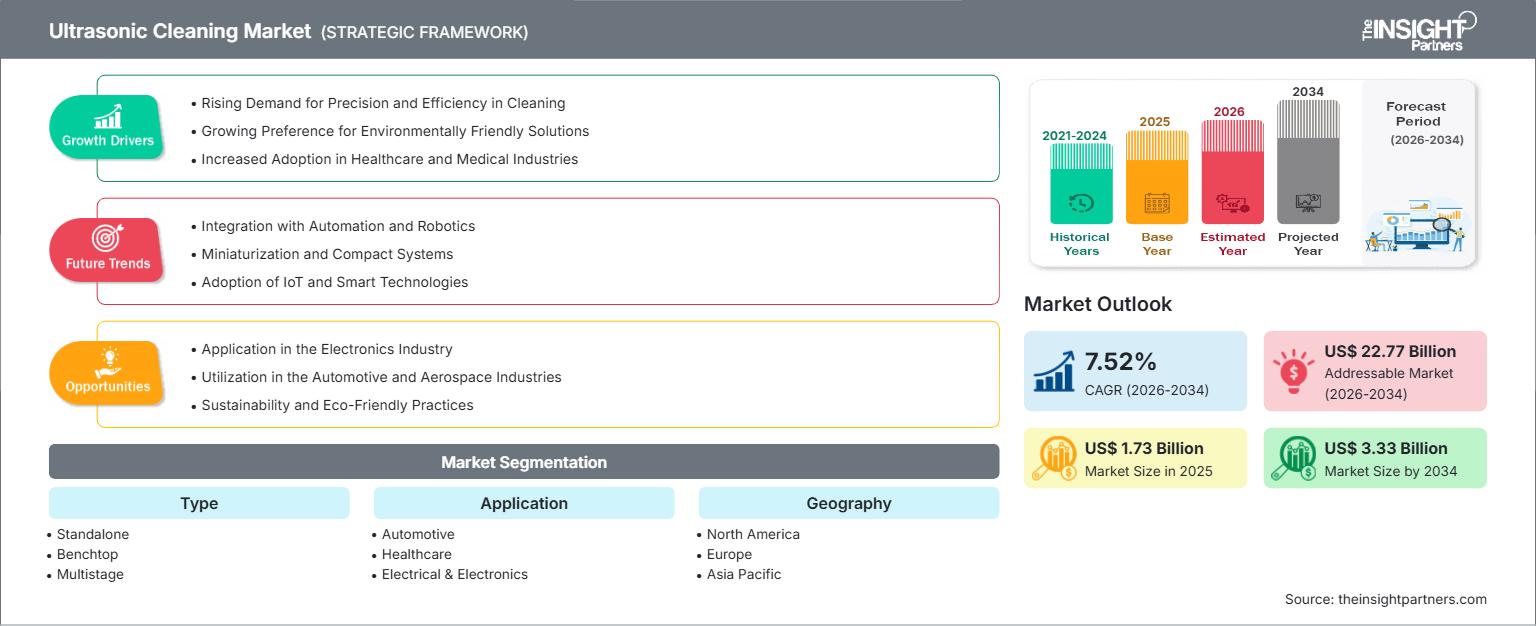
The ultrasonic cleaning market is projected to grow from US$ 1.73 Billion in 2025 to US$ 3.33 Billion by 2034, registering a CAGR of 7.52% during 2026–2034. Demand is being shaped by precision cleaning needs in automotive, healthcare, electrical and electronics, and aerospace and defense applications, where cavitation-based cleaning supports contaminant removal from complex parts, instruments, assemblies, and high-value components.
North America remains a strategically important region as advanced manufacturing, healthcare reprocessing, aerospace maintenance, and electronics production require repeatable cleaning performance. The ultrasonic cleaning market size in the region is supported by high adoption of benchtop and multistage systems, replacement of solvent-heavy cleaning processes, and investments in automation-compatible equipment that improves cleaning consistency, throughput, and process documentation.
Ultrasonic Cleaning Market Assessment and Insights
- North America: North America is estimated to account for 29–32% share in 2025 and grow at a CAGR of 6.6–7.1% during 2026–2034, supported by healthcare sterilization, aerospace maintenance, electronics assembly, and automated industrial cleaning adoption.
- US: The US is estimated to represent 76–80% of North America in 2025 and expand at a CAGR of 6.7–7.2% through 2034, driven by medical device, aerospace, semiconductor, and automotive component cleaning demand.
- Europe: Europe is estimated to hold 25–28% share in 2025 and grow at a CAGR of 6.9–7.4% during 2026–2034, led by Germany, the UK, France, Italy, and Spain across high-precision manufacturing and regulated cleaning environments.
- Asia Pacific: Asia Pacific is estimated to capture 31–34% share in 2025 and register a CAGR of 8.1–8.6% from 2026 to 2034, with China, Japan, South Korea, and India leading electronics, automotive, and industrial equipment deployment.
- Largest Segment: Benchtop systems are estimated to hold 39–43% market share in 2025 and grow at a CAGR of 6.8–7.3%, supported by laboratories, dental clinics, repair centers, and small-batch precision cleaning users.
- High Growth Segment: Multistage systems are estimated to hold 18–22% share in 2025 and grow at a CAGR of 8.4–8.9%, reflecting demand for automated washing, rinsing, drying, and validated process control.
- Key companies analyzed in detail: SharperTek, Mettler Electronics Corp., L&R Manufacturing, Elma Schmidbauer GmbH, Steelco S.p.A., Emerson Electric Co., GuangDong GT Ultrasonic Co., Ltd., Kemet International Limited, Crest Ultrasonics Corporation, and Blue Wave Ultrasonics.
Source: The Insight Partners' analysis based on proprietary research, government publications, company annual reports, investor presentations, industry databases, and expert interviews.
The development of technology has taken ultrasonic cleaning systems from simple immersion tanks into advanced, programmable, efficient, and application-based devices. Manufacturers are focusing on developing reliable transducers, accurate frequencies, uniform baths, and fluid handling techniques for use in applications involving electronic devices, medical instruments, aerospace components, and automotive parts. These developments have created opportunities for more facilities to adopt the technology because of the desire for consistent results rather than manual variations in cleaning.
Future opportunities include automation, manufacturing expansions in specific regions, and stricter contamination control regulations. The favorable production locations are Asia Pacific, the modernized industry in Europe, and regulated healthcare in North America. Market growth drivers include low-chemical aqueous cleaning and digitized monitoring systems.
Ultrasonic Cleaning Market Report Scope
| Report Attribute | Details |
|---|---|
| Market size in 2025 | US$ 1.73 Billion |
| Market Size by 2034 | US$ 3.33 Billion |
| Global CAGR (2026 - 2034) | 7.52% |
| Historical Data | 2021-2024 |
| Forecast period | 2026-2034 |
Ultrasonic Cleaning Market Analysis
Demand is being reinforced by the need to remove oil, particulate matter, polishing residues, flux, biological contaminants, and machining debris from intricate surfaces. The ultrasonic cleaning market benefits from its ability to clean blind holes, joints, cavities, and miniature components without aggressive mechanical abrasion. In production environments, buyers increasingly link cleaning quality with yield, safety, and warranty performance.
Supply dynamics are shaped by transducer quality, tank design, bath chemistry compatibility, and integration with rinsing or drying stages. Manufacturers serving electronics and medical applications prioritize stability at controlled frequencies, while heavy industrial users value throughput and durability. This creates a tiered ecosystem spanning compact benchtop units, standalone industrial cleaners, and fully integrated multistage lines.
Competitive positioning is highly fragmented, with specialty providers and diversified industrial technology providers catering to different levels of application depth. Emerson Electric Co., Crest Ultrasonics Corporation, Elma Schmidbauer GmbH, Steelco S.p.A., and Kemet International Limited use automation, system reliability, precise process control, and services, whereas SharperTek and Blue Wave Ultrasonics emphasize equipment availability for industrial as well as laboratory customers.
Investment flows point towards an increasing focus on connectivity, low solvent cleaning, and validated reprocessing processes. Based on this market analysis, equipment manufacturers who have the capability to integrate their expertise in cleaning chemicals, equipment design, and application consultation are better suited to serve the needs of the regulated end-users. Competitive differentiation has changed from just focusing on tank size to repeatability and documentation.
● REPORT CUSTOMIZATION
Tailor This Report To Align With Your Specific Business Requirements
This report can be customized to align precisely with your business objectives, scope, and target markets. Customization options include tailored segmentation, geography, competitive analysis, and strategic insights to support informed decision-making.
Customize This Report →WHAT YOU CAN ADJUST
- ● Segmentations
- ● Geography
- ● Competitive Analysis
- ● Language Preferences
Ultrasonic Cleaning Market: Strategic Insights
Regional Insights
North America ultrasonic cleaning market
North America is estimated to hold 29–32% ultrasonic cleaning market share in 2025 and grow at a CAGR of 6.6–7.1% during 2026–2034. Healthcare instrument reprocessing, aerospace maintenance, semiconductor fabrication support, and automotive component cleaning provide a broad demand base. Buyers increasingly favor systems that reduce manual variability and support process repeatability.
Regional adoption is also supported by higher labor costs and strict quality expectations in regulated environments. Multistage systems are gaining attention where cleaning, rinsing, drying, and validation must occur in one controlled workflow. Benchtop systems remain widely used in laboratories, dental practices, service centers, and small-part workshops.
U.S. ultrasonic cleaning Market
The US is estimated to account for 76–80% of North America in 2025 and grow at a CAGR of 6.7–7.2% through 2034, according to the ultrasonic cleaning market report. Demand is concentrated in medical device manufacturing, hospital sterile processing, aerospace component servicing, electronics production, and automotive maintenance. Local presence of established suppliers supports equipment customization and aftermarket service. Application trends favor compact systems for laboratories and healthcare clinics, while larger manufacturers adopt programmable and multistage configurations. The country’s advanced aerospace, semiconductor, and precision engineering base increases demand for cleaning processes that remove contaminants without damaging sensitive geometries or surface finishes.
Europe ultrasonic cleaning Market
Europe is estimated to represent 25–28% share in 2025 and grow at a CAGR of 6.9–7.4% from 2026 to 2034, according to the ultrasonic cleaning market forecast. Germany leads regional adoption due to automotive, machinery, medical technology, and precision engineering clusters. The UK and France contribute through healthcare, aerospace, research, and electronics-related demand.
Italy and Spain support additional deployment through equipment manufacturing, industrial maintenance, and component production. Sustainability rules and chemical reduction priorities encourage movement toward aqueous cleaning systems. European buyers also place strong emphasis on lifecycle reliability, energy efficiency, and compliance-ready cleaning documentation.
APAC ultrasonic cleaning Market
Asia Pacific is estimated to hold 31–34% share in 2025 and expand at a CAGR of 8.1–8.6% during 2026–2034. China remains a major manufacturing base, while Japan and South Korea drive high-precision electronics, semiconductors, and automotive applications. India is gaining momentum through industrial modernization and healthcare infrastructure expansion.
Regional demand is supported by high-volume manufacturing, export-oriented electronics assembly, EV component production, and medical device output. Buyers increasingly evaluate automated cleaning to improve yield, reduce rework, and support contamination standards across complex supply chains.
Middle East & Africa ultrasonic cleaning Market
The Middle East and Africa market is expected to grow at a CAGR of 5.8–6.3% during 2026–2034. Saudi Arabia and the UAE support demand through healthcare, aviation maintenance, energy equipment servicing, and industrial diversification programs. South Africa contributes through automotive, mining equipment, and general industrial cleaning applications.
Adoption is still developing compared with North America, Europe, and the Asia Pacific, but infrastructure investment and quality-focused maintenance practices are creating opportunities. Demand is strongest where high-value components require non-abrasive cleaning and reduced reliance on manual solvent methods.

Segmentation Analysis
Type
The Type segment is expected to grow at a CAGR of 7.1–7.6% during 2026–2034. The market scope spans standalone, benchtop, and multistage systems, enabling users to match cleaning intensity, space constraints, workflow integration, and validation requirements. System choice depends on part size, contamination level, production volume, and need for repeatable process control.
- Standalone: Standalone systems serve industrial environments that require higher tank capacity, stronger construction, and flexible part handling for automotive, metalworking, aerospace, and maintenance applications.
- Benchtop: Benchtop units are widely used in laboratories, dental clinics, jewelry workshops, repair centers, and small component cleaning, where compact size and quick turnaround are important.
- Multistage: Multistage systems combine washing, rinsing, drying, filtration, and handling functions, making them important for regulated, high-throughput, and contamination-sensitive manufacturing workflows.
Application
The Application segment is expected to grow at a CAGR of 7.4–7.9% during 2026–2034. Demand is distributed across automotive, healthcare, electrical and electronics, and aerospace and defense users. Each application group values ultrasonic cleaning for different reasons, including removal of machining oils, biological residues, solder flux, fine particles, and maintenance contaminants.
- Automotive: Automotive users apply ultrasonic cleaning to injectors, precision parts, machined components, remanufactured assemblies, and EV-related parts where cleaning consistency affects performance and durability.
- Healthcare: Healthcare adoption is supported by surgical instrument reprocessing, dental tool cleaning, laboratory equipment maintenance, and medical device manufacturing that require controlled contamination removal.
- Electrical & Electronics: Electronics applications focus on printed circuit boards, connectors, sensors, wafers, and precision assemblies where residue removal must avoid physical damage or reliability risk.
- Aerospace & Defense: Aerospace and defense users rely on non-abrasive cleaning for turbine parts, hydraulic components, precision fasteners, maintenance tools, and assemblies exposed to strict quality checks.
Opportunity Snapshot
| Application | Revenue Contribution | Trend Tag | Adoption Stage |
| Automotive | High | EV Parts | Scaling |
| Healthcare | High | Sterile Reuse | Mature |
| Electrical & Electronics | High | Micro Cleaning | Scaling |
| Aerospace & Defense | Medium | Precision MRO | Scaling |
Ultrasonic Cleaning Market Growth Drivers and Impact Analysis
Rising Precision Requirements in Regulated Industries
The increasing requirement in industries such as healthcare, aerospace, electronics, and medical devices is the development of technologies that are capable of cleaning cavities, textures, and geometric shapes without damaging them mechanically. Ultrasonic cleaning is one such technology that makes use of the process of cavitation to remove any residues from the surface areas that might not be cleaned through brushes, sprays, and manual immersion. The effect is practical in that there will be fewer occurrences of defects caused by residue, greater consistency in the reprocessing of parts, better preparation for coating or assembly, and less reliance on human technique.
Shift Toward Aqueous and Lower-Chemical Cleaning
Due to considerations like health and safety of workers, management of wastewater, costs of disposal and sustainability concerns, there is a shift among industrial consumers away from the use of aggressive solvents. This need can be addressed through ultrasonic technology that can enhance the cleaning process with water or less solvent-based cleaners. This trend applies mainly in Europe and North America, as environmental compliance and sustainability metrics at the plant level can drive procurement decisions. Implications for the market include growing demand for ultrasonic systems combined with appropriate detergents, filters and process control equipment.
Automation of Cleaning Workflows in Manufacturing
The manufacturers are looking for cleaning techniques that are compatible with automation in production, inspection and maintenance processes. The multistage ultrasonic technology facilitates this transition by combining various steps such as washing, rinsing, drying and sometimes material handling in an automated sequence. This minimizes manual labor and increases consistency from part to part. This effect is particularly felt in electronics manufacturing, automotive, aerospace industries and precision machining plants, since contamination may result in rework, failure, or process delays. Automation enhances labor efficiency and provides documentation of procedures, which makes ultrasonic cleaners appealing to those facilities that judge their quality on yield, throughput, and consistency.
Ultrasonic Cleaning Market Future Trends
Connected Cleaning Systems and Process Analytics
Ultrasonic cleaning market trends increasingly point toward connected systems that monitor temperature, power output, bath condition, cycle history, filtration performance, and maintenance needs. As factory processes become increasingly digitized with the use of digital manufacturing systems, cleaning machines will have to give information about the process itself rather than just being standalone tanks. This will assist users in recognizing the deterioration of the bath, planning maintenance, using energy more effectively, and maintaining documentation about the state of cleaning for audits. Those suppliers that offer sensors, dashboards, remote diagnostics, and predictive maintenance will be better differentiated from others, particularly in electronics, medical, and aerospace processes.
Application-Specific Frequency and Chemistry Optimization
Future product development will center on the proper matching of frequencies, power densities, tank designs, and cleaning chemistries to particular substrates and contaminants. Users of electronics would need less aggressive high-frequency or megasonic cleaning, whereas automotive and industrial components would benefit from more aggressive cavitation cleaning to deal with oils and metal particles. This shift will take the industry from generalized equipment selection to customized cleaning processes. The companies that offer services such as testing, validation, and application assistance will have an edge over their competitors since their clients would like to see the desired results before committing.
Ultrasonic Cleaning Market Opportunities
Expansion in Medical Device and Sterile Processing Workflows
The manufacturing of medical devices, dentistry, sterilization within hospitals, and laboratory activities provide solid business prospects, since their cleaning efficiency is linked to safety, compliance, and accessibility of the instruments. Ultrasonic Cleaning Forecasting reveals the potential increase in equipment purchases in case of a facility's upgrading of reprocessing room facilities, reducing manual scrubbing, and employing equipment that enables efficient cycles of cleaning. The compact benchtop models are suitable for smaller clinical settings, whereas more complex configurations could be required in the case of large sterile processing departments. It is possible to benefit from such trends through appropriate equipment sales and service offers.
Industrial Modernization Across Asia Pacific Manufacturing
Asia Pacific represents a significant market opportunity as the demand for electronics, automotive parts, electric vehicle components, precision machining, and medical devices continues to grow. Production lines located in China, Japan, South Korea, India, and other countries in the Asia Pacific region will require the need for continuous cleaning prior to coating, inspection, packaging, or assembly processes. Customers are moving away from manual work towards equipment that will increase their yield and productivity. The best opportunities lie in those companies that provide scalable solutions, on-site service, competitive pricing, and application engineering.
Frequently Asked Questions

- Comprehensive Market Sizing and Forecast Analysis
- Detailed Segmentation Analysis
- In-Depth Market Dynamics Assessment
- Regional and Country-Level Insights
- Competitive Landscape and Company Benchmarking
- Strategic Business Intelligence
Recent Reports
Testimonials

The Insight Partners provided valuable market intelligence that supported our global go-to-market strategy. Their team was professional, responsive, and attentive to our feedback, providing thoughtful analysis and helpful methodological clarifications throughout the project.
Junmo Kim Chief Financial Officer (CFO), Enertech Co., Ltd.
The Insight Partners' SCADA System Market report is comprehensive, with valuable insights on current trends and future forecasts. The team was highly professional, responsive, and supportive throughout. We are very satisfied and highly recommend their services.
RAN KEDEM Partner, Reali Technologies LTDs
I requested a report on a very specific software market and the team produced the report in a few days. The information was very relevant and well presented. I then requested some changes and additions to the report. The team was again very responsive and I got the final report in less than a week.
JEAN-HERVE JENN Chairman, Future Analytica
We worked with The Insight Partners for an important market study and forecast. They gave us clear insights into opportunities and risks, which helped shape our plans. Their research was easy to use and based on solid data. It helped us make smart, confident decisions. We highly recommend them.
PIYUSH NAGPAL Sr. Vice President, High Beam Global
The Insight Partners delivered insightful, well-structured market research with strong domain expertise. Their team was professional and responsive throughout. The user-friendly website made accessing industry reports seamless. We highly recommend them for reliable, high-quality research services
YUKIHIKO ADACHI CEO, Deep Blue, LLC.
This is the first time I have purchased a market report from The Insight Partners.While I was unsure at first, I visited their web site and felt more comfortable to take the risk and purchase a market report.I am completely satisfied with the quality of the report and customer service. I had several questions and comments with the initial report, but after a couple of dialogs over email with their analyst I believe I have a report that I can use as input to our strategic planning process.Thank you so much for taking the extra time and making this a positive experience.I will definitely recommend your service to others and you will be my first call when we need further market data.
JOHN SUZUKI President and Chief Executive Officer, Board Director, BK Technologies
I wish to appreciate your support and the professionalism you displayed in the course of attending to my request for information regarding to infectious disease IVD market in Nigeria. I appreciate your patience, your guidance, and the fact that you were willing to offer a discount, which eventually made it possible for us to close a deal. I look forward to engaging The Insight Partners in the future, all thanks to the impression you have created in me as a result of this first encounter.
DR CHIJIOKE ONYIA MANAGING DIRECTOR, PineCrest Healthcare Ltd.Reason to Buy
- Informed Decision-Making
- Understanding Market Dynamics
- Competitive Analysis
- Identifying Emerging Markets
- Customer Insights
- Market Forecasts
- Risk Mitigation
- Boosting Operational Efficiency
- Strategic Planning
- Investment Justification
- Tracking Industry Innovations
- Aligning with Regulatory Trends





 Get Free Sample for