
Ultrasonic Wall Thickness Gauges Market Share, Size & Demand by 2034
Coverage: By Product (Digital, Manual); Application (Commercial, Residential) , and Geography (North America, Europe, Asia Pacific, and South and Central America)
- Status : Data Released
- Report Code : TIPRE00017186
- Category : Electronics and Semiconductor
- No. of Pages : 150
- Available Report Formats :


- Last update date : September 21, 2026


2025 Market Size
US$ 1.75 Bn
Base year value
2034 Forecast
US$ 3.1 Bn
Projected by 2034
CAGR 2026-2034
6.53 %
Growth rate
Addressable Market
US$ 21.90 Bn
(2026-2034)
The ultrasonic wall thickness gauges market was valued at US$ 1.75 Billion in 2025 and is projected to reach US$ 3.1 Billion by 2034, registering a CAGR of 6.53% during 2026–2034. Demand is supported by non-destructive testing programs in oil and gas, power generation, aerospace, marine, manufacturing, and infrastructure, where operators need accurate wall-loss measurement without cutting, shutdowns, or destructive sampling.
North America remains a major demand center as refineries, pipelines, chemical plants, utilities, and industrial facilities increase inspection frequency for aging assets. The ultrasonic wall thickness gauges market size in the region is supported by strict safety practices, higher adoption of digital inspection workflows, and sustained investment in predictive maintenance programs that reduce unplanned outages and corrosion-related failures.
Ultrasonic Wall Thickness Gauges Market Assessment and Insights
- North America: The region is estimated to account for 30–35% share in 2025 and grow at a CAGR of 5.8–6.4% during 2026–2034, driven by pipeline integrity, refinery maintenance, and aerospace inspection demand.
- U.S.: The U.S. represents 72–78% of North America demand in 2025 and is expected to grow at a CAGR of 5.9–6.5% through 2034.
- Europe: Europe holds 25–30% share in 2025 and is projected to grow at a CAGR of 5.5–6.1%, led by Germany, the UK, France, Italy, and Spain.
- Asia Pacific: Asia Pacific accounts for 28–33% share in 2025 and is expected to grow at a CAGR of 6.8–7.5%, led by China, Japan, South Korea, India, and Australia.
- Largest Segment: Digital gauges hold 68–74% market share in 2025 and are expected to expand at a CAGR of 6.7–7.3%, supported by data logging, wireless connectivity, and faster scanning.
- High Growth Segment: Commercial applications hold 60–66% share in 2025 and are projected to grow at a CAGR of 6.6–7.2%, reflecting industrial inspection and service-provider adoption.
- Key companies analyzed in detail: Baker Hughes Company, Cygnus Instruments Ltd, Danatronics Corporation, DeFelsko Corporation, Fischer Technology Inc., Teledyne FLIR LLC, Intertek Group plc, Evident Corporation, SONOTEC GmbH, and VOGT Ultrasonics GmbH.
Source: The Insight Partners' analysis based on proprietary research, government publications, company annual reports, investor presentations, industry databases, and expert interviews.
Inspection practice has moved from basic manual spot checks to connected, high-resolution ultrasonic measurement. The ultrasonic wall thickness gauges market growth is shaped by corrosion monitoring, through-coating measurement, A-scan visualization, automated reporting, and asset lifecycle planning. Rugged handheld devices are replacing legacy tools because they combine portability with traceable readings for pipelines, tanks, pressure vessels, ship hulls, and fabricated components.
Future demand will be influenced by inspection digitization, stricter documentation requirements, and workforce productivity needs. Emerging economies are adding petrochemical, power, marine, and transportation assets, while mature markets are extending service life through condition-based maintenance. These forces make accuracy, repeatability, and inspection-data integration central purchase criteria for users and service providers.
Ultrasonic Wall Thickness Gauges Market Report Scope
| Report Attribute | Details |
|---|---|
| Market size in 2025 | US$ 1.75 Billion |
| Market Size by 2034 | US$ 3.1 Billion |
| Global CAGR (2026 - 2034) | 6.53% |
| Historical Data | 2021-2024 |
| Forecast period | 2026-2034 |
Ultrasonic Wall Thickness Gauges Market Analysis
The ultrasonic wall thickness gauges market growth is strongly linked to asset integrity programs across industries where metal loss can create safety, environmental, and financial risk. Gauges are employed to identify any form of corrosion, erosion, and variations arising from the manufacturing process on one side of the piece in order to save time without having to do destructive testing. Consistency in demand is notable, especially in pipeline applications, pressure vessels, ship building, bridge construction, aerospace components, and power generation.
Supply considerations depend largely on the availability of transducers, embedded software, calibration, and durable instruments. Manufacturers are working towards improving scan speeds, coating effects, memory and wireless data transfer. As customers standardize maintenance records, the ultrasonic wall thickness gauges market analysis increasingly favors devices that support repeat inspections, technician usability, and integration with broader non-destructive testing workflows.
The competition is focused among diversified NDT instrument providers and specialized gauge manufacturers. Competition among Baker Hughes Company, Evident Corporation, Cygnus Instruments Ltd, Danatronics Corporation, DeFelsko Corporation, and SONOTEC GmbH is determined by measurement accuracy, durability, usability of the instrument, probe variety, and service assistance. Intertek Group plc impacts demand by providing inspection services, while Fischer Technology Inc., Teledyne FLIR LLC, and VOGT Ultrasonics GmbH add to the development of the testing environment.
There is a trend of investment in connected and ready-to-use equipment in order to cut down inspection duration. The most recent positioning of the products includes wireless communication capability, high-speed scanning, ruggedness, and multifunctionality. Buyers increasingly consider the whole workflow value instead of instrument price due to the influence of digital documentation, fast reporting, and technician efficiency on the budgeting process.
● REPORT CUSTOMIZATION
Tailor This Report To Align With Your Specific Business Requirements
This report can be customized to align precisely with your business objectives, scope, and target markets. Customization options include tailored segmentation, geography, competitive analysis, and strategic insights to support informed decision-making.
Customize This Report →WHAT YOU CAN ADJUST
- ● Segmentations
- ● Geography
- ● Competitive Analysis
- ● Language Preferences
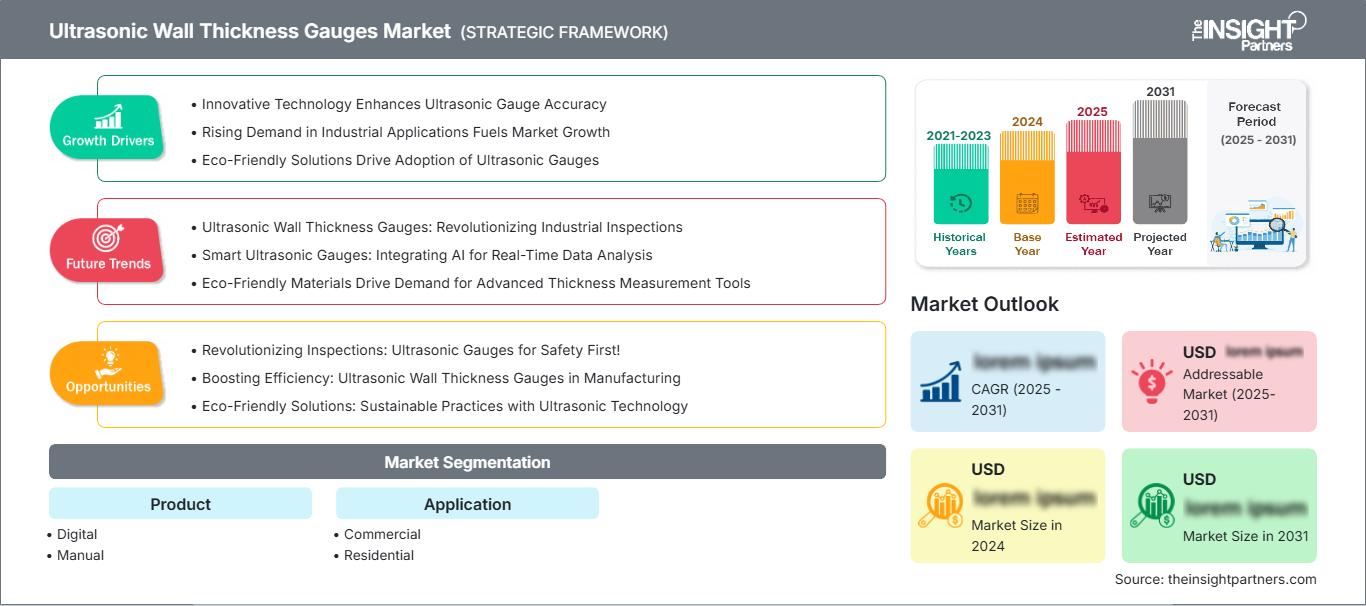
Ultrasonic Wall Thickness Gauges Market: Strategic Insights
Regional Insights
North America ultrasonic wall thickness gauges market
North America remains an early adopter because industrial owners face aging pipelines, storage tanks, boilers, aircraft fleets, and offshore assets. The region is expected to hold 30–35% ultrasonic wall thickness gauges market share in 2025 and grow at a CAGR of 5.8–6.4% through 2034. Demand is reinforced by established NDT standards, high maintenance spending, and widespread use of digital gauges in corrosion programs.
Service providers and in-house reliability teams increasingly prefer gauges with A-scan display, data logging, and connectivity. Oil and gas, aerospace, chemicals, and utilities drive repeat purchases, while regulatory scrutiny sustains inspection frequency. The region’s growth is steady rather than speculative because replacement cycles are tied to safety-critical assets and documented maintenance regimes.
U.S. ultrasonic wall thickness gauges market
The U.S. accounts for 72–78% of North America's demand in 2025 and is expected to grow at a CAGR of 5.9–6.5%, according to the ultrasonic wall thickness gauges market report. Refining, midstream pipelines, aerospace manufacturing, naval maintenance, and power plants create diversified demand. Buyers emphasize rugged handheld instruments that can support field inspection, coating compensation, and reliable performance in harsh operating environments. Company presence is broad, with Baker Hughes Company, Evident Corporation, Danatronics Corporation, DeFelsko Corporation, Fischer Technology Inc., and Intertek Group plc supporting products, services, and calibration capabilities. Adoption is strongest where operators need traceable wall-loss records for pressure vessels, tanks, aircraft parts, and high-value industrial components.
Europe ultrasonic wall thickness gauges market
Europe is estimated to represent 25–30% share in 2025 and grow at a CAGR of 5.5–6.1%. Germany leads through advanced manufacturing, automotive, process industries, and industrial quality control. The United Kingdom continues to play a significant role in offshore energy, marine inspections, and infrastructure maintenance, and the needs of France are catered for by aerospace, utilities, rail, and chemical processing.
Italy and Spain make their contribution through shipbuilding, refining, industrial fabrication, and maintenance of assets in the power sector. European customers tend to value certification, repeatability, and ruggedness of the instruments because inspection records are closely associated with safety management. Digital products become favored when service providers need to produce uniform reports from several facilities.
APAC ultrasonic wall thickness gauges market
APAC is projected to hold 28–33% share in 2025 and grow at a CAGR of 6.8–7.5%. China is the leading country due to its manufacturing scale, petrochemicals, shipbuilding, and infrastructure inspection. Japan and South Korea add demand from automotive, electronics, marine, and industrial maintenance, while India and Australia support growth through energy, mining, utilities, and transportation assets.
Policy-driven infrastructure investment and expanding industrial safety practices strengthen long-term adoption. Local service providers increasingly use digital gauges for faster site work, while multinational manufacturers supply advanced devices for high-accuracy applications. The ultrasonic wall thickness gauges market trends in APAC favor portable systems that combine affordability with reliable data capture.
Middle East & Africa ultrasonic wall thickness gauges market
The Middle East and Africa market is expected to grow at a CAGR of 5.9–6.6% during 2026–2034. Saudi Arabia and the UAE generate demand from oil and gas, petrochemicals, desalination, ports, and industrial construction. South Africa contributes through mining, power, manufacturing, and infrastructure maintenance, while the rest of MEA remains tied to energy and utilities.
Growth is supported by inspection requirements for pipelines, tanks, pressure systems, and offshore assets operating in corrosive environments. Buyers often value durable gauges, hot-surface capability, and service availability. Adoption remains selective but resilient because equipment integrity directly affects production continuity, worker safety, and environmental risk management.
Segmentation Analysis
Product
Product is expected to grow at a CAGR of 6.4–7.1% during 2026–2034. The ultrasonic wall thickness gauges market scope across product types is shaped by the shift from basic readings to digital inspection records. Digital instruments dominate because they improve repeatability, support A-scan or B-scan functionality, and help teams store inspection data for compliance and trend analysis.
- Digital: Digital gauges lead adoption because they provide faster readings, data logging, wireless transfer, and improved usability for corrosion surveys, maintenance documentation, and multi-site inspection programs.
- Manual: Manual gauges remain relevant for budget-sensitive users, training environments, and straightforward thickness checks where advanced connectivity, waveform display, or large inspection databases are not required.
Application
Application is expected to grow at a CAGR of 6.2–6.9% during 2026–2034. Commercial use leads because industrial asset owners and inspection service firms require recurring wall-thickness checks across pipelines, tanks, vessels, aircraft, ships, and infrastructure. Residential demand is smaller, focused on niche building diagnostics, specialized maintenance, and limited non-destructive evaluation needs.
- Commercial: Commercial applications dominate due to recurring inspection cycles in oil and gas, chemicals, utilities, marine, aerospace, manufacturing, and third-party NDT service operations.
- Residential: Residential applications are limited but useful for specialized structural checks, water-system maintenance, and contractor-led assessments where non-invasive thickness confirmation adds diagnostic value.
Opportunity Snapshot
| Application | Revenue Contribution | Trend Tag | Adoption Stage |
| Commercial | High | Asset Integrity | Mature |
| Residential | Low | Targeted Diagnostics | Emerging |
Ultrasonic Wall Thickness Gauges Market Growth Drivers and Impact Analysis
Aging Industrial Assets Requiring Corrosion Monitoring
The increasing number of aging pipelines, storage tanks, boilers, pressure vessels, ships, and bridges is leading to an increased demand for non-destructive wall-loss measurement. The ultrasonic gauges will enable the technicians to make the measurements of the remaining thickness even as the equipment continues operating, to help the owners identify priority maintenance work. The driver is most pronounced in industries such as the oil and gas industry, power generation plants, chemical facilities, marine operations, and heavy manufacturing industries since corrosion might result in failures.
Digital Inspection Workflows and Audit-Ready Maintenance Records
There is a greater demand for inspection results that are capable of being recorded, transmitted, compared, and analyzed. Wireless gauges, data loggers, and waveform displays increase accuracy by decreasing the possibility of mistakes in recording and ensuring compliance documentation. This is especially significant when it comes to the demands of service providers dealing with several properties and owners developing preventive maintenance programs. The effect of these changes on the market is noticeable from the preference towards high-quality handheld tools and platforms.
Expansion of Safety-Critical Infrastructure and Industrial Capacity
The expansion of investments in the chemical industry, liquefied natural gas, energy generation from renewable sources, transport network infrastructure, manufacturing sector, and aerospace industry leads to an increase in the number of objects that need to be inspected. All pipes, tanks, vessels, parts of the aircraft, and structures become a source of potential future demand for measuring wall thicknesses. The growth factor is especially relevant for the Asia Pacific region and the Middle East, which have seen additional industrial capacity coupled with higher safety standards.
Ultrasonic Wall Thickness Gauges Market Future Trends
Connected Handheld Gauges Becoming Standard Tools
The ultrasonic wall thickness gauges market trends point toward connected handheld devices becoming the default choice for professional inspection teams. Wireless transfer, app-based reporting, cloud storage, and remote review will reduce delays between field measurement and maintenance decisions. Users will expect devices to integrate with inspection management systems and support repeatable measurement locations. This trend will raise competitive pressure on vendors that rely on basic instruments and create opportunities for differentiated software, accessories, and calibration ecosystems.
Higher Accuracy for Advanced Materials and Coated Assets
Further developments in products would concentrate on accurate measurements in a range of coatings on metals, composite materials, plastics, thin films, high temperatures, and complex shapes. Gauges capable of performing inspections regardless of the material and maintaining their robustness in the field would be required more and more in aerospace, automotive, marine, and energy industries. More sophisticated transducers, algorithms, and waveform interpretation would assist the technician in minimizing uncertainties in difficult inspection situations.
Ultrasonic Wall Thickness Gauges Market Opportunities
Predictive Maintenance Programs in Energy and Utilities
Ultrasonic wall thickness gauges Market forecasts indicate an attractive opportunity in predictive maintenance programs for energy, utilities, and process industries. Asset owners are shifting from reactive repairs to risk-based inspection models that require reliable thickness trend data over time. Suppliers can capture value by offering gauges, probes, calibration, training, and software as a workflow package. This opportunity is strongest where operators must extend asset life while controlling downtime, regulatory exposure, and capital spending.
Service Provider Expansion in Emerging Industrial Regions
Third-party NDT service providers in Asia Pacific, the Middle East, Africa, and Latin America can expand ultrasonic wall thickness inspection offerings as industrial assets multiply. Gauge manufacturers have an opportunity to build distributor, rental, calibration, and training networks that support local technicians. Bundled solutions can help service firms standardize inspection quality across refineries, pipelines, ports, mines, utilities, and manufacturing sites. This channel opportunity improves market reach without relying only on direct equipment sales.
Frequently Asked Questions

- Comprehensive Market Sizing and Forecast Analysis
- Detailed Segmentation Analysis
- In-Depth Market Dynamics Assessment
- Regional and Country-Level Insights
- Competitive Landscape and Company Benchmarking
- Strategic Business Intelligence
Recent Reports
Testimonials

The Insight Partners provided valuable market intelligence that supported our global go-to-market strategy. Their team was professional, responsive, and attentive to our feedback, providing thoughtful analysis and helpful methodological clarifications throughout the project.
Junmo Kim Chief Financial Officer (CFO), Enertech Co., Ltd.
The Insight Partners' SCADA System Market report is comprehensive, with valuable insights on current trends and future forecasts. The team was highly professional, responsive, and supportive throughout. We are very satisfied and highly recommend their services.
RAN KEDEM Partner, Reali Technologies LTDs
I requested a report on a very specific software market and the team produced the report in a few days. The information was very relevant and well presented. I then requested some changes and additions to the report. The team was again very responsive and I got the final report in less than a week.
JEAN-HERVE JENN Chairman, Future Analytica
We worked with The Insight Partners for an important market study and forecast. They gave us clear insights into opportunities and risks, which helped shape our plans. Their research was easy to use and based on solid data. It helped us make smart, confident decisions. We highly recommend them.
PIYUSH NAGPAL Sr. Vice President, High Beam Global
The Insight Partners delivered insightful, well-structured market research with strong domain expertise. Their team was professional and responsive throughout. The user-friendly website made accessing industry reports seamless. We highly recommend them for reliable, high-quality research services
YUKIHIKO ADACHI CEO, Deep Blue, LLC.
This is the first time I have purchased a market report from The Insight Partners.While I was unsure at first, I visited their web site and felt more comfortable to take the risk and purchase a market report.I am completely satisfied with the quality of the report and customer service. I had several questions and comments with the initial report, but after a couple of dialogs over email with their analyst I believe I have a report that I can use as input to our strategic planning process.Thank you so much for taking the extra time and making this a positive experience.I will definitely recommend your service to others and you will be my first call when we need further market data.
JOHN SUZUKI President and Chief Executive Officer, Board Director, BK Technologies
I wish to appreciate your support and the professionalism you displayed in the course of attending to my request for information regarding to infectious disease IVD market in Nigeria. I appreciate your patience, your guidance, and the fact that you were willing to offer a discount, which eventually made it possible for us to close a deal. I look forward to engaging The Insight Partners in the future, all thanks to the impression you have created in me as a result of this first encounter.
DR CHIJIOKE ONYIA MANAGING DIRECTOR, PineCrest Healthcare Ltd.Reason to Buy
- Informed Decision-Making
- Understanding Market Dynamics
- Competitive Analysis
- Identifying Emerging Markets
- Customer Insights
- Market Forecasts
- Risk Mitigation
- Boosting Operational Efficiency
- Strategic Planning
- Investment Justification
- Tracking Industry Innovations
- Aligning with Regulatory Trends





 Get Free Sample for