
Underground High Voltage Cables Market Demand, Trends & Forecast by 2034
Coverage: by Voltage Rating (Less than 100 kV, 101- 200 kV, 201-300 kV, Above 300 kV); Application (Industrial, Utility) , and Geography (North America, Europe, Asia Pacific, and South and Central America)
- Status : Data Released
- Report Code : TIPRE00012581
- Category : Electronics and Semiconductor
- No. of Pages : 150
- Available Report Formats :


- Last update date : September 21, 2026


2025 Market Size
US$ 21.53 Bn
Base year value
2034 Forecast
US$ 57.92 Bn
Projected by 2034
CAGR 2026-2034
11.63 %
Growth rate
Addressable Market
US$ 349.60 Bn
(2026-2034)
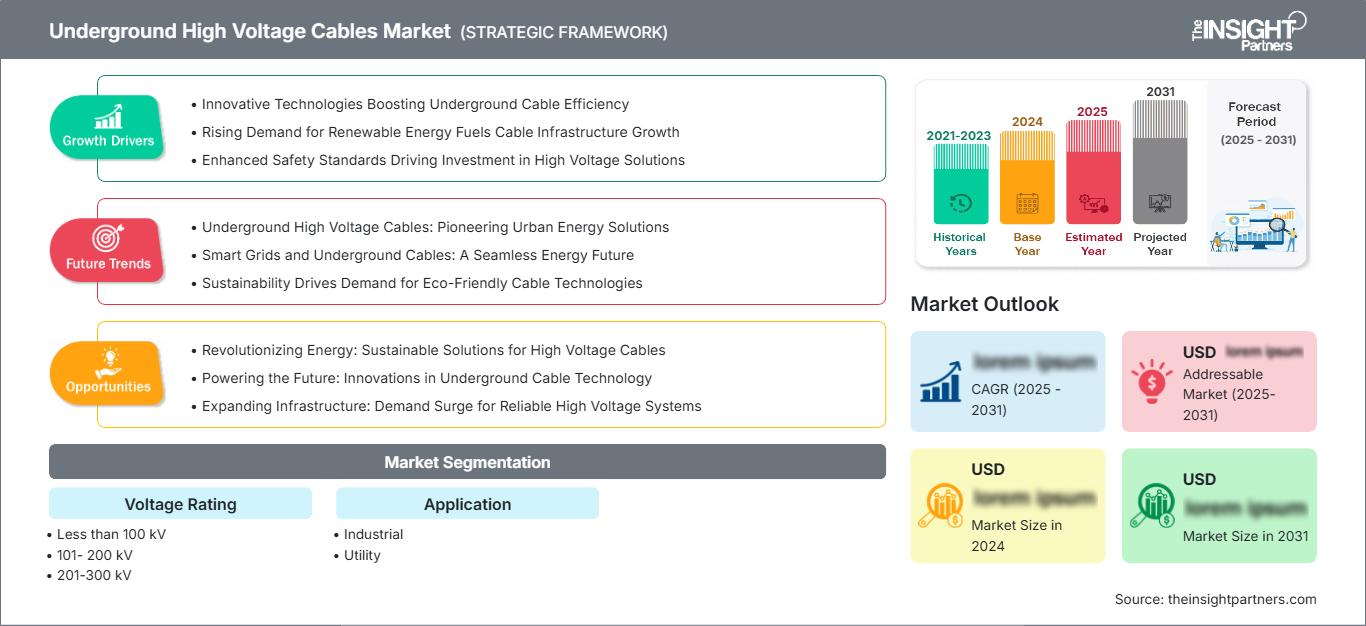
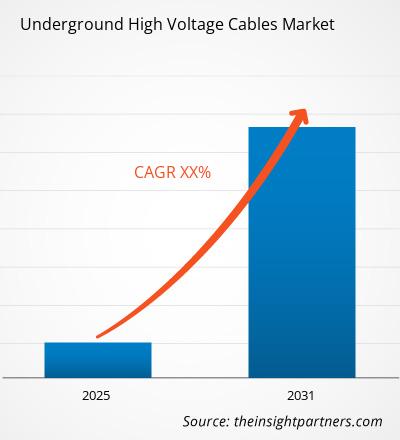
The underground high voltage cables market was valued at US$ 21.53 billion in 2025 and is projected to reach US$ 57.92 billion by 2034, growing at a CAGR of 11.63% during 2026–2034. Demand is rising as transmission owners reinforce urban grids, connect renewable generation, and reduce weather-related outage exposure through buried high-capacity cable corridors.
North America is expected to maintain a strong underground high voltage cables market size position through utility hardening programs, offshohre wind interconnection planning, and replacement of aging transmission assets. The region is estimated to expand at a CAGR range of 10–12% during 2026–2034, supported by procurement programs for resilient, compact, and lower-maintenance grid infrastructure.
Underground High Voltage Cables Market Assessment and Insights
- North America: The region accounted for 24–27% share in 2025 and is expected to grow at a CAGR range of 10–12% during 2026–2034 as utilities prioritize undergrounding in constrained corridors and climate-exposed networks.
- US: The US represented 72–76% of North America in 2025 and is set to grow at a 10–12% CAGR range, led by utility renewal and renewable interconnection projects.
- Europe: Europe held 27–30% share in 2025 and is expected to grow at 11–13% CAGR, with Germany, France, the UK, Italy, and Spain leading grid modernization and interconnector programs.
- Asia Pacific: Asia Pacific represented 35–39% share in 2025 and is forecast to grow at 12–14% CAGR, supported by China, India, Japan, South Korea, and Australia.
- Largest Segment: The utility application segment held 69–73% market share in 2025 and is expected to grow at 11–13% CAGR as transmission operators expand buried power corridors.
- High Growth Segment: The above 300 kV voltage segment held 13–16% share in 2025 and is projected to grow at 13–15% CAGR due to long-distance renewable power transfer.
- Key companies analyzed in detail: Finolex Cables Ltd., Furukawa Electric Co., Ltd., General Cable Technologies Corporation, LS Cable & System Ltd., NKT A/S, Nexans S.A., Reka Cables Ltd., SSG Cable, Sumitomo Electric Industries, Ltd., and TFKable Group.
Source: The Insight Partners' analysis based on proprietary research, government publications, company annual reports, investor presentations, industry databases, and expert interviews.
Cable technology has evolved from oil-filled and paper-insulated designs toward XLPE, compact accessories, digital monitoring, and higher-voltage direct-current systems. This shift is reshaping production dynamics by increasing demand for clean-room extrusion, precision jointing, advanced testing, and engineering-led installation services. The underground high voltage cables market growth is therefore linked not only to cable supply, but also to turnkey execution capacity.
Looking ahead, emerging demand will concentrate around renewable integration zones, dense metropolitan load centers, industrial clusters, and cross-border corridors. Regulatory support for transmission acceleration, combined with the need to reduce visual impact and right-of-way conflict, will keep underground solutions strategically relevant. Suppliers with manufacturing scale, installation fleets, and long-term utility relationships are positioned to gain share.
Underground High Voltage Cables Market Report Scope
| Report Attribute | Details |
|---|---|
| Market size in 2025 | US$ 21.53 Billion |
| Market Size by 2034 | US$ 57.92 Billion |
| Global CAGR (2026 - 2034) | 11.63% |
| Historical Data | 2021-2024 |
| Forecast period | 2026-2034 |
Underground High Voltage Cables Market Analysis
Demand is being shaped by power-sector electrification, renewable energy build-out, data center load growth, and rising resilience requirements. The underground high voltage cables market analysis indicates that utilities are moving from project-by-project procurement toward multi-year framework agreements to secure cable availability. It comes from increased lead times required for conductors, insulating material, joints, and experienced installation crews.
These stakeholders include suppliers of conductors, suppliers of insulating compounds, cable makers, engineering contractors, testing experts, and operators of power transmission networks. High-value propositions increasingly combine design, production, logistics, installation, jointing, commissioning, and maintenance under one contract. It provides an advantage to companies capable of managing technical risk through the lifecycle of a product instead of simply offering low-priced cables.
Competitive advantage is increasingly being built upon high voltage manufacturing capabilities, project experience, and flexibility of serving both AC and DC underground network solutions. Nexans S.A., NKT A/S, LS Cable & System Ltd., Sumitomo Electric Industries, Ltd., and Furukawa Electric Co., Ltd. participate in large-scale grid projects, whereas local market players specialize in smaller utility and industrial applications.
Investment trends show a clear shift toward additional extrusion capacity, upgraded testing equipment, and supply chain integration. The underground high voltage cables market is also affected by copper and aluminum cost volatility, which makes long-term procurement planning important. Companies that secure raw materials, skilled labor, and installation windows are better positioned during periods of grid investment acceleration.
● REPORT CUSTOMIZATION
Tailor This Report To Align With Your Specific Business Requirements
This report can be customized to align precisely with your business objectives, scope, and target markets. Customization options include tailored segmentation, geography, competitive analysis, and strategic insights to support informed decision-making.
Customize This Report →WHAT YOU CAN ADJUST
- ● Segmentations
- ● Geography
- ● Competitive Analysis
- ● Language Preferences
Underground High Voltage Cables Market: Strategic Insights
Regional Insights
North America Underground High Voltage Cables Market
North America accounted for 24–27% of global revenue in 2025 and is forecast to grow at a 10–12% CAGR during 2026–2034. The underground high voltage cables market share in the region is supported by utility hardening initiatives, renewable integration planning, and demand for reliable power supply in metropolitan and industrial corridors.
Transmission owners are prioritizing underground routes where overhead expansion faces permitting, land, or resilience barriers. Offshore wind connections, grid congestion relief, and data center-driven load growth are adding momentum. Procurement strategies increasingly emphasize long-term cable supply, installation reliability, and reduced outage exposure during extreme weather events.
U.S. Underground High Voltage Cables Market
The US represented 72–76% of North American demand in 2025 and is expected to grow at a 10–12% CAGR range. The country’s market is driven by the replacement of aging transmission infrastructure, new renewable interconnection corridors, and undergrounding in dense urban regions where overhead line expansion is difficult.
Utility applications dominate US demand, while industrial users adopt underground high voltage cables for petrochemical, semiconductor, mining, and large campus power networks. Company presence is strongest through global suppliers and domestic project partners that provide engineering, cable accessories, testing, and field services for complex transmission upgrades.
Europe Underground High Voltage Cables Market
Europe held 27–30% share in 2025 and is projected to expand at 11–13% CAGR. Germany is one of the key markets for the company because of the long-distance renewable power transmission and underground HVDC corridors. France is improving its transmission purchases via cable frame agreements, whereas in the UK, the demand is supported via offshore wind and grid reinforcement programs.
In Italy and Spain, investments in grid reliability are growing because of electrification, renewable generation, and interregional connections. Also, the demand in Europe depends on permitting issues, domestic production preferences, and sustainability considerations. The procurement process in this region prefers suppliers who have successful experience with high voltage and long-term delivery periods.
APAC Underground High Voltage Cables Market
APAC accounted for 35–39% share in 2025 and is expected to register a 12–14% CAGR range. China remains the largest contributor, supported by urban power demand, renewable integration, and high-voltage grid expansion. India is scaling transmission investment, while Japan and South Korea focus on reliable urban and industrial power networks.
Australia is increasing underground cable demand through renewable zones and grid reliability projects. Industrial growth, smart city initiatives, and policy-backed transmission upgrades make APAC the most dynamic regional opportunity. The region’s scale also encourages local manufacturing partnerships and diversified sourcing strategies.
Middle East & Africa Underground High Voltage Cables Market
The Middle East & Africa is expected to grow at a 9–11% CAGR during 2026–2034. Saudi Arabia and the UAE lead demand through urban expansion, industrial zones, renewable parks, and high-reliability infrastructure projects. South Africa contributes through grid reinforcement needs and selective transmission upgrades.
Regional adoption is concentrated in utility and large industrial applications where reliability, safety, and land-use considerations justify underground installation. Project execution depends on imported technology, EPC capability, and long-term grid planning. The rest of MEA demand will remain selective but important in high-growth cities and energy infrastructure corridors.
Segmentation Analysis
Voltage Rating
Voltage Rating is expected to grow at a 11–13% CAGR during 2026–2034. The market scope across voltage classes reflects different project needs, from sub-transmission connections to long-distance renewable power evacuation. Higher-voltage systems require advanced insulation, accessories, testing, and thermal management to ensure reliable operation.
- Less than 100 kV: Used mainly for sub-transmission, industrial connections, and urban grid reinforcement where compact installation, safety, and reduced maintenance are more important than long-distance transfer capacity.
- 101–200 kV: Supports regional transmission and utility interconnections, balancing capacity, cost, and installation complexity for substations, renewable feeders, and dense power corridors.
- 201–300 kV: Serves high-capacity transmission projects where utilities need stronger load transfer, improved stability, and underground routing through constrained or environmentally sensitive areas.
- Above 300 kV: Used for strategic transmission, HVDC corridors, and renewable integration projects requiring long-distance power movement, high reliability, and specialized engineering support.
Application
Application is expected to grow at an 11–13% CAGR during 2026–2034, according to the Underground High Voltage Cables market report. Utility demand dominates because grid operators use underground cables to reinforce transmission reliability, connect renewable assets, and reduce exposure to weather-related outages. Industrial users adopt these systems where safety, uptime, and land constraints are critical.
- Industrial: Demand comes from refineries, metals, mining, data centers, and large manufacturing campuses that require stable high-voltage power delivery with limited surface obstruction and high safety standards.
- Utility: Utilities remain the largest users, deploying underground cables for transmission reinforcement, offshore wind links, city networks, renewable corridors, and projects facing overhead line permitting constraints.
Opportunity Snapshot
| Application | Revenue Contribution | Trend Tag | Adoption Stage |
|---|---|---|---|
| Industrial | Medium | Data Centers | Scaling |
| Utility | High | Grid Hardening | Mature |
Underground High Voltage Cables Market Growth Drivers and Impact Analysis
Grid Modernization and Reliability Investment
Transmission infrastructure is being upgraded to accommodate increased renewable energy, increased electrification, and increased peak demand. Underground cables increase resilience against storms, wildfires, ice, and safety concerns that affect above-ground cables. Underground cables are also being used by utilities in urban environments where land access and visual concerns inhibit the installation of new towers. This creates a need for engineered cables and cable-related products and services.
Renewable Energy Integration Corridors
Large wind, solar, and offshore power generation projects need reliable connections from the power generation zones to the demand zones. The underground power transmission cables have gained increasing adoption where there are constraints on land availability, subsea landings, or power transmission through environmentally sensitive or populated regions. The application scope of the underground cables is growing as the power system is moving towards more decentralized renewable power generation from fossil fuels.
Urbanization and Space-Constrained Infrastructure
Densely packed cities require additional power to provide electric transportation, skyscrapers, data centers, and infrastructure. It is not easy to extend overhead power lines in such areas due to limitations on the space available, safety issues, and difficulty in obtaining permits. Underground power cables allow capacity upgrades without damaging street scenes or causing right-of-way problems. Such systems have become an ideal choice for city substations and regeneration areas.
Underground High Voltage Cables Market Future Trends
Higher-Voltage Underground HVDC Deployment
The underground high voltage cables market trends indicate growing interest in higher-voltage HVDC systems for long-distance renewable power movement. These projects reduce losses over extended routes and help connect remote generation with load centers. As converter technology, XLPE insulation, and installation practices mature, underground HVDC corridors will become more attractive for countries balancing energy transition targets with land-use constraints and public acceptance challenges.
Digital Monitoring and Predictive Maintenance
The utilities industry is forecasted to adopt greater usage of thermal monitoring, partial discharge monitoring, and asset analytics for its underground cables. This will help in condition-based maintenance, fault diagnosis, and extend asset lifetime. It also shifts the perspective on the supplier side because now more customers want to purchase integrated cables with monitoring capabilities as opposed to separate products.
Underground High Voltage Cables Market Opportunities
Multi-Year Utility Framework Agreements
Underground High Voltage Cables Forecasts point to rising opportunities in long-term utility procurement. Transmission operators are seeking supply security because high-voltage cable projects require specialized manufacturing slots, qualified accessories, and experienced installation teams. Suppliers that offer framework contracts, local production support, and lifecycle services can improve customer confidence. This approach also helps utilities control project schedules during periods of tight global cable capacity.
Industrial Electrification and Private Grid Expansion
Industrial electrification creates opportunities for high-reliability underground power systems serving data centers, hydrogen facilities, ports, mining operations, and heavy manufacturing. These users need secure, compact, and resilient power connections to support continuous operations. Cable suppliers can capture value by offering engineering services, rapid fault response, and tailored accessories, according to the Underground High Voltage Cables market forecast. Growth will be strongest where industrial sites require high power density but have limited surface space for overhead infrastructure.
Frequently Asked Questions

- Comprehensive Market Sizing and Forecast Analysis
- Detailed Segmentation Analysis
- In-Depth Market Dynamics Assessment
- Regional and Country-Level Insights
- Competitive Landscape and Company Benchmarking
- Strategic Business Intelligence
Recent Reports
Testimonials

The Insight Partners provided valuable market intelligence that supported our global go-to-market strategy. Their team was professional, responsive, and attentive to our feedback, providing thoughtful analysis and helpful methodological clarifications throughout the project.
Junmo Kim Chief Financial Officer (CFO), Enertech Co., Ltd.
The Insight Partners' SCADA System Market report is comprehensive, with valuable insights on current trends and future forecasts. The team was highly professional, responsive, and supportive throughout. We are very satisfied and highly recommend their services.
RAN KEDEM Partner, Reali Technologies LTDs
I requested a report on a very specific software market and the team produced the report in a few days. The information was very relevant and well presented. I then requested some changes and additions to the report. The team was again very responsive and I got the final report in less than a week.
JEAN-HERVE JENN Chairman, Future Analytica
We worked with The Insight Partners for an important market study and forecast. They gave us clear insights into opportunities and risks, which helped shape our plans. Their research was easy to use and based on solid data. It helped us make smart, confident decisions. We highly recommend them.
PIYUSH NAGPAL Sr. Vice President, High Beam Global
The Insight Partners delivered insightful, well-structured market research with strong domain expertise. Their team was professional and responsive throughout. The user-friendly website made accessing industry reports seamless. We highly recommend them for reliable, high-quality research services
YUKIHIKO ADACHI CEO, Deep Blue, LLC.
This is the first time I have purchased a market report from The Insight Partners.While I was unsure at first, I visited their web site and felt more comfortable to take the risk and purchase a market report.I am completely satisfied with the quality of the report and customer service. I had several questions and comments with the initial report, but after a couple of dialogs over email with their analyst I believe I have a report that I can use as input to our strategic planning process.Thank you so much for taking the extra time and making this a positive experience.I will definitely recommend your service to others and you will be my first call when we need further market data.
JOHN SUZUKI President and Chief Executive Officer, Board Director, BK Technologies
I wish to appreciate your support and the professionalism you displayed in the course of attending to my request for information regarding to infectious disease IVD market in Nigeria. I appreciate your patience, your guidance, and the fact that you were willing to offer a discount, which eventually made it possible for us to close a deal. I look forward to engaging The Insight Partners in the future, all thanks to the impression you have created in me as a result of this first encounter.
DR CHIJIOKE ONYIA MANAGING DIRECTOR, PineCrest Healthcare Ltd.Reason to Buy
- Informed Decision-Making
- Understanding Market Dynamics
- Competitive Analysis
- Identifying Emerging Markets
- Customer Insights
- Market Forecasts
- Risk Mitigation
- Boosting Operational Efficiency
- Strategic Planning
- Investment Justification
- Tracking Industry Innovations
- Aligning with Regulatory Trends





 Get Free Sample for