
Underwater Acoustic Communication Market Size, Share & Growth by 2034
Coverage: by Interface Platform (Sensor Interface, Acoustic Modem, Others); Communication Range (Shallow Water Range, Medium Water Range, Long Water Range, Full Ocean Range); Application (Environmental Monitoring, Pollution Monitoring, Climate Monitoring, Hydrography, Others); End-User (Oil and Gas, Military and Defense, Homeland Security, Aquaculture, Marine) , and Geography (North America, Europe, Asia Pacific, and South and Central America)
- Status : Data Released
- Report Code : TIPRE00008034
- Category : Electronics and Semiconductor
- No. of Pages : 150
- Available Report Formats :


- Last update date : October 30, 2026


2025 Market Size
US$ 3.14 Bn
Base year value
2034 Forecast
US$ 7.94 Bn
Projected by 2034
CAGR 2026-2034
10.86 %
Growth rate
Addressable Market
US$ 49.01 Bn
(2026-2034)
The Underwater Acoustic Communication Market was valued at US$ 3.14 Billion in 2025 and is projected to reach US$ 7.94 Billion by 2034, registering a CAGR of 10.86% from 2026 to 2034. The market covers technologies that transmit data, telemetry, commands, and positioning information through acoustic waves underwater, spanning Sensor Interface and Acoustic Modem platforms across Shallow Water Range, Medium Water Range, Long Water Range, and Full Ocean Range applications.
North America remains a major technology and procurement center, supported by naval modernization, autonomous underwater vehicle deployment, oceanographic observation, subsea infrastructure monitoring, and defense-oriented underwater networks. The Underwater Acoustic Communication Market size in North America is estimated at approximately ~34% of global demand in 2025, with a modeled CAGR of ~9.7% through 2034. The US Navy and associated defense ecosystem continue to emphasize autonomous systems, undersea surveillance, acoustic telemetry, and secure communications, while commercial operators increasingly use acoustic links to retrieve sensor information without deploying permanent cables.
Underwater Acoustic Communication Market Assessment and Insights
- North America: The region accounted for ~34% of global demand in 2025 and is expected to register a CAGR of ~9.7% through 2034. Mature naval programs, offshore engineering capabilities, and strong suppliers of acoustic modems and autonomous systems support its position. This creates a large installed base for replacement, integration, and next-generation networked communications.
- U.S.: The US represented ~77% of North American demand in 2025 and is projected to expand at a CAGR of ~9.4%. Defense procurement, undersea warfare ranges, autonomous underwater vehicles, and persistent seabed monitoring provide a broad application base. Integration of acoustic communications with unmanned platforms strengthens demand for compact, secure, and low-power systems.
- Europe: Europe represented ~28% of global demand in 2025 and is forecast to expand at a CAGR of ~10.3%. The UK, Germany, Norway, and France are important technology and deployment centers. European differentiation comes from integration of acoustic communications with subsea navigation, marine robotics, naval sonar, offshore energy, and scientific instrumentation.
- Asia Pacific: APAC represented ~27% of global demand in 2025 and is projected to achieve a CAGR of ~12.8%. China, Japan, South Korea, India, and Australia provide strong demand through naval modernization, marine research, offshore infrastructure, aquaculture, and autonomous maritime systems. Increasing domestic capability in marine electronics also supports localization.
- Largest Segment: Acoustic Modem is the largest main segment and is expected to record a CAGR of ~11.2% through 2034. Acoustic modems directly provide the communications layer required by subsea sensors, autonomous vehicles, transponders, and surface gateways, making them central to data exchange across diverse deployments.
- High Growth Segment: Aquaculture is the high-growth main segment, with a projected CAGR of ~14.1%. Increasing use of underwater sensing, remote feeding systems, environmental monitoring, cage management, and automated operational controls is expanding demand for dependable low-power communications in marine farms.
- Key companies analyzed in detail: Aquatec Group Ltd.; Baltrobotics; EvoLogics GmbH; Kongsberg Gruppen; Nortek; Sonardyne International; Teledyne Technologies; Thales Group; Ultra Maritime; L3Harris Technologies.
Source: The Insight Partners' analysis based on proprietary research, government publications, company annual reports, investor presentations, industry databases, and expert interviews.
The Underwater Acoustic Communication Market has evolved from point-to-point telemetry toward integrated communications architectures connecting sensors, autonomous underwater vehicles, transponders, surface vessels, and shore-based systems. In earlier operations, more often, the focus was placed on simple status transfer or acquisition of sensor data, whereas recent developments incorporate communication in conjunction with positioning, navigation, control and command, and onboard processing. The importance of acoustic channels persists due to the limitation of electromagnetic radio wave propagation through water, along with the need of clear water conditions for optical systems.
Recent advancements in equipment development are yet another proof of its growing integration. Acoustic modems are being incorporated into autonomous systems and oceanographic instruments and are not limited to acting as simple communication devices. Thus, the Modem 6 series by Sonardyne provides for subsea-surface data transfer and is suitable for use along with sensors, AUVs, seabed systems, buoys, and ships. The oceanographic instruments by Nortek show the efficiency of acoustic telemetry as a way to get processed measurement data from the instrument without recovering it.
The supply side is therefore headed toward miniaturized and low-power electronics, better signal processing, superior transducers, and pressure-rated housing. The demands of the buyer are also getting tougher. Consumers now want systems that work in multipath conditions, interface with sensors already in use, handle missions autonomously, and conserve on batteries.
Through 2034, the market is expected to move toward networked subsea architectures in which acoustic communications provide the underwater connectivity layer while satellite, cellular, radio, or fiber links connect surface gateways with control centers. Commercialization will increasingly depend on interoperability between vendors, open interfaces, autonomous mission software, and the ability to combine communications with sensing and navigation.
Deployment of capital is also likely to expand to users outside of the traditional oil and gas and navy markets. Underwater inspections of offshore wind farms, protection of undersea infrastructure, environmental monitoring of the marine environment, underwater farming operations, and autonomous oceanography are just a few examples of uses that could drive demand for underwater communication links that will remain submerged for long periods of time.
Underwater Acoustic Communication Market Report Scope
| Report Attribute | Details |
|---|---|
| Market size in 2025 | US$ 3.14 Billion |
| Market Size by 2034 | US$ 7.94 Billion |
| Global CAGR (2026 - 2034) | 10.86% |
| Historical Data | 2021-2024 |
| Forecast period | 2026-2034 |
Underwater Acoustic Communication Market Analysis
The Underwater Acoustic Communication Market growth is being shaped by the convergence of autonomous marine robotics, persistent sensing, subsea infrastructure monitoring, and defense requirements. Demand usually starts from the requirement to receive or transmit information using assets that are incapable of supporting normal wired or radio connectivity. Acoustic modems and sensor interfaces are subsequently chosen based on depth, range, water environment, power sources, data needs, and mobility of the platform. This generates demand further down the chain for transducers, signal processing electronics, pressure housing, batteries, positioning systems, and software integration.
The value chain does not stop at the point of communication devices alone. Sensors need a proper interface; AUV developers would need compact acoustic communication for command, telemetry, and navigation purposes; offshore service providers need to recover data from the subsea assets; and defense clients would need secure communication within the overall acoustic/surveillance system architecture. From a business standpoint, this means that providers capable of integrating their communications devices with positioning, sensing, and/or autonomy solutions would capture a larger share of the subsea system value chain.
Supply characteristics are determined by the special manufacturing of transducers, pressure-resistant material, underwater connections, digital signal processing, embedded systems software, and acoustic test facilities. Unlike wireless applications on land, where performance is largely independent of propagation characteristics, reliable performance under water is dependent on the local conditions of propagation. Multipathing, reverberation, sound speed profile, ambient noise, motion, and seabed or sea surface reflections all can degrade reliability. Thus, product differentiation is more likely based on signal processing ability rather than just the raw power of transmission.
Similarly, competitive positioning is trending towards integrated subsea systems. Kongsberg includes acoustic communication and positioning with autonomous underwater vehicles and marine navigation systems. Sonardyne concentrates on acoustic telemetry, positioning, and subsea instrumentation, while Teledyne includes acoustic communications within its overall marine instrumentation and autonomous vehicle offering. EvoLogics differentiates itself with software-based acoustic networking and modems for marine robotics and sensor arrays.
There is also a trend towards making investment more systemic. The acquisition of Sonatech by Kongsberg in 2026 has provided additional strength to the latter's sonar and underwater communication technologies in the US market, especially in the area of defense and specialized acoustic technologies. The product line of Teledyne includes acoustic modems, autonomous underwater vehicles, sensors and other subsea instruments. The company Thales has retained its focus on defense products in which the technology of underwater acoustic sensing and communication plays an important role in submarine and maritime missions.
● REPORT CUSTOMIZATION
Tailor This Report To Align With Your Specific Business Requirements
This report can be customized to align precisely with your business objectives, scope, and target markets. Customization options include tailored segmentation, geography, competitive analysis, and strategic insights to support informed decision-making.
Customize This Report →WHAT YOU CAN ADJUST
- ● Segmentations
- ● Geography
- ● Competitive Analysis
- ● Language Preferences
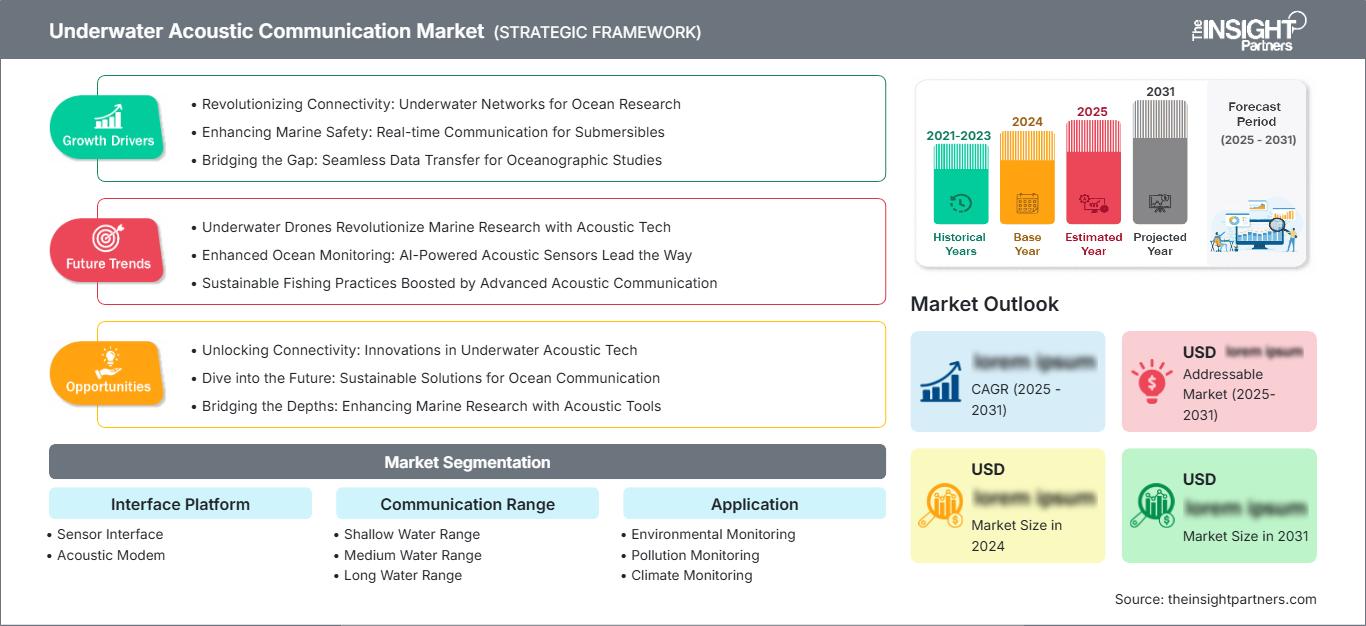
Underwater Acoustic Communication Market: Strategic Insights
Regional Insights
North America Underwater Acoustic Communication Market
North America is a major demand center, supported by defense procurement, oceanographic research, offshore engineering, and autonomous maritime systems. Its ~34% global share in 2025 and ~9.7% CAGR reflect a mature installed base combined with continued modernization. The US dominates regional demand, while Canada contributes through marine research, offshore activity, and specialized ocean technology.
The US defense industry fosters the demand for acoustic links that are secure between submarines, unmanned underwater vehicles, test facilities, seabed nodes, and surface gateways. Commercial needs may be varied, yet some applications include environmental observation, offshore oil exploration, hydrography, and sub-sea inspection. The high level of engineering firms, test facilities, and defense contractors within the region will accelerate the process.
U.S. Underwater Acoustic Communication Market
The US accounts for ~77% of North American demand and is projected to grow at a CAGR of ~9.4%. There are advantages for the market in the form of modernization of the navy and a wider network of acoustic technology companies, AUV companies, marine instrument manufacturers, and defense integrators. American companies like L3Harris and Teledyne are among other technology firms in the US providing various technologies, including acoustic modems, range tracking, underwater vehicles, and maritime monitoring.
The unique feature about this market is that there is a blend of acoustic communications along with autonomous operations. Submerged platforms must be able to communicate about mission status, positioning, and selected sensor data while submerged and then switch to satellite or other forms of communication upon surfacing.
Europe Underwater Acoustic Communication Market
Europe represented ~28% of global demand in 2025 and is projected to grow at a CAGR of ~10.3%. The UK, Norway, France, Germany, and the Nordic maritime technology ecosystem provide substantial demand and supply capabilities. Europe benefits from advanced naval programs, offshore energy infrastructure, oceanographic institutions, and a strong concentration of marine robotics companies.
The UK has a notable subsea technology base associated with offshore engineering and marine instrumentation. Norway combines offshore energy expertise with autonomous maritime systems and advanced ocean technology, supporting companies such as Kongsberg and related suppliers. Germany provides a strong marine robotics and research ecosystem, including EvoLogics. France remains important for naval systems and underwater acoustic technologies, with Thales supporting integrated submarine and sonar capabilities.
European demand is differentiated by the coexistence of defense and commercial subsea applications. Offshore wind development and seabed monitoring add commercial requirements, while maritime security and naval modernization increase demand for secure and resilient underwater communications.
APAC Underwater Acoustic Communication Market
APAC is expected to be the fastest-expanding core region, with a ~27% global share in 2025 and a projected CAGR of ~12.8%. China is the leading regional demand center, followed by Japan, South Korea, Australia, and India. Naval modernization, oceanographic research, offshore energy, aquaculture, and marine infrastructure are the principal demand drivers.
China's large maritime industrial base supports domestic development of underwater vehicles, acoustic equipment, and marine monitoring systems. Japan combines advanced marine electronics with extensive oceanographic and fisheries research requirements. South Korea's shipbuilding and naval industries create demand for underwater sensing and communication technologies integrated into complex maritime platforms.
Australia is strategically important because of its large maritime operating environment and defense focus, while India is expanding capabilities in naval systems, hydrography, offshore resources, and ocean observation. Across APAC, the combination of maritime security requirements and commercial ocean activity supports faster adoption than in mature Western markets.
Segmentation Analysis
Interface Platform
Sensor Interface is projected to record a CAGR of ~9.8%. These platforms connect underwater sensors with communication systems and are important for environmental stations, oceanographic instruments, and subsea monitoring. Their adoption is linked to the expansion of distributed sensing and the need to reduce the physical retrieval of instruments.
- Sensor Interface: Supports integration between underwater sensors and communication equipment. Environmental monitoring and scientific instrumentation are key demand sources, with interoperability and low power consumption shaping adoption.
- Acoustic Modem: Expected to grow at a CAGR of ~11.2%. Modems provide direct acoustic data transmission for AUVs, seabed nodes, transponders, and surface gateways and benefit from expanding autonomous and networked deployments.
Communication Range
Communication Range is projected to grow at a CAGR of ~11.0%. Range requirements determine transducer design, signal-processing complexity, power consumption, and deployment architecture.
- Shallow Water Range: Suited to coastal surveys, aquaculture, harbor operations, and short-distance autonomous vehicle communications. Multipath and surface interference remain important design considerations.
- Medium Water Range: Supports offshore monitoring and vehicle-to-vehicle communications where moderate separation is required without the complexity of full-ocean links.
- Long Water Range: Serves defense, oceanographic, and offshore missions requiring communication across larger operating areas. Signal robustness and energy efficiency are major selection factors.
- Full Ocean Range: Targets specialized deep-water and strategic applications where communication reliability, pressure tolerance, and advanced acoustic processing are critical.
Application
The application is expected to expand at a CAGR of ~11.3%, driven by increasing deployment of connected marine instruments and autonomous platforms.
- Environmental Monitoring: Enables remote transmission of water-quality, current, wave, and ecosystem information.
- Pollution Monitoring: Supports distributed sensing where rapid access to contamination-related measurements can improve response coordination.
- Climate Monitoring: Connects long-duration ocean observation instruments with surface or gateway systems and supports persistent scientific data collection.
- Hydrography: Provides communications for survey platforms, positioning systems, and underwater mapping operations.
End-User
End-User demand is projected to expand at a CAGR of ~11.4%, with defense and marine applications providing the largest established demand pools.
- Oil and Gas: Requires robust telemetry for subsea production, inspection, well monitoring, and remote sensor systems.
- Military and Defense: Uses secure underwater communications for submarines, unmanned systems, acoustic ranges, surveillance, and mission coordination.
- Homeland Security: Applies acoustic links to maritime surveillance, critical infrastructure protection, port security, and emergency response.
- Aquaculture: Uses underwater connectivity for environmental sensors, feeding systems, cage monitoring, and operational automation.
- Marine: Covers commercial marine operations, research, hydrography, autonomous vehicles, and general subsea monitoring.
Opportunity Snapshot
| End-User | Revenue Contribution | Trend Tag | Adoption Stage |
| Oil and Gas | High | Asset telemetry | Mature |
| Military and Defense | High | Secure networking | Mature |
| Homeland Security | Medium | Maritime awareness | Scaling |
| Aquaculture | Medium | Farm automation | Scaling |
| Marine | High | Robotic connectivity | Scaling |
Underwater Acoustic Communication Market Growth Drivers and Impact Analysis
Expansion of Autonomous Underwater Vehicles and Distributed Sensing
Autonomous underwater vehicles are increasingly used for seabed mapping, infrastructure inspection, mine reconnaissance, environmental observation, and persistent surveillance. These platforms cannot depend continuously on conventional radio links while submerged, creating a direct requirement for acoustic telemetry. The growth mechanism extends from AUV deployment to demand for compact modems, transponders, acoustic positioning, and surface gateways. As autonomous missions become longer and more data-intensive, communication systems that minimize energy use while providing dependable command and data exchange gain strategic importance.
Rising Requirement for Persistent Subsea Monitoring
Subsea operators increasingly require information from instruments without recovering them or installing permanent communication cables. Environmental stations, offshore energy assets, aquaculture systems, and seabed monitoring nodes can use acoustic links to transmit selected measurements to surface platforms. This changes the economics of subsea observation by reducing physical intervention requirements and supporting more frequent data retrieval. The effect is particularly important for applications where sensor replacement or recovery is costly.
Defense Focus on Underwater Domain Awareness
Growing attention to seabed infrastructure, submarine operations, maritime surveillance, and autonomous underwater systems is increasing demand for resilient underwater communications. Defense users require communication architectures that function in noisy and complex acoustic environments while limiting detectability and maintaining interoperability with broader command networks. This supports investment in spread-spectrum signaling, secure protocols, adaptive signal processing, and networked acoustic nodes.
Underwater Acoustic Communication Market Future Trends
Integration of Edge Processing With Underwater Communications
Underwater acoustic links have limited bandwidth compared with terrestrial networks, making it inefficient to transmit all raw sensor data. The Underwater Acoustic Communication Market trends therefore increasingly favor edge processing, in which instruments analyze measurements underwater and transmit only relevant parameters, alerts, or compressed information. This approach reduces acoustic traffic and power consumption while enabling near-real-time decisions. Sonardyne's integrated communication and processing approach for oceanographic instrumentation illustrates how communications are becoming part of an intelligent sensing architecture rather than a standalone transmission function.
Hybrid Acoustic Networks for Autonomous Maritime Systems
Future systems are likely to combine acoustic communication underwater with optical, radio, cellular, satellite, and wired links above the surface. The objective is not to replace acoustic communications but to assign each connectivity technology to the environment where it performs best. Autonomous vehicles can use acoustic links for submerged command and telemetry, then transition to higher-bandwidth surface communications when conditions permit. This architecture can increase mission autonomy while reducing dependence on any single communications channel.
Underwater Acoustic Communication Market Opportunities
Networked Communications for Long-Duration Ocean Observation
A significant opportunity exists in connecting distributed environmental and climate-monitoring instruments into persistent underwater networks. Research agencies, offshore operators, aquaculture companies, and environmental authorities can benefit from systems that transmit processed information without requiring frequent recovery. The opportunity is particularly relevant in remote ocean areas and harsh environments where vessel access is expensive. Suppliers can differentiate through low-power modems, integrated sensor interfaces, intelligent data filtering, and modular surface gateways.
The Underwater Acoustic Communication Market Forecasts also point toward commercial whitespace in interoperable systems that allow instruments from different manufacturers to communicate through common interfaces. Standardized software layers, flexible modem configurations, and open APIs could reduce integration time for operators deploying mixed fleets of sensors and autonomous vehicles.
Secure Connectivity for Underwater Infrastructure and Defense Networks
Protection of subsea cables, pipelines, offshore installations, naval assets, and autonomous systems creates a second opportunity. Operators need communications that can support distributed monitoring while functioning in noisy underwater environments. Suppliers capable of combining acoustic telemetry with positioning, encryption, anomaly detection, and autonomous mission management can address higher-value system requirements. North America, Europe, and selected APAC markets are particularly relevant because of their defense procurement capabilities and concentration of subsea infrastructure.
Frequently Asked Questions

- Comprehensive Market Sizing and Forecast Analysis
- Detailed Segmentation Analysis
- In-Depth Market Dynamics Assessment
- Regional and Country-Level Insights
- Competitive Landscape and Company Benchmarking
- Strategic Business Intelligence
Recent Reports
Testimonials

The Insight Partners provided valuable market intelligence that supported our global go-to-market strategy. Their team was professional, responsive, and attentive to our feedback, providing thoughtful analysis and helpful methodological clarifications throughout the project.
Junmo Kim Chief Financial Officer (CFO), Enertech Co., Ltd.
The Insight Partners' SCADA System Market report is comprehensive, with valuable insights on current trends and future forecasts. The team was highly professional, responsive, and supportive throughout. We are very satisfied and highly recommend their services.
RAN KEDEM Partner, Reali Technologies LTDs
I requested a report on a very specific software market and the team produced the report in a few days. The information was very relevant and well presented. I then requested some changes and additions to the report. The team was again very responsive and I got the final report in less than a week.
JEAN-HERVE JENN Chairman, Future Analytica
We worked with The Insight Partners for an important market study and forecast. They gave us clear insights into opportunities and risks, which helped shape our plans. Their research was easy to use and based on solid data. It helped us make smart, confident decisions. We highly recommend them.
PIYUSH NAGPAL Sr. Vice President, High Beam Global
The Insight Partners delivered insightful, well-structured market research with strong domain expertise. Their team was professional and responsive throughout. The user-friendly website made accessing industry reports seamless. We highly recommend them for reliable, high-quality research services
YUKIHIKO ADACHI CEO, Deep Blue, LLC.
This is the first time I have purchased a market report from The Insight Partners.While I was unsure at first, I visited their web site and felt more comfortable to take the risk and purchase a market report.I am completely satisfied with the quality of the report and customer service. I had several questions and comments with the initial report, but after a couple of dialogs over email with their analyst I believe I have a report that I can use as input to our strategic planning process.Thank you so much for taking the extra time and making this a positive experience.I will definitely recommend your service to others and you will be my first call when we need further market data.
JOHN SUZUKI President and Chief Executive Officer, Board Director, BK Technologies
I wish to appreciate your support and the professionalism you displayed in the course of attending to my request for information regarding to infectious disease IVD market in Nigeria. I appreciate your patience, your guidance, and the fact that you were willing to offer a discount, which eventually made it possible for us to close a deal. I look forward to engaging The Insight Partners in the future, all thanks to the impression you have created in me as a result of this first encounter.
DR CHIJIOKE ONYIA MANAGING DIRECTOR, PineCrest Healthcare Ltd.Reason to Buy
- Informed Decision-Making
- Understanding Market Dynamics
- Competitive Analysis
- Identifying Emerging Markets
- Customer Insights
- Market Forecasts
- Risk Mitigation
- Boosting Operational Efficiency
- Strategic Planning
- Investment Justification
- Tracking Industry Innovations
- Aligning with Regulatory Trends





 Get Free Sample for