
Universal Motion Control Market Size, Share & Growth by 2034
Coverage: by Component (AC Motors, Motors, Motion Controllers, AC Drives, Electronic Drives); Application (Packaging, Material Handling, Material Handling, Converting, Positioning); Industry (Aerospace and Defense, Automotive, Semiconductor and Electronics, Metal and Machinery Manufacturing, Others) , and Geography (North America, Europe, Asia Pacific, and South and Central America)
- Status : Data Released
- Report Code : TIPRE00010581
- Category : Electronics and Semiconductor
- No. of Pages : 150
- Available Report Formats :


- Last update date : October 30, 2026


2025 Market Size
US$ 11.08 Bn
Base year value
2034 Forecast
US$ 16.73 Bn
Projected by 2034
CAGR 2026-2034
4.68 %
Growth rate
Addressable Market
US$ 126.22 Bn
(2026-2034)
The universal motion control market was valued at US$ 11.08 Billion in 2025 and is projected to reach US$ 16.73 Billion by 2034, registering a CAGR of 4.68% from 2026 to 2034. The market covers AC Motors, Motors, Motion Controllers, AC Drives, and Electronic Drives across Packaging, Material Handling, Converting, and Positioning applications and Aerospace and Defense, Automotive, Semiconductor and Electronics, and Metal and Machinery Manufacturing industries.
North America represents an established demand center, supported by automation upgrades, reshoring of manufacturing capacity, warehouse modernization, semiconductor investment, and replacement of installed motors and drives. The Universal Motion Control Market Size in the region accounted for ~30% of the global market in 2025 and is expected to expand at a ~4.2% CAGR through 2034. The market is increasingly shaped by integrated controller-drive-motor architectures, industrial Ethernet connectivity, energy-efficiency requirements, and demand for flexible production systems. A current industry signal is the continued movement toward software-defined automation and integrated motion systems, with major vendors combining motion control, robotics, edge computing, and industrial software within common architectures.
Universal Motion Control Market Assessment and Insights
- North America: The region held ~30% of the global universal motion control market in 2025 and is expected to register a ~4.2% CAGR through 2034. Reshoring, factory automation, logistics modernization, and semiconductor manufacturing are sustaining demand, while the installed base creates a substantial retrofit opportunity for efficient drives and digitally connected controllers.
- U.S.: The U.S. represented ~70% of the North American universal motion control market in 2025 and is expected to grow at a ~4.0% CAGR. Demand is concentrated in packaging, material handling, automotive, semiconductor manufacturing, and advanced machinery, with factory modernization and investment in domestic production supporting purchases of servo systems, drives, controllers, and integrated motion platforms.
- Europe: Europe accounted for ~27% of the global market in 2025 and is projected to grow at a ~4.0% CAGR. Germany, Italy, and France are important markets because of their machinery, automotive, packaging, and industrial equipment bases. The region's principal differentiator is the strong integration of energy efficiency, machine safety, industrial networking, and digital engineering into automation procurement.
- Asia Pacific: Asia Pacific held ~36% of the global market in 2025 and is expected to expand at a ~5.5% CAGR. China, Japan, South Korea, and India provide the strongest demand base, supported by electronics production, automotive automation, machine tools, packaging equipment, logistics systems, and expanding local manufacturing capabilities.
- Largest Segment: AC Motors is the largest segment within the Component category and is expected to register a ~4.2% CAGR from 2026 to 2034. Its broad installed base across industrial machinery and material movement equipment supports replacement demand even where higher-performance motion architectures are being adopted.
- High Growth Segment: Semiconductor and Electronics is the high-growth segment within Industry, with an estimated ~6.2% CAGR. Demand is being reinforced by precision manufacturing, high-speed handling, automated inspection, semiconductor fabrication equipment, and electronics assembly systems that require tightly synchronized multi-axis motion.
- Key companies analyzed in detail: ABB Ltd., Eaton Corporation plc, Mitsubishi Electric Corporation, Moog Inc., Parker-Hannifin Corporation, Regal Rexnord Corporation, Rockwell Automation, Inc., Schneider Electric SE, Siemens AG, and Yaskawa Electric Corporation.
Source: The Insight Partners' analysis based on proprietary research, government publications, company annual reports, investor presentations, industry databases, and expert interviews.
The universal motion control market is shifting from discrete motor-and-drive purchases toward integrated automation architectures in which controllers, drives, motors, feedback devices, safety functions, and industrial networks are engineered as one machine subsystem. The shift is especially evident in packaging and material handling systems, where equipment manufacturers demand fast synchronization, electronic gearing, positioning, and faster setup time. More modern machines make use of industrial networks to provide access to operating data in addition to production and maintenance data. Motion control devices are now being marketed more often by companies such as Siemens, Schneider Electric, Mitsubishi Electric, Rockwell Automation, among others, as part of an automation environment.
A notable recent technology signal in the Universal Motion Control Market Report is the increasing computational role of motion controllers. Mitsubishi Electric has continued updating motion-control software and controller functions, including simulator support and security-related capabilities in 2025 and 2026. Yaskawa has likewise highlighted controller architectures capable of combining real-time motion control with data processing and higher-level programming. These developments reflect a broader buyer requirement for controllers that can execute sophisticated synchronization, diagnostics, communication, and machine-level decision functions without depending on separate computing layers.
Through 2034, the Universal Motion Control Market Forecast is expected to develop around higher integration, localized automation supply, energy optimization, and increasingly software-centric machine engineering. Asia Pacific is likely to attract additional production and engineering investment because electronics, electric vehicles, battery manufacturing, logistics, and automated machinery require dense motion architectures. India is also becoming more relevant as manufacturers expand local production and automation capabilities.
Regulation and corporate energy objectives will reinforce demand for efficient motors, variable-speed drives, regenerative technologies, and monitoring systems. Universal Motion Control Market Trends are increasingly influenced by supply-chain localization, encouraging vendors to expand regional manufacturing, engineering, service, and distribution capabilities. Machine builders will also increasingly prefer platforms that simplify commissioning, improve energy efficiency, and preserve compatibility across generations of automation equipment.
Universal Motion Control Market Report Scope
| Report Attribute | Details |
|---|---|
| Market size in 2025 | US$ 11.08 Billion |
| Market Size by 2034 | US$ 16.73 Billion |
| Global CAGR (2026 - 2034) | 4.68% |
| Historical Data | 2021-2024 |
| Forecast period | 2026-2034 |
Universal Motion Control Market Analysis
Demand for universal motion control is closely tied to the conversion of industrial processes from fixed-speed, mechanically synchronized equipment to electronically coordinated machinery. Universal Motion Control Market Share is increasingly influenced by applications requiring precise synchronization across multiple axes and production functions. A packaging machine, for example, may require synchronized axes for feeding, filling, sealing, cutting, and labeling, while material-handling equipment adds conveyor synchronization, lifting, sorting, and positioning requirements. As machine complexity increases, buyers gain value from coordinated controllers and drives that reduce commissioning effort and enable software-based changes rather than mechanical redesign.
The Universal Motion Control Market growth outlook is therefore driven less by a single end-use industry than by the expanding motion content of automated machines. Semiconductor and electronics production requires precision and repeatability; automotive plants require synchronized assembly and handling; aerospace manufacturing demands controlled positioning; and metal and machinery manufacturing depends on reliable movement under variable loads. This creates a layered value chain spanning motors and power electronics, control hardware, feedback systems, industrial networks, machine builders, system integrators, and aftermarket service providers.
Supply dynamics in the Universal Motion Control Market are also changing. Vendors increasingly integrate diagnostics, connectivity, safety, and motion functions into common platforms. Schneider Electric's motion portfolio combines controllers, drives, motors, robotics, and software, while Siemens links SIMATIC motion functions with SINAMICS drives and SIMOTICS motors. Rockwell Automation integrates controllers, servo drives, servo motors, actuators, and electromagnetic track technologies. Such architectures can increase switching costs for installed customers because engineering software, programming practices, network infrastructure, and service capabilities become part of the purchasing decision.
The competitive environment in the Universal Motion Control Market is consequently moving toward platform breadth and engineering integration rather than standalone component performance. ABB has been investing in drive manufacturing approaches and AI-enabled asset performance capabilities, while Regal Rexnord has built a broader Automation & Motion Control portfolio following its acquisition of Altra Industrial Motion. Parker-Hannifin combines motion technologies with broader industrial systems, and Eaton links drives and industrial controls with monitoring and automation capabilities. The strategic objective across these suppliers is to capture more of the machine-level value chain while supporting retrofit and lifecycle-service opportunities.
Investment in the Universal Motion Control Market is also moving toward software and digital engineering. Siemens emphasizes digital drivetrain engineering, simulation, connectivity, and condition monitoring, while Schneider Electric is integrating edge computing, AI, and software-defined automation into motion architectures. The implication is that future competition will increasingly depend on how effectively suppliers convert motion data into commissioning, maintenance, energy, and productivity benefits rather than solely on motor torque, drive capacity, or controller processing performance.
● REPORT CUSTOMIZATION
Tailor This Report To Align With Your Specific Business Requirements
This report can be customized to align precisely with your business objectives, scope, and target markets. Customization options include tailored segmentation, geography, competitive analysis, and strategic insights to support informed decision-making.
Customize This Report →WHAT YOU CAN ADJUST
- ● Segmentations
- ● Geography
- ● Competitive Analysis
- ● Language Preferences
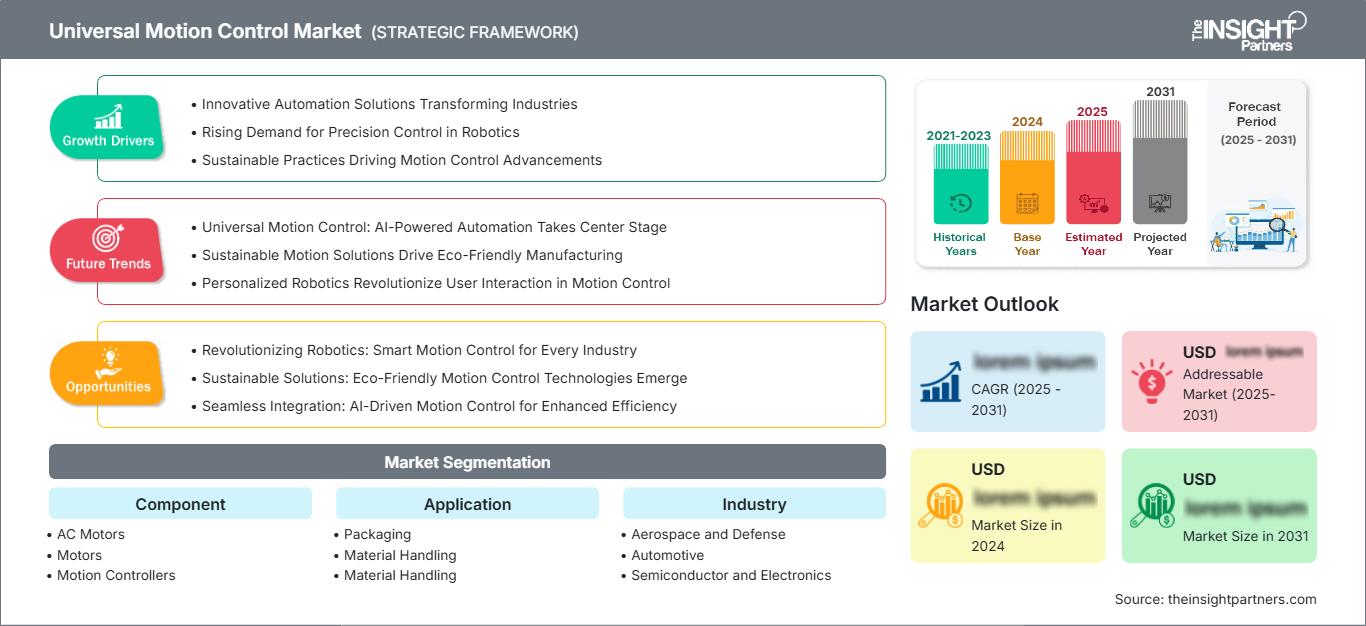
Universal Motion Control Market: Strategic Insights
Regional Insights
North America Universal Motion Control Market
North America accounted for ~30% of the universal motion control market in 2025 and is projected to grow at a ~4.2% CAGR. The region combines a large installed industrial base with renewed investment in domestic manufacturing, logistics, data centers, semiconductor facilities, and advanced automation. Replacement demand is particularly important because older motors, drives, and controllers can be upgraded to more efficient and connected architectures without replacing the entire production line.
The U.S. drives regional demand through its concentration of advanced manufacturing, distribution infrastructure, aerospace production, automotive plants, and semiconductor investment. Canada contributes through automotive, food processing, mining, and machinery applications, while Mexico is increasingly relevant to automotive, electronics, and nearshoring-oriented manufacturing. Major suppliers use established distributor and system-integrator networks to support retrofit, commissioning, and lifecycle service requirements.
U.S. Universal Motion Control Market
The U.S. represented ~70% of North America's universal motion control market in 2025 and is expected to record a ~4.0% CAGR. Packaging, material handling, automotive, aerospace, and semiconductor manufacturing are major application areas because each requires controlled positioning, synchronization, and high equipment availability. The expansion of domestic production capacity also increases demand for new automated machinery and modernization of existing lines.
Rockwell Automation, ABB, Siemens, Schneider Electric, Eaton, Parker-Hannifin, and other suppliers have broad U.S. engineering and distribution capabilities. The differentiating factor is the convergence of automation investment with labor availability, cybersecurity, energy management, and production flexibility, making integrated motion systems increasingly relevant to machine builders and industrial end users.
Europe Universal Motion Control Market
Europe represented ~27% of the global universal motion control market in 2025 and is expected to grow at a ~4.0% CAGR. Germany remains a leading market because of its concentration of machinery, automotive, factory automation, and industrial equipment manufacturers. Italy has strong demand from packaging, machinery, and production-equipment manufacturers, while France contributes through aerospace, automotive, food processing, and industrial automation.
European adoption is differentiated by the integration of energy efficiency, machine safety, digital engineering, and lifecycle management into equipment specifications. Buyers increasingly evaluate motors and drives as part of total machine efficiency rather than as isolated electrical components. This supports demand for regenerative drives, monitoring, integrated safety, and digitally engineered motion systems.
APAC Universal Motion Control Market
APAC accounted for ~36% of the global universal motion control market in 2025 and is forecast to expand at a ~5.5% CAGR. China is the dominant source of demand due to the vast manufacturing sector of China comprising machinery, electronics, automotive, battery, packaging, and logistics. Japan combines advanced machining technology and robots with a matured automation market. South Korea is a country having high requirements for its semiconductor industry, electronics industry, display equipment, and advanced manufacturing facilities. On the other hand, India is emerging as an important demand source with increasing manufacturing capacity.
While China's size will serve domestic and global motion suppliers, Japan continues to have influence in precision controllers, servos, and factory automation. While South Korea's precision demands are served by advanced synchronization motion platforms, India's development is driven by manufacturing localization and investment, packaging, automotive, pharmaceuticals, and electronics.
Middle East & Africa Universal Motion Control Market
Middle East and Africa is a smaller but strategically relevant market, with an estimated ~4% share of global demand and a ~4.9% CAGR. Industrial diversification in the Gulf, mining and metals projects, food processing, water infrastructure, and logistics automation are creating applications for drives and controllers. Saudi Arabia and the United Arab Emirates are particularly relevant for industrial modernization and logistics, while South Africa provides a mature base for mining, metals, food, and machinery applications. Demand remains sensitive to project timing, localization, and imported equipment availability.
South & Central America Universal Motion Control Market
South and Central America provide additional demand in the Universal Motion Control Market through food and beverage processing, packaging, mining, pulp and paper, automotive production, and agricultural machinery. Brazil is the principal regional market because of its diversified industrial base and machinery requirements. Mexico is addressed primarily within North America because of its regional manufacturing integration, while Chile and other mining-oriented economies provide specialized applications. Adoption is supported by the automation of production bottlenecks and the replacement of aging drive systems.
Segmentation Analysis
Component
The Universal Motion Control Market component segmentation covers AC Motors, Motors, Motion Controllers, AC Drives, and Electronic Drives. AC Motors remain central to installed industrial equipment because of their broad use across pumps, conveyors, fans, machine tools, compressors, and production machinery, supporting a ~4.2% CAGR. Motors as a broader category benefit from replacement demand and integration into automated equipment, with a ~4.5% CAGR.
Motion Controllers are expanding faster at ~6.1% as machines adopt multi-axis synchronization, advanced diagnostics, and centralized software control. AC Drives are projected to grow at ~4.4% CAGR because variable-speed control remains important for energy efficiency and process regulation. Electronic Drives are expected to grow at ~5.3% as digital control, compact integration, and connected diagnostics become increasingly important across automated industrial applications.
- AC Motors: Broad installed base; strong replacement and retrofit demand.
- Motors: Core electromechanical element across industrial equipment and automated machinery.
- Motion Controllers: Enable synchronized, programmable multi-axis operation and advanced machine functions.
- AC Drives: Support variable-speed operation, process control, and energy optimization.
- Electronic Drives: Increasingly valued for compact integration, digital diagnostics, and precise control.
Application
Packaging, Material Handling, Converting, and Positioning form the supplied application structure. Packaging is expected to register a ~5.3% CAGR because high-speed filling, sealing, labeling, and inspection equipment increasingly depends on synchronized electronic motion. Material Handling has a ~5.0% CAGR, supported by conveyors, sortation, lifting, warehouse automation, and flexible logistics equipment. The repeated Material Handling category in the supplied taxonomy is retained as provided and reflects the same application characteristics. Converting is projected at ~5.2% CAGR as web handling and precision processing require coordinated speed and tension control. Positioning records the strongest application growth at ~5.7%, supported by machine tools, robotics, semiconductor equipment, and precision manufacturing.
- Packaging: High synchronization requirements and frequent format changes support integrated motion.
- Material Handling: Demand is linked to conveyors, sorters, lifts, warehouse systems, and automated transfer.
- Material Handling: The repeated supplied category remains focused on automated movement and coordinated material flow.
- Converting: Precision web handling and tension control are central adoption factors.
- Positioning: Accuracy, repeatability, and multi-axis coordination drive technology selection.
Industry
The industry structures provided include Aerospace and Defense, Automotive, Semiconductor and Electronics, and Metal and Machinery Manufacturing industries. Aerospace and Defense will have a ~5.0% CAGR growth because there is a need for controlled motion for precision machining, assembling, testing, and materials handling processes. Automotive will have ~5.7% CAGR growth because of the increasing demand for motion in electric vehicles, battery production, automated assembly, and flexible manufacturing systems. The industry growing fastest is the Semiconductor and Electronics industry with ~6.2% CAGR growth due to precise, synchronized motion of equipment for fabricating and assembling electronic components.
- Aerospace and Defense: Precision, traceability, controlled machining, and repeatability influence adoption.
- Automotive: Electrification and flexible assembly increase the need for synchronized motion.
- Semiconductor and Electronics: Ultra-precise positioning and high-throughput handling support advanced controllers and drives.
- Metal and Machinery Manufacturing: Machine-tool modernization and automated production support replacement and new-system demand.
Opportunity Snapshot
| Industry Vertical | Revenue Contribution (High/Medium/Low) | Trend Tag | Adoption Stage |
| Aerospace and Defense | Medium | Precision machining | Scaling |
| Automotive | High | EV automation | Mature |
| Semiconductor and Electronics | High | Cleanroom precision | Scaling |
| Metal and Machinery Manufacturing | High | Smart machining | Mature |
Universal Motion Control Market Growth Drivers and Impact Analysis
Factory automation and flexible production requirements
Automation is being increased by manufacturers to cope with short production cycles, the diversity of products, and the limited availability of manpower. Motion control provides electronic coordination between conveyors, robotic systems, packing machines, machine tools, and assembly systems. With production changeovers becoming more frequent, configurable motion minimizes the need for mechanical transmission changeovers and allows machine builders to vary sequences using controllers and drives. This trend calls for an integrated platform that can coordinate multiple axes with safety and diagnostics capabilities.
Energy efficiency and variable-speed operation
Rising energy costs, along with the need for sustainability in industry, have led to greater emphasis on choosing more efficient motors and drives. With variable speed drives, the equipment is able to operate at the same speed as the motor, which is useful for conveyor, pump, fan, and compressor systems. Other regenerative methods can then be used to recover energy during braking cycles.
Growth of electronics, automotive, and advanced machinery production
Investments in semiconductors, electronics, electric vehicle technologies, and machine automation need accurate positioning and ever more complex motion control tasks. Manufacturing equipment needs to be able to synchronize fast axes and achieve repeatable processes. The result is an increase in the importance of motion control systems, servo drive systems, and electronically synchronized drives. This trend is not only relevant for new plants but also for older manufacturing lines.
Universal Motion Control Market Future Trends
Software-defined motion architectures
Universal trends in motion control include those related to software-based automation, where motion capabilities are programmed into larger control system settings. Controllers are being developed that include not only logical but also motion capabilities, communication capabilities, diagnostic capabilities, and data-processing capabilities. This helps minimize engineering duplication and gives equipment manufacturers the opportunity to reuse software among different machines. Such a trend applies specifically to OEMs that manufacture configurable equipment for several customers.
Edge intelligence and predictive motion maintenance
Condition monitoring and predictive maintenance are becoming data sources through motion systems. Motion drives and controllers can provide data on the load, temperature, speed, torque, vibrations, and cycle time, which allows maintenance personnel to spot degradation long before a failure causes production downtime. The AI-based asset performance capabilities of ABB and the edge and AI technologies of Schneider Electric are good examples of the trend towards motion systems that inform decisions as opposed to motion commands.
Integrated motor-drive-controller platforms
Compact integrated drives and increasingly modular motor-controller architectures are reducing panel space, cabling, and commissioning complexity. This trend is especially relevant to packaging, robotics, electronics, and material-handling equipment, where machine footprints are constrained. Integrated safety and standardized communication interfaces can further shorten installation and validation work, strengthening the case for complete motion platforms over individually specified components.
Universal Motion Control Market Opportunities
Retrofit platforms for installed industrial machinery
A substantial opportunity exists in upgrading aging motors, drives, and controllers without replacing complete production assets. The target customers include factories with long-lived conveyors, packaging lines, machine tools, process equipment, and material-handling systems. Retrofit solutions can combine efficient motors, modern drives, network connectivity, and condition monitoring while preserving mechanical infrastructure. Suppliers that offer migration tools, compatibility modules, engineering services, and lifecycle support can address the principal barrier of production downtime and integration risk. North America and Europe are particularly attractive because of their extensive installed industrial bases, while selected Asian manufacturing clusters provide additional demand.
Precision motion solutions for electronics and automated logistics
The expansion of semiconductor, electronics, automated warehousing, and high-speed packaging facilities creates demand for compact, high-precision motion architectures. Customers require accurate positioning, rapid acceleration, synchronized axes, low vibration, and reliable data exchange. Suppliers can target OEMs with modular servo-controller packages, integrated safety, digital twins, and application-specific software. APAC provides the strongest manufacturing concentration, while North America and Europe offer opportunities tied to semiconductor localization, warehouse modernization, and advanced machine-building investment.
Frequently Asked Questions

- Comprehensive Market Sizing and Forecast Analysis
- Detailed Segmentation Analysis
- In-Depth Market Dynamics Assessment
- Regional and Country-Level Insights
- Competitive Landscape and Company Benchmarking
- Strategic Business Intelligence
Recent Reports
Testimonials

The Insight Partners provided valuable market intelligence that supported our global go-to-market strategy. Their team was professional, responsive, and attentive to our feedback, providing thoughtful analysis and helpful methodological clarifications throughout the project.
Junmo Kim Chief Financial Officer (CFO), Enertech Co., Ltd.
The Insight Partners' SCADA System Market report is comprehensive, with valuable insights on current trends and future forecasts. The team was highly professional, responsive, and supportive throughout. We are very satisfied and highly recommend their services.
RAN KEDEM Partner, Reali Technologies LTDs
I requested a report on a very specific software market and the team produced the report in a few days. The information was very relevant and well presented. I then requested some changes and additions to the report. The team was again very responsive and I got the final report in less than a week.
JEAN-HERVE JENN Chairman, Future Analytica
We worked with The Insight Partners for an important market study and forecast. They gave us clear insights into opportunities and risks, which helped shape our plans. Their research was easy to use and based on solid data. It helped us make smart, confident decisions. We highly recommend them.
PIYUSH NAGPAL Sr. Vice President, High Beam Global
The Insight Partners delivered insightful, well-structured market research with strong domain expertise. Their team was professional and responsive throughout. The user-friendly website made accessing industry reports seamless. We highly recommend them for reliable, high-quality research services
YUKIHIKO ADACHI CEO, Deep Blue, LLC.
This is the first time I have purchased a market report from The Insight Partners.While I was unsure at first, I visited their web site and felt more comfortable to take the risk and purchase a market report.I am completely satisfied with the quality of the report and customer service. I had several questions and comments with the initial report, but after a couple of dialogs over email with their analyst I believe I have a report that I can use as input to our strategic planning process.Thank you so much for taking the extra time and making this a positive experience.I will definitely recommend your service to others and you will be my first call when we need further market data.
JOHN SUZUKI President and Chief Executive Officer, Board Director, BK Technologies
I wish to appreciate your support and the professionalism you displayed in the course of attending to my request for information regarding to infectious disease IVD market in Nigeria. I appreciate your patience, your guidance, and the fact that you were willing to offer a discount, which eventually made it possible for us to close a deal. I look forward to engaging The Insight Partners in the future, all thanks to the impression you have created in me as a result of this first encounter.
DR CHIJIOKE ONYIA MANAGING DIRECTOR, PineCrest Healthcare Ltd.Reason to Buy
- Informed Decision-Making
- Understanding Market Dynamics
- Competitive Analysis
- Identifying Emerging Markets
- Customer Insights
- Market Forecasts
- Risk Mitigation
- Boosting Operational Efficiency
- Strategic Planning
- Investment Justification
- Tracking Industry Innovations
- Aligning with Regulatory Trends





 Get Free Sample for