
Vacuum Pump Market Growth, Trends & Forecast by 2034
Coverage: by Type (Dry Vacuum Pumps, Wet Vacuum Pumps), Technology (Gas Transfer Pumps, Gas Capture/Binding Pumps), End-User (Chemical & Pharmaceutical, Semiconductor & Electronics, Oil & Gas), and Geography (North America, Europe, Asia Pacific, and South and Central America)
- Status : Data Released
- Report Code : TIPEL00002490
- Category : Electronics and Semiconductor
- No. of Pages : 150
- Available Report Formats :


- Last update date : September 17, 2026


2025 Market Size
US$ 6.66 Bn
Base year value
2034 Forecast
US$ 11.03 Bn
Projected by 2034
CAGR 2026-2034
5.77 %
Growth rate
Addressable Market
US$ 80.18 Bn
(2026-2034)
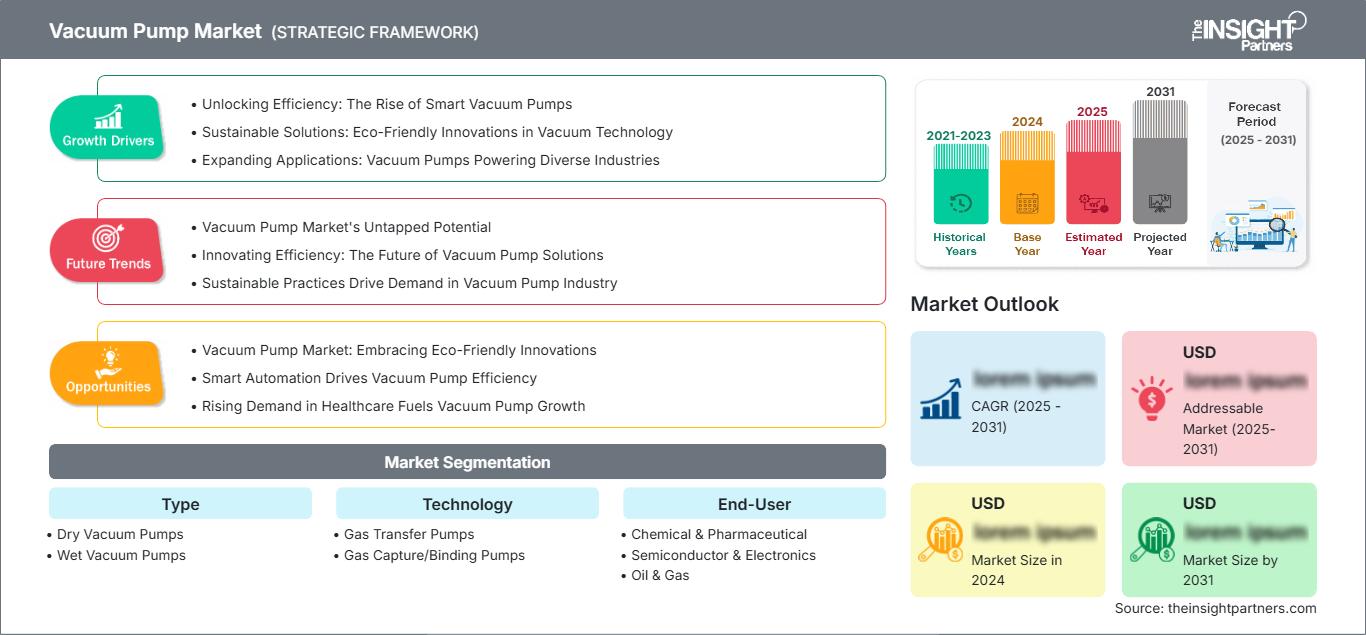
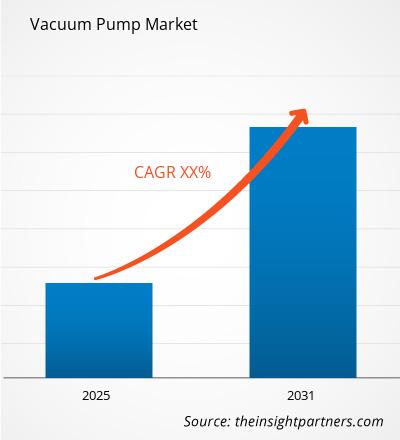
The vacuum pump market is projected to grow from US$ 6.66 billion in 2025 to US$ 11.03 billion by 2034, registering a CAGR of 5.77% during 2026–2034. Demand is supported by process industries that require controlled-pressure environments for drying, distillation, coating, degassing, semiconductor fabrication, medical systems, and laboratory operations. The market is shifting toward cleaner, energy-efficient, and digitally monitored systems across industrial and high-precision applications.
North America remains a technically mature region, with vacuum pump market size supported by semiconductor investment, pharmaceutical production, chemical processing capacity, and oil and gas infrastructure modernization. The region is expected to expand at a CAGR of 5.2–5.6% during 2026–2034, led by strong replacement demand, automation upgrades, and increasing adoption of dry and oil-free systems in contamination-sensitive environments.
Vacuum Pump Market Assessment and Insights
- North America: The region accounted for 30–34% share in 2025 and is projected to grow at a CAGR of 5.2–5.6% during 2026–2034, supported by semiconductor fabs, pharmaceutical manufacturing, and energy processing upgrades.
- US: The US represented 75–80% of North America demand in 2025 and is expected to grow at a CAGR of 5.3–5.7% through 2034, driven by electronics, chemicals, and healthcare applications.
- Europe: Europe held 24–28% share in 2025 and is forecast to expand at a CAGR of 4.8–5.2%, with Germany, the UK, France, and Italy leading demand from chemicals, manufacturing, and clean technology.
- Asia Pacific: Asia Pacific represented 36–40% share in 2025 and is projected to grow at a CAGR of 6.2–6.8%, led by China, Japan, South Korea, India, and Taiwan across electronics and industrial production.
- Largest Segment: Dry Vacuum Pumps held 58–62% market share in 2025 and are expected to grow at a CAGR of 6.0–6.5%, reflecting rising demand for oil-free, low-contamination operation.
- High Growth Segment: Semiconductor and Electronics held 23–27% share in 2025 and is expected to grow at a CAGR of 6.8–7.4%, supported by fabrication capacity and precision processing needs.
- Key companies analyzed in detail: Ingersoll Rand Inc., Pfeiffer Vacuum GmbH, EBARA CORPORATION, Gebr. Becker GmbH, Busch Vacuum Solutions, Agilent Technologies, Inc., VACUUBRAND GMBH + CO KG, ULVAC, Inc., Atlas Copco AB, and Wenling Tingwei Vacuum Equipment Co., Ltd.
Source: The Insight Partners' analysis based on proprietary research, government publications, company annual reports, investor presentations, industry databases, and expert interviews.
Production priorities have evolved from basic pressure control toward lifecycle efficiency, contamination prevention, and integration with automated production lines. The vacuum pump market's growth reflects a stronger role for dry screw, scroll, claw, turbomolecular, and liquid ring technologies, each serving distinct pressure, gas-load, and process-cleanliness requirements. The manufacturing companies are improving their materials, sealing systems, drives, and monitoring systems to minimize downtime and maintenance effort.
The future demand will be affected by considerations like investment in plant infrastructure in the area, development of the biopharmaceutical industry, specialty chemicals production, and environmental compliance issues. Process capability is improving in developing countries, while developed countries are moving away from using oil-sealed pumps.
Vacuum Pump Market Report Scope
| Report Attribute | Details |
|---|---|
| Market size in 2025 | US$ 6.66 Billion |
| Market Size by 2034 | US$ 11.03 Billion |
| Global CAGR (2026 - 2034) | 5.77% |
| Historical Data | 2021-2024 |
| Forecast period | 2026-2034 |
Vacuum Pump Market Analysis
Vacuum pump market growth is closely tied to industries where pressure reduction directly affects yield, purity, throughput, and product quality. Stability of vacuum is required for deposition, etching, lithography, and inspection in semiconductor and electronics plants, and for drying, distillation, crystallization, filtration, and solvent management in chemical and pharmaceutical plants. There is additional demand for oil and gas industry applications, laboratory applications, food packaging, and medical equipment.
Supplier performance is affected by precision manufacturing, availability of components, service infrastructure, and system design suited to specific application requirements. The growing importance of comparisons made by end users on the basis of power efficiency, maintenance interval, vapor tolerance, risk of contamination, and compatibility with factory automation creates a need for differentiation on the basis of after-sales support and customization.
Vacuum pump market analysis shows a competitive landscape that includes diversified industrial groups and specialized vacuum technology providers. Atlas Copco AB, Busch Vacuum Solutions, Pfeiffer Vacuum GmbH, EBARA CORPORATION, ULVAC, Inc., and Ingersoll Rand Inc. engage in rivalry using extensive product lines, semiconductor systems, geographical coverage, and energy improvements. Experts like VACUUBRAND GMBH + CO KG and Gebr. Becker GmbH increases competitive dynamics in the laboratory and industrial sectors.
The key elements of strategic positioning now include environmentally-friendly operations, digital tracking, and application engineering, apart from pricing. Agilent Technologies, Inc. gains from the analytical and laboratory segment, while Wenling Tingwei Vacuum Equipment Co., Ltd. helps in industrial applications that are cost-conscious. Cooperation with process equipment providers and fab, pharmaceutical, and chemical companies is becoming crucial for customer account management.
● REPORT CUSTOMIZATION
Tailor This Report To Align With Your Specific Business Requirements
This report can be customized to align precisely with your business objectives, scope, and target markets. Customization options include tailored segmentation, geography, competitive analysis, and strategic insights to support informed decision-making.
Customize This Report →WHAT YOU CAN ADJUST
- ● Segmentations
- ● Geography
- ● Competitive Analysis
- ● Language Preferences
Vacuum Pump Market: Strategic Insights
Regional Insights
North America Vacuum Pump Market
North America held a 30–34% vacuum pump market share in 2025, supported by semiconductor reshoring, pharmaceutical production, specialty chemicals, aerospace manufacturing, and oil and gas processing. The region is expected to grow at a CAGR of 5.2–5.6% during 2026–2034 as customers upgrade legacy oil-sealed systems and add dry vacuum capacity for cleaner production environments.
Demand is concentrated in the US, with Canada and Mexico contributing through energy, automotive, food processing, and industrial automation projects. Vacuum system buyers in the region prioritize reliability, low downtime, predictive maintenance, and compliance with process safety norms. High installed equipment density also creates steady replacement and service revenue for established suppliers.
U.S. Vacuum Pump Market
The US accounted for 75–80% of North America demand in 2025 and is projected to grow at a CAGR of 5.3–5.7% through 2034. Semiconductor fabs, research laboratories, pharmaceutical plants, and chemical processing facilities are the primary demand centers, while oil and gas applications continue to support liquid ring and rotary technologies.
Company presence is strong across distribution, systems engineering, and service. Atlas Copco AB, Ingersoll Rand Inc., Agilent Technologies, Inc., Busch Vacuum Solutions, and Pfeiffer Vacuum GmbH serve customers requiring precision, compliance, uptime, and local technical support. The vacuum pump market benefits from automation investment and advanced manufacturing incentives.
Europe Vacuum Pump Market
Europe accounted for 24–28% share in 2025 and is expected to grow at a CAGR of 4.8–5.2% during 2026–2034. Germany leads regional demand through chemicals, automotive, industrial machinery, and electronics, while the UK and France support adoption through pharmaceuticals, laboratories, aerospace, and energy applications. Italy and Spain contribute through food processing and manufacturing upgrades. As highlighted in the Vacuum Pump Market report, ongoing industrial modernization and process-efficiency initiatives continue to support adoption across a broad range of manufacturing and scientific applications.
European buyers emphasize energy efficiency, emissions reduction, product safety, and regulatory compliance. This favors dry vacuum systems, vapor recovery solutions, and digitally enabled pumps with a lower total cost of ownership. The region is also home to several established vacuum technology suppliers, supporting application engineering depth and export-oriented production.
APAC Vacuum Pump Market
APAC held 36–40% share in 2025 and is forecast to grow at a CAGR of 6.2–6.8% through 2034. China is the leading country, supported by electronics, chemicals, solar, batteries, and industrial machinery, while Japan and South Korea drive demand for high-specification electronics and semiconductor systems. As outlined in the Vacuum Pump Market forecast, the region is expected to maintain its leadership position due to continued industrial expansion, manufacturing investments, and growing demand for advanced vacuum technologies across high-growth sectors. India, Taiwan, and Australia add momentum through pharmaceuticals, chip packaging, mining support, laboratories, and food processing. Industrial policies, fab investments, and export manufacturing make APAC the highest-volume growth region. Cost competitiveness and process quality requirements are encouraging both local manufacturing and advanced imported systems.
Middle East & Africa Vacuum Pump Market
The Middle East and Africa are projected to grow at a CAGR of 4.5–5.0% during 2026–2034, supported by oil and gas, petrochemicals, desalination, infrastructure, laboratories, and healthcare. Saudi Arabia and the UAE lead adoption through downstream energy projects and industrial diversification, while South Africa contributes through mining, manufacturing, and research facilities. Vacuum Pump Market trends indicate increasing demand for energy-efficient systems, process automation, and advanced vacuum technologies across industrial and scientific applications throughout the region. Vacuum pump demand in the region is application-specific, with users prioritizing rugged designs, vapor handling, service availability, and reliability under harsh operating conditions. Future growth will depend on petrochemical investment, regional manufacturing strategies, and long-term maintenance programs for process equipment.
Segmentation Analysis
Type
Type is expected to grow at a CAGR of 5.6–6.1% during 2026–2034, with dry systems gaining preference in clean, automated, and maintenance-sensitive applications. Vacuum pump market scope is broadening as end users balance oil contamination risks, operating cost, gas compatibility, and required vacuum levels.
- Dry Vacuum Pumps: Dry systems are preferred in semiconductor, pharmaceutical, laboratory, and food applications where oil migration, contamination, and frequent maintenance can affect process quality and operating continuity.
- Wet Vacuum Pumps: Wet pumps remain important in chemical processing, oil and gas, and heavy industrial applications where vapor handling, rugged operation, and proven reliability are key purchasing considerations.
Technology
Technology is projected to grow at a CAGR of 5.4–5.9% through 2034 as users select systems based on pressure range, gas load, contamination tolerance, and process integration needs. Gas transfer systems dominate broader industrial use, while capture and binding technologies address high and ultra-high vacuum requirements.
- Gas Transfer Pumps: These pumps serve the widest application base, moving gases continuously from process chambers across manufacturing, chemicals, pharmaceuticals, packaging, and laboratory operations.
- Gas Capture/Binding Pumps: These technologies are critical in high-vacuum environments, especially analytical instruments, research systems, semiconductor tools, and advanced coating where extremely low pressure is required.
End-User
End-User demand is expected to grow at a CAGR of 5.8–6.4% during 2026–2034. Chemical and pharmaceutical plants support stable replacement demand, while semiconductor and electronics applications create the fastest growth profile. Oil and gas retains demand for robust pumps in processing and recovery systems.
- Chemical & Pharmaceutical: Demand is driven by distillation, drying, filtration, crystallization, solvent recovery, and sterile processing, where vacuum reliability supports yield, purity, and compliance.
- Semiconductor & Electronics: This segment requires clean, precise vacuum environments for deposition, etching, lithography, testing, and packaging, making advanced dry and high-vacuum systems strategically important.
- Oil & Gas: Applications include vapor recovery, gas handling, dehydration, refining, and petrochemical operations where durability, vapor tolerance, and continuous operation are central purchasing criteria.
Opportunity Snapshot
| End-User | Revenue Contribution | Trend Tag | Adoption Stage |
| Chemical & Pharmaceutical | High | Solvent Recovery | Mature |
| Semiconductor & Electronics | High | Fab Expansion | Scaling |
| Oil & Gas | Medium | Vapor Handling | Mature |
Vacuum Pump Market Growth Drivers and Impact Analysis
Semiconductor Capacity Expansion Requires Cleaner Vacuum Systems
The manufacture of semiconductors can be regarded as one of the strongest structural drivers due to the fact that vacuum systems are indispensable in deposition, etching, lithography, ion implantation, and inspection. In order to cope with the growing need for chips required for AI, automotive electronics, power devices, memory, and advanced packaging, semiconductor makers need stable, oil-free, and particle-free pump configurations. Dry screw, turbomolecular, and integrated pumping packages benefit from this driver.
Pharmaceutical and Chemical Processing Expands Controlled-Pressure Demand
Vacuum pumps are used in pharmaceuticals and chemical processing plants for such applications as drying, distillation, crystallization, filtration, solvent recovery, and reactors. Demand is increasing owing to the need of these manufacturers to enhance productivity, lower emissions, and maintain stringent quality requirements. Vacuum pumps are useful in controlling humidity, temperature, contamination, and vapor management. This makes vacuum pumps indispensable in the manufacture of Active Pharmaceutical Ingredients (APIs), specialty chemicals, and intermediate products.
Energy Efficiency and Maintenance Reduction Influence Replacement Cycles
The end-users are upgrading their old vacuum equipment with energy-efficient devices fitted with VSD, sensors, better seals, and predictive monitoring capabilities. Energy costs, downtimes, lubrication changes, maintenance, and regulatory obligations are among the factors driving the purchasing decision. This force applies more specifically to manufacturing companies where the process involves continuous operations because any malfunctioning pump can interrupt the production lines. The consequences of this driver include increased demand for dry and intelligent pumps.
Vacuum Pump Market Future Trends
Smart and Connected Vacuum Systems Become Standard
Vacuum pump market trends increasingly point to connected systems that monitor vibration, temperature, pressure stability, energy use, and maintenance needs in real time. With such capabilities, the operator can identify any performance drift before failure, adjust the speed of the pump, and tie the equipment data into the plant control systems. Predictive maintenance will be increasingly important in semiconductor fabrication plants, pharmaceutical production facilities, and continuous processing lines, where downtime can cost a lot of money. The vendors who provide reliable hardware, analytics, and service support will see more retention.
Oil-Free Designs Gain Share in Clean and Regulated Processes
Oil-free and dry vacuum pumps will increasingly be chosen due to their suitability for contamination avoidance in electronic, laboratory, food, medical, and pharmaceutical applications. Oil-free and dry vacuum systems decrease the risk of hydrocarbon backstreaming, ease maintenance processes, create better working environments, and are consistent with sustainability goals. In light of users' growing interest in considering the total cost of ownership as opposed to initial equipment cost, dry vacuum pumps are expected to be the preferred choice going forward.
Vacuum Pump Market Opportunities
Service-Led Upgrades for Installed Industrial Pump Bases
There is a significant retrofit, replacement, and performance improvement opportunity arising from large numbers of installed bases in the chemical, oil and gas, food processing, laboratory, and manufacturing sectors. This provides a good platform for vacuum pump manufacturers to reach out to their clients who are using older oil-sealed or less efficient units with services that include audits, energy-saving plans, monitoring systems, maintenance agreements, and complete dry conversions. The vacuum pump market forecast is further supported by this services-driven opportunity.
Application-Specific Systems for Emerging Manufacturing Clusters
The emergence of manufacturing centers in the Asia Pacific, North America, and the Middle East creates an opportunity for the production of application-specific vacuum packages. Assembly of semiconductors, battery manufacturing, specialty chemicals, pharmaceuticals, photovoltaic production, and hydrogen facilities all have specific pressure needs. Service providers who can offer technical engineering services, localized servicing, modular solutions, and proven efficiency can benefit from capturing such opportunities. The best opportunities are available when industrial policy, localized production chains, and quality standards come into play.
Frequently Asked Questions

- Comprehensive Market Sizing and Forecast Analysis
- Detailed Segmentation Analysis
- In-Depth Market Dynamics Assessment
- Regional and Country-Level Insights
- Competitive Landscape and Company Benchmarking
- Strategic Business Intelligence
Recent Reports
Testimonials

The Insight Partners provided valuable market intelligence that supported our global go-to-market strategy. Their team was professional, responsive, and attentive to our feedback, providing thoughtful analysis and helpful methodological clarifications throughout the project.
Junmo Kim Chief Financial Officer (CFO), Enertech Co., Ltd.
The Insight Partners' SCADA System Market report is comprehensive, with valuable insights on current trends and future forecasts. The team was highly professional, responsive, and supportive throughout. We are very satisfied and highly recommend their services.
RAN KEDEM Partner, Reali Technologies LTDs
I requested a report on a very specific software market and the team produced the report in a few days. The information was very relevant and well presented. I then requested some changes and additions to the report. The team was again very responsive and I got the final report in less than a week.
JEAN-HERVE JENN Chairman, Future Analytica
We worked with The Insight Partners for an important market study and forecast. They gave us clear insights into opportunities and risks, which helped shape our plans. Their research was easy to use and based on solid data. It helped us make smart, confident decisions. We highly recommend them.
PIYUSH NAGPAL Sr. Vice President, High Beam Global
The Insight Partners delivered insightful, well-structured market research with strong domain expertise. Their team was professional and responsive throughout. The user-friendly website made accessing industry reports seamless. We highly recommend them for reliable, high-quality research services
YUKIHIKO ADACHI CEO, Deep Blue, LLC.
This is the first time I have purchased a market report from The Insight Partners.While I was unsure at first, I visited their web site and felt more comfortable to take the risk and purchase a market report.I am completely satisfied with the quality of the report and customer service. I had several questions and comments with the initial report, but after a couple of dialogs over email with their analyst I believe I have a report that I can use as input to our strategic planning process.Thank you so much for taking the extra time and making this a positive experience.I will definitely recommend your service to others and you will be my first call when we need further market data.
JOHN SUZUKI President and Chief Executive Officer, Board Director, BK Technologies
I wish to appreciate your support and the professionalism you displayed in the course of attending to my request for information regarding to infectious disease IVD market in Nigeria. I appreciate your patience, your guidance, and the fact that you were willing to offer a discount, which eventually made it possible for us to close a deal. I look forward to engaging The Insight Partners in the future, all thanks to the impression you have created in me as a result of this first encounter.
DR CHIJIOKE ONYIA MANAGING DIRECTOR, PineCrest Healthcare Ltd.Reason to Buy
- Informed Decision-Making
- Understanding Market Dynamics
- Competitive Analysis
- Identifying Emerging Markets
- Customer Insights
- Market Forecasts
- Risk Mitigation
- Boosting Operational Efficiency
- Strategic Planning
- Investment Justification
- Tracking Industry Innovations
- Aligning with Regulatory Trends





 Get Free Sample for