
Variable Area Flowmeters Market Trends, Share & Demand by 2034
Coverage: By Material Type (Plastic Tube, Glass Tube, Metal Tube); End-user (Power, Chemical and Petrochemical, Food and Beverages, Metals and Mining, Paper and Pulp, Pharmaceuticals, Water and Wastewater Treatment, Oil and Gas, Others) , and Geography (North America, Europe, Asia Pacific, and South and Central America)
- Status : Data Released
- Report Code : TIPRE00018570
- Category : Electronics and Semiconductor
- No. of Pages : 150
- Available Report Formats :


- Last update date : September 17, 2026


2025 Market Size
US$ 1.44 Bn
Base year value
2034 Forecast
US$ 2.4 Bn
Projected by 2034
CAGR 2026-2034
5.83 %
Growth rate
Addressable Market
US$ 17.39 Bn
(2026-2034)
The Variable area flowmeters market was valued at US$ 1.44 Billion in 2025 and is projected to reach US$ 2.4 Billion by 2034, registering a CAGR of 5.83% during 2026–2034. The market reflects sustained demand for dependable volumetric flow measurement across process industries, particularly where simple installation, low operating complexity, compact construction, and reliable monitoring of clean liquids or gases remain important purchasing considerations.
North America is expected to maintain a structurally important position, with the variable area flowmeters market size anticipated to expand at an estimated 4.8–5.8% CAGR between 2026–2034. Aging process infrastructure, modernization of water and wastewater facilities, chemical processing investments, and replacement of legacy mechanical instrumentation support recurring demand. Adoption is also reinforced by requirements for compact flow monitoring in laboratory, analytical, utility, and industrial applications.
Variable Area Flowmeters Market Assessment and Insights
- North America: North America is estimated to account for 25–29% share in 2025, growing at a 4.8–5.8% CAGR between 2026–2034, supported by industrial replacement cycles, water infrastructure upgrades, and established instrumentation distribution networks.
- US: The US is estimated to represent 19–22% of North American share in 2025, growing at a 4.7–5.7% CAGR between 2026–2034, supported by process automation and utility modernization.
- Europe: Europe is estimated to hold 27–31% share in 2025, growing at a 4.9–5.9% CAGR between 2026–2034, with Germany, the UK, France, Italy, and Spain providing substantial demand through process manufacturing, pharmaceuticals, chemicals, and water management.
- Asia Pacific: Asia Pacific is estimated to hold 29–33% share in 2025, expanding at a 6.4–7.4% CAGR between 2026–2034. China, Japan, South Korea, and India are leading demand centers because of industrial capacity additions and infrastructure investment.
- Largest Segment: Metal Tube is estimated to command 48–53% market share in 2025, advancing at a 5.6–6.6% CAGR during 2026–2034, reflecting its suitability for demanding industrial environments.
- High Growth Segment: Water and Wastewater Treatment is estimated to represent 10–14% share in 2025, growing at a 6.8–7.8% CAGR during 2026–2034, driven by network rehabilitation and process monitoring requirements.
- Key companies analyzed in detail: ABB Ltd.; Brooks Instrument, LLC; Dwyer Instruments, LLC; Flowmetrics, Inc.; KROHNE Messtechnik GmbH; OMEGA Engineering, Inc.; Riels Instruments S.r.l.; Siemens AG; Swagelok Company; Yokogawa Electric Corporation.
Source: The Insight Partners' analysis based on proprietary research, government publications, company annual reports, investor presentations, industry databases, and expert interviews.
Variable area flowmeters market has evolved from predominantly mechanical local indicators toward configurations combining mechanical measurement with electronic transmission, alarms, digital diagnostics, and industrial communication. Glass tubes remain relevant for direct visual observation and low-flow applications, while metal construction supports higher pressure, temperature, and chemically demanding environments. Product development increasingly emphasizes modularity, hazardous-area suitability, compact installation, and integration with plant instrumentation.
Over the forecast period, variable area flowmeters market opportunities are expected to broaden in emerging industrial economies as water treatment, pharmaceuticals, specialty chemicals, food processing, and energy infrastructure receive capital investment. Regulatory emphasis on process safety, resource efficiency, and measurement reliability should favor instrumentation upgrades. Manufacturers are also likely to prioritize localized production, distributor coverage, configurable electronics, and service capabilities to shorten delivery cycles and improve lifecycle support.
Variable Area Flowmeters Market Report Scope
| Report Attribute | Details |
|---|---|
| Market size in 2025 | US$ 1.44 Billion |
| Market Size by 2034 | US$ 2.4 Billion |
| Global CAGR (2026 - 2034) | 5.83% |
| Historical Data | 2021-2024 |
| Forecast period | 2026-2034 |
Variable Area Flowmeters Market Analysis
The variable area flowmeters market benefits from applications where operators require straightforward measurement of gases and liquids without excessive instrumentation complexity. The demand is created in process plants, utilities, laboratories, analyzer systems, and equipment skids. The ecosystem encompasses suppliers of tube and float materials, manufacturers of precision parts, assemblers of instruments, calibrators, distributors, integrators, and end-users. The purchasing process usually considers pressure and temperature range, accuracy, compatibility with materials, type of connection, installation space, and maintenance needs.
The supply is defined by the unique manufacturing abilities of glass cones, stainless steel body, floats, valves, seals, transmitters, and communication modules. Metal tube instruments tend to have more flexibility in the case of severe-duty applications, whereas glass tube instruments still have an edge in cases where visual inspection and cost-effective low flow measurement are important.
The variable area flowmeters market remains competitive because global automation companies operate alongside specialized flow measurement manufacturers. KROHNE Messtechnik GmbH emphasizes modular variable-area products with mechanical and electronic configurations, while Yokogawa Electric Corporation maintains rotameter offerings spanning glass and stainless-steel designs. Brooks Instrument, LLC, Dwyer Instruments, LLC, OMEGA Engineering, Inc., and Flowmetrics, Inc. compete through specialized instrumentation portfolios and application-focused configurations. ABB Ltd. and Siemens AG strengthen competitive intensity through broader process automation ecosystems.
Investment is increasingly directed toward digital connectivity, calibration capability, product modularity, localized manufacturing, and service infrastructure. Strategic positioning therefore, extends beyond meter hardware. Suppliers that can integrate flow measurement into plant control systems, provide hazardous-area configurations, support replacement of installed equipment, and maintain dependable distribution channels are better placed to capture recurring demand. The market also presents opportunities for partnerships with engineering contractors and industrial automation integrators, according to the Variable Area Flowmeters Market report.
● REPORT CUSTOMIZATION
Tailor This Report To Align With Your Specific Business Requirements
This report can be customized to align precisely with your business objectives, scope, and target markets. Customization options include tailored segmentation, geography, competitive analysis, and strategic insights to support informed decision-making.
Customize This Report →WHAT YOU CAN ADJUST
- ● Segmentations
- ● Geography
- ● Competitive Analysis
- ● Language Preferences
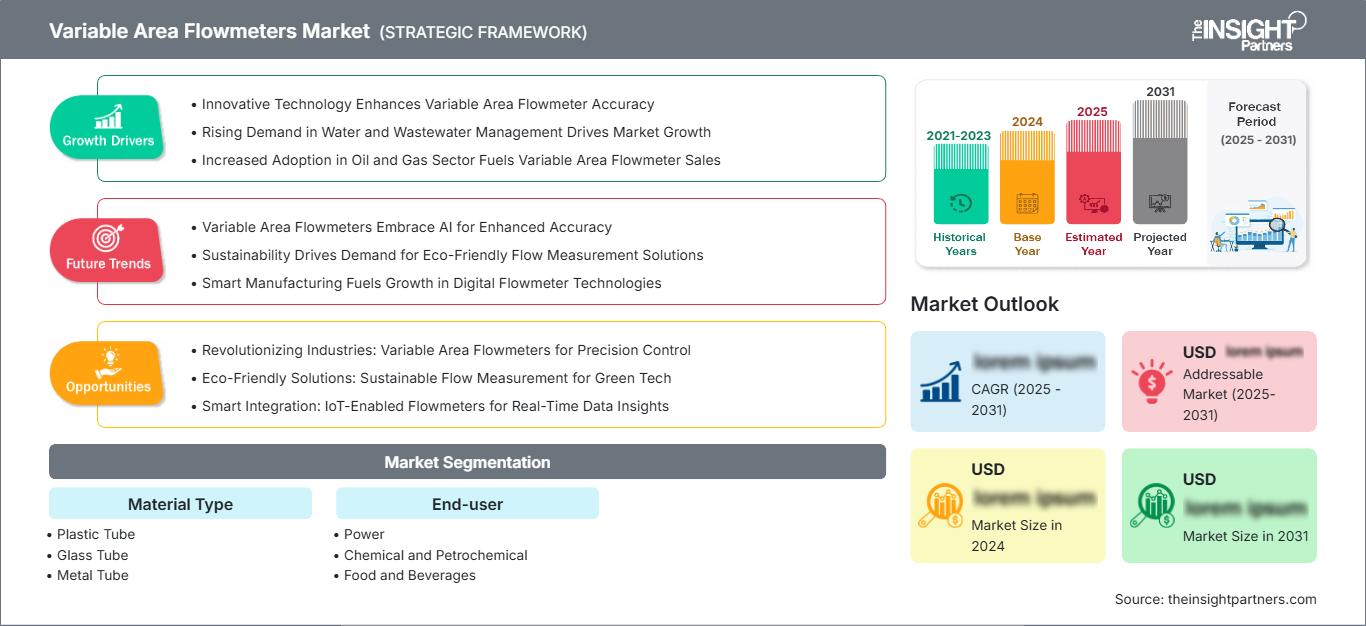
Variable Area Flowmeters Market: Strategic Insights
Regional Insights
North America Variable Area Flowmeters Market
North America is estimated to represent 25–29% of the Variable Area Flowmeters Market share in 2025, with the regional market expanding at a 4.8–5.8% CAGR through 2034. The US is the biggest market in the region, followed by Canada and Mexico, due to the presence of significant chemical processing, refining, food processing, pharmaceutical, utility, and machinery manufacturing industries. The need for new instrumentation replaces older instrumentation and ensures repeat purchases due to the preference for local indication and ease of maintenance.
Regional business prospects are associated with the upgrade of water infrastructure, energy savings in industry, and process control system upgrades. The variable area instrumentation still finds applications in purge systems, analyzer lines, cooling systems, lab and utility equipment, where advanced mass or ultrasonic flow measurements are not required. There is already an extensive distribution network, engineering companies offering access to standardized product lines, and local manufacturing and servicing for custom assemblies and replacement installations.
U.S. Variable Area Flowmeters Market
The US is estimated to contribute 19–22% of the North American Variable Area Flowmeters Market share in 2025 and is projected to expand at a 4.7–5.7% CAGR through 2034. Various applications in chemical plants, pharmaceuticals, food processing plants, semiconductors, water and energy plants have specific needs for low flow and utility metering. Modern industry tends to prefer products with a combination of local display along with electronics, which allows integrating it into the supervision system.
Examples of the application are analyzer sampling, compressed gas, cooling water, laboratory equipment, and chemical dosing. The presence of such suppliers such as ABB Ltd., Brooks Instrument, LLC, Dwyer Instruments, LLC, OMEGA Engineering, Inc., and Swagelok Company increases the availability of the product. The need for replacement applies in cases when the existing mechanical meters can be replaced without changing the pipework.
Europe Variable Area Flowmeters Market
Europe is estimated to hold 27–31% share of the Variable Area Flowmeters Market in 2025, with a 4.9–5.9% CAGR through 2034. Germany is the dominant national market driven by industrial automation and chemical manufacturing, whereas the UK, France, Italy, and Spain add their support through pharmaceuticals, food processing, energy, utilities, and engineered systems. The European market buyers usually focus on reliability, materials compatibility, safety compliance, and lifetime performance.
In the UK market, the demand is driven by water management, pharmaceuticals, food production, and process engineering. Germany gains from having a dense machinery and chemical manufacturing industry base, which demands sturdy measuring equipment. In France and Italy, the opportunities lie in chemicals, food, pharmaceuticals, and utilities, while in Spain, it is water treatment, food processing, and energy applications.
APAC Variable Area Flowmeters Market
Asia Pacific is estimated to hold 29–33% share of the Variable Area Flowmeters Market in 2025 and is projected to expand at a 6.4–7.4% CAGR through 2034, making it the fastest-growing major region. China leads regional demand, followed by Japan, South Korea, India, and Australia. Industrial expansion, water infrastructure investment, and process modernization support adoption across multiple end users.
China combines large chemical, power, metals, and manufacturing capacity with extensive infrastructure programs. Japan and South Korea emphasize high-quality process instrumentation, while India is supported by industrialization, pharmaceuticals, food processing, and water treatment. Australia contributes through mining, utilities, and resource processing. Policy emphasis on industrial efficiency, domestic manufacturing, and water security should sustain instrumentation investment throughout the forecast period.
Middle East & Africa Variable Area Flowmeters Market
Middle East & Africa Variable Area Flowmeters Market is expected to expand at a 5.2–6.2% CAGR through 2034, with Saudi Arabia and the UAE representing important demand centers. South Africa contributes through mining, water management, chemicals, and industrial processing, while the Rest of MEA provides opportunities through municipal infrastructure and energy projects.
Saudi Arabia remains a leading market because of energy diversification, industrial development, and water infrastructure investment. The UAE benefits from utilities, desalination, chemicals, and advanced industrial facilities. South Africa requires dependable measurement across mining and municipal systems. Across the wider region, energy projects, desalination capacity, and infrastructure modernization create demand for simple flow monitoring technologies suited to utility and process applications.
Segmentation Analysis
Material Type
Material Type is divided into Plastic Tube, Glass Tube, and Metal Tube. The segment is shaped by pressure, temperature, chemical compatibility, visibility, installation requirements, and total ownership cost. Metal Tube remains the largest category because it accommodates demanding process environments, while glass and plastic configurations remain important in low-pressure and visually monitored applications. The segment is expected to expand at a 5.5–6.5% CAGR during 2026–2034, according to the Variable Area Flowmeters Market forecast.
- Plastic Tube: Plastic tube instruments serve applications requiring corrosion resistance, lightweight construction, and economical measurement of compatible liquids or gases. Their strategic importance is strongest in laboratory, water, chemical, and OEM systems where operating pressures remain moderate.
- Glass Tube: Glass tube meters provide direct visual indication of float position and remain important for low-flow measurement, purge systems, laboratory applications, and analyzer installations. Transparent construction supports rapid operator verification without complex electronics.
- Metal Tube: Metal tube products hold the largest position because stainless-steel and alloy construction supports higher pressure, temperature, mechanical durability, and demanding process conditions. They are strategically important in chemical, oil and gas, power, and industrial applications.
End-user
End-user includes Power, Chemical and Petrochemical, Food and Beverages, Metals and Mining, Paper and Pulp, Pharmaceuticals, Water and Wastewater Treatment, and Oil and Gas. The segment is expected to expand at a 5.9–6.9% CAGR during 2026–2034, supported by broad process monitoring requirements and replacement of installed instruments, reflecting key Variable Area Flowmeters Market trends.
- Power: Power facilities use flowmeters for auxiliary services, cooling systems, fuel-related processes, and utility monitoring. Demand is linked to plant modernization and requirements for dependable measurement across conventional and newer energy infrastructure.
- Chemical and Petrochemical: Chemical and petrochemical plants require corrosion-resistant and pressure-capable instruments for process gases, liquids, purge lines, and analyzer systems. Material compatibility and hazardous-area suitability remain central purchasing considerations.
- Food and Beverages: Food and beverage facilities use compact flow instruments for utilities, cleaning systems, gases, and process-support applications. Hygienic connections, ease of maintenance, and repeatable local indication influence equipment selection.
- Metals and Mining: Mining and metals facilities require robust instruments for water, gases, process chemicals, and auxiliary services. Durability and tolerance of harsh environments make metal-tube configurations strategically relevant.
- Paper and Pulp: Paper and pulp facilities use flow measurement across chemical dosing, water circuits, steam-related services, and process utilities. Instrument reliability and resistance to demanding plant environments support continued adoption.
- Pharmaceuticals: Pharmaceutical manufacturers use flowmeters in laboratory, clean utility, gas, and process-support systems. Compact designs, traceable calibration, material compatibility, and controllable installation conditions influence purchasing decisions.
- Water and Wastewater Treatment: Water and wastewater facilities require dependable monitoring for treatment processes, dosing, purge services, and utility lines. Infrastructure renewal and efficiency objectives strengthen demand for economical measurement technologies.
- Oil and Gas: Oil and gas operators use variable-area instruments for purge, sampling, analyzer, utility, and auxiliary gas applications. Hazardous-area certifications, rugged construction, and reliable indication are important strategic requirements.
Opportunity Snapshot
| End-user | Revenue Contribution | Trend Tag | Adoption Stage |
| Power | High | Utility Monitoring | Mature |
| Chemical and Petrochemical | High | Process Purging | Mature |
| Food and Beverages | Medium | Hygienic Flow | Scaling |
| Metals and Mining | Medium | Harsh Service | Mature |
| Paper and Pulp | Medium | Chemical Dosing | Mature |
| Pharmaceuticals | Medium | Clean Utilities | Scaling |
| Water and Wastewater Treatment | High | Network Monitoring | Scaling |
| Oil and Gas | High | Analyzer Systems | Mature |
Variable Area Flowmeters Market Growth Drivers and Impact Analysis
Industrial Process Monitoring and Replacement Demand
There is still a need for reliable flow indication in industries for utilities, purge systems, analyzers, and process support applications where highly sophisticated measuring devices may not be needed. Thus, there will be an opportunity from the replacement market, since the existing mechanical metering devices can last for years before needing replacement, repair, or even recalibration. In situations where there is too much pressure, vibration, high temperatures, or chemical content, metal tube devices are preferred. This effect will cascade down to distributors, calibration suppliers, engineering firms, and OEMs who manufacture standard assemblies. With the modernization of control systems, electronically enabled variable area meters can act as a stepping stone from mechanical measuring devices to digital process monitoring.
Water Infrastructure Modernization and Resource Efficiency
A major growth opportunity is created by the investment in water and wastewater systems because measurement of treatment plants and utilities requires reliable instrumentation. Renewal initiatives are moving towards the improvement of leakage prevention, efficiency, visibility, and reliability. Variable area flowmeters have much significance in low flow, purge, sample, chemical feed, and auxiliary applications, which may not require the use of sophisticated measuring instruments. Their compactness and no need for additional power in their mechanical form can make their installation easier within a localized system. The market influence will be felt more in cases where there is a combination of the replacement of the equipment along with the modernization initiative undertaken by municipal corporations and industrial water users.
Expansion of Process Industries in Emerging Economies
The expansion of capabilities in the areas of chemistry, pharmaceuticals, food processing, mining, and engineered manufacturing in developing countries will result in an increase in the base of measurement equipment used in industries. These plants would have the need for instrumentation in the production line, utilities, laboratories, analyzers, and environmental control systems, which will give rise to an opportunity to supply both standard and custom-built flowmeters. The Asia Pacific region plays a vital role in this regard, since investment in manufacturing involves large process plants as well as smaller OEM and laboratory facilities. Production locally can help improve the competitiveness of manufacturers in terms of shorter shipping times, product adaptation, and technical support. The effect goes even further and extends to valve and fitting suppliers as well as calibration and automation component suppliers.
Variable Area Flowmeters Market Future Trends
Greater Integration of Digital Communication and Diagnostics
The future trend of the development of variable area flowmeters will probably lie in the direction of hybrid flowmeters that will have all the advantages of the variable area measuring principle with additional options for data communication and diagnostics. Current designs of the devices can have the possibility of indicating mechanically, 4–20 mA output, HART, limit switches, fieldbus, or digital diagnostics. The operators can thus keep their well-known principle of measurement while enhancing their possibilities to obtain data about processes. Manufacturers in the future will probably pay more attention to modular electronics that will be upgradeable independently of the replacement of the entire flowmeter. Diagnostic features will probably detect float blocking, unusual flow characteristics, installation issues, and sensor diagnostics.
Application-Specific Materials and Compact Instrumentation
Future development of the products will be based on the use of specific materials and compact design in order to meet different process conditions. Requirements for the usage of corrosion-resistant alloys, engineered plastics, coatings, hygienic connectors and wetted parts compatible with chemicals will increase along with the analysis of more aggressive or sensitive media. Compact instruments, at the same time, can help in cases when there are limitations regarding the size of the analyzer panels, laboratories, machines and packed process equipment. Manufacturers can develop low flow ranges while increasing readability, connection options and the possibility to mount the instruments at any angle. The use of specific materials and compact designs will help maintain the relevance of variable area technology in the market niche where simple direct measurement works to advantage.
Variable Area Flowmeters Market Opportunities
Localized Manufacturing and Service Ecosystems
Variable area flowmeters forecasts indicate attractive opportunities for suppliers that establish localized manufacturing, calibration, distribution, and technical service capabilities in high-growth industrial economies. Regional production can reduce lead times and improve responsiveness to application-specific requirements, particularly where customers need customized materials, connections, scales, valves, or electronic outputs. India, China, Southeast Asia, and selected Middle Eastern markets offer opportunities because industrial capacity additions are occurring alongside infrastructure modernization. Service networks can become an important differentiator as customers increasingly seek calibration, replacement, commissioning, and maintenance support rather than equipment alone. Companies can also strengthen channel performance through partnerships with automation integrators and engineering contractors that influence instrumentation specifications during project design and procurement.
Digital Retrofit Packages for Installed Instrument Bases
A second opportunity lies in retrofitting existing mechanical flow measurement points with electronic indication, alarm functionality, or communication capabilities without replacing complete process assemblies. Many industrial users retain functioning piping and measurement bodies but require improved visibility for centralized monitoring and maintenance. Modular transmitters, sensors, and communication accessories can address this need while limiting shutdown duration and installation costs. Suppliers can develop retrofit packages tailored to common meter sizes, connection standards, and process conditions, creating recurring aftermarket revenue. This strategy is particularly relevant to mature industrial regions where replacement budgets compete with other capital priorities. Combining retrofit engineering with calibration and field service can further strengthen customer retention and create a lifecycle-based commercial model.
Frequently Asked Questions

- Comprehensive Market Sizing and Forecast Analysis
- Detailed Segmentation Analysis
- In-Depth Market Dynamics Assessment
- Regional and Country-Level Insights
- Competitive Landscape and Company Benchmarking
- Strategic Business Intelligence
Recent Reports
Testimonials

The Insight Partners provided valuable market intelligence that supported our global go-to-market strategy. Their team was professional, responsive, and attentive to our feedback, providing thoughtful analysis and helpful methodological clarifications throughout the project.
Junmo Kim Chief Financial Officer (CFO), Enertech Co., Ltd.
The Insight Partners' SCADA System Market report is comprehensive, with valuable insights on current trends and future forecasts. The team was highly professional, responsive, and supportive throughout. We are very satisfied and highly recommend their services.
RAN KEDEM Partner, Reali Technologies LTDs
I requested a report on a very specific software market and the team produced the report in a few days. The information was very relevant and well presented. I then requested some changes and additions to the report. The team was again very responsive and I got the final report in less than a week.
JEAN-HERVE JENN Chairman, Future Analytica
We worked with The Insight Partners for an important market study and forecast. They gave us clear insights into opportunities and risks, which helped shape our plans. Their research was easy to use and based on solid data. It helped us make smart, confident decisions. We highly recommend them.
PIYUSH NAGPAL Sr. Vice President, High Beam Global
The Insight Partners delivered insightful, well-structured market research with strong domain expertise. Their team was professional and responsive throughout. The user-friendly website made accessing industry reports seamless. We highly recommend them for reliable, high-quality research services
YUKIHIKO ADACHI CEO, Deep Blue, LLC.
This is the first time I have purchased a market report from The Insight Partners.While I was unsure at first, I visited their web site and felt more comfortable to take the risk and purchase a market report.I am completely satisfied with the quality of the report and customer service. I had several questions and comments with the initial report, but after a couple of dialogs over email with their analyst I believe I have a report that I can use as input to our strategic planning process.Thank you so much for taking the extra time and making this a positive experience.I will definitely recommend your service to others and you will be my first call when we need further market data.
JOHN SUZUKI President and Chief Executive Officer, Board Director, BK Technologies
I wish to appreciate your support and the professionalism you displayed in the course of attending to my request for information regarding to infectious disease IVD market in Nigeria. I appreciate your patience, your guidance, and the fact that you were willing to offer a discount, which eventually made it possible for us to close a deal. I look forward to engaging The Insight Partners in the future, all thanks to the impression you have created in me as a result of this first encounter.
DR CHIJIOKE ONYIA MANAGING DIRECTOR, PineCrest Healthcare Ltd.Reason to Buy
- Informed Decision-Making
- Understanding Market Dynamics
- Competitive Analysis
- Identifying Emerging Markets
- Customer Insights
- Market Forecasts
- Risk Mitigation
- Boosting Operational Efficiency
- Strategic Planning
- Investment Justification
- Tracking Industry Innovations
- Aligning with Regulatory Trends





 Get Free Sample for