
Ventilation Fan Market Segments, Size, Share, and Trends by Forecast by 2034
Coverage: By Product Type (Axial Fans, Centrifugal Fans, Propeller Fans); Installation (Wall Mounted, Roof Mounted); Applications (Residential, Commercial, Industrial), and Geography
- Status : Data Released
- Report Code : TIPRE00013816
- Category : Electronics and Semiconductor
- No. of Pages : 150
- Available Report Formats :


- Last update date : September 08, 2026


2025 Market Size
US$ 3.41 Bn
Base year value
2034 Forecast
US$ 6.95 Bn
Projected by 2034
CAGR 2026-2034
8.9 %
Growth rate
Addressable Market
US$ 48.15 Bn
(2026-2034)
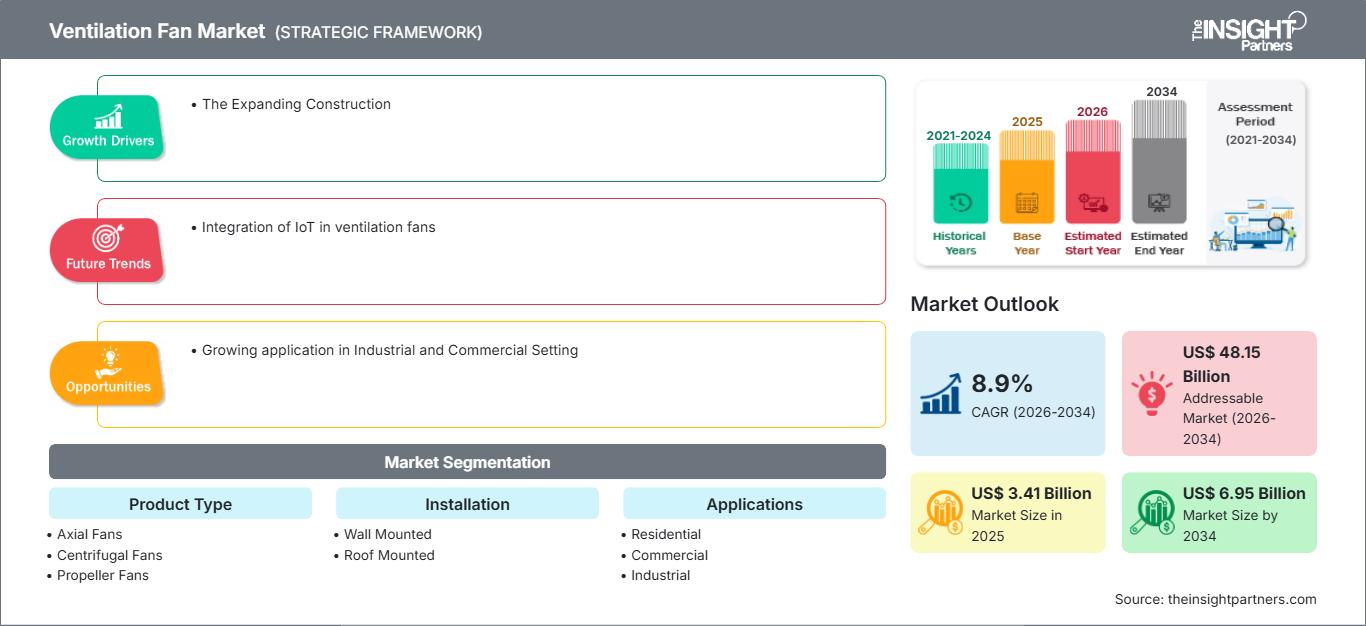
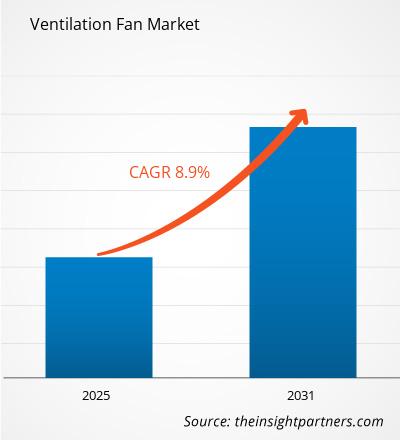
The ventilation fan market is projected to grow from US$ 3.41 billion in 2025 to US$ 6.95 billion by 2034, registering a CAGR of 8.9% during 2026–2034. Demand is rising as residential builders, commercial facility owners, and industrial operators prioritize indoor air quality, moisture control, heat removal, and energy-efficient air movement across new construction and retrofit projects.
North America remains a mature but innovation-led region, with the ventilation fan market size supported by green building upgrades, tighter indoor air quality standards, and replacement demand in multifamily housing, offices, healthcare spaces, and light industrial facilities. Regional growth is expected to remain in the 7.6–8.2% CAGR range through 2034, driven by electronically commutated motors, low-noise designs, and smart controls.
Ventilation Fan Market Assessment and Insights
- North America accounted for a 33–36% share in 2025 and is projected to grow at a CAGR of 7.6–8.2% during 2026–2034, supported by retrofit activity, IAQ awareness, and energy-code aligned ventilation upgrades.
- US represented 72–75% of North America share in 2025 and is expected to expand at a CAGR of 7.4–8.0% through 2034, led by residential remodeling and commercial HVAC modernization.
- Europe held a 24–27% share in 2025 and is forecast to grow at a CAGR of 7.1–7.8%, with Germany, the UK, France, Italy, and Spain leading demand for efficient ventilation systems.
- Asia Pacific captured a 30–33% share in 2025 and is projected to grow at a CAGR of 9.4–10.2%, driven by China, India, Japan, South Korea, and Australia.
- Largest Segment: Axial fans held a 42–46% market share in 2025 and are expected to grow at a CAGR of 8.1–8.7% due to broad residential and commercial use.
- High Growth Segment: Industrial applications held a 27–30% share in 2025 and are expected to grow at a CAGR of 9.6–10.4% as factories and processing facilities upgrade ventilation safety.
- Key companies analyzed in detail: Delta Electronics, Inc., Fuji Electric Co., Ltd., Greenwood Airvac, Mitsubishi Electric Corporation, Nortek Air Solutions, LLC, Panasonic Corporation, Polypipe Limited, Systemair AB, Titon Holdings Plc, Volution Group plc, KAFF Appliances, Havells India Limited, Orient Electric Limited, Protan AS, GM Modular Pvt. Ltd., Wadbros Imports and Exports, Suzhou Blauberg Motoren Technology Co., Ltd., American ALDES Ventilation Corporation, and Kruger Ventilation Industries Pte Ltd.
Source: The Insight Partners' analysis based on proprietary research, government publications, company annual reports, investor presentations, industry databases, and expert interviews.
Product development in the market has moved on from simple exhaust equipment to engineered products having high air flow rates, lower noise emissions, more efficient motors, and smaller sizes. The market has seen increased development of wall and roof-mounted products that cater to space limitations in apartments, commercial kitchens, warehouses, hospitals, and other industrial workspaces at reduced operational costs.
Future progress will largely depend upon factors such as increasing urbanization, growing demands from the building construction side, and the health consciousness of the people. In emerging economies, there is development of new housing and industrial floor space, whereas in developed countries, there is replacement of old fans with advanced controllable and sensing products.
Ventilation Fan Market Report Scope
| Report Attribute | Details |
|---|---|
| Market size in 2025 | US$ 3.41 Billion |
| Market Size by 2034 | US$ 6.95 Billion |
| Global CAGR (2026 - 2034) | 8.9% |
| Historical Data | 2021-2024 |
| Forecast period | 2026-2034 |
Ventilation Fan Market Analysis
The ventilation fan market growth is anchored in rising indoor air quality awareness, code-driven ventilation requirements, and the need to remove heat, odor, humidity, smoke, and airborne contaminants from enclosed spaces. Demand is strongest where compact buildings, sealed envelopes, and high occupancy increase mechanical ventilation dependence across kitchens, bathrooms, offices, hospitals, workshops, and production floors.
Supply conditions are also becoming favorable as manufacturers become able to produce efficient motors, corrosion-resistant housing, and noise reduction features. The supply chain consists of motor producers, blade and housing producers, building contractors, HVAC distributors, online retailers, and maintenance services for facilities. Such an extensive supply chain gives room for both regional and international companies to compete based on their price, performance, certification, and installation.
The competitive landscape of the industry involves global electrical and HVAC companies, as well as specialized ventilation manufacturers. Some of these companies include the Panasonic Corporation, the Mitsubishi Electric Corporation, the Systemair AB, the Volution Group plc, and the Delta Electronics, Inc.
Investment is moving toward digitally monitored airflow, low-profile designs, and products compatible with building management systems. Companies are positioning around energy savings, compliance, and installer-friendly upgrades rather than unit pricing alone. Strategic differentiation is expected to depend on certified performance, quieter operation, availability of replacement kits, and the ability to serve residential, commercial, and industrial buyers.
● REPORT CUSTOMIZATION
Tailor This Report To Align With Your Specific Business Requirements
This report can be customized to align precisely with your business objectives, scope, and target markets. Customization options include tailored segmentation, geography, competitive analysis, and strategic insights to support informed decision-making.
Customize This Report →WHAT YOU CAN ADJUST
- ● Segmentations
- ● Geography
- ● Competitive Analysis
- ● Language Preferences
Ventilation Fan Market: Strategic Insights
Regional Insights
North America ventilation fan market
North America held a 33–36% ventilation fan market share in 2025 and is expected to grow at a CAGR of 7.6–8.2% during 2026–2034. Demand is supported by residential remodeling, multifamily construction, commercial kitchen upgrades, healthcare ventilation needs, and warehouse modernization. The region also benefits from strong channel access through HVAC contractors and home improvement retailers.
Energy efficiency has become a central purchase criterion as facility managers address operating costs and occupants expect quieter indoor environments. Replacement demand is especially visible in bathrooms, kitchens, offices, schools, and light industrial facilities where older fans are being exchanged for efficient, low-noise, sensor-assisted units with longer service life.
U.S. ventilation fan Market
The US accounted for 72–75% of North America revenue in 2025 and is projected to expand at a CAGR of 7.4–8.0% through 2034. Demand is led by large housing stock, remodeling activity, healthcare facilities, commercial kitchens, and industrial buildings requiring reliable exhaust performance and compliance-oriented airflow management.
Company presence is broad, with Panasonic Corporation, Delta Electronics, Inc., Nortek Air Solutions, LLC, and American ALDES Ventilation Corporation serving residential, commercial, and engineered ventilation needs. US buyers increasingly prioritize quiet operation, humidity sensing, easy retrofitting, and compatibility with whole-building ventilation strategies.
Europe ventilation fan Market
Europe represented a 24–27% share in 2025 and is forecast to grow at a CAGR of 7.1–7.8%. Both the UK and Germany fuel demand because of building renovations with efficient use of energy, ventilation systems, and the extensive use of low-noise exhaust equipment in densely populated buildings.
Demand in France, Italy, and Spain is driven by building renovations, hospitality industry improvements, and infrastructural upgrades. Companies active in Europe get demand owing to the need for heat recovery compatibility, compact bathroom fans, roof-mounted commercial exhaust units, and industrial ventilation systems.
APAC ventilation fan Market
APAC accounted for 30–33% share in 2025 and is expected to grow at a CAGR of 9.4–10.2%. China is still the top player due to the construction of skyscrapers and manufacturing plants, as well as the demand for urban housing. India, Japan, South Korea, and Australia contribute by improving their residential sector, investing in industrial safety measures, and energy-efficient office buildings.
Urban density, reduced apartment sizes, industrial development, and building efficiency policies increase the demand for the product. Local and foreign brands vie to provide affordable solutions that are effective in ventilation and noise resistance.
Middle East & Africa ventilation fan Market
The Middle East and Africa region is projected to grow at a CAGR of 8.3–9.0% through 2034. Saudi Arabia and the UAE lead demand through commercial construction, hospitality projects, healthcare investments, and infrastructure development requiring reliable exhaust and heat removal. South Africa supports demand through industrial and commercial refurbishment.
High ambient temperatures, energy management priorities, and large enclosed facilities create a sustained need for efficient ventilation. Roof mounted fans and industrial-grade products are gaining relevance in warehouses, manufacturing spaces, shopping centers, and service facilities across major urban corridors.
Segmentation Analysis
Product Type
According to the Ventilation Fan Market Report, Product Type is expected to grow at a CAGR of 8.2–8.9% during 2026–2034, reflecting demand for multiple airflow technologies across residential, commercial, and industrial settings. The market scope is broad because each product architecture addresses a different pressure, airflow, installation, and operating environment requirement.
- Axial Fans remain the largest product category because they move high air volumes efficiently at low pressure, making them suitable for bathrooms, kitchens, wall exhaust, warehouses, and general commercial airflow applications.
- Centrifugal Fans are preferred where higher pressure, ducted airflow, and more demanding industrial or commercial ventilation conditions are required, especially in factories, processing areas, and HVAC-linked installations.
- Propeller Fans serve cost-sensitive and high-volume air exchange applications where simple installation, direct exhaust, and robust operation are needed in workshops, storage spaces, agricultural facilities, and industrial buildings.
Installation
Installation is projected to grow at a CAGR of 8.0–8.8% through 2034 as buyers match ventilation equipment to building design, duct routing, maintenance access, and airflow direction. Wall mounted systems remain common in residential and light commercial use, while roof mounted units gain traction in larger facilities.
- Wall Mounted fans are widely adopted in apartments, kitchens, bathrooms, offices, and small commercial units because they simplify installation, reduce duct complexity, and provide direct exhaust paths for localized ventilation needs.
- Roof Mounted fans are important for warehouses, restaurants, manufacturing plants, and commercial buildings where centralized exhaust, higher airflow capacity, and reduced interior noise support operational efficiency.
Applications
Applications are expected to grow at a CAGR of 8.6–9.4% during 2026–2034, with demand spread across homes, commercial buildings, and industrial facilities. This segment captures how ventilation needs differ by occupancy, operating intensity, safety requirements, and exposure to humidity, odors, fumes, or process heat.
- Residential demand is supported by bathroom and kitchen exhaust upgrades, compact housing, mold prevention, humidity control, and consumer preference for quieter, efficient fans suited to apartments and single-family homes.
- Commercial applications include offices, healthcare facilities, restaurants, hotels, schools, and retail spaces where occupant comfort, odor control, ventilation compliance, and maintenance reliability influence procurement decisions.
- Industrial applications are expanding as factories, warehouses, workshops, and processing facilities require durable fans for heat removal, contaminant extraction, worker safety, and stable operating conditions.
Opportunity Snapshot
| Applications | Revenue Contribution | Trend Tag | Adoption Stage |
| Residential | High | Quiet Retrofit | Mature |
| Commercial | Medium | IAQ Compliance | Scaling |
| Industrial | High | Safety Venting | Scaling |
Ventilation Fan Market Growth Drivers and Impact Analysis
Indoor Air Quality Expectations Reshape Procurement
The rising awareness about indoor air pollution, humid conditions, smell, and stagnant air is leading to an increased adoption of ventilation fans within residential units, office spaces, hospitals, and manufacturing facilities. Indoor spaces require healthy air conditions from people's perspective, while owners need ventilation systems that provide a mold-free atmosphere along with improved comfort without consuming too much energy. It requires the development of more efficient fans that offer better airflow, lower noise generation, and moisture/occupancy sensing.
Energy-Efficient Buildings Accelerate Replacement Demand
Energy performance ratings and costs associated with operation have made consumers gravitate towards electronically commutated motors, variable speed drives, and low-wattage fans. Older systems have been found to provide variable air flow that consumes higher amounts of electrical power, as well as emit high noise levels. Replacement of such systems will be of benefit to property owners in achieving efficiencies and compliance with indoor air exchange regulations. The rationale applies specifically to commercial buildings, apartments, hospitals, and other facilities.
Industrial Safety and Process Ventilation Needs Expand Use Cases
Industrial settings need ventilation fans that will control the temperature, fumes, dust, moisture, and any pollutants in the environment that could have adverse effects on the personnel and machines. Industrial development, warehousing, food production, chemicals handling, and clean production environments have led to an ongoing demand for durable axial, centrifugal, and propeller fan systems. Purchasing considerations now include corrosion-resistance, flow stability, maintenance requirements, and pressure capabilities. This factor increases revenue quality since industrial purchasers need superior products and maintenance services.
Ventilation Fan Market Future Trends
Smart Airflow Monitoring Moves Into Mainstream Products
ventilation fan market trends increasingly point toward sensor-enabled and connected products that adjust airflow based on humidity, occupancy, temperature, or indoor pollutant levels. Smart monitoring helps reduce unnecessary energy use while maintaining ventilation effectiveness in spaces with variable occupancy. Over the forecast period, more residential and commercial fans are expected to integrate app-based controls, diagnostics, and compatibility with building management systems. This transition will shift competition from basic airflow performance toward data-enabled comfort, maintenance planning, and energy optimization.
Low-Noise Compact Designs Gain Strategic Importance
As the urban population increases and commercial configurations become increasingly space-saving, quiet and low-profile ventilation fans are going to be increasingly important. Consumers are looking for products that are capable of fitting into limited spaces of the ceiling, walls, and roofs, and causing no disturbance in bedrooms, hotel rooms, offices, medical facilities, and schools. Manufacturers are likely to focus on better blade design, vibration dampening, noise-reducing enclosures, and simpler forms of retrofitting.
Ventilation Fan Market Opportunities
Retrofit Programs in Aging Buildings
Ventilation fan market Forecasts indicate a significant opportunity in replacing outdated fans in aging housing, schools, offices, healthcare facilities, and light industrial buildings. Many existing systems operate with poor airflow, high noise, and inefficient motors, creating measurable gaps in comfort and energy performance. Suppliers can target retrofit kits, compact form factors, and contractor-friendly installation designs that reduce downtime. This opportunity is especially attractive because replacement demand is less dependent on new construction cycles and can generate recurring channel revenue.
Industrial and Commercial Specification Channels
Commercial and industrial buyers offer the chance for manufacturers who can prove performance capabilities and technical know-how. Storage units, dining rooms, labs, processing plants, and other logistics companies need venting systems that fulfill their demands for flow rate, pressure, durability, and safety. Manufacturers who improve their relationship with consultants, HVAC installers, and facility managers can win bigger projects. Differentiation will rely on reliability, efficiency, after-sales support, and the ability to offer both standardized and customized venting products.
Frequently Asked Questions

- Comprehensive Market Sizing and Forecast Analysis
- Detailed Segmentation Analysis
- In-Depth Market Dynamics Assessment
- Regional and Country-Level Insights
- Competitive Landscape and Company Benchmarking
- Strategic Business Intelligence
Recent Reports
Testimonials

The Insight Partners provided valuable market intelligence that supported our global go-to-market strategy. Their team was professional, responsive, and attentive to our feedback, providing thoughtful analysis and helpful methodological clarifications throughout the project.
Junmo Kim Chief Financial Officer (CFO), Enertech Co., Ltd.
The Insight Partners' SCADA System Market report is comprehensive, with valuable insights on current trends and future forecasts. The team was highly professional, responsive, and supportive throughout. We are very satisfied and highly recommend their services.
RAN KEDEM Partner, Reali Technologies LTDs
I requested a report on a very specific software market and the team produced the report in a few days. The information was very relevant and well presented. I then requested some changes and additions to the report. The team was again very responsive and I got the final report in less than a week.
JEAN-HERVE JENN Chairman, Future Analytica
We worked with The Insight Partners for an important market study and forecast. They gave us clear insights into opportunities and risks, which helped shape our plans. Their research was easy to use and based on solid data. It helped us make smart, confident decisions. We highly recommend them.
PIYUSH NAGPAL Sr. Vice President, High Beam Global
The Insight Partners delivered insightful, well-structured market research with strong domain expertise. Their team was professional and responsive throughout. The user-friendly website made accessing industry reports seamless. We highly recommend them for reliable, high-quality research services
YUKIHIKO ADACHI CEO, Deep Blue, LLC.
This is the first time I have purchased a market report from The Insight Partners.While I was unsure at first, I visited their web site and felt more comfortable to take the risk and purchase a market report.I am completely satisfied with the quality of the report and customer service. I had several questions and comments with the initial report, but after a couple of dialogs over email with their analyst I believe I have a report that I can use as input to our strategic planning process.Thank you so much for taking the extra time and making this a positive experience.I will definitely recommend your service to others and you will be my first call when we need further market data.
JOHN SUZUKI President and Chief Executive Officer, Board Director, BK Technologies
I wish to appreciate your support and the professionalism you displayed in the course of attending to my request for information regarding to infectious disease IVD market in Nigeria. I appreciate your patience, your guidance, and the fact that you were willing to offer a discount, which eventually made it possible for us to close a deal. I look forward to engaging The Insight Partners in the future, all thanks to the impression you have created in me as a result of this first encounter.
DR CHIJIOKE ONYIA MANAGING DIRECTOR, PineCrest Healthcare Ltd.Reason to Buy
- Informed Decision-Making
- Understanding Market Dynamics
- Competitive Analysis
- Identifying Emerging Markets
- Customer Insights
- Market Forecasts
- Risk Mitigation
- Boosting Operational Efficiency
- Strategic Planning
- Investment Justification
- Tracking Industry Innovations
- Aligning with Regulatory Trends





 Get Free Sample for