
Vibration Meter Market Growth, Trends & Forecast by 2034
Coverage: By Type (Analog, Digital); Application (Motors and Cam Analysis, Bearing Checks, Gear Movement and Engagement, Pumps, Turbine Monitoring, Others); Industry Vertical (Manufacturing, Chemical Processing, Oil and Gas, Energy and Power, Others) , and Geography (North America, Europe, Asia Pacific, and South and Central America)
- Status : Data Released
- Report Code : TIPRE00004815
- Category : Electronics and Semiconductor
- No. of Pages : 150
- Available Report Formats :


- Last update date : September 17, 2026


2025 Market Size
US$ 907.29 Mn
Base year value
2034 Forecast
US$ 1,737.57 Mn
Projected by 2034
CAGR 2026-2034
7.49 %
Growth rate
Addressable Market
US$ 11,922.14 Mn
(2026-2034)
The Vibration meter market was valued at US$ 907.29 Million in 2025 and is projected to reach US$ 1,737.57 Million by 2034, expanding at a CAGR of 7.49% during 2026–2034. The market covers instruments used to quantify vibration in rotating and mechanical equipment, supporting condition assessment, troubleshooting, preventive maintenance, and asset reliability across industrial environments.
North America is expected to expand at an estimated CAGR of 6.8–7.5% through 2034, supported by mature predictive-maintenance programs, high installed bases of rotating equipment, and continued investment in digital condition monitoring. The vibration meter market size benefits from replacement demand for connected instruments and broader adoption among manufacturing, energy, and process-industry maintenance teams.
Vibration Meter Market Assessment and Insights
- North America: North America is expected to represent 29–33% share in 2025 and grow at a CAGR of 6.8–7.5% between 2026–2034, supported by established maintenance practices, industrial automation, and demand for portable diagnostic equipment.
- US: The US is estimated to account for 24–28% of global demand in 2025 and expand at a CAGR of 6.7–7.4% between 2026–2034, led by manufacturing and energy applications.
- Europe: Europe is projected to hold 25–29% share in 2025 and grow at a CAGR of 6.4–7.1% between 2026–2034, with Germany, the UK, France, Italy, and Spain supporting demand through machinery modernization and industrial reliability programs.
- Asia Pacific: Asia Pacific is estimated at 27–31% share in 2025 and is expected to register a CAGR of 8.0–8.8% between 2026–2034, led by China, Japan, South Korea, and India as industrial capacity expands.
- Largest Segment: Digital instruments are expected to represent 68–72% market share in 2025 and expand at a CAGR of 7.8–8.5% between 2026–2034, reflecting greater diagnostic functionality.
- High Growth Segment: Turbine monitoring is expected to hold 11–15% market share in 2025 and grow at a CAGR of 8.5–9.3% between 2026–2034, supported by reliability requirements.
- Key companies analyzed in detail: Dalian Teren Instruments Co., Ltd.; FLIR Systems, Inc.; Fluke Corporation; General Electric Company; Honeywell International Inc.; KANOMAX USA, INC.; Meggitt SA; PCE Deutschland GmbH; Shenzhen Jumaoyuan Science and Technology Co., Ltd.; SKF AB; Brüel & Kjær Vibro A/S; RION Co., Ltd.
Source: The Insight Partners' analysis based on proprietary research, government publications, company annual reports, investor presentations, industry databases, and expert interviews.
The market has moved from basic amplitude measurements to more advanced portable diagnostic equipment that is able to measure acceleration, velocity, displacement, bearing state, temperature, and the level of severity. With the use of digital processing technologies, repeatability has become better and has allowed storing results, performing trending, transferring data wirelessly, and integrating into maintenance processes. In terms of product specifications, consistency of measurements, durability, frequency range, and easy-to-understand results have become important.
Further development of this market will focus on the connection between handheld measurements and the reliability ecosystem. While vendors are developing sensors, cloud connectivity, data analysis, and software solutions for specific applications, customers are focusing on the ability of products to help reduce unexpected shutdowns of production facilities. Moreover, new manufacturing centers will provide new customers for the market, as well.
Vibration Meter Market Report Scope
| Report Attribute | Details |
|---|---|
| Market size in 2025 | US$ 907.29 Million |
| Market Size by 2034 | US$ 1,737.57 Million |
| Global CAGR (2026 - 2034) | 7.49% |
| Historical Data | 2021-2024 |
| Forecast period | 2026-2034 |
Vibration Meter Market Analysis
Vibration meter market growth is closely linked to the installed population of motors, pumps, compressors, fans, turbines, gearboxes, and other rotating assets. The demand comes from maintenance staff and machinery operators, whereas the value chain includes such players as sensor producers, electronic producers, calibrators, software designers, distribution companies, and companies specializing in industrial services. The importance of portable devices lies in the fact that measurements can be taken directly on each piece of equipment.
The supply situation works in favor of the suppliers who can offer not only precise sensors but also durable design and ergonomic interfaces. For instance, the Fluke 805 range allows users to evaluate the vibration level and bearing condition, and severity level. Moreover, the Extech range allows taking acceleration, velocity, and displacement measurements at different frequencies used in industry.
Vibration meter market analysis indicates a fragmented competitive structure combining global measurement companies, condition-monitoring specialists, bearing manufacturers, and regional instrument producers. Fluke Corporation differentiates itself using handheld diagnostic ecosystems, whereas SKF AB is using the combination of vibration measurements along with bearing technology, reliability services, and analytics. Honeywell International Inc. is extending its vibration-based equipment health monitoring to the field of industrial automation, thus providing possibilities for the development of equipment health management propositions.
The investments are being made in the field of digitization of the equipment rather than the equipment itself. More emphasis is being placed on wireless communication, storage, analytics, hazardous area compatibility, and service. The condition monitoring product line of SKF AB shows this trend, whereas Honeywell International Inc. shows it using its Versatilis Experion EHM product.
● REPORT CUSTOMIZATION
Tailor This Report To Align With Your Specific Business Requirements
This report can be customized to align precisely with your business objectives, scope, and target markets. Customization options include tailored segmentation, geography, competitive analysis, and strategic insights to support informed decision-making.
Customize This Report →WHAT YOU CAN ADJUST
- ● Segmentations
- ● Geography
- ● Competitive Analysis
- ● Language Preferences
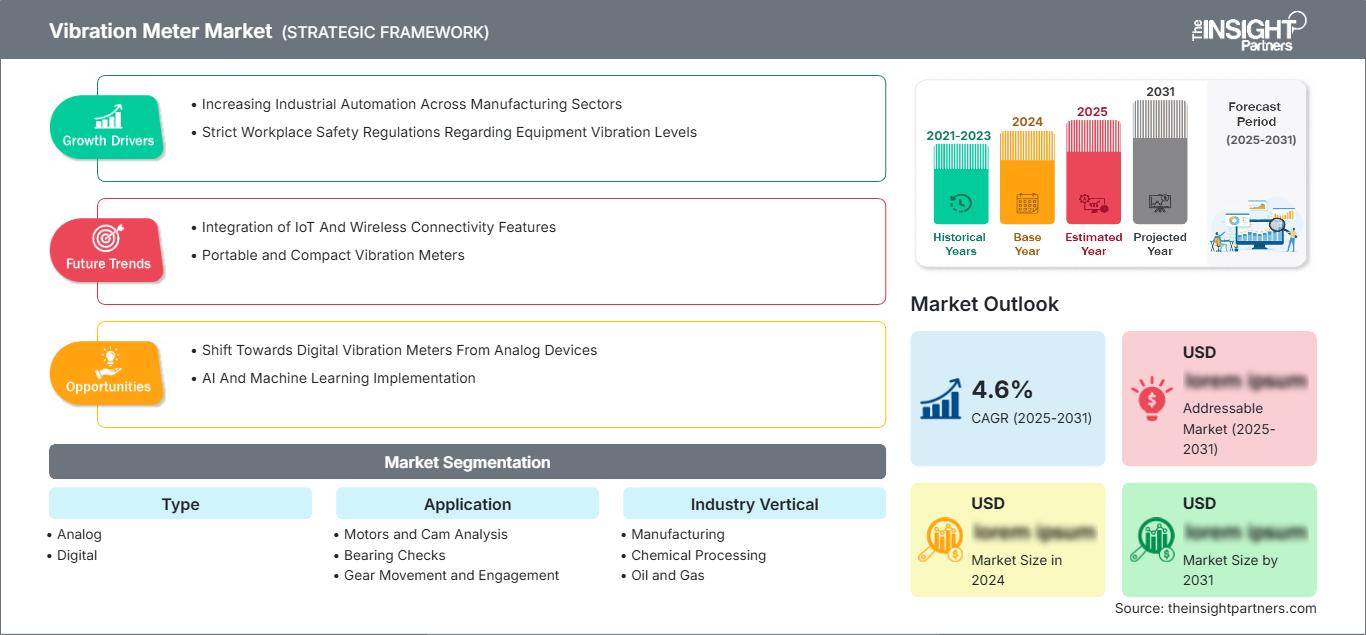
Vibration Meter Market: Strategic Insights
Regional Insights
North America Vibration meter market
North America is estimated to account for 29–33% of the global Vibration meter market share in 2025 and expand at a CAGR of 6.8–7.5% through 2034. The US dominates regional demand because manufacturing plants, utilities, oil and gas facilities, and aerospace operations maintain extensive rotating-equipment populations. Mature predictive-maintenance programs encourage routine vibration checks alongside thermal and electrical diagnostics.
Canada participates in mining, energy production, pulp & paper production, and industrial processing through applications that demand reliable machinery operation. Portable analyzers are employed to examine the motors, pumps, bearings, fans, and gearboxes before commissioning for further analysis. The local market also gains from the replacement cycle, whereby the users move from basic analog equipment to digital equipment with data logging capabilities. Suppliers with calibrated and trained service technicians have an edge since the performance and the competency of the technicians directly affect maintenance decisions.
U.S. Vibration meter market
The US represents an estimated 78–84% of the North American Vibration meter market share in 2025 and is expected to grow at a CAGR of 6.7–7.4% through 2034. Manufacturing, power generation, chemical processing, and oil and gas facilities are major application centers, with Fluke Corporation, Honeywell International Inc., General Electric Company, and FLIR Systems, Inc. maintaining relevant industrial offerings.
Increasingly, there is a demand for devices that allow for repeatable measurements combined with simpler condition indicators and data transfer capability, all done via digital meters. In terms of maintenance, there is an increasing use of hand-held instruments at the middle level in terms of inspection versus permanently installed devices. This helps to ensure fast screening of a large fleet of assets, while more sophisticated spectrum analysis is used on those machines whose behavior is out of the norm.
Europe Vibration meter market
Europe is estimated to hold 25–29% share of the Vibration meter market in 2025 and grow at a CAGR of 6.4–7.1% through 2034. Germany leads regional demand, supported by machinery production, automotive manufacturing, industrial automation, and extensive rotating-equipment installations. The UK contributes through energy, aerospace, manufacturing, and process industries, where predictive maintenance supports asset availability and safety.
With Germany’s manufacturing process being heavily dependent on equipment, there is continuous demand for instruments of measurement on account of the use of motors, gears, pumps, and manufacturing equipment. In addition, there is more demand from France and Italy through their aerospace, automotive, machinery, energy and chemicals industries. Further, Spain also adds to the demand due to manufacturing activities, renewable energy, utilities, and industrial services. The growing trend of measurement accuracy, record keeping, durability, and compatibility with maintenance procedures is increasingly becoming a focus for European buyers.
APAC Vibration meter market
APAC is estimated to represent 27–31% share of the Vibration meter market in 2025 and grow at a CAGR of 8.0–8.8% through 2034, making it the fastest-growing major region. China leads regional demand, followed by Japan, South Korea, India, and Australia. Expanding manufacturing capacity and industrial automation are central drivers.
The machinery, electronics, chemicals, and power sectors of China generate a wide range of needs in terms of equipment monitoring. Precision maintenance is the focus in Japan, and South Korea offers strong applicability in semiconductors, automotive, and the manufacturing industry. India's growing manufacturing base and energy sector infrastructure provide a boost to the implementation of CBM, while Australia contributes to the demand from the mining industry. Policy support for modernizing industry and digital manufacturing further encourages the implementation of CBM.
Middle East & Africa Vibration meter market
The Middle East and Africa Vibration meter market demand is projected to expand at a CAGR of 6.1–6.8% through 2034. Saudi Arabia leads regional adoption, followed by the UAE and South Africa, while other Gulf states and African industrial markets provide additional opportunities through energy and infrastructure investment.
Oil and gas facilities require reliable monitoring of pumps, compressors, turbines, and other rotating assets, creating recurring demand for rugged instruments. Saudi Arabia and the UAE are also expanding industrial processing and infrastructure capacity, while South Africa contributes mining, metals, utilities, and manufacturing applications. Buyers increasingly value portable devices that allow technicians to perform rapid field checks before engaging specialized vibration-analysis services.
Segmentation Analysis
Type
Digital instruments are expected to remain the dominant type, with a CAGR of 7.8–8.5% during 2026–2034. Their ability to combine multiple measurement parameters, store readings, display severity indicators, and support digital maintenance workflows makes them increasingly preferable for industrial teams. Analog instruments retain relevance where simplicity, low acquisition cost, and established maintenance routines outweigh advanced data-management requirements, according to the Vibration Meter Market report.
- Analog: Analog instruments retain a niche position among cost-sensitive users and legacy maintenance operations. Their straightforward displays and limited electronics can support basic field checks where connectivity and automated diagnostics are unnecessary.
- Digital: Digital instruments offer broader measurement functionality, data retention, improved readability, and diagnostic features. Their compatibility with connected maintenance workflows strengthens adoption across manufacturing, energy, chemical processing, and other industrial environments.
Application
Application demand is diversified across rotating machinery, with motors and cam analysis forming a major installed-use case. The application segment is projected to expand at a CAGR of 7.3–8.1% during 2026–2034 as users apply portable measurements for fault screening, equipment commissioning, and preventive maintenance, reflecting key Vibration Meter Market trends.
- Motors and Cam Analysis: Motor-related measurement remains fundamental because electric motors are widely deployed across industrial facilities. Portable vibration checks help identify imbalance, misalignment, looseness, and developing mechanical abnormalities.
- Bearing Checks: Bearing inspection is strategically important because vibration changes can provide early indications of lubrication, alignment, wear, and mechanical condition, enabling maintenance teams to intervene before secondary equipment damage occurs.
- Gear Movement and Engagement: Gear monitoring supports machinery reliability, where tooth wear, eccentricity, backlash, and alignment problems can generate distinctive vibration patterns. Demand is strongest in gear-driven production and process equipment.
- Pumps: Pump applications remain significant across water, chemical, energy, and manufacturing facilities. Vibration measurements help identify imbalance, cavitation-related conditions, misalignment, and bearing deterioration during routine maintenance.
- Turbine Monitoring: Turbine monitoring is gaining importance as power-generation and industrial turbine assets require high availability. Portable instruments provide complementary checks during inspections, commissioning, troubleshooting, and planned maintenance activities.
- Others: Additional applications span fans, compressors, blowers, conveyors, machine tools, and miscellaneous rotating assets. These uses broaden the customer base because vibration screening can be applied across varied equipment configurations.
Industry Vertical
Manufacturing represents a broad demand center because plants operate numerous motors, pumps, gearboxes, fans, and machine tools. The industry vertical segment is expected to grow at a CAGR of 7.4–8.2% during 2026–2034, supported by reliability-focused maintenance and industrial automation across the Vibration Meter Market.
- Manufacturing: Manufacturing plants use vibration measurement to support production continuity and identify mechanical problems before they affect throughput. Adoption is reinforced by large installed equipment populations and preventive-maintenance schedules.
- Chemical Processing: Chemical plants rely on pumps, compressors, motors, and rotating process equipment that require dependable monitoring. Rugged instruments and hazardous-area-compatible solutions are particularly important where equipment operates in demanding environments.
- Oil and Gas: Oil and gas facilities use vibration measurements across compressors, pumps, turbines, and auxiliary equipment. Monitoring supports asset integrity and maintenance planning in operations where equipment failure can have substantial production consequences.
- Energy and Power: Power facilities use vibration checks across turbines, generators, pumps, and balance-of-plant machinery. Measurement supports reliability programs, outage planning, commissioning, and troubleshooting across conventional and renewable-energy infrastructure.
Opportunity Snapshot
| Application | Revenue Contribution | Trend Tag | Adoption Stage |
| Motors and Cam Analysis | High | Motor Health | Mature |
| Bearing Checks | High | Bearing Diagnostics | Mature |
| Gear Movement and Engagement | Medium | Gear Reliability | Scaling |
| Pumps | High | Pump Health | Mature |
| Turbine Monitoring | Medium | Turbine Reliability | Scaling |
| Others | Low | Asset Screening | Scaling |
Vibration Meter Market Growth Drivers and Impact Analysis
Expansion of predictive maintenance programs
Industrial operators are moving maintenance from fixed schedules toward condition-based decisions because unexpected equipment failures can disrupt production, increase repair requirements, and reduce asset utilization. Vibration measurement provides a relatively accessible diagnostic layer for identifying abnormal mechanical behavior before failures become severe. The impact is strongest where facilities operate large populations of motors, pumps, compressors, fans, gearboxes, and turbines. Portable meters can be deployed without the installation expense associated with fully instrumented monitoring networks, making them suitable for periodic inspection routes. As maintenance organizations formalize asset-health procedures, measurement frequency can increase, and handheld devices can become standard technician equipment. This expands recurring demand while also encouraging manufacturers to improve repeatability, data storage, connectivity, and user guidance, according to the Vibration Meter Market report.
Growth of industrial automation and connected maintenance
Increased automation in the manufacturing process means more complex and comprehensive data generated by the production assets, and there is now a need for measuring instruments that will complement the maintenance system already in place. Digital vibration meters can offer standardized readings that will allow for comparisons among inspection runs and machines. With regard to connectivity, it means less manual transcription and more collaboration between the people on the ground and other departments like reliability engineering and maintenance management. There is much more than mere hardware involved when it comes to the commercial success of digital meters, as software, calibration, training, and reliability services can be added around each meter sold. Companies with the capability to integrate measuring devices in the production workflow are in a better position to take advantage of higher-value opportunities.
Rising reliability requirements for critical rotating equipment
For critical machinery used in energy production, chemical processing, oil and gas production, and manufacturing plants, operating conditions may lead to the onset of degradation, resulting in potential consequences to their operation. Vibration analysis represents a proven technique for evaluating balance problems, alignment problems, looseness, bearing wear, and other mechanical problems. Increased focus on equipment availability makes companies adopt inspection using quantitative measurements in addition to visual inspection. This aspect becomes important when dealing with equipment that cannot be inspected easily due to its operational status. Portable tools make it possible to conduct inspections when the equipment is still operating or during scheduled maintenance periods. As more facilities are built or upgraded, procurement needs take into account measurement ranges, environmental protection, sensors, calibration capabilities, and data management systems.
Vibration Meter Market Future Trends
Integration of handheld meters with intelligent reliability platforms
The next stage of product development is likely to connect handheld measurement more closely with asset-management and reliability platforms. Instead of treating each reading as an isolated observation, digital systems can associate measurements with equipment identifiers, inspection routes, historical values, technician notes, and maintenance actions. This approach can improve trend visibility and reduce the risk of inconsistent recordkeeping. Wireless transfer and mobile interfaces will support faster communication between field personnel and reliability specialists, while automated thresholds can help prioritize abnormal assets. Manufacturers are therefore likely to compete through complete measurement workflows rather than hardware specifications alone. The most valuable products will combine practical field ergonomics with reliable data handling, making advanced diagnostics accessible to technicians who do not perform specialist vibration analysis every day in the Vibration Meter Market.
Greater specialization for hazardous and demanding environments
Industrial users increasingly require measurement equipment that can operate safely around hazardous atmospheres, high temperatures, dust, moisture, and difficult access conditions. This will encourage greater specialization in enclosure design, certification, sensor mounting, battery management, and measurement workflows. The trend is particularly relevant to chemical processing, oil and gas, mining, and energy applications, where conventional handheld devices may not satisfy operational requirements. SKF's development of a hazardous-area version of its Microlog Analyzer dBX, certified for IECEx, ATEX, Class I Division 2, and Class I Zone 2 applications, illustrates how suppliers are responding to this requirement. As certification capabilities broaden, specialized instruments can address higher-value maintenance environments and strengthen supplier differentiation.
Vibration Meter Market Opportunities
Expansion across emerging manufacturing clusters
Emerging manufacturing clusters in India, Southeast Asia, China, and other developing industrial economies present an opportunity for suppliers to build distribution, calibration, training, and after-sales networks alongside hardware sales. Many facilities are expanding production capacity while simultaneously formalizing maintenance practices, creating demand for practical instruments that can be deployed across large equipment populations. Suppliers can target these customers with tiered portfolios covering basic digital meters, connected devices, and more advanced diagnostic platforms. Local service partnerships can reduce procurement barriers and improve instrument uptime through calibration and repair capabilities. The opportunity is strongest where industrial modernization is accompanied by investments in automation, energy efficiency, and reliability engineering. Companies that establish technical support early can build durable customer relationships as facilities progressively adopt more sophisticated monitoring programs.
Development of specialized application packages
Application-specific packages can create additional value by combining vibration meters with sensors, mounting accessories, software, training, and standardized inspection procedures. Rather than selling a generic measurement device, suppliers can configure solutions for motors, bearings, pumps, turbines, compressors, or hazardous-area equipment. This approach can simplify procurement for industrial customers and help less-specialized maintenance teams obtain consistent results. It also creates opportunities for recurring service revenue through calibration, analytics, training, and equipment-health assessments. Vendors with established relationships in manufacturing, energy, chemical processing, and oil and gas can use these application packages to increase penetration within existing accounts. The opportunity is particularly attractive where customers want to expand condition-based maintenance but lack the internal expertise needed to design measurement programs independently.
Frequently Asked Questions

- Comprehensive Market Sizing and Forecast Analysis
- Detailed Segmentation Analysis
- In-Depth Market Dynamics Assessment
- Regional and Country-Level Insights
- Competitive Landscape and Company Benchmarking
- Strategic Business Intelligence
Recent Reports
Testimonials

The Insight Partners' SCADA System Market report is comprehensive, with valuable insights on current trends and future forecasts. The team was highly professional, responsive, and supportive throughout. We are very satisfied and highly recommend their services.
RAN KEDEM Partner, Reali Technologies LTDs
I requested a report on a very specific software market and the team produced the report in a few days. The information was very relevant and well presented. I then requested some changes and additions to the report. The team was again very responsive and I got the final report in less than a week.
JEAN-HERVE JENN Chairman, Future Analytica
We worked with The Insight Partners for an important market study and forecast. They gave us clear insights into opportunities and risks, which helped shape our plans. Their research was easy to use and based on solid data. It helped us make smart, confident decisions. We highly recommend them.
PIYUSH NAGPAL Sr. Vice President, High Beam Global
The Insight Partners delivered insightful, well-structured market research with strong domain expertise. Their team was professional and responsive throughout. The user-friendly website made accessing industry reports seamless. We highly recommend them for reliable, high-quality research services
YUKIHIKO ADACHI CEO, Deep Blue, LLC.
This is the first time I have purchased a market report from The Insight Partners.While I was unsure at first, I visited their web site and felt more comfortable to take the risk and purchase a market report.I am completely satisfied with the quality of the report and customer service. I had several questions and comments with the initial report, but after a couple of dialogs over email with their analyst I believe I have a report that I can use as input to our strategic planning process.Thank you so much for taking the extra time and making this a positive experience.I will definitely recommend your service to others and you will be my first call when we need further market data.
JOHN SUZUKI President and Chief Executive Officer, Board Director, BK Technologies
I wish to appreciate your support and the professionalism you displayed in the course of attending to my request for information regarding to infectious disease IVD market in Nigeria. I appreciate your patience, your guidance, and the fact that you were willing to offer a discount, which eventually made it possible for us to close a deal. I look forward to engaging The Insight Partners in the future, all thanks to the impression you have created in me as a result of this first encounter.
DR CHIJIOKE ONYIA MANAGING DIRECTOR, PineCrest Healthcare Ltd.Reason to Buy
- Informed Decision-Making
- Understanding Market Dynamics
- Competitive Analysis
- Identifying Emerging Markets
- Customer Insights
- Market Forecasts
- Risk Mitigation
- Boosting Operational Efficiency
- Strategic Planning
- Investment Justification
- Tracking Industry Innovations
- Aligning with Regulatory Trends





 Get Free Sample for