
Vibration Motors Market Size, Share & Demand by 2034
Coverage: By Type (AC Motor, DC Motor); Voltage Rating (Below 1.5 V, 1.5 V - 2 V, Above 2 V); Application (Consumer Electronics, Medical Devices, Industrial Handheld Devices, Others), and Geography (North America, Europe, Asia Pacific, and South and Central America)
- Status : Data Released
- Report Code : TIPRE00015334
- Category : Electronics and Semiconductor
- No. of Pages : 150
- Available Report Formats :


- Last update date : September 18, 2026


2025 Market Size
US$ 5.84 Bn
Base year value
2034 Forecast
US$ 18.28 Bn
Projected by 2034
CAGR 2026-2034
13.52 %
Growth rate
Addressable Market
US$ 104.48 Bn
(2026-2034)
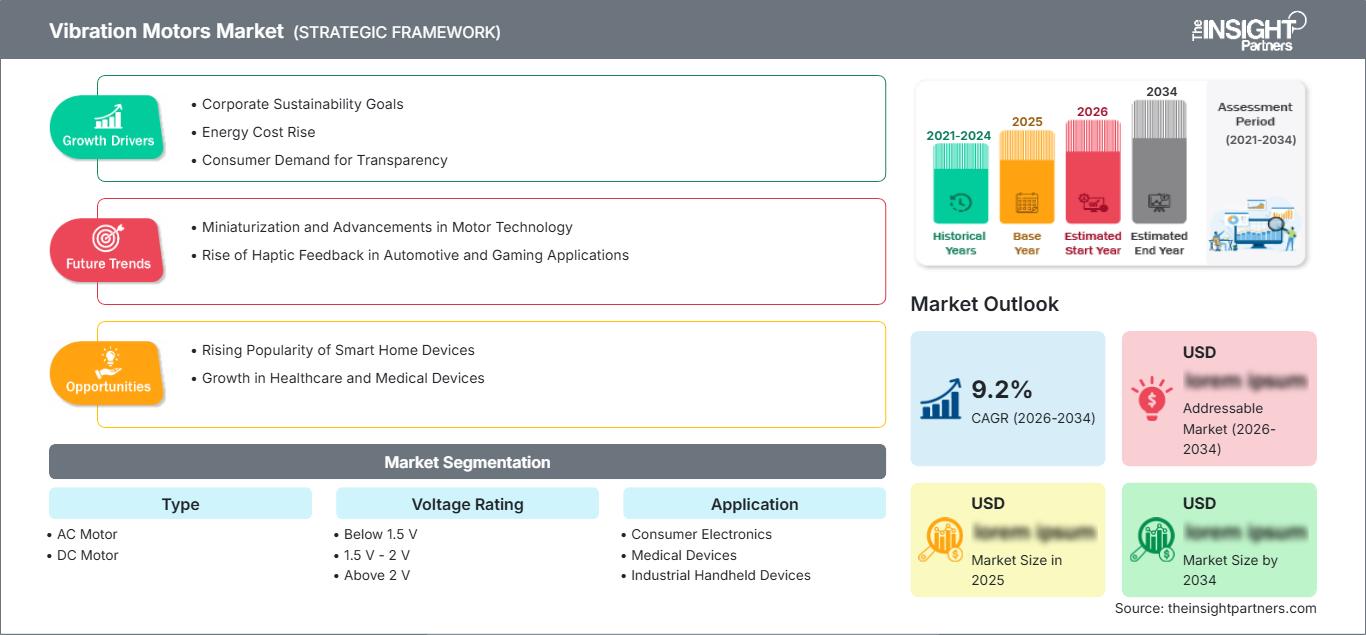
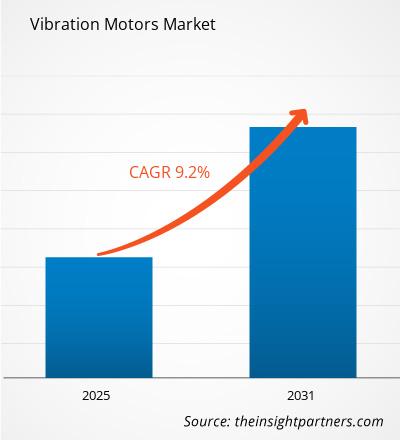
The vibration motors market is valued at US$ 5.84 Billion in 2025 and is projected to reach US$ 18.28 Billion by 2034, registering a CAGR of 13.52% during 2026–2034. Expansion is supported by increasing integration of compact haptic feedback, alerting, and tactile functions across electronic and medical products, alongside continued miniaturization of electromechanical components.
In North America, the vibration motors market size is expected to expand at an estimated CAGR of 11.8–12.8% during 2026–2034. Growth is structurally supported by demand for advanced consumer electronics, connected medical equipment, industrial handheld devices, and sophisticated human-machine interfaces requiring compact, responsive feedback mechanisms.
Vibration Motors Market Assessment and Insights
- North America: The region is estimated to account for 23–27% share in 2025 and is projected to grow at a CAGR of 11.8–12.8% between 2026–2034, supported by electronics innovation and medical-device manufacturing.
- US: The US represents approximately 72–76% of North American demand in 2025 and is expected to grow at a CAGR of 11.5–12.5% during 2026–2034.
- Europe: Europe holds an estimated 21–25% share in 2025 and is projected to expand at 12.2–13.2% CAGR. Germany, the UK, France, Italy, and Spain support demand through medical technology and industrial automation.
- Asia Pacific: Asia Pacific represents approximately 43–47% share in 2025 and is forecast to grow at 14.5–15.5% CAGR, led by China, Japan, South Korea, and India through electronics manufacturing and component localization.
- Largest Segment: DC Motor is estimated to hold a 72–76% market share in 2025 and grow at a 13.1–14.0% CAGR through established low-voltage designs and broad integration.
- High Growth Segment: Medical Devices is estimated at a 16–20% market share in 2025 and is expected to expand at a 15.2–16.2% CAGR as tactile and alerting functions diversify.
- Key companies analyzed in detail: GW Electric (Shanghai) Co., Ltd.; JAHWA ELECTRONICS CO., LTD.; Jinlong Machinery & Electronics Co., Ltd.; MABUCHI MOTOR CO., LTD.; Nidec Copal Corporation; Precision Microdrives Limited; Shandong Shanbo Electric Machine Group Co., Ltd.; Shinano Kenshi Co., Ltd.; Venanzetti Vibrazioni Milano S.r.l.; Wolong Electric Group Co., Ltd.; MinebeaMitsumi Inc.; AAC Technologies Holdings Inc.
Source: The Insight Partners' analysis based on proprietary research, government publications, company annual reports, investor presentations, industry databases, and expert interviews.
The vibration motors market has evolved from conventional rotary alert mechanisms toward compact actuators engineered for differentiated amplitude, frequency, response time, and power consumption. Production increasingly emphasizes thinner housings, improved balancing, tighter tolerances, and application-specific mounting. Miniature linear and eccentric rotating mass architectures are being optimized for smartphones, wearables, gaming equipment, medical instruments, and industrial interfaces where available installation volume is constrained.
Going forward, procurement will increasingly prioritize energy efficiency, repeatability, lifecycle reliability, and integration flexibility alongside unit price. Emerging manufacturing centers in Asia Pacific are strengthening localized supply, while North American and European buyers emphasize qualification, traceability, and application validation. Regulatory attention toward medical-device reliability and electronic-product efficiency should encourage suppliers to demonstrate consistent performance across higher-volume production environments.
Vibration Motors Market Report Scope
| Report Attribute | Details |
|---|---|
| Market size in 2025 | US$ 5.84 Billion |
| Market Size by 2034 | US$ 18.28 Billion |
| Global CAGR (2026 - 2034) | 13.52% |
| Historical Data | 2021-2024 |
| Forecast period | 2026-2034 |
Vibration Motors Market Analysis
The vibration motors market growth is being shaped by rising demand for immediate tactile feedback, compact alerting functions, and low-power electromechanical interfaces. The chain of supply ranges from the raw materials through the magnets, windings, shafts, unbalances, cases, electronic controls, assembly, testing and OEM integration process. Those suppliers that coordinate their production activities in an integrated manner may enhance reliability and reduce time spent in the qualification process, while application engineers have a greater role in selecting components.
Supply chain dynamics continue to be tightly linked with the capabilities of producing miniature motors in China, Japan, South Korea and other Asian countries. Buyers now need parts that meet stricter requirements for vibration performance and customized electrical features rather than the standard commodity parts. It works in favor of those suppliers who can integrate mass production with engineering capability.
The vibration motors market analysis also indicates a fragmented competitive structure, with global motor specialists competing alongside regional miniature-actuator manufacturers. MABUCHI MOTOR CO., LTD., Nidec Copal Corporation, Shinano Kenshi Co., Ltd., and MinebeaMitsumi Inc. focus on deep engineering and expertise in miniature motors, while Precision Microdrives Limited is characterized by customization capabilities in miniature products. The strategies of JAHWA ELECTRONICS CO., LTD. and AAC Technologies Holdings Inc. are focused on small-scale haptic and mobile device applications.
New investment directions include automation technologies, custom actuator designs, and application engineering value add. Wolong Electric Group Co., Ltd. keeps expanding its motor system technology, while Shandong Shanbo Electric Machine Group Co., Ltd., Jinlong Machinery & Electronics Co., Ltd., GW Electric (Shanghai) Co., Ltd., and Venanzetti Vibrazioni Milano S.r.l. contribute additional competitive strength. Increasingly, strategic positioning requires qualification competence, geographical supply flexibility, broadness of product range, and customer support from design prototype to volume manufacturing capability.
● REPORT CUSTOMIZATION
Tailor This Report To Align With Your Specific Business Requirements
This report can be customized to align precisely with your business objectives, scope, and target markets. Customization options include tailored segmentation, geography, competitive analysis, and strategic insights to support informed decision-making.
Customize This Report →WHAT YOU CAN ADJUST
- ● Segmentations
- ● Geography
- ● Competitive Analysis
- ● Language Preferences
Vibration Motors Market: Strategic Insights
Regional Insights
North America vibration motors market
North America is estimated to hold 23–27% of the global vibration motors market share in 2025 and is projected to grow at a CAGR of 11.8–12.8% through 2034. The US continues to be the main market, owing to consumer electronics, medical devices, video game equipment, industrial equipment, and complex human-machine interface technologies. The trend in procurement is moving towards smaller and more efficient actuators, which are capable of providing predictable tactile feedback on device platforms.
The local demand will be driven by advanced medical device manufacturing and automation infrastructure. The application designers now incorporate the requirements for vibrations at the design phase of a product rather than treat the actuators as replaceable parts. Canada provides opportunities in specialized industrial and health care sectors, while Mexico has opportunities in electronic devices and product manufacturing.
U.S. vibration motors market
The U.S. accounts for approximately 72–76% of the North American vibration motors market demand in 2025 and is expected to expand at a CAGR of 11.5–12.5% during 2026–2034. The industry is fortunate to have consumer-device developers, medical-equipment manufacturers, game platforms, and industrial tool manufacturers in its midst. The application needs are becoming more concerned with miniaturization, noise reduction, quick responsiveness, and programmable haptic response.
Nidec Copal Corporation, Precision Microdrives Limited, MABUCHI MOTOR CO., LTD., and MinebeaMitsumi Inc. offer their products to their customers based on the strength of miniaturized motors and actuators. There is growing interest among customers beyond the traditional mobile phone alarms and into wearable products, diagnostic devices, smart control systems, and custom-designed interfaces. Customers in the United States are particularly concerned about the qualification, electromagnetic compatibility, and reliability of components.
Europe vibration motors market
Europe is estimated to represent 21–25% share of the vibration motors market in 2025 and is projected to register a CAGR of 12.2–13.2% through 2034. Germany is still leading, with advantages such as industrial automation, precision engineering, medical engineering, and manufacturing technologies. The demands of Europe include high quality, miniaturization of components, repeatability, and good documentation.
The UK is backed by medical instruments, robotics, wearable technology, and engineering applications. On the other hand, Germany leads in industrial and automotive engineering. France, Italy, and Spain provide through medical devices, consumer goods, industrial machinery, and electronic manufacturing. Efficient actuators are in great demand within the region, along with customizing and good-quality systems.
APAC vibration motors market
APAC represents approximately 43–47% share of the vibration motors market in 2025 and is expected to expand at a CAGR of 14.5–15.5% through 2034. China is the most dominant country due to electronics manufacturing, local sourcing of components, and mass manufacturing processes. Japan and South Korea will continue to play a significant role in producing precision motors, smartphones, wearable devices, and electronic assemblies.
India and Australia also offer prospects from electronics localization, medical equipment, industrial digitization, and device manufacturing. Policy programs from different regions regarding semiconductors, electronics, and manufacturing can further enhance demand for locally integrated miniature components. Efficient manufacturing, along with increasing domestic demand, will ensure APAC’s role in global supply chain evolution.
Middle East & Africa vibration motors market
The Middle East and Africa vibration motors market demand is projected to expand at an estimated CAGR of 11.0–12.0% during 2026–2034. Saudi Arabia and the UAE are leading regional markets, supported by industrial diversification, smart infrastructure, healthcare investment, and electronics adoption. South Africa contributes through industrial equipment, medical applications, and established distribution networks.
The broader region offers opportunities where automation and connected equipment are expanding. Healthcare modernization and infrastructure programs can increase adoption of compact alerting and tactile components, while energy-sector digitization supports industrial handheld applications. Local assembly and distribution partnerships are likely to become increasingly important as customers seek shorter delivery times and technical support.
Segmentation Analysis
Type
Type segmentation is defined by AC Motor and DC Motor architectures. DC Motor is the largest category, benefiting from mature low-voltage designs, broad availability, straightforward control, and extensive deployment in consumer and industrial products. AC Motor solutions remain relevant where specific vibration characteristics, operating conditions, or application architectures justify their use. Type-level demand is expected to remain differentiated by power requirements, form factor, control method, and lifecycle expectations.
- AC Motor: AC Motor solutions serve applications requiring defined operating characteristics and specialized actuation. Demand is supported by industrial equipment and selected device architectures where alternating-current operation aligns with existing system design.
- DC Motor: DC Motor technology maintains broad adoption because compact construction, simple control, and extensive manufacturing availability suit phones, wearables, medical devices, scanners, and handheld equipment.
Voltage Rating
Voltage Rating segmentation comprises Below 1.5 V, 1.5 V - 2 V, and Above 2 V. The segment is increasingly influenced by battery constraints, controller architecture, required vibration intensity, and available electrical headroom, reflecting key vibration motors market trends. Low-voltage products are particularly relevant to portable electronics, while higher ratings support applications requiring stronger output or different operating conditions. Component suppliers are therefore developing broader voltage compatibility and tighter electrical tolerances.
- Below 1.5 V: Low-voltage motors address battery-powered products where energy consumption and thermal performance are critical. Their compact architecture supports wearables, portable electronics, and highly constrained embedded designs.
- 1.5 V - 2 V: This range balances compact electronics requirements with useful vibration output. It is strategically relevant for mainstream consumer devices and medical products requiring predictable tactile or alerting performance.
- Above 2 V: Higher-voltage motors support applications requiring stronger vibration characteristics or greater operating headroom. Industrial handheld equipment and selected larger electronic devices represent important demand areas.
Application
Application segmentation includes Consumer Electronics, Medical Devices, and Industrial Handheld Devices. Consumer Electronics remains the broadest demand pool, while Medical Devices represents the fastest-expanding application because tactile alerts, user guidance, and compact actuation are becoming more relevant to sophisticated equipment. Industrial Handheld Devices provide a stable opportunity where vibration is used for warnings, confirmations, and operator interaction, according to the vibration motors market forecast.
- Consumer Electronics: Consumer Electronics demand is anchored by smartphones, wearables, gaming devices, smart controls, and other products requiring silent alerts or tactile confirmation. Design cycles increasingly favor thinner, lower-power actuators.
- Medical Devices: Medical Devices require reliable, compact feedback mechanisms for alerts, guidance, and user interaction. Adoption benefits from device miniaturization, home healthcare, portable diagnostics, and increasingly sophisticated interfaces.
- Industrial Handheld Devices: Industrial Handheld Devices use vibration for operator warnings, status notifications, and interaction feedback. Demand is linked to barcode scanners, measurement equipment, power tools, inspection devices, and connected field equipment.
Opportunity Snapshot
| Application | Revenue Contribution | Trend Tag | Adoption Stage |
| Consumer Electronics | High | Tactile Interfaces | Mature |
| Medical Devices | Medium | Clinical Alerts | Scaling |
| Industrial Handheld Devices | Medium | Operator Feedback | Scaling |
Vibration Motors Market Growth Drivers and Impact Analysis
Miniaturization of Electronic and Wearable Devices
The reduction of internal space and increased functionality are pushing device makers to seek out actuators that have smaller form factors and reduced energy consumption. In terms of business impact, this means increasing the applicability of miniature vibration components in applications such as smartphones, smartwatches, game devices, medical wearable devices, and dedicated instruments. The miniature vibration technology that Nidec has produced has a few millimeters in size, showing how, through shrinking components, a new range of architectures can be developed. From a supply side point of view, this means moving from general motors to custom components with precise specifications in terms of vibration characteristics, size, heat, and performance.
Expansion of Haptic and Tactile User Interfaces
User interfaces are increasingly combining visual information with physical feedback to improve interaction, confirmation, accessibility, and immersion. Gaming controllers, wearables, smart devices, automotive interfaces, and emerging spatial-computing products are expanding the range of applications requiring precise vibration patterns. The vibration motors market benefits because tactile functionality can be implemented through compact actuators without materially increasing product size. Competition is consequently shifting toward response speed, vibration consistency, acoustic characteristics, and compatibility with sophisticated control electronics. Suppliers capable of producing multiple vibration profiles and supporting application-specific tuning can participate in higher-value opportunities. Increasing expectations for realistic tactile feedback also encourage manufacturers to develop components that support more nuanced actuation rather than simple binary alerts.
Growing Use of Portable Medical and Industrial Equipment
Healthcare devices and handheld industrial devices now need quick feedback as a means of communication of warning messages, operation states, and user instructions. Vibration provides a means of communicating feedback without attracting much attention, especially if the operator is moving around or working in a noisy environment. Vibrations help in medical products where there is a need for small-scale feedback communication due to limited screen and battery capacity. Vibration has market applications in diagnostic devices, drug management devices, barcode readers, inspection devices, and connected devices. The need for reliability, accuracy, and resistance to different environments becomes a challenge for suppliers in these applications. With early integration of feedback systems into the product development process, motor companies that can test and customize their mechanical products can gain an important role in the process.
Vibration Motors Market Future Trends
Software-Defined Tactile Feedback and Adaptive Actuation
Future vibration systems are likely to see the merging of small actuators with computer-controlled feedback curves that provide different intensities, frequencies, and durations of vibrations, dependent on the situation. Rather than providing one constant vibration pattern as an alarm, the device will be able to generate distinct vibration patterns to distinguish between notifications, navigational purposes, security warnings, and other interactions. Such advancement would result in higher demand for motors that provide quick responses and repeatable results in varied conditions. Adaptive feedback would prompt the collaboration between actuator manufacturers and electronic developers to develop validated actuator and motor control systems combinations. With increasing personalization of user interfaces, manufacturers would have to characterize vibration performance not only from the components but from the system point of view as well.
Ultra-Low-Power Actuation for Battery-Constrained Products
Energy efficiency is likely to be a deciding factor in choosing wearables, intelligent accessories, health-related sensors, and portable connectable gadgets that have to run on very low battery power. In future, the actuators will feature the following design aspects: efficient magnetic circuit, minimized mechanical energy losses, optimum mass balance, and precise driving. Very tiny actuators will be used in devices where normal actuators would waste too much power or take up too much room. This trend will promote the wider implementation of tactile feedback in light-weighted devices such as styli products and smart glasses. Suppliers who manage to cut down power consumption without decreasing the vibration level of actuators will establish their positions in design programs where battery life influences the usability of the product.
Vibration Motors Market Opportunities
Localized Production for Asian Electronics Ecosystems
The rapid concentration of electronics manufacturing in the Asia Pacific creates opportunities for suppliers to establish localized engineering, assembly, and testing capabilities close to major device-production clusters. China, Japan, South Korea, and India offer different combinations of component expertise, consumer demand, manufacturing scale, and government-supported electronics development. Local production can reduce logistics exposure, shorten prototype cycles, and improve responsiveness to customized specifications. For investors and manufacturers, the strongest opportunities are likely to involve facilities capable of both high-volume standard production and smaller engineering batches for new designs. Partnerships with electronics assemblers and original-equipment manufacturers can further improve access to recurring programs. These strategies can also strengthen supply-chain resilience by reducing dependence on single-country production footprints.
Premium Medical and Industrial Actuator Solutions
Medical and industrial customers offer opportunities to move beyond commodity motor supply toward application-specific assemblies supported by engineering, testing, and lifecycle services. Buyers in these segments often value reliability, repeatability, customization, and documentation more heavily than minimum component price. Suppliers can develop differentiated products around specialized mounting systems, controlled vibration output, low-noise operation, environmental resistance, and application-specific electrical characteristics. Medical equipment represents an attractive avenue because portable diagnostics, home healthcare, and sophisticated patient-interface products require compact feedback mechanisms. Industrial applications similarly create opportunities in scanners, inspection instruments, connected tools, and field equipment. A strategy combining motor manufacturing with testing, mechanism design, and technical support can improve customer retention and increase value captured per design program.
Frequently Asked Questions

- Comprehensive Market Sizing and Forecast Analysis
- Detailed Segmentation Analysis
- In-Depth Market Dynamics Assessment
- Regional and Country-Level Insights
- Competitive Landscape and Company Benchmarking
- Strategic Business Intelligence
Recent Reports
Testimonials

The Insight Partners provided valuable market intelligence that supported our global go-to-market strategy. Their team was professional, responsive, and attentive to our feedback, providing thoughtful analysis and helpful methodological clarifications throughout the project.
Junmo Kim Chief Financial Officer (CFO), Enertech Co., Ltd.
The Insight Partners' SCADA System Market report is comprehensive, with valuable insights on current trends and future forecasts. The team was highly professional, responsive, and supportive throughout. We are very satisfied and highly recommend their services.
RAN KEDEM Partner, Reali Technologies LTDs
I requested a report on a very specific software market and the team produced the report in a few days. The information was very relevant and well presented. I then requested some changes and additions to the report. The team was again very responsive and I got the final report in less than a week.
JEAN-HERVE JENN Chairman, Future Analytica
We worked with The Insight Partners for an important market study and forecast. They gave us clear insights into opportunities and risks, which helped shape our plans. Their research was easy to use and based on solid data. It helped us make smart, confident decisions. We highly recommend them.
PIYUSH NAGPAL Sr. Vice President, High Beam Global
The Insight Partners delivered insightful, well-structured market research with strong domain expertise. Their team was professional and responsive throughout. The user-friendly website made accessing industry reports seamless. We highly recommend them for reliable, high-quality research services
YUKIHIKO ADACHI CEO, Deep Blue, LLC.
This is the first time I have purchased a market report from The Insight Partners.While I was unsure at first, I visited their web site and felt more comfortable to take the risk and purchase a market report.I am completely satisfied with the quality of the report and customer service. I had several questions and comments with the initial report, but after a couple of dialogs over email with their analyst I believe I have a report that I can use as input to our strategic planning process.Thank you so much for taking the extra time and making this a positive experience.I will definitely recommend your service to others and you will be my first call when we need further market data.
JOHN SUZUKI President and Chief Executive Officer, Board Director, BK Technologies
I wish to appreciate your support and the professionalism you displayed in the course of attending to my request for information regarding to infectious disease IVD market in Nigeria. I appreciate your patience, your guidance, and the fact that you were willing to offer a discount, which eventually made it possible for us to close a deal. I look forward to engaging The Insight Partners in the future, all thanks to the impression you have created in me as a result of this first encounter.
DR CHIJIOKE ONYIA MANAGING DIRECTOR, PineCrest Healthcare Ltd.Reason to Buy
- Informed Decision-Making
- Understanding Market Dynamics
- Competitive Analysis
- Identifying Emerging Markets
- Customer Insights
- Market Forecasts
- Risk Mitigation
- Boosting Operational Efficiency
- Strategic Planning
- Investment Justification
- Tracking Industry Innovations
- Aligning with Regulatory Trends





 Get Free Sample for