
Video Processing Platform Market Share, Growth & Demand by 2034
Coverage: By Component (Hardware, Platform, Services); Application (Video Upload and Ingestion, Dynamic Ad Insertion, Video Transcoding and Processing, Video Hosting, Content Rendering, Others); Industry (BFSI, Manufacturing, Healthcare and Lifesciences, IT and Telecommunications, Retail and Consumer Goods, Media and Entertainment, Others); Content Type (Real-Time/Live, On-Demand) , and Geography (North America, Europe, Asia Pacific, and South and Central America)
- Status : Data Released
- Report Code : TIPRE00026045
- Category : Electronics and Semiconductor
- No. of Pages : 150
- Available Report Formats :


- Last update date : September 22, 2026


2025 Market Size
US$ 8.43 Bn
Base year value
2034 Forecast
US$ 21.96 Bn
Projected by 2034
CAGR 2026-2034
11.22 %
Growth rate
Addressable Market
US$ 134.04 Bn
(2026-2034)
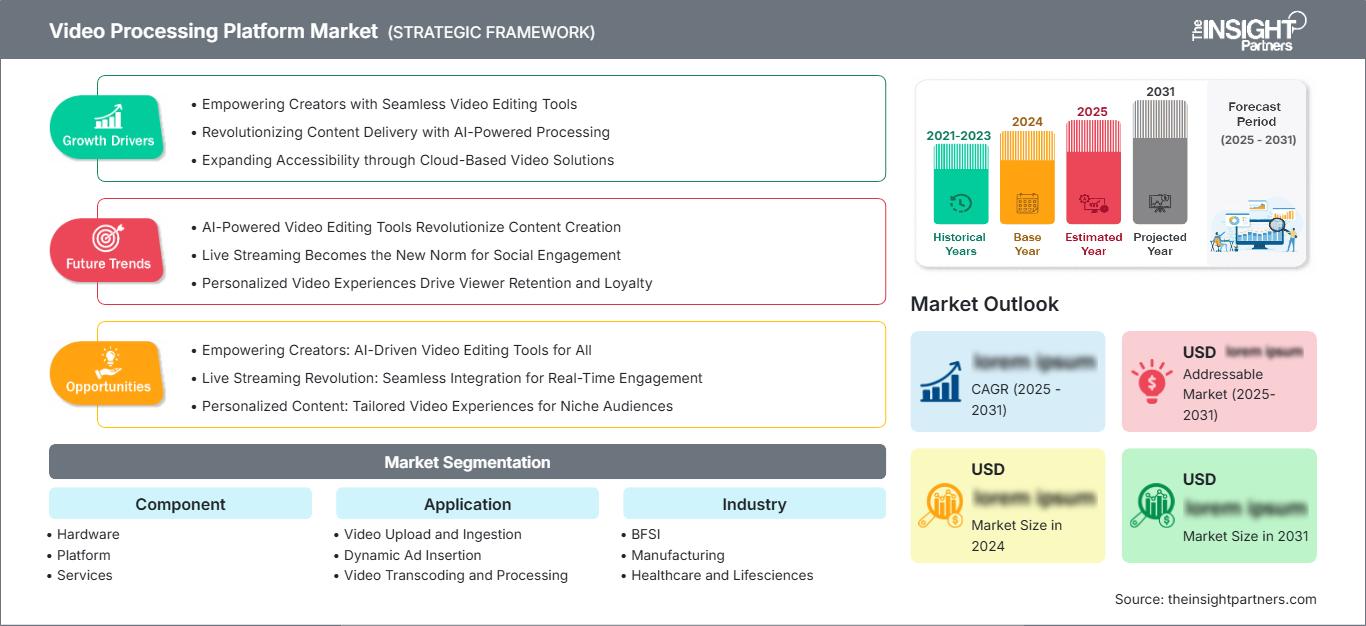
The Video processing platform market is valued at US$ 8.43 Billion in 2025 and is projected to reach US$ 21.96 Billion by 2034, expanding at a CAGR of 11.22% from 2026 to 2034. The market encompasses hardware, software platforms, and services supporting video ingestion, transcoding, hosting, rendering, monetization, and distribution across live and on-demand workflows for enterprise and media applications.
North America remains a structurally important market, with the video processing platform market size estimated to expand at approximately 9.5–11.0% CAGR between 2026–2034. High OTT penetration, cloud infrastructure availability, connected-TV adoption, live sports streaming, and increasing requirements for automated content processing support sustained investment across broadcasters, enterprises, and service providers.
Video Processing Platform Market Assessment and Insights
- North America: The region is expected to account for 36–40% share in 2025 and grow at a CAGR of 9.5–11.0% between 2026–2034, supported by mature streaming infrastructure and enterprise cloud adoption.
- US: The US is estimated to represent 80–84% of North America's 2025 market share, expanding at a CAGR of 9.7–11.2% during 2026–2034 through OTT, sports, advertising, and enterprise video workloads.
- Europe: Europe is projected to hold 25–29% share in 2025 and register a 10.0–11.8% CAGR between 2026–2034, led by the UK, Germany, France, Italy, and Spain as broadcasters modernize distribution.
- Asia Pacific: Asia Pacific is estimated at 21–25% share in 2025 and is forecast to grow at a CAGR of 12.5–14.5% through 2034, with China, Japan, South Korea, and India driving deployments.
- Largest Segment: Platform is estimated to hold a 43–47% market share in 2025 and expand at a CAGR of 11.5–13.0% during 2026–2034 as organizations favor software-defined workflows.
- High Growth Segment: Dynamic Ad Insertion is estimated at a 9–13% market share in 2025 and is expected to grow at a CAGR of 14.0–16.0% through 2034 as targeted monetization scales.
- Key companies analyzed in detail: Akamai Technologies, Inc.; Imagine Communications Corp.; MediaKind Global Ltd.; Kaltura, Inc.; ATEME S.A.; Synamedia Limited; SeaChange International, Inc.; Vantrix Corporation; NVIDIA Corporation; Pixel Power Ltd.; Amazon Web Services, Inc.; Brightcove Inc.; Harmonic Inc.
Source: The Insight Partners' analysis based on proprietary research, government publications, company annual reports, investor presentations, industry databases, and expert interviews.
The video processing platform market has evolved from appliance-heavy broadcast architectures toward software-defined, cloud-native processing environments. Higher-resolution content, adaptive bitrate delivery, codec diversification, and multiscreen distribution have increased processing requirements. At the same time, specialized GPUs, VPUs, and media accelerators are shifting transcoding economics by improving throughput and reducing infrastructure intensity. This evolution is strengthening platform-based orchestration across ingest, encoding, packaging, storage, rendering, and distribution.
In the Video Processing Platform Market report, over the forecast period, investment is expected to move toward hybrid architectures, AI-assisted media operations, low-latency processing, and automated monetization. Emerging markets in Asia Pacific and the Middle East are likely to increase deployments as broadband, 5G, connected television, and local streaming ecosystems mature. Regulatory emphasis on accessibility, privacy, content rights, and digital infrastructure will also encourage standardized, auditable workflows across enterprise and media environments.
Video Processing Platform Market Report Scope
| Report Attribute | Details |
|---|---|
| Market size in 2025 | US$ 8.43 Billion |
| Market Size by 2034 | US$ 21.96 Billion |
| Global CAGR (2026 - 2034) | 11.22% |
| Historical Data | 2021-2024 |
| Forecast period | 2026-2034 |
Video Processing Platform Market Analysis
Demand is increasingly shaped by the need to process multiple video formats while maintaining consistent quality across devices, networks, and business applications. The video processing platform market growth is therefore linked to OTT expansion, enterprise communications, digital learning, remote collaboration, surveillance, and live-event production. The environment includes cameras, contribution networks, cloud platforms, encoders, content management, advertising platforms, storage, and distribution tiers. Suppliers are consolidating these capabilities using shared control planes.
There are also shifts in the supply side as consumers are moving away from purpose-built appliances in favor of modular services. With cloud platforms, consumers can build capacity on top of the platform without buying permanent capacity. Dedicated acceleration makes processing more economic at scale. Consumers judge platforms based on their support for codecs, latency, automation, interoperation, security, observability, and total cost of ownership.
Competitive positioning is becoming increasingly multidimensional. The video processing platform market analysis indicates that vendors with strong cloud integration can compete on elasticity, while established broadcast specialists retain advantages in reliability, workflow depth, and standards support. Akamai Technologies, Inc., Imagine Communications Corp., MediaKind Global Ltd., Kaltura, Inc., ATEME S.A., and Synamedia Limited overlap in terms of the ecosystem segments addressed, whereas NVIDIA Corporation adds value to the acceleration segment by means of GPU processing and AI technology.
Investments also promote collaboration between infrastructure providers and applications experts. SeaChange International, Inc., Vantrix Corporation, Pixel Power Ltd., Brightcove Inc., and Amazon Web Services, Inc. work in different complementary areas of the workflow, and Harmonic Inc. and MediaKind Global Ltd. exemplify portfolio adjustments in media technology. Competitiveness becomes more focused on interoperability, cloud portability, monetization, and AI-based automation of workflow.
● REPORT CUSTOMIZATION
Tailor This Report To Align With Your Specific Business Requirements
This report can be customized to align precisely with your business objectives, scope, and target markets. Customization options include tailored segmentation, geography, competitive analysis, and strategic insights to support informed decision-making.
Customize This Report →WHAT YOU CAN ADJUST
- ● Segmentations
- ● Geography
- ● Competitive Analysis
- ● Language Preferences
Video Processing Platform Market: Strategic Insights
Regional Insights
North America Video Processing Platform Market
North America is estimated to command 36–40% of the Video Processing Platform Market share in 2025 and is projected to grow at a CAGR of 9.5–11.0% through 2034. The US market accounts for the key consumer of such services due to the significant presence of OTT services, connected TVs, sports streaming, enterprise communications, and advertising technologies. The contribution of Canada to the market is seen through the broadcasting sector, telecom providers, and cloud-based media solutions.
There is strong structural demand in the region due to the well-developed data center infrastructure and the large number of streaming platforms. Scalability and latency issues are handled through the use of distributed processing technology. In addition, the demand for scalable encoding and packaging is growing because of advertising-based streaming, FAST channels, personalization, and event workloads.
U.S. Video Processing Platform Market
The U.S. is estimated to represent 80–84% of North America's 2025 Market share and is forecast to grow at a CAGR of 9.7–11.2% during 2026–2034. The Video Processing Platform Market forecast remains supported by major technology and media companies that maintain substantial processing requirements spanning streaming, advertising, sports, entertainment, corporate communications, and cloud services.
Application trends increasingly favor cloud-based transcoding, real-time processing, automated metadata creation, and dynamic advertising. Akamai Technologies, Inc., Kaltura, Inc., NVIDIA Corporation, Brightcove Inc., and Amazon Web Services, Inc. have relevant technology exposure across these workflows. Enterprise customers are also emphasizing security, content governance, and integration with existing identity, storage, analytics, and distribution systems.
Europe Video Processing Platform Market
Europe is estimated to hold 25–29% share in 2025 and expand at a CAGR of 10.0–11.8% through 2034. The UK is a leading market because broadcasters and streaming operators continue investing in cloud migration, live services, targeted advertising, and multiscreen distribution. Germany is another important market, supported by industrial digitization, public broadcasting requirements, and enterprise video adoption. These Video Processing Platform Market trends reflect increasing demand for scalable cloud-native processing, AI-driven content workflows, enhanced viewer experiences, and efficient media distribution across diverse digital platforms.
France, Italy, and Spain are also expanding platform deployments as broadcasters and telecom operators modernize video infrastructure. France benefits from strong media technology capabilities, while Italy and Spain are supported by pay-TV, OTT, sports, and digital advertising applications. European demand increasingly emphasizes interoperability, data governance, energy efficiency, accessibility, and flexible hybrid architectures.
APAC Video Processing Platform Market
APAC is estimated to account for 21–25% share of the Video Processing Platform Market in 2025 and is expected to expand at a CAGR of 12.5–14.5% through 2034. China leads the regional opportunity, followed by Japan, South Korea, India, and Australia. Expanding digital video consumption and large mobile audiences are increasing processing requirements.
Policy-led digitalization, 5G deployment, local streaming platforms, and enterprise cloud adoption support investment. India presents substantial long-term potential through regional-language content and mobile-first consumption, while Japan and South Korea emphasize high-quality, technologically advanced media services. Australia benefits from mature broadband and cloud infrastructure.
Middle East & Africa Video Processing Platform Market
The Middle East and Africa Video Processing Platform Market is expected to grow at a CAGR of 10.5–12.5% through 2034. Saudi Arabia and the UAE are leading demand centers because of digital transformation programs, media investments, smart-city development, and large-scale live-event infrastructure. South Africa represents a key African market with established broadcasting and telecommunications capabilities.
Across the Rest of MEA, investments are increasingly connected to cloud adoption, telecom modernization, sports content, and digital media distribution. Energy-intensive infrastructure remains an important consideration, encouraging efficient processing architectures and workload consolidation. Regional providers are consequently evaluating cloud and hybrid platforms that can scale without extensive fixed infrastructure.
Segmentation Analysis
Component
Component remains central to platform purchasing decisions because customers balance dedicated processing performance with software flexibility and managed capabilities. The segment is projected to expand at a CAGR of 10.8–12.3% during 2026–2034. Hardware remains important for high-throughput environments, while platforms and services increasingly determine workflow scalability, automation, and lifecycle economics.
- Hardware: Hardware remains important for broadcasters and high-volume processing environments requiring predictable throughput, codec acceleration, and controlled latency. Specialized processors increasingly complement conventional servers in demanding workflows.
- Platform: Platform solutions provide centralized orchestration for ingest, processing, packaging, storage, and distribution. Their strategic importance rises as organizations seek standardized workflows across cloud and on-premises environments.
- Services: Services support implementation, integration, managed operations, optimization, and technical maintenance. Demand increases where customers require specialist expertise while limiting internal media engineering resources.
Application
Application is projected to grow at a CAGR of 11.6–13.2% between 2026–2034 as video workflows become more automated and monetization increasingly depends on processing speed and personalization. Video transcoding and processing remain foundational, while ingestion, hosting, rendering, and advertising functions are becoming more integrated.
- Video Upload and Ingestion: Ingestion systems are becoming more automated as enterprises and broadcasters manage larger volumes of live feeds, user-generated content, and distributed production sources.
- Dynamic Ad Insertion: Dynamic Ad Insertion is strategically important for monetization because operators can tailor advertising to audiences, content windows, devices, and viewing contexts without rebuilding entire distribution workflows.
- Video Transcoding and Processing: Transcoding remains a core workload because one source must frequently support multiple resolutions, codecs, bitrates, and device environments while maintaining quality and delivery efficiency.
- Video Hosting: Hosting solutions support centralized content management, playback infrastructure, security, and scalable access. Their role expands as organizations consolidate fragmented video libraries and delivery environments.
- Content Rendering: Rendering capabilities support graphics, overlays, personalization, and automated production. Adoption is encouraged by the increasing use of virtual production, branded content, and real-time viewer experiences.
Industry
Industry is expected to register a CAGR of 10.9–12.5% through 2034 as video becomes embedded in customer engagement, operational communication, training, commerce, and media distribution. Media and entertainment remain the largest application environment, while enterprise sectors broaden adoption.
- BFSI: Banks and insurers increasingly use secure video for training, customer communication, advisory services, and internal collaboration, creating requirements for governance and controlled content access.
- Manufacturing: Manufacturers deploy video for training, remote assistance, production documentation, quality processes, and connected operations, increasing demand for reliable internal video workflows.
- Healthcare and Lifesciences: Healthcare organizations use video for education, telehealth, medical communication, and professional training, requiring secure processing and controlled access.
- IT and Telecommunications: Telecom and technology companies support large-scale streaming, communications, and digital services, making scalable processing infrastructure strategically important.
- Retail and Consumer Goods: Retailers use video for commerce, advertising, product education, and customer engagement, increasing demand for personalized and rapidly deployable content.
- Media and Entertainment: Media companies require high-volume live and on-demand processing, monetization, distribution, and content management across increasingly fragmented viewing environments.
Content Type
Content Type is projected to grow at a CAGR of 11.2–12.8% during 2026–2034. Real-time video demands low latency and resilient processing, while on-demand workloads prioritize scalable storage, encoding efficiency, content enrichment, and automated distribution.
- Real-Time/Live: Live content requires synchronized ingestion, encoding, packaging, and distribution with minimal delay. Sports, news, events, and interactive applications strengthen its strategic importance.
- On-Demand: On-demand content supports scalable libraries and repeated viewing. Processing priorities include compression efficiency, automated metadata, searchability, localization, and cost-effective storage.
Opportunity Snapshot
| Application | Revenue Contribution (High/Medium/Low) | Trend Tag | Adoption Stage |
| Video Upload and Ingestion | Medium | Automated Ingest | Scaling |
| Dynamic Ad Insertion | Medium | Targeted Monetization | Scaling |
| Video Transcoding and Processing | High | Codec Acceleration | Mature |
| Video Hosting | High | Cloud Hosting | Mature |
| Content Rendering | Medium | AI Rendering | Scaling |
Video Processing Platform Market Growth Drivers and Impact Analysis
Expansion of OTT and Multiscreen Distribution Ecosystems
This constant increase in streaming services means that more versions need to be created per source material. This is because each operator may ask for varied specifications, including resolution, codecs, bitrate, captioning, packaging, and device profile. Live events such as sports add urgency to this process, since traffic can spike up within minutes and failure will have an immediate effect on the viewing experience. The video processing platform market benefits because cloud-based architectures allow operators to scale processing capacity around unpredictable demand rather than permanently maintaining peak infrastructure. FAST channels and advertising-supported services add another processing layer through segmentation, packaging, and monetization workflows. As content portfolios diversify across regions and devices, integrated platforms can reduce operational fragmentation and improve workflow consistency.
Shift Toward Specialized and Accelerated Video Processing
The economics of processing are transforming due to GPUs, VPUs, ASICs, and customized media acceleration solutions. High-resolution encoding, together with more complex codecs, can create higher CPU demands, making acceleration an increasingly tempting proposition for the big players. The effects go well beyond performance because energy usage, data center density, and resource management now play a bigger role in technology selection. Companies that combine acceleration with orchestrator software offer customers a better way of handling workloads. The video processing platform market therefore, increasingly rewards architectures that dynamically assign workloads according to complexity, latency requirements, and cost. This shift is particularly relevant for live events, large content libraries, and AI-assisted media operations, where processing intensity can vary substantially over short periods.
Growth of Addressable Video Monetization
Video advertising is increasingly being integrated into video processing infrastructure because streaming companies are exploring ways to increase their income from sources other than subscriptions. Dynamic ad insertion entails the identification of content borders, ad decisioning, packaging, and personalization. This results in the need for processing infrastructure that can support segmentation on the fly without any impact on the viewing experience. From a business perspective, this integration takes special significance in the case of FAST TV channels, connected TV, sports events, and regional channels because the audiences and the ads themselves may be quite different. In addition, there is no duplication of work processes when better integration is achieved between video processing and monetization.
Video Processing Platform Market Future Trends
AI-Native Media Processing and Automated Content Intelligence
In the future, AI is predicted to be integrated into the processing pipelines rather than just running in an analytics layer independently. Scene detection, metadata production, captioning, summarizing, quality control, classification of content, and personalization are going to be automated by the future platforms. Automation of such processes might help reduce the number of manual operations and make searching and monetization of big libraries possible. AI-supported compression is also predicted to allocate bitrate optimally, taking into account the complexity of the scenes and the conditions of watching. Eventually, orchestration engines will be able to decide on their own where to process each workload, taking into account latency, available computing power, energy consumption, and costs. This will lead to the creation of more flexible video infrastructure whose processing is always optimized and not manually configured.
Convergence of Cloud, Edge, and Hybrid Video Architectures
The future of video processing architectures is likely to involve increasing distribution rather than being strictly centralized. The advantages offered by cloud computing include elasticity and reach. Edge computing offers low latencies and reduced unnecessary data transfers for live and interactive video applications. The hybrid approach would be able to achieve the best of both worlds, where local processing can be retained for sensitive or known tasks, and capacity as well as specific functions can be moved to the public cloud environment. The hybrid approach will be applicable especially to broadcasters, telecommunication companies, sports federations, and businesses operating in various geographic locations. Future platforms will involve centralized control over heterogeneous environments where workloads can be managed irrespective of location.
Video Processing Platform Market Opportunities
Enterprise Video Infrastructure Consolidation
Companies offer a growing prospect for vendors as video technology shifts from use in communication to applications such as training, knowledge management, customer support, business transactions, and workflow automation. Organizations still rely on disjointed technologies for capture, storage, editing, publishing, and access control. Consolidation in unified environments can help in streamlining governance while eliminating redundancy and improving discoverability and reuse. Vendors can exploit this opportunity by providing flexible architectures that connect with enterprise solutions in identity, collaboration, storage, analysis, and security. Vendor offerings tailored to vertical industries can increase adoption in highly regulated sectors that have concerns about retention, privacy, accessibility, and auditing. This is especially true in cases where organizations produce large amounts of video but lack a unified architecture to manage it.
Localized Streaming and Regional Content Expansion
There is scope for regional content ecosystems for platforms that could support multilingual, localized, and geographically distributed video production. Increasingly, there is a need for content providers to adapt their programming rapidly for different regions, which include localized subtitles, metadata, advertising, and delivery profiles. Platforms for video processing would be able to benefit from this trend by integrating these processes as one coordinated process. There are several regions where there is relevance in expanding operations because of growing digital audiences and localization of the content strategy – namely India, Southeast Asia, the Middle East, and parts of Latin America. Video processing platform Forecasts suggest that it will be possible for providers that can scale up and offer regional workflows without having to invest in different infrastructure for each region.
Frequently Asked Questions

- Comprehensive Market Sizing and Forecast Analysis
- Detailed Segmentation Analysis
- In-Depth Market Dynamics Assessment
- Regional and Country-Level Insights
- Competitive Landscape and Company Benchmarking
- Strategic Business Intelligence
Recent Reports
Testimonials

The Insight Partners provided valuable market intelligence that supported our global go-to-market strategy. Their team was professional, responsive, and attentive to our feedback, providing thoughtful analysis and helpful methodological clarifications throughout the project.
Junmo Kim Chief Financial Officer (CFO), Enertech Co., Ltd.
The Insight Partners' SCADA System Market report is comprehensive, with valuable insights on current trends and future forecasts. The team was highly professional, responsive, and supportive throughout. We are very satisfied and highly recommend their services.
RAN KEDEM Partner, Reali Technologies LTDs
I requested a report on a very specific software market and the team produced the report in a few days. The information was very relevant and well presented. I then requested some changes and additions to the report. The team was again very responsive and I got the final report in less than a week.
JEAN-HERVE JENN Chairman, Future Analytica
We worked with The Insight Partners for an important market study and forecast. They gave us clear insights into opportunities and risks, which helped shape our plans. Their research was easy to use and based on solid data. It helped us make smart, confident decisions. We highly recommend them.
PIYUSH NAGPAL Sr. Vice President, High Beam Global
The Insight Partners delivered insightful, well-structured market research with strong domain expertise. Their team was professional and responsive throughout. The user-friendly website made accessing industry reports seamless. We highly recommend them for reliable, high-quality research services
YUKIHIKO ADACHI CEO, Deep Blue, LLC.
This is the first time I have purchased a market report from The Insight Partners.While I was unsure at first, I visited their web site and felt more comfortable to take the risk and purchase a market report.I am completely satisfied with the quality of the report and customer service. I had several questions and comments with the initial report, but after a couple of dialogs over email with their analyst I believe I have a report that I can use as input to our strategic planning process.Thank you so much for taking the extra time and making this a positive experience.I will definitely recommend your service to others and you will be my first call when we need further market data.
JOHN SUZUKI President and Chief Executive Officer, Board Director, BK Technologies
I wish to appreciate your support and the professionalism you displayed in the course of attending to my request for information regarding to infectious disease IVD market in Nigeria. I appreciate your patience, your guidance, and the fact that you were willing to offer a discount, which eventually made it possible for us to close a deal. I look forward to engaging The Insight Partners in the future, all thanks to the impression you have created in me as a result of this first encounter.
DR CHIJIOKE ONYIA MANAGING DIRECTOR, PineCrest Healthcare Ltd.Reason to Buy
- Informed Decision-Making
- Understanding Market Dynamics
- Competitive Analysis
- Identifying Emerging Markets
- Customer Insights
- Market Forecasts
- Risk Mitigation
- Boosting Operational Efficiency
- Strategic Planning
- Investment Justification
- Tracking Industry Innovations
- Aligning with Regulatory Trends





 Get Free Sample for