
Visible Light Communication Market Share, Growth & Demand by 2034
Coverage: By Component (LED, Photo Detector, Microcontroller, Others), Transmission (Uni-directional, and Bi-directional), Application (Consumer Electronics, Automotive, Aerospace & defense, Life Sciences, and Others), and Geography (North America, Europe, Asia Pacific, and South and Central America)
- Status : Data Released
- Report Code : TIPRE00003395
- Category : Electronics and Semiconductor
- No. of Pages : 150
- Available Report Formats :


- Last update date : September 22, 2026


2025 Market Size
US$ 2.71 Bn
Base year value
2034 Forecast
US$ 31.82 Bn
Projected by 2034
CAGR 2026-2034
31.49 %
Growth rate
Addressable Market
US$ 121.64 Bn
(2026-2034)
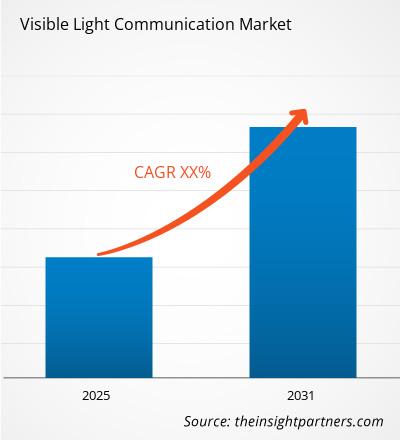
The Visible light communication market is valued at US$ 2.71 Billion in 2025 and is projected to reach US$ 31.82 Billion by 2034, registering a CAGR of 31.49% during 2026–2034. The market encompasses optical wireless communication technologies that use LED-based illumination and photo detection to transmit information. Its development is supported by advances in high-speed optical components, network integration, and applications requiring reliable connectivity in environments where conventional radio-frequency communication faces limitations.
North America is expected to record an estimated CAGR of 29–33% during 2026–2034, supported by investment in secure wireless infrastructure and increasing deployment of connected lighting systems. Demand from defense, aerospace, healthcare, and enterprise environments is strengthening adoption because optical transmission can reduce electromagnetic interference and confine wireless signals within defined physical spaces. The Visible Light Communication Market size is therefore gaining relevance in specialized high-security and data-intensive environments.
Visible Light Communication Market Assessment and Insights
- North America: North America is estimated to account for a 25–29% share in 2025 and grow at a CAGR of 29–33% between 2026–2034, supported by defense modernization, enterprise connectivity, and smart-building investments.
- US: The US represents approximately 70–74% of North America's 2025 market share and is projected to grow at a CAGR of 30–34% between 2026–2034, led by secure communications and aerospace applications.
- Europe: Europe is estimated to hold a 21–25% share in 2025 and expand at a CAGR of 28–32% during 2026–2034, with Germany, the UK, France, Italy, and Spain supporting industrial digitization and connected infrastructure.
- Asia Pacific: Asia Pacific is estimated to command a 40–44% share in 2025 and advance at a CAGR of 34–38% through 2034, led by China, Japan, South Korea, India, and Australia.
- Largest Segment: LED is estimated to hold a 48–52% market share in 2025 and expand at a CAGR of 29–33% between 2026–2034, reflecting its central role in optical transmission.
- High Growth Segment: Bi-directional transmission is estimated to represent a 42–46% market share in 2025 and grow at a CAGR of 34–38% through 2034, supported by networked LiFi architectures.
- Key companies analyzed in detail: Axrtek; Bytelight Inc.; Acuity Brands, Inc.; pureLiFi Ltd.; Signify N.V.; Oledcomm SAS; VLNComm Inc.; Lucibel SA; Renesas Electronics Corporation; Panasonic Holdings Corporation; Velmenni Ltd.
Source: The Insight Partners' analysis based on proprietary research, government publications, company annual reports, investor presentations, industry databases, and expert interviews.
The development of technology is making VLC move away from mere signaling and into networked optical wireless communication technology. The use of higher bandwidth LEDs, better detectors of photodetection, modulation, smaller microcontrollers and standardized interfaces is making this technology more viable. The ecology of this technology is bringing together lighting companies, semiconductor companies, connectivity companies, and hardware manufacturers, among others.
The forward progress of this technology is expected to increase as institutions try to look for alternatives to congested radio frequency networks. Deployment of this technology is expected to center around places that are secure like indoors, transport areas, manufacturing industries and certain areas of health care facilities. There is also standardization of the technology as seen through the ITU-T G.9991. Continued alignment with interoperability requirements should support investment in compatible access points, clients, controllers, and optical interfaces, according to the Visible Light Communication Market report.
Visible Light Communication Market Report Scope
| Report Attribute | Details |
|---|---|
| Market size in 2025 | US$ 2.71 Billion |
| Market Size by 2034 | US$ 31.82 Billion |
| Global CAGR (2026 - 2034) | 31.49% |
| Historical Data | 2021-2024 |
| Forecast period | 2026-2034 |
Visible Light Communication Market Analysis
The Visible Light Communication Market growth is being shaped by the convergence of solid-state lighting and wireless networking. LED infrastructure offers a distributed physical substrate for optical transmission capabilities, whereas photodetectors and microcontrollers offer means for receiving and processing signals. The supply chain accordingly spans from LED and semiconductor production to optical modules, firmware, networking components, lighting fixtures, installation, and software. Supply conditions become increasingly favorable for suppliers able to integrate communication functionality without adding appreciable complexity to lighting systems.
Applications tend to be those where security, electromagnetic compatibility, reduced latency, or localized dense connectivity offer a rationale for covering deployment expenses. Special applications in aerospace and defense industries, health care environments, industrial facilities, and certain consumer goods serve as examples. Two-way systems are especially important due to their ability to facilitate network communication. In light of improving component efficiencies, developers can pursue a more extensive range of coverage, mobility, interoperability, and coexistence with Wi-Fi and other wireless systems.
The competitive environment includes legacy lighting players, optical-wireless experts, semiconductor vendors, and tech providers. Signify N.V. participates in competition using its Trulifi product and lighting infrastructure, while pureLiFi Ltd. highlights dedicated LiFi connectivity solutions. Oledcomm SAS, VLNComm Inc., Lucibel SA, and Velmenni Ltd. remain specialists in optical networking and positioning technologies. Acuity Brands, Inc. remains significant due to the integration of its ByteLight technology into LED-based indoor positioning solutions.
Current competitive positioning becomes more dependent on compliance with standards, security, integration, and economics of deployment rather than speed of communication only. Renesas Electronics Corporation and Panasonic Holdings Corporation have semiconductor, electronics, and systems competencies that might help in further integration. Axrtek keeps being an example of a VLC technology specialist. The focus for investments is currently moving towards interoperable devices, compact optical modules, secure firmware, and applications that will benefit from the containment of light physically.
● REPORT CUSTOMIZATION
Tailor This Report To Align With Your Specific Business Requirements
This report can be customized to align precisely with your business objectives, scope, and target markets. Customization options include tailored segmentation, geography, competitive analysis, and strategic insights to support informed decision-making.
Customize This Report →WHAT YOU CAN ADJUST
- ● Segmentations
- ● Geography
- ● Competitive Analysis
- ● Language Preferences
Visible Light Communication Market: Strategic Insights

Regional Insights
North America Visible Light Communication Market
North America is estimated to represent 25–29% of the global Visible Light Communication Market revenue in 2025 and is projected to expand at a CAGR of 29–33% during 2026–2034. The area has access to sophisticated semiconductor technologies, defense purchasing, investment in intelligent buildings, and needs communications that will work in conjunction with radio frequency communication systems. The US is the major provider, but Canada offers research, connectivity of industry and infrastructure possibilities.
Defense and aerospace applications are structurally significant since optical communications could provide a solution for electromagnetic interference control and signal confinement in limited spaces. Health care and corporate facilities are two more sectors that would benefit from adoption due to their need for reliable connectivity and coverage. There are mature players in lighting, optical communications, semiconductors and technology integration present in the regional environment.
U.S. Visible Light Communication Market
The U.S. accounts for approximately 70–74% of North America's 2025 Visible Light Communication Market and is expected to grow at a CAGR of 30–34% through 2034. Technology validation efforts are being driven by government, defense, aerospace, health care, and enterprise applications. Security issues and radio frequency interference contribute to an interest in optical wireless solutions, especially those that work indoors in line-of-sight environments.
Organizations range from lighting firms, semiconductor organizations, and dedicated LiFi organizations. Applications are moving beyond demonstrations and into secure networking, indoor positioning, industry communication, and specific broadband access applications. Requirements are becoming more focused on interoperability, cybersecurity, reliability, and life-cycle economics. The US is a favorable environment for standards-based systems since developers can test optical networking technologies with established Ethernet, Wi-Fi, and cloud computing environments.
Europe Visible Light Communication Market
Europe is estimated to hold 21–25% of the global Visible Light Communication Market revenue in 2025 and is expected to register a CAGR of 28–32% through 2034. Germany is an advanced nation with support from industrial automation, automotive engineering, research, and advanced manufacturing. The UK has contributions from aerospace, defense, telecommunications research, and the adoption of enterprise technologies. The regulatory focus on digital infrastructure and energy-efficient lighting also helps in integrating optical networking.
Aerospace, transport, healthcare, and secure communications are the opportunities that France has, while developing demands come from Italy and Spain in the areas of smart infrastructure, tourism, transport, and industrialization. Technology suppliers from Europe are becoming more oriented towards standards-based interoperability and applications where radio-free communication offers an operational advantage. The well-established lighting infrastructure in the region is another way to integrate communication capabilities into commercial and industrial lighting.
APAC Visible Light Communication Market
APAC is estimated to account for 40–44% of the global Visible Light Communication Market revenue in 2025 and is projected to expand at a CAGR of 34–38% through 2034, making it the leading regional market. China benefits from electronics manufacturing and smart infrastructure, while Japan and South Korea contribute advanced automotive and semiconductor capabilities.
Industrial connectivity, security, smart infrastructure, and specialized communications can be pursued in India and Australia. The manufacturing scale, data demands, connected devices, and digital infrastructure investment by the government make regional implementation possible. China is projected to continue being the top country due to its electronic system integration and smart cities investment, whereas Japan and South Korea reinforce the technological base through components and automotive innovations.
Middle East & Africa Visible Light Communication Market
The Middle East and Africa Visible Light Communication Market is estimated to represent 5.5–7.5% of global revenue in 2025 and is expected to grow at a CAGR of 24–28% through 2034. Opportunities offered by Saudi Arabia and the UAE are the best owing to the development of smart cities projects, information technology infrastructure, transportation, and high-security facilities. The South African contribution would be in industrial and infrastructure applications.
The opportunity that exists in the region is associated with the development of infrastructure on a large scale, energy upgrades and the need for reliable communications in a controlled environment. The optical wireless technology could serve as a complement to the conventional network technology in areas where there is electromagnetic compatibility, security or physical challenges.
Segmentation Analysis
Component
Component segmentation is expected to grow at a CAGR of 29–33% during 2026–2034. LED devices remain foundational because they perform both illumination and optical transmission functions. Photodetectors enable reception, while microcontrollers provide modulation, decoding, synchronization, and system control. Increasing component integration is improving form factors and simplifying deployment across networked lighting platforms.
- LED: LED components occupy the central position in VLC architectures because they provide high-speed optical modulation while retaining illumination functionality. Demand is linked to connected lighting upgrades and increasingly integrated communication-enabled luminaires.
- Photo Detector: Photodetectors support signal reception and optical-to-electrical conversion. Their sensitivity, response speed, noise performance, and compact packaging influence system reliability, particularly in dense indoor and mobility-oriented applications.
- Microcontroller: Microcontrollers coordinate modulation, signal processing, networking, and device management. Demand is strengthened by the need for compact, interoperable communication platforms capable of integrating optical links with conventional digital interfaces.
Transmission
Transmission is forecast to expand at a CAGR of 32–36% during 2026–2034. Bi-directional systems are increasingly important because commercial networking requires uplink and downlink communication. Unidirectional configurations remain relevant for signaling, positioning, broadcasting, and applications where only optical downlink functionality is required.
- Uni-directional: Uni-directional transmission remains useful for broadcasting, indoor positioning, signaling, and selected transportation applications. Its simpler architecture can reduce implementation complexity where uplink connectivity is unnecessary.
- Bi-directional: Bi-directional transmission supports networked connectivity by enabling both downlink and uplink communication. Its strategic importance is increasing as LiFi architectures move toward interactive broadband, enterprise networking, and secure wireless access.
Application
Application segmentation is expected to grow at a CAGR of 30–35% during 2026–2034. Consumer electronics provide scale opportunities, while automotive and aerospace applications emphasize reliability and controlled connectivity. Life sciences offer a specialized opportunity because optical communication can address environments where electromagnetic interference and security considerations influence technology selection.
- Consumer Electronics: Consumer applications can incorporate optical communication into connected devices, indoor networking, and positioning systems. Adoption depends on component miniaturization, device interoperability, consumer value propositions, and compatibility with established wireless technologies.
- Automotive: Automotive applications include vehicle communication, positioning, and infrastructure interaction. Optical links can complement conventional wireless systems in controlled environments, particularly where lighting infrastructure is already extensively deployed.
- Aerospace & defense: Aerospace and defense applications prioritize secure, interference-resistant communication. Optical transmission can support controlled environments, tactical networking, aircraft applications, and facilities where radio-frequency emissions or interception risks require additional communication options.
- Life Sciences: Life sciences applications benefit from communication technologies capable of operating in sensitive environments. Hospitals, laboratories, and medical facilities can use optical links where electromagnetic compatibility, localized coverage, and secure data transmission are important.
Opportunity Snapshot
| Application | Revenue Contribution | Trend Tag | Adoption Stage |
| Consumer Electronics | High | Device Integration | Scaling |
| Automotive | Medium | Optical V2X | Emerging |
| Aerospace & Defense | Medium | Secure Links | Scaling |
| Life Sciences | Medium | RF-Free Connectivity | Emerging |
Visible Light Communication Market Growth Drivers and Impact Analysis
Rising demand for secure, localized wireless connectivity
Security-critical entities are building a unique demand segment for optical wireless communications owing to the fact that light cannot travel through opaque media in the same way that radio frequencies can. This unique property could minimize any exposure outside the designated coverage zones and complement cybersecurity controls based on encryption. The significance of such an aspect would apply mainly to defense agencies, healthcare institutions, enterprises, and industries transmitting confidential information in a contained environment. Validation of Signify's Trulifi FIPS 140-3 in 2025 shows how there is a trend towards validating security measures in place. As organizations assess their wireless communications networks by cybersecurity and physical containment considerations, optical communications can become one such complementary layer to Wi-Fi.
Expansion of connected LED lighting infrastructure
The move to LED lighting technology allows for an existing hardware infrastructure, which can potentially be used for communication without the need to create a completely different physical infrastructure network. LEDs offer the ability to modulate quickly, and the lighting controller can have added capabilities for processing and networking. This synergy leads to an ecosystem play ranging from the luminaires, the driver, sensors, microcontroller, photodetectors, and software. The biggest impact on the economy is likely to come from the commercial buildings, industrial installations, transportation infrastructure, and smart spaces where lighting retrofit takes place as part of modernization initiatives. Adding communication to lighting can optimize the use of the infrastructure and enhance the value of the system functionally.
Increasing pressure on wireless spectrum capacity
The fast development of the number of connected devices, high-quality content, industrial automation, and machine-to-machine communication places a strain on the spectrum of radio frequencies. VLC is the solution that offers an alternative optical channel that can be used in conjunction with other traditional wireless networks, especially within localized spaces. Therefore, the technology is related to the densification of network infrastructure rather than to cases of replacement. Standards developed by the ITU have created a base for high-speed indoor optical communications, while further work on IEEE 802.11bb LiFi devices increases the possibility of interactivity. The practical implications will emerge in those environments where more capacity, guaranteed coverage or lower RF usage is needed.
Visible Light Communication Market Future Trends
Integration of optical wireless with hybrid network architectures
The Visible Light Communication Market trends are expected to increasingly center on hybrid networking rather than isolated optical deployments. The next-generation systems will merge LiFi connections along with Wi-Fi, Ethernet, 5G, and edge-computing components in order to allocate each level of communications based on the corresponding coverage, latency, security, and mobility needs. The network controllers will be more and more in charge of handling the switching between optical and RF connections, thus alleviating the user experience problems related to the presence of line-of-sight issues. The creation of standardized interfaces must lead equipment manufacturers to provide interoperable access points and clients. The resulting system architecture can help turn the optical connection into a specific capacity and security layer of the overall network.
Growth of optical positioning and sensing convergence
The next stage of development for VLC technology is expected to involve a combination of communication with the positioning and sensing features. LED luminaires will be able to produce distinctive optical signals that can help to identify locations, whereas sensors and cameras can add more context. Such a combination of technologies can lead to the creation of solutions going far beyond just connecting people. The business case is made stronger in this way because one infrastructure can serve multiple digital purposes. An increase in the sensitivity of photodetectors, reception using cameras, edge computing, and machine learning algorithms will allow for improving positioning accuracy and reducing the need for dedicated infrastructure. The value of such systems is likely to be measured based on the combined benefits of all three mentioned components.
Visible Light Communication Market Opportunities
Secure communications for defense and regulated facilities
The Visible Light Communication Market scope is expanding toward defense, government, healthcare, laboratories, and other regulated environments where wireless security and electromagnetic compatibility are important procurement criteria. Investors and technologists can aim for integration of optical access points, secure client terminals, encryption hardware, and network management software. The most promising application would be one in which the physical confinement of signals is advantageous compared to conventional wireless technology. The pureLiFi system, Kitefin XE, shows the business path of secure government and military communication, through standardization and extensive room coverage. Companies that offer secure, interoperable, mobile, and easily installable solutions will tap into a higher-value market than mere optical communication equipment.
Smart infrastructure and transportation connectivity
The Visible Light Communication Market Forecasts indicate an expanding opportunity in infrastructure where lighting is already distributed across physical spaces. Applications where lighting can be utilized for purposes of communication, positioning, or data delivery include airports, logistics centers, parking garages, factories, tunnels, warehouses, and intelligent buildings. The business case becomes even stronger if the application solves more than one problem, such as indoor navigation, tracking of assets, local communication, and energy management. Asia Pacific and North America provide the best opportunities in terms of business models, thanks to their electronics clusters and investments in smart infrastructure. Technology vendors must focus on modular solutions that can combine optical communication with existing lighting control systems.
Frequently Asked Questions

- Comprehensive Market Sizing and Forecast Analysis
- Detailed Segmentation Analysis
- In-Depth Market Dynamics Assessment
- Regional and Country-Level Insights
- Competitive Landscape and Company Benchmarking
- Strategic Business Intelligence
Recent Reports
Testimonials

The Insight Partners provided valuable market intelligence that supported our global go-to-market strategy. Their team was professional, responsive, and attentive to our feedback, providing thoughtful analysis and helpful methodological clarifications throughout the project.
Junmo Kim Chief Financial Officer (CFO), Enertech Co., Ltd.
The Insight Partners' SCADA System Market report is comprehensive, with valuable insights on current trends and future forecasts. The team was highly professional, responsive, and supportive throughout. We are very satisfied and highly recommend their services.
RAN KEDEM Partner, Reali Technologies LTDs
I requested a report on a very specific software market and the team produced the report in a few days. The information was very relevant and well presented. I then requested some changes and additions to the report. The team was again very responsive and I got the final report in less than a week.
JEAN-HERVE JENN Chairman, Future Analytica
We worked with The Insight Partners for an important market study and forecast. They gave us clear insights into opportunities and risks, which helped shape our plans. Their research was easy to use and based on solid data. It helped us make smart, confident decisions. We highly recommend them.
PIYUSH NAGPAL Sr. Vice President, High Beam Global
The Insight Partners delivered insightful, well-structured market research with strong domain expertise. Their team was professional and responsive throughout. The user-friendly website made accessing industry reports seamless. We highly recommend them for reliable, high-quality research services
YUKIHIKO ADACHI CEO, Deep Blue, LLC.
This is the first time I have purchased a market report from The Insight Partners.While I was unsure at first, I visited their web site and felt more comfortable to take the risk and purchase a market report.I am completely satisfied with the quality of the report and customer service. I had several questions and comments with the initial report, but after a couple of dialogs over email with their analyst I believe I have a report that I can use as input to our strategic planning process.Thank you so much for taking the extra time and making this a positive experience.I will definitely recommend your service to others and you will be my first call when we need further market data.
JOHN SUZUKI President and Chief Executive Officer, Board Director, BK Technologies
I wish to appreciate your support and the professionalism you displayed in the course of attending to my request for information regarding to infectious disease IVD market in Nigeria. I appreciate your patience, your guidance, and the fact that you were willing to offer a discount, which eventually made it possible for us to close a deal. I look forward to engaging The Insight Partners in the future, all thanks to the impression you have created in me as a result of this first encounter.
DR CHIJIOKE ONYIA MANAGING DIRECTOR, PineCrest Healthcare Ltd.Reason to Buy
- Informed Decision-Making
- Understanding Market Dynamics
- Competitive Analysis
- Identifying Emerging Markets
- Customer Insights
- Market Forecasts
- Risk Mitigation
- Boosting Operational Efficiency
- Strategic Planning
- Investment Justification
- Tracking Industry Innovations
- Aligning with Regulatory Trends





 Get Free Sample for