
Voice Gateway Market Share, Size & Demand by 2034
Coverage: By Product Type (Below 24 ports, 24 Ports-64 Ports); Application (Commercial, Institutional, Others) , and Geography (North America, Europe, Asia Pacific, and South and Central America)
- Status : Data Released
- Report Code : TIPRE00023399
- Category : Electronics and Semiconductor
- No. of Pages : 150
- Available Report Formats :


- Last update date : September 22, 2026


2025 Market Size
US$ 1.61 Bn
Base year value
2034 Forecast
US$ 3.57 Bn
Projected by 2034
CAGR 2026-2034
9.27 %
Growth rate
Addressable Market
US$ 23.17 Bn
(2026-2034)
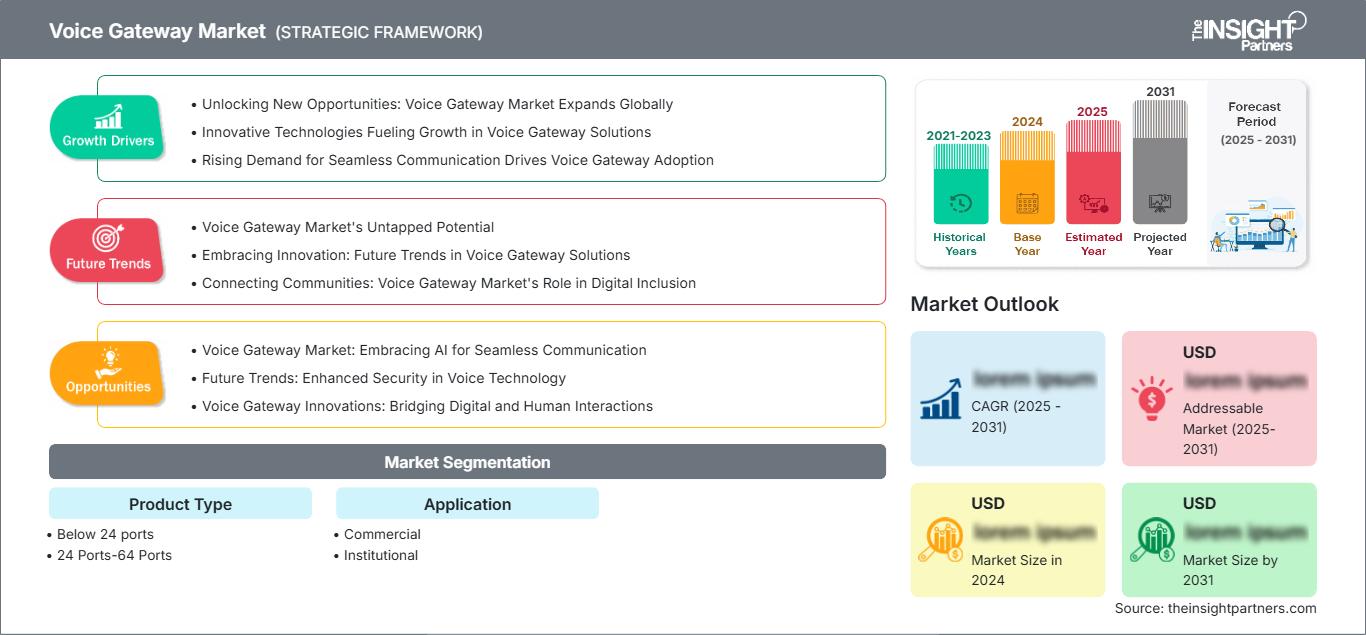
The voice gateway market is projected to grow from US$ 1.61 billion in 2025 to US$ 3.57 billion by 2034, registering a CAGR of 9.27% during 2026–2034. Growth is supported by enterprise migration from legacy telephony to IP-based communications, sustained demand for analog device protection, and the expansion of unified communications across commercial and institutional environments.
North America is expected to remain a strategically important region as businesses modernize contact centers, healthcare communications, education networks, and distributed office infrastructure. The voice gateway market size in the region is supported by hybrid communication architectures, high installed bases of PBX systems, and rising demand for secure PSTN-to-VoIP interworking.
Voice Gateway Market Assessment and Insights
- North America accounted for an estimated 32–36% share in 2025 and is expected to grow at a CAGR of 8.4–9.1% during 2026–2034, supported by enterprise UC migration and analog endpoint continuity.
- US represented about 76–80% of North American revenue in 2025 and is forecast to grow at 8.6–9.2% CAGR through 2034.
- Europe held an estimated 24–28% share in 2025, led by the UK, Germany, France, Italy, and Spain, with growth near 7.8–8.6% CAGR.
- Asia Pacific accounted for 26–30% share in 2025 and is expected to grow at 10.2–11.1% CAGR, led by China, India, Japan, South Korea, and Australia.
- Largest Segment: Commercial applications held 66–70% market share in 2025 and are expected to grow at 8.8–9.5% CAGR during 2026–2034.
- High Growth Segment: Institutional applications held 30–34% share in 2025 and are projected to grow at 9.7–10.4% CAGR through 2034.
- Key companies analyzed in detail: Cisco Systems, Inc., D-Link Corporation, International Business Machines Corporation, Sangoma Technologies Corporation, Multi-Tech Systems, Inc., Matrix Comsec Pvt. Ltd., Cognigy GmbH, REDCOM Laboratories, Inc., Fortinet, Inc., and ARRIS International Limited.
Source: The Insight Partners' analysis based on proprietary research, government publications, company annual reports, investor presentations, industry databases, and expert interviews.
Voice gateway architectures have evolved from basic protocol conversion appliances into managed communication nodes that connect analog phones, fax machines, modems, SIP trunks, PBX systems, and cloud UC platforms. The Voice Gateway Market report reflects the need to preserve established telephony assets while extending IP-based services across branches, campuses, and mission-critical facilities without large-scale rip-and-replace projects.
The demand for forward-looking systems will become increasingly stronger, since migration agility, survivability, interoperability, and security are going to be more valued by carriers, institutions, and corporations. The developing geographies have been implementing gateways to compensate for the inconsistencies in broadband quality, whereas developed geographies are making investments in high-port devices with centralized management capabilities.
Voice Gateway Market Report Scope
| Report Attribute | Details |
|---|---|
| Market size in 2025 | US$ 1.61 Billion |
| Market Size by 2034 | US$ 3.57 Billion |
| Global CAGR (2026 - 2034) | 9.27% |
| Historical Data | 2021-2024 |
| Forecast period | 2026-2034 |
Voice Gateway Market Analysis
The demand comes from enterprises that have a need for interworking between PSTN, ISDN, analog terminals and SIP-based communications systems. The market environment includes gateway hardware vendors, UC platforms vendors, telecommunications operators, system integrators and managed services partners. Increasingly, the value of product offering is built not only around call conversion capabilities but security, codec support, high port density and simplicity of configuration. Increased demand for gateways due to growing trends such as unified communications, hybrid working environment and cloud telephony is also expected. Enterprises seek solutions that provide the possibility of seamless business continuity through communication system upgrades.
On the supply side, factors influencing the development of the market include component sourcing, firmware support, channel strategy and enterprise refresh cycles. Cisco VG series gateways emphasize analog legacy investment protection. On the other hand, Sangoma Vega gateways are specialized in PSTN to VoIP interworking. D-Link, Matrix Comsec, Multi-Tech, REDCOM and ARRIS cover various use cases in terms of density, deployment model and network operator application. Efficient supply chain management and lifecycle support are also becoming important competitive factors, as highlighted in the Voice Gateway Market forecast.
The competition is moderately fragmented as the requirements depend on the size, deployment scenario, and legacy systems. Cisco Systems, Inc. gains a competitive advantage through the integration of UC solutions, Sangoma Technologies Corporation supports users with hybrid telephony, while REDCOM Laboratories, Inc. provides solutions for secure communications. The company Fortinet, Inc. differentiates itself using its security-oriented network positioning, whereas Cognigy GmbH makes an impact on AI-based voice automation processes. Competitive advantage is increasingly shifting towards secure connections, application integration, scalability, and manageability of solutions.
Current investment preferences are moving towards approaches that balance voice continuity, central control, and security improvements. Product positioning by suppliers centers on the suitability of the solutions for SIP trunking, resilience of remote branches, and contact center transformation. The strategy pursued by the players helps to ensure long-term replacement cycles for gateways despite the growing importance of the cloud-first communication approach. In terms of future trends, market players will be concentrating on AI-enabled administration, automatic provisioning, better cybersecurity protection, and support for new enterprise communication architecture designs. Further development of business communication infrastructures will provide growth potential.
● REPORT CUSTOMIZATION
Tailor This Report To Align With Your Specific Business Requirements
This report can be customized to align precisely with your business objectives, scope, and target markets. Customization options include tailored segmentation, geography, competitive analysis, and strategic insights to support informed decision-making.
Customize This Report →WHAT YOU CAN ADJUST
- ● Segmentations
- ● Geography
- ● Competitive Analysis
- ● Language Preferences
Voice Gateway Market: Strategic Insights
Regional Insights
North America voice gateway market
North America continues to hold a leading voice gateway market share, estimated at 32–36% in 2025, supported by extensive installed PBX infrastructure and demand for IP migration without disrupting analog endpoints. Enterprises use gateways to maintain fax, emergency phones, elevator lines, and operational communication devices while adopting cloud collaboration platforms. The region is expected to grow at 8.4–9.1% CAGR during 2026–2034. The highest demand for communication products is observed in healthcare, education, government, financial services, and commercial multi-site organizations, where the continuity of communications is absolutely critical. It is evident that the products from Cisco and Sangoma fit into this market perfectly well. Growth will be further driven by hybrid work arrangements, increased spending on secure communications, and cloud telephony.
U.S. voice gateway Market
The U.S. accounted for about 76–80% of North American revenue in 2025 and is expected to grow at 8.6–9.2% CAGR through 2034. The adoption of these gateways is motivated by the modernization of the branch, migration of SIP trunk, upgrading of the contact center, and compliance-oriented communication systems within large corporations and public organizations. The vendor presence is widespread with Cisco Systems, Inc., Sangoma Technologies Corporation, Multi-Tech Systems, Inc., Fortinet, Inc., and REDCOM Laboratories, Inc. providing for gateways, network security, and communication networks. The adoption will be correlated with a hybrid implementation that includes the use of cloud services and the resilience of local telephony.
Europe voice gateway Market
Europe held an estimated 24–28% share in 2025 and is forecast to register 7.8–8.6% CAGR during 2026–2034. Leading regional adoption is observed in the UK thanks to enterprise upgrades in UC and advanced managed communication services. Germany takes second place as it implements its industrial, manufacturing, and institutional modernization projects. France, Italy, and Spain offer consistent demand as companies implement consolidation of office networks and IP communication solutions, keeping on using analog equipment at the same time. Focus of regulatory bodies on service availability and access to emergency communications drives a persistent need for gateways in the fields of transport, health care, education, and the public sector.
APAC voice gateway Market
APAC represented 26–30% share in 2025 and is projected to expand at 10.2–11.1% CAGR. China continues to lead in terms of size, while India provides fast-growing demand from enterprise digitization, modernization of SMEs, and infrastructure development in the telecommunication sector. The advanced market environment characterized by UC integration, branch continuity, and secure voice infrastructure is demonstrated by Japan, South Korea, and Australia. The favorable conditions for 24 Ports-64 Ports equipment include industrial growth, smart city initiatives, and the development of managed services. Increasing cloud computing adoption, growth of business networks, and communication interoperability needs should positively affect market opportunities in the region.
Middle East & Africa voice gateway Market
The Middle East & Africa market is expected to grow at 8.1–8.9% CAGR through 2034, led by the UAE and Saudi Arabia. Demand is driven by the modernization of enterprise communication, energy industry infrastructure, hospitality infrastructure, and the digitization of public services. South Africa provides organizational demand as companies continue IP communication expansion while keeping their old voice lines. The Rest of the MEA region takes up gateway adoption slowly, with the use of gateways to increase interoperability in regions where there are broadband issues, legacy PBX systems, and different telecom standards. Future investments in smart infrastructure, enterprise networks, and the digitization of government can bring new voice gateway opportunities.
Segmentation Analysis
Product Type
Product Type defines key Voice Gateway Market trends by port density and deployment scale. Below 24 ports systems are widely used by small offices and distributed sites, while 24 Ports-64 Ports devices support campuses, hospitals, hotels, and larger branch networks. The segment is expected to grow at 8.7–9.6% CAGR during 2026–2034.
- Below 24 ports gateways address small branches, clinics, classrooms, retail outlets, and offices that need limited analog or PSTN connectivity with simple installation and lower upfront cost.
- 24 Ports-64 Ports gateways serve medium-density environments where multiple analog endpoints, fax lines, and PBX interfaces must be integrated into centralized IP communication networks.
Application
Application segmentation shows stronger revenue contribution from commercial users, although institutional demand is rising faster. Commercial adoption is supported by multi-site offices, telecom cost optimization, and UC integration. Institutional demand is increasing in healthcare, education, government, and public safety. The segment is expected to grow at 9.1–10.0% CAGR.
- Commercial users deploy gateways to connect offices, contact centers, hotels, retail networks, and service operations that require continuity between legacy devices and SIP-based communication systems.
- Institutional users rely on gateways for emergency phones, paging, fax continuity, campus communication, secure voice channels, and migration control across healthcare, education, and public agencies.
Opportunity Snapshot
| Application | Revenue Contribution | Trend Tag | Adoption Stage |
| Commercial | High | UC Migration | Mature |
| Institutional | Medium | Continuity Systems | Scaling |
Voice Gateway Market Growth Drivers and Impact Analysis
Migration from Legacy PBX to IP Communications
Voices have been migrated into IP and cloud UC services, although many companies still use their analog phones, faxes, modems, door phones, and emergency lines. Through the use of gateways, companies are able to mitigate risk through phased transition and do not have to replace everything at once. This driver can be applied in both low and medium-density deployments since companies need continuity when migrating their telecommunication services. In most cases, companies would want to maintain their previous investments while upgrading their communication systems.
Need for Reliable Hybrid Communication Infrastructure
Voice service resiliency in hybrid work models, distributed operations, and branch deployments becomes necessary when there are any disruptions to the network services. Gateways become important in connecting the local telephony resources with the SIP trunk and UC centralization platform. Such benefits are realized most prominently by industries such as healthcare, educational institutions, hospitality services, public sector organizations, and multi-site businesses whose continuity of voice services is vital for safety and service delivery. Reliance on uninterrupted voice services for customer care, emergency operations, and coordination becomes a motivating factor for resilient voice services.
Growth of Managed Voice and SIP Trunk Services
Gateway solutions are now being employed by telecom carriers and managed services partners to make it easier for clients to migrate from old circuits to IP-based voice services. With SIP trunking gaining popularity, there is an increasing need for devices that will cater to issues like compatibility, security, codecs, and centralized maintenance. In view of increasing outsourcing of communication needs, gateway providers are gaining due to channel-based sales and repeatable deployments on enterprise campuses. This demand is driven by the increased desire for communication as a service models, centralized management systems, and scalable network architectures.
Voice Gateway Market Future Trends
Security-Integrated Voice Edge Platforms
The market trends are moving toward security-aware platforms that combine voice interworking with encryption, authentication, traffic monitoring, and policy control. As voice networks become part of broader IP environments, unmanaged gateways can create exposure. Future products are expected to align more closely with network security architectures, especially for institutions, financial services, and critical infrastructure operators.
Cloud-Managed Gateway Administration
Remote provisioning and cloud-based monitoring will become increasingly important as organizations manage voice infrastructure across many small sites. Vendors are likely to emphasize centralized dashboards, automated updates, health alerts, and simplified fleet management. This trend supports service providers and enterprises that need consistent configuration, faster troubleshooting, and reduced dependence on on-site technical resources.
Voice Gateway Market Opportunities
Institutional Communication Modernization
Healthcare, education, government, and public safety facilities provide attractive opportunities because they often retain analog systems for emergency communication, paging, alarms, and fax workflows. These environments cannot migrate entirely to cloud voice without continuity planning. Gateway vendors can target institutional buyers with resilient solutions that support compliance, uptime, and phased modernization across campuses and critical facilities.
Medium-Density Branch and Campus Deployments
The 24 Ports-64 Ports category presents opportunities where organizations need higher endpoint concentration without enterprise-scale hardware. Hotels, hospitals, universities, warehouses, and regional offices frequently require multiple analog lines connected to IP infrastructure. Vendors can differentiate through compact form factors, simplified configuration, SIP interoperability, and support packages that reduce deployment time for integrators.
Frequently Asked Questions

- Comprehensive Market Sizing and Forecast Analysis
- Detailed Segmentation Analysis
- In-Depth Market Dynamics Assessment
- Regional and Country-Level Insights
- Competitive Landscape and Company Benchmarking
- Strategic Business Intelligence
Recent Reports
Testimonials

The Insight Partners provided valuable market intelligence that supported our global go-to-market strategy. Their team was professional, responsive, and attentive to our feedback, providing thoughtful analysis and helpful methodological clarifications throughout the project.
Junmo Kim Chief Financial Officer (CFO), Enertech Co., Ltd.
The Insight Partners' SCADA System Market report is comprehensive, with valuable insights on current trends and future forecasts. The team was highly professional, responsive, and supportive throughout. We are very satisfied and highly recommend their services.
RAN KEDEM Partner, Reali Technologies LTDs
I requested a report on a very specific software market and the team produced the report in a few days. The information was very relevant and well presented. I then requested some changes and additions to the report. The team was again very responsive and I got the final report in less than a week.
JEAN-HERVE JENN Chairman, Future Analytica
We worked with The Insight Partners for an important market study and forecast. They gave us clear insights into opportunities and risks, which helped shape our plans. Their research was easy to use and based on solid data. It helped us make smart, confident decisions. We highly recommend them.
PIYUSH NAGPAL Sr. Vice President, High Beam Global
The Insight Partners delivered insightful, well-structured market research with strong domain expertise. Their team was professional and responsive throughout. The user-friendly website made accessing industry reports seamless. We highly recommend them for reliable, high-quality research services
YUKIHIKO ADACHI CEO, Deep Blue, LLC.
This is the first time I have purchased a market report from The Insight Partners.While I was unsure at first, I visited their web site and felt more comfortable to take the risk and purchase a market report.I am completely satisfied with the quality of the report and customer service. I had several questions and comments with the initial report, but after a couple of dialogs over email with their analyst I believe I have a report that I can use as input to our strategic planning process.Thank you so much for taking the extra time and making this a positive experience.I will definitely recommend your service to others and you will be my first call when we need further market data.
JOHN SUZUKI President and Chief Executive Officer, Board Director, BK Technologies
I wish to appreciate your support and the professionalism you displayed in the course of attending to my request for information regarding to infectious disease IVD market in Nigeria. I appreciate your patience, your guidance, and the fact that you were willing to offer a discount, which eventually made it possible for us to close a deal. I look forward to engaging The Insight Partners in the future, all thanks to the impression you have created in me as a result of this first encounter.
DR CHIJIOKE ONYIA MANAGING DIRECTOR, PineCrest Healthcare Ltd.Reason to Buy
- Informed Decision-Making
- Understanding Market Dynamics
- Competitive Analysis
- Identifying Emerging Markets
- Customer Insights
- Market Forecasts
- Risk Mitigation
- Boosting Operational Efficiency
- Strategic Planning
- Investment Justification
- Tracking Industry Innovations
- Aligning with Regulatory Trends





 Get Free Sample for