
Voltage Level Translators Market Size, Demand & Growth by 2034
Coverage: By Type (Dual Supply Level Translators, Open Drain Devices); End User (Defense and Aerospace, Automobile, Healthcare, Consumer Electronics, Others) , and Geography (North America, Europe, Asia Pacific, and South and Central America)
- Status : Data Released
- Report Code : TIPRE00017021
- Category : Electronics and Semiconductor
- No. of Pages : 150
- Available Report Formats :


- Last update date : September 22, 2026


2025 Market Size
US$ 1.83 Bn
Base year value
2034 Forecast
US$ 2.67 Bn
Projected by 2034
CAGR 2026-2034
4.31 %
Growth rate
Addressable Market
US$ 20.46 Bn
(2026-2034)
The Voltage Level Translators market was valued at US$ 1.83 Billion in 2025 and is projected to reach US$ 2.67 Billion by 2034, registering a CAGR of 4.31% during 2026–2034. Demand will be driven by rising levels of semiconductor integration, system heterogeneity, and the requirement for dependable signaling among the low-voltage domain and older interface. market is growing as electronic systems tend to incorporate processors, sensors, memory units, and other peripherals in distinct voltage domains.
In North America, the Voltage Level Translators market size is forecast to develop at a CAGR of 3.9–4.6% till 2034. Market growth will be driven by semiconductor product designs, automotive electronics, aerospace applications, and data processing systems.
Voltage Level Translators Market Assessment and Insights
- North America: North America is estimated to account for 31–35% share in 2025, growing at a CAGR of 3.9–4.6% between 2026–2034. Semiconductor design, aerospace electronics, automotive computing, and data infrastructure sustain demand for reliable interface components.
- US: The US represents approximately 68–72% of North America's 2025 market, expanding at a 3.8–4.5% CAGR during 2026–2034, supported by advanced electronics manufacturing and defense modernization.
- Europe: Europe is estimated at 24–28% share in 2025 and is projected to grow at 3.7–4.4% CAGR through 2034, with Germany, the UK, France, Italy, and Spain supporting automotive and industrial electronics demand.
- Asia Pacific: Asia Pacific is estimated to hold 29–33% share in 2025 and expand at 4.8–5.6% CAGR during 2026–2034. China, Japan, South Korea, and India remain important electronics manufacturing and consumption centers.
- Largest Segment: Dual Supply Level Translators represent an estimated 64–68% market share in 2025 and are expected to grow at a 4.4–5.0% CAGR between 2026–2034.
- High Growth Segment: Automobile represents an estimated 23–27% market share in 2025 and is projected to advance at a 4.9–5.4% CAGR during 2026–2034.
- Key companies analyzed in detail: Advanced Linear Devices, Inc.; Analog Devices, Inc.; Infineon Technologies AG; Maxim Integrated Products, Inc. (now part of Analog Devices, Inc.); Microchip Technology Inc.; Nexperia; NXP Semiconductors N.V.; Semiconductor Components Industries, LLC; STMicroelectronics N.V.; Texas Instruments Incorporated.
Source: The Insight Partners' analysis based on proprietary research, government publications, company annual reports, investor presentations, industry databases, and expert interviews.
Voltage level translators market has transformed from simple interface converters to smaller size, bidirectional, power-efficient devices with heterogeneous electronic architectures. The current offerings can provide 1.8 V, 3.3 V, and 5 V combinations, in addition to ESD protection, direction control, and smaller package sizes. The manufacturing focus has thus moved to silicon efficiency, signal integrity, auto qualified, and application specific integrations in consumer, industrial, auto, and communications markets.
The future outlook for voltage level translators market will be positively impacted due to increased presence of electronics in automobiles, industrial control systems, medical equipment, and connected devices. There is an increasing spending towards faster translators, lower voltage operation, enhanced electromagnetic compatibility, and auto qualifications. The regulatory pressure on function reliability and efficiency will drive development of voltage level translator components that simplify multivoltage architecture while ensuring predictable operations in different conditions.
Voltage Level Translators Market Report Scope
| Report Attribute | Details |
|---|---|
| Market size in 2025 | US$ 1.83 Billion |
| Market Size by 2034 | US$ 2.67 Billion |
| Global CAGR (2026 - 2034) | 4.31% |
| Historical Data | 2021-2024 |
| Forecast period | 2026-2034 |
Voltage Level Translators Market Analysis
Voltage Level Translators market products are tied to the trend of the development of mixed voltage semiconductor architectures. More advanced processors run on lower voltages, whereas the peripheral controllers, memories, sensors, and legacy interfaces may need higher voltages. Voltage translators serve as the interface solution without obliging the customer to redesign other devices. Value chain includes semiconductor manufacturing, packaging, logic design, qualification, distribution, and systems integration, with suppliers competing in performance and reliability.
It is not the amount of semiconductors that makes the need for voltage translators arise but rather the amount of voltage domains in the system. Dual supply voltages are important for two-way communication, and open-drain devices are utilized for buses and interfaces. The propagation delay, leakage, output drive, ESD protection, thermal behavior, package area, and sourcing become extremely important parameters for the vendor. Aerospace and automotive segments also consider qualification and lifetime aspects.
Competition intensity in voltage level translators market report is due to the varied capabilities of the existing semiconductor producers. Texas Instruments Incorporated features a wide range of logic products, whereas Nexperia focuses on small-size translators and interfaces. Analog Devices, Inc., Infineon Technologies AG, Microchip Technology Inc., NXP Semiconductors N.V., STMicroelectronics N.V., and Semiconductor Components Industries, LLC are involved in a combination of different logic, automotive, industrial, and specific markets.
Strategic positioning is more about integration than stand-alone translation capability. There is a tendency to integrate such things as ESD protection, auto-direction control, filtering, and higher speed in order to cut down the number of external elements and minimize board space. For instance, the translator offering from Nexperia is targeted at automotive, consumer, enterprise, and interface applications, while STMicroelectronics features dual supply offerings ranging from low-voltage to higher-voltage systems.
● REPORT CUSTOMIZATION
Tailor This Report To Align With Your Specific Business Requirements
This report can be customized to align precisely with your business objectives, scope, and target markets. Customization options include tailored segmentation, geography, competitive analysis, and strategic insights to support informed decision-making.
Customize This Report →WHAT YOU CAN ADJUST
- ● Segmentations
- ● Geography
- ● Competitive Analysis
- ● Language Preferences
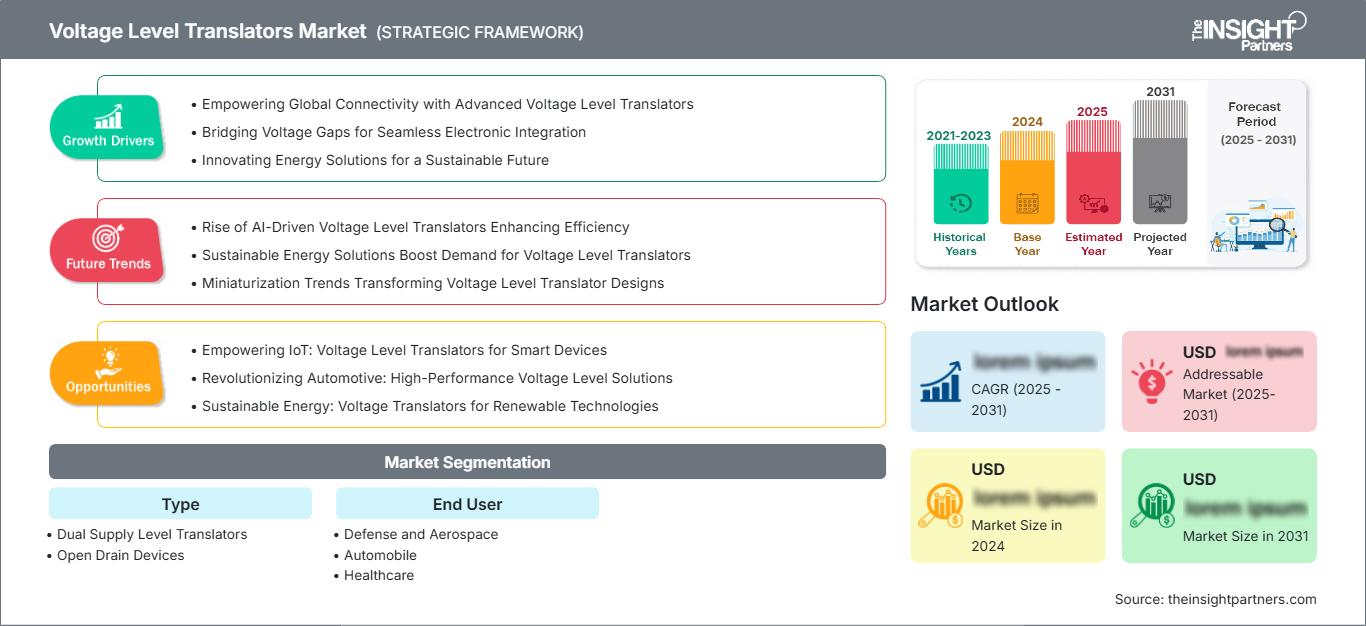
Voltage Level Translators Market: Strategic Insights
Regional Insights
North America Voltage Level Translators Market
North America is projected to contribute to 31-35% of the Voltage Level Translators market share in 2025 and expected to witness a CAGR of 3.9-4.6% until 2034. The United States is the catalyst for regional consumption due to the semiconductor design, defense electronics, cloud computing, healthcare electronics, and automotive electronics. Canada contributes due to the need for industrial automation, aerospace applications, telecommunications, and embedded electronic systems that require robust mixed voltage interface requirements.
Some of the key factors to consider while purchasing products in the region include qualification, availability, reliability over life cycle, and support. There are higher reliability and traceability considerations in the case of aerospace and defense products, and there is an increasing requirement of multi-voltage operating components in automotive products. Local semiconductor design ecosystems form a reason for adoption of the interface translator architecture. Companies with large logic families and distribution channels have opportunities to design in multiple times in industrial and high reliability segments.
U.S. Voltage Level Translators Market
The United States represents about 68-72% of the Voltage Level Translators market share for 2025 in North America and will experience a CAGR of 3.8-4.5% over 2026-2034. Drivers for demand include defense upgrades, automotive electronics, instrumentation within healthcare, semiconductor industry developments, and data center systems. Leading vendors have considerable design and distribution capabilities within each of the aforementioned application areas.
The trends in the application involve the implementation of small form factors, two-way capabilities, increased ESD protection, and processor capability for low voltages. The environment is another factor in the design phase especially for applications in defense and aerospace where qualification cycle periods are lengthy. Consumer and automotive applications emphasize integration and efficiency. Yet another factor that hastens the design process is that there is quite a bit of semiconductor engineering involved in the requirements for voltage translation.
Europe Voltage Level Translators Market
The Europe region is expected to constitute between 24 to 28% of the market in 2025 and the region's market growth rate is expected to be between 3.7 to 4.4% CAGR up to 2034. Germany leads with its automotive electronics, industrial automation, manufacturing, and control systems. The United Kingdom provides its contribution through aerospace, defense, telecommunications and electronics design industry, while France gains from its transport, aerospace, and industrial markets.
In Germany, the automobile sector creates the need for high quality and advanced interface components as electronic control units, sensing, and connectivity modules become more sophisticated. In the United Kingdom, the market has been created by the aerospace and defense sectors, where component longevity and robust performance plays an important role in purchase decision. Italy, France, and Spain contribute by way of industrial machinery, automobiles, medical electronics and consumer electronics.
APAC Voltage Level Translators Market
The APAC region is projected to have 29-33% of the market share in 2025, at CAGR growth rates of 4.8-5.6% till 2034, making it the fastest-growing region in terms of interface component usage. China leads in terms of demand, followed by Japan, South Korea, India, and Australia. Applications driving interface component usage include electronics manufacturing, automobile, communications, and industrial automation applications.
China being a very active country in terms of electronics manufacturing, is a big consumer of interface components while Japan and South Korea enjoy their advantages in automobile, semiconductor, display, and electronics manufacturing industry. India is fast becoming a big market in electronics manufacturing and automobiles (local content) while Australia is an important country although smaller, in industrial, communications, and military fields. The backing from the government of the regions in electronics manufacturing and semiconductors will ensure component demands.
Middle East & Africa Voltage Level Translators Market
ME&A region is projected to show a CAGR between 3.4 and 4.1% for 2026–2034. Saudi Arabia drives regional demand thanks to digitization of industries, infrastructure investments, and modernization of the energy sector. UAE promotes the development of electronic applications and communications, whereas South Africa remains a key market for control and instrumentation applications.
Regional demand is increasingly related to automation, intelligent infrastructure, energy systems, transportation, and communications equipment. Saudi Arabia and the UAE are positively affected by extensive infrastructure projects related to technological developments, while South Africa's industrial sector stimulates the growth of control and instrumentation applications. ME&A rest of market remains fragmented, with distributors playing an important role in technology procurements due to harsh environment and durable components' requirements.
Segmentation Analysis
Type
The Type segment is shaped by the electrical architecture and communication behavior of the target system. Dual-supply devices are favored where two distinct voltage rails must communicate bidirectionally, while open-drain solutions remain important for shared buses. The Type segment is projected to grow at a 4.1–4.8% CAGR from 2026–2034 as designers prioritize compact, low-power, and increasingly integrated interface solutions.
- Dual Supply Level Translators: These devices address systems with distinct supply domains and support bidirectional or controlled signal conversion. Their flexibility makes them important in processors, memory, automotive controllers, industrial equipment, and mixed-voltage embedded platforms.
- Open Drain Devices: Open-drain translators remain strategically relevant for shared-bus architectures, particularly I²C and SMBus applications. Their compatibility with pull-up based signaling supports straightforward communication among devices operating at different voltage levels.
End User
End-user demand is determined by application reliability, interface complexity, qualification requirements, and electronic content. The segment is expected to grow at a 4.3–5.0% CAGR during 2026–2034, with automobile applications benefiting from rising electronic control, connectivity, sensing, and computing requirements across vehicle platforms.
- Defense and Aerospace: High-reliability electronics require stable signal conversion across multiple voltage domains. Long qualification cycles and stringent environmental requirements favor established suppliers capable of providing traceability, robust packaging, and extended product availability.
- Automobile: Vehicle electronics increasingly combine processors, sensors, communication modules, memory, and control units with different voltage requirements. Translators support reliable interfaces while helping designers manage increasingly distributed electronic architectures and constrained board space.
- Healthcare: Medical equipment uses mixed-voltage controllers, displays, sensors, memory, and communication interfaces. Translators help isolate incompatible logic domains while supporting compact equipment designs where electrical reliability and predictable operation are important.
- Consumer Electronics: Smartphones, wearables, personal electronics, computing equipment, and connected devices require compact interface components as processor and peripheral voltage domains diverge. Low power, package size, signal speed, and cost remain central purchasing considerations.
Opportunity Snapshot
| End User | Revenue Contribution | Trend Tag | Adoption Stage |
|---|---|---|---|
| Defense and Aerospace | Medium | Mission Electronics | Mature |
| Automobile | High | Vehicle Computing | Scaling |
| Healthcare | Medium | Connected Diagnostics | Scaling |
| Consumer Electronics | High | Low Power | Mature |
Voltage Level Translators Market Growth Drivers and Impact Analysis
Increasing Electronic Content in Vehicles
Automotive electronics are becoming more distributed as vehicles incorporate advanced driver assistance, infotainment, connectivity, battery management, sensing, and centralized computing. These architectures frequently combine processors and peripheral devices using different supply domains, creating recurring requirements for dependable signal translation. The impact extends beyond unit demand because automotive-grade components typically require qualification, longer availability, and enhanced environmental performance. Suppliers that provide qualified translator families can therefore secure design positions across several vehicle subsystems. The shift toward zonal and centralized electrical architectures may further increase the importance of carefully managed interfaces as control units consolidate functions while retaining legacy peripherals. This structural change supports sustained component consumption even when individual translator prices remain constrained by semiconductor industry competition.
Expansion of Mixed-Voltage Semiconductor Architectures
Semiconductor integration continues to place different functional blocks on architectures optimized for their individual power and performance requirements. Processor cores may use substantially lower voltages than memory, sensors, controllers, or external interfaces, creating electrical-domain mismatches that cannot always be eliminated through system redesign. Translators provide a practical solution by allowing heterogeneous components to communicate without compromising the operating conditions of either side. This driver affects both new equipment and redesign cycles because manufacturers increasingly replace individual subsystems while retaining established peripherals. Demand therefore extends across industrial equipment, healthcare devices, communications platforms, and consumer products. Suppliers that combine translation with ESD protection, filtering, direction control, and compact packaging can capture additional bill-of-materials value while simplifying system implementation for equipment manufacturers.
Growing Requirement for Reliable High-Speed Interfaces
Higher data throughput is increasing the technical requirements placed on voltage translation devices. Interfaces used for memory, processors, storage, display control, and embedded communications must preserve signal integrity while operating across different voltage domains. Traditional translation methods can introduce propagation delay, leakage, loading, or waveform distortion that becomes more consequential as interface speeds increase. This encourages migration toward architectures with stronger drive capability, optimized parasitics, auto-direction functionality, and integrated protection. The resulting market impact is qualitative as well as quantitative because customers may replace basic translators with more capable devices even when overall electronic unit volumes remain stable. Suppliers able to demonstrate reliable performance under higher-frequency switching conditions can strengthen their position in advanced computing, industrial control, automotive electronics, and communications equipment.
Voltage Level Translators Market Future Trends
Integration of Translation With Signal Conditioning
Voltage Level Translators market are increasingly likely to incorporate functions that historically required separate passive or active components. Future devices can combine translation with ESD protection, filtering, signal redriving, isolation-related features, pull-up integration, and enhanced output control. This approach can reduce board area and simplify qualification by limiting the number of interface components exposed to electrical stress. High-speed applications will encourage greater attention to parasitic capacitance, propagation delay, edge-rate management, and electromagnetic compatibility. Automotive and industrial customers are likely to favor integrated devices that reduce design complexity while maintaining predictable behavior over temperature. As package dimensions continue to shrink, semiconductor suppliers can use higher integration as a differentiation mechanism, particularly where system designers face tight PCB constraints and increasing numbers of processor-peripheral voltage boundaries.
Automotive Qualification Becomes a Broader Product Differentiator
Automotive qualification is expected to become increasingly important beyond traditional power and control semiconductor categories. As vehicles incorporate more processors, sensors, communication interfaces, and distributed control modules, interface components become part of safety-relevant and long-lived electronic architectures. Customers consequently evaluate operating temperature, qualification status, documentation, change control, supply continuity, and failure performance alongside electrical specifications. This can create a widening distinction between general-purpose and automotive-specific translator portfolios. Suppliers with qualified variants can potentially command stronger design-in positions because replacing a component after vehicle validation can be costly and time-consuming. The trend should also encourage broader availability of translator families with automotive temperature ranges, enhanced ESD protection, smaller packages, and compatibility with common vehicle communication and peripheral interfaces.
Voltage Level Translators Market Opportunities
Design Wins in Next-Generation Vehicle Electronics
Automotive electronics provide an attractive investment area because the transition toward centralized computing and zonal architectures is changing how processors communicate with distributed devices. Suppliers can target opportunities in sensor interfaces, memory connections, display modules, control units, connectivity systems, and gateway architectures. Products combining translation with ESD protection, low leakage, compact packaging, and automotive qualification are particularly positioned for design consideration. Strategic investment should focus on reference designs and early engagement with Tier 1 suppliers and semiconductor ecosystem partners because interface requirements are often fixed during system architecture. Companies that build families across multiple channel counts and voltage combinations can increase platform reuse and reduce qualification friction. This opportunity can therefore generate recurring design activity rather than relying solely on replacement demand.
High-Speed Translation for Computing and Industrial Equipment
Computing and industrial equipment create opportunities for translators designed around higher-speed interfaces and demanding signal-integrity conditions. Memory-intensive systems, embedded controllers, storage platforms, industrial gateways, and data-processing equipment can require communication between components operating at different voltage rails. Products with enhanced drive strength, lower parasitic loading, integrated filtering, and bidirectional functionality can address these requirements more effectively than basic level-shifting solutions. Suppliers should prioritize evaluation platforms, simulation models, and application-specific reference designs that demonstrate performance under realistic loading conditions. Partnerships with processor, memory, and controller vendors can also improve ecosystem visibility and accelerate qualification. The Voltage Level Translators market forecast opportunity is strongest where a translator can solve both voltage mismatch and signal-quality challenges, increasing its value within the broader interface architecture.
Frequently Asked Questions

- Comprehensive Market Sizing and Forecast Analysis
- Detailed Segmentation Analysis
- In-Depth Market Dynamics Assessment
- Regional and Country-Level Insights
- Competitive Landscape and Company Benchmarking
- Strategic Business Intelligence
Recent Reports
Testimonials

The Insight Partners provided valuable market intelligence that supported our global go-to-market strategy. Their team was professional, responsive, and attentive to our feedback, providing thoughtful analysis and helpful methodological clarifications throughout the project.
Junmo Kim Chief Financial Officer (CFO), Enertech Co., Ltd.
The Insight Partners' SCADA System Market report is comprehensive, with valuable insights on current trends and future forecasts. The team was highly professional, responsive, and supportive throughout. We are very satisfied and highly recommend their services.
RAN KEDEM Partner, Reali Technologies LTDs
I requested a report on a very specific software market and the team produced the report in a few days. The information was very relevant and well presented. I then requested some changes and additions to the report. The team was again very responsive and I got the final report in less than a week.
JEAN-HERVE JENN Chairman, Future Analytica
We worked with The Insight Partners for an important market study and forecast. They gave us clear insights into opportunities and risks, which helped shape our plans. Their research was easy to use and based on solid data. It helped us make smart, confident decisions. We highly recommend them.
PIYUSH NAGPAL Sr. Vice President, High Beam Global
The Insight Partners delivered insightful, well-structured market research with strong domain expertise. Their team was professional and responsive throughout. The user-friendly website made accessing industry reports seamless. We highly recommend them for reliable, high-quality research services
YUKIHIKO ADACHI CEO, Deep Blue, LLC.
This is the first time I have purchased a market report from The Insight Partners.While I was unsure at first, I visited their web site and felt more comfortable to take the risk and purchase a market report.I am completely satisfied with the quality of the report and customer service. I had several questions and comments with the initial report, but after a couple of dialogs over email with their analyst I believe I have a report that I can use as input to our strategic planning process.Thank you so much for taking the extra time and making this a positive experience.I will definitely recommend your service to others and you will be my first call when we need further market data.
JOHN SUZUKI President and Chief Executive Officer, Board Director, BK Technologies
I wish to appreciate your support and the professionalism you displayed in the course of attending to my request for information regarding to infectious disease IVD market in Nigeria. I appreciate your patience, your guidance, and the fact that you were willing to offer a discount, which eventually made it possible for us to close a deal. I look forward to engaging The Insight Partners in the future, all thanks to the impression you have created in me as a result of this first encounter.
DR CHIJIOKE ONYIA MANAGING DIRECTOR, PineCrest Healthcare Ltd.Reason to Buy
- Informed Decision-Making
- Understanding Market Dynamics
- Competitive Analysis
- Identifying Emerging Markets
- Customer Insights
- Market Forecasts
- Risk Mitigation
- Boosting Operational Efficiency
- Strategic Planning
- Investment Justification
- Tracking Industry Innovations
- Aligning with Regulatory Trends





 Get Free Sample for