
Wide Area RFID Systems Market Size, Share & Trends by 2034
Coverage: By Component (Tags, Readers, Antennas, Others); End-use Industry (Automotive, Retail, Oil and Gas, Manufacturing, Healthcare, Others) , and Geography (North America, Europe, Asia Pacific, and South and Central America)
- Status : Data Released
- Report Code : TIPRE00019382
- Category : Electronics and Semiconductor
- No. of Pages : 150
- Available Report Formats :


- Last update date : September 28, 2026


2025 Market Size
US$ 3.49 Bn
Base year value
2034 Forecast
US$ 5.83 Bn
Projected by 2034
CAGR 2026-2034
5.87 %
Growth rate
Addressable Market
US$ 42.23 Bn
(2026-2034)
The global Wide Area RFID Systems market was valued at US$ 3.49 billion in 2025 and is expected to reach US$ 5.83 billion by 2034; it is estimated to record a CAGR of 5.87% during 2026-2034.
Wide Area RFID Systems Market Assessment and Insights
- North America holds an estimated 32–36% share in 2025 and is projected to grow at a 7.1–7.8% CAGR between 2026–2034. Retail automation, logistics visibility, manufacturing digitization, and healthcare asset tracking underpin regional demand.
- US accounts for approximately 68–72% of North America's 2025 market and is expected to expand at a 7.2–7.9% CAGR between 2026–2034, supported by enterprise automation and item-level inventory programs.
- Europe represents approximately 27–31% share in 2025 and is projected to expand at a 6.3–7.0% CAGR between 2026–2034. Germany, the UK, France, Italy, and Spain remain important adoption centers, supported by industrial automation and traceability requirements.
- Asia Pacific represents approximately 24–28% share in 2025 and is projected to grow at a 7.5–8.4% CAGR between 2026–2034. China, Japan, South Korea, and India benefit from manufacturing scale, logistics modernization, and digital infrastructure investment.
- Largest Segment: It is estimated to command a 46–50% market share in 2025 and expand at a 6.4–7.2% CAGR between 2026–2034, reflecting the central role of tags in identification deployments.
- High Growth Segment: It is estimated to hold a 10–14% market share in 2025 and grow at a 9.0–10.2% CAGR between 2026–2034 as healthcare organizations increase asset, inventory, and patient-safety traceability.
- Key companies analyzed in detail: Barcoding, Inc.; Impinj, Inc.; Guard RFID Solutions, Inc.; Balluff GmbH; PervasID; SkyRFID Inc.; Omnitec Group; Idesco Oy; Balogh Group; GAO RFID, Inc.
Source: The Insight Partners' analysis based on proprietary research, government publications, company annual reports, investor presentations, industry databases, and expert interviews.
There will be a trend towards higher read rates, better performance in the area of metal and liquids, small readers, improved authentication capabilities of the tags and software-based identification solutions. Gen2X solutions have been improving stray reads, inventory efficiency, read zone control and counterfeit tags. At the same time, integrators will be combining RFID technologies with WMS, ERP, MES and analytical software platforms and deploying RFID solutions not just for point-of-scanning but for continuous data collection during operations.
Future growth will be driven by areas requiring multiple identification transactions without any human interaction. Smart factories, automated distribution centers, omnichannel retail, pharmaceutical traceability, and hospital connectivity will drive more deployments. The Wide Area RFID Systems Market report highlights that regulatory attention to product traceability and digital product information can further strengthen the investment case, particularly where RFID data can complement existing barcode, sensor, and machine-vision infrastructure without requiring complete replacement of established identification workflows.
Wide Area RFID Systems Market Report Scope
| Report Attribute | Details |
|---|---|
| Market size in 2025 | US$ 3.49 Billion |
| Market Size by 2034 | US$ 5.83 Billion |
| Global CAGR (2026 - 2034) | 5.87% |
| Historical Data | 2021-2024 |
| Forecast period | 2026-2034 |
Wide Area RFID Systems Market Analysis
The wide area rfid systems market growth is being shaped by demand for persistent visibility rather than periodic identification. Tags offer unique identities, readers gather the signals, antennas ensure coverage, and middleware helps in transforming collected events into actions. In system integration, tags are integrated with the WMS, ERP, MES, and healthcare software systems. Hence, the demand is not based on just the cost of hardware, but also the complexity of integration, the environmental performance, reader density, tag conversion, and software compatibility.
On the other hand, the supply side will be impacted by the availability of semiconductors, inlay production capabilities, antenna design, reader components design, and system integration in the region. The RAIN Alliance estimates 42.7 billion chips of RAIN tags manufactured by its members in 2025, compared to 52.8 billion in 2024. This is a representation of how much experimentation can happen in this market, and how it drives suppliers to enhance reading efficiency and implementation cost savings.
The wide area rfid systems market analysis indicates a competitive environment spanning component specialists, RFID platform providers, industrial automation companies, and solution integrators. Impinj, Inc. emphasizes an integrated RAIN platform covering endpoint ICs, reader ICs, readers, gateways, production systems, software, and cloud services. Balluff GmbH positions RFID within industrial automation, while Barcoding, Inc. focuses on implementation and data-capture integration. Guard RFID Solutions, Inc. adds specialized visibility capabilities for healthcare environments.
Strategic positioning increasingly centers on complete deployment economics rather than individual hardware specifications. Vendors are investing in smaller readers, higher-performance tags, configurable antennas, software tools, and partner ecosystems that shorten implementation cycles. Impinj, Inc. reported that its M800 tag-chip family surpassed 5 billion lifetime shipments in early 2025, while new Gen2X capabilities expanded opportunities across logistics, manufacturing, automotive, and healthcare. According to the Wide Area RFID Systems Market forecast, these developments indicate increasing emphasis on scalable enterprise use cases, with demand being driven by the need for real-time asset visibility, automated data capture, and seamless integration across complex supply chain and operational environments.
● REPORT CUSTOMIZATION
Tailor This Report To Align With Your Specific Business Requirements
This report can be customized to align precisely with your business objectives, scope, and target markets. Customization options include tailored segmentation, geography, competitive analysis, and strategic insights to support informed decision-making.
Customize This Report →WHAT YOU CAN ADJUST
- ● Segmentations
- ● Geography
- ● Competitive Analysis
- ● Language Preferences
Wide Area RFID Systems Market: Strategic Insights
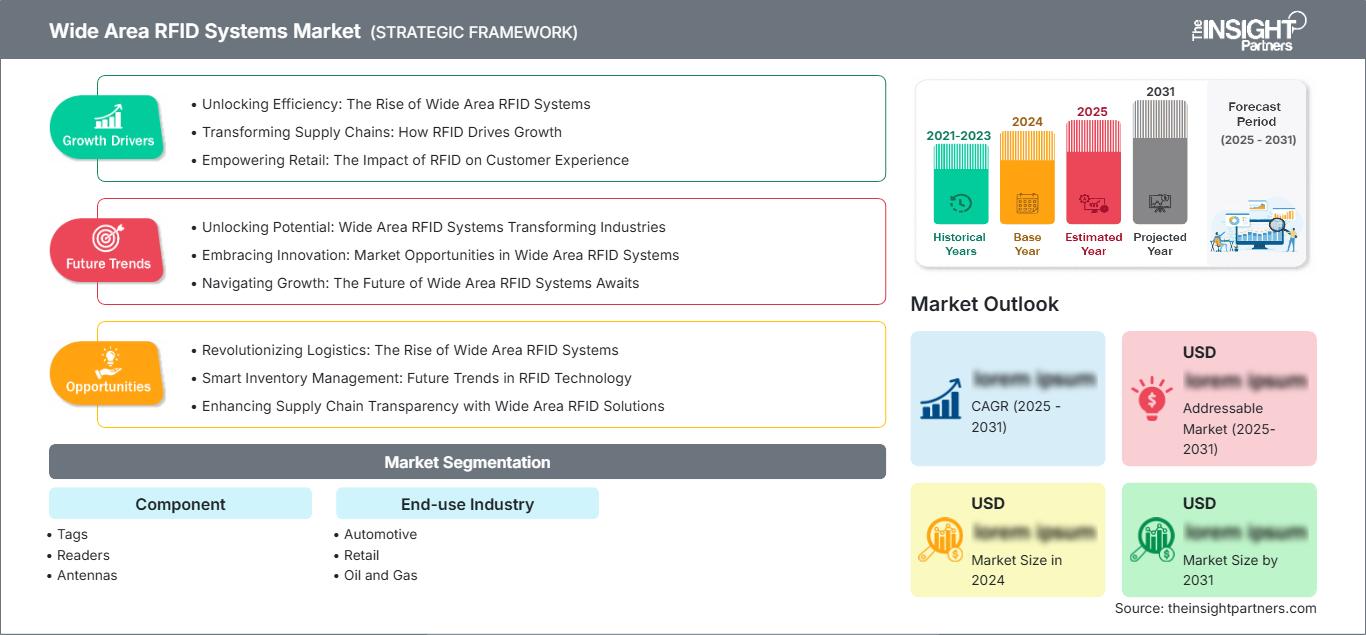
Regional Insights
North America wide area rfid systems market
North America is estimated to represent 32–36% of 2025 wide area rfid systems market demand, with a 7.1–7.8% CAGR through 2034. Retailers are extending item-level identification into distribution, replenishment, returns, and loss-prevention workflows. Manufacturers are similarly using RFID to synchronize material movement, work-in-process, tooling, and finished-goods records.
The US accounts for most regional demand, while Canada contributes through logistics, industrial, and healthcare applications. Enterprise buyers increasingly prioritize integration with existing WMS and ERP environments rather than standalone RFID infrastructure. Strong technology ecosystems, high warehouse automation investment, and labor-productivity objectives support continued deployment. Healthcare organizations are also adopting RFID for equipment location and inventory control, while pharmaceutical operations emphasize traceability and authentication. The region is expected to remain the largest geographic market through the forecast period as established deployments broaden their coverage and move toward automated event capture.
U.S. wide area rfid systems Market
The US represents approximately 68–72% of North America's 2025 wide area rfid systems market demand and is projected to grow at 7.2–7.9% through 2034. Large retailers, logistics providers, manufacturers, and hospitals are major deployment groups, with enterprise software integration becoming increasingly important.
Applications range from merchandise visibility and distribution-center verification to automotive component tracking and medical-equipment management. Impinj, Inc., Barcoding, Inc., Guard RFID Solutions, Inc., and other specialists have established market presence through hardware, software, integration, and industry-focused solutions. Retail programs increasingly connect RFID events with omnichannel fulfillment and inventory accuracy, while manufacturing deployments emphasize work-in-process traceability. Adoption is also supported by continued automation investment and pressure to improve labor utilization without compromising operational visibility. As deployments mature, buyers are likely to prioritize measurable return on investment, coverage optimization, data governance, and interoperability with existing enterprise systems.
Europe wide area rfid systems Market
Europe is estimated to account for 27–31% of the wide area rfid systems market share in 2025 and is projected to expand at a 6.3–7.0% CAGR through 2034. Germany is the leading industrial adoption center, while the UK, France, Italy, and Spain contribute through retail, logistics, automotive, and manufacturing programs.
The UK enjoys advanced retail and distribution systems in which RFID technology can contribute to inventory management and omnichannel delivery. The German economy has been noted for its strengths in the automotive and industrial automation sectors, in addition to RFID expertise. France has been expanding usage cases in the sectors of retailing, logistics, healthcare, and industrial identification. Italy has adopted the technology in manufacturing and fashion-related logistics chains, in which item traceability is an operational issue. Spain is working on implementation in retail logistics and distribution networks. Traceability, sustainability, product information, and automation have become driving forces behind investment decisions in Europe.
APAC wide area rfid systems Market
APAC is estimated to hold 24–28% share of the wide area rfid systems market in 2025 and is forecast to grow at 7.5–8.4% through 2034. China leads regional demand, supported by manufacturing scale and logistics modernization. Japan and South Korea benefit from advanced automation, while India is expanding connected warehousing and industrial digitization.
Australia's participation comes from the sectors of retailing, logistics, healthcare, and asset management. Manufacturers in the region have been employing RFID in the areas of process control of products in process, traceability of components, and automated movement of materials. There are additional drivers of demand arising from the digitalization programs backed by the government and smart manufacturing infrastructure. China is still the top-ranking country due to its robust manufacturing and distribution network, but India provides great opportunities for growth in the future.
Middle East & Africa wide area rfid systems Market
The Middle East and Africa-wide area rfid systems market demand is projected to expand at a 5.8–6.6% CAGR through 2034. Saudi Arabia leads regional development, supported by logistics, industrial diversification, and smart-infrastructure initiatives. The UAE follows through with advanced logistics, airports, retail, and connected facilities.
South Africa is still a significant African adoption center; however, the remainder of MEA offers prospects in the oil & gas, healthcare, logistics, and industrial asset management sectors. Identification technologies for use in the energy sector have to be long-lasting and robust enough to identify equipment, tools, maintenance assets, and other inventory that passes through such complicated infrastructure. The renovation of infrastructure and the execution of logistics projects can generate the need for automated identification at warehousing, port, and industrial facilities.
Segmentation Analysis
Component
The Component segment is expected to grow at a 6.4–7.2% CAGR during 2026–2034. Tags remain fundamental because every identification event depends on a reliable transponder, while readers and antennas determine coverage, read accuracy, and deployment architecture. Demand is shifting toward higher sensitivity, compact form factors, specialized materials, and better performance around challenging products and environments. The Wide Area RFID Systems Market is being shaped by ongoing advancements in tag design, reader capabilities, and antenna technologies that enhance deployment flexibility and identification accuracy across diverse operational settings.
- Tags remain central to item-level identification, with demand spanning retail merchandise, automotive components, industrial assets, healthcare equipment, and logistics units requiring persistent digital identity.
- Readers support fixed, handheld, portal, conveyor, and embedded deployments, with buyers prioritizing faster processing, reliable detection, network connectivity, and software interoperability.
- Antennas determine coverage geometry and read-zone performance, making antenna selection strategically important for portals, dock doors, production cells, shelves, conveyors, and constrained industrial spaces.
End-use Industry
The End-use Industry segment is projected to grow at a 6.8–7.6% CAGR during 2026–2034. Adoption depends on the operational value of automated identification, the number of assets or products requiring visibility, and the maturity of digital workflows. Retail and manufacturing remain broad application bases, while healthcare offers strong expansion potential. Current Wide Area RFID Systems Market trends indicate increasing demand for real-time asset tracking, inventory visibility, and automated identification solutions as organizations accelerate digital transformation and supply chain optimization initiatives.
- Automotive uses RFID for components, tools, work-in-process materials, returnable containers, and production sequencing, supporting traceability across increasingly complex vehicle manufacturing ecosystems.
- Retail applies RFID to inventory accuracy, replenishment, omnichannel fulfillment, returns, loss prevention, and merchandise visibility across stores, distribution centers, and fulfillment operations.
- Oil and Gas requires durable identification for equipment, tools, maintenance inventories, containers, and field assets operating in geographically dispersed and demanding environments.
- Manufacturing uses RFID to coordinate work-in-process, tooling, raw materials, finished goods, and production records, improving synchronization between physical movement and digital systems.
- Healthcare uses RFID for medical equipment, supplies, pharmaceuticals, inventory, and workflow visibility, supporting asset utilization and reducing time spent locating critical resources.
Opportunity Snapshot
| End-use Industry | Revenue Contribution (High/Medium/Low) | Trend Tag (MAX 2 words, specific) | Adoption Stage (Emerging/Scaling/Mature) |
| Automotive | High | Parts Traceability | Scaling |
| Retail | High | Item Visibility | Mature |
| Oil and Gas | Medium | Asset Tracking | Scaling |
| Manufacturing | High | WIP Automation | Mature |
| Healthcare | Medium | Asset Visibility | Scaling |
Wide Area RFID Systems Market Growth Drivers and Impact Analysis
Expansion of Automated Warehouse and Distribution Operations
As the SKU count increases along with more rapid order cycles and more rigorous fulfillment expectations, warehouses are automating to keep up. RFID technology does not require visual contact to recognize multiple items that have been tagged, and therefore has use cases from docks to conveyor belts to staging, storage, and shipping. Not only is the benefit of faster recognition realized through this automation process, but the capture of such events allows the system to automatically update the warehouse software, cutting down on manual reconciliation. With the addition of autonomous mobile robots, automation in storage and sortation, and machine vision systems, RFID can help to create an additional layer of ID that supports context for the item or asset.
Growing Requirement for Traceable Industrial Production
There is an increasing need for the availability of a digital system that correlates component parts, manufacturing process stages, tooling, quality inspection, and the final product. The RFID technology helps meet this need in that it enables the association of physical items with the machine and enterprise data as material flows through the manufacturing process. Visibility can lead to a reduction in search time, proper sequencing, enhanced readiness of recall, and the detection of process deviations. It is important to note that automobile manufacturers fit well into the context in that they have complex bills of material with increasing electronics content, which requires proper component movements. Other industries that need RFID are machines, electronics, metalworking, and engineered products.
Increasing Healthcare Asset and Supply Visibility
In the field of healthcare, organizations continue to grapple with problems in tracking mobile equipment, management of their high-value assets, supplies management, and record keeping of their inventories. RFID technology can automate the identification process of these physical resources through storage rooms, procedure rooms, pharmacies, labs, and clinical departments. This effect will be felt especially in cases where equipment usage is hindered by a lack of visibility rather than the availability of these assets. In addition, RFID technology can aid in the chain of custody processes and can be used to detect any inventory that does not match the expected inventory. With hospitals increasingly going digital in their operations and medical environments, RFID can be part of larger visibility systems.
Wide Area RFID Systems Market Future Trends
Gen2X-Enabled Identification Architectures
The Gen2X capabilities are likely to impact future RFID deployments as they will enhance the ability of future systems to select proper tags, manage read zones, perform reinventories quickly, and authenticate them. Such capabilities will enable future RFID deployments to differentiate between desired tags and unwanted signals in congested environments. The need for such capability is particularly important in warehouse settings, retail stores, manufacturing cells, and healthcare facilities, where tag population is large enough to complicate the process of reading the tags. Further, better capabilities exhibited by endpoint devices might aid in detecting counterfeits and enhancing item-level controls. As Gen2X-based components are becoming available in wider partner ecosystems, designers are likely to use them in future deployments rather than just upgrading the protocols.
RFID Convergence with Digital Product and Asset Records
Future implementation of RFID technology is expected to be tied much more closely with digital product information, enterprise asset management platforms, and product lifecycles. Rather than just being a means for product identification, RFID systems can serve as a layer of event generation, which includes operational history, maintenance records, provenance information, inventory status, and sustainability workflows. The convergence can result in improved control over the products through all the manufacturing, distribution, retail, usage, and recycling cycles. Integration with cloud computing environments and business intelligence tools can help companies contrast the actual movement of products with expected transactions and detect any deviations much earlier. The evolution can be applicable to digital product information projects due to RFID capability of providing the machine-readable product identity at various operational checkpoints. RFID vendors who make integration with enterprise environments easier can acquire strategic significance for their buyers.
Wide Area RFID Systems Market Opportunities
Expansion into Connected Industrial Facilities
Industrial facilities provide an opportunity to extend RFID beyond conventional inventory applications into tools, containers, workstations, production assets, and maintenance workflows. Investors and solution providers can target plants where physical movement remains dependent on manual confirmation or disconnected records. A scalable approach can begin with high-value assets or bottleneck processes before expanding across production areas. Opportunities are particularly attractive where multiple facilities share common workflows because standardized tag formats, reader configurations, and software interfaces can reduce deployment complexity. Industrial customers are also seeking solutions that function reliably around metal, liquids, machinery, and electromagnetic interference. Suppliers that combine rugged hardware with engineering services and analytics integration can address a larger share of project value. The opportunity therefore, extends beyond component sales toward repeatable facility-level deployment models.
Healthcare and Pharmaceutical Traceability Platforms
Healthcare and pharmaceutical organizations offer opportunities for specialized RFID platforms that combine identification with workflow management, inventory analytics, and compliance-oriented records. High-value equipment, critical supplies, medication inventories, and reusable assets can each provide distinct deployment cases. Providers can prioritize environments where shortages, misplaced equipment, expired inventory, or manual reconciliation create measurable operational costs. Pharmaceutical applications can extend identification across manufacturing, storage, distribution, and controlled handling points, supporting stronger chain-of-custody records. The opportunity favors suppliers that can address sector-specific requirements for data security, environmental durability, interoperability, and implementation governance. Partnerships with healthcare technology providers, pharmaceutical manufacturers, and systems integrators can accelerate adoption by embedding RFID into broader digital transformation projects rather than positioning it as a standalone identification purchase.
Frequently Asked Questions

- Comprehensive Market Sizing and Forecast Analysis
- Detailed Segmentation Analysis
- In-Depth Market Dynamics Assessment
- Regional and Country-Level Insights
- Competitive Landscape and Company Benchmarking
- Strategic Business Intelligence
Recent Reports
Testimonials

The Insight Partners' SCADA System Market report is comprehensive, with valuable insights on current trends and future forecasts. The team was highly professional, responsive, and supportive throughout. We are very satisfied and highly recommend their services.
RAN KEDEM Partner, Reali Technologies LTDs
I requested a report on a very specific software market and the team produced the report in a few days. The information was very relevant and well presented. I then requested some changes and additions to the report. The team was again very responsive and I got the final report in less than a week.
JEAN-HERVE JENN Chairman, Future Analytica
We worked with The Insight Partners for an important market study and forecast. They gave us clear insights into opportunities and risks, which helped shape our plans. Their research was easy to use and based on solid data. It helped us make smart, confident decisions. We highly recommend them.
PIYUSH NAGPAL Sr. Vice President, High Beam Global
The Insight Partners delivered insightful, well-structured market research with strong domain expertise. Their team was professional and responsive throughout. The user-friendly website made accessing industry reports seamless. We highly recommend them for reliable, high-quality research services
YUKIHIKO ADACHI CEO, Deep Blue, LLC.
This is the first time I have purchased a market report from The Insight Partners.While I was unsure at first, I visited their web site and felt more comfortable to take the risk and purchase a market report.I am completely satisfied with the quality of the report and customer service. I had several questions and comments with the initial report, but after a couple of dialogs over email with their analyst I believe I have a report that I can use as input to our strategic planning process.Thank you so much for taking the extra time and making this a positive experience.I will definitely recommend your service to others and you will be my first call when we need further market data.
JOHN SUZUKI President and Chief Executive Officer, Board Director, BK Technologies
I wish to appreciate your support and the professionalism you displayed in the course of attending to my request for information regarding to infectious disease IVD market in Nigeria. I appreciate your patience, your guidance, and the fact that you were willing to offer a discount, which eventually made it possible for us to close a deal. I look forward to engaging The Insight Partners in the future, all thanks to the impression you have created in me as a result of this first encounter.
DR CHIJIOKE ONYIA MANAGING DIRECTOR, PineCrest Healthcare Ltd.Reason to Buy
- Informed Decision-Making
- Understanding Market Dynamics
- Competitive Analysis
- Identifying Emerging Markets
- Customer Insights
- Market Forecasts
- Risk Mitigation
- Boosting Operational Efficiency
- Strategic Planning
- Investment Justification
- Tracking Industry Innovations
- Aligning with Regulatory Trends





 Get Free Sample for