
Wood Based Panel Market Trends, Size & Forecast by 2034
Coverage: By Product (Plywood, Medium-density Fibreboard, Particleboard, Softboard, Hardboard); Application (Construction, Furniture, Packaging, Others) , and Geography (North America, Europe, Asia Pacific, and South and Central America)
- Status : Data Released
- Report Code : TIPMC00002700
- Category : Manufacturing and Construction
- No. of Pages : 150
- Available Report Formats :


- Last update date : September 30, 2026


2025 Market Size
US$ 215.54 Bn
Base year value
2034 Forecast
US$ 356 Bn
Projected by 2034
CAGR 2026-2034
5.73 %
Growth rate
Addressable Market
US$ 2,589.68 Bn
(2026-2034)
The wood based panel market was valued at US$ 215.54 Billion in 2025 and is projected to reach US$ 356 Billion by 2034, registering a CAGR of 5.73% during 2026–2034. Demand is supported by the expanding use of engineered wood products across construction, furniture, and packaging, while manufacturers increasingly optimize fiber utilization, panel performance, processing efficiency, and material consistency across residential and industrial applications.
North America is expected to record an estimated CAGR of 4.8–5.6% during 2026–2034, supported by residential repair and remodeling, structural panel consumption, and replacement of aging housing stock. The wood based panel market size in the region is also influenced by construction productivity requirements, formaldehyde-emission standards, domestic timber availability, and continued investment in automated panel manufacturing and distribution infrastructure.
Wood Based Panel Market Assessment and Insights
- North America: The region is estimated to represent 16–20% wood based panel market share in 2025 and grow at a CAGR of 4.8–5.6% during 2026–2034, supported by housing renovation, structural construction, and established engineered-wood manufacturing capacity.
- US: The US accounts for approximately 78–82% of North American demand in 2025 and is expected to expand at a CAGR of 4.9–5.7%, led by residential construction and remodeling.
- Europe: Europe represents an estimated 18–22% share in 2025 and is projected to expand at 4.1–5.0% CAGR, with Germany, Italy, France, Spain, and the UK supporting furniture, renovation, and engineered-building-material demand.
- Asia Pacific: Asia Pacific holds an estimated 50–54% share in 2025 and is expected to grow at 5.6–6.4% CAGR, with China, India, Japan, South Korea, and Australia shaping regional consumption and production.
- Largest Segment: Plywood is estimated to hold a 27–31% market share in 2025, with a 5.1–5.9% CAGR through 2034, reflecting structural strength and broad construction applicability.
- High Growth Segment: MDF is estimated to represent 20–24% share in 2025 and expand at 5.8–6.6% CAGR, supported by furniture machining, decorative finishing, and modular interiors.
- Key companies analyzed in detail: Dongwha Enterprise Co., Ltd.; Kronoplus Limited; Binderholz GmbH; Canfor Corporation; Timber Products Company; GreenSpec; PERI SE; Metroply; Geometrik Manufacturing Inc.; Koskisen Corporation; EGGER Group.
Source: The Insight Partners' analysis based on proprietary research, government publications, company annual reports, investor presentations, industry databases, and expert interviews.
The production of wood based panels has moved from traditional board making to automated pressing, precise fiber preparation, resin optimization, surface finishing, and wood residue recycling. Distinguishing features in the industry now are moisture resistance, dimensional stability, fire resistance, machining, and decoration compatibility. Plywood is still used for structural purposes, whereas MDF and particle boards serve to make furniture in bulk quantities. Digital process control systems have been used to improve yield efficiency and energy management as well as quality in mass production processes.
Future investments in the wood based panel market will focus on efficient fiber recovery, reduced emissions glue, recycled content usage, and capacity close to large furniture and building areas. New centers of demand in South and Southeast Asia will be complementary to developed regions of Europe and North America. Formaldehyde emissions, sustainability of forestry, traceability and environmental information about products will play a key role in the decision-making process.
Wood Based Panel Market Report Scope
| Report Attribute | Details |
|---|---|
| Market size in 2025 | US$ 215.54 Billion |
| Market Size by 2034 | US$ 356 Billion |
| Global CAGR (2026 - 2034) | 5.73% |
| Historical Data | 2021-2024 |
| Forecast period | 2026-2034 |
Wood Based Panel Market Analysis
Growth of the wood based panel market will be related to construction, furniture manufacturing, remodeling, and packaging needs. Structural strength of plywood, machining ability of MDF, and economical use of wood particles for particleboard make up the panel types. The industry chain includes forests owners, saw mills, residue suppliers, resin makers, panel manufacturers, distributors, furniture makers, contractors, and retailers. Integration along all these links will allow the producers to control the sources of fibers and their quality.
The economics of the wood based panel market are strongly determined by prices for wood, wood residues, resins, electricity, transportation, and capacity of the mills. Growing demand for high fiber efficiency from residues and recycling makes the panel producers less vulnerable to the availability of virgin wood. The process of production may be improved by using large continuous presses, automation in material handling, and better drying systems. Supplies of the industry will remain regional due to differing end use cycles of structural plywood, furniture-grade MDF, and particleboard.
The wood based panel market forecast shows that there is a fragmented competitive landscape, whereby size, location, product range, and source materials determine the competitive stance. Kronoplus Limited and EGGER Group are focused on having extensive ranges of panels along with the value added surfaces. On the other hand, Dongwha Enterprise Co., Ltd. has the ability to produce engineered panels and interior products. Binderholz GmbH and Canfor Corporation have a competitive advantage owing to their integration into wood processing systems.
Competitive investments in the wood based panel market are shifting towards automation, energy saving, special grades and downstream processing and not just commodity capacities. Koskisen Corporation is working on enhancing its plywood production through staged investments. Similarly, PERI SE utilizes its plywood experience in the industrial and construction segments. There are a number of companies like Timber Products Company, Metroply, Geometrik Manufacturing Inc., GreenSpec and many more who are competing with customized offerings, technical know-how and relationship building.
● REPORT CUSTOMIZATION
Tailor This Report To Align With Your Specific Business Requirements
This report can be customized to align precisely with your business objectives, scope, and target markets. Customization options include tailored segmentation, geography, competitive analysis, and strategic insights to support informed decision-making.
Customize This Report →WHAT YOU CAN ADJUST
- ● Segmentations
- ● Geography
- ● Competitive Analysis
- ● Language Preferences
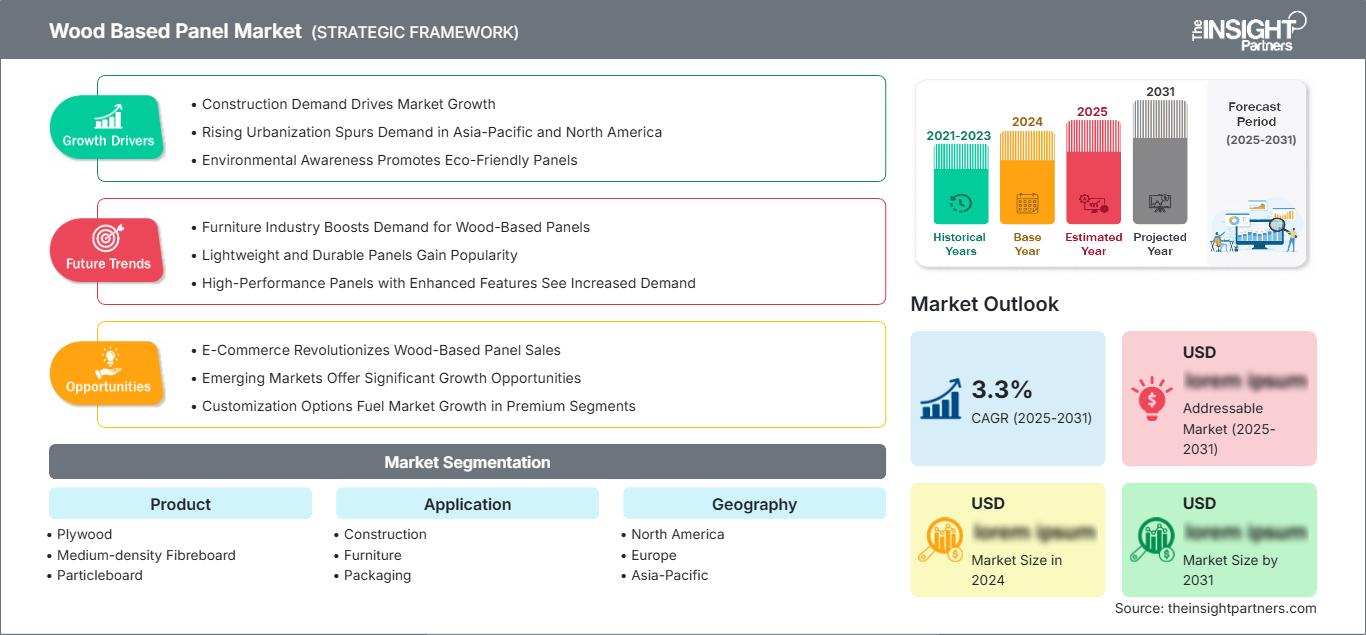
Wood Based Panel Market: Strategic Insights
Regional Insights
North America wood based panel market
North America is estimated to account for 16–20% of global wood based panel market in 2025 and expand at a 4.8–5.6% CAGR through 2034. Residential construction, remodeling, and repair, along with refurbishment needs in the commercial segment, continue to play a key role in driving demand. Structural plywood and engineered panels can gain from lightweight construction trends, while furniture manufacture provides support for MDF and particleboard use. Emission standards and product certification programs will drive investments into compliant panels.
The region has well-developed manufacturing capabilities, solid forestry, and extensive distribution network in place. Panel manufacturers tend to make full use of their mills’ capabilities and raw material efficiency in view of timber supplies, freight, and weather-driven interruptions in procurement. Canadian producers can offer wood-processing capability; demand, meanwhile, will be concentrated in the US. Infrastructure renovation and housing shortages are additional drivers for the next several years, despite mortgage costs, labor market factors, and regional lumber prices.
U.S. wood based panel market
The wood based panel market report shows that the U.S. represents approximately 78–82% of North American consumption in 2025 and is projected to grow at a 4.9–5.7% CAGR through 2034. The demand is focused in construction, remodels, cabinets, furniture, floor substrates, and interior applications. Specification trends are increasingly focusing on moisture resistance, performance, low emissions, and processing uniformity.
Geographic coverage in the wood based panel market is aided by large-scale producers and distributors, and small regional mills play an important role in producing transport-sensitive materials. There is a trend towards the use of prefabrication in construction, modular interiors, and digitization in furniture production. Inventory limitations in the housing sector will be helpful in promoting renovations despite a slowdown in new housing construction. On the other hand, domestic production will continue to depend on wood prices, mill operations, transport costs, and panel imports.
Europe wood based panel market
Europe is estimated to hold an 18–22% share in 2025 and expand at a 4.1–5.0% CAGR. Germany is one of the key markets due to the country's furniture, building, and industrial manufacturing activities. The UK maintains the demand through renovations, fitted furniture, and refurbishing. France combines building modernization with high consumption of interiors and furniture, whereas Italy is still important for furniture manufacturing and design-driven products. The Spanish market has the potential for construction, cabinetry, and furniture manufacture for exports. More emphasis is being placed on certified woods, traceability, low-emission resins, recycling, and energy efficiency.
APAC wood based panel market
APAC represents an estimated 50–54% share in 2025 and is expected to grow at a 5.6–6.4% CAGR, with China remaining the leading market. India is set for relatively faster growth in demand due to rising investments in construction, furniture, and infrastructures. On the other hand, Japan and South Korea contribute demand for good quality interior panel products while Australia contributes applications in construction.
China benefits from having very large production facilities as well as large construction and furniture industries. The regional producers are increasingly automating their factories and venturing into decorative and performance grades of MDF products. Structural demand is provided by housing programs and redevelopment policies, industrial growth, and furniture exports.
Middle East & Africa wood based panel market
Middle East and Africa demand is projected to expand at a 4.3–5.2% CAGR, supported by construction, hospitality, retail interiors, logistics infrastructure, and furniture imports. The markets for Saudi Arabia and the UAE are essential regional markets, whereas South Africa has a comparatively advanced manufacturing and distribution platform. Large-scale construction is driving demand for plywood and particle boards.
Saudi Arabia gets its strength from infrastructure and urban development, whereas the UAE is a mix of commercial construction, hospitality, and interior fit-out requirements. South Africa helps with furniture and building material consumption, whereas the rest of the MEA is relatively import-reliant. Costs of energy, transportation logistics, local manufacturing benefits, and financing conditions of the projects all affect the regional demand.
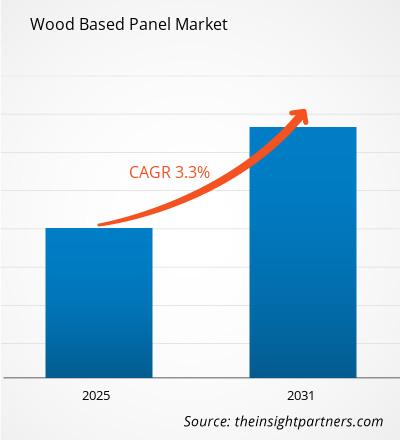
Segmentation Analysis
Product
The Product segment is expected to expand at a 5.1–5.9% CAGR during 2026–2034. Demand varies substantially by structural performance, machinability, appearance, density, and price. Plywood remains strategically important for load-bearing uses, while fiber-based boards benefit from automated furniture production and decorative finishing requirements.
- Plywood: Plywood maintains a strong position where strength, dimensional stability, and durability are required. Construction, transportation, furniture, and formwork applications support recurring demand across developed and emerging markets.
- Medium-density Fibreboard: MDF benefits from smooth surfaces, uniform density, and machinability. Its compatibility with routing, painting, laminating, and automated furniture production strengthens its role in value-added interior applications.
- Particleboard: Particleboard remains important for cost-sensitive furniture, cabinetry, shelving, and interior components. Its efficient use of wood particles supports high-volume manufacturing where standardized dimensions and competitive material costs matter.
- Softboard: Softboard serves insulation, acoustic, backing, and interior applications where lightweight construction and workability are priorities. Demand remains linked to building-performance requirements and specialized interior applications.
- Hardboard: Hardboard supports applications requiring a dense, thin, and durable panel. Its use in furniture components, doors, backing, and industrial products provides a stable specialist demand base.
Application
The Application segment is projected to expand at a 5.2–6.0% CAGR through 2034. Furniture remains a major consumption center because panel products enable standardized dimensions, automated machining, decorative surfaces, and efficient material utilization. Construction provides another significant demand pool through structural, interior, and temporary applications.
- Construction: Construction demand centers on structural plywood, interior panels, formwork, flooring components, and engineered building systems. Procurement increasingly emphasizes certified sourcing, consistent performance, low emissions, and compatibility with prefabrication.
- Furniture: Furniture represents the strongest recurring application because MDF and particleboard integrate efficiently with automated cutting, edge-banding, laminating, and surface finishing. Modular kitchens, wardrobes, offices, and ready-to-assemble products reinforce demand.
- Packaging: Packaging applications use selected plywood and panel grades for crates, pallets, protective structures, and industrial packaging. Demand follows manufacturing output, export logistics, machinery shipments, and requirements for reusable protective packaging.
Opportunity Snapshot
| Application | Revenue Contribution | Trend Tag | Adoption Stage |
| Construction | High | Modular Building | Scaling |
| Furniture | High | Automated Interiors | Mature |
| Packaging | Medium | Reusable Crating | Scaling |
Wood Based Panel Market Growth Drivers and Impact Analysis
Expansion of modular and industrialized construction
Industrialized construction is increasing the importance of standardized panels that can be cut, assembled, transported, and installed with predictable tolerances. Off-site manufacturing favors materials that integrate with automated saws, CNC equipment, fastening systems, and prefabricated assemblies. This supports demand for plywood and other engineered panels with consistent thickness and dimensional stability. The impact extends beyond residential structures into commercial interiors, temporary construction systems, and infrastructure projects. Panel producers able to provide certified performance, reliable dimensions, and application-specific grades can secure recurring contracts with manufacturers rather than depending entirely on spot construction demand. Over time, industrialized construction also encourages closer coordination between panel producers, architects, fabricators, contractors, and distributors, creating opportunities for customized specifications and higher-value products.
Growth of automated furniture manufacturing
Furniture manufacturing is becoming increasingly automated as producers respond to shorter product cycles, mass customization, labor constraints, and demand for consistent finishing. MDF and particleboard are particularly compatible with CNC routing, precision cutting, edge-banding, lamination, and digital production workflows. This expands the addressable role of panels beyond basic board supply toward engineered components with controlled surface properties and machining performance. Manufacturers are consequently investing in boards designed for efficient processing, improved screw holding, moisture resistance, and decorative finishing. The impact is strongest in large furniture-producing countries where modular kitchens, wardrobes, office furniture, and ready-to-assemble products are expanding. Suppliers that combine reliable board quality with surface treatments, cutting services, and technical support can improve customer retention and reduce substitution risk.
Pressure for efficient fiber utilization and circular production
Rising attention to resource efficiency is encouraging producers to extract greater value from forestry residues, sawmill by-products, recovered wood, and manufacturing waste. Particleboard already provides an efficient route for converting smaller wood particles into usable panels, while fiberboard production can incorporate selected recovered feedstocks when technical and regulatory requirements are satisfied. Manufacturers are also improving resin efficiency, energy management, and process controls to reduce waste and emissions. These changes can moderate raw-material exposure while supporting sustainability requirements from furniture manufacturers, builders, and institutional buyers. The market impact is particularly relevant in regions where timber availability is constrained or environmental regulations are stringent. Traceability, recycled content, environmental product declarations, and certified forestry practices are therefore becoming increasingly important procurement attributes.
Wood Based Panel Market Future Trends
Integration of low-emission and bio-based binder technologies
The wood based panel market trends show that future product development is likely to place greater emphasis on binders that reduce formaldehyde emissions while maintaining pressing speed, bond strength, moisture resistance, and surface quality. Manufacturers are exploring combinations of lower-emission resin systems, bio-based components, optimized curing conditions, and improved process monitoring. The commercial opportunity will depend on whether these technologies can achieve consistent performance without materially increasing manufacturing costs. Demand is expected to be strongest in furniture, residential interiors, schools, healthcare facilities, and other environments where indoor-air-quality considerations influence procurement. As regulations and voluntary building standards become more demanding, compliance may increasingly shift from a basic specification requirement toward a differentiating product attribute. Producers with scalable chemistry and process expertise should be better positioned to introduce premium grades without disrupting plant economics.
Digital product traceability and performance-based procurement
Digitalization in the wood based panel market is expected to extend from factory automation into product-level traceability, environmental documentation, and customer-specific specification management. Panel buyers increasingly require information about raw-material origin, certification, emissions, recycled content, and lifecycle characteristics. Digital product records can connect manufacturing data with environmental declarations and supply-chain documentation, improving transparency for builders, furniture companies, and public-sector procurement. In parallel, digital design tools can allow fabricators to match panel grades with structural loads, machining requirements, moisture conditions, and finishing processes before production begins. This may reduce material waste and improve project-level planning. Suppliers that combine traceable sourcing with accessible technical data can strengthen relationships with sophisticated buyers while reducing administrative friction across international supply chains.
Wood Based Panel Market Opportunities
Localized capacity near furniture manufacturing clusters
A major investment opportunity lies in establishing or expanding panel capacity close to rapidly growing furniture and interior-manufacturing clusters. Local production can reduce freight exposure, shorten lead times, improve inventory responsiveness, and enable customized thicknesses or surface treatments. India, Southeast Asia, Eastern Europe, and selected Latin American markets offer attractive conditions where furniture exports, housing construction, and manufacturing ecosystems are developing simultaneously. Investors should prioritize plants with flexible production lines capable of switching between grades and incorporating locally available fiber sources. Partnerships with furniture manufacturers can further improve utilization and provide predictable offtake. Capacity decisions should nevertheless account for forestry certification, resin availability, energy reliability, transportation infrastructure, and environmental permitting because these factors materially affect long-term operating economics.
Value-added panels for specialized industrial applications
Specialized grades offer an avenue for improving margins without relying solely on commodity-volume expansion. Opportunities include moisture-resistant boards, fire-performance grades, lightweight panels, high-wear surfaces, precision-machined components, and customized plywood for transportation and industrial packaging. These products can address customer requirements that are less sensitive to basic board pricing and more dependent on technical performance. Manufacturers can develop such opportunities through application engineering, co-design with customers, and downstream processing services. Construction equipment, commercial interiors, electric-vehicle logistics, modular furniture, and industrial packaging provide potential demand pools. Successful investment requires careful validation of certification requirements and customer qualification cycles, but specialized products can create stronger relationships and improve resilience against raw-material and freight-cost volatility.
Frequently Asked Questions

- Comprehensive Market Sizing and Forecast Analysis
- Detailed Segmentation Analysis
- In-Depth Market Dynamics Assessment
- Regional and Country-Level Insights
- Competitive Landscape and Company Benchmarking
- Strategic Business Intelligence
Recent Reports
Testimonials

The Insight Partners' SCADA System Market report is comprehensive, with valuable insights on current trends and future forecasts. The team was highly professional, responsive, and supportive throughout. We are very satisfied and highly recommend their services.
RAN KEDEM Partner, Reali Technologies LTDs
I requested a report on a very specific software market and the team produced the report in a few days. The information was very relevant and well presented. I then requested some changes and additions to the report. The team was again very responsive and I got the final report in less than a week.
JEAN-HERVE JENN Chairman, Future Analytica
We worked with The Insight Partners for an important market study and forecast. They gave us clear insights into opportunities and risks, which helped shape our plans. Their research was easy to use and based on solid data. It helped us make smart, confident decisions. We highly recommend them.
PIYUSH NAGPAL Sr. Vice President, High Beam Global
The Insight Partners delivered insightful, well-structured market research with strong domain expertise. Their team was professional and responsive throughout. The user-friendly website made accessing industry reports seamless. We highly recommend them for reliable, high-quality research services
YUKIHIKO ADACHI CEO, Deep Blue, LLC.
This is the first time I have purchased a market report from The Insight Partners.While I was unsure at first, I visited their web site and felt more comfortable to take the risk and purchase a market report.I am completely satisfied with the quality of the report and customer service. I had several questions and comments with the initial report, but after a couple of dialogs over email with their analyst I believe I have a report that I can use as input to our strategic planning process.Thank you so much for taking the extra time and making this a positive experience.I will definitely recommend your service to others and you will be my first call when we need further market data.
JOHN SUZUKI President and Chief Executive Officer, Board Director, BK Technologies
I wish to appreciate your support and the professionalism you displayed in the course of attending to my request for information regarding to infectious disease IVD market in Nigeria. I appreciate your patience, your guidance, and the fact that you were willing to offer a discount, which eventually made it possible for us to close a deal. I look forward to engaging The Insight Partners in the future, all thanks to the impression you have created in me as a result of this first encounter.
DR CHIJIOKE ONYIA MANAGING DIRECTOR, PineCrest Healthcare Ltd.Reason to Buy
- Informed Decision-Making
- Understanding Market Dynamics
- Competitive Analysis
- Identifying Emerging Markets
- Customer Insights
- Market Forecasts
- Risk Mitigation
- Boosting Operational Efficiency
- Strategic Planning
- Investment Justification
- Tracking Industry Innovations
- Aligning with Regulatory Trends





 Get Free Sample for