
Woodworking Tools Market Size, Share & Demand by 2034
Coverage: By Product Type (Power Tools, Jigs, Wood Pins and Plugs, Others); Application (Industrial, Commercial, Residential) , and Geography (North America, Europe, Asia Pacific, and South and Central America)
- Status : Data Released
- Report Code : TIPRE00027297
- Category : Manufacturing and Construction
- No. of Pages : 150
- Available Report Formats :


- Last update date : September 30, 2026


2025 Market Size
US$ 24.77 Bn
Base year value
2034 Forecast
US$ 35.16 Bn
Projected by 2034
CAGR 2026-2034
3.97 %
Growth rate
Addressable Market
US$ 272.21 Bn
(2026-2034)
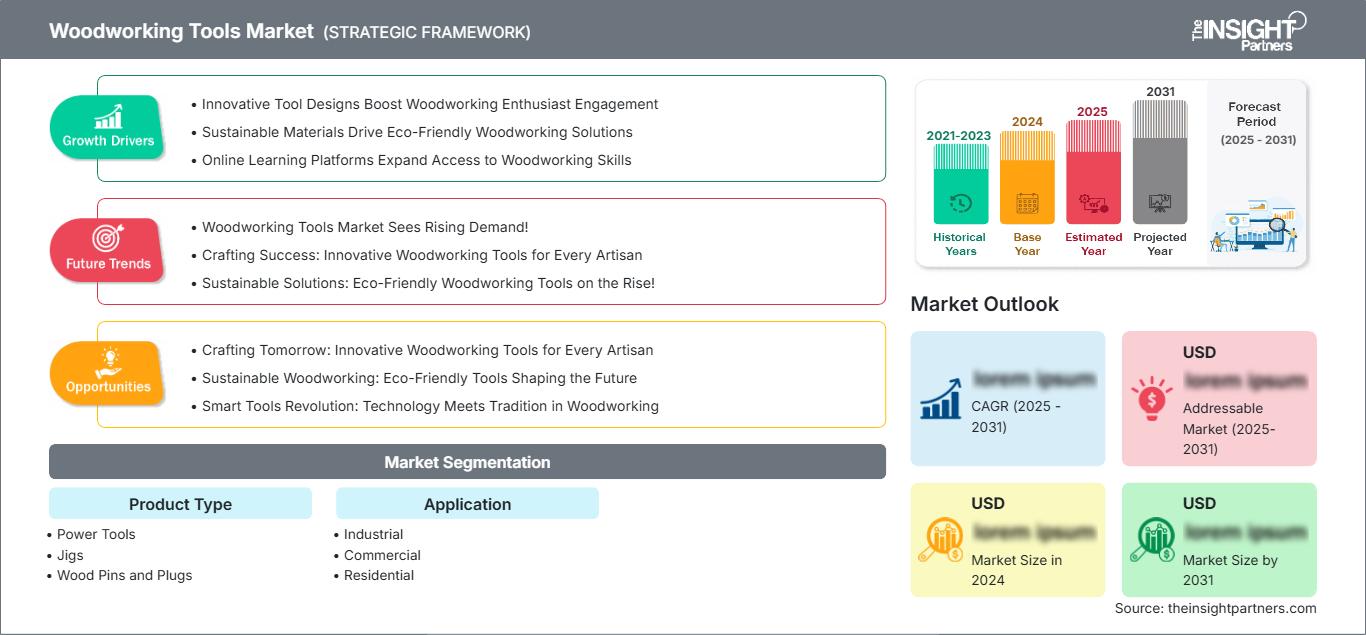
The woodworking tools market size is valued at US$ 24.77 Billion in 2025 and is projected to reach US$ 35.16 Billion by 2034, registering a CAGR of 3.97% during 2026–2034. The market encompasses power tools, jigs, wood pins, and plugs serving industrial, commercial, and residential users. Demand is shaped by furniture manufacturing, construction, remodeling, workshop modernization, productivity requirements, and the gradual replacement of conventional equipment with safer, more ergonomic, and increasingly cordless solutions.
Across North America, the market is expected to expand at an estimated 4.1–4.5% CAGR through 2034, supported by repair and remodeling activity, professional contractor demand, and continued investment in manufacturing productivity. The regional size is also supported by established distribution networks, a large installed base of professional equipment, and rising adoption of battery-powered tools that reduce setup time and improve mobility across job sites.
Woodworking Tools Market Assessment and Insights
- North America: North America is estimated to account for 30–34% woodworking tools market share in 2025 and grow at a 4.1–4.5% CAGR between 2026–2034, supported by remodeling, professional construction, and manufacturing modernization.
- US: The US represents 82–87% of North American demand in 2025 and is projected to grow at a 4.0–4.4% CAGR between 2026–2034, supported by replacement and contractor applications.
- Europe: Europe holds an estimated 27–31% share in 2025 and is expected to register a 3.5–3.9% CAGR between 2026–2034. Germany, Italy, France, the UK, and Spain support demand through furniture production, engineered wood processing, and renovation.
- Asia Pacific: Asia Pacific represents approximately 29–33% share in 2025 and is forecast to grow at a 4.8–5.4% CAGR between 2026–2034. China, Japan, South Korea, India, and Australia underpin expansion through manufacturing and construction.
- Largest Segment: Power Tools is estimated to hold a 56–60% market share in 2025 and expand at a 4.2–4.6% CAGR during 2026–2034, reflecting productivity and mobility requirements.
- High Growth Segment: Commercial applications are estimated at 25–30% market share in 2025 and are expected to grow at a 4.5–5.0% CAGR during 2026–2034, driven by workshops and contractors.
- Key companies analyzed in detail: Altendorf GmbH, DEWALT, C. & E. Fein GmbH, General Tools & Instruments LLC, Hida Tool & Hardware, Kreg Tool Company, Makita Corporation, Techtronic Industries Co. Ltd. (Milwaukee), Ridge Tool Company (RIDGID), and Robert Bosch GmbH.
Source: The Insight Partners' analysis based on proprietary research, government publications, company annual reports, investor presentations, industry databases, and expert interviews.
Woodworking tools have transitioned from mainly corded machines with manual tuning to cordless technology, brushless motors, accessories, dust collection systems, and digital assistance. Manufacturers now focus on ergonomics, battery compatibility, reduced vibrations, and consistent cuts. The trend is especially important in labor-limited regions and productivity per labor unit. US woodworking employment will fall by 2% between 2025 and 2035; automation is a key factor in determining labor needs.
In the future, the woodworking tools market is set to experience gains from new manufacturing hubs, professional workshops, and investment in renovations and prefabrication. Asia Pacific will continue to be an important market for expansion, given the increasing automation in furniture and building product manufacturing. In developed markets, replacement, safety improvements, dust control requirements, and battery platform switching are expected to drive sales despite fluctuations in construction of houses.
Woodworking Tools Market Report Scope
| Report Attribute | Details |
|---|---|
| Market size in 2025 | US$ 24.77 Billion |
| Market Size by 2034 | US$ 35.16 Billion |
| Global CAGR (2026 - 2034) | 3.97% |
| Historical Data | 2021-2024 |
| Forecast period | 2026-2034 |
Woodworking Tools Market Analysis
Demand in the woodworking tools market is based on three interrelated ecosystems: building and renovation, manufacture of furniture and cabinets, and individual workshops. Professional consumers favor portable yet precise tools more and more often, whereas industrial consumers are interested in productivity, accuracy, maintenance capabilities, and integration with automated processes. Thus, the market covers both manufacturing needs in large volumes and less common applications, which depend on the accuracy of processing, finishing, and flexibility.
According to the woodworking tools market forecast, the dynamics of supply depends on global procurement of components, motors and batteries, special accessories, and a wide distribution network. Tool makers are competing through product lines, availability of spare parts, ergonomic design, warranty service, and compatibility of all tool types within one line. Residential users are provided with retail sales and online stores, while industrial buyers still rely on distributors and specialists. Stock control is crucial for modern manufacturers.
The woodworking tools market research report also highlights competitive differentiation on cordless systems, brushless motors, vibration damping, and application specific accessories. DEWALT, Makita Corporation, Robert Bosch GmbH, Techtronic Industries Co. Ltd. via Milwaukee, and Ridge Tool Company via RIDGID engage in competition within comprehensive professional tools ranges, whereas Altendorf GmbH, C. & E. Fein GmbH, Kreg Tool Company, Hida Tool & Hardware, and General Tools & Instruments LLC target specialty precision, workshop, or professional tool needs.
The woodworking tools market report shows that increasing investments focus on battery technology, digitization of manufacturing, ergonomics, and accessories that improve tool use efficiency. Product launches illustrate how tool vendors attempt to establish user loyalty through complementary platform solutions rather than individual tool acquisitions. Bosch has added new professional tools to its 18V range in 2025, and Makita introduced new cordless fastening tools for carpenters, framers, homebuilders, and fine woodworkers.
● REPORT CUSTOMIZATION
Tailor This Report To Align With Your Specific Business Requirements
This report can be customized to align precisely with your business objectives, scope, and target markets. Customization options include tailored segmentation, geography, competitive analysis, and strategic insights to support informed decision-making.
Customize This Report →WHAT YOU CAN ADJUST
- ● Segmentations
- ● Geography
- ● Competitive Analysis
- ● Language Preferences
Woodworking Tools Market: Strategic Insights
Regional Insights
North America woodworking tools market
North America is estimated to represent 30–34% of the woodworking tools market in 2025 and is projected to grow at a 4.1–4.5% CAGR through 2034. The US dominates regional consumption, followed by Canada and Mexico. Demand benefits from professional remodeling, furniture production, contractor activity, and a mature replacement market. In 2025, US private construction totaled US$1.65 trillion, while residential improvements increased 1.2%, demonstrating continued activity in an important tool-consuming segment.
In addition, regional purchases are also going towards wireless products, dust-control equipment, and other types of tools that make operation more efficient. Manufacturers are spending money on products that can work in conjunction with CNC machinery, whereas contractors are buying small tools that will require little transportation and less set up time. As a result, regional woodworking tools are not dependent solely on new construction since there are different ways to generate demand. There is no shortage of suppliers in this industry.
U.S. woodworking tools market Market
The US is estimated to account for 82–87% of North American market demand in 2025 and is expected to expand at a 4.0–4.4% CAGR through 2034. The country benefits from extensive construction, remodeling, furniture manufacturing, professional contracting, and mature home-improvement distribution. However, housing conditions remain uneven, making replacement demand and renovation particularly important for manufacturers and distributors.
The American consumers prefer cordless systems, brushless motors, less vibration, dust management system, and application-specific attachments. DEWALT, Robert Bosch GmbH, Makita Corporation, Milwaukee, RIDGID, Kreg Tool Company, and General Tools & Instruments LLC have noticeable presence in the market. Private construction investment in 2025 reduced by 2.6% while that of residential improvements rose by 1.2%.
Europe woodworking tools market Market
Europe is estimated to hold 27–31% of the market in 2025 and is forecast to grow at a 3.5–3.9% CAGR through 2034. Germany is at the forefront of regional demand thanks to its highly developed machinery, furniture production, engineered wood processing, and an industrial supply base. Contributions are also made by Italy and France with their respective demands from furniture, cabinetry, interior construction, and renovations.
The UK boasts significant professional and domestic demand, while Spain has advantages from renovation projects in construction, hospitality sector, and furniture production. The key reason for Germany's continued influence is that precision machining and industrial woodworking create a need for robust and high performance machinery. Engineering and performance throughout the product life cycle are favored by European buyers over price alone.
APAC woodworking tools market Market
APAC is estimated to account for 29–33% of the woodworking tools market in 2025 and is projected to grow at a 4.8–5.4% CAGR through 2034. China leads regional consumption, supported by furniture manufacturing and construction. Japan and South Korea emphasize precision production, while India is expanding workshop and construction capacity.
Australia is one example of a well-established professional and residential market. The industrial modernization, furniture production that involves exporting, urbanization, and policies that encourage manufacturing efficiency are structural factors that will increase demand. The use of battery-operated machines will also be favored due to their mobility.
Middle East & Africa woodworking tools market Market
Middle East and Africa demand is expected to expand at a 4.0–4.5% CAGR through 2034, with Saudi Arabia, the UAE, and South Africa representing important markets. Saudi Arabia gets advantages from projects related to construction and diversification, while the UAE provides help in regard to commercial interiors and top-notch fit-outs. South Africa has the traditional demand in relation to woodworking, furniture, and contractors.
The regional potential is connected to infrastructure development, hospitality sector development, residential construction and refurbishment. The professional equipment purchased is still important, but the distributors focus on the supply of consumables and support. The costs related to energy and logistics may affect the choice of tools and equipment.
Segmentation Analysis
Product Type
Product Type is divided into Power Tools, Jigs, and Wood Pins and Plugs. The segment is expected to register a 4.2–4.6% CAGR during 2026–2034, with power equipment benefiting from productivity requirements, cordless adoption, and replacement of older machinery. Workshop professionals increasingly evaluate complete tool platforms rather than individual devices.
- Power Tools: This category remains central to professional woodworking because cutting, drilling, sanding, routing, fastening, and finishing tasks require consistent output. Cordless platforms increasingly complement corded equipment where mobility and rapid setup matter.
- Jigs: Jigs support repeatable positioning, drilling, cutting, and assembly, making them strategically important for small workshops and professional users seeking accuracy without investing immediately in complex automated machinery.
- Wood Pins and Plugs: These products support joinery, alignment, fastening, and finishing applications. Demand is linked to cabinetmaking, furniture assembly, repair work, and projects where concealed or visually consistent connections are preferred.
Application
Application comprises Industrial, Commercial, and Residential users and is expected to expand at a 3.8–4.3% CAGR during 2026–2034. Industrial customers prioritize throughput and precision, while commercial workshops balance productivity with flexibility. Residential demand is more influenced by affordability, ease of use, and compact storage requirements.
- Industrial: Industrial users require durable tools capable of sustained operation and repeatable results. Integration with automated production, standardized workflows, and quality-control processes makes reliability and serviceability decisive purchasing criteria.
- Commercial: Commercial workshops, contractors, cabinetmakers, and furniture specialists require flexible equipment that can transition between applications. Professional cordless systems and specialized accessories support productivity where jobs vary in scale and location.
- Residential: Residential users typically prioritize ease of operation, compact design, safety, and affordability. DIY renovation, hobby woodworking, and home repair applications create demand for accessible equipment that delivers adequate precision without industrial complexity.
Opportunity Snapshot
| Application | Revenue Contribution (High/Medium/Low) | Trend Tag | Adoption Stage |
|---|---|---|---|
| Industrial | High | Automated Production | Mature |
| Commercial | Medium | Cordless Workflows | Scaling |
| Residential | Medium | DIY Workshops | Scaling |
Woodworking Tools Market Growth Drivers and Impact Analysis
Migration Toward Cordless Professional Platforms
The use of cordless power tools changes purchasing dynamics in favor of mobility, ease of setup, and fewer restrictions on electricity access. Battery platforms further drive purchases because customers can buy more devices while using the same batteries and chargers. The competitive impact is substantial, as those who have extensive product lines can build a higher customer base in cutting, fastening, sanding, and drilling products. In 2025, Bosch supplemented its 18V line-up with additional offerings to show how important battery platforms remain strategically. Makita added to its collection of cordless nailers and staplers for fine woodworkers, framers, carpenters, and home builders.
Rising Productivity Pressure Across Small Workshops
Small and medium woodworking businesses increasingly face labor constraints, variable project schedules, and customer expectations for consistent finishes. These conditions increase the value of tools that shorten setup time and reduce repetitive manual work. Productivity-focused equipment can improve output without requiring a complete transition to automated machinery. This creates a broad opportunity for precision jigs, compact power tools, dust-management equipment, and application-specific accessories. The effect is particularly relevant in developed markets, where replacement purchasing can remain resilient even when new construction slows. Manufacturers that combine ergonomics, reliability, and straightforward maintenance can address productivity requirements without positioning every purchase around high-end industrial automation.
Expansion of Renovation and Interior Refurbishment
Renovation provides an important counterbalance to fluctuations in new construction because repair, remodeling, cabinetry, flooring, and interior refurbishment require repeated cutting, drilling, sanding, fastening, and finishing activities. In the US, residential improvement spending increased 1.2% in 2025 despite declines in several other construction categories. This pattern illustrates how renovation can sustain professional tool utilization when housing starts weaken. The opportunity extends beyond North America into European refurbishment markets and rapidly urbanizing Asian economies. Suppliers can capture this demand through compact professional systems, accessories designed for finish quality, and tools that enable contractors to complete multiple tasks without transporting extensive equipment inventories.
Woodworking Tools Market Future Trends
Connected and Data-Assisted Workshop Equipment
Connected functionality is likely to become more relevant as workshops seek measurable productivity and equipment utilization. Future tools may increasingly incorporate usage monitoring, battery-health information, maintenance alerts, digital setup guidance, and compatibility with workshop management platforms. The woodworking tools market trends are expected to favor solutions that translate tool data into operational decisions rather than adding connectivity without a practical purpose. Larger professional workshops could use equipment data to schedule maintenance, manage battery inventories, and identify underutilized assets. Smaller businesses may benefit from simplified diagnostics and guided setup features. Over time, manufacturers with software capabilities, interoperable platforms, and strong service networks could differentiate through lifecycle management rather than hardware specifications alone.
Greater Convergence Between Manual and Automated Workflows
The boundary between conventional woodworking tools and automated production is likely to become less distinct. CNC equipment can handle standardized production, while portable tools remain essential for installation, finishing, correction, prototyping, and customized work. Future purchasing strategies should therefore combine automation with flexible handheld equipment instead of treating the categories as substitutes. This approach is supported by labor dynamics: US employment of woodworkers is projected to decline 2% from 2025 to 2035, with automation identified as an important factor. The resulting market direction should favor tools that complement digitally planned production and enable workers to perform higher-value finishing and assembly activities efficiently.
Woodworking Tools Market Opportunities
Localized Professional Tool Ecosystems in Emerging Manufacturing Hubs
Manufacturers can expand in emerging woodworking clusters by adapting professional portfolios to local production practices, distribution structures, and service expectations. India, Southeast Asia, and selected Middle Eastern markets offer opportunities where furniture production, construction, and interior contracting are becoming more organized. A localized strategy should combine suitable cordless platforms with dependable accessories, technical training, spare-parts availability, and distributor support. Such investments can reduce barriers to adoption among small workshops that may hesitate to purchase unfamiliar professional equipment. Companies can also use tiered product architectures to address different levels of workshop sophistication while preserving platform compatibility. This approach creates opportunities for recurring sales through batteries, accessories, consumables, and replacement tools.
Service, Refurbishment, and Lifecycle-Based Revenue Models
Lifecycle services represent an underdeveloped opportunity as professional users increasingly evaluate total ownership costs. Manufacturers and distributors can build recurring revenue through preventive maintenance, refurbishment, spare-parts programs, battery replacement, calibration, and trade-in initiatives. Such models can improve equipment availability while helping customers manage capital expenditure. The opportunity is particularly relevant for industrial and commercial users where downtime can exceed the cost of routine service. Digital registration can further support warranty administration and maintenance scheduling without requiring complex technology. Suppliers that establish regional service centers and dependable parts networks can strengthen customer retention while differentiating themselves from low-cost competitors focused primarily on initial purchase price.
Frequently Asked Questions

- Comprehensive Market Sizing and Forecast Analysis
- Detailed Segmentation Analysis
- In-Depth Market Dynamics Assessment
- Regional and Country-Level Insights
- Competitive Landscape and Company Benchmarking
- Strategic Business Intelligence
Recent Reports
Testimonials

The Insight Partners' SCADA System Market report is comprehensive, with valuable insights on current trends and future forecasts. The team was highly professional, responsive, and supportive throughout. We are very satisfied and highly recommend their services.
RAN KEDEM Partner, Reali Technologies LTDs
I requested a report on a very specific software market and the team produced the report in a few days. The information was very relevant and well presented. I then requested some changes and additions to the report. The team was again very responsive and I got the final report in less than a week.
JEAN-HERVE JENN Chairman, Future Analytica
We worked with The Insight Partners for an important market study and forecast. They gave us clear insights into opportunities and risks, which helped shape our plans. Their research was easy to use and based on solid data. It helped us make smart, confident decisions. We highly recommend them.
PIYUSH NAGPAL Sr. Vice President, High Beam Global
The Insight Partners delivered insightful, well-structured market research with strong domain expertise. Their team was professional and responsive throughout. The user-friendly website made accessing industry reports seamless. We highly recommend them for reliable, high-quality research services
YUKIHIKO ADACHI CEO, Deep Blue, LLC.
This is the first time I have purchased a market report from The Insight Partners.While I was unsure at first, I visited their web site and felt more comfortable to take the risk and purchase a market report.I am completely satisfied with the quality of the report and customer service. I had several questions and comments with the initial report, but after a couple of dialogs over email with their analyst I believe I have a report that I can use as input to our strategic planning process.Thank you so much for taking the extra time and making this a positive experience.I will definitely recommend your service to others and you will be my first call when we need further market data.
JOHN SUZUKI President and Chief Executive Officer, Board Director, BK Technologies
I wish to appreciate your support and the professionalism you displayed in the course of attending to my request for information regarding to infectious disease IVD market in Nigeria. I appreciate your patience, your guidance, and the fact that you were willing to offer a discount, which eventually made it possible for us to close a deal. I look forward to engaging The Insight Partners in the future, all thanks to the impression you have created in me as a result of this first encounter.
DR CHIJIOKE ONYIA MANAGING DIRECTOR, PineCrest Healthcare Ltd.Reason to Buy
- Informed Decision-Making
- Understanding Market Dynamics
- Competitive Analysis
- Identifying Emerging Markets
- Customer Insights
- Market Forecasts
- Risk Mitigation
- Boosting Operational Efficiency
- Strategic Planning
- Investment Justification
- Tracking Industry Innovations
- Aligning with Regulatory Trends





 Get Free Sample for