
Yield Monitoring Devices Market Demand, Trends & Forecast by 2034
Coverage: by Component (Hardware, Software, Services); Technology (Remote Sensing Systems, Guidance Systems); Application (Crop Scouting, Field Mapping, Variable Rate Application (VRA), Soil Monitoring, Others) , and Geography (North America, Europe, Asia Pacific, and South and Central America)
- Status : Data Released
- Report Code : TIPRE00004817
- Category : Electronics and Semiconductor
- No. of Pages : 150
- Available Report Formats :


- Last update date : September 30, 2026


2025 Market Size
US$ 2.96 Bn
Base year value
2034 Forecast
US$ 5.48 Bn
Projected by 2034
CAGR 2026-2034
7.11 %
Growth rate
Addressable Market
US$ 38.15 Bn
(2026-2034)
The yield monitoring devices market captures the growing use of connected sensing, positioning, and data-management technologies to quantify crop performance during harvesting and across field operations. The market is valued at US$ 2.96 Billion in 2025 and is projected to reach US$ 5.48 Billion by 2034, registering a CAGR of 7.11% during 2026–2034. Expansion reflects increasing precision agriculture adoption and stronger demand for field-level productivity intelligence.
Across North America, adoption is supported by large-scale mechanized farming, established precision-agriculture infrastructure, and rapid integration of connected farm machinery. The yield monitoring devices size is expected to expand at an estimated 6.8–8.2% CAGR during 2026–2034. Increasing use of digital farm-management platforms and variable-rate applications should sustain replacement and retrofit demand.
Yield Monitoring Devices Market Assessment and Insights
- North America: North America represented an estimated 38–42% yield monitoring devices market share in 2025 and is expected to expand at a 6.8–8.2% CAGR between 2026–2034, supported by mechanized harvesting, connected machinery, and established precision-agriculture workflows.
- US: The US accounted for an estimated 28–32% share of global demand in 2025 and is projected to grow at a 6.7–8.1% CAGR during 2026–2034, led by large farms and digital agronomy adoption.
- Europe: Europe held an estimated 23–27% share in 2025 and is forecast to grow at a 6.2–7.6% CAGR between 2026–2034, with Germany, France, the UK, Italy, and Spain supporting demand through precision farming.
- Asia Pacific: Asia Pacific represented approximately 20–24% share in 2025 and is expected to record a 7.8–9.4% CAGR during 2026–2034, with China, Japan, India, South Korea, and Australia expanding digital agricultural capabilities.
- Largest Segment: Hardware held an estimated 54–58% market share in 2025 and is expected to grow at a 6.5–7.7% CAGR through 2034, reflecting sensor and display requirements.
- High Growth Segment: Software is estimated at a 22–26% share in 2025 and is projected to grow at a 8.4–10.1% CAGR during 2026–2034 as analytics become central to farm decisions.
- Key companies analyzed in detail: Ag Leader Technology; AgJunction Inc.; AGCO Corporation; CNH Industrial N.V.; Deere & Company; Precision Planting LLC; Raven Industries, Inc.; TeeJet Technologies; Trimble Inc.; Topcon Corporation.
Source: The Insight Partners' analysis based on proprietary research, government publications, company annual reports, investor presentations, industry databases, and expert interviews.
The yield monitoring devices market size will be shifting from the harvest sensor stage towards the ecosystem stage, which combines optical or load cell sensor systems, GPS, machine display units, and cloud analytics. The hardware component of the ecosystem continues to play a critical role since sensors have to deal with changing crop flow, vibrations, dust and moisture conditions, and different speeds of operations. On the other hand, software becomes more advanced in terms of turning raw data into maps, comparisons, prescriptions, and recommendations for farmers.
Future growth opportunities for yield monitoring devices market may involve expansion from the North American agricultural landscape into the developing precision agriculture market where machinery upgrades and digital advice services are advancing together. Increased interoperability, open data standards, retrofitting ability, and reduced cost architecture may increase the availability of the solution. Attention of regulators to resource use efficiency, soil sustainability, and traceability may also stimulate adoption.
Yield Monitoring Devices Market Report Scope
| Report Attribute | Details |
|---|---|
| Market size in 2025 | US$ 2.96 Billion |
| Market Size by 2034 | US$ 5.48 Billion |
| Global CAGR (2026 - 2034) | 7.11% |
| Historical Data | 2021-2024 |
| Forecast period | 2026-2034 |
Yield Monitoring Devices Market Analysis
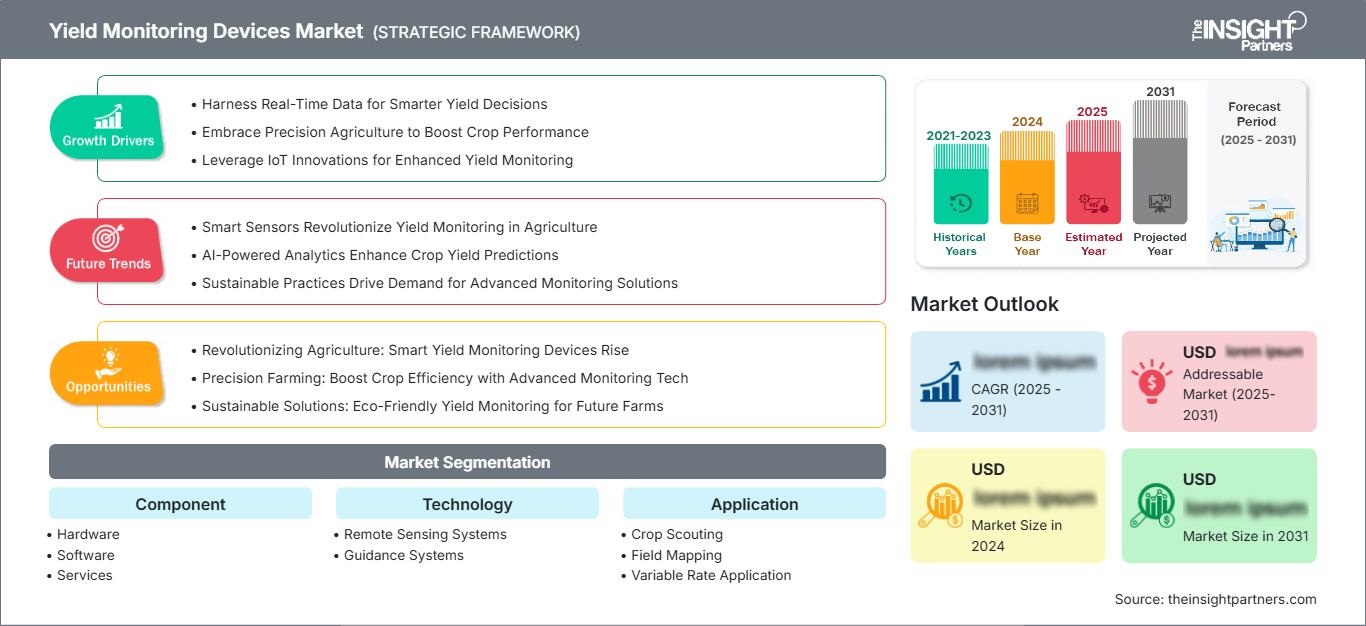
The yield monitoring devices market growth is driven by the change from machine-based agriculture towards data-driven production management. On average, an ecosystem comprises crop flow sensors, moisture measuring instruments, GNSS receivers, displays, controllers, farm management software, machinery vendors, distributors, agronomists, and support companies. Data obtained during the harvest can be used to choose the right seeds, field zoning, soil preparation, and variable-rate application.
Market dynamics of the yield monitoring devices market are influenced by technical specifics of sensing devices and their ability to connect and work together in combines, harvesters, tractors, and machines. Hardware vendors compete in accuracy, robustness, calibration, installation and interoperability, while software companies compete in data visualization, synchronization, analytics, and prescription generation. Leading companies in the ecosystem are those that combine equipment with digital services and let users share data between planting, crop care, and harvest processes.
The yield monitoring devices market forecast will reveal that the market exhibits a competitive landscape comprising traditional agriculture equipment manufacturers as well as advanced technology providers. The companies such as Deere & Company, AGCO Corporation, and CNH Industrial N.V. have the advantage of already having their installed base of machinery. Companies such as Ag Leader Technology, Trimble Inc., Topcon Corporation, and Raven Industries, Inc. possess specialized technology pertaining to positioning, sensing, control, and data management respectively.
The investment trends of the yield monitoring devices market are increasingly inclined toward platform solutions, as opposed to standalone devices. AGCO Corporation's FarmENGAGE platform is a perfect example of the trend toward integration of connectivity, agronomics, and task management. Similarly, the Operations Center from Deere & Company serves to connect information on machines, fields, and operators. Topcon's agriculture portfolio includes yield monitoring along with positioning and digital farm management.
● REPORT CUSTOMIZATION
Tailor This Report To Align With Your Specific Business Requirements
This report can be customized to align precisely with your business objectives, scope, and target markets. Customization options include tailored segmentation, geography, competitive analysis, and strategic insights to support informed decision-making.
Customize This Report →WHAT YOU CAN ADJUST
- ● Segmentations
- ● Geography
- ● Competitive Analysis
- ● Language Preferences
Yield Monitoring Devices Market: Strategic Insights
Regional Insights
North America yield monitoring devices market
North America remains the leading regional market, with an estimated 38–42% share in 2025 and a projected 6.8–8.2% CAGR through 2034. There is the presence of extensive mechanized harvests, large-scale commercial farms, mature GNSS technology, and precision farming. Yields are increasingly used in field planning as opposed to being stored as records after the harvest process. Interoperability with connected displays, farm management software, and prescription technology makes it possible to see a steady demand for replacement and retrofits in corn, soybean, wheat, cotton, and specialty crops.
Dealer networks, financing for equipment, and farmers' familiarity with digital agronomy help create structural demand in yield monitoring devices. Producers in the US and Canada increasingly expect compatibility between their machines and software, hence vendors are encouraged to support standard interfaces and cloud operations. Durable sensors are necessary because of the tough environmental conditions experienced during the harvest process. The competitiveness in the region's market is greatly helped by the presence of Deere & Company, AGCO Corporation, CNH Industrial N.V., Trimble Inc., Ag Leader Technology, and Topcon Corporation.
U.S. yield monitoring devices market
The U.S. represents approximately 68–76% of North American demand in 2025 and is expected to grow at a 6.7–8.1% CAGR through 2034. Mass grain production, high machine utilization, and broad adoption of precision agriculture technologies enable demand. Farmers growing corn, soybean, wheat, cotton, and other specialty crops are linking their yield data with navigation, field mapping, application control, and farm management system technologies.
Trends related to applications are pointing towards integrated solutions that can collect yield data along with other parameters such as moisture, location, and machine data in real-time mode. Deere & Company benefits from its leading position in the segment due to the connected farm management technologies. AGCO Corporation and CNH Industrial N.V. offer integrated precision technologies on multiple equipment brands. Companies specialized in precision agriculture such as Ag Leader Technology and Trimble Inc. compete on flexible retrofitting and data interoperability.
Europe yield monitoring devices market
The yield monitoring devices market report shows that Europe accounted for an estimated 23–27% share in 2025 and is forecast to grow at a 6.2–7.6% CAGR through 2034. Germany is a leading market, supported by advanced machinery, technology-oriented farms, and strong equipment manufacturing. France provides substantial demand because of its large arable sector and increasing focus on input efficiency. The UK, Italy, and Spain also contribute through precision farming, specialty crops, and modernization programs.
The reason for Germany being on the list is that it combines high-quality machines along with automation and guidance of machines and farm data. France pays attention to such elements as productivity, input efficiency, and field management in extensive agricultural zones. The United Kingdom focuses on using connected machines and digital agronomy. Italy and Spain present possibilities in relation to vineyards, horticulture, cereals, and irrigated agriculture, in which spatial variability provides justification for the targeted measurements.
APAC yield monitoring devices market
APAC represented approximately 20–24% share in 2025 and is projected to grow at a 7.8–9.4% CAGR through 2034. China represents the largest market, whereas Japan, South Korea, India, and Australia represent different possibilities. China gains advantage through agricultural mechanization and digital farming investment, Japan from automation, and Australia from broad acre farming.
India presents potential for the future as a result of increased mechanization, remote sensing, and digital advisory. Australia profits from advanced broad acre farming and large farm sizes. South Korea and Japan focus on smart agriculture, robotics, and connected machines. Policy programs that promote the use of technologies to achieve more effective farming in terms of resource utilization will help drive development in the region. It is affordable devices and equipment, retrofitting options, local analytics, and services provided by dealers that will dictate penetration rates outside the leading farming technology adopters.
Middle East & Africa yield monitoring devices market
Middle East and Africa demand is emerging from a smaller base, with growth projected at approximately 6.0–7.5% CAGR through 2034. Saudi Arabia and the UAE are emphasizing technology-enabled agriculture amid water constraints, while South Africa provides a comparatively mature commercial-farming environment. Precision measurement is particularly relevant where irrigation, input management, and farm productivity must be optimized.
Saudi Arabia and the UAE can support adoption through controlled-environment agriculture, smart-farming programs, and investment in agricultural technology. South Africa offers opportunities across grains, horticulture, and commercial field crops. The rest of the region remains constrained by machinery costs, fragmented farm structures, connectivity gaps, and technical-service availability. Nevertheless, agricultural modernization, food-security priorities, and pressure to improve water and input efficiency can create selective opportunities for durable, interoperable monitoring systems.
Segmentation Analysis
Component
Component segmentation is led by hardware because sensing, positioning, display, and controller equipment forms the physical foundation for measurement. The segment is projected to grow at a 6.5–7.7% CAGR during 2026–2034. Demand is supported by replacement cycles, retrofit installations, sensor upgrades, and increasing machine connectivity.
- Hardware: Combines sensors, displays, controllers, receivers, and associated components needed for field measurement. Demand centers on accuracy, durability, compatibility, calibration simplicity, and integration with existing agricultural machinery.
- Software: Converts field observations into maps, reports, comparisons, and actionable information. Its strategic importance is increasing as producers seek centralized data environments connecting harvesting, planting, application, and agronomic decisions.
- Services: Includes installation, calibration, integration, technical support, data management, and advisory activities. Demand is strongest where farms require assistance deploying connected systems or interpreting increasingly complex datasets.
Technology
Technology combines remote sensing and guidance capabilities that improve the spatial accuracy and usefulness of collected field information. The segment is expected to expand at a 7.2–8.6% CAGR during 2026–2034 as GNSS connectivity and sensor sophistication advance.
- Remote Sensing Systems: Use optical, electromagnetic, or related sensing approaches to capture crop-flow and field-condition information. Their importance rises with demand for non-contact measurement, real-time monitoring, and high-resolution field mapping.
- Guidance Systems: Coordinate machine location, movement, and operating paths using positioning technologies. Their strategic role is expanding as producers integrate yield information with automated steering, application control, and machine-data workflows.
Application
Application demand is broad because yield information can influence multiple operational stages. The segment is projected to grow at a 7.4–8.8% CAGR during 2026–2034, supported by stronger integration between measurement and agronomic decision-making.
- Crop Scouting: Uses spatial information to identify variability and prioritize field inspection. Its importance grows when yield maps are combined with crop-health observations, enabling producers to investigate underperforming areas efficiently.
- Field Mapping: Converts georeferenced observations into visual productivity patterns. Demand is supported by requirements for historical comparison, field zoning, management planning, and clearer communication between farmers, operators, and agronomists.
- Variable Rate Application: Connects field variability with targeted input decisions. Its strategic value comes from linking measured performance with differentiated seeding, fertilization, spraying, or amendment rates.
- Soil Monitoring: Relates productivity observations to underlying soil conditions and management practices. Adoption can improve diagnosis of recurring variability and strengthen long-term planning for fertility, moisture management, and field productivity.
Opportunity Snapshot
| Application | Revenue Contribution (High/Medium/Low) | Trend Tag (MAX 2 words, specific) | Adoption Stage (Emerging/Scaling/Mature) |
|---|---|---|---|
| Crop Scouting | Medium | Field Intelligence | Scaling |
| Field Mapping | High | Yield Mapping | Mature |
| Variable Rate Application | High | Rate Optimization | Scaling |
| Soil Monitoring | Medium | Soil Analytics | Scaling |
Yield Monitoring Devices Market Growth Drivers and Impact Analysis
Expansion of connected farm machinery ecosystems
Connected machinery is changing the economic role of field measurement by allowing observations to move automatically between equipment, displays, software platforms, and farm records. Producers can increasingly combine yield, moisture, location, and machine information rather than treating harvest data as an isolated output. This connectivity encourages equipment manufacturers to embed monitoring capabilities and creates opportunities for specialists offering interoperable retrofit technologies. The impact extends across the value chain because dealers can provide installation and support, software providers can develop analytics, and agronomists can interpret field-level datasets. As connectivity becomes standard across new machinery, compatibility and data portability will become increasingly important purchasing criteria, favoring suppliers that can operate across mixed fleets and multiple farm-management environments.
Demand for precise input allocation and operational efficiency
Pressure to improve input efficiency is strengthening the commercial case for measurement technologies. Fertilizer, seed, crop-protection products, fuel, labor, and machinery represent significant operating costs, making field-level productivity information useful for identifying variability and improving resource allocation. Yield information can reveal persistent underperformance, support comparisons between management zones, and provide evidence for adjusting subsequent applications. The impact is particularly relevant on large farms where small efficiency improvements can accumulate across thousands of hectares. It also supports integration with variable-rate application systems, because measurement creates an empirical basis for evaluating whether differentiated treatments produced the intended results. Vendors that connect monitoring data with actionable prescriptions can therefore capture greater value than suppliers focused solely on displaying harvest information.
Greater emphasis on measurable agricultural sustainability
Sustainability objectives are increasingly shifting from broad commitments toward measurable resource-use outcomes. Yield monitoring can contribute to this transition by documenting productivity variations and supporting more targeted use of water, nutrients, crop-protection products, and machinery passes. Although monitoring equipment alone does not guarantee environmental improvement, better measurement can help producers evaluate management decisions using field-specific evidence. This capability is relevant to farms seeking stronger traceability, improved nutrient-use efficiency, and clearer documentation of production practices. Equipment manufacturers and software providers can respond by linking yield information with agronomic records and sustainability metrics. Over time, the commercial opportunity should expand as food producers, processors, and agricultural stakeholders place greater value on transparent production data and repeatable evidence of resource-efficiency improvements.
Yield Monitoring Devices Market Future Trends
AI-assisted yield interpretation and predictive field intelligence
The yield monitoring devices market trends indicate that artificial intelligence is expected to move yield monitoring beyond visualization toward prediction and decision support. Future platforms can combine historical yield maps with weather, soil, crop-health, machinery, and application records to identify recurring productivity patterns. Instead of simply showing where yields were high or low, software can prioritize probable causes and recommend areas requiring investigation. Machine-learning models may also improve calibration by identifying anomalies caused by speed, crop flow, moisture variation, or sensor conditions. As computational capability becomes embedded in farm-management platforms, producers could receive near-real-time alerts during harvest and automated comparisons after field operations. This trend will increase the importance of high-quality, consistently georeferenced datasets and could shift competition toward platforms capable of combining heterogeneous data sources without creating excessive operator complexity.
Sensor fusion across harvest and crop-management workflows
Sensor fusion is likely to become a defining architecture as farms seek a unified view of crop performance. Yield, moisture, position, crop condition, machine status, and application information can provide more useful context when analyzed together than when maintained in separate systems. Future devices are therefore likely to emphasize standardized interfaces, wireless connectivity, automated calibration, and compatibility with mixed equipment fleets. Optical sensors, load cells, GNSS receivers, cameras, and remote-sensing inputs may increasingly work as coordinated measurement layers. This development can also support specialty crops where conventional grain-flow measurement is insufficient. Suppliers able to combine multiple sensing modalities while maintaining simple installation and reliable field performance should be better positioned to serve farms transitioning toward more automated, data-intensive production management.
Yield Monitoring Devices Market Opportunities
Retrofit solutions for mixed and aging machinery fleets
A significant opportunity exists in retrofit systems designed for farms that operate older combines, harvesters, and tractors alongside newer connected equipment. Full machinery replacement requires substantial capital, whereas modular sensing and display packages can introduce selected precision capabilities without replacing the underlying machine. Suppliers can target this opportunity through universal interfaces, simplified installation, wireless data transfer, and compatibility with widely used positioning systems. Dealer partnerships can reduce technical barriers by providing calibration and maintenance services. The strongest offerings should allow data generated by older equipment to enter modern farm-management platforms without extensive manual conversion. This approach can broaden the addressable customer base across developed markets and support adoption in emerging regions where machinery replacement cycles are longer and investment decisions are highly sensitive to upfront costs.
Integrated data services for specialty and high-value crops
Specialty crops present another opportunity because growers often manage substantial variability in crop condition, harvest timing, moisture, quality, and field performance. Potatoes, sugar beets, onions, tomatoes, vineyards, and other high-value crops can benefit from measurement systems adapted to conveyor-based or specialized harvesting equipment. Suppliers can develop differentiated solutions combining yield, weight, moisture, contamination, positioning, and farm-management information. Such platforms can generate value beyond production volume by improving harvest planning, quality management, inventory visibility, and field comparisons. Partnerships with equipment manufacturers, agronomists, processors, and agricultural cooperatives could accelerate deployment because these stakeholders influence technology selection and data use. Expansion into specialty crops therefore provides a route for technology vendors to diversify beyond conventional broad-acre harvesting applications.
Frequently Asked Questions

- Comprehensive Market Sizing and Forecast Analysis
- Detailed Segmentation Analysis
- In-Depth Market Dynamics Assessment
- Regional and Country-Level Insights
- Competitive Landscape and Company Benchmarking
- Strategic Business Intelligence
Recent Reports
Testimonials

The Insight Partners provided valuable market intelligence that supported our global go-to-market strategy. Their team was professional, responsive, and attentive to our feedback, providing thoughtful analysis and helpful methodological clarifications throughout the project.
Junmo Kim Chief Financial Officer (CFO), Enertech Co., Ltd.
The Insight Partners' SCADA System Market report is comprehensive, with valuable insights on current trends and future forecasts. The team was highly professional, responsive, and supportive throughout. We are very satisfied and highly recommend their services.
RAN KEDEM Partner, Reali Technologies LTDs
I requested a report on a very specific software market and the team produced the report in a few days. The information was very relevant and well presented. I then requested some changes and additions to the report. The team was again very responsive and I got the final report in less than a week.
JEAN-HERVE JENN Chairman, Future Analytica
We worked with The Insight Partners for an important market study and forecast. They gave us clear insights into opportunities and risks, which helped shape our plans. Their research was easy to use and based on solid data. It helped us make smart, confident decisions. We highly recommend them.
PIYUSH NAGPAL Sr. Vice President, High Beam Global
The Insight Partners delivered insightful, well-structured market research with strong domain expertise. Their team was professional and responsive throughout. The user-friendly website made accessing industry reports seamless. We highly recommend them for reliable, high-quality research services
YUKIHIKO ADACHI CEO, Deep Blue, LLC.
This is the first time I have purchased a market report from The Insight Partners.While I was unsure at first, I visited their web site and felt more comfortable to take the risk and purchase a market report.I am completely satisfied with the quality of the report and customer service. I had several questions and comments with the initial report, but after a couple of dialogs over email with their analyst I believe I have a report that I can use as input to our strategic planning process.Thank you so much for taking the extra time and making this a positive experience.I will definitely recommend your service to others and you will be my first call when we need further market data.
JOHN SUZUKI President and Chief Executive Officer, Board Director, BK Technologies
I wish to appreciate your support and the professionalism you displayed in the course of attending to my request for information regarding to infectious disease IVD market in Nigeria. I appreciate your patience, your guidance, and the fact that you were willing to offer a discount, which eventually made it possible for us to close a deal. I look forward to engaging The Insight Partners in the future, all thanks to the impression you have created in me as a result of this first encounter.
DR CHIJIOKE ONYIA MANAGING DIRECTOR, PineCrest Healthcare Ltd.Reason to Buy
- Informed Decision-Making
- Understanding Market Dynamics
- Competitive Analysis
- Identifying Emerging Markets
- Customer Insights
- Market Forecasts
- Risk Mitigation
- Boosting Operational Efficiency
- Strategic Planning
- Investment Justification
- Tracking Industry Innovations
- Aligning with Regulatory Trends





 Get Free Sample for