
Application Server Market Report by Share, Growth and Size: 2034
Coverage: By Type (Java, Microsoft Windows, Others); Deployment Model (On-premise, Cloud) , and Geography (North America, Europe, Asia Pacific, and South and Central America)
- Status : Data Released
- Report Code : TIPTE00002633
- Category : Technology, Media and Telecommunications
- No. of Pages : 150
- Available Report Formats :


- Last update date : August 27, 2026


2025 Market Size
US$ 25.63 Bn
Base year value
2034 Forecast
US$ 78.21 Bn
Projected by 2034
CAGR 2026-2034
13.2 %
Growth rate
Addressable Market
US$ 451.07 Bn
(2026-2034)
The application server market is projected to grow from US$ 25.63 Billion in 2025 to US$ 78.21 Billion by 2034, registering a CAGR of 13.2% during 2026–2034. Growth is supported by modernization of enterprise application estates, rising demand for secure runtime environments, and increasing use of application middleware to support cloud-native, API-driven, and transaction-intensive workloads across finance, telecom, manufacturing, healthcare, and public-sector systems.
Across North America, the application server market size is expected to expand at an estimated CAGR range of 12.4–13.0% during 2026–2034. Demand is anchored by large installed bases of enterprise Java, Microsoft-based middleware, regulated digital services, and hybrid deployment patterns. U.S. organizations are prioritizing runtime consolidation, container orchestration, automated patching, and workload portability as application modernization programs move from pilot migration to enterprise-scale platform rationalization.
Application Server Market Assessment and Insights
- North America accounted for 33–36% share in 2025 and is expected to grow at a CAGR between 12.4–13.0% during 2026–2034, supported by cloud migration, regulated workloads, and enterprise middleware upgrades.
- US represented 78–82% of North America in 2025 and is projected to grow at a CAGR between 12.6–13.2% during 2026–2034, led by financial services, healthcare, and software platforms.
- Europe held 24–27% share in 2025 and is expected to grow at a CAGR between 11.5–12.1% during 2026–2034, with Germany, the UK, and France leading regulated digital modernization.
- Asia Pacific captured 26–30% share in 2025 and is forecast to grow at a CAGR between 14.0–14.8% during 2026–2034, driven by China, India, Japan, South Korea, and Australia.
- Largest Segment: Java held 63–67% market share in 2025 and is expected to grow at a CAGR between 12.8–13.5% during 2026–2034 due to enterprise application persistence.
- High Growth Segment: Cloud held 41–45% market share in 2025 and is expected to grow at a CAGR between 15.0–16.2% during 2026–2034 as platform-managed runtimes scale.
- Key companies analyzed in detail: Microsoft Corporation, IBM Corporation, Cisco Systems, Inc., Red Hat, Inc., SAP SE, Adobe Inc., Oracle Corporation, NEC Corporation, Fujitsu Limited, and Pegasystems Inc.
Source: The Insight Partners' analysis based on proprietary research, government publications, company annual reports, investor presentations, industry databases, and expert interviews.
Enterprise middleware has evolved from monolithic runtime management to a policy-based platform with support for containerization, microservices, DevOps workflows, and secure API access. Software companies are rearchitecting their old-school server software for Kubernetes, automated patching, observability, and identity. The dynamics of production are becoming increasingly less about licensing and increasingly about life cycle management, migration assistance, runtime security, and resilience in a hybrid cloud and private environment context.
Demand for the future will be driven by rapid growth in cloud regions, government digital transformation, banking transformation, and telecommunication workload orchestration. Tailwinds from regulatory pressures in relation to data sovereignty, operational resilience, and software supply chain security are forcing organizations to standardize deployment practices. Emerging economies are adopting managed runtime platforms due to increased applications, while established economies focus on paying down technical debt associated with aging middleware running on Java, Windows Server, and ERP environments.
Application Server Market Report Scope
| Report Attribute | Details |
|---|---|
| Market size in 2025 | US$ 25.63 Billion |
| Market Size by 2034 | US$ 78.21 Billion |
| Global CAGR (2026 - 2034) | 13.2% |
| Historical Data | 2021-2024 |
| Forecast period | 2026-2034 |
Application Server Market Analysis
Demand for the application server market growth is tied to enterprise pressure to modernize business-critical applications without rewriting every workload. Banks, insurance companies, retail businesses, logistics firms, and governments have kept alive systems handling many transactions needing clustering, session management, security, and database and identity integration. With the adoption of APIs, event streams, and AI-based workflows, there is a need for runtime platforms to manage both the stability of legacy systems and the performance of distributed applications.
The ecosystem consists of software vendors, cloud computing providers, systems integrators, container computing platform providers, cybersecurity specialists, and managed services providers. Supply-side dynamics are moving towards subscriptions, open-source supported distributions, cloud credits, and platform engineering deals. This prompts buyers to consider the total cost of ownership through patch release speed, availability guarantee, compliance tools, and developer efficiency and not server license cost only.
The application server market analysis shows a competitive structure split between established enterprise middleware and cloud-native runtime delivery. Oracle Corporation and IBM Corporation continue to exert influence over the major Java estates, while Red Hat, Inc., gains from the modernization efforts associated with OpenShift. Microsoft Corporation owns the Windows and Azure-based workload, SAP SE continues its influence over enterprise business systems, and Adobe Inc. provides ColdFusion workloads with modernization and security.
The positioning strategy will increasingly be driven by migration paths, container packaging, Java longevity, and managed operations. Cisco Systems, Inc., NEC Corporation, Fujitsu Limited, and Pegasystems Inc. contribute to the effort through enterprise infrastructure, regional systems integration, application delivery, and process automation domains. Investments are being made in observability, runtime hardening, automated dependency management, and hybrid management consoles that minimize application downtime during modernization.
● REPORT CUSTOMIZATION
Tailor This Report To Align With Your Specific Business Requirements
This report can be customized to align precisely with your business objectives, scope, and target markets. Customization options include tailored segmentation, geography, competitive analysis, and strategic insights to support informed decision-making.
Customize This Report →WHAT YOU CAN ADJUST
- ● Segmentations
- ● Geography
- ● Competitive Analysis
- ● Language Preferences
Application Server Market: Strategic Insights
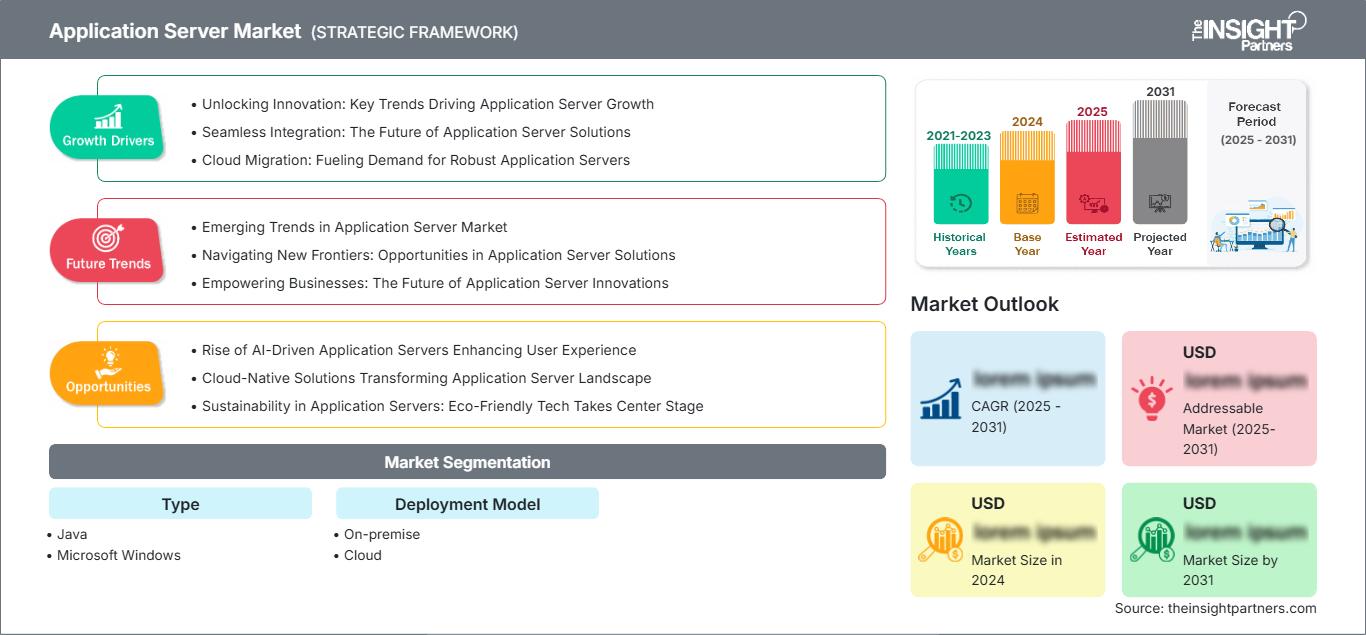
Regional Insights
North America application server market
North America represented 33–36% of global revenue in 2025 and is expected to grow at a CAGR range of 12.4–13.0% during 2026–2034. The region’s application server market share is supported by high cloud spending, mature enterprise software adoption, and concentration of mission-critical workloads in banking, insurance, healthcare, retail, and public administration.
There is an inclination towards standardizing on hybrid runtimes as opposed to a complete replacement. Companies have been keeping their reliable Java and Microsoft platforms, but administering, scaling and securing through cloud and container technologies. There is a high demand for these types of solutions where compliance-driven companies need logging, hot-patching, encryption, and controlled modernization of old systems.
U.S. application server Market
The U.S. accounted for 78–82% of North America in 2025 and is expected to expand at a CAGR range of 12.6–13.2% during 2026–2034. Strong corporate presence by Microsoft Corporation, IBM Corporation, Oracle Corporation, Red Hat, Inc., Adobe Inc., and Pegasystems Inc. enables a rich ecosystem of platform engineering, consulting, and management services.
Key application areas include financial transaction platforms, citizen services in government, healthcare interoperability, software-as-a-service back-end applications, and digital commerce. There is increasing focus on runtime observability, secure API gateway, identity federation, and patching automation. The U.S. is also ahead in middleware estate consolidation using standard deployment templates for public cloud, private cloud, and on-premises implementations.
Europe application server Market
Europe held 24–27% share in 2025 and is forecast to grow at a CAGR range of 11.5–12.1% during 2026–2034. Germany is leading in adoption as the manufacturing sector, automotive, chemicals industry, and enterprise resource planning environments need secure application runtimes connected to SAP, Java, and industrial data platforms.
The UK has high demand in sectors like banking, insurance, online services, and public cloud adoption. The buying organizations look for resiliency, identity governance, and operational continuity. Demand in Germany is boosted by integration with Industry 4.0, use of private clouds, and well-controlled modernization of ERP-integrated applications.
Demand in France, Italy, and Spain comes from banking digitalization, government service modernization, modernization of telecom networks, and regional cloud initiatives. The European customers are relatively cautious about the location of workloads and vendor lock-in, which favors a hybrid deployment model and standardization. That generates consistent demand for Java servers, managed runtime services, and middleware.
APAC application server Market
APAC accounted for 26–30% share of the application server Market in 2025 and is expected to grow at a CAGR range of 14.0–14.8% during 2026–2034. China tops the regional revenue race, while India is the country with the highest growth momentum in enterprise modernization. Demand comes from Japan, South Korea, and Australia in terms of finance, telecommunications, e-government, and industrial applications.
Digital infrastructure with policy support, cloud region growth, and local systems integration are driving adoption. Moving to managed runtimes and containerization from simple hosting is seen among enterprises. The cost-sensitive market goes for open-source-supported Java platforms, while the regulated markets continue using commercial solutions for their needs.
Middle East & Africa application server Market
The Middle East & Africa application server Market is projected to grow at a CAGR range of 12.0–12.8% during 2026–2034, with Saudi Arabia leading regional demand. UAE, South Africa, and the Rest of MEA are adopting application servers for e-government, banking, telecom platforms, energy modernization, and national cloud programs.
Energy companies and public agencies require resilient middleware for workflow automation, data integration, and secure citizen or customer services. Saudi Arabia’s infrastructure investment and the UAE’s cloud-first enterprise orientation support growth, while South Africa provides a base for banking and telecom modernization across sub-Saharan markets.
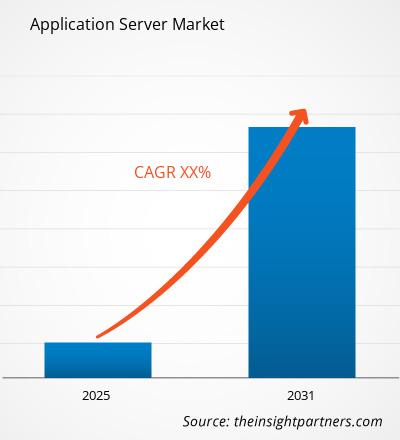
Segmentation Analysis
Type
Type is expected to grow at a CAGR range of 12.7–13.4% during 2026–2034, reflecting continued dependence on language-specific and operating-system-specific middleware. The application server market scope remains strongly shaped by Java because enterprises need platform portability, transaction control, and integration with databases, while Microsoft Windows-based servers retain relevance in organizations standardized on .NET, Windows Server, and Azure administration models.
- Java remains the largest sub-segment, supported by enterprise applications, Jakarta EE compatibility, banking systems, ERP extensions, and containerized modernization programs requiring stable, portable runtime environments.
- Microsoft Windows serves organizations committed to Windows Server, .NET workloads, Active Directory integration, and Azure-linked operations, particularly where administrative continuity outweighs full platform refactoring.
Deployment Model
Deployment Model is expected to grow at a CAGR range of 13.5–14.3% during 2026–2034 as buyers rebalance control, cost, and agility. On-premise deployment remains necessary for latency-sensitive, regulated, and legacy workloads, while cloud deployment is expanding faster because managed scaling, automated patching, and pay-as-you-go economics improve operational efficiency.
- On-premise remains strategically important for regulated industries, sovereign workloads, legacy ERP-linked systems, and environments requiring direct infrastructure control, custom clustering, or tightly governed security policies.
- Cloud is gaining share as enterprises shift to managed application platforms, container services, and hybrid cloud operations that reduce administration overhead and speed application release cycles.
Opportunity Snapshot
| Deployment Model | Revenue Contribution | Trend Tag | Adoption Stage |
| On-premise | Medium | Sovereign Runtime | Mature |
| Cloud | High | Managed Runtime | Scaling |
Application Server Market Growth Drivers and Impact Analysis
Enterprise Application Modernization Without Full Rebuilds
Large enterprise application portfolios consist of years of Java, Windows, ERP, and proprietary transactional logic. It is too costly and too risky to replace all, so organizations are upgrading their runtimes first. This is made possible by the application server, which retains business logic that has been thoroughly vetted but enhances it with containerization, automation, monitoring, and security. The effects of this can be seen in gradual migration initiatives in which an existing application is moved from its physical server environment into a virtualized environment and then into a private cloud/Kubernetes. This creates an ongoing need for supported middleware, migration tools, runtime services, and hybrid operations.
Security, Compliance, and Runtime Patch Management
The application runtime layer poses more risk to the security environment since web applications interface with third-party APIs, identity providers, data services, and partner organizations. In order to manage the risk, businesses require application servers that allow for quick patches, secure configurations by default, vulnerability assessments, encryption, credential vault management, and secure access to management consoles. The impact on the market involves a move away from simple deployment infrastructure to governance at the runtime layer. Customers tend to factor in vendor maintenance cycles and security advisories when evaluating modernization initiatives. This driver plays out in the banking, health care, government, and telecom sectors.
Hybrid Cloud Adoption Across Regulated Workloads
The hybrid cloud is emerging as the solution of choice for companies that do not want to transfer all their applications to the public cloud yet need a speedier deployment cycle and scalability. Application servers are helpful here in ensuring uniform runtime performance from the on-premise data centers, private cloud, and public clouds. The financial implications of such a development are increased investment in the areas of platform integration, container orchestration, monitoring, and workload mobility. Industries regulated for security purposes employ the hybrid approach by maintaining their confidential data in their own infrastructure while locating customer-facing services near the cloud-native delivery approach.
Application Server Market Future Trends
AI-Assisted Runtime Operations
AI-assisted operations will become a defining layer of application server market trends as enterprises seek faster root-cause analysis and lower downtime. Future platforms are expected to analyze logs, transaction traces, configuration drift, memory behavior, and patch dependencies before administrators intervene. This will change application server operations from reactive monitoring to predictive remediation. The trend is especially relevant for complex Java and Windows estates, where small configuration errors can cause large service disruptions. Vendors are likely to embed recommendations for scaling, rollback, security hardening, and performance tuning into management consoles. Buyers will value systems that create measurable reductions in incident resolution time and administrator workload.
Convergence of Application Servers and Platform Engineering
Application servers are expected to become part of broader internal developer platforms that standardize deployment, policy enforcement, secrets management, observability, and compliance. Platform engineering teams will package approved runtime templates so developers can release applications without manually configuring infrastructure. This trend will reduce fragmentation across business units and improve governance in hybrid estates. It also changes vendor competition because integration with CI/CD tools, Kubernetes, identity platforms, and service meshes becomes as important as traditional runtime performance. Enterprises will increasingly select application server technologies that fit standardized golden paths, enabling quicker onboarding, predictable security controls, and consistent operating models across application teams.
Application Server Market Opportunities
Cloud-Native Migration Services for Legacy Java Estates
Legacy Java estates present a major opportunity because many enterprises want modernization benefits without disrupting validated transaction systems. Application server market Forecasts indicate that vendors and service providers can grow by offering assessment tools, automated migration scripts, container-ready templates, and managed upgrade programs. The most attractive opportunity lies in converting traditional application server domains into standardized cloud or Kubernetes environments while preserving application behavior. Providers can differentiate through repeatable migration factories, cost modeling, downtime reduction, and security hardening. Financial services, public administration, telecom, and manufacturing are strong targets because they operate large Java workloads and require structured modernization roadmaps.
Managed Runtime Platforms for Mid-Market Enterprises
Mid-market organizations often lack dedicated middleware administration teams but still need secure, scalable application environments. Managed runtime platforms create an opportunity to deliver enterprise-grade application server capabilities through simplified subscriptions, automated patching, backup integration, and built-in monitoring. This opportunity is strongest among regional banks, healthcare networks, retailers, and digital service providers that are modernizing applications but cannot sustain complex infrastructure teams. Vendors can improve adoption by bundling migration assistance, security baselines, and predictable pricing. Channel partners and regional systems integrators will be important because localized support, compliance knowledge, and workload assessment services can reduce adoption friction for smaller enterprises.
Frequently Asked Questions

- Comprehensive Market Sizing and Forecast Analysis
- Detailed Segmentation Analysis
- In-Depth Market Dynamics Assessment
- Regional and Country-Level Insights
- Competitive Landscape and Company Benchmarking
- Strategic Business Intelligence
Recent Reports
Testimonials

The Insight Partners provided valuable market intelligence that supported our global go-to-market strategy. Their team was professional, responsive, and attentive to our feedback, providing thoughtful analysis and helpful methodological clarifications throughout the project.
Junmo Kim Chief Financial Officer (CFO), Enertech Co., Ltd.
The Insight Partners' SCADA System Market report is comprehensive, with valuable insights on current trends and future forecasts. The team was highly professional, responsive, and supportive throughout. We are very satisfied and highly recommend their services.
RAN KEDEM Partner, Reali Technologies LTDs
I requested a report on a very specific software market and the team produced the report in a few days. The information was very relevant and well presented. I then requested some changes and additions to the report. The team was again very responsive and I got the final report in less than a week.
JEAN-HERVE JENN Chairman, Future Analytica
We worked with The Insight Partners for an important market study and forecast. They gave us clear insights into opportunities and risks, which helped shape our plans. Their research was easy to use and based on solid data. It helped us make smart, confident decisions. We highly recommend them.
PIYUSH NAGPAL Sr. Vice President, High Beam Global
The Insight Partners delivered insightful, well-structured market research with strong domain expertise. Their team was professional and responsive throughout. The user-friendly website made accessing industry reports seamless. We highly recommend them for reliable, high-quality research services
YUKIHIKO ADACHI CEO, Deep Blue, LLC.
This is the first time I have purchased a market report from The Insight Partners.While I was unsure at first, I visited their web site and felt more comfortable to take the risk and purchase a market report.I am completely satisfied with the quality of the report and customer service. I had several questions and comments with the initial report, but after a couple of dialogs over email with their analyst I believe I have a report that I can use as input to our strategic planning process.Thank you so much for taking the extra time and making this a positive experience.I will definitely recommend your service to others and you will be my first call when we need further market data.
JOHN SUZUKI President and Chief Executive Officer, Board Director, BK Technologies
I wish to appreciate your support and the professionalism you displayed in the course of attending to my request for information regarding to infectious disease IVD market in Nigeria. I appreciate your patience, your guidance, and the fact that you were willing to offer a discount, which eventually made it possible for us to close a deal. I look forward to engaging The Insight Partners in the future, all thanks to the impression you have created in me as a result of this first encounter.
DR CHIJIOKE ONYIA MANAGING DIRECTOR, PineCrest Healthcare Ltd.Reason to Buy
- Informed Decision-Making
- Understanding Market Dynamics
- Competitive Analysis
- Identifying Emerging Markets
- Customer Insights
- Market Forecasts
- Risk Mitigation
- Boosting Operational Efficiency
- Strategic Planning
- Investment Justification
- Tracking Industry Innovations
- Aligning with Regulatory Trends





 Get Free Sample for