
AR and VR Chip Market Size, Share & Forecast by 2034
Coverage: By Chip Type (Processor ICs, User Interface ICs, Power Management ICs); Device Type (Head Mounted Display, Head Up Display, Handheld Device, Gesture Tracking Device, Projector and Display wall); End-user (Gaming, Entertainment and Media, Aerospace and Defense, Healthcare, Others), and Geography (North America, Europe, Asia Pacific, and South and Central America)
- Status : Data Released
- Report Code : TIPRE00018556
- Category : Electronics and Semiconductor
- No. of Pages : 150
- Available Report Formats :


- Last update date : July 17, 2026


2025 Market Size
US$ 6.44 Bn
Base year value
2034 Forecast
US$ 29.56 Bn
Projected by 2034
CAGR 2026-2034
18.45 %
Growth rate
Addressable Market
US$ 148.43 Bn
(2026-2034)
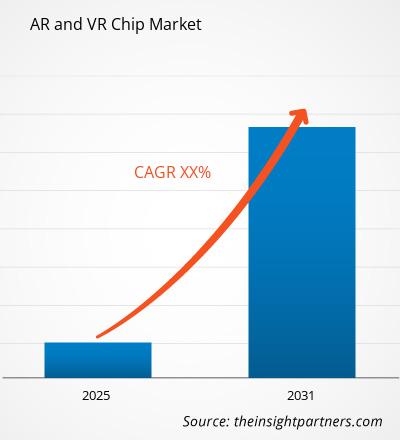
The AR and VR Chip Market was valued at US$ 6.44 Billion in 2025 and is projected to reach US$ 29.56 Billion by 2034, growing at a CAGR of 18.54% during 2026–2034. The market is expanding as spatial computing devices require processors, interface controllers, and power management ICs that can support low-latency rendering, sensor fusion, artificial intelligence workloads, and compact thermal envelopes.
North America remains a high-value adoption center, with the AR and VR chip Market size supported by an estimated regional CAGR range of 16.5–18.5% through 2034. Demand is reinforced by enterprise training, defense simulation, developer ecosystems, and device launches using advanced XR platforms. Wider smart glasses availability and cloud-edge connectivity are improving commercial viability across the U.S. and Canada.
AR and VR Chip Market Assessment and Insights
- North America accounted for 34–37% share in 2025 and is growing at a CAGR range of 16.5–18.5% during 2026–2034, supported by XR platform design, gaming, healthcare visualization, and defense training procurement.
- US represented 78–82% of North America in 2025 and is growing at a CAGR range of 16.0–18.0% during 2026–2034, led by semiconductor design and headset ecosystems.
- Europe held 20–23% share in 2025 and is growing at a CAGR range of 15.5–17.5% during 2026–2034, with Germany, the UK, France, Italy, and Spain leading enterprise, automotive, aerospace, and media applications.
- Asia Pacific captured 31–34% share in 2025 and is growing at a CAGR range of 19.5–21.5% during 2026–2034, driven by China, Japan, South Korea, India, and Australia across manufacturing, gaming, and consumer electronics supply chains.
- Largest Segment Processor ICs held 52–56% market share in 2025 and are growing at a CAGR range of 17.5–19.5% during 2026–2034 because they anchor rendering, AI, and sensor workloads.
- High Growth Segment Head Mounted Display held 46–50% AR and VR Chip market share in 2025 and is growing at a CAGR range of 19.0–21.0% during 2026–2034 as mixed reality headsets and smart glasses scale.
- Key companies analyzed in detail: Advanced Micro Devices, Inc., Broadcom Inc., Huawei Technologies Co., Ltd., Imagination Technologies Limited, Intel Corporation, MediaTek Inc., NVIDIA Corporation, Qualcomm Technologies, Inc., Samsung Electronics Co., Ltd., Spectra7 Microsystems Inc.
Source: The Insight Partners' analysis based on proprietary research, government publications, company annual reports, investor presentations, industry databases, and expert interviews.
The AR and VR Chip Market has shifted from graphics-heavy headset components toward integrated spatial computing silicon that combines CPU, GPU, NPU, ISP, connectivity, and sensor pipelines. Qualcomm platforms support up to 3K by 3K displays and 10 concurrent cameras, while newer XR2+ platforms support 4.3K by 4.3K per eye and at least 12 cameras. These specifications are reshaping production priorities toward advanced nodes, packaging efficiency, and specialized firmware optimization.
The forward demand will depend on the magnitude of Asian manufacturing, North American software ecosystems, and European industrial digitalization. In addition, public spending on defense simulation, medical training, and immersive education has improved procurement visibility. The reduction in weight and power issues for devices means that semiconductor companies will be competing for power efficiency, camera simultaneity, AI, and software development, not just graphics processing alone.
AR and VR Chip Market Report Scope
| Report Attribute | Details |
|---|---|
| Market size in 2025 | US$ 6.44 Billion |
| Market Size by 2034 | US$ 29.56 Billion |
| Global CAGR (2026 - 2034) | 18.45% |
| Historical Data | 2021-2024 |
| Forecast period | 2026-2034 |
AR and VR Chip Market Analysis
AR and VR chip Market growth is being driven by a shift from entertainment-based headset applications to mixed reality, spatial computing, and simulation. According to IDC, shipments of AR/VR headsets and displayless smart glasses were expected to hit 14.3 million in 2025, with shipment growth of 39.2%. With such hardware growth, there will be increasing demand for application processors, display drivers, and power ICs optimized for thin, thermally constrained devices.
Supply dynamics depend on foundry access, IP licensing, optics coordination, and software integration. Processor ICs require close coupling with camera modules, displays, wireless systems, and battery management. The ecosystem increasingly favors vendors that can deliver reference designs, developer kits, and AI libraries, reducing engineering risk for headset makers while improving time-to-market for consumer and enterprise devices.
The AR and VR Chip Market analysis presents a competitive business landscape characterized by processor specialization and platform dominance. In terms of XR platform design, Qualcomm Technologies, Inc. takes the lead, while NVIDIA Corporation holds a leading position in high-end visualization, simulation, and rendering. Additionally, companies such as MediaTek Inc., Samsung Electronics Co., Ltd., and Huawei Technologies Co., Ltd. support local producers, while Imagination Technologies Limited provides graphics.
Investment is being made in chipsets with AI integration, efficient display pipeline solutions, and connectivity solutions. Advanced Micro Devices, Inc., Intel Corporation, Broadcom Inc., and Spectra7 Microsystems Inc. still matter for graphics processing, networking, interface, and signal transmission. The strategic positioning comes from preparedness of reference design solutions, software compatibility, and partnerships with headset manufacturers, cloud service providers, optical technology providers, and enterprise application providers.
● REPORT CUSTOMIZATION
Tailor This Report To Align With Your Specific Business Requirements
This report can be customized to align precisely with your business objectives, scope, and target markets. Customization options include tailored segmentation, geography, competitive analysis, and strategic insights to support informed decision-making.
Customize This Report →WHAT YOU CAN ADJUST
- ● Segmentations
- ● Geography
- ● Competitive Analysis
- ● Language Preferences
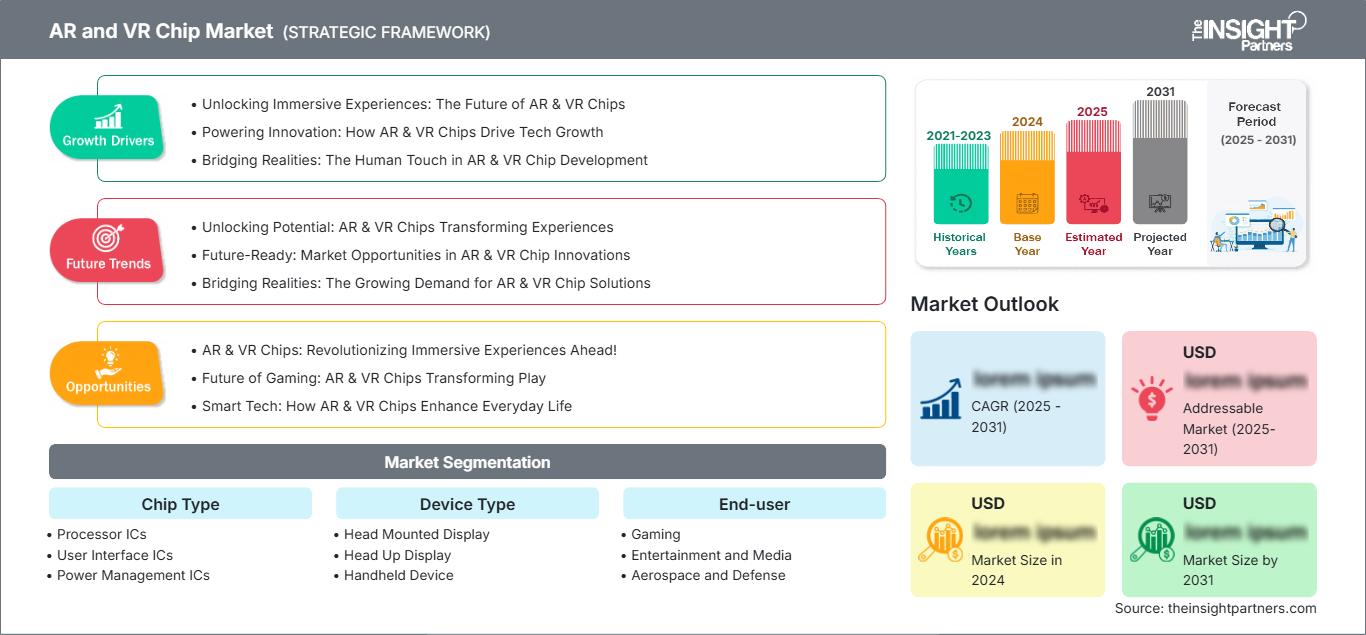
AR and VR Chip Market: Strategic Insights
Regional Insights
North America AR and VR Chip Market
North America held 34–37% share in 2025 and is expected to grow at a CAGR range of 16.5–18.5% during 2026–2034. The AR and VR chip Market share in the region reflects strong semiconductor design, defense simulation budgets, gaming demand, and enterprise training adoption. IDC’s 2025 shipment data shows XR glasses and headset volumes rebounding, supporting chip demand across processors, display controllers, and power ICs.
High-performance mixed reality headsets, smart glasses, medical visualization, aerospace simulation, and industrial collaboration applications drive procurement in the region. The developer ecosystem in the United States and Canada creates initial pull for AI acceleration, low-latency pass-through, and Wi-Fi 7 capability. Venture capital and enterprise pilots in North America are also driving the need for reliable chips with software support.
U.S. AR and VR chip Market
The U.S. accounted for 78–82% of North America in 2025 and is growing at a CAGR of 16.0–18.0% during 2026–2034. Its position reflects the presence of Qualcomm Technologies, Inc., NVIDIA Corporation, Advanced Micro Devices, Inc., Intel Corporation, Broadcom Inc., and Spectra7 Microsystems Inc. across processing, graphics, connectivity, and signal transmission layers.
Trends in applications are evident in gaming, military simulations, surgical planning, collaborative work, and design visualization. Low latency, security through firmware, AI inference capabilities, and platform developer compatibility are the key factors that matter to buyers in the United States. Semiconductor companies can benefit by having strong relationships with original equipment manufacturers of headsets, cloud computing companies, game developers, medical companies, and the military.
Europe AR and VR chip Market
Europe held 20–23% share in 2025 and is growing at a CAGR range of 15.5–17.5% during 2026–2034. Germany is the leading country because automotive engineering, industrial training, and advanced manufacturing use XR for design reviews, maintenance, and digital twin workflows. The UK contributes through gaming, defense training, and immersive media production.
France promotes the adoption of processors through aerospace, medical training simulators, and digitalization programs in the public sector. In contrast, both Italy and Spain have a gradual level of demand in areas such as tourism, education, and industrial visualization. Buyers in the regions are aware of issues such as information privacy, user-friendly devices, and total cost over the life cycle. These factors favor efficient processor ICs, secure interface chips, and power management designs that can support enterprise deployment cycles.
APAC AR and VR chip Market
Asia-Pacific region had a market share of 31–34% in 2025 and is expanding at a CAGR of 19.5–21.5% from 2026 to 2034. The Chinese AR and VR Chip market drives regional growth through its efforts in device and display production and the use of smart glasses. Japan and South Korea are making headway with optics, games, and electronic devices.
India and Australia generate demand from enterprise training, health care pilots, education, and defense. Semiconductors, 5G networks, and consumer electronics assembly through industrial policies increase the chances of local supply. APAC’s competitive edge stems from rapid product iterations, low-cost assembly, and close collaboration among semiconductor firms, display companies, battery producers, and headset producers.
Middle East & Africa AR and VR chip Market
Middle East and Africa are expected to register a compound annual growth rate range of 14.0–16.0% from 2026 to 2034. The major driver of the market would be adoption in Saudi Arabia across smart cities, energy, tourism, and education through AR and VR initiatives.
Emerging market applications in other nations, such as South Africa and MEA countries, could be seen in augmented and virtual reality chips, driven by the need for safety in mining, oil and gas maintenance, and infrastructure development. These are anticipated to be project-based rather than mass-consumption, which makes ruggedness and battery longevity vital for AR and VR applications.
Segmentation Analysis
Chip Type
Chip Type is growing at a CAGR range of 17.0–19.0% during 2026–2034 as device makers balance performance, thermal limits, and power efficiency. The AR and VR Chip Market scope covers silicon devices such as processors, interface chips, and energy-control chips that must operate as an integrated system. This is because user experience is dependent on low latency, high frame rates, and untethered time.
- Processor ICs: Hold prominence because they control rendering, AI computation, camera data, eye tracking, spatial mapping, and application execution in headsets and glasses that require smaller, more efficient computing capacity.
- User Interface ICs: Provide functions related to gestures, controllers, haptics, and sensors; therefore, they become important as XR devices evolve from using controllers to natural interactions.
- Power Management ICs: Become crucial as they help extend battery life, reduce heat dissipation, provide charging protection, and deliver a steady supply of voltage, particularly for thin headsets and smart glasses.
Device Type
Device Type is growing at a CAGR range of 18.0–20.0% during 2026–2034 because chip demand varies by form factor, display architecture, and user mobility. Headsets will need powerful processors and a pipeline display, but handheld and projection-based devices will need stable interfaces.
- Head Mounted Display: Remains the main driver of demand due to mixed reality headsets that integrate display, camera, artificial intelligence, tracking, and power management into a single, small, semiconductor-intensive package.
- Head Up Display: Receives benefits from automotive, aircraft, and military visualization, where reliability, brightness management, low latency, and heat management impact chip selection.
- Handheld Device: Receives its demand from mobile augmented reality applications, industrial inspection, and education that require processors to work with cameras, displays, and communications interfaces without draining batteries.
- Gesture Tracking Device: Becomes strategically important because controller-free interaction is crucial for training, healthcare, and industrial applications, where motion tracking and low latency are essential.
- Projector and Display: Receives its demand from wall-based collaboration visualization, simulating rooms, and training facilities where semiconductor demand is centered on image processing, synchronization, interface management, and high-quality output.
End-user
End-user is growing at a CAGR range of 18.5–20.5% during 2026–2034 as adoption moves beyond gaming into operational training, healthcare, media, and defense. Semiconductor needs vary by application; however, all key customers demand high visual quality, responsiveness, energy efficiency, and software support.
- Gaming: Still one of the earliest volume end users, as immersive gameplay requires high frames per second, graphics processing, motion capture, and low latency.
- Entertainment and Media: Uses chips to provide immersive video experiences, virtual event attendance, spatial storytelling, and interactive media, requiring chips for displays, audio processing, and rendering.
- Aerospace and Defense: Focuses on simulation, maintenance, mission rehearsal, and training, making secure, rugged, and reliable chip platforms necessary to enable accurate tracking and prolonged operation.
- Healthcare: Increasingly uses chips in planning surgical procedures, therapy, anatomy training, and rehabilitation, as the accuracy of visualization, latency, and device comfort become crucial factors for clinical usability.
Opportunity Snapshot
| Segment Name | Revenue Contribution | Trend Tag | Adoption Stage |
| Gaming | High | Immersive Play | Mature |
| Entertainment and Media | Medium | Spatial Content | Scaling |
| Aerospace and Defense | Medium | Mission Simulation | Scaling |
| Healthcare | Medium | Surgical Planning | Emerging |
AR and VR Chip Market Growth Drivers and Impact Analysis
Rising demand for low-latency spatial computing
Spatial computing devices will have to render graphics, analyze motion, process camera data, and respond to user movement at extremely low latency. According to Qualcomm, the latency of full-color video see-through on the firm’s XR2 Gen 2 platform is 12 milliseconds, clearly showing how important processor efficiency is to the user experience. Such a technology makes the need for processing chips, sensor fusion engines, and display controllers that can perform multiple functions simultaneously without overheating especially important. It is highly influential in the commercial sector for gaming, training, medical visualization, and design reviews.
Expansion of AI-enabled XR interaction models
AI plays an increasingly important role in hand tracking, scene comprehension, voice commands, object recognition, and adaptive rendering. Qualcomm claims that the Snapdragon XR2 Gen 2 delivers 8x better AI performance than the previous generation, but current platforms prioritize higher NPU capacity. Such a change raises the value of semiconductor hardware per unit, since headsets and glasses need on-device AI inference, not only cloud-based inference. It can be seen in smart glasses, training simulators, and medical devices that need to operate privately, quickly, and robustly, regardless of network quality.
Enterprise training and simulation procurement
Enterprises and government organizations are utilizing XR for training purposes owing to the benefits of immersive learning, such as transportation cost savings and the ability to conduct repeatable simulations in dangerous environments. The security concerns, stability of frame rate, accuracy of tracking, and robustness of power sources required by aerospace/defense, healthcare, and manufacturing industries necessitate the use of powerful processors and power management integrated circuits, not mobile-grade chips. Market implications include longer procurement cycles, the need for certification, and chips that provide reliability, a software ecosystem, and compatibility with corporate device management systems.
AR and VR Chip Market Future Trends
AI-first smart glasses architectures
AR and VR chip market trends are shifting towards AI-first smart glasses that use small chips, power-efficient vision-processing pipelines, and contextual assistance at all times. IDC has pointed out that the emergence of smart glasses is the key driver of growth in 2025 XR shipments, including display-less smart glasses. The future of chip architecture would focus on having lightweight thermal design, efficient cameras, multimodal interfaces, and secure on-device inference. This trend will favor vendors that can combine AI acceleration with wearable battery constraints while enabling translation, navigation, notifications, and work-assistance features without bulky headset designs.
Display pipeline specialization for mixed reality
Mixed reality hardware needs a better-optimized display pipeline to meet demands for higher-quality pass-through, reduced motion blur, and extended usage periods. Integrated into the chips will be technologies such as image signal processing, foveated rendering, eye tracking, and frame interpolation. Hardware providers that succeed in synchronizing cameras, displays, and processors will be able to deliver greater comfort and realism. In future years, this development can shift buying priorities from the highest levels of computational power to visual stability, efficiency, and the availability of rendering optimization tools.
AR and VR Chip Market Opportunities
Reference platforms for enterprise XR deployment
AR and VR Chip Market Forecasts indicate that enterprise use of AR and VR technology will favor chip manufacturers with validated reference platforms rather than just silicon. Customers in healthcare, aerospace, defense, and industry applications require guaranteed thermal characteristics, camera integration, security capabilities, and software support. Chipmakers can benefit by bundling processors, interface chips, power management, firmware, and software development kits in a solution. This will reduce engineering expenses for original equipment manufacturers (OEMs) and shorten time-to-market for products. There are also opportunities for repeat business as customers scale up their XR solutions.
Power-efficient chips for lightweight wearable devices
As the form factor of XR hardware evolves towards glasses-like devices, energy efficiency becomes a defining advantage. Consumers and field workers will not tolerate heavy batteries, overheating, or short usage cycles. Energy efficiency can become an important differentiator for chip vendors via advanced processes, workload management, low-power sensor hubs, and display processors optimized for sporadic use. The advantage is particularly interesting for smart glasses, med tech, warehouses, and maintenance applications. Efficiency will enable OEMs to reduce device weight while retaining the functionality necessary for practical daily use.
Recent Developments
- June 2026: Qualcomm unveiled the Snapdragon Reality Elite XR chipset, delivering up to 60% faster GPU, 30% faster CPU, 160% better AI performance (48 TOPS), improved battery life, and support for 4.4K-per-eye at 90Hz. The chip is designed for next-generation AR glasses and XR headsets, with first devices expected in late 2026 and broader adoption in 2027.
- June 2026: Industry reports highlighted that Qualcomm's new XR platform marks a major shift toward AI-powered AR glasses, enabling slimmer, cooler, and more capable wearable devices such as XREAL Project Aura, accelerating the move from bulky VR headsets to everyday smart glasses.
- February 2026: XR industry outlooks identified 2026 as a pivotal year for AR and VR hardware, with multiple confirmed launches, some delays, and a stronger focus on lightweight designs, onboard AI, and Android XR ecosystems replacing prototype-stage devices.
Frequently Asked Questions

- Comprehensive Market Sizing and Forecast Analysis
- Detailed Segmentation Analysis
- In-Depth Market Dynamics Assessment
- Regional and Country-Level Insights
- Competitive Landscape and Company Benchmarking
- Strategic Business Intelligence
Recent Reports
Testimonials

The Insight Partners' SCADA System Market report is comprehensive, with valuable insights on current trends and future forecasts. The team was highly professional, responsive, and supportive throughout. We are very satisfied and highly recommend their services.
RAN KEDEM Partner, Reali Technologies LTDs
I requested a report on a very specific software market and the team produced the report in a few days. The information was very relevant and well presented. I then requested some changes and additions to the report. The team was again very responsive and I got the final report in less than a week.
JEAN-HERVE JENN Chairman, Future Analytica
We worked with The Insight Partners for an important market study and forecast. They gave us clear insights into opportunities and risks, which helped shape our plans. Their research was easy to use and based on solid data. It helped us make smart, confident decisions. We highly recommend them.
PIYUSH NAGPAL Sr. Vice President, High Beam Global
The Insight Partners delivered insightful, well-structured market research with strong domain expertise. Their team was professional and responsive throughout. The user-friendly website made accessing industry reports seamless. We highly recommend them for reliable, high-quality research services
YUKIHIKO ADACHI CEO, Deep Blue, LLC.
This is the first time I have purchased a market report from The Insight Partners.While I was unsure at first, I visited their web site and felt more comfortable to take the risk and purchase a market report.I am completely satisfied with the quality of the report and customer service. I had several questions and comments with the initial report, but after a couple of dialogs over email with their analyst I believe I have a report that I can use as input to our strategic planning process.Thank you so much for taking the extra time and making this a positive experience.I will definitely recommend your service to others and you will be my first call when we need further market data.
JOHN SUZUKI President and Chief Executive Officer, Board Director, BK Technologies
I wish to appreciate your support and the professionalism you displayed in the course of attending to my request for information regarding to infectious disease IVD market in Nigeria. I appreciate your patience, your guidance, and the fact that you were willing to offer a discount, which eventually made it possible for us to close a deal. I look forward to engaging The Insight Partners in the future, all thanks to the impression you have created in me as a result of this first encounter.
DR CHIJIOKE ONYIA MANAGING DIRECTOR, PineCrest Healthcare Ltd.Reason to Buy
- Informed Decision-Making
- Understanding Market Dynamics
- Competitive Analysis
- Identifying Emerging Markets
- Customer Insights
- Market Forecasts
- Risk Mitigation
- Boosting Operational Efficiency
- Strategic Planning
- Investment Justification
- Tracking Industry Innovations
- Aligning with Regulatory Trends





 Get Free Sample for