
Automotive Composite Leaf Springs Market Growth and Analysis by 2034
Coverage: By Installation Type (Transversal, Longitudinal), Location Type (Front Leaf Spring, and Rear Leaf Spring), Process Type (High-Pressure Resin Transfer Molding Process, Prepreg Layup Process, and Others), Vehicle Type (Passenger Car, Light Commercial Vehicles, Medium and Heavy-Duty Vehicles), and Geography
- Status : Data Released
- Report Code : TIPRE00021960
- Category : Automotive and Transportation
- No. of Pages : 150
- Available Report Formats :


- Last update date : August 27, 2026


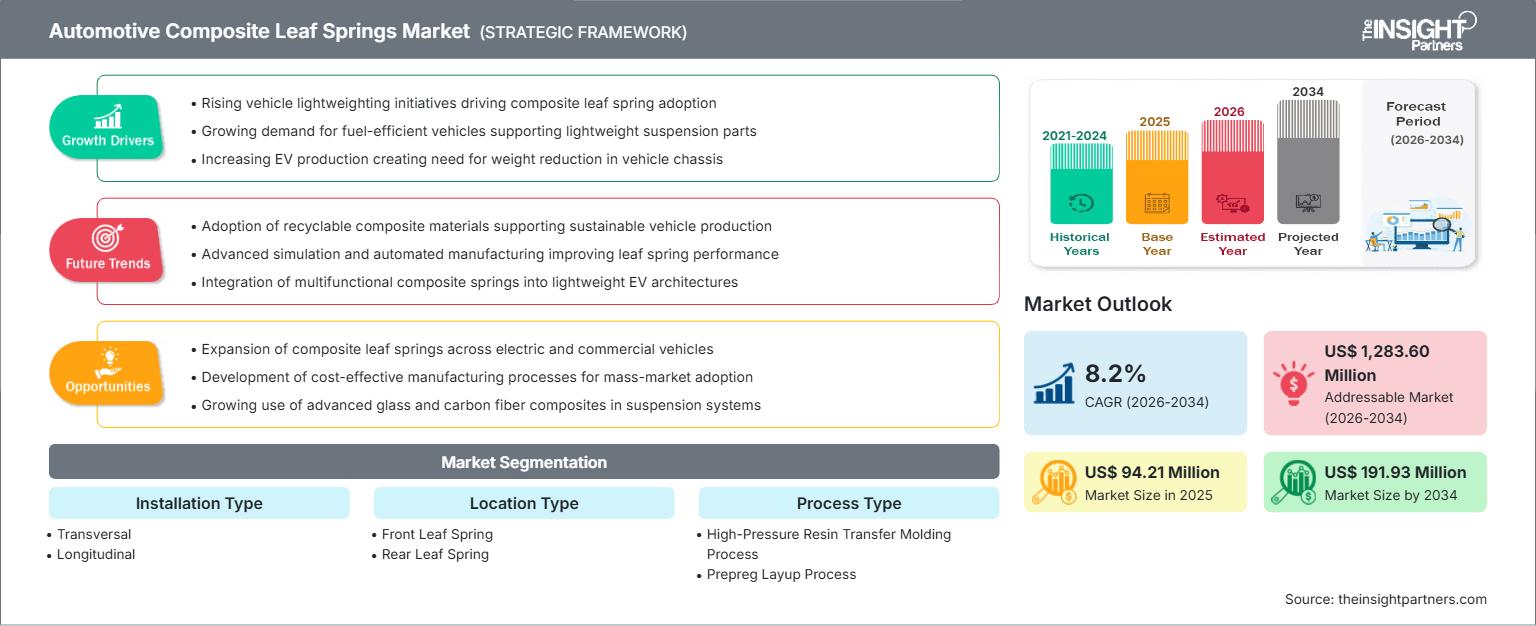
2025 Market Size
US$ 94.21 Mn
Base year value
2034 Forecast
US$ 191.93 Mn
Projected by 2034
CAGR 2026-2034
8.2 %
Growth rate
Addressable Market
US$ 1,283.60 Mn
(2026-2034)
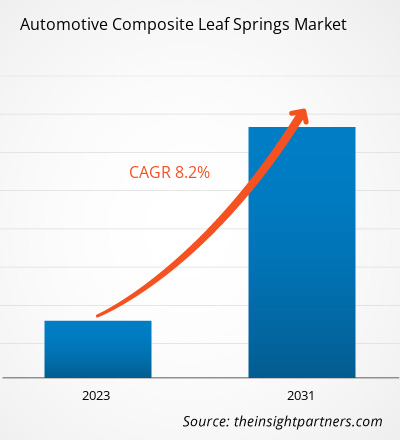
The automotive composite leaf springs market was valued at US$ 94.21 Million in 2025 and is projected to reach US$ 191.93 Million by 2034, registering a CAGR of 8.2% from 2026 to 2034. Demand is increasing as OEMs use glass fiber and carbon fiber reinforced suspension components to reduce vehicle mass, improve corrosion resistance, and support fuel-efficiency and electric vehicle range objectives.
North America automotive composite leaf springs market size is projected to expand at a CAGR of 7.1–7.8% during 2026–2034, supported by pickup, trailer, light commercial vehicle, and electric mobility applications. Adoption is reinforced by fleet payload priorities, aftermarket familiarity with leaf spring layouts, and growing interest in lightweight chassis parts that lower unsprung mass without altering proven suspension architecture.
Automotive Composite Leaf Springs Market Assessment and Insights
- North America: Accounted for an estimated 22–25% share in 2025 and is expected to grow at a CAGR between 7.1–7.8% during 2026–2034, supported by trailers, pickups, commercial fleets, and lightweight suspension upgrades.
- US: Represented about 75–79% of North America demand in 2025 and is projected to grow at a CAGR between 7.0–7.7% during 2026–2034.
- Europe: Held an estimated 29–33% share in 2025 and is likely to expand at a CAGR between 7.6–8.3%, led by Germany, the UK, France, Italy, and Spain.
- Asia Pacific: Accounted for an estimated 34–38% share in 2025 and is expected to grow at a CAGR between 8.9–9.7%, driven by China, India, Japan, South Korea, and Australia.
- Largest Segment: Longitudinal Installation estimated 58–63% market share in 2025 and a CAGR between 7.8–8.5% during 2026–2034.
- High Growth Segment: High-Pressure Resin Transfer Molding Process estimated 42–46% share in 2025 and a CAGR between 9.0–9.8% during 2026–2034.
- Key companies analyzed in detail: Hendrickson USA, L.L.C., Flex-Form S.p.A., KraussMaffei Group GmbH, Muhr und Bender KG, Olgun Celik A.S., SGL Carbon SE, Shandong Beiqi Hai Hua Automobile Parts Co., Ltd., M.W. Industries, Inc., ARC Suspension, and Heathcote Industrial Plastics Ltd.
Source: The Insight Partners' analysis based on proprietary research, government publications, company annual reports, investor presentations, industry databases, and expert interviews.
Technology evolution has shifted suspension lightweighting from experimental prototypes toward validated glass fiber reinforced plastic and hybrid composite spring systems. The automotive composite leaf springs market benefits from weight savings of up to 50–70% compared with steel in selected applications, while maintaining spring rate design flexibility, corrosion resistance, and improved damping. Production dynamics are influenced by HP-RTM automation, prepreg processing, bonding quality, and OEM validation cycles for durability, fatigue, temperature exposure, and road-load variation.
Future adoption will accelerate where electric vehicles, vans, pickups, and commercial platforms need lighter rear or transverse suspension layouts. Automotive Composite Leaf Springs Market forecast projections indicate increasing investment in automated molding, material traceability, recyclable resin systems, and local composite manufacturing. Regulatory tailwinds around emissions, efficiency, and vehicle range will support adoption, although cost, repair practices, and long qualification timelines will keep penetration concentrated in programs where weight reduction produces measurable platform value.
Automotive Composite Leaf Springs Market Report Scope
| Report Attribute | Details |
|---|---|
| Market size in 2025 | US$ 94.21 Million |
| Market Size by 2034 | US$ 191.93 Million |
| Global CAGR (2026 - 2034) | 8.2% |
| Historical Data | 2021-2024 |
| Forecast period | 2026-2034 |
Automotive Composite Leaf Springs Market Analysis
The automotive composite leaf springs market growth is tied to vehicle lightweighting, electrification, and commercial fleet efficiency. Suspension components contribute to unsprung mass, so replacing steel leaves with composite structures can improve ride quality, payload efficiency, and energy consumption. Demand is also supported by light commercial vehicle production, trailer modernization, and OEM interest in packaging space around battery packs and rear axle systems.
The value chain includes fiber suppliers, resin formulators, fabric and prepreg producers, molding equipment providers, spring designers, Tier 1 chassis integrators, OEM validation teams, and aftermarket distributors. Automotive composite leaf springs market analysis shows that material selection, process consistency, end-fitting integration, and fatigue testing determine supplier qualification. Higher automation is reducing unit-cost barriers, but steel remains difficult to displace where price sensitivity dominates.
The competition landscape is influenced by specialists and diversified suppliers of components. Hendrickson USA, L.L.C. sells LITEFLEX composite springs for trailers, automobiles, and trucks, whereas SGL Carbon SE emphasizes its capability to manufacture large amounts of GFRP leaf springs. The company Muhr und Bender KG backs the design concepts for longitudinal, transverse, and tension springs, and the KraussMaffei Group GmbH offers HP-RTM processing systems.
Strategic investment is focused on series production readiness, vehicle-specific engineering, and stronger OEM collaboration. The Automotive Composite Leaf Springs Market is supported by companies such as Flex-Form S.p.A., Olgun Celik A.S., ARC Suspension, Heathcote Industrial Plastics Ltd., Shandong Beiqi Hai Hua Automobile Parts Co., Ltd., and M.W. Industries, Inc., which strengthen the supplier base through regional manufacturing, replacement channels, and application-specific spring design. Competitive advantage depends on validated durability, cost-effective automation, and consistent interface hardware.
● REPORT CUSTOMIZATION
Tailor This Report To Align With Your Specific Business Requirements
This report can be customized to align precisely with your business objectives, scope, and target markets. Customization options include tailored segmentation, geography, competitive analysis, and strategic insights to support informed decision-making.
Customize This Report →WHAT YOU CAN ADJUST
- ● Segmentations
- ● Geography
- ● Competitive Analysis
- ● Language Preferences
Automotive Composite Leaf Springs Market: Strategic Insights
Regional Insights
North America automotive composite leaf springs market
North America held an estimated 22–25% automotive composite leaf springs market share in 2025 and is forecast to grow at a 7.1–7.8% CAGR through 2034. Demand is driven by trailers, pickups, recreational vehicles, special performance platforms, and fleet applications where payload capability, durability, and weight management play an important role in purchase decisions.
Fleet managers are looking at composite springs to mitigate corrosion concerns, decrease unsprung weight, and enhance service reliability in severe duty applications. OEM adoption is still limited, although electric pickup, delivery van, and trailer platforms have better business cases due to battery weight.
U.S. automotive composite leaf springs market
The US represented an estimated 75–79% of North American demand in 2025 and is expected to grow at a 7.0–7.7% CAGR during 2026–2034. The nation has been enjoying the advantages of pickup culture, trailer park, logistic operations, and suppliers of light-weight heavy-duty suspensions.
Hendrickson USA, L.L.C. has evident composite springs for medium-duty, trailer, auto and heavy-duty. Aftermarket needs have been helping out with replacement composite springs in sports car models. Application preference includes replacement of rear leaf springs, trailer suspension and chassis for which weight reduction is beneficial.
Europe automotive composite leaf springs market
Europe accounted for an estimated 29–33% share in 2025 and is projected to grow at a 7.6–8.3% CAGR during 2026–2034. Germany is the leading country because of strong OEM engineering, composite materials expertise, and suppliers such as SGL Carbon SE, Muhr und Bender KG, and KraussMaffei Group GmbH.
The UK contributes through specialty vehicle, motorsport, and lightweight engineering demand, while France, Italy, and Spain add commercial vehicle, van, and component manufacturing opportunities. European emissions targets, battery electric vehicle platforms, and advanced chassis programs support transverse and longitudinal composite spring adoption where packaging and efficiency gains are measurable.
APAC automotive composite leaf springs market
APAC held an estimated 34–38% share in 2025 and is expected to expand at an 8.9–9.7% CAGR during 2026–2034. China is the leading country due to electric vehicle scale, local component capacity, and commercial vehicle production.
India supports growth through light commercial vehicles, logistics expansion, and cost-focused lightweighting, while Japan and South Korea add advanced materials capability. Australia contributes to trailer, pickup, and utility vehicle replacement demand. Policy support for vehicle efficiency and manufacturing localization should raise regional adoption.
Middle East & Africa automotive composite leaf springs Market
The Middle East and Africa are projected to grow at a 6.6–7.3% CAGR during 2026–2034. Saudi Arabia leads demand through logistics, construction, oilfield transport, and premium utility vehicle usage.
The UAE contributes through vehicle imports, parts trading, and high-temperature durability requirements, while South Africa adds commercial vehicle assembly and aftermarket repair channels. The rest of the MEA demand is fragmented, but corrosion resistance and payload benefits support gradual uptake in severe operating conditions.
Segmentation Analysis
Installation Type
Installation Type is expected to grow at a CAGR of 8.0–8.7% during 2026–2034. The automotive composite leaf springs market scope across this segment depends on axle packaging, load path, chassis architecture, and whether OEMs prioritize compact transverse layouts or conventional longitudinal load-carrying designs.
- Transversal systems are strategically important in passenger cars and electric platforms because one spring can support compact packaging, roll control, and battery space optimization.
- Longitudinal systems remain dominant in pickups, vans, trailers, and commercial vehicles where proven load-carrying geometry, durability expectations, and replacement familiarity support adoption.
Location Type
Location Type is forecast to grow at a CAGR of 7.8–8.5% during 2026–2034. Rear installations dominate because many commercial vehicles, pickups, and vans use rear leaf spring arrangements, while front applications remain selective where vehicle design requires weight or ride improvements.
- Front Leaf Spring applications are niche but relevant for specialty vehicles, heavy-duty platforms, and designs where reducing front axle unsprung mass improves ride, steering response, or packaging.
- Rear Leaf Spring applications generate the strongest demand because rear axles carry payload, towing loads, and cargo weight in vans, pickups, trailers, and commercial fleets.
Process Type
Process Type is projected to grow at a CAGR of 8.4–9.1% during 2026–2034. HP-RTM and prepreg layup compete on throughput, repeatability, tooling investment, mechanical performance, and suitability for medium-volume or high-volume vehicle programs.
- High-Pressure Resin Transfer Molding Process is the fastest-growing route because automation, short cycle times, and consistent resin impregnation support scalable automotive series production.
- Prepreg Layup Process remains important for tailored fiber orientation, high mechanical performance, lower-volume programs, and specialist applications where design flexibility outweighs cycle-time pressure.
Vehicle Type
Vehicle Type is expected to grow at a CAGR of 8.1–8.8% during 2026–2034. Passenger cars create transverse and premium lightweighting opportunities, while light commercial and medium and heavy-duty vehicles offer stronger load, payload, and corrosion-related adoption logic.
- Passenger Car adoption is concentrated in performance, premium, and electric platforms, where packaging, ride quality, and mass reduction justify composite suspension investment.
- Light Commercial Vehicles show strong potential because vans and pickups benefit from payload efficiency, energy savings, and rear suspension durability across logistics and service fleets.
- Medium and Heavy-Duty Vehicles require rigorous validation, but composite systems can reduce corrosion, improve ride, and lower weight in buses, trailers, and heavy-duty commercial applications.
Opportunity Snapshot
| Vehicle Type | Revenue Contribution | Trend Tag | Adoption Stage |
| Passenger Car | Medium | EV Packaging | Scaling |
| Light Commercial Vehicles | High | Payload Efficiency | Scaling |
| Medium and Heavy-Duty Vehicles | Medium | Fleet Durability | Emerging |
Automotive Composite Leaf Springs Market Growth Drivers and Impact Analysis
Vehicle Lightweighting and Emission Reduction Pressure
Car manufacturers are increasingly substituting certain steel parts with composite materials in order to decrease their weight while retaining functionality. Composites are able to provide significant weight reductions within the suspension system, thus directly affecting the car’s fuel efficiency, carrying capacity, and electric vehicle range. The effects are particularly strong when there are opportunities to quantify the advantages at the platform level – namely, vans, pickups, trailers, and electric cars. Reduced unsprung weight might even positively affect vehicle handling and ride comfort.
Commercial Fleet Need for Payload and Corrosion Resistance
Commercial fleets operate with high mileage, varying loads, exposure to road salts, moisture, and other aggressive duty cycles, and hence durability as well as load efficiency form key criteria in their purchases. Composite springs exhibit corrosion resistance and are capable of reducing the weight of a vehicle. This allows an operator to optimize its load-carrying capacity or fuel consumption without having to do significant modifications to the vehicle structure. This application creates recurrent value because fleets replace parts in view of up-time, reliability, and overall life cycle costs.
Manufacturing Automation Through HP-RTM and Prepreg Systems
The adoption of composite suspensions is as dependent on the repeatability of manufacturing as it is on the performance of materials. High-pressure resin transfer molding, automation of layup processes, curing under controlled conditions, and bonding help in increasing dimensional accuracy and lowering labor costs compared to manually made springs. The effect of this is that composite spring programs become more attractive to OEMs requiring quality, traceability, and the economics of mass manufacturing. The effect of this is a larger number of suppliers able to compete for serial manufacturing programs.
Automotive Composite Leaf Springs Market Future Trends
Integrated Composite Suspension Modules
Automotive composite leaf springs market trends are moving toward integrated suspension modules that combine spring action, roll stabilization, and packaging benefits. Transverse designs may be used to replace several components in a chosen concept of an axle, and the longitudinal design may be used to incorporate interfaces that make mounting easy. In the future, the systems will be made with a view to fatigue durability, recycle-friendly materials, and integrated quality control. The OEMs will consider these modules not only as weight-reduction components but also as architecture solutions for electric vehicles.
Recyclable Resins and Circular Composite Strategies
Future buying decisions will take into account end-of-life processes, repairability, and carbon footprint. The composite spring manufacturers will definitely look towards investing in recyclable resin systems, low-energy curing, recycling of fibers, and lifecycle assessment. This is significant since the sustainability efforts will go beyond simply reducing weight and include proper material usage. The automobile manufacturers will need to see clear benefits of recycling and reduced emissions before any large-scale adoption.
Automotive Composite Leaf Springs Market Opportunities
EV Van and Pickup Platform Programs
Electrified vans and pickups represent an opportunity due to higher load on payload capacity, range, and rear spring packaging due to the weight of the batteries. Automotive composite leaf springs Forecast suggests that manufacturers may succeed in getting into programs based on their ability to show weight saving, corrosion resistance, and fatigue strength under commercial duty cycles. This opportunity is an actionable one for Tier 1 suppliers capable of working on axle systems along with automakers at the early stage of platform development. This opportunity is strongest in North America, Europe, and China.
Aftermarket Conversion Kits for Trailers and Specialty Vehicles
Aftermarket conversion kits can help composite springs reach buyers before broad OEM standardization. Trailers, recreational vehicles, performance cars, and specialty utility platforms are attractive because owners value corrosion resistance, ride tuning, and weight reduction. Suppliers can package springs with mounting hardware, fitment documentation, and service guidance to reduce installation risk. This opportunity supports premium pricing where product benefits are easy to communicate. It also creates field data that can strengthen future OEM validation discussions and distributor confidence.
Frequently Asked Questions

- Comprehensive Market Sizing and Forecast Analysis
- Detailed Segmentation Analysis
- In-Depth Market Dynamics Assessment
- Regional and Country-Level Insights
- Competitive Landscape and Company Benchmarking
- Strategic Business Intelligence
Recent Reports
Testimonials

The Insight Partners' SCADA System Market report is comprehensive, with valuable insights on current trends and future forecasts. The team was highly professional, responsive, and supportive throughout. We are very satisfied and highly recommend their services.
RAN KEDEM Partner, Reali Technologies LTDs
I requested a report on a very specific software market and the team produced the report in a few days. The information was very relevant and well presented. I then requested some changes and additions to the report. The team was again very responsive and I got the final report in less than a week.
JEAN-HERVE JENN Chairman, Future Analytica
We worked with The Insight Partners for an important market study and forecast. They gave us clear insights into opportunities and risks, which helped shape our plans. Their research was easy to use and based on solid data. It helped us make smart, confident decisions. We highly recommend them.
PIYUSH NAGPAL Sr. Vice President, High Beam Global
The Insight Partners delivered insightful, well-structured market research with strong domain expertise. Their team was professional and responsive throughout. The user-friendly website made accessing industry reports seamless. We highly recommend them for reliable, high-quality research services
YUKIHIKO ADACHI CEO, Deep Blue, LLC.
This is the first time I have purchased a market report from The Insight Partners.While I was unsure at first, I visited their web site and felt more comfortable to take the risk and purchase a market report.I am completely satisfied with the quality of the report and customer service. I had several questions and comments with the initial report, but after a couple of dialogs over email with their analyst I believe I have a report that I can use as input to our strategic planning process.Thank you so much for taking the extra time and making this a positive experience.I will definitely recommend your service to others and you will be my first call when we need further market data.
JOHN SUZUKI President and Chief Executive Officer, Board Director, BK Technologies
I wish to appreciate your support and the professionalism you displayed in the course of attending to my request for information regarding to infectious disease IVD market in Nigeria. I appreciate your patience, your guidance, and the fact that you were willing to offer a discount, which eventually made it possible for us to close a deal. I look forward to engaging The Insight Partners in the future, all thanks to the impression you have created in me as a result of this first encounter.
DR CHIJIOKE ONYIA MANAGING DIRECTOR, PineCrest Healthcare Ltd.Reason to Buy
- Informed Decision-Making
- Understanding Market Dynamics
- Competitive Analysis
- Identifying Emerging Markets
- Customer Insights
- Market Forecasts
- Risk Mitigation
- Boosting Operational Efficiency
- Strategic Planning
- Investment Justification
- Tracking Industry Innovations
- Aligning with Regulatory Trends





 Get Free Sample for