
Control Room Solution Market Growth, Demand & Size by 2034
Coverage: By Component (Hardware, Software, Services); End-user (Government, Military and Defense, Energy and Utilities, Hospitality, Mining, BFSI, IT and Telecom, Healthcare, Manufacturing, Others), and Geography (North America, Europe, Asia Pacific, and South and Central America)
- Status : Data Released
- Report Code : TIPRE00014746
- Category : Electronics and Semiconductor
- No. of Pages : 150
- Available Report Formats :


- Last update date : August 06, 2026


2025 Market Size
US$ 60.97 Bn
Base year value
2034 Forecast
US$ 110.91 Bn
Projected by 2034
CAGR 2026-2034
6.87 %
Growth rate
Addressable Market
US$ 776.26 Bn
(2026-2034)
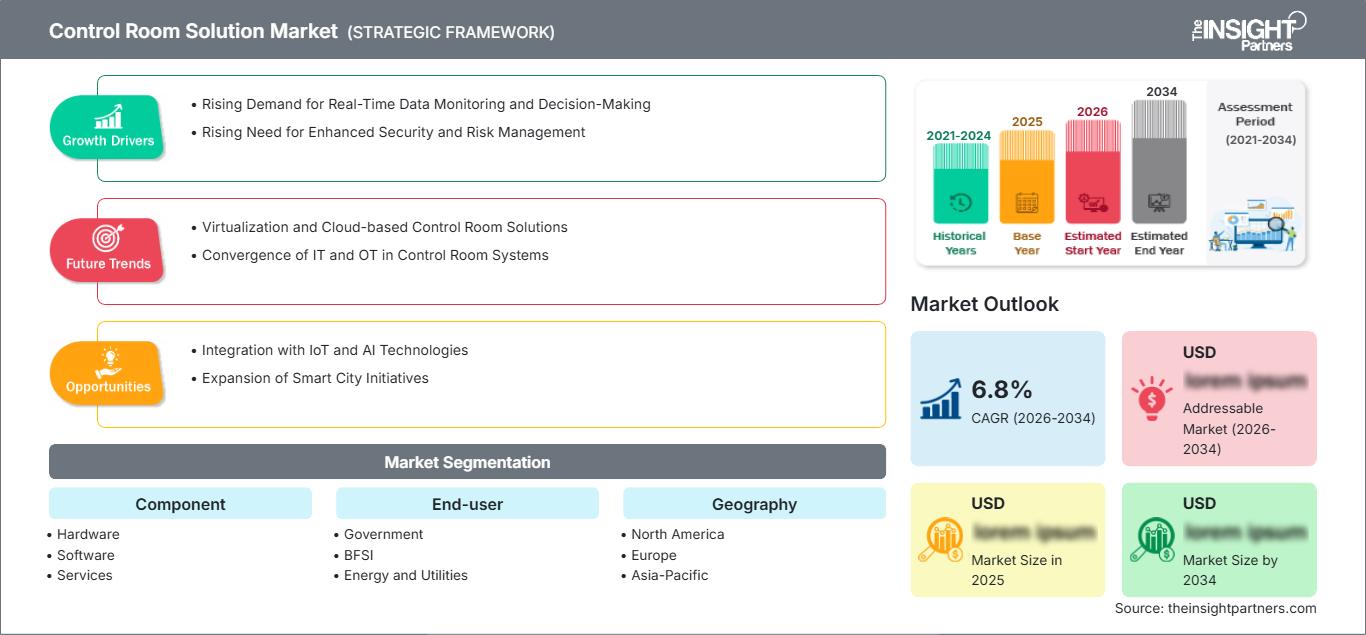
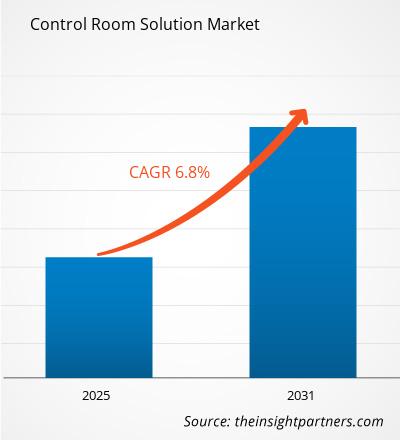
The Control Room Solution Market is estimated to increase from US$ 60.97 Billion in 2025 to US$ 110.91 Billion in 2034 at a CAGR of 6.87% from 2026 to 2034. Market demand is driven by the need for modernization of critical operation centers where real-time visualization, collaboration, and decision-making systems are increasingly becoming necessary in public infrastructure, energy grids, finance, telecoms, healthcare, and smart manufacturing.
North America is still a key geography as companies continue to replace their aging command centers with new-generation command centers characterized by IP visualization systems, resilient KVM access, and situational awareness platforms. The North America Control Room Solution Market size is forecast to enjoy a 6.5%-7.1% CAGR growth period during the forecast period.
Control Room Solution Market Assessment and Insights
- North America accounted for 31–34% share in 2025 and is projected to grow at a CAGR of 6.5–7.1% between 2026–2034, led by utility modernization, emergency response upgrades, and secure enterprise operations.
- US represented 74–78% of North America in 2025 and is expected to grow at a CAGR of 6.6–7.2% between 2026–2034, supported by federal, utility, and telecom deployments.
- Europe held 24–27% share in 2025 and is projected to grow at a CAGR of 6.0–6.6% between 2026–2034, with Germany, the UK, and France leading modernization programs.
- Asia Pacific captured 25–29% share in 2025 and is expected to grow at a CAGR of 7.3–8.0% between 2026–2034, led by China, Japan, South Korea, India, and Australia.
- Largest Segment Hardware held 42–46% market share in 2025 and is projected to grow at a CAGR of 6.1–6.7% between 2026–2034, supported by visualization infrastructure replacement cycles.
- High Growth Segment Software held 28–32% market share in 2025 and is projected to grow at a CAGR of 7.6–8.3% between 2026–2034, driven by analytics, integration, and workflow orchestration.
- Key companies analyzed in detail: ABB Ltd., Barco NV, Black Box Corporation, Christie Digital Systems USA, Inc., Cyviz AS, Delta Electronics, Inc., NEC Corporation, RGB Spectrum, Samsung Electronics Co., Ltd., and Tory Technologies, Inc.
Source: The Insight Partners' analysis based on proprietary research, government publications, company annual reports, investor presentations, industry databases, and expert interviews.
Control room settings have evolved from being display-centric settings to being defined by software-enabled operation facilities whereby the video wall, operator consoles, secure switching, and workflow applications operate as one architectural construct. There is now an emphasis on modular LED screens, low power CPUs, and integration through service as users need flexible refresh cycles rather than system overhaul. Interoperability with SCADA, GIS, security, and enterprise information systems is another priority for energy, public safety, BFSI, and manufacturing.
The requirements for the future will be even more when command and control centers, smart grids, border protection, and digital healthcare systems start being used in the developing countries. The government regulations in regard to resilience, cybersecurity, and continuity of critical infrastructure have made the procurement process happen, while private investments have been directed at visualization as a service and lifecycle services. The above situation makes the solution an infrastructure solution.
Control Room Solution Market Report Scope
| Report Attribute | Details |
|---|---|
| Market size in 2025 | US$ 60.97 Billion |
| Market Size by 2034 | US$ 110.91 Billion |
| Global CAGR (2026 - 2034) | 6.87% |
| Historical Data | 2021-2024 |
| Forecast period | 2026-2034 |
Control Room Solution Market Analysis
The Market Growth for Control Room Solution is Stimulated by Growing Need for Visibility. It is important to act quickly in case of outage at utilities, consolidate network visibility at telecom companies, and to integrate facilities management, security and patient flows at hospitals. There is an interdependent ecosystem of hardware vendors, software vendors, system integrators and managed services providers in which reliability, security and ergonomics are critical to buying.
Dynamics of the supply chain move towards shorter integration cycles and platforms-led purchasing. LED video walls, KVM over IP, AV-over-IP Distribution, control room furniture, analytical software, and life cycle services are being increasingly integrated into the package in order to mitigate integration risks. Buyers appreciate companies that are capable of supporting hybrid setups, air-gapped networks, and multiple locations.
Moderate consolidation occurs within this industry among firms that provide visualization and integration services. There are display, security, and service options available from competitors including Barco NV, ABB Ltd., Samsung Electronics Co., Ltd., NEC Corporation, and Christie Digital Systems USA, Inc., whereas there are added benefits from Black Box Corporation, RGB Spectrum, Cyviz AS, Delta Electronics, Inc., and Tory Technologies, Inc.
The Control Room Solution Market Report shows the shift in investments from room-by-room solutions to integrated systems of command. The customers evaluate vendors based on cybersecurity compliance, mean time to repair, operator comfort, energy efficiency, and flexibility of software. Strategic positions will be determined by providing continuity benefits to the grid, governments, banks, telecommunications, healthcare institutions, and manufacturing facilities.
● REPORT CUSTOMIZATION
Tailor This Report To Align With Your Specific Business Requirements
This report can be customized to align precisely with your business objectives, scope, and target markets. Customization options include tailored segmentation, geography, competitive analysis, and strategic insights to support informed decision-making.
Customize This Report →WHAT YOU CAN ADJUST
- ● Segmentations
- ● Geography
- ● Competitive Analysis
- ● Language Preferences
Control Room Solution Market: Strategic Insights
Regional Insights
North America Control Room Solution Market
North America held 31–34% share in 2025 and is projected to grow at a CAGR of 6.5–7.1% during 2026–2034. The region benefits from early adoption of mission-critical visualization, high utility automation spending, and strong public safety modernization. The Control Room Solution Market share in North America is also supported by cyber-focused procurement across government and enterprise networks.
Utility firms, transportation authorities, BFSI security organizations, and telecom providers are moving away from separate rooms toward integrated command centers. The emphasis of IEA on energy security and electrification will cover all the requirements for grid monitoring, and emergency management systems will guarantee continuous funding for safe and functioning facilities. Compliance of vendors in the United States will ensure procurement advantages.
U.S. Control Room Solution Market
In 2025, the U.S. had the highest representation of 74-78% in the entire North American region and is forecast to grow with a CAGR of 6.6-7.2% till 2034. Applications are prevalent in federal operations, electric utility, financial security center, telecom network operations, healthcare command centers, and manufacturing control rooms with downtime having an operational cost impact.
The market presence is significant because companies like ABB Ltd., Barco NV, Black Box Corporation, Christie Digital Systems USA, Inc., RGB Spectrum, Samsung Electronics Co., Ltd., and NEC Corporation provide their services via regional channels. The applications include LED visualization, KVM over IP, secure content distribution, and operator-oriented work environment.
Europe Control Room Solution Market
Europe has a market share of 24-27%, growing at CAGR of 6.0-6.6% for the period 2026-2034. Germany is leading because of automation in industry, energy balancing, and manufacturing process controls. UK is still a major market owing to transportation, defense-oriented public safety, and financial operations facilities.
France, Italy, and Spain have been focusing on smart infrastructures, utility robustness, and hospital facilities monitoring, which has generated a consistent demand for modular visualization and integration services. Prioritization of cyber resilience by EU along with cross border energy collaboration favors a secured architecture. The region prefers vendors having interoperable, lifecycle-based, energy-efficient display devices, and compliant solutions.
APAC Control Room Solution Market
APAC has 25-29% market share in 2025 and forecasted to rise at a CAGR of 7.3-8.0% till 2034. Leading demand drivers from the region include smart city command centers, grid expansion, metro networks, and industrial surveillance in China, while Japan and South Korea focus on robust infrastructure and high definition visualization.
Additional drivers in the region include digital government services, utility upgrades, mining activities, and telecommunication network expansion in India and Australia respectively. Infrastructure development driven by policy and industrial automation are growing the demand for standardized control rooms with integration of SCADA, video surveillance, and GIS capabilities.
Middle East & Africa Control Room Solution Market
MEA & Africa are expected to witness a CAGR of 6.8%–7.5% in the period 2026–2034, with Saudi Arabia emerging as a frontrunner for the construction of smart cities and energy and transport command centers. UAE will be next in line, with the support of airport, public safety, and enterprise security management services, while South Africa will have mining and utilities monitoring.
The remaining market requirements for MEA will be dependent on the continuous supply of oil and gas, power grids, port facilities, and urban safety measures. The purchasing criteria will involve durable monitors, remote accessibility, and security connections because of the geographic dispersion of infrastructure assets.
Segmentation Analysis
Component
The component segment is projected to grow at a CAGR of 6.7–7.2% during 2026–2034. Control Room Solution Market scope within components is widening as buyers combine display infrastructure, software orchestration, and integration services into unified operating environments. Replacement of legacy LCD walls, higher data volumes, and cybersecurity requirements are increasing demand for standardized architectures that can scale across multiple rooms and facilities.
- Hardware remains the largest component, supported by LED video walls, controllers, consoles, and signal infrastructure required for 24/7 visualization in utilities, government, telecom, healthcare, and manufacturing facilities.
- Software is gaining strategic importance as operators need workflow orchestration, analytics, source management, remote collaboration, and secure access layers that reduce information overload and improve response consistency.
- Services support long-term value through consulting, design, integration, maintenance, training, and lifecycle support, especially where organizations lack in-house expertise for mission-critical multi-vendor deployments.
End-user
The end-user segment is projected to grow at a CAGR of 6.6–7.1% during 2026–2034. Demand varies by operational criticality, regulatory pressure, and digital maturity. Government agencies focus on public safety and emergency coordination, utilities prioritize grid resilience, BFSI users emphasize threat monitoring, and healthcare, telecom, and manufacturing operators require integrated visibility across increasingly distributed assets.
- Government adoption is shaped by emergency response, transportation command, city surveillance, and defense-adjacent operations where secure visualization and cross-agency coordination improve incident handling and resilience.
- BFSI users deploy control rooms for security operations, fraud monitoring, trading support, facility oversight, and business continuity, making reliability, auditability, and cyber isolation central procurement criteria.
- Energy and Utilities require real-time monitoring of grids, pipelines, generation assets, renewables, and distribution networks, making SCADA integration and outage response essential to control room investment.
- IT and Telecom demand is driven by network operations centers, service assurance, cybersecurity monitoring, and 5G infrastructure management, where operators must interpret thousands of live data streams.
- Healthcare organizations use command centers for capacity management, security, facilities, clinical logistics, and emergency coordination, improving visibility across hospitals, campuses, and regional care networks.
- Manufacturing facilities invest in control rooms to supervise production lines, safety systems, robotics, and quality data, supporting Industry 4.0 programs and reducing unplanned downtime.
Opportunity Snapshot
| End Users | Revenue Contribution | Trend Tag | Adoption Stage |
| Government | High | City Command | Scaling |
| BFSI | Medium | Security Ops | Mature |
| Energy and Utilities | High | Grid Control | Mature |
| IT and Telecom | High | Network Ops | Scaling |
| Healthcare | Medium | Care Command | Scaling |
| Manufacturing | Medium | Smart Plant | Scaling |
Control Room Solution Market Growth Drivers and Impact Analysis
Critical Infrastructure Modernization
The replacement of stand-alone monitoring facilities with control centers that provide an integrated solution is being experienced in utilities, transportation companies, governmental organizations, and telecommunication firms. The driver includes the fact that the infrastructure is aging, the expectation for continued operations is increasing, and the coordination of an event among several systems is necessary. The use of modern control centers decreases reaction times by bringing together SCADA systems, geographic information systems, cameras, alarm systems, communication, and analysis within one workstation. The market effects of this driver are felt when there are high costs of outages, cyber threats, or public safety incidents.
Cyber-Secure Operations and Network Segregation
Access to segregated systems while ensuring the integrity of security boundaries is becoming an imperative for operators. This is driving more need for KVM over IP, secure content routing, authentication, and architectures that will ensure separation of OT from IT and secure networks. The consequence is evident in energy, BFSI, telecom, and government establishments where auditability and uptime are essential. Purchase decisions today include cybersecurity considerations besides display performance and ergonomic issues. In this situation, vendors who integrate visualization and secure workflow management have an edge over those providing pure hardware solutions.
Operator Workload and Data Fusion Needs
There is an increase in the amount of data that gets to control rooms from IoT sensors, video cameras, industrial systems, cybersecurity solutions, and enterprise systems. This makes the need for good information design essential since otherwise, operators will be faced with too many alerts and a slow cycle of decisions. Integrated solutions solve this challenge by organizing feeds, showing context dashboards, and promoting collaboration among teams. The effect of this is the greater need for software orchestration, analysis, ergonomically designed consoles, and service-centric workflow design.
Control Room Solution Market Future Trends
AI-Assisted Decision Support
Control Room Solution Market trends will increasingly center on AI-assisted prioritization rather than simple data aggregation. Future platforms will classify incidents, recommend response workflows, and identify abnormal patterns across video, sensor, SCADA, and network data. Adoption will be gradual because mission-critical operators require explainability, audit trails, and human approval. The strongest use cases will emerge in grid operations, public safety, healthcare logistics, and telecom service assurance. Vendors that embed analytics without overwhelming operators will gain advantage as buyers seek measurable improvements in response quality, staffing efficiency, and continuity planning.
Hybrid and Distributed Command Models
Future control rooms will become more distributed as organizations operate multiple sites, remote experts, and backup facilities. Hybrid command models will link primary rooms, crisis rooms, mobile teams, and cloud-supported analytics while retaining secure on-premise control for sensitive operations. This trend will increase demand for interoperable software, low-latency routing, and standardized user experiences across locations. It will also shift purchasing from one-time installations toward platform roadmaps, managed support, and resilience planning. The result will be stronger recurring revenue potential for integrators and technology providers.
Control Room Solution Market Opportunities
Managed Lifecycle Services for Mission-Critical Rooms
Technology providers can expand margins by offering managed lifecycle programs that cover assessment, design, integration, training, preventive maintenance, software updates, and modernization planning. Many operators lack specialized internal teams to manage multi-vendor visualization, networking, and ergonomic systems. Control Room Solution Market Forecasts point to stronger demand for service-led models as buyers prefer predictable performance and budget visibility. The opportunity is especially attractive in utilities, healthcare, telecom, and government agencies where uptime requirements are high but procurement teams face staffing constraints. Outcome-based service packages can differentiate suppliers beyond hardware specifications.
Standardized Platforms for Smart Cities and Utilities
Smart city and utility programs create opportunities for repeatable command center platforms that can be deployed across municipalities, grid operators, water networks, and transport agencies. Standardization lowers integration risk, shortens project timelines, and enables shared training across departments. Suppliers can target this opportunity by packaging visualization, incident management, GIS integration, cybersecurity controls, and support into modular offerings. Emerging markets offer particular upside because many public agencies are building centralized monitoring capacity for the first time. Partnerships with local integrators and infrastructure contractors will be critical for execution.
Recent Developments
- April 2026: ABB launched Unification X, a next-generation control room integration platform designed to streamline industrial operations by connecting multiple operational systems into a single interface. The platform improves operator situational awareness, reduces control room complexity, and enhances efficiency across industries such as energy, utilities, and manufacturing.
- March 2026: Honeywell commercially launched its Experion Operations Assistant, an AI-powered control room solution following successful pilot projects with Chevron and TotalEnergies. The assistant combines real-time and historical operational data to predict alarm incidents, provide decision support, and help operators reduce unplanned downtime and improve plant safety.
- October 2024: RGB Spectrum introduced the IPX Flyaway Kit, a rugged mobile control room solution for defence and public safety applications. The portable command centre integrates display, communications, and video processing capabilities into a compact deployable system, enabling rapid situational awareness and coordination during emergency and field operations.
Frequently Asked Questions

- Comprehensive Market Sizing and Forecast Analysis
- Detailed Segmentation Analysis
- In-Depth Market Dynamics Assessment
- Regional and Country-Level Insights
- Competitive Landscape and Company Benchmarking
- Strategic Business Intelligence
Recent Reports
Testimonials

The Insight Partners provided valuable market intelligence that supported our global go-to-market strategy. Their team was professional, responsive, and attentive to our feedback, providing thoughtful analysis and helpful methodological clarifications throughout the project.
Junmo Kim Chief Financial Officer (CFO), Enertech Co., Ltd.
The Insight Partners' SCADA System Market report is comprehensive, with valuable insights on current trends and future forecasts. The team was highly professional, responsive, and supportive throughout. We are very satisfied and highly recommend their services.
RAN KEDEM Partner, Reali Technologies LTDs
I requested a report on a very specific software market and the team produced the report in a few days. The information was very relevant and well presented. I then requested some changes and additions to the report. The team was again very responsive and I got the final report in less than a week.
JEAN-HERVE JENN Chairman, Future Analytica
We worked with The Insight Partners for an important market study and forecast. They gave us clear insights into opportunities and risks, which helped shape our plans. Their research was easy to use and based on solid data. It helped us make smart, confident decisions. We highly recommend them.
PIYUSH NAGPAL Sr. Vice President, High Beam Global
The Insight Partners delivered insightful, well-structured market research with strong domain expertise. Their team was professional and responsive throughout. The user-friendly website made accessing industry reports seamless. We highly recommend them for reliable, high-quality research services
YUKIHIKO ADACHI CEO, Deep Blue, LLC.
This is the first time I have purchased a market report from The Insight Partners.While I was unsure at first, I visited their web site and felt more comfortable to take the risk and purchase a market report.I am completely satisfied with the quality of the report and customer service. I had several questions and comments with the initial report, but after a couple of dialogs over email with their analyst I believe I have a report that I can use as input to our strategic planning process.Thank you so much for taking the extra time and making this a positive experience.I will definitely recommend your service to others and you will be my first call when we need further market data.
JOHN SUZUKI President and Chief Executive Officer, Board Director, BK Technologies
I wish to appreciate your support and the professionalism you displayed in the course of attending to my request for information regarding to infectious disease IVD market in Nigeria. I appreciate your patience, your guidance, and the fact that you were willing to offer a discount, which eventually made it possible for us to close a deal. I look forward to engaging The Insight Partners in the future, all thanks to the impression you have created in me as a result of this first encounter.
DR CHIJIOKE ONYIA MANAGING DIRECTOR, PineCrest Healthcare Ltd.Reason to Buy
- Informed Decision-Making
- Understanding Market Dynamics
- Competitive Analysis
- Identifying Emerging Markets
- Customer Insights
- Market Forecasts
- Risk Mitigation
- Boosting Operational Efficiency
- Strategic Planning
- Investment Justification
- Tracking Industry Innovations
- Aligning with Regulatory Trends





 Get Free Sample for