Dried Honey Market Trends, Size & Forecast by 2034
Dried Honey Market Size and Forecast (2021 - 2034), Global and Regional Share, Trend, and Growth Opportunity Analysis Report Coverage: By Form (Powder and Granules), Category (Organic and Conventional), and Application (Food & Beverages, Personal Care, and Pharmaceuticals & Nutraceuticals)
Historic Data: 2021-2024 | Base Year: 2025 | Forecast Period: 2026-2034- Report Date : Apr 2026
- Report Code : TIPRE00017405
- Category : Food and Beverages
- Status : Upcoming
- Available Report Formats :


- No. of Pages : 150

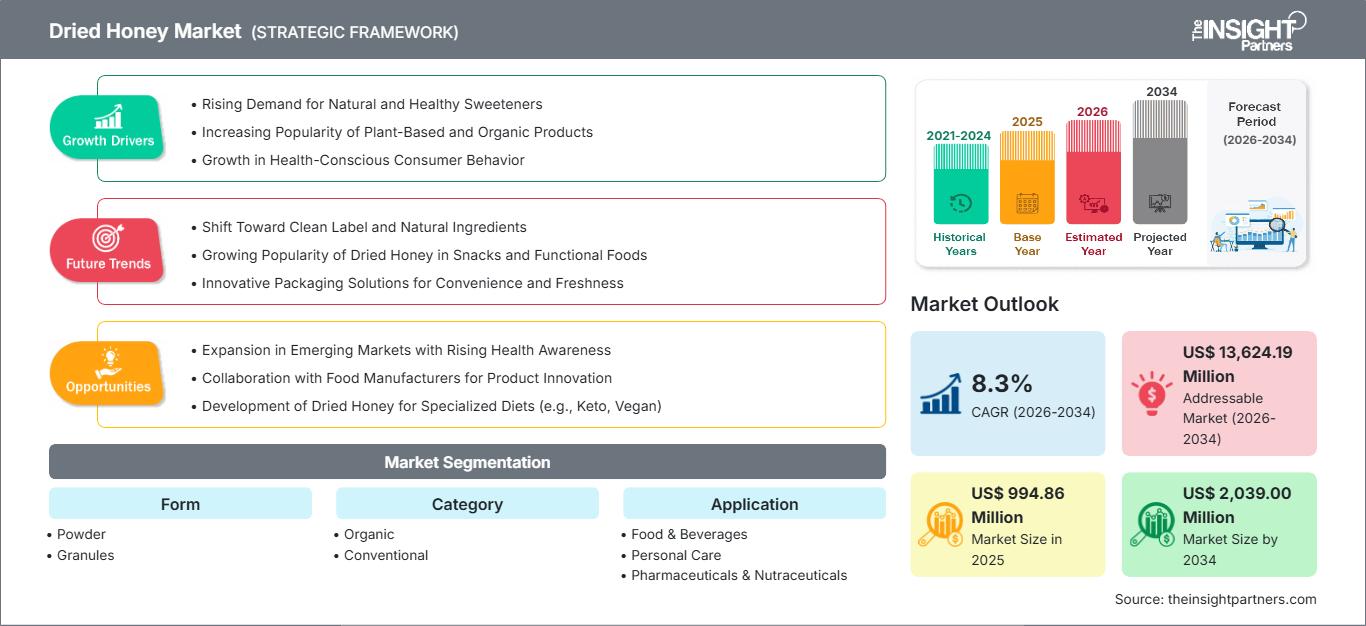
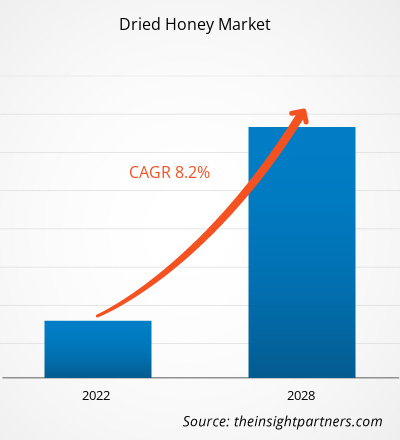
The global Dried Honey market size is projected to reach US$ 2,039.00 million by 2034 from US$ 994.86 million in 2025. The market is anticipated to register a CAGR of 8.3% during the forecast period 2026–2034. Key market dynamics include an intensifying global demand for clean-label natural sweeteners, a surge in the utilization of dehydrated ingredients for industrial food processing, and the rising application of honey-based powders in the cosmetic and nutraceutical sectors. Additionally, the market is set to benefit from the growing "better-for-you" snack trend, advancements in spray-drying and freeze-drying technologies that preserve enzymatic integrity, and the logistical advantages of shelf-stable dried formats over traditional liquid honey.
Dried Honey Market Analysis
The dried honey market analysis indicates a strategic shift toward high-purity, functional ingredients as manufacturers move away from refined sugars and artificial additives. Procurement trends highlight a bifurcation in the market between high-volume spray-dried powders for the bakery industry and premium freeze-dried granules that retain superior flavor profiles for the gourmet beverage sector. Strategic opportunities are emerging in the formulation of "immune-boosting" supplements and sports nutrition, where dried honey's natural carbohydrate profile and antioxidant content provide a clean-energy claim. The analysis also underscores that long-term market competitiveness is contingent upon securing transparent supply chains and implementing rigorous anti-adulteration testing to meet the evolving regulatory standards for honey-based exports.
Dried Honey Market Overview
Dried honey is transitioning from a niche culinary ingredient to a versatile industrial commodity. Historically valued for its extended shelf life and ease of handling, dried honey is now a staple in the global shift toward natural and organic sweeteners. The sector encompasses a wide range of products, including fine powders and crystalline granules, catering to diverse industries such as confectionery, dairy, and personal care. While Europe and Asia-Pacific remain traditional strongholds for honey production, technological innovation in North America has accelerated the adoption of dried honey in specialized health and wellness products. As consumer awareness regarding the benefits of raw, minimally processed sweeteners grows, the market is seeing a notable influx of organic and mono-floral dried honey variants. For instance, the market in the US is characterized by a high demand for clean-label ingredients across the industrial food sector. Driven by a robust consumer preference for natural alternatives to high-fructose corn syrup, the region serves as a hub for innovation in honey-infused snacks, premium baked goods, and natural personal care products.
Customize This Report To Suit Your Requirement
Get FREE CUSTOMIZATIONDried Honey Market: Strategic Insights
-
Get Top Key Market Trends of this report.This FREE sample will include data analysis, ranging from market trends to estimates and forecasts.
Dried Honey Market Drivers and Opportunities
Market Drivers:
- Convenience and Extended Shelf Life: Dried honey eliminates the stickiness and crystallization issues associated with liquid honey, offering a free-flowing format that simplifies industrial dosing and storage.
- Rising Demand for Natural Sweeteners: Increasing health consciousness and the rising prevalence of lifestyle-related disorders are pushing consumers toward natural, nutrient-dense sweeteners with perceived medicinal properties.
- Growth in Clean-Label Beauty Products: The humectant and antimicrobial properties of honey make its dried form a sought-after ingredient in the "waterless beauty" trend for masks, soaps, and exfoliants.
Market Opportunities:
- Development of Fortified Nutraceuticals: There is a significant opportunity to blend dried honey with botanical extracts or probiotics to create functional "superfood" powders for the health-conscious demographic.
- Expansion into Emerging Asia-Pacific Markets: Rapid urbanization and the westernization of diets in China and India are creating high-margin opportunities for premium, imported dried honey ingredients.
- Mono-floral and Specialty Varieties: Producers can achieve price premiums by offering dried versions of specific varieties like Mānuka, Acacia, or Buckwheat honey, appealing to the connoisseur market.
Dried Honey Market Report Segmentation Analysis
The Dried Honey Market share is analyzed across various segments to provide a clearer understanding of its structure, growth potential, and emerging trends. Below is the standard segmentation approach used in most industry reports:
By Form:
- Powder: This segment serves as a primary ingredient in dry baking mixes, seasonings, and powdered beverages due to its high solubility and ease of blending.
- Granules: Often preferred for applications requiring a specific texture or visual appeal, such as tea blends, decorative toppings, and gourmet cereals.
By Category:
- Organic: A premium segment experiencing rapid growth, fueled by consumer demand for pesticide-free products and ethical beekeeping practices.
- Conventional: The dominant volume driver, utilized extensively in large-scale industrial food manufacturing where cost-efficiency and consistent supply are paramount.
By Application:
- Food & Beverages: The largest application area, encompassing bakery products, confectionery, dairy, and ready-to-drink healthy beverages.
- Personal Care: Utilizing the natural moisturizing and antibacterial properties of honey in skincare and haircare formulations.
- Pharmaceuticals & Nutraceuticals: A high-growth segment focusing on cough suppressants, throat lozenges, and dietary supplements.
By Geography:
- North America
- Europe
- Asia Pacific
- South & Central America
- Middle East & Africa
Dried Honey Market Report Scope
| Report Attribute | Details |
|---|---|
| Market size in 2025 | US$ 994.86 Million |
| Market Size by 2034 | US$ 2,039.00 Million |
| Global CAGR (2026 - 2034) | 8.3% |
| Historical Data | 2021-2024 |
| Forecast period | 2026-2034 |
| Segments Covered |
By Form
|
| Regions and Countries Covered |
North America
|
| Market leaders and key company profiles |
|
Dried Honey Market Players Density: Understanding Its Impact on Business Dynamics
The Dried Honey Market is growing rapidly, driven by increasing end-user demand due to factors such as evolving consumer preferences, technological advancements, and greater awareness of the product's benefits. As demand rises, businesses are expanding their offerings, innovating to meet consumer needs, and capitalizing on emerging trends, which further fuels market growth.
Dried Honey Market Share Analysis by Geography
Asia-Pacific is expected to grow fastest in the coming years. Emerging markets in South & Central America, the Middle East, and Africa also have many untapped opportunities for premium natural sweetener producers and functional ingredient manufacturers to expand.
The dried honey market is undergoing a significant transformation, moving from a traditional pantry staple to a global high-value functional ingredient. Growth is driven by the rising prevalence of sugar-related health concerns, a surge in "clean-label" food demand, and the expansion of the luxury natural cosmetics sector. Below is a summary of market share and trends by region:
North America
- Market Share: A mature yet evolving segment (holding approx. 34% of market revenue) driven by a robust industrial food sector and high consumer health consciousness.
- Key Drivers:
- Rising consumer preference for natural, non-refined sweeteners in "better-for-you" snack categories.
- Mainstreaming of honey-based powders in high-end retail chains and specialized health stores.
- Increased demand for convenient, shelf-stable ingredients in the booming home-baking and meal-kit sectors.
- Trends: Scaling of organic-certified powders and the successful adoption of specialty formats (e.g., non-sticky granules) to appeal to the premium industrial bakery and confectionery segments.
Europe
- Market Share: Holds a significant global share, anchored by a long-standing tradition of honey consumption and strict quality standards for natural ingredients.
- Key Drivers:
- High domestic demand for honey-infused products in major economies like Germany, France, and the UK.
- Established regulatory frameworks ensuring the purity and traceability of honey-derived products.
- Strong government and institutional support for sustainable beekeeping and biodiversity initiatives.
- Trends: A strategic shift toward prioritizing single-origin and mono-floral dried honey variants. There is also an increasing focus on sustainable, plastic-free packaging to meet the demands of eco-conscious European consumers.
Asia-Pacific
- Market Share: The fastest-growing region, with China and India acting as the primary production and export engines for honey-based raw materials.
- Key Drivers:
- Massive consumer base in emerging economies seeking premium, natural alternatives to artificial sweeteners.
- Government-supported agricultural initiatives focused on modernizing apiculture and dehydration technologies.
- Rapid urbanization and rising disposable incomes are leading to a preference for westernized "luxury" health supplements and snacks.
- Trends: Heavy reliance on e-commerce platforms for cross-border trade and an increasing use of dried honey in the regional nutraceutical and traditional medicine industries.
South and Central America
- Market Share: An emerging market with a growing artisanal sector in countries like Brazil, Chile, and Argentina.
- Key Drivers:
- Increasing awareness of the nutritional superiority and antimicrobial benefits of dried honey for gut health.
- Modernization of local honey processing facilities to meet international commercial standards for export.
- Rising interest in clean-label, "farm-to-table" ingredients among middle-to-high income urban segments.
- Trends: Growth of boutique, "origin-specific" brands and the introduction of honey-infused artisanal products to differentiate from bulk commodity sweeteners.
Middle East and Africa
- Market Share: A developing market with deep cultural roots in apiculture, transitioning toward formalized commercial production of value-added honey products.
- Key Drivers:
- The traditional presence of honey in regional diets and natural remedies, now shifting to convenient dried formats.
- High demand for shelf-stable ingredients in arid climates, where liquid honey storage can be challenging.
- Strategic investments in "Smart Agriculture" to improve hive productivity and local food security.
- Trends: Implementation of modern spray-drying and refrigeration technologies to formalize the local market, coupled with a focus on high-nutrient powders for the pediatric and health supplement segments.
High Market Density and Competition
Competition is intensifying due to the presence of established leaders such as Best Ground International, ASR Group, Hoosier Hill Farm, Associated British Foods Plc., Specialty Products and Technology, Inc., Spice Jungle, SWEET HARVEST FOODS, THE ARCHER DANIELS MIDLAND COMPANY, and Hangzhou Youither Bioscience Co. Ltd., which also contribute to a diverse and rapidly expanding market landscape.
This competitive environment pushes vendors to differentiate through:
- Premiumization and Functional Branding: Positioning dried honey as a superior nutritional alternative to refined sugars by emphasizing its antioxidant content, enzymes, and low-glycemic index for health-conscious consumers.
- Diversification of Product Portfolios: Dried honey applications now include more than just industrial sweeteners. Companies offer gourmet granules for tea blends, probiotic-infused powders, and high-end cosmetic bases for waterless beauty products.
- Integrated Supply Chain Management: Producers manage the entire value chain, from ethical beekeeping and floral source selection to advanced spray-drying or freeze-drying. This approach ensures quality, transparency, and meets rigorous non-GMO and organic standards.
- Advanced Processing Technologies: New dehydration methods, such as vacuum drying and membrane filtration, help create high-purity honey powders that maintain the natural flavor and therapeutic properties required for the pharmaceutical and nutraceutical sectors.
Opportunities and Strategic Moves
- Partner with high-end retail channels and e-commerce platforms: Tap into the surging demand for natural, portable, and clean-label sweeteners in the Asia-Pacific and North American markets through direct-to-consumer digital strategies.
- Incorporate sustainable beekeeping practices and regenerative agriculture certifications: Appeal to environmentally conscious millennials and Gen Z consumers seeking ethically produced and planet-friendly alternatives to traditional sweeteners.
Major Companies operating in the Dried Honey Market are:
- Best Ground International
- ASR Group
- Hoosier Hill Farm
- Associated British Foods Plc.
- Specialty Products and Technology, Inc
- Spice Jungle
- SWEET HARVEST FOODS
- THE ARCHER DANIELS MIDLAND COMPANY
- Hangzhou Youither Bioscience Co., Ltd.
Disclaimer: The companies listed above are not ranked in any particular order.
Dried Honey Market News and Recent Developments
- In November 2024, Tate & Lyle announced that it had completed the acquisition of the entire issued share capital of CP Kelco U.S., CP Kelco China, and CP Kelco ApS, along with their respective subsidiaries, from J.M. Huber Corporation. As a leading provider of pectin and specialty gums, this acquisition significantly bolstered Tate & Lyle's nature-based ingredient portfolio, enhancing their technical capacity to stabilize complex formulations in the dried honey market for global food and beverage applications.
- In October 2024, Comvita continued to lead in the wellness sector by launching two innovative products: an improved formula of its Mānuka Honey Lozenges and an all-new Squeezy Bottle. These lozenges utilized dried honey in a convenient, portable solid format that was specifically engineered to be moisture-minimizing and heat-resistant. The products were designed to assist consumers in incorporating the natural benefits of ultra-premium Mānuka honey into their daily routines to help boost the immune system, soothe coughs, and alleviate throat irritation.
Dried Honey Market Report Coverage and Deliverables
The "Dried Honey Market Size and Forecast (2021–2034)" report provides a detailed analysis of the market covering below areas:
- Dried Honey Market size and forecast at global, regional, and country levels for all the key market segments covered under the scope
- Dried Honey Market trends, as well as market dynamics such as drivers, restraints, and key opportunities
- Detailed PEST and SWOT analysis
- Dried Honey Market analysis covering key market trends, global and regional framework, major players, regulations, and recent market developments
- Industry landscape and competition analysis covering market concentration, heat map analysis, prominent players, and recent developments in the Dried Honey Market.
- Detailed company profiles
Frequently Asked Questions

- Historical Analysis (2 Years), Base Year, Forecast (7 Years) with CAGR
- PEST and SWOT Analysis
- Market Size Value / Volume - Global, Regional, Country
- Industry and Competitive Landscape
- Excel Dataset
Recent Reports
Testimonials

The Insight Partners' SCADA System Market report is comprehensive, with valuable insights on current trends and future forecasts. The team was highly professional, responsive, and supportive throughout. We are very satisfied and highly recommend their services.
RAN KEDEM Partner, Reali Technologies LTDs
I requested a report on a very specific software market and the team produced the report in a few days. The information was very relevant and well presented. I then requested some changes and additions to the report. The team was again very responsive and I got the final report in less than a week.
JEAN-HERVE JENN Chairman, Future Analytica
We worked with The Insight Partners for an important market study and forecast. They gave us clear insights into opportunities and risks, which helped shape our plans. Their research was easy to use and based on solid data. It helped us make smart, confident decisions. We highly recommend them.
PIYUSH NAGPAL Sr. Vice President, High Beam Global
The Insight Partners delivered insightful, well-structured market research with strong domain expertise. Their team was professional and responsive throughout. The user-friendly website made accessing industry reports seamless. We highly recommend them for reliable, high-quality research services
YUKIHIKO ADACHI CEO, Deep Blue, LLC.
This is the first time I have purchased a market report from The Insight Partners.While I was unsure at first, I visited their web site and felt more comfortable to take the risk and purchase a market report.I am completely satisfied with the quality of the report and customer service. I had several questions and comments with the initial report, but after a couple of dialogs over email with their analyst I believe I have a report that I can use as input to our strategic planning process.Thank you so much for taking the extra time and making this a positive experience.I will definitely recommend your service to others and you will be my first call when we need further market data.
JOHN SUZUKI President and Chief Executive Officer, Board Director, BK Technologies
I wish to appreciate your support and the professionalism you displayed in the course of attending to my request for information regarding to infectious disease IVD market in Nigeria. I appreciate your patience, your guidance, and the fact that you were willing to offer a discount, which eventually made it possible for us to close a deal. I look forward to engaging The Insight Partners in the future, all thanks to the impression you have created in me as a result of this first encounter.
DR CHIJIOKE ONYIA MANAGING DIRECTOR, PineCrest Healthcare Ltd.Reason to Buy
- Informed Decision-Making
- Understanding Market Dynamics
- Competitive Analysis
- Identifying Emerging Markets
- Customer Insights
- Market Forecasts
- Risk Mitigation
- Boosting Operational Efficiency
- Strategic Planning
- Investment Justification
- Tracking Industry Innovations
- Aligning with Regulatory Trends




 Get Free Sample For