
Hollow Core Insulator Market Competitive Landscape, Size, Segments, and Growth by 2034
Coverage: by Material (Ceramic, Composite); Voltage (1-69kV, 69-230kV, Above 230kV); Application (Switchgear, Current and Voltage Transformer, Cable Termination and Bushing, Surge Arrester, Station Post, Others) , and Geography (North America, Europe, Asia Pacific, and South and Central America)
- Status : Data Released
- Report Code : TIPRE00008388
- Category : Electronics and Semiconductor
- No. of Pages : 150
- Available Report Formats :


- Last update date : October 26, 2026


2025 Market Size
US$ 3.72 Bn
Base year value
2034 Forecast
US$ 5.71 Bn
Projected by 2034
CAGR 2026-2034
4.86 %
Growth rate
Addressable Market
US$ 42.77 Bn
(2026-2034)
Hollow Core Insulator Market is valued at US$ 3.72 Billion in 2025 and is projected to reach US$ 5.71 Billion by 2034. The market is expected to register a CAGR of 4.86% during 2026–2034. Demand is being shaped by transmission-grid expansion, replacement of aging substation equipment, renewable-energy interconnection, and increasing requirements for compact, mechanically robust insulation across high-voltage applications.
North American demand is supported by transmission refurbishment, interconnection bottlenecks, and resilience investments. The Hollow Core Insulator Market size is expected to expand at an estimated 5.0–5.4% CAGR through 2034, supported by utility modernization programs, data-center-related load growth, and increased deployment of high-voltage equipment across the US and Canada.
Hollow Core Insulator Market Assessment and Insights
- North America: North America represented a 28–32% share in 2025 and is expected to grow at a 5.0–5.4% CAGR between 2026–2034. Aging transmission assets, grid resilience programs, and renewable interconnection requirements support replacement and new-build demand.
- US: The US accounted for 72–76% of North American demand in 2025 and is projected to grow at a 5.1–5.5% CAGR between 2026–2034, led by transmission expansion and substation upgrades.
- Europe: Europe held a 25–29% share in 2025 and is forecast to expand at a 4.5–4.9% CAGR between 2026–2034. Germany, the UK, France, Italy, and Spain are key markets as grid modernization and cross-border capacity investment accelerate.
- Asia Pacific: Asia Pacific captured a 34–38% share in 2025 and is anticipated to grow at a 5.4–5.8% CAGR between 2026–2034. China, Japan, South Korea, and India remain important demand centers because of transmission construction and industrial electrification.
- Largest Segment: Composite material held a 55–59% market share in 2025 and is expected to register a 5.1–5.5% CAGR between 2026–2034, supported by lightweight construction and pollution resistance.
- High Growth Segment: Above 230kV represented an 18–22% market share in 2025 and is projected to grow at a 5.7–6.1% CAGR between 2026–2034, reflecting high-voltage transmission expansion.
- Key companies analyzed in detail: ABB Ltd, Allied Insulators Ltd, CAD Schroer UK Ltd, CTC Insulators Co Ltd, LAPP Insulators GmbH, Maschinenfabrik Reinhausen GmbH, Modern Insulators Ltd., PPC Austria Holding GmbH, S.A.V.E.R. S.p.A., and TE Connectivity Ltd.
Source: The Insight Partners' analysis based on proprietary research, government publications, company annual reports, investor presentations, industry databases, and expert interviews.
In terms of materials used in hollow core insulators, the market is slowly moving away from purely ceramic components towards more varied options involving composites, resins, and fibers for the cores. The current trend towards lightweight components which cut down on transport costs and installation needs without compromising electrical and mechanical properties will continue. High voltage makers are also developing better shed designs, sealant technologies, and end connections to improve contaminant performance and longevity in harsh substations environments.
Throughout the forecast period, investments will be made in areas where power generation and distribution, industrial electrification, and inter-regional transfers generate a need for substations. With network resilience gaining prominence as a regulatory consideration, there will be increased focus on technically superior products. Furthermore, utilities are now looking at total cost over the lifecycle of the equipment rather than just its purchase cost.
Hollow Core Insulator Market Report Scope
| Report Attribute | Details |
|---|---|
| Market size in 2025 | US$ 3.72 Billion |
| Market Size by 2034 | US$ 5.71 Billion |
| Global CAGR (2026 - 2034) | 4.86% |
| Historical Data | 2021-2024 |
| Forecast period | 2026-2034 |
Hollow Core Insulator Market Analysis
Hollow Core Insulator Market growth is strongly correlated to investments in transmission and substation equipment. The demand arises from utilities, transmission companies, equipment manufacturers, and engineering companies before passing through specification, testing, procurement, and implementation. Competition among composite and ceramics is based on their performance in terms of dielectric, mechanical, contamination resistance, sizing, and certification. The increasing need for connections between renewable sources of energy increases projects that demand good insulators at outdoor substations and high voltage switchgear.
The value chain consists of ceramics or reinforced core bodies, polymers in the form of housing, conductive joints, sealing systems, testing facilities, and final equipment assembly. Supply is affected by the highly energy-consuming process of ceramics manufacture, availability of resins and silicone materials, machining skills, and testing capabilities. When utilities request custom-sized or high voltage tested products, lead time increases. Therefore, manufacturers with testing facilities and multiple sources of supply components benefit in complicated procurement processes.
The Hollow Core Insulator market report indicates that the industry exists in an environment where there is a combination of both diversified electrical equipment manufacturing firms and specialist insulation manufacturing firms. The two electrical equipment and grid firms include ABB Ltd. and TE Connectivity Ltd, while those specializing in insulation include Allied Insulators Ltd., CTC Insulators Co Ltd., Modern Insulators Ltd, and S.A.V.E.R. S.p.A. In addition, LAPP Insulators GmbH and PPC Austria Holding GmbH are specialized engineering insulation firms, and Maschinenfabrik Reinhausen GmbH has improved its position in grid equipment and composites.
Product qualification, production volumes, and nearness to utility companies will play an increasing role in strategic positioning. The company ABB Ltd can use its electrification portfolio, whereas TE Connectivity Ltd can use its insulation products together with cable accessories and grid connectivity features. Specialists can also compete through customizations and shorter engineering times. Investment is also going into capacity expansion, automation, materials, and local production. Thus, qualification and supply will matter as much as pricing.
● REPORT CUSTOMIZATION
Tailor This Report To Align With Your Specific Business Requirements
This report can be customized to align precisely with your business objectives, scope, and target markets. Customization options include tailored segmentation, geography, competitive analysis, and strategic insights to support informed decision-making.
Customize This Report →WHAT YOU CAN ADJUST
- ● Segmentations
- ● Geography
- ● Competitive Analysis
- ● Language Preferences
Hollow Core Insulator Market: Strategic Insights
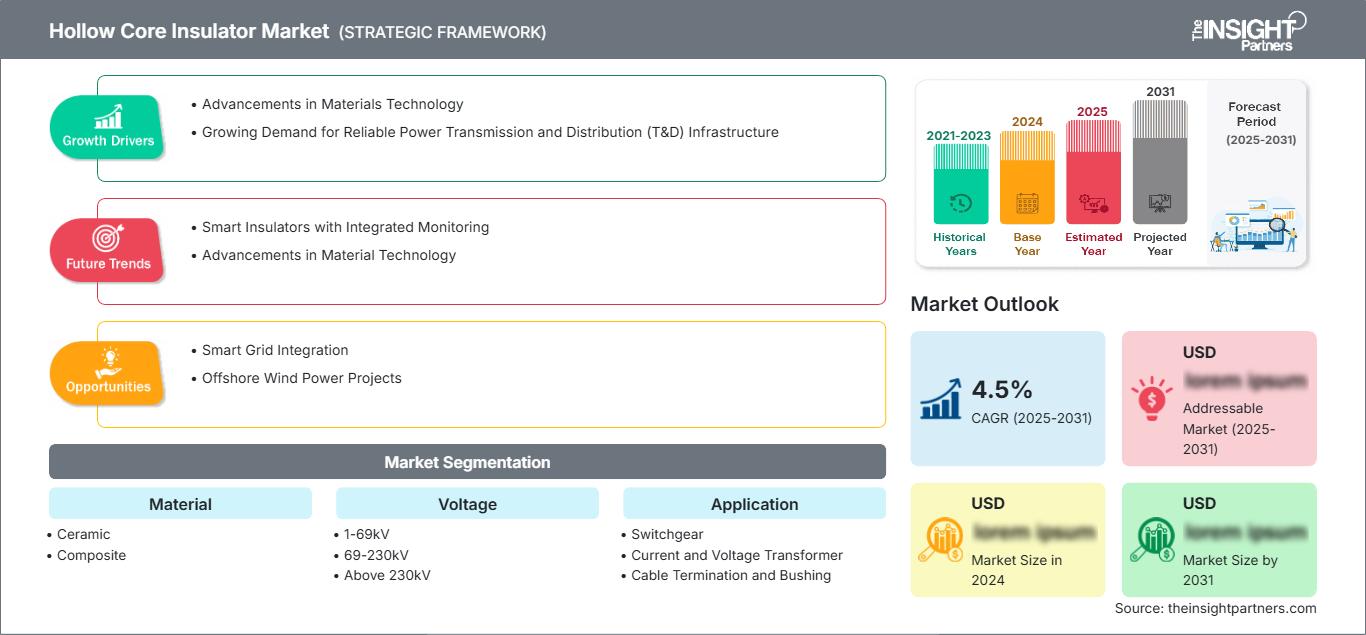
Regional Insights
North America Hollow Core Insulator Market
North America commanded a 28–32% share in 2025, while the regional market is expected to grow at a 5.0–5.4% CAGR during 2026-2034. There is a focus on enhancing transmission reliability, integration of renewable energy, and renewal of old substations in the US and Canada. There are growing federal and utility initiatives targeting capacity building, strengthening, and flexibility of the grid.
The US continues to be the major demand hub driven by huge transmission projects and the growing need for power by data centers, industries, and electrification. The contribution of Canada includes transmission reinforcement in resource-rich provinces and remote generation. The demand will be relevant in the case of high-voltage substations, switchgear, transformers, and surge arresters. Consideration is given to robustness, pollution resistance, qualification track record, and maintenance-friendly design, providing opportunities for composite hollow-core designs.
U.S. Hollow Core Insulator Market
The United States represents 72-76% of the North American market share in 2025, and its growth rate will be estimated between 5.1-5.5% CAGR till 2034. Transmission investments are being expedited due to higher electricity demands and limited interconnection capacities. Furthermore, federal initiatives have been focused on advanced transmission solutions and increased grid resiliency, creating a bigger pipeline for infrastructure investments.
ABB Ltd., TE Connectivity Ltd. along with other industry incumbents have an advantage because of widespread customer relations and qualification experience. The applications include switchgears, current and voltage transformers, cable termination equipment, bushings, and surge arresters. The utilities' growing focus is put on equipment minimizing maintenance and installation complexity. Composite materials get more popularity where lower weight, contamination resistance, and easy handling can bring additional cost savings without affecting electrical parameters.
Europe Hollow Core Insulator Market
Europe holds a 25–29% Hollow Core Insulator Market share and is expected to grow at a CAGR of 4.5–4.9% up to 2034. Germany is the largest market due to its investments in the reinforcement of transmission grids, renewable energy, and cross-border connections. In addition, the UK, France, Italy, and Spain play an important role due to their grid modernization and electrification programs.
In the UK, there will be demand for the components of high-voltage substations, due to integration of offshore wind and transmission reinforcement. Germany needs network expansion due to its distributed renewable energy generation. France generates power via nuclear plants as well as increases its renewable generation and interconnection capacity. Italy is developing its transmission infrastructure, while Spain is modernizing its networks in order to incorporate renewable energy generation and cross-border energy flows.
APAC Hollow Core Insulator Market
In 2025, APAC will have a 34–38% market share, which is projected to grow with a CAGR of 5.4–5.8% till 2034, positioning it as the highest regional market share. China is the largest market driven by growth in the country’s UHV grid infrastructure. Japan, South Korea, India, and Australia also have huge potential, especially in relation to the need for long-distance power transmission in Australia and industrial applications in others.
In addition, India plans to build transmission corridor projects to utilize renewable energy sources. Japan and South Korea will focus on reliability and small substation size, but industrial growth will drive purchases in all the regions.
Middle East & Africa Hollow Core Insulator Market
The Middle East & Africa region's demand is forecast to grow with a CAGR of 5.0%-5.4% until 2034. Saudi Arabia is leading investments within the region, backed by grid modernization and diversification. Electricity infrastructure upgrades for urban development is underway in the UAE, while South Africa continues to focus on transmission security and generation.
Rest of MEA offers opportunities through renewables, interconnection projects, and industrial electrification. Extreme heat, dust, salty conditions, and difficult maintenance access emphasize the need for a durable insulation system. This is why utilities and project owners prefer creepage designed, environmentally resilient, mechanically tough, and qualified for high voltage insulation materials.
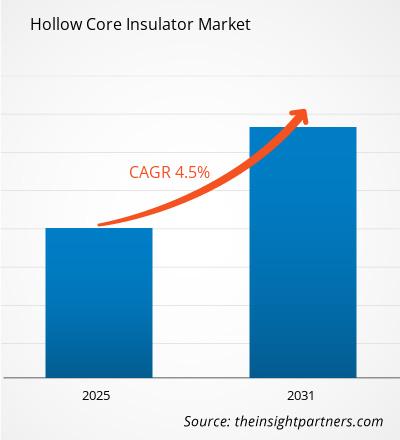
Segmentation Analysis
Material
Composite materials are expected to register a 5.1–5.5% CAGR during 2026–2034, supported by lower weight, hydrophobic surfaces, corrosion resistance, and easier handling. Ceramic remains important where established specifications, proven thermal behavior, and legacy equipment compatibility influence procurement. The Hollow Core Insulator Market scope is therefore shaped by application environment, voltage class, installation constraints, and lifecycle-cost requirements rather than material preference alone.
- Ceramic: Ceramic products retain a strong position in established utility specifications, particularly where proven dielectric behavior and long service experience support replacement procurement and compatibility with existing equipment designs.
- Composite: Composite products benefit from lightweight construction, hydrophobic performance, mechanical resilience, and simplified handling, making them strategically important for new substations and projects where installation logistics influence total cost.
Voltage
The voltage segment is expected to expand at a 4.8–5.2% CAGR during 2026–2034, with demand closely tied to substation configuration and transmission investment. Higher-voltage installations require stringent electrical and mechanical qualification, while lower classes benefit from replacement cycles across distribution and industrial facilities. Procurement is increasingly linked to network planning and equipment standardization.
- 1-69kV: This range serves distribution, industrial, and utility equipment where compact insulation and dependable outdoor performance are important. Replacement demand is supported by aging networks and expanding localized electrical infrastructure.
- 69-230kV: Mid-voltage transmission and substation projects create recurring demand for mechanically robust insulation. Utilities favor standardized components that simplify maintenance while accommodating renewable interconnection and network reinforcement.
- Above 230kV: High-voltage transmission projects require advanced insulation engineering, extensive testing, and stringent mechanical design. Demand is strategically important where long-distance transmission and major interconnections require reliable high-voltage equipment.
Application
Application demand is forecast to grow at a 4.9–5.3% CAGR during 2026–2034. Switchgear, transformers, terminations, bushings, and surge arresters require insulation systems matched to electrical stress, mechanical loading, environmental exposure, and installation configuration. The segment in Hollow Core Insulator Market benefits from increasing substation modernization and greater complexity in networks integrating variable renewable generation and bidirectional power flows.
- Switchgear: Switchgear remains a core application because insulation supports electrical isolation and mechanical stability within substations. Demand follows replacement programs, new substations, and modernization of aging switching infrastructure.
- Current and Voltage Transformer: Instrument-transformer applications require dependable insulation around measurement and protection systems. Procurement emphasizes dimensional accuracy, dielectric reliability, and compatibility with utility protection architectures.
- Cable Termination and Bushing: These applications connect energized conductors to transformers, switchgear, and cables while controlling electrical stress. Demand increases with underground networks, compact substations, and higher-capacity transmission projects.
- Surge Arrester: Surge-arrester applications support protection against transient overvoltage from lightning and switching events. Their strategic importance rises as utilities seek improved asset protection and reliability across exposed transmission infrastructure.
- Station Post: Station-post configurations provide mechanical support and electrical isolation for substation conductors and equipment. Demand remains linked to outdoor substation construction, refurbishment, and equipment-layout requirements.
Opportunity Snapshot
| Application | Revenue Contribution | Trend Tag | Adoption Stage |
|---|---|---|---|
| Switchgear | High | Substation Renewal | Mature |
| Current and Voltage Transformer | High | Grid Protection | Mature |
| Cable Termination and Bushing | High | Cable Expansion | Scaling |
| Surge Arrester | Medium | Surge Protection | Scaling |
| Station Post | Medium | Outdoor Substations | Mature |
| Others | Low | Specialized Systems | Emerging |
Hollow Core Insulator Market Growth Drivers and Impact Analysis
Transmission grid modernization and replacement of aging assets
A major structural driver is the need to replace aging transmission and substation infrastructure while increasing network capacity. In the US, federal planning has identified substantial additional transmission capacity as necessary to accommodate demand growth and reliability requirements. Europe is likewise pursuing large-scale grid investment, with substantial funding requirements for transmission and distribution through 2040. These programs directly influence procurement of insulators because each upgraded substation or transmission corridor requires electrically qualified support components. For suppliers, replacement cycles create more predictable demand than purely discretionary industrial projects. The impact is particularly favorable for products that combine established qualification with reduced installation burden. Utilities can justify premium specifications when improved reliability and lower maintenance offset higher initial acquisition costs.
Renewable integration and increasingly complex substation configurations
Renewable generation is changing where electricity is produced and how transmission systems are configured. Large solar and wind projects frequently connect at high-voltage substations located far from established demand centers, increasing the need for reliable insulation across switching and transformation equipment. Variable generation also creates greater operating complexity, making dependable equipment performance more important during changing load conditions. Hollow-core designs can support compact layouts while accommodating demanding electrical and mechanical requirements. This driver affects manufacturers by increasing demand for products qualified across broader environmental conditions and voltage classes. It also encourages closer collaboration among insulator producers, equipment manufacturers, engineering contractors, and utilities during project specification. Suppliers capable of engineering application-specific solutions can therefore gain access to technically demanding renewable-grid projects.
Lifecycle economics and resilience requirements in harsh environments
Utility procurement is increasingly influenced by lifecycle economics rather than acquisition price alone. Insulation failures can trigger equipment outages, emergency maintenance, and collateral damage, making reliability a central purchasing criterion. Composite designs can reduce handling requirements because their lower weight may simplify transportation and installation, while hydrophobic surfaces can improve performance in polluted or humid environments. Ceramic solutions continue to benefit from established field experience and robust thermal characteristics. Extreme weather and environmental exposure further strengthen the importance of mechanical and electrical margins. As asset managers adopt more structured risk assessment, manufacturers with strong qualification records, traceable production, and documented environmental testing are better positioned to participate in high-value tenders.
Hollow Core Insulator Market Future Trends
Digital qualification and condition-aware insulation design
The Hollow Core Insulator Market trends are likely to move toward digitally supported engineering in which simulation, testing, and field data are combined earlier in product development. Manufacturers can increasingly use digital models to evaluate electrical stress, mechanical loading, thermal behavior, and environmental exposure before physical qualification. Over time, condition-monitoring information from substations may also influence product design by identifying recurring failure mechanisms and contamination conditions. This could shorten engineering cycles for customized components while improving consistency across production batches. Utilities may increasingly request traceability data, digital documentation, and standardized qualification records as part of procurement. Such requirements would favor suppliers that integrate design software, testing laboratories, manufacturing execution systems, and field-service feedback rather than treating engineering and production as separate activities.
Higher-voltage platforms and modular substation architectures
Future demand is expected to favor insulation systems compatible with increasingly modular substation architectures and higher transmission voltages. Renewable interconnections, long-distance power transfer, and cross-border networks require equipment that can operate reliably under elevated electrical stress while fitting constrained project footprints. Modular designs can reduce installation time and simplify project sequencing, particularly where construction schedules are affected by limited skilled labor. Manufacturers are likely to refine composite cores, sealing systems, shed geometries, and metallic interfaces to support these requirements. At the same time, utilities may standardize preferred component dimensions across multiple projects to reduce inventory complexity. Suppliers that can combine standardized platforms with controlled customization should be better positioned to address the technical diversity of future grid infrastructure.
Hollow Core Insulator Market Opportunities
Localized manufacturing for transmission expansion programs
Localized production offers a strategic opportunity as utilities and governments seek resilient supply chains for critical grid equipment. The Hollow Core Insulator Market Forecasts can benefit from manufacturing investments located close to major transmission-development corridors in North America, Europe, India, and selected Asia-Pacific economies. Regional facilities can reduce transportation exposure, improve response times for customized products, and simplify compliance with local procurement requirements. Investors should prioritize facilities with flexible production, automated inspection, and high-voltage testing capabilities rather than focusing only on nominal manufacturing capacity. Partnerships with switchgear, transformer, and cable-equipment manufacturers can further improve market access. For established suppliers, selective localization can also reduce dependence on concentrated raw-material and component sources while creating stronger relationships with utilities and engineering contractors.
Advanced composite platforms for high-voltage applications
Investment in advanced composite platforms can create differentiated opportunities where weight, pollution resistance, installation speed, and mechanical performance are critical. The opportunity is strongest in high-voltage substations, renewable-energy interconnections, and compact equipment configurations where conventional designs may impose handling or space constraints. Product development should emphasize reliable interfaces between composite housings, fiber-reinforced cores, and metallic fittings because these interfaces influence long-term field performance. Manufacturers can also explore modular product families covering several voltage classes, reducing engineering duplication while preserving application-specific configurations. Qualification partnerships with utilities and equipment OEMs would provide valuable field validation. Over time, suppliers that demonstrate measurable lifecycle benefits and consistent production quality can strengthen their position in technically demanding procurement programs.
Recent Developments
- April 2026: HUBER+SUHNER strengthened its collaboration with Microsoft Azure through planned investments to scale Hollow Core Fibre (HCF) cable and connectivity production for cloud and AI infrastructure, including ruggedized outside- and inside-plant cables, next-generation higher-density HCF designs and patented mode-converting connectors already carrying live Azure traffic.
- October 2025: Teijin Frontier launched THERMOFRONT™, a sustainable high-performance sheet insulation brand containing more than 70% recycled ECOPET® polyester fiber and hollow cross-sectional fibers for enhanced warmth, introducing three sub-brands—THERMOFRONT™ OA, SL and BE—with features including lightweight comfort, bulkiness, softness, shape recovery and moisture control for outdoor, sports and casual apparel.
Frequently Asked Questions

- Comprehensive Market Sizing and Forecast Analysis
- Detailed Segmentation Analysis
- In-Depth Market Dynamics Assessment
- Regional and Country-Level Insights
- Competitive Landscape and Company Benchmarking
- Strategic Business Intelligence
Recent Reports
Testimonials

The Insight Partners provided valuable market intelligence that supported our global go-to-market strategy. Their team was professional, responsive, and attentive to our feedback, providing thoughtful analysis and helpful methodological clarifications throughout the project.
Junmo Kim Chief Financial Officer (CFO), Enertech Co., Ltd.
The Insight Partners' SCADA System Market report is comprehensive, with valuable insights on current trends and future forecasts. The team was highly professional, responsive, and supportive throughout. We are very satisfied and highly recommend their services.
RAN KEDEM Partner, Reali Technologies LTDs
I requested a report on a very specific software market and the team produced the report in a few days. The information was very relevant and well presented. I then requested some changes and additions to the report. The team was again very responsive and I got the final report in less than a week.
JEAN-HERVE JENN Chairman, Future Analytica
We worked with The Insight Partners for an important market study and forecast. They gave us clear insights into opportunities and risks, which helped shape our plans. Their research was easy to use and based on solid data. It helped us make smart, confident decisions. We highly recommend them.
PIYUSH NAGPAL Sr. Vice President, High Beam Global
The Insight Partners delivered insightful, well-structured market research with strong domain expertise. Their team was professional and responsive throughout. The user-friendly website made accessing industry reports seamless. We highly recommend them for reliable, high-quality research services
YUKIHIKO ADACHI CEO, Deep Blue, LLC.
This is the first time I have purchased a market report from The Insight Partners.While I was unsure at first, I visited their web site and felt more comfortable to take the risk and purchase a market report.I am completely satisfied with the quality of the report and customer service. I had several questions and comments with the initial report, but after a couple of dialogs over email with their analyst I believe I have a report that I can use as input to our strategic planning process.Thank you so much for taking the extra time and making this a positive experience.I will definitely recommend your service to others and you will be my first call when we need further market data.
JOHN SUZUKI President and Chief Executive Officer, Board Director, BK Technologies
I wish to appreciate your support and the professionalism you displayed in the course of attending to my request for information regarding to infectious disease IVD market in Nigeria. I appreciate your patience, your guidance, and the fact that you were willing to offer a discount, which eventually made it possible for us to close a deal. I look forward to engaging The Insight Partners in the future, all thanks to the impression you have created in me as a result of this first encounter.
DR CHIJIOKE ONYIA MANAGING DIRECTOR, PineCrest Healthcare Ltd.Reason to Buy
- Informed Decision-Making
- Understanding Market Dynamics
- Competitive Analysis
- Identifying Emerging Markets
- Customer Insights
- Market Forecasts
- Risk Mitigation
- Boosting Operational Efficiency
- Strategic Planning
- Investment Justification
- Tracking Industry Innovations
- Aligning with Regulatory Trends





 Get Free Sample for