
LAN Network Adapters Market Growth, Trends & Forecast by 2034
Coverage: By Type (Desktop NIC, PC Card, USB Adapter, Other); Application (Household, Commercial, Use Public, Services, Other) , and Geography (North America, Europe, Asia Pacific, and South and Central America)
- Status : Data Released
- Report Code : TIPRE00017149
- Category : Electronics and Semiconductor
- No. of Pages : 150
- Available Report Formats :


- Last update date : September 21, 2026


2025 Market Size
US$ 3.65 Bn
Base year value
2034 Forecast
US$ 6.07 Bn
Projected by 2034
CAGR 2026-2034
5.80 %
Growth rate
Addressable Market
US$ 44.01 Bn
(2026-2034)
Lan Network Adapter Market is positioned as a mature connectivity hardware market serving desktops, personal computers, household networking environments, commercial infrastructure, public-use installations, and service-oriented deployments. The market is valued at US$ 3.65 Billion in 2025 and is projected to reach US$ 6.07 Billion by 2034, registering a CAGR of 5.80% during 2026–2034. Demand is supported by network upgrades, device replacement, multi-gigabit connectivity, and continued expansion of wired and wireless local-area networking.
North America Lan Network Adapter Market Size remains a structurally important market, with an estimated CAGR of 5–7% during 2026–2034. Enterprise network modernization and high broadband penetration provide a stable replacement base, while data-center expansion and higher-speed Ethernet adoption create incremental demand. The region also benefits from established distribution channels, strong PC and peripheral ecosystems, and widespread adoption of Wi-Fi 6E and Wi-Fi 7 client infrastructure.
LAN Network Adapters Market Assessment and Insights
- North America is estimated to hold a 36–40% share in 2025 and expand at a CAGR of 5–7% between 2026–2034, supported by mature enterprise networking, high broadband penetration, data-center investment, and recurring hardware replacement.
- US represents approximately 72–77% of North America's 2025 market and is expected to grow at a CAGR of 5–7% during 2026–2034, supported by enterprise upgrades and consumer connectivity.
- Europe is estimated at a 2025 share of 21–24% and a CAGR of 5–6% during 2026–2034, with Germany, the UK, France, Italy, and Spain supporting demand through enterprise modernization and broadband upgrades.
- Asia Pacific represents a 29–33% share in 2025 and is projected to register a CAGR of 6–8% during 2026–2034, led by China, Japan, South Korea, India, and Australia.
- Largest Segment: Desktop NIC is estimated to hold a market share of 43–47% in 2025, expanding at a CAGR of 4–6% during 2026–2034, supported by enterprise and desktop replacement demand.
- High Growth Segment: USB Adapter is estimated at a market share of 20–24% in 2025, growing at a CAGR of 7–9% during 2026–2034, supported by flexible device connectivity and multi-gigabit upgrades.
- Key companies analyzed in detail: Buffalo Americas, Inc.; Cisco Systems, Inc.; D-Link Corporation; EDIMAX Technology Co., Ltd.; Hawking Technologies, Inc.; NET-DYN WIFI.; NETGEAR, Inc.; TP-Link Corporation Limited; Tripp Lite; Zyxel Networks Corporation.
Source: The Insight Partners' analysis based on proprietary research, government publications, company annual reports, investor presentations, industry databases, and expert interviews.
Network adapters have evolved from simple Ethernet interface products into more sophisticated, faster, and standards compliant connectivity products that are capable of wired and wireless connectivity. Desktop NICs continue to be significant for enterprise and high performance computing, whereas USB adapters cater to thin form factors and lack of ports in certain systems. Wi-Fi generations, multi-gigabit Ethernet, USB-C connectivity, better drivers, and energy efficient chipsets will affect the product design and upgrade choices.
The future demand for the products is likely to center on Asia Pacific due to electronics manufacturing capacity, broadband infrastructure availability, cloud computing infrastructure, and enterprise digitization. Replacement of older technologies continues to drive North America and Europe, but Wi-Fi 7, multi-gigabit Ethernet, and datacenter upgrades could provide better value opportunities there. Concerns about cyber security and network resiliency on the part of regulations could impact the enterprise segment.
LAN Network Adapters Market Report Scope
| Report Attribute | Details |
|---|---|
| Market size in 2025 | US$ 3.65 Billion |
| Market Size by 2034 | US$ 6.07 Billion |
| Global CAGR (2026 - 2034) | 5.80% |
| Historical Data | 2021-2024 |
| Forecast period | 2026-2034 |
LAN Network Adapters Market Analysis
Lan Network Adapter market growth is highly dependent on increasing data transfer needs, device replacement cycles, broadband adoption, and connected computing infrastructure. The ecosystem includes chipset providers, adapter makers, PC manufacturers, operating system providers, distributors, system integrators, and telecommunication operators. More and more consumers tend to assess adapters in terms of speed, latencies, compatibility, power efficiency, drivers, security, and deployment ease compared to simply having a connection.
Market supply is affected by the semiconductor supply situation, interface standards, certifications, and the presence of the network functionality within the PC itself or motherboard. Integrated connectivity can result in reducing demand for the standalone adapters in certain categories of PCs, which makes a need for adapter manufacturers to stress particular applications of their adapters. USB-C, 2.5GbE, Wi-Fi 6E, Wi-Fi 7, and higher-performing PCIe interfaces create possibilities for external and upgradable product offerings.
Lan Network Adapter Market Report provides competition in terms of enterprise networking, peripheral device manufacturing, wireless network adapter solutions, and specialized interface solutions. Cisco Systems, Inc. is the leader in enterprise networking market, Buffalo Americas, Inc., D-Link Corporation, EDIMAX Technology Co., Ltd. and NETGEAR, Inc. serve a wider array of connectivity/peripheral markets. TP-Link Corporation Limited and Zyxel Networks Corporation compete through wide range of consumer/SMB/networking offerings.
Increasing investments are made in high-speed interfaces, wireless standards, thermal management, compact design, and interoperability. Tripp Lite enjoys advantages of a wider connectivity accessory offering, while Hawking Technologies, Inc. and NET-DYN WIFI are active in consumer applications of adapters. Suppliers are also focusing on simplicity and operating system compatibility. Competitive market therefore favors firms that can offer price, reliability, performance, channel and standards support without significantly increasing deployment complexity.
● REPORT CUSTOMIZATION
Tailor This Report To Align With Your Specific Business Requirements
This report can be customized to align precisely with your business objectives, scope, and target markets. Customization options include tailored segmentation, geography, competitive analysis, and strategic insights to support informed decision-making.
Customize This Report →WHAT YOU CAN ADJUST
- ● Segmentations
- ● Geography
- ● Competitive Analysis
- ● Language Preferences
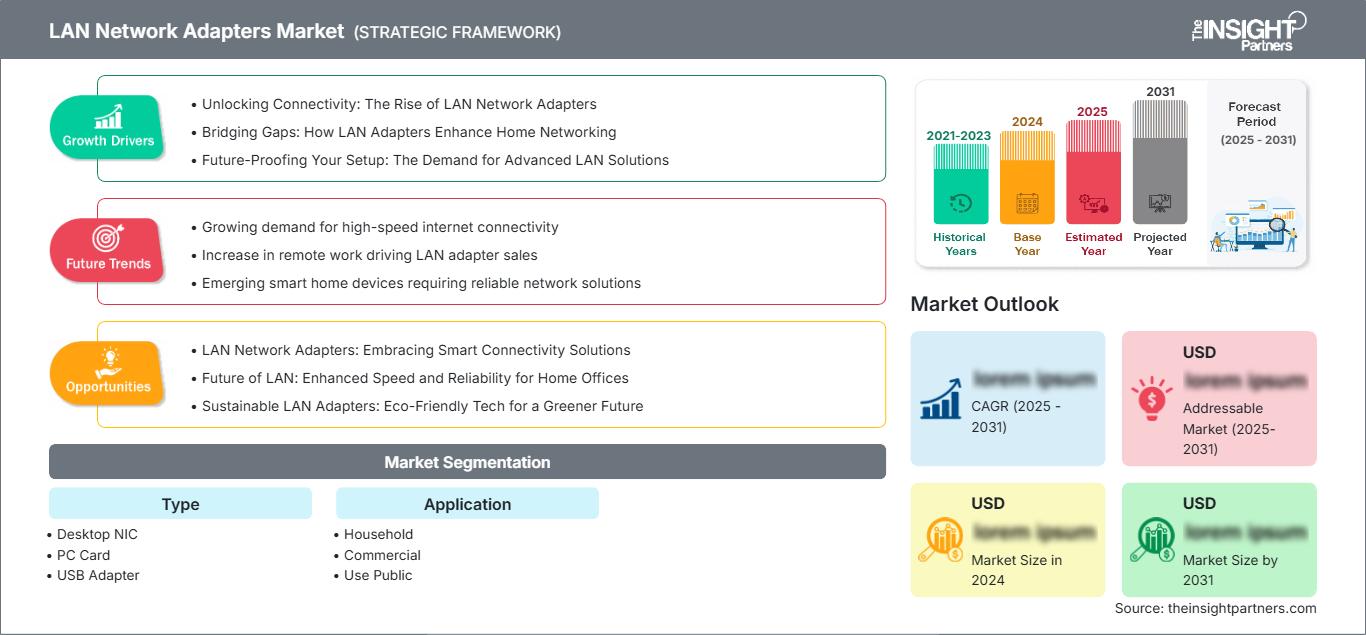
LAN Network Adapters Market: Strategic Insights
Regional Insights
North America Lan Network Adapter Market
The North American region is projected to have a Lan Network Adapter Market share of 36-40% in 2025 and will have a CAGR of 5-7% until 2034. Most of the demand is from the United States, with additional demand coming from Canada from enterprise IT, broadband roll-out, education, and small business networking. Due to the maturity of the infrastructure, there is an ongoing need for upgrades especially due to the need for faster Ethernet and better wireless standards. Commercial customers require compatibility, deployment management, security, and lifecycle support when replacing adapters.
In addition, data center investments are impacting the overall networking ecosystem because advanced infrastructure demands better performance from endpoints. Wi-Fi 7 client, multi-gigabit Ethernet, USB-C devices, and workstation refresh can drive demand for more valuable adapters. Additionally, consumer replacement cycles are still valid because old computers lack the new wireless standards or Ethernet speed. North America also has strong retail, e-commerce, distribution, and system integration channels that make the adoption of new adapter technologies easy without infrastructure upgrades.
U.S. Lan Network Adapter Market
The US represents about 72–77% of the North American 2025 market and is anticipated to grow at a 5–7% CAGR during 2026–2034. Business and residential needs are driven by enterprise IT expenditure, broadband access, cloud computing, and desktop replacement. The market is characterized by well-established procurement routes and good vendor presence, enabling organizations to update their connectivity modules separate from their overall network upgrades.
The major companies such as Cisco Systems, Inc., NETGEAR, Inc., Buffalo Americas, Inc., and TP-Link Corporation Limited are visible within the relevant networking segments, while the additional connectivity needs are served by D-Link Corporation and Tripp Lite. Adapters increasingly become preferred by applications because of their high bandwidth, USB-C connectivity, Wi-Fi 6E, Wi-Fi 7, and multi-gigabit Ethernet capabilities. Managed solutions are the top choice for enterprises, while residential customers are more likely to buy adapters to replace outdated PCs, gaming consoles, and entertainment stations.
Europe Lan Network Adapter Market
The Europe segment is expected to have a Lan Network Adapter Market share of 21-24% by 2025 and will grow at a CAGR of 5-6% till 2034. Germany is the largest country, driven by industrial computing and enterprise networking. The other countries contributing to the region include the UK, France, Italy, and Spain due to business digitalization and broadband upgrades.
The UK has an advanced level of enterprise networking ecosystem, and the demand is influenced by the hybrid work model, use of cloud-based applications, and office connectivity upgrades. The sales for the adapters are now focusing on the compatibility of the adapter with the new generation laptops and workstations. Wi-Fi 6E and Wi-Fi 7 can cater to premium replacement demand, and USB-C adapters continue to be relevant in situations where newer computers have less legacy ports.
The Germany market comprises a strong manufacturing industry along with highly developed enterprise IT infrastructure. The industrial companies, engineering firms, and SMEs need reliable connectivity for their workstations and computing equipment. The demand for adapters would come from the upgrade of production and office networks, whereas high-speed Ethernet adapters are required in situations where performance and low latency are critical.
France, Italy, and Spain offer varied demands from business, residential, educational, and governmental segments. Modernization of business operations serves France well, manufacturing and small and medium enterprises serve Italy, and broadband and IT infrastructure serves Spain. The replacement cycle is more pronounced in Europe compared to emerging markets, but newer wireless technology, multi-gigabit Ethernet, and power-efficient computing may still offer upgrade potential.
APAC Lan Network Adapter Market
The APAC region is forecast to represent 29-33% in 2025 and exhibit a 6-8% CAGR, with China dominating the market. The countries include Japan, South Korea, India, and Australia, with demand coming from consumer electronics, enterprise computing, telecoms, and industry.
China profits from its electronics manufacturing capabilities, whereas India gets support from the development of digital infrastructure and enterprise communications. Japan and South Korea have advanced technology environments, and Australia has matured broadband and enterprise markets. Increasing computer penetration, cloud computing, data centers, and network upgrades will support adapter upgrades and replacements.
Middle East & Africa Lan Network Adapter Market
MEA/Africa region expected to grow at a CAGR of 5-7% until 2034, with UAE and Saudi Arabia being key growth drivers. South Africa plays an essential role in business connections; meanwhile, Rest of MEA will provide additional demand, due to the development of broadband infrastructure in the region.
Smart infrastructure deployment, cloud computing, e-learning technology, and enterprise digitization drives networking hardware spend. Gulf countries are creating a sophisticated digital economy ecosystem, while South Africa contributes more installed base. Price sensitivity in some regions creates additional importance of availability of compatible and reliable adapters via technology distribution channels.
Segmentation Analysis
Type
Type is expected to expand at a 5–7% CAGR during 2026–2034. The Lan Network Adapter Market scope increasingly reflects coexistence between integrated connectivity and upgradeable external interfaces. Desktop NICs retain importance for fixed systems, PC Cards serve specialized legacy or embedded requirements, and USB adapters provide flexible connectivity for modern portable devices.
- Desktop NIC remains the principal product category for desktops, workstations, servers, and fixed computing systems requiring dependable wired connectivity, upgradeable interfaces, or higher throughput than existing integrated network hardware.
- PC Card continues serving selected legacy, industrial, embedded, and specialized computing environments where established expansion architectures remain operational and replacement requirements favor compatibility over newer interface standards.
- USB Adapter benefits from portability, simple installation, and broad compatibility, particularly where laptops and compact computers lack Ethernet ports or require upgraded wireless or wired connectivity.
Application
Application is forecast to register a 5–7% CAGR during 2026–2034. The segment reflects demand from households, commercial organizations, public-use environments, and service providers. Purchasing priorities differ by application, with households emphasizing affordability and convenience, while commercial and service users prioritize reliability, lifecycle support, security, and standardized deployment.
- Household demand centers on personal computers, gaming, streaming, home offices, and connected entertainment equipment where adapters provide flexible wired or wireless connectivity during device upgrades.
- Commercial users require dependable connectivity across offices, retail environments, SMEs, professional workstations, and managed computing installations, making compatibility and lifecycle support important purchasing criteria.
- Use Public applications include educational institutions, libraries, community facilities, hospitality venues, and other shared-access environments where simple deployment and broad device compatibility support network accessibility.
- Services covers connectivity and technical-service environments where adapters support installation, maintenance, device replacement, and network integration activities across customer-facing and managed IT operations.
Opportunity Snapshot
| Application | Revenue Contribution (High/Medium/Low) | Trend Tag (MAX 2 words) | Adoption Stage (Emerging/Scaling/Mature) |
|---|---|---|---|
| Household | High | Wi-Fi Upgrades | Mature |
| Commercial | High | Multi-Gig Ethernet | Scaling |
| Use Public | Medium | Campus Connectivity | Scaling |
| Services | Medium | Network Support | Mature |
LAN Network Adapters Market Growth Drivers and Impact Analysis
Growth of multi-gigabit broadband and enterprise connectivity
Higher broadband speeds are creating pressure for endpoint hardware capable of transferring data beyond traditional Gigabit Ethernet limits. Fiber deployments, Wi-Fi 6E, Wi-Fi 7, cloud applications, and large-file workflows can expose performance limitations in older network interfaces. Consequently, adapters supporting 2.5GbE and higher speeds are gaining relevance for workstations, gaming systems, professional users, and selected business applications. The commercial impact is a shift from simple replacement toward performance-led upgrades. Vendors can capture this demand by offering compact interfaces, reliable drivers, thermal stability, and backward compatibility. Distributors also benefit because adapters can be sold as relatively low-complexity upgrades alongside routers, switches, access points, PCs, and broadband equipment.
Expansion of hybrid work and distributed computing environments
Hybrid work has increased the number of computing environments where users require dependable connectivity outside traditional corporate offices. Laptops often prioritize thin form factors and therefore provide fewer physical ports, increasing the relevance of USB adapters and docking-related networking accessories. At the same time, businesses continue supporting branch offices, home workers, temporary workspaces, and distributed teams. This creates demand for connectivity products that can be deployed without specialist installation. The market impact is strongest for USB adapters and compact wireless devices because they can address connectivity gaps quickly. Commercial buyers also increasingly value standardized device fleets, operating-system support, and security compatibility, encouraging suppliers to improve software support and simplify product deployment across heterogeneous endpoint environments.
Continued replacement of legacy network interfaces
The installed base of older computers, peripherals, and networking equipment creates a durable replacement opportunity as operating systems, broadband services, and network infrastructure advance. Devices lacking modern wireless standards or higher-speed Ethernet can remain operational when an adapter provides an economical connectivity upgrade. This dynamic extends hardware life while improving network performance, making adapters attractive where complete computer replacement is unnecessary. The impact is particularly visible among households, SMEs, educational institutions, and service organizations managing mixed-generation equipment. Suppliers can benefit by maintaining broad driver compatibility and offering adapters across different interface formats. As Wi-Fi standards evolve and multi-gigabit Ethernet becomes more accessible, adapter products can bridge the gap between legacy endpoint hardware and upgraded network infrastructure.
LAN Network Adapters Market Future Trends
Wi-Fi 7 and multi-gigabit Ethernet will reshape premium adapter demand
The Lan Network Adapter Market trends are expected to increasingly reflect the transition toward Wi-Fi 7 and multi-gigabit Ethernet. Wi-Fi 7 introduces features including 320 MHz channels and Multi-Link Operation, raising performance expectations for compatible client devices and networks. Standalone adapters can therefore become useful upgrade products for computers that cannot support newer wireless capabilities natively. On the wired side, 2.5GbE and higher-speed interfaces can gain traction as broadband and local network infrastructure improve. Vendors are likely to emphasize USB-C, compact thermal designs, advanced antennas, and broad operating-system compatibility. Premium demand should concentrate among gamers, creators, professionals, and business users whose workloads benefit from higher throughput and lower latency.
Software-defined compatibility will become a stronger purchasing criterion
Future adapters are likely to compete increasingly through software quality rather than hardware specifications alone. Operating-system updates, security requirements, virtualization, power management, and driver stability can materially affect user experience, particularly across commercial deployments. Suppliers may therefore increase investment in signed drivers, automated updates, diagnostic utilities, and compatibility testing across Windows, Linux, macOS, and specialized enterprise environments. Cloud-based device management could become relevant for larger fleets, allowing IT administrators to monitor adapter status and standardize configurations. This evolution can reduce support costs and improve lifecycle management while creating differentiation between low-cost commodity products and enterprise-ready solutions. The result should be greater emphasis on total ownership experience rather than headline throughput alone.
LAN Network Adapters Market Opportunities
USB-C adapter ecosystems for modern computing devices
The Lan Network Adapter Forecasts point toward continued opportunities for USB-C connectivity products as laptops and compact computers reduce legacy ports. Vendors can develop differentiated adapters combining Ethernet, wireless connectivity, power delivery, and peripheral interfaces within compact form factors. Such products can address home offices, mobile professionals, education, gaming, and enterprise deployments without requiring internal hardware changes. Investment should prioritize thermal management, reliable driver support, compact enclosure design, and compatibility across major operating systems. Multi-gigabit Ethernet can provide an additional premium tier where users have suitable network infrastructure. Retail and e-commerce channels are well suited to these products because installation is straightforward and purchasing decisions can be made independently from major network equipment projects.
Enterprise upgrade bundles can create recurring replacement demand
Commercial opportunities in the Lan Network Adapter Market Forecast extend beyond individual adapters through standardized upgrade packages for workstations, branch offices, classrooms, and distributed employee fleets. Vendors can bundle adapters with switches, wireless access equipment, endpoint-management software, warranties, and technical support. Such offerings can reduce procurement complexity while creating recurring replacement opportunities as organizations migrate to higher network speeds. System integrators can also incorporate adapters into workstation refresh programs and infrastructure modernization projects. Investment should focus on products with strong compatibility documentation, centralized management options, and predictable lifecycle availability. The opportunity is particularly attractive where enterprises operate mixed generations of computing hardware, because adapters can improve connectivity without forcing immediate replacement of otherwise serviceable endpoint devices.
Recent Developments
- June 2026: Intel introduced the Ethernet E835 Controllers and Network Adapters, expanding its 800 Series portfolio with connectivity designed for high-density data center, enterprise, AI, edge and telecom environments. The E835 supports scalable throughput from 10GbE to 200GbE, with configurations including 2×25G, 4×25G, 2×100G and 1×200G, and uses PCIe 5.0/4.0 host interfaces to increase system bandwidth. It incorporates RDMA (RoCEv2/iWARP) to reduce CPU utilization and Dynamic Device Personalization (DDP) for intelligent packet processing and application optimization.
- August 2026: Innodisk launched its High-Speed 10GbE LAN Series, a portfolio of compact LAN modules designed to meet the growing connectivity requirements of Edge AI applications, including AI inference, AGV/AMR coordination, smart-factory vision systems and NVR surveillance. Available in M.2 2242, M.2 2280 and low-profile PCIe form factors, the modules use Intel E610/X710 Ethernet controllers and support DPDK, PTP and SR-IOV for low-latency packet processing, precise time synchronization and improved resource utilization in virtualized environments. Select models support -40°C to 85°C operation for harsh industrial and outdoor deployments.
- August 2026: TP-Link India expanded beyond its traditional networking portfolio with the launch of a new connectivity accessories portfolio designed for modern workspaces, learning environments and digital lifestyles. The range includes USB/Type-C hubs and docking stations, USB adapters, USB/Type-C-to-Ethernet adapters, Bluetooth adapters and memory-card readers, enabling users to connect displays, peripherals, storage devices and wired networks to laptops, tablets and other devices.
Frequently Asked Questions

- Comprehensive Market Sizing and Forecast Analysis
- Detailed Segmentation Analysis
- In-Depth Market Dynamics Assessment
- Regional and Country-Level Insights
- Competitive Landscape and Company Benchmarking
- Strategic Business Intelligence
Recent Reports
Testimonials

The Insight Partners provided valuable market intelligence that supported our global go-to-market strategy. Their team was professional, responsive, and attentive to our feedback, providing thoughtful analysis and helpful methodological clarifications throughout the project.
Junmo Kim Chief Financial Officer (CFO), Enertech Co., Ltd.
The Insight Partners' SCADA System Market report is comprehensive, with valuable insights on current trends and future forecasts. The team was highly professional, responsive, and supportive throughout. We are very satisfied and highly recommend their services.
RAN KEDEM Partner, Reali Technologies LTDs
I requested a report on a very specific software market and the team produced the report in a few days. The information was very relevant and well presented. I then requested some changes and additions to the report. The team was again very responsive and I got the final report in less than a week.
JEAN-HERVE JENN Chairman, Future Analytica
We worked with The Insight Partners for an important market study and forecast. They gave us clear insights into opportunities and risks, which helped shape our plans. Their research was easy to use and based on solid data. It helped us make smart, confident decisions. We highly recommend them.
PIYUSH NAGPAL Sr. Vice President, High Beam Global
The Insight Partners delivered insightful, well-structured market research with strong domain expertise. Their team was professional and responsive throughout. The user-friendly website made accessing industry reports seamless. We highly recommend them for reliable, high-quality research services
YUKIHIKO ADACHI CEO, Deep Blue, LLC.
This is the first time I have purchased a market report from The Insight Partners.While I was unsure at first, I visited their web site and felt more comfortable to take the risk and purchase a market report.I am completely satisfied with the quality of the report and customer service. I had several questions and comments with the initial report, but after a couple of dialogs over email with their analyst I believe I have a report that I can use as input to our strategic planning process.Thank you so much for taking the extra time and making this a positive experience.I will definitely recommend your service to others and you will be my first call when we need further market data.
JOHN SUZUKI President and Chief Executive Officer, Board Director, BK Technologies
I wish to appreciate your support and the professionalism you displayed in the course of attending to my request for information regarding to infectious disease IVD market in Nigeria. I appreciate your patience, your guidance, and the fact that you were willing to offer a discount, which eventually made it possible for us to close a deal. I look forward to engaging The Insight Partners in the future, all thanks to the impression you have created in me as a result of this first encounter.
DR CHIJIOKE ONYIA MANAGING DIRECTOR, PineCrest Healthcare Ltd.Reason to Buy
- Informed Decision-Making
- Understanding Market Dynamics
- Competitive Analysis
- Identifying Emerging Markets
- Customer Insights
- Market Forecasts
- Risk Mitigation
- Boosting Operational Efficiency
- Strategic Planning
- Investment Justification
- Tracking Industry Innovations
- Aligning with Regulatory Trends





 Get Free Sample for