
Level Translators Market Size, Trends & Demand by 2034
Coverage: By Type (Dual Supply Level Translators, Open Drain Devices); Application (Automotive, Consumer Electronics, Defense and Aerospace, Healthcare, Others) , and Geography (North America, Europe, Asia Pacific, and South and Central America)
- Status : Data Released
- Report Code : TIPRE00026896
- Category : Electronics and Semiconductor
- No. of Pages : 150
- Available Report Formats :


- Last update date : October 26, 2026


2025 Market Size
US$ 314.20 Mn
Base year value
2034 Forecast
US$ 687.03 Mn
Projected by 2034
CAGR 2026-2034
9.08 %
Growth rate
Addressable Market
US$ 4,477.68 Mn
(2026-2034)
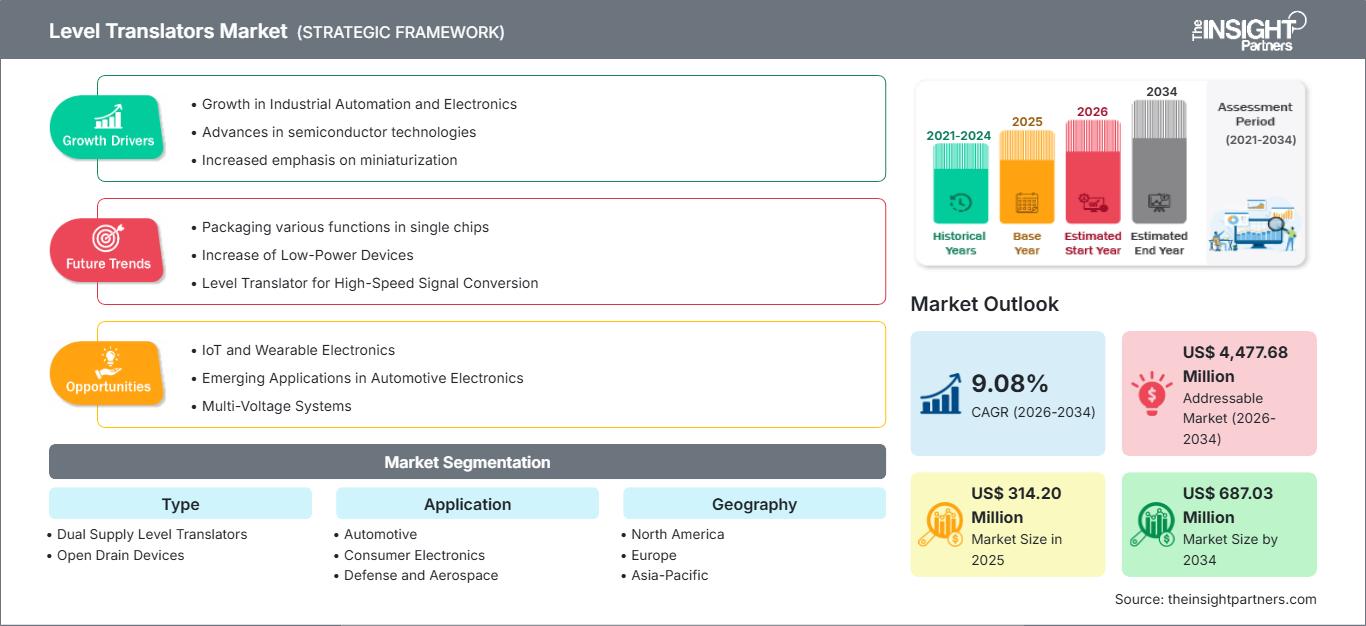
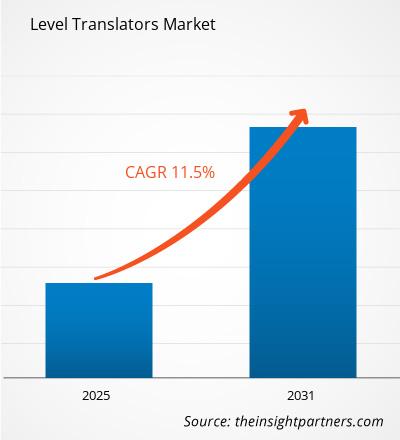
The Level Translators Market is positioned for sustained expansion as electronic systems increasingly combine processors, sensors, interfaces, and peripherals operating at different voltage domains. The market is valued at US$ 314.20 Million in 2025 and is projected to reach US$ 687.03 Million by 2034, registering a CAGR of 9.08% during 2026–2034. Demand is supported by semiconductor integration, automotive electronics, connected devices, and increasingly compact multi-voltage architectures.
North America is expected to remain a technologically important regional market, with an estimated CAGR of 8.2–8.9% through 2034. The regional Level Translators Market size is supported by automotive electronics, aerospace systems, industrial automation, and advanced semiconductor design activity. Increasing deployment of mixed-voltage processors and interfaces is also strengthening demand for compact, low-power translation devices across new equipment platforms.
Level Translators Market Assessment and Insights
- North America: North America is expected to account for a 29–33% Level Translators Market share in 2025 and expand at a CAGR of 8.2–8.9% between 2026–2034, supported by automotive electronics, aerospace systems, industrial automation, and semiconductor design activity.
- US: The US is expected to represent 80–84% of North America’s 2025 share, growing at a CAGR of 8.0–8.7% between 2026–2034 as advanced electronics manufacturing and defense programs expand.
- Europe: Europe is projected to hold a 24–28% share in 2025 and grow at a CAGR of 7.6–8.4% during 2026–2034, led by Germany, France, the UK, Italy, and Spain through automotive electronics and industrial digitization.
- Asia Pacific: Asia Pacific is estimated at a 36–40% share in 2025 and is expected to grow at a CAGR of 9.7–10.5% during 2026–2034, led by China, Japan, South Korea, and India.
- Largest Segment: Consumer Electronics is estimated to command a 37–41% market share in 2025, with a CAGR of 9.2–9.9% during 2026–2034, supported by high-volume connected devices.
- High Growth Segment: Open Drain Devices are estimated to hold a 44–48% market share in 2025 and expand at a CAGR of 10.1–10.8% during 2026–2034.
- Key companies analyzed in detail: Texas Instruments Incorporated, Infineon Technologies AG, NXP Semiconductors N.V., Analog Devices, Inc., STMicroelectronics N.V., Maxim Integrated, onsemi, Microchip Technology Incorporated, Advanced Linear Devices, Inc., Nexperia B.V.
Source: The Insight Partners' analysis based on proprietary research, government publications, company annual reports, investor presentations, industry databases, and expert interviews.
The ongoing evolution in technology will move away from mere voltage domain level translation to high-speed level translation, low power consumption level translation, level translation for specific applications, multiple voltage capability, bi-directional communication, partial power down mode capability, electrostatic discharge protection and reduced package sizes. In the auto industry, ground offset translation will become another requirement, where voltage compatible translation will be insufficient.
Future expansion will need to take into consideration more electronics localization, automotive software defined architectures and industrial modernization in developing economies. The semiconductor efforts in North America, Europe and Asia Pacific regions will push more toward localized semiconductor design and manufacturing, while auto industry functional safety needs will set qualification hurdles. As such, capital spending is expected to favor suppliers that offer interface semiconductor products with microcontrollers, power management and automotive semiconductors.
Level Translators Market Report Scope
| Report Attribute | Details |
|---|---|
| Market size in 2025 | US$ 314.20 Million |
| Market Size by 2034 | US$ 687.03 Million |
| Global CAGR (2026 - 2034) | 9.08% |
| Historical Data | 2021-2024 |
| Forecast period | 2026-2034 |
Level Translators Market Analysis
The growth of the Level Translators Market has a strong connection with the emergence of multi-voltage electronic architectures. Processors, microcontrollers, sensors, memory, display, and interfaces work at different voltage supply levels and require constant translation into logic domains. The value chain includes wafer fabrication, analog and mixed-signal design, packaging, distributors, design house, original equipment manufacturers, and system integration. Applications that require small size and high signal quality generate more demand.
The supply chain is driven by the availability of semiconductor fabrication, capacity of mature-node fabrication, effective packaging, and lengthy product qualification processes. Standard level translators may benefit from the utilization of existing manufacturing platforms, whereas those used in automotive and aerospace applications will have to go through further validation. Suppliers that possess wide distribution networks are able to simplify the purchase process for designers. On the other hand, customers seek devices with long-life cycle support, predictable electrical performance, and system qualification documentation.
Analysis of the Competitive Level Translators Market suggests a fragmented market with a technical concentration of suppliers. Texas Instruments Incorporated has a wide interface portfolio, while Infineon Technologies AG and NXP Semiconductors N.V. have a competitive advantage in automotive semiconductor market segment. Analog Devices, Inc., STMicroelectronics N.V., onsemi, Microchip Technology Incorporated, and Nexperia B.V. are competing by combining interface, analog, power, and embedded portfolios. Advanced Linear Devices, Inc. provides specialized analog interface solutions.
The strategic positioning becomes based more on integration than on translator price itself. Suppliers are making investments in automotive-qualified devices, smaller packages, faster data rates, improved protection, and solutions that solve tough ground conditions issues. NXP Semiconductors N.V. is building its software-defined vehicle ecosystem, while Infineon Technologies AG is growing its automotive system offerings. The broader portfolio may provide more chances for design-ins as interface elements become a part of platforms rather than individual devices.
● REPORT CUSTOMIZATION
Tailor This Report To Align With Your Specific Business Requirements
This report can be customized to align precisely with your business objectives, scope, and target markets. Customization options include tailored segmentation, geography, competitive analysis, and strategic insights to support informed decision-making.
Customize This Report →WHAT YOU CAN ADJUST
- ● Segmentations
- ● Geography
- ● Competitive Analysis
- ● Language Preferences
Level Translators Market: Strategic Insights
Regional Insights
North America Level Translators Market
North America is estimated to represent 29–33% of the 2025 market and is projected to grow at a CAGR of 8.2–8.9% through 2034. Key strengths are the availability of expertise in semiconductor design, aerospace electronics, defense procurement, industrial automation, and automotive electronics. American systems design organizations have also been generating chances for the use of components in mixed voltage processors, sensors, communication systems, and control architectures.
Canada enjoys a competitive advantage in its automotive supply chain, industrial machines, and telecommunications sector while Mexico is increasingly becoming relevant with growing electronic and vehicle manufacturing capabilities. Products required by the customers need to be documented and reliable and should also be available throughout the life cycle of the products. This would suit semiconductor companies with qualification and distribution systems in place.
U.S. Level Translators Market
The US represents an estimated 80–84% share of North America in 2025 and is expected to grow at a CAGR of 8.0–8.7% during 2026–2034. Demand will be driven by applications such as defense electronics, heavy computations, industrial control, medical instrumentation, automotive systems, and semiconductor development. Companies such as Texas Instruments Incorporated, Analog Devices, Inc. and Microchip Technology Incorporated have established significant engineering and logistical capabilities within their domestic market.
Application trends will increasingly require interface products which support low-voltage processors but also allow signals to be carried over higher-voltage peripherals. Aerospace and defense applications will emphasize reliability and longevity, whereas consumer electronics will focus on size and efficiency. Increasing numbers of distributed control and communication domains in automotive systems will drive further demand for interface products.
Europe Level Translators Market
Europe is estimated to account for 24–28% of the 2025 market and is forecast to expand at a CAGR of 7.6–8.4%. With Germany as the top nation driven by automotive electronics and automation of industries, there are other countries including the UK, France, Italy, and Spain that make up other sources of demand in transport, aerospace, health care, and industrial electronics.
The UK creates demand through the fields of aerospace, defense, medical technology, and specialist electronics engineering that involve component traceability and long-term support. There is specific demand for automotive and factory automation products from Germany because of their software-driven architecture. France will benefit from aerospace and defense electronics, whereas Italy and Spain make up for automotive production, industry products, energy systems, and infrastructure.
APAC Level Translators Market
APAC is estimated to hold a 36–40% share in 2025 and is projected to grow at a CAGR of 9.7–10.5%, making it the leading region. Demand in the region is dominated by China, while Japan, South Korea, India, and Australia follow. Electronics production and automotive electronics drive demand.
Industrial policies, semiconductor localization, electronics export, and electric vehicles drive design activity in the region. China has significant electronics production coupled with automotive systems demand, Japan focuses on automotive and precision electronics, South Korea has advanced electronics, India is growing its electronics production, and Australia provides specific industrial and defense demands.
Middle East & Africa Level Translators Market
Middle East and Africa is expected to expand at a CAGR of 7.1–7.9%, with Saudi Arabia leading regional demand through infrastructure modernization and electronics-intensive industrial projects. The UAE’s contribution lies in its intelligent infrastructure, communication, and aerospace industry, while the contributions from South Africa involve the industries of manufacturing, automotive, and healthcare.
Within the Rest of MEA region, demand is still dependent on telecom infrastructure, energy, transport, and industrial upgrading. Investment in digitized infrastructure raises the number of control and communication interfaces, while demanding environments lead to higher requirements for reliable components.
Segmentation Analysis
Type
Type is projected to expand at a CAGR of 8.6–9.4% during 2026–2034. The Level Translators Market scope by type reflects differing requirements for bidirectional buses, fixed-direction signals, open-drain communication, and multi-voltage digital interfaces. Dual-supply solutions remain important for general-purpose system integration, while open-drain architectures benefit applications involving shared buses and communication protocols.
- Dual Supply Level Translators: These devices remain important for systems connecting independently powered logic domains. Their bidirectional capability and broad voltage compatibility support processors, peripherals, displays, sensors, and embedded control designs requiring predictable interface behavior.
- Open Drain Devices: Open-drain products are strategically positioned for shared-bus applications such as I²C and SMBus. Their architecture supports flexible pull-up arrangements and makes them useful where different voltage domains must coexist without complex direction control.
Application
Application is forecast to grow at a CAGR of 9.0–9.7% during 2026–2034. Automotive and consumer electronics provide substantial design volumes, while defense and aerospace and healthcare require higher reliability and longer qualification cycles. The Level Translators Market scope by application is therefore shaped by both unit volume and the technical value attached to qualified interface performance.
- Automotive: Electrified powertrains, ADAS, infotainment, body electronics, and distributed controllers create numerous voltage-domain interfaces. Automotive qualification requirements make reliability, temperature performance, electromagnetic robustness, and long product availability important purchasing criteria.
- Consumer Electronics: Smartphones, wearables, tablets, smart-home devices, gaming products, and personal computers require compact interfaces between processors and peripherals. Short product cycles encourage suppliers to deliver small, power-efficient translators with flexible voltage support.
- Defense and Aerospace: Mission-critical platforms prioritize reliability, traceability, environmental robustness, and extended availability. Level translation supports communications, sensors, control electronics, and embedded computing where interface failures can materially affect system performance.
- Healthcare: Medical imaging, monitoring, diagnostic, and portable healthcare equipment require stable communication among controllers, sensors, displays, and data interfaces. Design priorities include low power, predictable electrical behavior, compact packaging, and qualification support.
- Others: Industrial equipment, telecommunications, energy systems, and specialized instrumentation create diversified demand. These applications broaden the addressable customer base and provide opportunities for devices optimized for specific voltage, speed, temperature, or protection requirements.
Opportunity Snapshot
| Application | Revenue Contribution | Trend Tag | Adoption Stage |
|---|---|---|---|
| Automotive | High | Vehicle Zoning | Scaling |
| Consumer Electronics | High | Edge Devices | Mature |
| Defense and Aerospace | Medium | Mission Systems | Scaling |
| Healthcare | Medium | Connected Monitoring | Scaling |
| Others | Medium | Industrial IoT | Scaling |
Level Translators Market Growth Drivers and Impact Analysis
Expansion of Multi-Voltage System Architectures
Electronic devices in contemporary times feature more and more integration of processors, sensors, memory, connectivity units, and peripherals that work in various voltage domains. Such diversity in design leads to a permanent demand for effective translation of signals instead of their physical matching. This issue has the largest influence on the market of compact embedded devices, where the size of the circuit board needs to be minimized, while at the same time leaving enough time margins and low power consumption. Flexibility in voltage range, automatic control of the signal direction, and various channel types used by semiconductor manufacturers make the interface components more design-in favorable.
Vehicle Electrification and Distributed Electronics
The process of electrification in automobiles will lead to the increase in the number of electronic control domains inside the automobile, whereas new approaches to the interaction among the domains such as zonal or software-defined architectures will lead to a change in their methods of interaction. Level shifting becomes relevant whenever controllers, sensors, communication ports, and peripheral devices run on different voltage levels. This becomes even more pronounced due to the demands of automotive qualification programs that will give preference to vendors able to cope with a wide temperature range, functional safety, electromagnetic resistance, and long product life cycles. Moreover, design opportunities in automotive programs become more valuable compared to pure consumer programs as the choice of the supplier in addition to cost depends on the program qualifications and engineering support.
Electronics Manufacturing and Semiconductor Localization
Semiconductor investments that are government-sponsored along with electronics manufacturing localization will lead to the expansion of design and manufacturing ecosystem within regions. There is no automatic demand creation with new fabrication, packaging, assembly and systems development, but there are more locally designed products that need to be interfaced with verified interface components. Market effects are felt across component vendors, original equipment manufacturers, contract manufacturers and design houses. Localization efforts will also make for secondary source qualification where there will be opportunities for vendors with complementary footprints and wide voltage ranges. For customers, localization will decrease lead-time risk and help in better procurement planning. For vendors, localization will be an incentive for application engineering and distribution partnerships close to manufacturing centers. The competition will shift towards qualification capability, product longevity, documentation quality and logistics as opposed to pricing alone.
Level Translators Market Future Trends
Adaptive Translation for Heterogeneous Computing
Level Translators Market trends are likely to include flexible interfaces that can react to increasingly varied computing environments. The designers will incorporate processors, accelerators, sensors, and communication devices having varied electrical specifications, thus rendering any fixed interface specifications less relevant. Future levels of translator products are expected to incorporate more sophisticated features such as automatic direction sensing, dynamic power control, configurable channels, and increased security in smaller package sizes. These features can help to minimize external components and facilitate board design. Automotive applications and edge-computing systems are anticipated to be significant testing grounds for these translators due to their need for stringent power constraints and high-quality signal integrity. Supplier differentiators are therefore expected to shift to interface characteristics at a system level rather than voltage translation alone.
Higher Integration Across Interface and Power Functions
Another one of the trends in the works involves a higher degree of integration among functions such as level translation, signal conditioning, power management, and connectivity. Instead of purchasing many different interface products, it will become more common practice for system designers to use more integrated products, which will simplify boards and cut down on component numbers. Such an integration will allow simplification of routing and qualification process in cases where multiple interface functions are under control of the same family of devices. This will open up possibilities for companies with a comprehensive range of analog and mixed-signal products as they will be able to integrate translation functions with protection, switching, sensing, or communication functions.
Level Translators Market Opportunities
Automotive Ground-Offset and Zonal Architectures
The opportunity for automotive system designers is that the advent of zonal architectures will bring about difficult electrical situations as well as multi-voltage domains. Designers can invest in specialized translators able to cope with ground shifts, high-speed communication, partial powering down, and automobile qualified systems. Designers should aim at products designed to be used for the specific use case of automobile communication and control and not interface standards. Designers can also explore reference designs showing functionality under 12V, 48V, and higher voltages to enable car makers to cut down on validation time. This is not just an opportunity in electric cars but in automobiles with advanced electronics that are going into powertrains, bodies, and even commercial cars.
Regional Design-In Platforms and Specialized Distribution
Level Translators Market Forecasts can support targeted investment in regional design-in platforms where electronics manufacturing is expanding rapidly. Suppliers should prioritize application engineering, evaluation hardware, reference designs, and distributor inventory in China, India, Southeast Asia, Mexico, and selected European manufacturing clusters. Local engineering support can materially improve adoption because translators are often selected during schematic and interface-definition stages rather than late procurement cycles. Specialized distribution can further reduce qualification friction by maintaining multiple package and voltage variants for commonly used interfaces. Another opportunity lies in second-source strategies, as manufacturers increasingly seek resilience against component shortages and geopolitical disruptions. Vendors able to provide footprint-compatible alternatives, documented electrical equivalence, and stable lifecycle commitments can strengthen their position with contract manufacturers and original equipment designers.
Recent Developments
- May 2026: Analog Devices announced an agreement to acquire Empower Semiconductor for $1.5 billion in an all-cash transaction, expanding its high-density power-management portfolio for AI computing. Empower’s integrated voltage regulator (IVR) and silicon capacitor technologies are designed to enable efficient power conversion closer to processors, addressing the increasing power-density and thermal challenges of next-generation AI systems.
- January 2025: Nexperia introduced its next-generation NXU family of fixed-direction voltage level translators, designed to combine the high data rates, strong drive capability and glitch-free power sequencing of direction-controlled translators with the lower pin count and smaller size of auto-direction devices. The new translators consume more than two times less power than comparable auto-direction devices, while supporting a wider supply-voltage range and helping reduce system power consumption and board space.
Frequently Asked Questions

- Comprehensive Market Sizing and Forecast Analysis
- Detailed Segmentation Analysis
- In-Depth Market Dynamics Assessment
- Regional and Country-Level Insights
- Competitive Landscape and Company Benchmarking
- Strategic Business Intelligence
Recent Reports
Testimonials

The Insight Partners provided valuable market intelligence that supported our global go-to-market strategy. Their team was professional, responsive, and attentive to our feedback, providing thoughtful analysis and helpful methodological clarifications throughout the project.
Junmo Kim Chief Financial Officer (CFO), Enertech Co., Ltd.
The Insight Partners' SCADA System Market report is comprehensive, with valuable insights on current trends and future forecasts. The team was highly professional, responsive, and supportive throughout. We are very satisfied and highly recommend their services.
RAN KEDEM Partner, Reali Technologies LTDs
I requested a report on a very specific software market and the team produced the report in a few days. The information was very relevant and well presented. I then requested some changes and additions to the report. The team was again very responsive and I got the final report in less than a week.
JEAN-HERVE JENN Chairman, Future Analytica
We worked with The Insight Partners for an important market study and forecast. They gave us clear insights into opportunities and risks, which helped shape our plans. Their research was easy to use and based on solid data. It helped us make smart, confident decisions. We highly recommend them.
PIYUSH NAGPAL Sr. Vice President, High Beam Global
The Insight Partners delivered insightful, well-structured market research with strong domain expertise. Their team was professional and responsive throughout. The user-friendly website made accessing industry reports seamless. We highly recommend them for reliable, high-quality research services
YUKIHIKO ADACHI CEO, Deep Blue, LLC.
This is the first time I have purchased a market report from The Insight Partners.While I was unsure at first, I visited their web site and felt more comfortable to take the risk and purchase a market report.I am completely satisfied with the quality of the report and customer service. I had several questions and comments with the initial report, but after a couple of dialogs over email with their analyst I believe I have a report that I can use as input to our strategic planning process.Thank you so much for taking the extra time and making this a positive experience.I will definitely recommend your service to others and you will be my first call when we need further market data.
JOHN SUZUKI President and Chief Executive Officer, Board Director, BK Technologies
I wish to appreciate your support and the professionalism you displayed in the course of attending to my request for information regarding to infectious disease IVD market in Nigeria. I appreciate your patience, your guidance, and the fact that you were willing to offer a discount, which eventually made it possible for us to close a deal. I look forward to engaging The Insight Partners in the future, all thanks to the impression you have created in me as a result of this first encounter.
DR CHIJIOKE ONYIA MANAGING DIRECTOR, PineCrest Healthcare Ltd.Reason to Buy
- Informed Decision-Making
- Understanding Market Dynamics
- Competitive Analysis
- Identifying Emerging Markets
- Customer Insights
- Market Forecasts
- Risk Mitigation
- Boosting Operational Efficiency
- Strategic Planning
- Investment Justification
- Tracking Industry Innovations
- Aligning with Regulatory Trends





 Get Free Sample for