
Mechanical Control Cables Market for Military and Aerospace Market Growth, Size & Forecast by 2034
Coverage: By Type (Push-Pull, Pull-Pull); Application (Air, Land, Naval); End-Use (Commercial, Defense) , and Geography (North America, Europe, Asia Pacific, and South and Central America)
- Status : Data Released
- Report Code : TIPRE00010250
- Category : Electronics and Semiconductor
- No. of Pages : 150
- Available Report Formats :


- Last update date : October 13, 2026


2025 Market Size
US$ 13.19 Bn
Base year value
2034 Forecast
US$ 23.61 Bn
Projected by 2034
CAGR 2026-2034
6.68 %
Growth rate
Addressable Market
US$ 166.32 Bn
(2026-2034)
The mechanical control cables market was valued at US$ 13.19 Billion in 2025 and is projected to reach US$ 23.61 Billion by 2034, expanding at a CAGR of 6.68% during 2026–2034. The market continues to benefit from sustained demand across aerospace, defense, commercial vehicles, marine systems, and industrial equipment, where reliable mechanical actuation remains essential. Product innovation focused on durability, lightweight materials, corrosion resistance, and precision control is supporting broader adoption across both original equipment manufacturing and aftermarket applications.
Across North America, the mechanical control cables market size continues to strengthen owing to consistent investments in aerospace manufacturing, defense modernization programs, and commercial transportation. The region is expected to expand at a CAGR of 6.2%–6.8% during 2026–2034, supported by replacement demand for high-performance cable assemblies, increasing aircraft maintenance activities, and continuous procurement of advanced military platforms. Growing emphasis on operational safety, longer service life, and lightweight engineering solutions further reinforces regional market development.
Mechanical Control Cables Market Assessment and Insights
- North America: North America is expected to account for 34%–38% share in 2025 and is projected to grow at a CAGR of 6.2%–6.8% during 2026–2034. Strong aerospace manufacturing capabilities, expanding defense procurement, and sustained investments in commercial transportation continue to support regional demand for high-performance mechanical control cable systems.
- US: The US is anticipated to contribute 72%–76% of the North American market in 2025 while expanding at a CAGR of 6.3%–6.9% during 2026–2034, supported by aircraft production, military modernization, and extensive aftermarket maintenance activities.
- Europe: Europe is estimated to represent 27%–31% share in 2025 and is expected to grow at a CAGR of 6.1%–6.7% during 2026–2034. Germany, France, the UK, and Italy remain leading contributors owing to their established aerospace manufacturing base, automotive engineering expertise, and defense modernization initiatives.
- Asia Pacific: Asia Pacific is projected to account for 24%–28% share in 2025 while registering the highest CAGR of 7.2%–7.8% during 2026–2034. China, Japan, India, and South Korea are driving demand through expanding aircraft fleets, industrial automation, naval modernization, and increasing investments in transportation infrastructure.
- Largest Segment: Application – Land is expected to hold a market share of 48%–52% in 2025 and is projected to expand at a CAGR of 6.4%–7.0% during 2026–2034, supported by widespread adoption across commercial vehicles, heavy equipment, agricultural machinery, and defense ground platforms.
- High Growth Segment: End-Use – Defense is anticipated to account for a market share of 37%–41% in 2025 while recording a CAGR of 7.3%–7.9% during 2026–2034, driven by increasing investments in military aircraft, naval vessels, armored vehicles, and modernization of tactical equipment.
- Key companies analyzed in detail: AeroControlex, Bergen Cable Technology, Cable Manufacturing & Assembly Co., Crane Aerospace & Electronics, Elliott Manufacturing, Loos & Co., Inc., Orscheln Products, LLC, Triumph Group, Inc., Tyler Madison, Inc., Wescon Controls, LLC.
Source: The Insight Partners' analysis based on proprietary research, government publications, company annual reports, investor presentations, industry databases, and expert interviews.
Advancements in material engineering, precision manufacturing, and corrosion-resistant cable assemblies have reshaped the mechanical control cables market across aerospace, transportation, marine, and industrial applications. There have been increasing efforts to add stainless steel strands, low-friction liners, and composite parts in order to enhance efficiency while minimizing the maintenance needs. Manufacturing plants have been using automated cable assembly techniques, as well as digital inspection techniques, to ensure efficient operations. The trends have made it possible for companies to offer their products in applications that require durability and reliable operations in difficult operating conditions.
The growth in aircraft manufacturing in Asia Pacific region, defense modernization programs and investments in commercial transportation systems will create a positive operating environment for market players in the future. The regulatory focus on safe operations, traceability and equipment reliability will drive the companies to innovate better cables. According to the Mechanical Control Cables Market report, strategic partnerships between OEMs and specialized cable manufacturers, coupled with increasing aftermarket replacement demand, are expected to strengthen supply chains and support sustainable market expansion through the forecast period.
Mechanical Control Cables Market Report Scope
| Report Attribute | Details |
|---|---|
| Market size in 2025 | US$ 13.19 Billion |
| Market Size by 2034 | US$ 23.61 Billion |
| Global CAGR (2026 - 2034) | 6.68% |
| Historical Data | 2021-2024 |
| Forecast period | 2026-2034 |
Mechanical Control Cables Market Analysis
Growing investments in transportation infrastructure, commercial aviation, military modernization, and industrial automation continue to support the mechanical control cables market growth. The demand is sustained by the fact that mechanical control systems are reliable regarding force transfer, require little electronic infrastructure, and operate effectively in tough environmental conditions. It becomes advantageous because of the presence of reliable suppliers of the raw materials, high precision cables, system integration, and OEMs providing custom solutions in aerospace and defense, construction machinery, marine and agricultural machinery.
Supply chain resilience has become essential in the manufacturing process, where diversification and regional production are being pursued by manufacturers. Increased use of high-performance alloys, polymers, and precision cables allows suppliers to meet customer needs in terms of lightweight, more durable products with increased efficiency and less frequent maintenance.
Competitive intensity within the mechanical control cables market analysis continues to increase as established manufacturers focus on product differentiation, engineering capabilities, and long-term supply agreements. Companies such as Triumph Group, Inc., Crane Aerospace & Electronics, Loos & Co., Inc., Bergen Cable Technology, AeroControlex, Wescon Controls, LLC, and Orscheln Products, LLC engage in competition through the development of specialized product offerings, improving their manufacturing processes, and producing custom-made cable assemblies that meet rigorous needs in both commercial and military applications.
In terms of investments, manufacturers are focusing on production automation, state-of-the-art testing equipment, and the development of lighter materials. Manufacturers are also partnering more with aerospace OEMs, commercial vehicle manufacturers, and naval systems integrators to ensure the reliability of products and meet certification challenges. Such efforts will not only ensure continued competitiveness but also help to generate revenues in the future.
● REPORT CUSTOMIZATION
Tailor This Report To Align With Your Specific Business Requirements
This report can be customized to align precisely with your business objectives, scope, and target markets. Customization options include tailored segmentation, geography, competitive analysis, and strategic insights to support informed decision-making.
Customize This Report →WHAT YOU CAN ADJUST
- ● Segmentations
- ● Geography
- ● Competitive Analysis
- ● Language Preferences
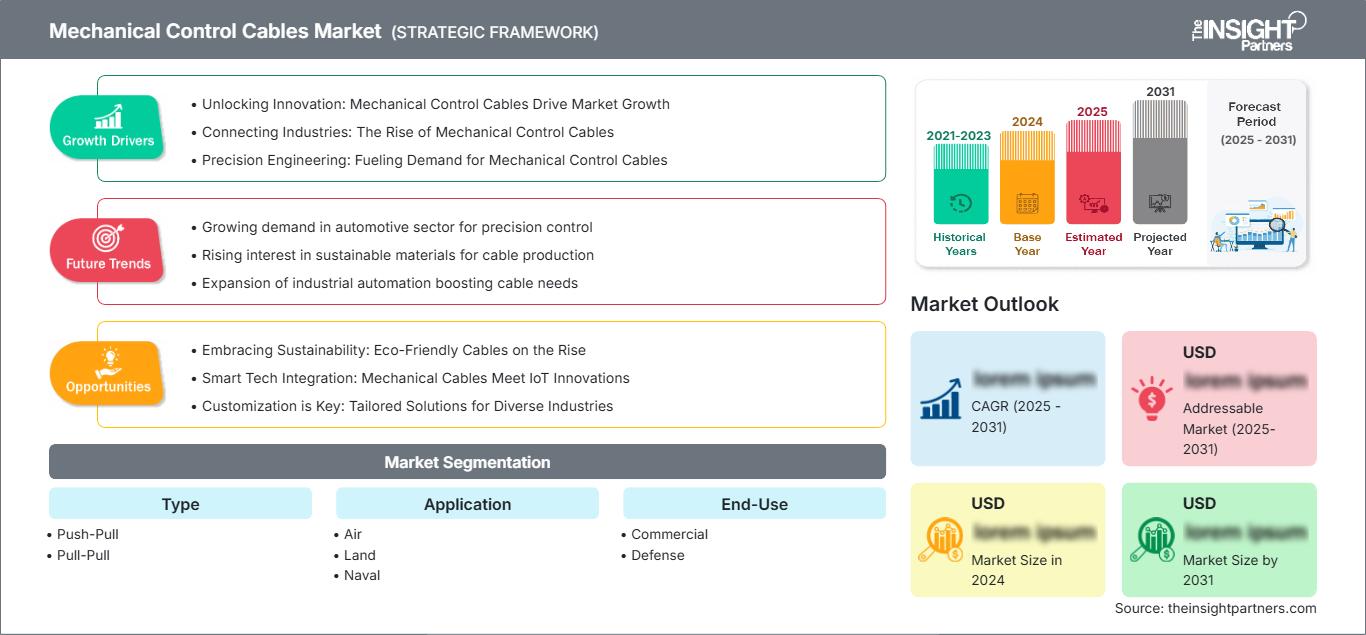
Mechanical Control Cables Market: Strategic Insights
Regional Insights
North America Mechanical Control Cables Market
North America accounted for an estimated 34%–38% of the mechanical control cables market share in 2025 and is projected to expand at a CAGR of 6.2%–6.8% during 2026–2034. This region capitalizes on an established aerospace industry supply chain, a large defense budget, and constant investment in commercial aviation and heavy transportation. Increased requirement for robust mechanical actuation systems within aircraft, military transport, and industrial equipment ensures sustained demand for replacement and new parts.
Moreover, in addition to a thriving MRO system, both the United States and Canada enjoy constant demand for premium cable assemblies. Fleet upgrades, military acquisitions, and rigorous safety standards ensure that manufacturers manufacture cables that are lightweight and corrosion-resistant in harsh environments.
U.S. Mechanical Control Cables Market
The U.S. represented approximately 72%–76% of the North American market in 2025 and is anticipated to register a CAGR of 6.3%–6.9% through 2034. It retains its leadership position on account of its large-scale manufacturing facilities in the aerospace industry, robust defense manufacturing industry, and commercial vehicle industry. The demand for the products is sustained due to the manufacturing of aircraft, military modernization projects, and higher replacement needs for aging transportation fleets.
Some of the major OEMs, Tier-1 manufacturers, and specialist cable manufacturers have large-scale manufacturing and engineering presence in the country. Higher adoption of lightweight materials for aircraft and modernization of military aircraft and armored vehicles, along with increased maintenance work, present several opportunities for manufacturers of precision mechanical control cables.
Europe Mechanical Control Cables Market
Europe is estimated to account for 27%–31% of the global market in 2025 while expanding at a CAGR of 6.1%–6.7% during 2026–2034. Germany is still the biggest regional market due to the presence of efficient aerospace engineering, automobile manufacturing, and the industrial machinery industry. The region will be growing due to constant investments in upgrading the defense sector. The United Kingdom is growing due to aircraft manufacturing, naval defense, and aerospace maintenance. France is investing in commercial aviation and military aerospace. Italy and Spain are contributing towards the growth of the region by way of marine engineering, defense manufacturing, and transportation equipment manufacturing.
APAC Mechanical Control Cables Market
Asia Pacific is projected to represent 24%–28% of the global market in 2025 while recording the fastest CAGR of 7.2%–7.8% during 2026–2034. China leads regional demand through expanding aerospace production, industrial manufacturing, and defense modernization, followed by Japan, India, South Korea, and Australia.
Government investments in transportation infrastructure, indigenous defense manufacturing, commercial aircraft programs, and industrial automation continue to support regional expansion. Increasing localization of component manufacturing and rising export capabilities further strengthen long-term market prospects across Asia Pacific.
Middle East & Africa Mechanical Control Cables Market
The Middle East & Africa mechanical control cables market is expected to expand at a CAGR of 5.8%–6.4% during 2026–2034. Saudi Arabia remains the leading regional market, supported by increasing defense procurement, aviation infrastructure development, and industrial diversification initiatives. The UAE continues investing in commercial aviation, aerospace maintenance, and advanced manufacturing, creating sustained demand for precision mechanical control systems.
South Africa contributes through its established mining equipment, transportation, and defense manufacturing sectors, while the Rest of the Middle East & Africa benefits from gradual investments in maritime infrastructure, commercial vehicle fleets, and industrial machinery. Rising emphasis on equipment reliability, lifecycle optimization, and localized maintenance capabilities is expected to support steady adoption of high-performance mechanical control cable assemblies across the region.
Segmentation Analysis
Type
The Type segment is projected to register a CAGR of 6.5%–7.1% during 2026–2034. Product selection is primarily influenced by operating load, installation flexibility, control precision, and application environment. Continuous improvements in cable materials, protective coatings, and friction-reducing liners are enhancing operational efficiency while extending service life across aerospace, transportation, marine, and industrial equipment. The mechanical control cables market scope continues to broaden as manufacturers introduce application-specific cable configurations designed for higher durability and lower maintenance requirements.
- Push-Pull – This sub-segment dominates demand because it enables bidirectional motion control with high precision, making it widely used in aircraft controls, heavy equipment, agricultural machinery, marine steering systems, and commercial vehicle applications.
- Pull-Pull – Pull-pull cable systems are preferred where synchronized tensile movement and flexible routing are required. Their simple mechanical design supports reliable operation in industrial machinery, specialty vehicles, and selected aerospace control applications.
Application
The Application segment is anticipated to grow at a CAGR of 6.6%–7.2% during 2026–2034. Increasing demand from commercial transportation, military platforms, and marine equipment manufacturers continues to drive product innovation. Manufacturers are focusing on lightweight, corrosion-resistant, and high-cycle cable assemblies capable of operating under demanding environmental and mechanical conditions.
- Air – Aircraft manufacturers and maintenance providers utilize advanced cable assemblies for flight control systems, engine controls, and cockpit mechanisms where reliability, low weight, and certification compliance remain critical purchasing factors.
- Land – Land-based applications account for the largest deployment across commercial vehicles, agricultural machinery, construction equipment, rail systems, and defense vehicles due to dependable performance and cost-effective mechanical operation.
- Naval – Naval platforms employ mechanical control cables for steering, propulsion controls, hatch mechanisms, and auxiliary systems where corrosion resistance, operational reliability, and extended service life are essential under harsh marine conditions.
End-Use
The End-Use segment is forecast to expand at a CAGR of 6.8%–7.4% during 2026–2034. Rising procurement of commercial aircraft, military platforms, and advanced transportation equipment continues to generate demand for high-performance mechanical control cable systems. Manufacturers are increasingly developing application-specific solutions with enhanced fatigue resistance, lightweight construction, and longer operational life to meet evolving industry requirements across commercial and defense sectors.
- Commercial – Commercial applications generate substantial demand through civil aviation, commercial vehicles, rail transportation, marine equipment, and industrial machinery. Fleet expansion, equipment modernization, and growing aftermarket replacement cycles continue supporting stable procurement of precision mechanical control cable assemblies.
- Defense – Defense applications require highly reliable cable assemblies capable of operating under extreme vibration, temperature fluctuations, and mission-critical conditions. Ongoing military modernization programs, naval fleet expansion, and increasing procurement of next-generation aircraft and armored vehicles continue to strengthen long-term demand.
Opportunity Snapshot
| End-Use | Revenue Contribution | Trend Tag | Adoption Stage |
| Commercial | High | Fleet Expansion | Mature |
| Defense | High | Platform Modernization | Scaling |
Mechanical Control Cables Market Growth Drivers and Impact Analysis
Increasing Global Aircraft Production and Fleet Modernization
The growing need for recovery in the commercial aviation industry and the ongoing investment in the purchase of military aircraft are fueling the demand for mechanical control cable systems. In order to ensure efficient mechanical actuation, there is a growing need for aircraft manufacturers that can develop lightweight and fatigue resistant and anti-corrosive cable assemblies. The growing modernization projects in North America, Europe, and Asia Pacific are expected to drive the demand for replacement through the maintenance, repair and overhaul process. The efforts by suppliers of these cables that are improving material properties and offering customized designs of these cables are helping in building long-term business ties with OEMs and aerospace integrators.
Expansion of Defense Procurement Programs Worldwide
Increasing geopolitical uncertainty has led to greater investment by governments in defense modernization, thereby opening up great potential for makers of mission-critical mechanical control systems. The military airplanes, warships, tanks, and other tactical vehicles will continue to require high-quality cable assemblies that can guarantee effective control. The focus on reliability, readiness, and lifecycle efficiency makes procurement programs open to the use of performance-oriented equipment, which is able to withstand harsh environmental conditions. Defense long-term contracts also guarantee steady manufacturing volumes, thus allowing for investments in manufacturing technology, engineering capabilities, and product certification, and expansion of business globally.
Growing Adoption in Heavy Industrial and Commercial Equipment
Rapid infrastructure development, agricultural mechanization, mining expansion, and construction equipment production continue to create stable demand for mechanical control cable assemblies. Equipment manufacturers value these systems for their durability, straightforward installation, and dependable performance in harsh operating environments. Continuous improvements in protective coatings, flexible cable routing, and wear-resistant materials further enhance operational reliability while reducing maintenance frequency. As industrial operators prioritize equipment uptime and lifecycle optimization, demand for customized mechanical control solutions is expected to remain resilient across commercial transportation, heavy machinery, marine equipment, and specialized industrial applications.
Mechanical Control Cables Market Future Trends
Lightweight Materials and Advanced Cable Engineering
Manufacturers are increasingly adopting lightweight alloys, stainless steel wire constructions, engineered polymers, and low-friction liner technologies to improve system efficiency and durability. These mechanical control cables market trends are driven by demand from aerospace, defense, and commercial transportation sectors seeking lower equipment weight, improved fuel efficiency, and extended maintenance intervals. Advanced manufacturing techniques such as automated cable assembly, precision crimping, and digital quality inspection are also improving product consistency. Future developments are expected to focus on enhanced corrosion resistance, reduced operating friction, and customized cable designs capable of meeting increasingly demanding operational environments while supporting long-term lifecycle performance.
Regional Manufacturing Expansion and Supply Chain Localization
Manufacturers are expanding regional production facilities and strengthening local supplier networks to improve supply chain resilience and shorten delivery times. Growing investments in Asia Pacific and selected Middle Eastern manufacturing hubs are encouraging localized production of precision cable assemblies for aerospace, transportation, and defense applications. Companies are also integrating digital production planning and automated inspection technologies to enhance manufacturing efficiency. These initiatives are expected to reduce procurement risks, improve responsiveness to OEM requirements, and support long-term competitiveness through better operational flexibility and regional customer support.
Mechanical Control Cables Market Opportunities
Increasing Investments in Emerging Aerospace Manufacturing Hubs
Emerging aerospace manufacturing centers across Asia Pacific and the Middle East present significant expansion opportunities for cable manufacturers. Government initiatives supporting domestic aircraft production, aerospace component localization, and maintenance infrastructure are increasing procurement requirements for high-performance mechanical control systems. Mechanical control cables market forecasts indicate that suppliers capable of establishing regional manufacturing partnerships, engineering support, and certified production capabilities will be well positioned to secure long-term contracts with aircraft OEMs, Tier-1 suppliers, and maintenance organizations. Investment in localized production and application-specific product development is expected to improve competitiveness while supporting sustainable revenue growth throughout the forecast period.
Product Customization for Specialized Defense Platforms
Growing demand for mission-specific military aircraft, naval vessels, armored vehicles, and unmanned platforms creates opportunities for manufacturers offering customized cable assemblies. Defense customers increasingly require products engineered for extreme operating environments, enhanced durability, and compliance with rigorous military specifications. Suppliers investing in advanced materials, precision manufacturing, and collaborative product development with defense contractors can strengthen long-term strategic relationships. Expanding engineering services, rapid prototyping capabilities, and lifecycle support programs will further differentiate manufacturers while enabling participation in future defense modernization initiatives across established and emerging procurement markets.
Frequently Asked Questions

- Comprehensive Market Sizing and Forecast Analysis
- Detailed Segmentation Analysis
- In-Depth Market Dynamics Assessment
- Regional and Country-Level Insights
- Competitive Landscape and Company Benchmarking
- Strategic Business Intelligence
Recent Reports
Testimonials

The Insight Partners provided valuable market intelligence that supported our global go-to-market strategy. Their team was professional, responsive, and attentive to our feedback, providing thoughtful analysis and helpful methodological clarifications throughout the project.
Junmo Kim Chief Financial Officer (CFO), Enertech Co., Ltd.
The Insight Partners' SCADA System Market report is comprehensive, with valuable insights on current trends and future forecasts. The team was highly professional, responsive, and supportive throughout. We are very satisfied and highly recommend their services.
RAN KEDEM Partner, Reali Technologies LTDs
I requested a report on a very specific software market and the team produced the report in a few days. The information was very relevant and well presented. I then requested some changes and additions to the report. The team was again very responsive and I got the final report in less than a week.
JEAN-HERVE JENN Chairman, Future Analytica
We worked with The Insight Partners for an important market study and forecast. They gave us clear insights into opportunities and risks, which helped shape our plans. Their research was easy to use and based on solid data. It helped us make smart, confident decisions. We highly recommend them.
PIYUSH NAGPAL Sr. Vice President, High Beam Global
The Insight Partners delivered insightful, well-structured market research with strong domain expertise. Their team was professional and responsive throughout. The user-friendly website made accessing industry reports seamless. We highly recommend them for reliable, high-quality research services
YUKIHIKO ADACHI CEO, Deep Blue, LLC.
This is the first time I have purchased a market report from The Insight Partners.While I was unsure at first, I visited their web site and felt more comfortable to take the risk and purchase a market report.I am completely satisfied with the quality of the report and customer service. I had several questions and comments with the initial report, but after a couple of dialogs over email with their analyst I believe I have a report that I can use as input to our strategic planning process.Thank you so much for taking the extra time and making this a positive experience.I will definitely recommend your service to others and you will be my first call when we need further market data.
JOHN SUZUKI President and Chief Executive Officer, Board Director, BK Technologies
I wish to appreciate your support and the professionalism you displayed in the course of attending to my request for information regarding to infectious disease IVD market in Nigeria. I appreciate your patience, your guidance, and the fact that you were willing to offer a discount, which eventually made it possible for us to close a deal. I look forward to engaging The Insight Partners in the future, all thanks to the impression you have created in me as a result of this first encounter.
DR CHIJIOKE ONYIA MANAGING DIRECTOR, PineCrest Healthcare Ltd.Reason to Buy
- Informed Decision-Making
- Understanding Market Dynamics
- Competitive Analysis
- Identifying Emerging Markets
- Customer Insights
- Market Forecasts
- Risk Mitigation
- Boosting Operational Efficiency
- Strategic Planning
- Investment Justification
- Tracking Industry Innovations
- Aligning with Regulatory Trends





 Get Free Sample for