
Microwave Oven Market Share, Size & Demand by 2034
Coverage: by Product Type (Convection, Grill, Solo); Structure (Counter Top, Built-in); End-user (Household, Commercial) , and Geography (North America, Europe, Asia Pacific, and South and Central America)
- Status : Data Released
- Report Code : TIPRE00008281
- Category : Electronics and Semiconductor
- No. of Pages : 150
- Available Report Formats :


- Last update date : September 30, 2026


2025 Market Size
US$ 10.84 Bn
Base year value
2034 Forecast
US$ 16.86 Bn
Projected by 2034
CAGR 2026-2034
5.04 %
Growth rate
Addressable Market
US$ 125.76 Bn
(2026-2034)
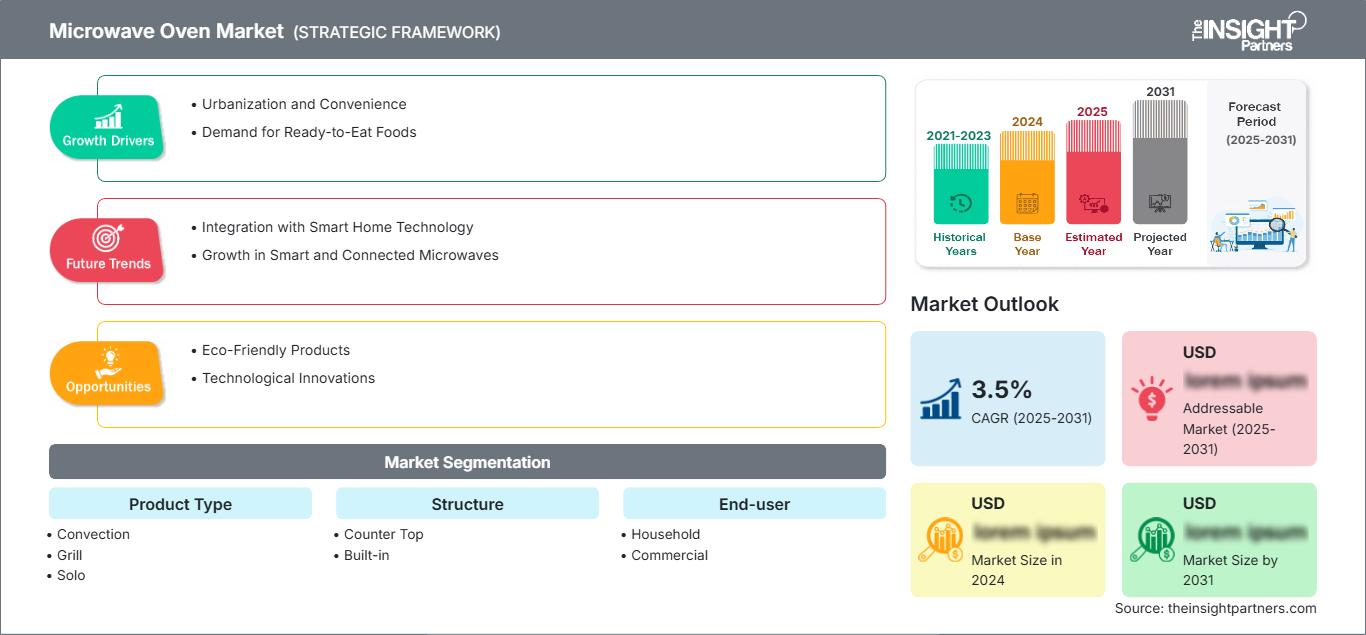
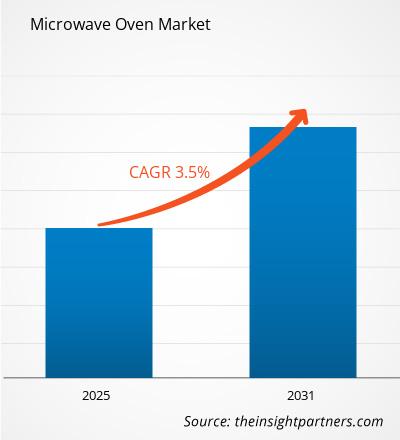
The Microwave oven market was valued at US$ 10.84 Billion in 2025 and is projected to reach US$ 16.86 Billion by 2034, expanding at a CAGR of 5.04% during 2026–2034. Rising demand for convenient cooking appliances, increasing urbanization, evolving consumer lifestyles, and growing adoption of smart kitchen technologies continue supporting market expansion. Manufacturers are introducing energy-efficient, multifunctional microwave ovens with advanced cooking features to meet changing household and commercial food preparation requirements.
North America remains a significant regional market because of high household appliance penetration, strong replacement demand, and widespread adoption of connected kitchen appliances. The microwave oven market size across the region is expected to register a CAGR of 4.6–5.3% through 2034. Growth is supported by increasing smart home adoption, demand for premium built-in kitchen appliances, and modernization of commercial foodservice operations.
Microwave Oven Market Assessment and Insights
- North America: Accounted for an estimated 25–29% microwave oven market share in 2025 and is projected to grow at a CAGR of 4.6–5.3% during 2026–2034. Rising smart kitchen adoption, appliance replacement cycles, and commercial foodservice expansion continue supporting regional demand.
- US: Represented approximately 81–85% of the North American market in 2025 and is expected to expand at a CAGR of 4.7–5.4% during 2026–2034, supported by premium appliance demand and strong household ownership.
- Europe: Held an estimated 23–27% share in 2025 and is anticipated to register a CAGR of 4.8–5.5% during 2026–2034. Germany, the UK, France, Italy, and Spain remain leading contributors through premium kitchen appliance adoption.
- Asia Pacific: Accounted for approximately 36–40% share in 2025 and is projected to expand at a CAGR of 5.8–6.5% during 2026–2034. China, Japan, South Korea, and India continue driving production and consumer demand through urbanization and rising disposable income.
- Largest Segment: End-user – Household accounted for approximately 72–76% market share in 2025 and is projected to grow at a CAGR of 5.1–5.8% during 2026–2034, supported by rising residential appliance purchases.
- High Growth Segment: Product Type – Convection represented approximately 30–34% market share in 2025 and is expected to register a CAGR of 6.0–6.7% during 2026–2034, driven by demand for multifunctional cooking solutions.
- Key companies analyzed in detail: Alto-Shaam, Inc., BSH Home Appliances Corporation, Daewoo Electronics, AB Electrolux, Haier Smart Home Co., Ltd., LG Electronics Inc., Panasonic Holdings Corporation, Samsung Electronics Co., Ltd., Sharp Electronics Corporation, Whirlpool Corporation.
Source: The Insight Partners' analysis based on proprietary research, government publications, company annual reports, investor presentations, industry databases, and expert interviews.
Continuous innovation in the area of cooking technologies, digital control features, inverter technology, and advanced connectivity has brought about substantial change in microwave ovens' manufacturing. Currently, manufacturers are trying to make cooking more efficient, lower energy consumption levels, and provide multifunctional capabilities such as convection cooking, grilling, and sensor cooking. These innovations continue driving microwave oven industry development through meeting growing consumer needs for efficient and connected kitchen appliances.
Future growth of the market will be facilitated by growing urbanization, integration into smart homes, kitchen remodeling, and investment in food service across emerging economies. Major appliance manufacturers will continue investing in localized manufacturing as well as developing smart cooking solutions that include voice control features, mobile connectivity, and artificial intelligence cooking programs.
Microwave Oven Market Report Scope
| Report Attribute | Details |
|---|---|
| Market size in 2025 | US$ 10.84 Billion |
| Market Size by 2034 | US$ 16.86 Billion |
| Global CAGR (2026 - 2034) | 5.04% |
| Historical Data | 2021-2024 |
| Forecast period | 2026-2034 |
Microwave Oven Market Analysis
Increasing consumer taste for convenience regarding meals' preparation and energy-efficient cookers is one of the main factors driving the demand globally. Microwave ovens keep developing from being just a machine used for heating food to becoming a complete cooking system capable of baking, grilling, roasting, steaming, and sensor cooking. The rise in disposable income levels, the busy lifestyle of consumers, and increasing prevalence of modular kitchens keeps boosting the market of microwave ovens, while companies produce more premium products with inverter systems, touch screens, and smart connectivity.
This ecosystem comprises different players, such as component producers, appliance producers, distributors, retailers, and foodservice equipment providers collaborating for better product availability and consumer experience. Increased investment in manufacturing technologies, sustainable materials, and online sales channels are making global supply chains more powerful and product availability higher.
The level of competition keeps on rising owing to efforts made by appliance manufacturers worldwide in areas of innovation, energy efficiency, and kitchen appliances of high caliber. This is a market analysis of the microwave ovens industry, where the competitive strategies adopted by companies such as LG Electronics Inc., Samsung Electronics Co., Ltd., Panasonic Holdings Corporation, Whirlpool Corporation, AB Electrolux, BSH Home Appliances Corporation, Haier Smart Home Co., Ltd., and Sharp Electronics Corporation will be explored as each of these companies keep widening its product offerings through innovation and market expansion.
The competitive strategies include introduction of smart or connected kitchen appliances, inverter cooking technology, antibacterial features of the interior parts of the kitchen appliances, and environmentally friendly manufacturing processes.
● REPORT CUSTOMIZATION
Tailor This Report To Align With Your Specific Business Requirements
This report can be customized to align precisely with your business objectives, scope, and target markets. Customization options include tailored segmentation, geography, competitive analysis, and strategic insights to support informed decision-making.
Customize This Report →WHAT YOU CAN ADJUST
- ● Segmentations
- ● Geography
- ● Competitive Analysis
- ● Language Preferences
Microwave Oven Market: Strategic Insights
Regional Insights
North America Microwave Oven Market
North America accounted for an estimated 25–29% microwave oven market share in 2025 and is projected to expand at a CAGR of 4.6–5.3% during 2026–2034. High penetration rate of household appliances, increased remodeling of kitchens, and rising consumer inclination toward high-end built-in appliances remain the key drivers for market growth. Increased adoption of home automation technology has resulted in the development of microwave ovens that are Wi-Fi enabled and offer intelligent cooking functionality.
Foodservice commercial establishments, such as restaurants, hotels, cafeterias, and convenience stores, are still upgrading their kitchens with microwave technologies to optimize operational efficiency and cooking time. The need for replacement and inclination toward cooking appliances with multiple functionalities is adding to the market growth potential. Continued innovations and wide availability of these products through retail channels are anticipated to ensure steady market growth in the forecast period.
U.S. Microwave Oven Market
The United States represented approximately 81–85% of the North American market in 2025 and is anticipated to register a CAGR of 4.7–5.4% during 2026–2034. High levels of household penetration, high purchasing power of consumers, and ongoing cycles of product replacement keep stimulating market demand. Growing investment made by households in sophisticated residential kitchens and foodservice establishments for upgrading to more advanced systems further boosts the demand for advanced microwave ovens with inverters and cooking capabilities.
The key players like Whirlpool Corporation, LG Electronics Inc., Samsung Electronics Co., Ltd., Panasonic Holdings Corporation, and Sharp Electronics Corporation maintain their market presence due to their wide variety of products and the distribution network that they have. The increasing consumer preference for energy-efficient appliances and smart kitchens provides a bright prospect for the future of the market.
Europe Microwave Oven Market
Europe accounted for approximately 23–27% of the global market in 2025 and is expected to register a CAGR of 4.8–5.5% during 2026–2034. Germany still constitutes the largest regional market due to appliance ownership, the use of premium kitchens and a great deal of demand for built-in appliances. Manufacturers are still launching energy-efficient models that conform to the regional sustainability programs as well as evolving consumer preferences.
The United Kingdom is still experiencing consistent demand fueled by home remodeling and replacement purchases. Contributions from France, Italy, and Spain come from rising urban population, premium residential constructions and hospitality sectors. The growing consumer awareness about energy-efficient appliances is driving consistent demand for advanced microwaves in the region.
APAC Microwave Oven Market
Asia Pacific represented approximately 36–40% of the global market in 2025 and is projected to expand at a CAGR of 5.8–6.5% during 2026–2034. The Chinese market holds the top spot for manufacturing as well as consumption, whereas Japan and South Korea dominate innovations and premium appliance segments.
India is experiencing rising use of appliances due to urbanization, increase in disposable income levels, and organized retail networks. The region is likely to grow further during the forecast period owing to residential constructions and demand for smart homes and convenient cooking appliances.
Middle East & Africa Microwave Oven Market
The Microwave Oven Market report shows that Middle East & Africa is projected to register a CAGR of 4.3–5.0% during 2026–2034, supported by increasing urbanization, rising residential construction, and growing demand for modern household appliances. Saudi Arabia and the United Arab Emirates continue leading regional demand through premium residential developments and hospitality sector expansion.
South Africa remains an important consumer market for household appliances, while the Rest of the Middle East & Africa continues experiencing gradual adoption driven by improving living standards, expanding retail infrastructure, and increasing consumer preference for convenient food preparation solutions.
Segmentation Analysis
Product Type
Product Type remains a key differentiator as consumers increasingly seek appliances that combine convenience with multiple cooking functions. The segment is projected to register a CAGR of 5.2–5.9% during 2026–2034, supported by technological innovation, energy-efficient heating systems, and changing cooking preferences. The microwave oven market scope continues expanding as manufacturers introduce advanced multifunctional products capable of baking, grilling, roasting, and reheating within a single appliance.
- Convection – Combines microwave heating with convection technology to support baking, roasting, grilling, and faster cooking, making it increasingly popular among households seeking multifunctional kitchen appliances.
- Grill – Designed to provide grilling and browning capabilities alongside microwave cooking, making it suitable for consumers looking for enhanced cooking versatility without requiring separate appliances.
- Solo – Primarily intended for reheating, defrosting, and basic cooking functions, remaining a preferred option for budget-conscious households and first-time appliance buyers.
Structure
Structure segmentation reflects consumer preferences regarding kitchen layout, aesthetics, and installation flexibility. The segment is expected to expand at a CAGR of 4.9–5.6% during 2026–2034, driven by increasing residential construction, modular kitchen adoption, and premium home renovation activities.
- Counter Top – The most widely adopted structure because of its affordability, installation flexibility, portability, and suitability for residential kitchens, offices, and small commercial establishments.
- Built-in – Increasingly preferred in premium residential kitchens and hospitality applications owing to seamless kitchen integration, modern aesthetics, and optimized space utilization.
End-user
End-user segmentation reflects the broad utilization of microwave ovens across residential and commercial environments. The segment is projected to register a CAGR of 5.0–5.7% during 2026–2034. Household users continue accounting for the largest demand because of widespread appliance ownership, while commercial establishments increasingly adopt high-performance microwave systems to improve operational efficiency.
- Household – The largest end-user segment benefits from rising urbanization, increasing disposable incomes, home renovation activities, and growing preference for convenient meal preparation solutions.
- Commercial – Restaurants, hotels, cafés, hospitals, institutional kitchens, convenience stores, and catering businesses increasingly deploy advanced microwave ovens to accelerate food preparation, maintain product consistency, and improve service efficiency.
Opportunity Snapshot
| End-user | Revenue Contribution | Trend Tag | Adoption Stage |
|---|---|---|---|
| Household | High | Smart Kitchen | Mature |
| Commercial | Medium | Quick Service | Scaling |
Microwave Oven Market Growth Drivers and Impact Analysis
Growing Consumer Preference for Convenient Cooking Solutions
Change in lifestyle, increasing urbanization, and longer working hours continue to motivate people to opt for appliances that can help them in simplifying their routine tasks of meal preparation. Microwave ovens are quick to heat, defrost, cook, and reheat food items, and they take less time than traditional cooking methods. Modern households have a tendency to use appliances that are multi-functional and that can allow them to grill, bake, and cook using the convection mode in one appliance. Increasing consumption of ready-to-eat and frozen foods further augments the use of these appliances in household kitchens.
Expansion of Commercial Foodservice and Hospitality Industries
Restaurants, cafes, hotels, hospitals, institutional food kitchens, and quick service restaurants today require commercial microwave ovens for increasing efficiency and ensuring consistency in food quality. Commercial microwave systems help save time in preparing food items, increase efficiency in the kitchen and offer quick customer service during peak business hours. Increase in the demand for food delivery services, convenience stores and cloud kitchens has further led to the purchase of reliable commercial cooking appliances. Manufacturers keep on launching robust and efficient commercial microwave ovens meant for intensive commercial applications.
Increasing Adoption of Smart and Energy-Efficient Appliances
There is an increasing trend among consumers to buy kitchen appliances that are networked because of their benefits such as added convenience, remote operation capability, and better energy management. Microwave ovens that are networked, have voice assistant capability, sensor cooking capabilities, inverter technology, and intelligent automation allow cooking accuracy while saving electricity usage. The drive by governments to promote energy-efficient household products and new sustainable designs by manufacturers will further motivate the substitution of existing products with these microwave ovens.
Microwave Oven Market Future Trends
Artificial Intelligence Enhancing Smart Cooking Experiences
Artificial intelligence is transforming microwave ovens by enabling automatic cooking adjustments, food recognition, recipe recommendations, and intelligent temperature control. Connected appliances increasingly utilize cloud-based software, mobile applications, and voice assistants to simplify cooking while improving energy efficiency. As digital kitchens continue evolving, microwave oven market trends are expected to emphasize personalized cooking experiences, predictive maintenance, and seamless integration with broader smart home ecosystems.
Growing Popularity of Multifunctional Kitchen Appliances
Consumers increasingly prefer appliances capable of performing multiple cooking functions within a compact footprint. Manufacturers are responding by combining convection, grilling, steaming, air frying, and microwave cooking into integrated products that reduce kitchen space requirements while improving versatility. Continued innovation in inverter heating, sensor-based cooking, and intuitive user interfaces is expected to support premium product adoption across residential and commercial markets.
Microwave Oven Market Opportunities
Expansion Across Emerging Residential Markets
Rapid urbanization, rising disposable incomes, expanding middle-class populations, and improving access to organized retail continue creating favorable conditions for household appliance adoption across emerging economies. Consumers increasingly seek convenient cooking appliances that combine affordability with advanced functionality. Long-term microwave oven market Forecast indicate significant opportunities for manufacturers introducing energy-efficient, compact, and competitively priced products tailored to regional consumer preferences. Expanding local manufacturing, distribution partnerships, and digital retail platforms are expected to further strengthen market penetration.
Premium Built-in Kitchen Appliance Adoption
Increasing investments in luxury residential construction, modular kitchens, and home renovation projects continue supporting demand for built-in microwave ovens. Consumers increasingly value integrated appliance designs that enhance aesthetics while maximizing available kitchen space. Manufacturers introducing premium products featuring intelligent controls, minimalist designs, advanced cooking modes, and connected home compatibility are expected to benefit from growing demand among high-income households and premium residential developers.
Frequently Asked Questions

- Comprehensive Market Sizing and Forecast Analysis
- Detailed Segmentation Analysis
- In-Depth Market Dynamics Assessment
- Regional and Country-Level Insights
- Competitive Landscape and Company Benchmarking
- Strategic Business Intelligence
Recent Reports
Testimonials

The Insight Partners provided valuable market intelligence that supported our global go-to-market strategy. Their team was professional, responsive, and attentive to our feedback, providing thoughtful analysis and helpful methodological clarifications throughout the project.
Junmo Kim Chief Financial Officer (CFO), Enertech Co., Ltd.
The Insight Partners' SCADA System Market report is comprehensive, with valuable insights on current trends and future forecasts. The team was highly professional, responsive, and supportive throughout. We are very satisfied and highly recommend their services.
RAN KEDEM Partner, Reali Technologies LTDs
I requested a report on a very specific software market and the team produced the report in a few days. The information was very relevant and well presented. I then requested some changes and additions to the report. The team was again very responsive and I got the final report in less than a week.
JEAN-HERVE JENN Chairman, Future Analytica
We worked with The Insight Partners for an important market study and forecast. They gave us clear insights into opportunities and risks, which helped shape our plans. Their research was easy to use and based on solid data. It helped us make smart, confident decisions. We highly recommend them.
PIYUSH NAGPAL Sr. Vice President, High Beam Global
The Insight Partners delivered insightful, well-structured market research with strong domain expertise. Their team was professional and responsive throughout. The user-friendly website made accessing industry reports seamless. We highly recommend them for reliable, high-quality research services
YUKIHIKO ADACHI CEO, Deep Blue, LLC.
This is the first time I have purchased a market report from The Insight Partners.While I was unsure at first, I visited their web site and felt more comfortable to take the risk and purchase a market report.I am completely satisfied with the quality of the report and customer service. I had several questions and comments with the initial report, but after a couple of dialogs over email with their analyst I believe I have a report that I can use as input to our strategic planning process.Thank you so much for taking the extra time and making this a positive experience.I will definitely recommend your service to others and you will be my first call when we need further market data.
JOHN SUZUKI President and Chief Executive Officer, Board Director, BK Technologies
I wish to appreciate your support and the professionalism you displayed in the course of attending to my request for information regarding to infectious disease IVD market in Nigeria. I appreciate your patience, your guidance, and the fact that you were willing to offer a discount, which eventually made it possible for us to close a deal. I look forward to engaging The Insight Partners in the future, all thanks to the impression you have created in me as a result of this first encounter.
DR CHIJIOKE ONYIA MANAGING DIRECTOR, PineCrest Healthcare Ltd.Reason to Buy
- Informed Decision-Making
- Understanding Market Dynamics
- Competitive Analysis
- Identifying Emerging Markets
- Customer Insights
- Market Forecasts
- Risk Mitigation
- Boosting Operational Efficiency
- Strategic Planning
- Investment Justification
- Tracking Industry Innovations
- Aligning with Regulatory Trends





 Get Free Sample for