
Military Communications Market Growth, Trends & Forecast by 2034
Coverage: by Component (SATCOM System, Radio System, Radar and Sonar System); Application (Command and Control, Situational Awareness, Routine Operations, Others); End-user (Air Force, Ground Force, Naval Force) , and Geography (North America, Europe, Asia Pacific, and South and Central America)
- Status : Data Released
- Report Code : TIPRE00011209
- Category : Electronics and Semiconductor
- No. of Pages : 150
- Available Report Formats :


- Last update date : October 13, 2026


2025 Market Size
US$ 41.47 Bn
Base year value
2034 Forecast
US$ 71.96 Bn
Projected by 2034
CAGR 2026-2034
6.31 %
Growth rate
Addressable Market
US$ 513.16 Bn
(2026-2034)
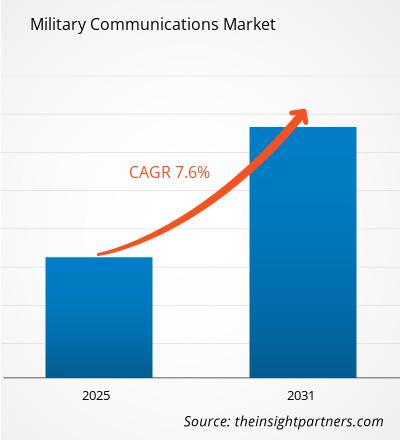
The military communications market was valued at US$ 41.47 Billion in 2025 and is projected to reach US$ 71.96 Billion by 2034, expanding at a CAGR of 6.31% during 2026–2034. Rising defense modernization programs, increasing demand for secure tactical connectivity, and rapid adoption of software-defined communication technologies are strengthening procurement activities across armed forces. Continuous investment in resilient network architectures and multi-domain operational capabilities is expected to reinforce long-term demand for advanced communication platforms across land, air, and naval defense environments.
Across North America, defense agencies continue prioritizing secure and interoperable communication infrastructure to support joint operations, intelligence sharing, and resilient battlefield networking. The military communications market size is supported by sustained procurement budgets, modernization of legacy command systems, and growing deployment of satellite-enabled tactical networks. The regional market is estimated to expand at a CAGR of 5.8%–6.4% between 2026 and 2034, supported by next-generation defense electronics and integrated digital battlefield initiatives.
Military Communications Market Assessment and Insights
- North America: The region remains the largest contributor due to sustained defense expenditure, strong indigenous manufacturing capabilities, and continuous modernization initiatives. Share in 2025: 37%–40%; CAGR between 2026–2034: 5.8%–6.4%.
- U.S.: Extensive investment in secure battlefield networking, satellite communications, and multi-domain command infrastructure sustains regional leadership. Share in 2025: 82%–85% of North America; CAGR between 2026–2034: 5.9%–6.5%.
- Europe: NATO capability enhancement programs and defense spending growth across the UK, Germany, France, Italy, and Spain continue supporting procurement of advanced communication technologies. Share in 2025: 24%–27%; CAGR between 2026–2034: 5.7%–6.3%.
- Asia Pacific: Rising geopolitical tensions and defense modernization initiatives in China, India, Japan, South Korea, and Australia continue accelerating deployment of secure tactical communication systems. Share in 2025: 26%–29%; CAGR between 2026–2034: 7.0%–7.6%.
- Largest Segment: Application – Command and Control remains the leading segment owing to extensive deployment across integrated military operations. Market share in 2025: 40%–44%; CAGR between 2026–2034: 6.2%–6.8%.
- High Growth Segment: Component – SATCOM System records the fastest expansion due to increasing demand for beyond-line-of-sight communications and resilient battlefield connectivity. Market share in 2025: 31%–35%; CAGR between 2026–2034: 7.1%–7.8%.
- Key companies analyzed in detail: General Dynamics Corporation, Airbus SE, QinetiQ Group plc, BAE Systems plc, Northrop Grumman Corporation, Collins Aerospace, Lockheed Martin Corporation, RTX Corporation, Thales Group, and L3Harris Technologies, Inc.
Source: The Insight Partners' analysis based on proprietary research, government publications, company annual reports, investor presentations, industry databases, and expert interviews.
Changes in the priorities of operations in international defense institutions have led to changes in communication structures, changing them from platform-based communication to networked communications that are software-defined and very interoperable. Concepts of digital battlefields, artificial intelligence support for mission management, encryption algorithms, and satellite communications remain key in determining the procurement priorities. Modern production methods have focused on the development of modularity in hardware, open system architecture, and upgrades of the communication assets lifecycle. This military communications market growth reflects sustained investment in secure, real-time information exchange across multidomain operations.
Moving forward, it is anticipated that the pace of procurement will increase in the Asia Pacific, the Middle East, and certain European nations because of increased emphasis on strengthening their local manufacturing capabilities as well as defense partnership efforts. Legislative measures aimed at ensuring the efficient management of the radio spectrum, cybersecurity, and interoperability within the defense alliance will serve as catalysts for modernization. Cooperation between defense companies, communication technology firms, and government organizations will help facilitate innovation and improve the efficiency of implementation.
Military Communications Market Report Scope
| Report Attribute | Details |
|---|---|
| Market size in 2025 | US$ 41.47 Billion |
| Market Size by 2034 | US$ 71.96 Billion |
| Global CAGR (2026 - 2034) | 6.31% |
| Historical Data | 2021-2024 |
| Forecast period | 2026-2034 |
Military Communications Market Analysis
With the ever-changing defense environment, there continues to be accelerated growth in the development of secure, reliable, and interoperable communication infrastructure in military institutions. Growth in the military communications industry will be driven by greater deployment of software-defined radio devices, satellite communications devices, encryption capabilities for broadband networks, and artificial intelligence-powered command systems. Governments have been focusing on modernization programs aimed at replacing old communication systems with systems that will integrate multidomain operations, electronic warfare resiliency, and real-time intelligence sharing capabilities. With the increasing number of military activities that depend on data, there has been an increase in demand for secure communication systems that will be able to operate within contested environments.
A stronger defense electronics ecosystem is reinforcing market expansion through collaboration among communication equipment manufacturers, semiconductor suppliers, cybersecurity providers, and satellite network operators. Procurement strategies increasingly emphasize modular platforms that simplify technology upgrades while reducing lifecycle costs. Growing investments in indigenous defense manufacturing, combined with international defense cooperation programs, are improving supply chain resilience and expanding production capacity. These developments are enabling armed forces to deploy advanced communication technologies faster while maintaining interoperability with allied defense networks operating across land, maritime, air, space, and cyber domains.
The military communications market analysis indicates that competition is increasingly centered on technology integration, cybersecurity capabilities, open-system architectures, and long-term modernization contracts rather than hardware performance alone. Prominent firms like General Dynamics Corporation, Lockheed Martin Corporation, RTX Corporation, Northrop Grumman Corporation, Airbus SE, BAE Systems plc, Thales Group, Collins Aerospace, L3Harris Technologies, Inc., and QinetiQ Group plc are aggressively increasing their R&D spending on creating resilient tactical communication systems for future defense operations. Collaborations with government organizations and defense ministries will enable them to improve their product offerings and boost their market reach across the globe.
Investment in secure satellite communications, tactical cloud connections, AI-enabled network management, and command-and-control system ecosystems that can support multidomain military missions remains a key trend in the sector. Procurement departments of defense organizations seek scalable systems that can be upgraded during their entire lifecycle while meeting emerging cybersecurity needs and standards. Innovation in encryption systems, spectrum management, and resilient battlefield networking will create competitive differentiation and long-term defense contracts in addition to driving technological growth in the future.
● REPORT CUSTOMIZATION
Tailor This Report To Align With Your Specific Business Requirements
This report can be customized to align precisely with your business objectives, scope, and target markets. Customization options include tailored segmentation, geography, competitive analysis, and strategic insights to support informed decision-making.
Customize This Report →WHAT YOU CAN ADJUST
- ● Segmentations
- ● Geography
- ● Competitive Analysis
- ● Language Preferences
Military Communications Market: Strategic Insights

Regional Insights
North America Military Communications Market
North America accounted for approximately 37%–40% military communications market share in 2025 and continues to lead global adoption through sustained defense modernization programs and strong investments in secure communication infrastructure. The region is projected to expand at a CAGR of 5.8%–6.4% during 2026–2034, supported by continuous procurement of software-defined radios, SATCOM terminals, encrypted tactical networks, and integrated command platforms. Ongoing digital transformation initiatives across defense agencies are further strengthening interoperability between air, land, maritime, cyber, and space operations.
Defense contractors, communication equipment manufacturers, and government agencies maintain close collaboration to accelerate the deployment of resilient communication technologies capable of supporting multidomain military missions. Increasing emphasis on artificial intelligence-assisted network management, cybersecurity resilience, and open-system architectures is encouraging the replacement of legacy communication infrastructure. Modernization programs across the United States and Canada, together with growing research investments in secure battlefield connectivity, are expected to sustain regional leadership throughout the forecast period.
U.S. Military Communications Market
The United States represented nearly 82%–85% of the North American market in 2025 and is forecast to register a CAGR of 5.9%–6.5% through 2034. Continuous defense appropriations and long-term modernization programs support the procurement of advanced communication platforms across every military branch. Large-scale deployment of secure satellite communication systems, tactical data links, artificial intelligence-enabled command centers, and resilient networking solutions continues to strengthen operational readiness while improving coordination across multidomain missions.
The presence of leading defense companies, including General Dynamics Corporation, Lockheed Martin Corporation, RTX Corporation, Northrop Grumman Corporation, Collins Aerospace, and L3Harris Technologies, Inc., further reinforces innovation and manufacturing capabilities. Defense agencies continue emphasizing integrated command-and-control platforms, secure cloud-enabled battlefield communications, and advanced encryption technologies to improve operational efficiency while ensuring interoperability among allied military forces during joint operations and multinational defense exercises.
Europe Military Communications Market
Europe represented approximately 24%–27% of the global Military Communications Market revenue in 2025 and is anticipated to expand at a CAGR of 5.7%–6.3% through the forecast period. NATO capability enhancement initiatives, higher defense budgets, and collaborative procurement programs continue to stimulate demand for secure communication platforms. The United Kingdom remains the leading national market, supported by modernization of tactical communication systems, digital command infrastructure, and strong domestic defense manufacturing capabilities serving both national and allied military requirements.
Germany continues investing in advanced battlefield networking, encrypted communication systems, and interoperable command platforms to strengthen operational readiness across multinational defense missions. France, Italy, and Spain are collectively increasing procurement of secure satellite communications, software-defined radio technologies, and digital command systems while supporting indigenous industrial capabilities. Regional collaboration on defense research, cybersecurity, and communication interoperability continues to enhance long-term competitiveness and technological resilience throughout the European defense ecosystem.
APAC Military Communications Market
Asia Pacific accounted for nearly 26%–29% of the global Military Communications Market in 2025 and is projected to record the fastest regional expansion with a CAGR of 7.0%–7.6% during 2026–2034. Rising geopolitical tensions, expanding indigenous defense manufacturing, and accelerated military modernization continue to support long-term procurement across regional armed forces.
China leads regional investments, while India, Japan, South Korea, and Australia continue strengthening secure communication infrastructure through advanced satellite systems, digital battlefield networks, and software-defined radio deployments. Government policies encouraging domestic defense production and technology collaboration further reinforce regional growth prospects.
Middle East & Africa Military Communications Market
The Middle East and Africa Military Communications Market is expected to experience steady expansion with a CAGR of 5.6%–6.2% between 2026 and 2034. Defense modernization initiatives, border security programs, and growing investment in digital command infrastructure are supporting the procurement of advanced communication technologies across military organizations.
Saudi Arabia remains the largest regional market, followed by the United Arab Emirates and South Africa, while other MEA countries continue upgrading tactical communication capabilities. Strategic investments linked to critical infrastructure protection, energy security, and regional defense partnerships are encouraging wider adoption of secure and interoperable military communication systems.
Segmentation Analysis
Component
The Component segment is projected to expand at a CAGR of 6.4%–6.9% during 2026–2034, supported by continuous investments in resilient communication infrastructure and digital battlefield transformation. Defense organizations increasingly prioritize interoperable communication equipment capable of supporting secure voice, video, and data transmission across multidomain operations. Modernization initiatives, coupled with demand for encrypted connectivity, artificial intelligence-enabled networking, and cyber-resilient architectures, continue accelerating procurement of advanced communication platforms. The military communications market scope continues to broaden as governments invest in next-generation communication ecosystems that improve operational effectiveness while ensuring compatibility across allied defense networks.
- SATCOM System: SATCOM systems remain the fastest-growing component, enabling beyond-line-of-sight connectivity, strategic command communications, and uninterrupted data transmission across remote operational environments while supporting resilient communications during contested missions and multinational defense operations.
- Radio System: Radio systems continue serving as the operational backbone for tactical communications, offering secure voice and data exchange across ground, airborne, and maritime platforms through software-defined technologies, frequency agility, and enhanced encryption capabilities.
- Radar and Sonar System: Radar and sonar communication integration strengthens operational awareness by supporting coordinated surveillance, target detection, maritime security, and information sharing between defense platforms, improving mission effectiveness across complex operational environments.
Application
The Application segment is anticipated to register a CAGR of 6.2%–6.8% throughout the forecast period, driven by expanding requirements for secure information exchange and integrated mission management. Armed forces continue investing in digital command systems that enable rapid decision-making, battlefield coordination, and real-time intelligence dissemination. Increasing adoption of artificial intelligence, secure cloud architectures, and advanced networking technologies further strengthens communication capabilities across tactical and strategic defense operations while improving operational flexibility, resilience, and mission success across increasingly complex security environments.
- Command and Control: This application maintains the largest deployment footprint by supporting mission planning, operational coordination, secure decision-making, and integrated communications among military headquarters and deployed units operating across multiple combat domains.
- Situational Awareness: Demand continues increasing as armed forces integrate intelligence, surveillance, reconnaissance, and battlefield sensor information into unified communication platforms that enable faster operational decisions and improved threat assessment during dynamic military missions.
- Routine Operations: Routine operational communications remain essential for logistics coordination, personnel management, maintenance activities, training exercises, and administrative communications, ensuring secure information exchange across everyday defense operations while supporting long-term operational readiness.
End-user
The End-user segment is forecast to grow at a CAGR of 6.3%–6.8% between 2026 and 2034 as defense organizations modernize their communication infrastructure across every operational domain. Procurement priorities increasingly emphasize interoperable communication platforms capable of supporting multidomain operations, joint command structures, and secure tactical coordination. Investments in advanced networking technologies, software-defined communication systems, satellite connectivity, and cyber-secure digital architectures continue improving operational efficiency while enabling seamless coordination among air, land, and maritime forces during both conventional and hybrid military missions.
- Air Force: Air forces increasingly deploy secure airborne communication systems supporting network-centric warfare, real-time intelligence exchange, mission coordination, and integration between manned aircraft, unmanned platforms, satellites, and ground command centers.
- Ground Force: Ground forces represent a significant deployment base for tactical communication equipment, utilizing secure radios, mobile communication platforms, battlefield networking technologies, and digital command systems to improve coordination and operational responsiveness during field missions.
- Naval Force: Naval forces continue investing in integrated maritime communication solutions supporting fleet coordination, submarine communications, coastal surveillance, satellite connectivity, and secure information sharing across multinational naval operations and maritime security missions.
Opportunity Snapshot
| Application | Revenue Contribution | Trend Tag | Adoption Stage |
|---|---|---|---|
| Command and Control | High | AI Command | Mature |
| Situational Awareness | High | Sensor Fusion | Scaling |
| Routine Operations | Medium | Secure Mobility | Scaling |
Military Communications Market Growth Drivers and Impact Analysis
Growing Defense Modernization Programs and Rising Military Expenditure
Governments in developed and emerging nations continue boosting their defense budgets in order to update outdated communication infrastructure and improve operational capabilities. Military establishments are equipping themselves with modern technology, such as software-defined radios, satellite communications with encryption capabilities, tactical communication networks and command and control systems that are capable of supporting multidomain operations. Geopolitical tension, emerging security threats, and the need for real-time intelligence in the battlefield have led to continuous purchases of modern communication equipment. Investments in the digital battlefield transformation have not only increased the interoperability of land, air, naval, cyberspace, and space forces but have also improved decision-making processes in complex operations. Given the continued emphasis on defense modernization by NATO member nations and countries in the Asia Pacific and the Middle East regions, long-term procurement strategies are likely to ensure stable growth of the market through the forecast period.
Expansion of Secure Satellite Communication and Network-Centric Warfare
The growing trend toward network-centric warfare principles has immensely fueled the need for robust satellite communications systems that would allow for continuous connectivity among various military missions through geographically separated locations. Contemporary defense doctrines call for flawless interaction among voice, video, intelligence, and vital data between the headquarters, fielded troops, unmanned systems, and allied troops. The satellite-based communication network offers connectivity beyond line of sight, greater flexibility, and better mission coordination amid hostile conditions where conventional communication facilities are either not available or compromised. At the same time, the development of robust encryption technologies and cyber-resilient communication architecture is improving the security on the battlefield and mitigating vulnerabilities.
Increasing Integration of Artificial Intelligence and Cyber-Resilient Communication Systems
The emerging technologies of artificial intelligence, machine learning, and cybersecurity are revolutionizing military communication systems through intelligent network management, automated threat detection, predictive maintenance, and adaptive spectrum use. Communication systems are becoming more intelligent through the incorporation of AI-powered routing, secure data prioritization, and network optimization while ensuring the continuation of communication through electronic warfare environments. The rising number of cyberattacks on defense infrastructure is raising the need for encrypted communications with robust cybersecurity measures, including authentication and intrusion detection. Open systems architecture is being implemented to facilitate the implementation of future digital systems easily. These technological advancements not only add to the effectiveness of missions but also provide ongoing business opportunities to the communication technology suppliers during the forecast period.
Military Communications Market Future Trends
Artificial Intelligence and Autonomous Network Management
Artificial intelligence is expected to become a defining element of next-generation military communication architectures by enabling autonomous network optimization, intelligent spectrum allocation, predictive maintenance, and adaptive cybersecurity. The military communications market trends indicate increasing deployment of AI-enabled command platforms capable of processing large volumes of operational data while supporting rapid battlefield decision-making. In the future, communication networks will be designed in such a way that there is the incorporation of machine learning techniques together with software-defined radio, tactical cloud architecture, and edge computing functionalities. There will also be emphasis on self-healing communication networks, which are capable of detecting problems, rerouting of traffic, and sustaining security in an environment of electronic warfare. These changes will create robustness and minimize communication delays.
Expansion of Multi-Domain Integrated Communication Ecosystems
Military institutions are gradually shifting towards a completely integrated communications network that can interconnect land, air, naval, cyber, and space assets using a universal digital network. Procurement policies in the future will ensure that there is an open architecture approach, interoperability of communication networks, and secure satellite connectivity that guarantees information interchange across all domains. The adoption of low-earth orbit satellites, enhanced encryption, and cloud-based command systems is anticipated to enhance communication security while still facilitating distributed military operations. With governments continuing to invest in multi-domain operational capabilities, communication companies will shift towards platforms that guarantee scalability, allowing for technology upgrades without having to replace the entire system.
Military Communications Market Opportunities
Expansion of Indigenous Defense Manufacturing and Strategic Partnerships
Growing government emphasis on domestic defense production presents significant opportunities for communication equipment manufacturers to establish localized manufacturing, technology transfer programs, and long-term industrial partnerships. Military communications market forecasts suggest that countries across the Asia Pacific, the Middle East, and Europe will continue encouraging domestic production through procurement incentives and defense industrial policies. Companies capable of forming joint ventures with regional defense organizations, integrating locally manufactured components, and supporting sovereign communication technologies will be well-positioned to secure multi-year contracts. Investment in regional research centers, engineering capabilities, and maintenance infrastructure can further strengthen market access while improving supply chain resilience and reducing dependence on imported communication technologies.
Commercialization of Secure Space-Based Communication Infrastructure
The development of modern satellites and space-based communication systems provides great prospects for defense contractors and technology suppliers. The growing need for reliable beyond-line-of-sight communications, worldwide presence, and constant battlefield connectivity makes military organizations seek the use of new satellite communication systems. The development and implementation of payload technologies, anti-jamming systems, quantum-resistant encryption technologies, and ground communication infrastructure will bring great benefits to companies. Cooperation between satellite operators, communication systems producers, and governmental defense agencies will stimulate innovations and enable the deployment of reliable communication systems that can support multidomain military operations in the future.
Frequently Asked Questions

- Comprehensive Market Sizing and Forecast Analysis
- Detailed Segmentation Analysis
- In-Depth Market Dynamics Assessment
- Regional and Country-Level Insights
- Competitive Landscape and Company Benchmarking
- Strategic Business Intelligence
Recent Reports
Testimonials

The Insight Partners provided valuable market intelligence that supported our global go-to-market strategy. Their team was professional, responsive, and attentive to our feedback, providing thoughtful analysis and helpful methodological clarifications throughout the project.
Junmo Kim Chief Financial Officer (CFO), Enertech Co., Ltd.
The Insight Partners' SCADA System Market report is comprehensive, with valuable insights on current trends and future forecasts. The team was highly professional, responsive, and supportive throughout. We are very satisfied and highly recommend their services.
RAN KEDEM Partner, Reali Technologies LTDs
I requested a report on a very specific software market and the team produced the report in a few days. The information was very relevant and well presented. I then requested some changes and additions to the report. The team was again very responsive and I got the final report in less than a week.
JEAN-HERVE JENN Chairman, Future Analytica
We worked with The Insight Partners for an important market study and forecast. They gave us clear insights into opportunities and risks, which helped shape our plans. Their research was easy to use and based on solid data. It helped us make smart, confident decisions. We highly recommend them.
PIYUSH NAGPAL Sr. Vice President, High Beam Global
The Insight Partners delivered insightful, well-structured market research with strong domain expertise. Their team was professional and responsive throughout. The user-friendly website made accessing industry reports seamless. We highly recommend them for reliable, high-quality research services
YUKIHIKO ADACHI CEO, Deep Blue, LLC.
This is the first time I have purchased a market report from The Insight Partners.While I was unsure at first, I visited their web site and felt more comfortable to take the risk and purchase a market report.I am completely satisfied with the quality of the report and customer service. I had several questions and comments with the initial report, but after a couple of dialogs over email with their analyst I believe I have a report that I can use as input to our strategic planning process.Thank you so much for taking the extra time and making this a positive experience.I will definitely recommend your service to others and you will be my first call when we need further market data.
JOHN SUZUKI President and Chief Executive Officer, Board Director, BK Technologies
I wish to appreciate your support and the professionalism you displayed in the course of attending to my request for information regarding to infectious disease IVD market in Nigeria. I appreciate your patience, your guidance, and the fact that you were willing to offer a discount, which eventually made it possible for us to close a deal. I look forward to engaging The Insight Partners in the future, all thanks to the impression you have created in me as a result of this first encounter.
DR CHIJIOKE ONYIA MANAGING DIRECTOR, PineCrest Healthcare Ltd.Reason to Buy
- Informed Decision-Making
- Understanding Market Dynamics
- Competitive Analysis
- Identifying Emerging Markets
- Customer Insights
- Market Forecasts
- Risk Mitigation
- Boosting Operational Efficiency
- Strategic Planning
- Investment Justification
- Tracking Industry Innovations
- Aligning with Regulatory Trends





 Get Free Sample for