
Optical Isolator Market Size, Growth & Trends by 2034
Coverage: by Power Level (High Power, Medium Power, Low Power); End-user (Research and Development, Defense, Manufacturing, Consumer Electronics, Medical, Others) , and Geography (North America, Europe, Asia Pacific, and South and Central America)
- Status : Data Released
- Report Code : TIPRE00011675
- Category : Electronics and Semiconductor
- No. of Pages : 150
- Available Report Formats :


- Last update date : October 13, 2026


2025 Market Size
US$ 886.73 Mn
Base year value
2034 Forecast
US$ 1,218.62 Mn
Projected by 2034
CAGR 2026-2034
4.05 %
Growth rate
Addressable Market
US$ 9,784.16 Mn
(2026-2034)
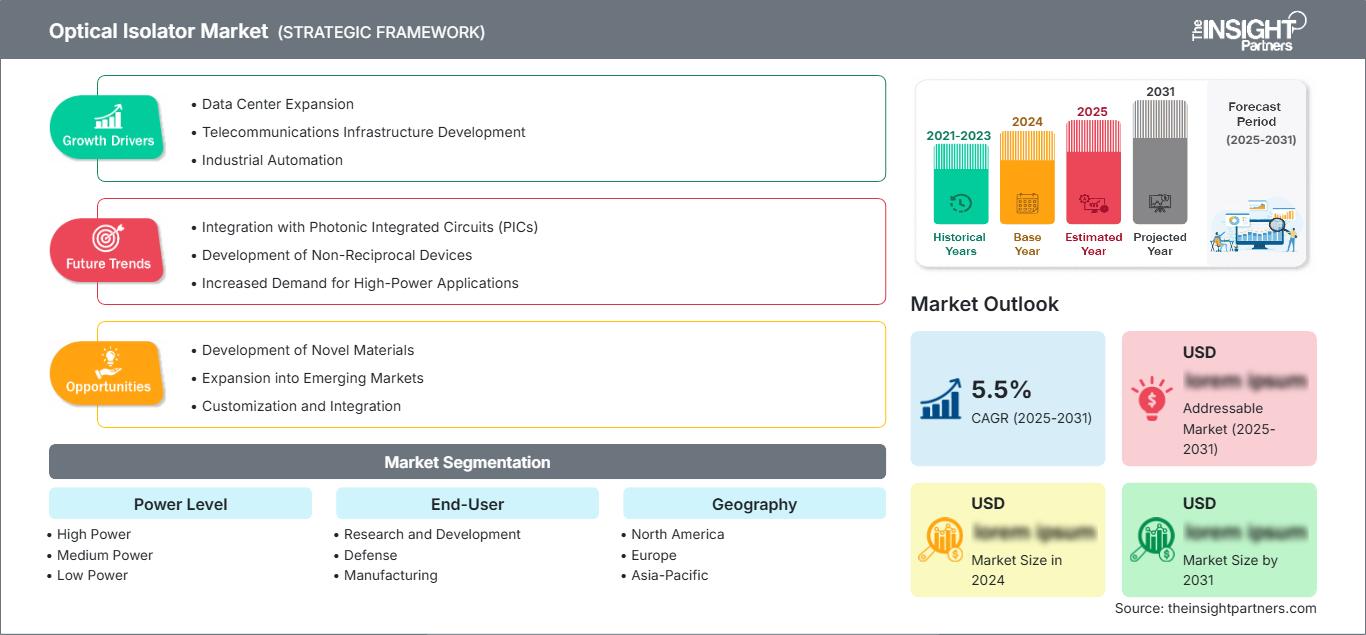
Optical Isolator Market reached US$ 886.73 Million in 2025 and is projected to reach US$ 1,218.62 Million by 2034, registering a CAGR of 4.05% during 2026–2034. The market covers passive non-reciprocal optical components used to suppress reflected light and stabilize lasers, fiber links, sensing systems, and photonic instruments across research, industrial, defense, medical, and consumer applications.
North America Optical Isolator Market Size is expected to maintain a structurally strong position, supported by advanced laser research, defense photonics, semiconductor manufacturing, and expanding high-performance computing infrastructure. The regional growth trajectory is modeled at 4.0–4.6% during 2026–2034, with demand strengthened by domestic photonics manufacturing, university laboratories, and investment in precision optical systems.
Optical Isolator Market Assessment and Insights
- North America: North America is estimated to hold a 30–34% share in 2025 and expand at a 4.0–4.6% CAGR between 2026–2034, supported by defense photonics, advanced research infrastructure, and domestic optical component manufacturing.
- US: The US represents approximately 72–76% of North America's 2025 demand and is projected to grow at a 4.1–4.7% CAGR during 2026–2034, led by lasers, aerospace, research, and photonic computing.
- Europe: Europe is estimated at a 24–28% share in 2025 and is modeled to grow at a 3.7–4.3% CAGR during 2026–2034. Germany, the UK, France, Italy, and Spain support demand through industrial lasers, medical optics, research, and advanced manufacturing.
- Asia Pacific: Asia Pacific accounts for an estimated 31–35% share in 2025 and is projected to expand at a 4.4–5.1% CAGR during 2026–2034, with China, Japan, South Korea, and India supporting electronics, communications, and manufacturing demand.
- Largest Segment: High Power is estimated to represent a 40–44% market share in 2025 and is projected to expand at a 4.1–4.6% CAGR during 2026–2034, reflecting demanding laser applications.
- High Growth Segment: Research and Development is estimated at a 17–21% market share in 2025 and is modeled to grow at a 4.8–5.4% CAGR during 2026–2034, supported by photonics innovation.
- Key companies analyzed in detail: AC Photonics, Inc.; AFW Technologies Pty Ltd.; Agiltron Inc.; Corning Incorporated; DK Photonics Technology; Gould Fiber Optics; Innolume GmbH; Opto-Link Corporation Limited; Thorlabs, Inc.; TOPTICA Photonics.
Source: The Insight Partners' analysis based on proprietary research, government publications, company annual reports, investor presentations, industry databases, and expert interviews.
The market has evolved from the conventional isolated Faraday isolators to small size application-specific isolators that have been optimized in relation to their wavelengths, polarization, insertion losses, return losses, and power handling. Fiber coupled isolators are gaining more popularity along with the traditional free space isolators, while high power isolators meet the demands of lasers. The economics of production will depend on magneto-optic crystals, polarizers, coatings, fiber coupling, assembly, environmental testing, and packaging.
Future growth of the market will be determined by the geographic distribution of photonics manufacturing and local supply chain strategies. Investments in semiconductor and AI infrastructure in North America, photonics in Europe, and electronics manufacturing in Asia offer complementary demand opportunities. Emphasis on resilient technology supply chains in the regulatory arena may promote regional manufacturing of optical components, while investments in quantum computing, medical instrumentation, sensors, and military systems will provide alternative applications for isolators.
Optical Isolator Market Report Scope
| Report Attribute | Details |
|---|---|
| Market size in 2025 | US$ 886.73 Million |
| Market Size by 2034 | US$ 1,218.62 Million |
| Global CAGR (2026 - 2034) | 4.05% |
| Historical Data | 2021-2024 |
| Forecast period | 2026-2034 |
Optical Isolator Market Analysis
Optical Isolator Market growth of optical isolator is driven by growing demand for devices where use of lasers and optical fibers may create an unstable source operation due to the optical feedback. Optical isolator components are used in the telecommunication industry, in fiber lasers, in spectroscopy, in OCT, in sensors and in precision instruments. The supply chain includes magnetooptic materials producers, optical elements manufacturers, fiber and laser producers, precision assemblers, OEM integrators and research facilities. So, competitive advantage of the supplier is based on such characteristics as insertion loss, isolation, power capacity, wavelength dependence, polarization and environmental stability.
Supply market is still divided according to application. For standardized telecom components standard manufacturing processes exist, while high-power and specialty wavelength products have stricter requirements concerning optical alignment, heat dissipation, coatings and validation. Customized products are technologically more advanced but their engineering time is longer. This results in the value chain favoring integrated design, assembly, testing and customization capabilities of suppliers.
Optical Isolator Market report reveals a fragmented competitive landscape consisting of diversified photonics players along with specialized components providers. The presence of broad optical connectivity solutions is an advantage for Corning Incorporated, while Thorlabs, Inc. has a large portfolio that includes free space as well as fiber optic solutions. Application-specific isolator configurations are strengths of AC Photonics, Inc., AFW Technologies Pty Ltd. and DK Photonics Technology. Agiltron Inc. provides a combination of optical components and photonic technologies.
Customization, miniaturization, power handling and wavelength range, and not only component availability are becoming important for competitive positioning. Gould Fiber Optics, Innolume GmbH, Opto-Link Corporation Limited and TOPTICA Photonics are bringing specialized skills to fiber optics, laser, and scientific photonics segments. Consequently, key investments will be made in precision assembly, advanced materials, photonic architectures and application qualification. Suppliers can gain competitive advantages through providing design-in capability along with continuous engineering support throughout product development process.
● REPORT CUSTOMIZATION
Tailor This Report To Align With Your Specific Business Requirements
This report can be customized to align precisely with your business objectives, scope, and target markets. Customization options include tailored segmentation, geography, competitive analysis, and strategic insights to support informed decision-making.
Customize This Report →WHAT YOU CAN ADJUST
- ● Segmentations
- ● Geography
- ● Competitive Analysis
- ● Language Preferences
Optical Isolator Market: Strategic Insights
Regional Insights
North America Optical Isolator Market
It is estimated that North America will constitute 30-34% of global demand in 2025, with CAGR at 4.0-4.6% up to 2034. The USA leads the regional market due to defense laboratories, semiconductor research, laser production, and photonics programs. Canada makes its contribution through telecommunications, scientific research, and sensing applications, while regional suppliers enjoy an advantage of already available technologies in precision optics.
In addition, the demand in the region is driven by investment into advanced computing and optical connectivity. Defense applications need robust components that are capable of maintaining isolation during harsh working conditions, while research laboratories prefer wavelength versatility and low insertion losses. The supplier base of the region consists of specific component makers and diversified photonics producers; therefore, customers can acquire standard and customized products.
U.S. Optical Isolator Market
According to market estimates, the United States will account for 72–76% of North American demand by 2025 and have a forecasted CAGR of 4.1–4.7% through 2034. Its dominance is attributed to the presence of many defense contractors, research labs, laser developers, manufacturers of medical devices, and semiconductor firms. Increasingly, applications stress the importance of reliability, accuracy, and integration within small optical assemblies.
Firms such as Agiltron Inc., Corning Incorporated, and Thorlabs, Inc. contribute to the domestic ecosystem along with specialist suppliers. Research labs continue to be key buyers since applications for quantum optics, atomic physics, spectroscopy, and high power lasers necessitate successful optical feedback suppression. Military and aerospace sectors generate demand for rugged optical components whereas medical and industrial applications expand the scope of applications.
Europe Optical Isolator Market
The region of Europe has been projected to possess a 24-28% share in 2025 and grow at a 3.7-4.3% CAGR up till 2034. Leading countries in the region are expected to be Germany with industrial lasers, scientific instrumentation, automobile production, and engineering capabilities, followed by the United Kingdom with university research programs, defense photonics, and quantum technology. Other European countries contributing are France with aerospace, medical opticals, and research, along with Italy and Spain through their manufacturing facilities, research laboratories, and laser application.
Regional markets have access to experienced optical engineering capabilities and photonic systems being used across industries. Germany, through its industrial capability, demands high-performance optical components, whereas the United Kingdom and France demand research-oriented solutions. Italy and Spain contribute to the demand through industrial automation, medicine, and scientific applications. European suppliers are expected to concentrate on assembling compact optical parts, specialization in wavelength and integration of advanced laser platforms.
APAC Optical Isolator Market
The APAC market is predicted to account for 31–35% of world demand in 2025 and is projected to experience 4.4–5.1% growth from 2025 to 2034. China dominates in terms of regional demand, Japan, South Korea, India, and Australia follow. Applications include electronic manufacturing, optical fibers, semiconductor manufacturing, and R&D funding.
China provides component demand due to large-scale manufacturing, Japan and South Korea due to advanced electronics and precision optics, India via expansion of photonics R&D and manufacturing, and Australia via scientific equipment, defense R&D, and sensing. Local government policies aimed at developing semiconductor, telecommunications, and advanced manufacturing industries can increase demands for high quality optical components.
Middle East & Africa Optical Isolator Market
The Middle East & Africa region is relatively small but expected to grow by a modeled CAGR of 3.2–4.0% until 2034. Both Saudi Arabia and the UAE show the most prominent adoption in this region thanks to the development of infrastructure, industry diversification, modernization of the military sector, and technological innovations. South Africa offers contributions in the form of research work, mining technologies, telecommunication technologies, and scientific instruments.
The basis for the opportunity in this region is connected to infrastructure modernization and technology needs in the energy sector. Saudi Arabia and the UAE are boosting their investments in digital and industrial technologies, whereas South Africa offers a more research-based photonics ecosystem. The Rest of MEA is still dependent on telecommunication technologies, industrial control and monitoring systems, and imported precision devices.
Segmentation Analysis
Power Level
Power Level segmentation is projected to expand at a 3.8–4.5% CAGR during 2026–2034. High-power configurations remain strategically important because fiber lasers, industrial processing systems, defense lasers, and scientific instruments require strong protection against reflected optical energy. Medium- and low-power products retain broad applicability across communications, instrumentation, sensing, and laboratory systems, creating a diversified demand base.
- High Power: High-power isolators hold the strongest position because demanding laser architectures require robust back-reflection suppression, thermal stability, and reliable operation at elevated optical intensities. Their strategic importance is highest in industrial, defense, and scientific laser platforms.
- Medium Power: Medium-power products serve a broad middle ground spanning instrumentation, fiber systems, medical equipment, and laboratory lasers. Their balanced performance and cost characteristics support recurring demand across established optical architectures.
- Low Power: Low-power isolators remain important for compact lasers, sensing equipment, spectroscopy, and research instruments. Their smaller form factors and wavelength flexibility support integration into space-constrained optical assemblies.
End-User
End-User demand is projected to grow at a 4.0–5.0% CAGR during 2026–2034. Research and Development remains strategically significant because emerging laser architectures, quantum photonics, sensing platforms, and integrated optics require reliable optical isolation. Defense, manufacturing, consumer electronics, and medical applications broaden the addressable market and support diversification beyond laboratory environments.
- Research and Development: Research institutions require flexible wavelength, polarization, and power configurations for experimental lasers, spectroscopy, quantum photonics, and precision measurements. Customization and rapid prototyping make this sub-segment strategically important.
- Defense: Defense applications prioritize ruggedness, environmental stability, low optical loss, and dependable feedback suppression. Demand is linked to laser systems, sensing, targeting, communications, and other mission-critical photonic architectures.
- Manufacturing: Manufacturing users apply isolators within industrial lasers, inspection systems, metrology equipment, and automated production platforms. Consistent performance and durability are central purchasing criteria for high-utilization equipment.
- Consumer Electronics: Consumer electronics applications require compact and cost-sensitive optical components for sensing, imaging, and laser-based functions. Miniaturization, manufacturability, and integration efficiency remain important strategic considerations.
- Medical: Medical applications use optical isolation in laser systems, diagnostic instrumentation, imaging, and precision treatment equipment. Reliability, low insertion loss, and repeatable optical performance are particularly important for regulated equipment designs.
Opportunity Snapshot
| End Users | Revenue Contribution (High/Medium/Low) | Trend Tag | Adoption Stage |
| Research and Development | High | Quantum Photonics | Scaling |
| Defense | High | Rugged Lasers | Scaling |
| Manufacturing | High | Laser Processing | Mature |
| Consumer Electronics | Medium | Compact Optics | Scaling |
| Medical | Medium | Laser Diagnostics | Scaling |
Optical Isolator Market Growth Drivers and Impact Analysis
Expansion of High-Power Laser Applications
Industrial and scientific laser systems increasingly require reliable suppression of reflected optical energy as power levels rise and optical architectures become more sensitive. Fiber lasers used in cutting, welding, marking, and precision processing place greater emphasis on thermal stability, return-loss control, and component durability. Defense and research programs similarly require isolators that preserve laser stability under demanding conditions. This driver benefits high-power products by increasing the value placed on performance rather than component price alone. It also encourages suppliers to develop improved coatings, larger apertures, enhanced thermal management, and rugged packaging. The resulting market impact extends beyond unit demand because customers increasingly evaluate isolators as performance-critical elements of complete laser systems.
Growth of Photonics-Based Research and Instrumentation
Investment in quantum photonics, spectroscopy, precision measurement, sensing, and advanced imaging is creating demand for optical systems with increasingly stringent stability requirements. Optical feedback can introduce noise, frequency instability, or unwanted interference, making isolation important in many experimental configurations. Research laboratories also require diverse wavelength and power options because development programs frequently operate across multiple optical platforms. This supports suppliers capable of producing customized and low-volume components without compromising optical specifications. Over time, laboratory requirements can transition into commercial product requirements when experimental architectures move toward industrialization. The market impact is therefore amplified by the design-in nature of research procurement, as components validated in laboratory systems can become embedded within subsequent commercial instrumentation and photonic equipment.
Increasing Integration of Fiber-Based Optical Architectures
The expansion of fiber-based sensing, communications, medical instrumentation, and laser systems increases the need for compact optical components that can be incorporated into increasingly dense assemblies. Fiber-coupled isolators reduce alignment complexity and can protect sensitive laser sources without requiring large free-space optical layouts. This is particularly relevant to OEM developers seeking repeatable component integration across standardized platforms. The resulting demand favors suppliers with strong fiber handling, precision alignment, packaging, and testing capabilities. It also creates opportunities for customized wavelength bands and polarization-maintaining configurations. As optical systems become more integrated, component suppliers increasingly compete on packaging dimensions, insertion loss, reliability, and compatibility with customer assemblies rather than on isolation performance as a standalone specification.
Optical Isolator Market Future Trends
Miniaturized and Integrated Non-Reciprocal Photonics
The next stage of optical isolation development is likely to emphasize miniaturization and integration with photonic circuits. Conventional magneto-optic architectures remain valuable, but researchers are advancing approaches that can reduce footprint and simplify integration with waveguides and chip-scale systems. Hybrid Faraday structures, thin-film materials, and dynamically modulated non-reciprocal devices could eventually complement discrete components in selected applications. The Optical Isolator Market trend is especially relevant to quantum photonics, coherent communications, and dense optical computing architectures where component count and footprint influence system efficiency. Suppliers that can combine isolation, polarization control, and coupling functions within compact packages may gain design-in opportunities as customers move from laboratory-scale assemblies toward scalable photonic platforms.
Broader Wavelength and Environmental Performance Requirements
Future product development is expected to extend operating windows while improving stability across temperature, vibration, optical power, and polarization conditions. Demand is likely to increase for isolators supporting visible, near-infrared, infrared, and specialty wavelengths used in medical, sensing, spectroscopy, and scientific systems. Customers will increasingly specify performance under actual operating environments rather than relying solely on room-temperature laboratory specifications. This shift can encourage suppliers to refine magneto-optic materials, coatings, thermal designs, and packaging methods. The competitive advantage will increasingly come from predictable performance across the full operating envelope. Customization capabilities may therefore become more important as photonic OEMs seek components optimized for specific wavelength, power, aperture, and environmental requirements.
Optical Isolator Market Opportunities
Design-In Partnerships With Photonic OEMs
Suppliers can capture incremental value by establishing early-stage engineering relationships with laser, sensing, medical, and instrumentation OEMs. Early design participation allows manufacturers to tailor wavelength, power, polarization, package geometry, and connector requirements before system architecture is finalized. Such collaboration can reduce substitution risk because validated components become embedded within qualified platforms. The Optical Isolator Market forecast opportunity is particularly attractive for manufacturers capable of rapid prototyping followed by consistent volume production. Investment in application engineering, automated alignment, and qualification laboratories can strengthen this strategy. Suppliers can also create modular product families that share internal architectures while accommodating customer-specific specifications. This approach can improve manufacturing efficiency while preserving customization, supporting stronger long-term relationships with photonic equipment developers.
Localized Supply Chains for Specialty Photonics Components
The geographic concentration of advanced photonics manufacturing creates opportunities for suppliers to establish regional assembly, testing, and qualification capabilities closer to major customers. Localized production can shorten lead times, improve technical responsiveness, and reduce procurement exposure for defense, medical, semiconductor, and industrial customers. Regional facilities can focus on final assembly and qualification while retaining centralized production of specialized optical elements. This model can also support compliance requirements where customers prefer domestic or regionally controlled supply chains. Investment priorities include precision alignment equipment, environmental testing, optical metrology, and automated quality inspection. Companies that combine regional responsiveness with globally consistent component specifications can improve procurement attractiveness without requiring complete duplication of upstream manufacturing infrastructure.
Frequently Asked Questions

- Comprehensive Market Sizing and Forecast Analysis
- Detailed Segmentation Analysis
- In-Depth Market Dynamics Assessment
- Regional and Country-Level Insights
- Competitive Landscape and Company Benchmarking
- Strategic Business Intelligence
Recent Reports
Testimonials

The Insight Partners provided valuable market intelligence that supported our global go-to-market strategy. Their team was professional, responsive, and attentive to our feedback, providing thoughtful analysis and helpful methodological clarifications throughout the project.
Junmo Kim Chief Financial Officer (CFO), Enertech Co., Ltd.
The Insight Partners' SCADA System Market report is comprehensive, with valuable insights on current trends and future forecasts. The team was highly professional, responsive, and supportive throughout. We are very satisfied and highly recommend their services.
RAN KEDEM Partner, Reali Technologies LTDs
I requested a report on a very specific software market and the team produced the report in a few days. The information was very relevant and well presented. I then requested some changes and additions to the report. The team was again very responsive and I got the final report in less than a week.
JEAN-HERVE JENN Chairman, Future Analytica
We worked with The Insight Partners for an important market study and forecast. They gave us clear insights into opportunities and risks, which helped shape our plans. Their research was easy to use and based on solid data. It helped us make smart, confident decisions. We highly recommend them.
PIYUSH NAGPAL Sr. Vice President, High Beam Global
The Insight Partners delivered insightful, well-structured market research with strong domain expertise. Their team was professional and responsive throughout. The user-friendly website made accessing industry reports seamless. We highly recommend them for reliable, high-quality research services
YUKIHIKO ADACHI CEO, Deep Blue, LLC.
This is the first time I have purchased a market report from The Insight Partners.While I was unsure at first, I visited their web site and felt more comfortable to take the risk and purchase a market report.I am completely satisfied with the quality of the report and customer service. I had several questions and comments with the initial report, but after a couple of dialogs over email with their analyst I believe I have a report that I can use as input to our strategic planning process.Thank you so much for taking the extra time and making this a positive experience.I will definitely recommend your service to others and you will be my first call when we need further market data.
JOHN SUZUKI President and Chief Executive Officer, Board Director, BK Technologies
I wish to appreciate your support and the professionalism you displayed in the course of attending to my request for information regarding to infectious disease IVD market in Nigeria. I appreciate your patience, your guidance, and the fact that you were willing to offer a discount, which eventually made it possible for us to close a deal. I look forward to engaging The Insight Partners in the future, all thanks to the impression you have created in me as a result of this first encounter.
DR CHIJIOKE ONYIA MANAGING DIRECTOR, PineCrest Healthcare Ltd.Reason to Buy
- Informed Decision-Making
- Understanding Market Dynamics
- Competitive Analysis
- Identifying Emerging Markets
- Customer Insights
- Market Forecasts
- Risk Mitigation
- Boosting Operational Efficiency
- Strategic Planning
- Investment Justification
- Tracking Industry Innovations
- Aligning with Regulatory Trends





 Get Free Sample for