
PCR Detection Systems Market Growth, Trends & Demand by 2034
Coverage: by Type (Nested PCR Detection systems, Real-Time PCR Detection Systems); Application (Food and Beverages, Pharmaceuticals, Healthcare, Research Laboratories, Others) , and Geography (North America, Europe, Asia Pacific, and South and Central America)
- Status : Data Released
- Report Code : TIPRE00006354
- Category : Electronics and Semiconductor
- No. of Pages : 150
- Available Report Formats :


- Last update date : October 15, 2026


2025 Market Size
US$ 5.06 Bn
Base year value
2034 Forecast
US$ 7.76 Bn
Projected by 2034
CAGR 2026-2034
5.49 %
Growth rate
Addressable Market
US$ 60.06 Bn
(2026-2034)
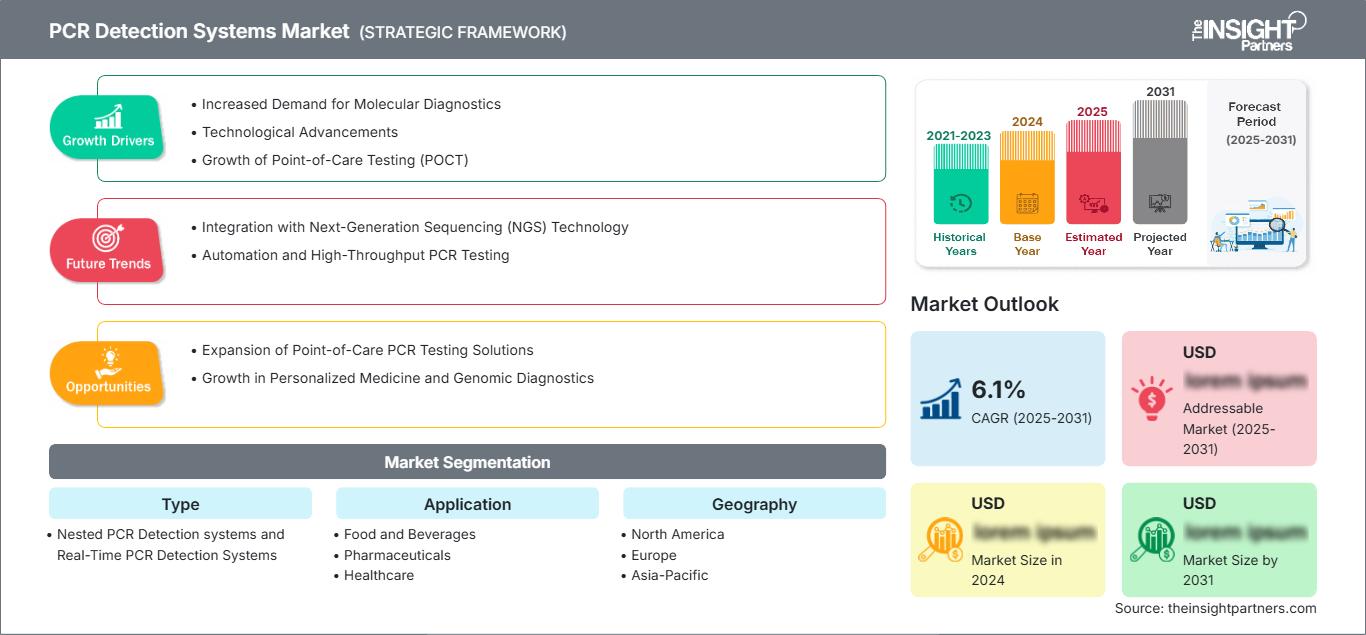
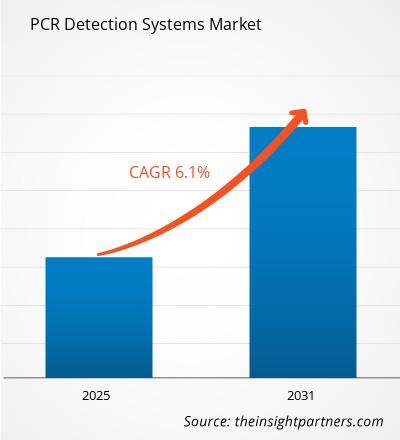
The PCR Detection Systems Market was valued at US$ 5.06 Billion in 2025 and is projected to reach US$ 7.76 Billion by 2034, expanding at a CAGR of 5.49% during 2026–2034. The market encompasses systems supporting targeted nucleic-acid amplification across clinical, pharmaceutical, food, beverage, and research workflows, with adoption shaped by demand for sensitive molecular detection, faster laboratory decisions, and increasingly standardized testing protocols.
The PCR Detection Systems Market size in North America is supported by established molecular diagnostic infrastructure, high laboratory automation penetration, and sustained demand for infectious-disease and food-safety testing. The region is expected to expand at approximately 5.1–5.8% CAGR through 2034, with replacement demand and multiplex workflow adoption supporting system investments.
PCR Detection Systems Market Assessment and Insights
- North America: North America is estimated to hold a 34–38% share in 2025 and expand at a 5.1–5.8% CAGR between 2026–2034, supported by advanced laboratories, regulatory maturity, and broad molecular testing adoption.
- US: The US accounts for an estimated 27–31% of global revenue in 2025 and is projected to grow at a 5.0–5.7% CAGR during 2026–2034.
- Europe: Europe represents approximately 27–31% share in 2025 and is expected to grow at a 5.0–5.7% CAGR through 2034, led by Germany, the UK, France, Italy, and Spain.
- Asia Pacific: Asia Pacific holds an estimated 23–27% share in 2025 and is forecast to record a 6.0–6.8% CAGR during 2026–2034, led by China, Japan, South Korea, and India.
- Largest Segment: Real-Time PCR Detection Systems represents an estimated 70–74% market share in 2025 and is projected to expand at a 5.6–6.2% CAGR during 2026–2034.
- High Growth Segment: Nested PCR Detection systems account for approximately 26–30% share in 2025 and are expected to grow at a 4.9–5.6% CAGR during 2026–2034.
- Key companies analyzed in detail: Abbott Laboratories; Agilent Technologies, Inc.; Analytik Jena GmbH; bioMérieux, Inc.; Bio-Rad Laboratories, Inc.; BIOTECON Diagnostics GmbH; F. Hoffmann-La Roche Ltd; Hangzhou Bioer Technology Co., Ltd.; Hygiena, LLC; QIAGEN N.V.
Source: The Insight Partners' analysis based on proprietary research, government publications, company annual reports, investor presentations, industry databases, and expert interviews.
PCR detection has come a long way from being a more specialized process in molecular biology to becoming a combined laboratory process that encompasses amplification, fluorescence detection, software, automation, and standardized consumables. Real-time systems have increasingly improved acceptance by simplifying post-amplification processing and facilitating quantifiable results. The production process has been impacted accordingly as instrument platforms have increasingly become a factor in purchase decisions along with instrument characteristics.
In the future, acceptance is forecasted to expand to newly developing laboratories in Asia, regional food testing labs, pharmaceutical quality control laboratories, and decentralized clinical networks. Increased regulatory attention on the aspects of analytical validity, laboratory quality systems, and rapid disease detection will further drive the acceptance process. Activities by WHO on the topics of standardizing PCR processes and access to molecular diagnostics show the continued institutional interest in standardized nucleic acid testing processes.
PCR Detection Systems Market Report Scope
| Report Attribute | Details |
|---|---|
| Market size in 2025 | US$ 5.06 Billion |
| Market Size by 2034 | US$ 7.76 Billion |
| Global CAGR (2026 - 2034) | 5.49% |
| Historical Data | 2021-2024 |
| Forecast period | 2026-2034 |
PCR Detection Systems Market Analysis
The growth drivers behind PCR detection systems market include laboratories desiring high sensitivity, reproducibility, and rapid turnaround for molecular targets. Health care applications continue to be significant, but food and beverages laboratories are increasingly adopting automated PCR workflow for pathogen and authenticity testing. Reliable amplification platforms are required by pharmaceutical manufacturers for quality control, microbiology, research and development activities within increasingly sophisticated biological pipelines.
The industry chain in the PCR Detection Systems Market Report includes instrument makers, assay providers, reagent makers, sample preparation companies, lab software companies, distributors, and service providers. In terms of the supply dynamic, there is a need for multi-purpose systems that are capable of working on several assays as opposed to single purpose systems that can only do one assay. Cloud connectivity, automation, multiplexing, and workflow integration can help maximize the use of the lab, while reagent sales are a consistent revenue stream for suppliers.
Competition is based on broad portfolios, assay compatibility, presence of laboratory infrastructure, regulatory skills, and geographical reach. F. Hoffmann-La Roche Ltd, Abbott Laboratories, bioMérieux, Inc., Bio-Rad Laboratories, Inc., and QIAGEN N.V. compete on integrated molecular workflows, whereas Agilent Technologies, Inc. and Analytik Jena GmbH focus on instrumentation and laboratory technology skills. Specialists add to the competition in food safety and applied analysis.
Capital investments in equipment have been directed towards fields like automation, multiplexing, workflow management, and specialty testing. For instance, in 2025, Bio-Rad Laboratories, Inc. has been growing their portfolio of PCR through innovation as well as acquisitions of Stilla Technologies. This is an example where a company can grow its portfolio in order to increase its molecular analysis capabilities.
● REPORT CUSTOMIZATION
Tailor This Report To Align With Your Specific Business Requirements
This report can be customized to align precisely with your business objectives, scope, and target markets. Customization options include tailored segmentation, geography, competitive analysis, and strategic insights to support informed decision-making.
Customize This Report →WHAT YOU CAN ADJUST
- ● Segmentations
- ● Geography
- ● Competitive Analysis
- ● Language Preferences
PCR Detection Systems Market: Strategic Insights
Regional Insights
North America PCR Detection Systems Market
North America is forecasted to account for 34%–38% of global revenue in 2025 and is expected to show a CAGR of 5.1%–5.8% between 2025 and 2034. The United States is the major contributor, due to the presence of well-established clinical lab facilities, R&D in pharmaceuticals, food safety initiatives, and molecular diagnostics.
North America is blessed with well-developed supplier channels and a well-developed installed base in terms of hospitals, diagnostic labs, universities, pharmaceuticals, and food companies. The need is shifting towards real-time systems capable of offering automation, multiplexing, connectivity, and proper analysis of data. The wide scope of application makes it unnecessary to rely on one testing technology.
U.S. PCR Detection Systems Market
The US is estimated to account for 27–31% of global revenue and approximately 79–83% of North American revenue in 2025. Its market is projected to grow at a 5.0–5.7% CAGR through 2034, supported by advanced clinical laboratories and pharmaceutical research.
The list of companies offering their products and services is long, and includes such names as Abbott Laboratories, Agilent Technologies Inc., Bio-Rad Laboratories Inc., F. Hoffmann-La Roche Ltd., and QIAGEN N.V. The trend in application is leaning toward automated real-time processes for studies in infectious diseases, food safety, oncology, and pharmaceuticals.
Europe PCR Detection Systems Market
The European region accounts for 27-31% of the PCR Detection Systems Market share in 2025 and is expected to register a CAGR of 5.0-5.7%. Germany dominates as the largest national market driven by industrial laboratory facilities, pharmaceutical research, and diagnostic technology infrastructure.
High demand is maintained by the United Kingdom through academic research, clinical diagnostics, and public labs. In Germany, there are strong activities in pharmaceuticals and biotech industries whereas in France, demand has been driven through clinical laboratories, food safety testing, and healthcare applications. Modernization in diagnostics, food assurance and pharmaceutical manufacturing has resulted in the development of Italy and Spain.
APAC PCR Detection Systems Market
APAC constitutes around 23-27% market share in 2025 and will continue its growth at a CAGR of 6.0-6.8% up to 2034. In APAC, China holds the highest market share, trailed by Japan, South Korea, India, and Australia with the demand fueled by the development of laboratory infrastructure.
Growing adoption will come from industrial testing, pharmaceutical production, disease surveillance, food safety, and biotechnology investments. The development of national laboratories and the promotion of local production of diagnostics can help gain access to molecular technologies.
Middle East & Africa PCR Detection Systems Market
The MEA region will register an annual growth rate of 5.4-6.2%, reaching 2034, with Saudi Arabia and UAE driving growth in Gulf markets, and South Africa being the primary market in Africa for laboratories. Modernizing healthcare contributes to investments in molecular diagnostic technologies.
Saudi Arabia and UAE are improving their laboratory capabilities along with building up healthcare infrastructure, while South Africa will provide demand for laboratories through infectious disease diagnostics and R&D activities. Adoption in the Rest of MEA will be more dependent on the infrastructure, which will lead to scalable solutions.
Segmentation Analysis
Type
PCR Detection Systems Market adoption by type is shaped by analytical sensitivity, workflow complexity, throughput, and the requirement for quantitative versus endpoint interpretation. Real-time systems remain central to routine molecular workflows, while nested approaches retain relevance where target sensitivity and amplification specificity are important. The type segment is projected to expand at a 5.3–6.0% CAGR during 2026–2034.
- Nested PCR Detection systems: Nested PCR Detection systems retain relevance in research and specialized diagnostic workflows where enhanced target specificity and sensitivity are important. Their strategic role is strongest in applications requiring additional amplification selectivity.
- Real-Time PCR Detection Systems: Real-Time PCR Detection Systems dominate routine quantitative molecular workflows because fluorescence-based monitoring supports rapid interpretation, reduced post-amplification handling, and integration with automated laboratory processes.
Application
Application demand is diversified across food and beverages, pharmaceuticals, healthcare, and research laboratories. Healthcare remains strategically important because molecular testing supports infectious-disease detection and surveillance, while food and pharmaceutical applications broaden recurring demand. The application segment is projected to grow at a 5.5–6.1% CAGR during 2026–2034.
- Food and Beverages: Food and beverage laboratories use PCR for pathogen, authenticity, and quality testing, making rapid and scalable workflows strategically important for release decisions, contamination control, and regulatory compliance.
- Pharmaceuticals: Pharmaceutical laboratories require molecular amplification for research, quality control, microbiological monitoring, and development workflows. Demand favors validated platforms offering reproducibility, traceability, and compatibility with controlled laboratory environments.
- Healthcare: Healthcare applications center on infectious disease, oncology research, genetic analysis, and other molecular workflows. Adoption is supported by requirements for sensitive detection, rapid results, standardized protocols, and growing laboratory automation.
- Research Laboratories: Research laboratories value flexible systems capable of supporting diverse assays, experimental designs, and quantitative workflows. Open platforms and broad reagent compatibility are strategically relevant for universities, biotechnology companies, and translational research.
Opportunity Snapshot
| Application | Revenue Contribution (High/Medium/Low) | Trend Tag | Adoption Stage (Emerging/Scaling/Mature) |
| Food and Beverages | Medium | Pathogen Testing | Scaling |
| Pharmaceuticals | Medium | QC Automation | Scaling |
| Healthcare | High | Molecular Diagnostics | Mature |
| Research Laboratories | High | Assay Flexibility | Mature |
PCR Detection Systems Market Growth Drivers and Impact Analysis
Expansion of Molecular Testing Across Infectious-Disease Programs
The importance of molecular diagnostic testing is increasing in terms of strategic consideration due to its early and effective detection capability in the identification of pathogens. WHO has stressed the need for increased access to molecular testing through the adoption of new generation point-of-care nucleic acid amplification tests for tuberculosis. The potential of such policy orientation is that it increases the scope for laboratories from which the test can be conducted. In the case of PCR system manufacturers, the influence goes beyond the sale of the instrument itself as the increased volume of testing generates ongoing need for reagents, assays, services, and software. Turnaround time, workflow and multiplicity of targets are also important considerations when assessing the system by laboratories, making it favorable for companies with a complete workflow solution rather than amplification instruments alone.
Automation and Throughput Requirements in Food Safety Testing
There is an increasing need for food companies and laboratories to have workflow capabilities which will enable them to work with larger samples without the need to increase the level of manual effort required. The PCR systems are able to achieve this since they provide quick pathogen detection and standard molecular workflows. Food testing systems in the market today have assays, instruments and software which allow for pathogen testing and other quality tests in a streamlined manner. This has a great market impact because quicker testing will be able to minimize any delays in releasing products and contamination problems. Laboratories will be keen on acquiring systems which provide scalability in throughput, easy workflows, automated results and wider target range.
Rising Need for Standardized, Reproducible Molecular Workflows
Standardization of laboratory equipment is becoming increasingly significant as molecular diagnostics becomes widespread in healthcare and scientific environments. WHO's efforts on PCR process harmonization illustrate the significance of having standard operating procedures, external quality assessments, proper training of personnel, and implementation of processes. In this scenario, the significance of having equipment which enables the provision of reproducible thermal cycling, validated assay compatibility, quality control, trackability, and software-enabled interpretations becomes very significant. Providers of laboratory equipment can distinguish themselves through protocol specificity and service provisions apart from simply providing hardware products. To laboratories, standardization of processes would eliminate operator variability and streamline quality management processes. In terms of business impact, the move to well-documented platforms with broad assay availability and reliable technical support is slowly emerging.
PCR Detection Systems Market Future Trends
AI-Assisted Result Interpretation and Connected Laboratory Workflows
Future PCR platforms are likely to integrate more sophisticated software for automated quality checks, curve interpretation, anomaly detection, and result review. Connectivity can link instruments with laboratory information systems, cloud environments, and centralized quality dashboards, reducing transcription and improving traceability. As laboratories manage larger datasets, software functionality may increasingly influence procurement decisions alongside thermal performance. Vendors can also use connected systems to support remote diagnostics, instrument monitoring, workflow optimization, and predictive maintenance. These capabilities could improve utilization and reduce downtime across distributed laboratory networks. The trend is particularly relevant to multi-site healthcare providers, contract laboratories, pharmaceutical manufacturers, and large food-testing organizations seeking consistent workflows across locations. Greater digital integration may therefore transform PCR systems from individual instruments into connected analytical nodes within broader laboratory infrastructure.
Multiplex and Flexible Assay Architectures for Broader Testing
Multiplex testing in the PCR Detection Systems Market Trends is expected to become more important as laboratories seek broader information from limited samples and fewer analytical runs. Improvements in optical channels, assay design, reagent chemistry, and software interpretation can support simultaneous target detection while preserving workflow efficiency. This direction is particularly relevant to infectious-disease panels, food pathogen screening, and research applications where multiple targets may need evaluation. Flexible platforms that support diverse assays can improve capital utilization because the same instrument can serve multiple laboratory functions. Suppliers may increasingly compete through expandable menus, open architecture, validated assay libraries, and modular automation. The resulting trend could favor systems that balance multiplex capability with simple operation, since laboratories must manage both analytical complexity and staffing constraints while maintaining reproducibility and regulatory confidence.
PCR Detection Systems Market Opportunities
Localized Molecular Testing Infrastructure in Emerging Economies
Emerging markets provide an opportunity to expand PCR capacity through compact systems, regional laboratory networks, and locally supported reagent supply. India, Southeast Asia, Latin America, and selected African markets can benefit from platforms designed around lower infrastructure requirements and scalable throughput. Investment priorities should focus on serviceability, training, assay availability, and dependable supply chains rather than instruments alone. Public-private partnerships can also support laboratory deployment where capital budgets are constrained. The PCR Detection Systems Market Forecast opportunity extends into food safety and pharmaceutical manufacturing, where local testing capability can shorten sample transport and improve production responsiveness. Suppliers that develop region-specific workflows, distributor networks, and financing structures can improve adoption while reducing dependence on centralized testing centers. Such approaches may create durable installed bases and recurring consumable demand.
Application-Specific Platforms for Food and Pharmaceutical Laboratories
Application-specific PCR workflows offer an attractive investment pathway because they connect instrument performance directly with operational outcomes. Food laboratories can prioritize rapid pathogen and authenticity testing, while pharmaceutical users can emphasize validated quality-control and microbiological applications. Vendors can strengthen value propositions by combining instruments with dedicated assays, controls, automation, software, and technical support. This model creates opportunities for recurring revenue while lowering the implementation burden for laboratories that lack extensive molecular expertise. Strategic partnerships with contract testing organizations, pharmaceutical manufacturers, food producers, and laboratory service providers can accelerate deployment. Future investment should also consider interoperability and data integrity, as customers increasingly require traceable results that can move efficiently between analytical instruments and broader quality-management systems.
Frequently Asked Questions

- Comprehensive Market Sizing and Forecast Analysis
- Detailed Segmentation Analysis
- In-Depth Market Dynamics Assessment
- Regional and Country-Level Insights
- Competitive Landscape and Company Benchmarking
- Strategic Business Intelligence
Recent Reports
Testimonials

The Insight Partners provided valuable market intelligence that supported our global go-to-market strategy. Their team was professional, responsive, and attentive to our feedback, providing thoughtful analysis and helpful methodological clarifications throughout the project.
Junmo Kim Chief Financial Officer (CFO), Enertech Co., Ltd.
The Insight Partners' SCADA System Market report is comprehensive, with valuable insights on current trends and future forecasts. The team was highly professional, responsive, and supportive throughout. We are very satisfied and highly recommend their services.
RAN KEDEM Partner, Reali Technologies LTDs
I requested a report on a very specific software market and the team produced the report in a few days. The information was very relevant and well presented. I then requested some changes and additions to the report. The team was again very responsive and I got the final report in less than a week.
JEAN-HERVE JENN Chairman, Future Analytica
We worked with The Insight Partners for an important market study and forecast. They gave us clear insights into opportunities and risks, which helped shape our plans. Their research was easy to use and based on solid data. It helped us make smart, confident decisions. We highly recommend them.
PIYUSH NAGPAL Sr. Vice President, High Beam Global
The Insight Partners delivered insightful, well-structured market research with strong domain expertise. Their team was professional and responsive throughout. The user-friendly website made accessing industry reports seamless. We highly recommend them for reliable, high-quality research services
YUKIHIKO ADACHI CEO, Deep Blue, LLC.
This is the first time I have purchased a market report from The Insight Partners.While I was unsure at first, I visited their web site and felt more comfortable to take the risk and purchase a market report.I am completely satisfied with the quality of the report and customer service. I had several questions and comments with the initial report, but after a couple of dialogs over email with their analyst I believe I have a report that I can use as input to our strategic planning process.Thank you so much for taking the extra time and making this a positive experience.I will definitely recommend your service to others and you will be my first call when we need further market data.
JOHN SUZUKI President and Chief Executive Officer, Board Director, BK Technologies
I wish to appreciate your support and the professionalism you displayed in the course of attending to my request for information regarding to infectious disease IVD market in Nigeria. I appreciate your patience, your guidance, and the fact that you were willing to offer a discount, which eventually made it possible for us to close a deal. I look forward to engaging The Insight Partners in the future, all thanks to the impression you have created in me as a result of this first encounter.
DR CHIJIOKE ONYIA MANAGING DIRECTOR, PineCrest Healthcare Ltd.Reason to Buy
- Informed Decision-Making
- Understanding Market Dynamics
- Competitive Analysis
- Identifying Emerging Markets
- Customer Insights
- Market Forecasts
- Risk Mitigation
- Boosting Operational Efficiency
- Strategic Planning
- Investment Justification
- Tracking Industry Innovations
- Aligning with Regulatory Trends





 Get Free Sample for