
Power Line Communication Market Demand, Size & Forecast by 2034
Coverage: By Type (Narrowband PLC, Broadband PLC); Solution (PLC Over AC lines, PLC Over DC lines); Component (Coupling Capacitor, Line Trap Unit, Transmitters and Receivers, Line Tuners, Others); Application (Commercial, Residential, Automotive, Oil and Gas, Telecommunication, Power Distribution, Healthcare) , and Geography (North America, Europe, Asia Pacific, and South and Central America)
- Status : Data Released
- Report Code : TIPRE00007874
- Category : Electronics and Semiconductor
- No. of Pages : 150
- Available Report Formats :


- Last update date : October 15, 2026


2025 Market Size
US$ 24.6 Bn
Base year value
2034 Forecast
US$ 82.51 Bn
Projected by 2034
CAGR 2026-2034
14.39 %
Growth rate
Addressable Market
US$ 460.22 Bn
(2026-2034)
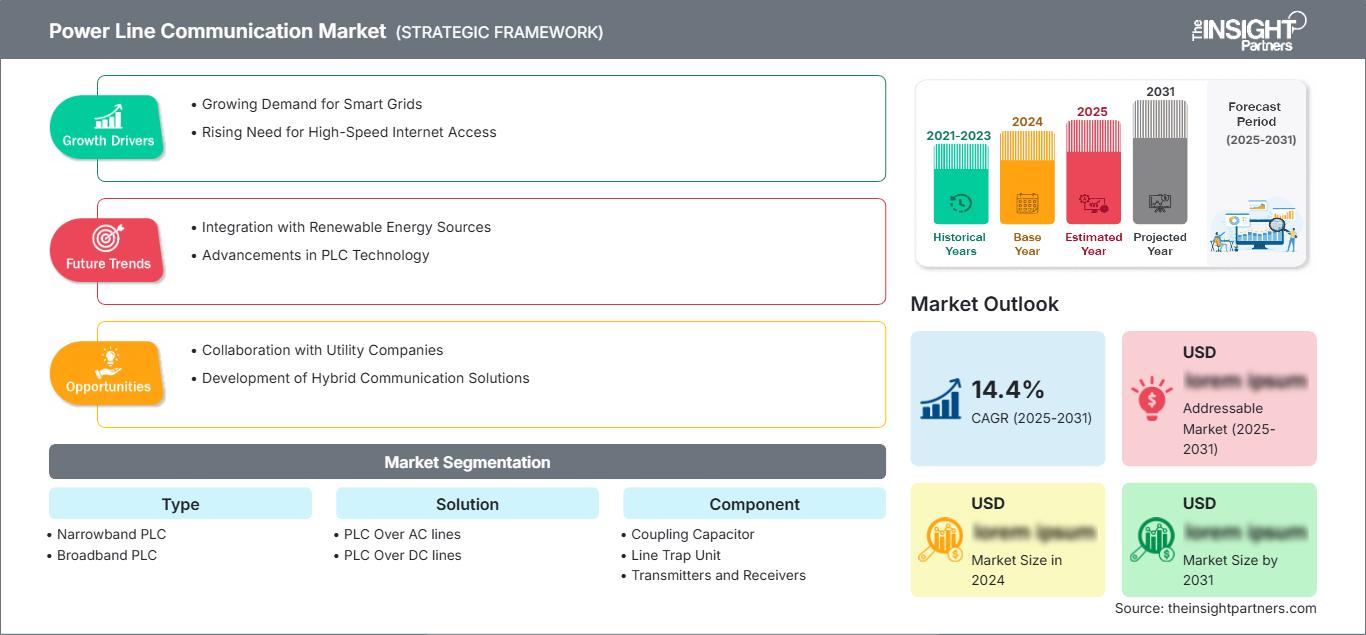
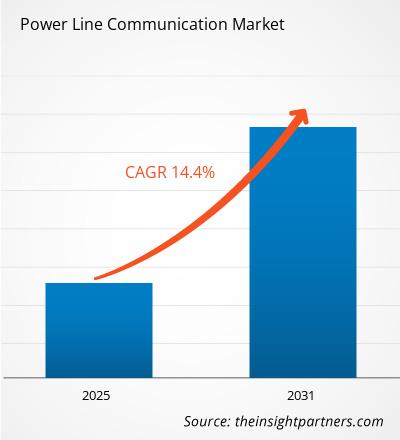
The global Power Line Communication Market reached a valuation of US$ 24.6 Billion in 2025 and is projected to expand to US$ 82.51 Billion by 2034, advancing at a CAGR of 14.39% between 2026 and 2034. This trajectory reflects accelerating grid digitization, rising smart metering deployments, and growing integration of communication infrastructure across utility, industrial, and residential networks worldwide, positioning power line communication as a foundational technology for connected energy ecosystems globally.
Within this landscape, the Power Line Communication Market size across North America is estimated to expand at a CAGR of roughly 12.8% to 13.6% through 2034, propelled by utility grid modernization mandates and widespread smart meter rollouts. Federal infrastructure funding and utilities' preference for advanced metering infrastructure are reinforcing demand, while automotive electrification programs across the United States and Canada further diversify application pathways for narrowband and broadband deployments.
Power Line Communication Market Assessment and Insights
- North America: North America held an estimated 26-30% power line communication market share in 2025, supported by mature utility infrastructure and smart grid investment, and is projected to grow at a CAGR of 12.8-13.6% between 2026 and 2034.
- US: The United States commands the majority of the regional share, contributing an estimated 82-86% of North America's 2025 revenue, with a projected CAGR of 12.9-13.7% through 2034.
- Europe: Europe accounted for approximately 22-26% of the market in 2025, led by Germany, the United Kingdom, and France, and is forecast to expand at a CAGR of 13.5-14.2% through 2034 amid strict grid modernization mandates.
- Asia Pacific: Asia Pacific captured an estimated 30-34% share in 2025, led by China, Japan, and India, and is expected to register the fastest regional CAGR of 15.6-16.4% between 2026 and 2034 amid rapid grid electrification.
- Largest Segment: Narrowband PLC remains the largest type segment, holding an estimated 58-62% share in 2025 and growing at a CAGR of 13.2-13.9% through 2034 on sustained smart metering demand.
- High Growth Segment: Broadband PLC is the fastest-growing type segment, estimated at 38-42% share in 2025 and advancing at a CAGR of 15.8-16.6% through 2034, driven by high-speed grid data needs.
- Key companies analyzed in detail: Maxim Integrated, Inc., Cypress Semiconductor Corporation, Atmel Corporation, Echelon Corporation, Enverv, Inc., Semtech Corporation, Sigma Designs, Inc., Rational Network, Setel Limited, and Marvell International Ltd.
Source: The Insight Partners' analysis based on proprietary research, government publications, company annual reports, investor presentations, industry databases, and expert interviews.
Significant improvements have been seen in powerline communications technology, from basic narrowband signaling that was initially applied to early automated meter reading systems, to advanced broadband technology that can effectively transmit data at high speeds using existing electric lines. With new semiconductor technologies, the combination of transceiver and coupling capacitor becomes more integrated, providing less delay time and better noise resistance in both AC and DC lines. Utilities have started scaling up from small-scale pilot projects to full-scale smart grids roll-outs, and chipset makers have adapted their architectures to IEEE and ITU-T requirements, thus enhancing interoperability between various applications from residences to industries and telecommunications.
As for the future, emerging markets in Southeast Asia, Latin America, and Africa will continue electrifying their grids, offering a range of deployment possibilities for narrowband and broadband powerline communication technology. Governments have become stricter on interoperability and security standards for smart grid communications, making companies create compliant platforms for smart grid communications. Capital investment to advanced metering infrastructure, together with utility's budget for digitization, is expected to keep this market alive for the next decade.
Power Line Communication Market Report Scope
| Report Attribute | Details |
|---|---|
| Market size in 2025 | US$ 24.6 Billion |
| Market Size by 2034 | US$ 82.51 Billion |
| Global CAGR (2026 - 2034) | 14.39% |
| Historical Data | 2021-2024 |
| Forecast period | 2026-2034 |
Power Line Communication Market Analysis
Growth in the powerline communication market is being driven by increasing needs for smart metering solutions, grid automation, and last mile connectivity in those regions where installation of new communication cables is still economically unfeasible. The use of PLC becomes attractive for utilities owing to its capability to operate through existing electric wiring, saving money on investments while providing two-way communication that supports demand responses, outage management and load balancing.
Supply Chain The supply chain includes the manufacturers of semiconductors who manufacture the transceivers, the suppliers who manufacture the coupling capacitors and line tuners, the system integrators who integrate the PLC transceivers to smart meters and industrial controllers and the utilities to create the networks. The suppliers' factors involved are the semiconductor components, and the semiconductor suppliers have expanded their supplier base to ensure that there is a constant supply of the chips needed for the implementation by the utilities.
The present competitive environment in the power line communication market is moderately concentrated in the sense that the companies manufacturing the semiconductors such as Maxim Integrated, Inc., Semtech Corporation, and Marvell International Ltd compete with the specialized firms such as Echelon Corporation and Sigma Designs, Inc.
Investments in the sector are being made in next-generation broadband chipsets, enhanced firmware to improve cybersecurity, and partnering activities between semiconductor companies and utility companies. These include companies like Cypress Semiconductor Corporation, Atmel Corporation, Enverv, Inc., Rational Network, and Setel Limited who have been building their regional distribution channel and partnering for pilots with the grid operators before issuing major tenders in the coming future.
● REPORT CUSTOMIZATION
Tailor This Report To Align With Your Specific Business Requirements
This report can be customized to align precisely with your business objectives, scope, and target markets. Customization options include tailored segmentation, geography, competitive analysis, and strategic insights to support informed decision-making.
Customize This Report →WHAT YOU CAN ADJUST
- ● Segmentations
- ● Geography
- ● Competitive Analysis
- ● Language Preferences
Power Line Communication Market: Strategic Insights
Regional Insights
North America Power Line Communication Market
North America's share of the power line communication market is expected to be 26-30% in 2025 due to its highly developed utilities sector, strong regulatory system, and deployment of smart grids in the USA and Canada. Utilities in North America have already been focused on deploying their advanced metering infrastructure, where PLC technology is implemented in demand response, outage management, and distribution automation applications.
It is forecasted that the compound annual growth rate of the market will increase at 12.8-13.6% between 2026 and 2034. Such high growth rates are due to grid modernization funding by governmental organizations, increasing electric vehicle charging infrastructure, and utilities' tendency to use low-cost communications through the existing wiring. Utility digitization efforts in Canada and grid interconnection projects also contribute to steady regional demand for both narrowband and broadband deployments.
U.S. Power Line Communication Market
The US is the largest market in North America, contributing 82-86% to the regional revenues by 2025 owing to its large network of investor-owned utilities and existing advanced metering infrastructure projects in key states. There are strong component manufacturers and chip providers in the country, providing transceivers, coupling capacitors, and line tuners to meter makers for use in their products in regulated and municipal utility applications.
The country is projected to record a CAGR of 12.9-13.7% during 2024-2034 driven by growing demand for electric vehicle charging solutions, renewable energy generation, and demand from industries for automation in oil and gas plants. Power distribution and telecommunication remain the key demand drivers for the technology; however, automotive and healthcare applications will present new growth opportunities in the coming years.
Europe Power Line Communication Market
The Europe region contributed 22-26% share to the total market during 2025, led by Germany owing to the strong grid modernization initiatives and digitization programs among utility companies. The Europe region is favored by regulatory policies supporting the adoption of smart meters within the residential and commercial sectors, as well as high industrial demand for automotive and oil & gas end-user applications.
The UK continues to deploy smart meters within the country, driven by mandatory national initiatives for installation, contributing to the demand for narrowband PLC products within residential distribution networks and municipal utilities. Germany is leading deployment within the region through the initiatives for grid digitization and industrial automation. Metering infrastructure development is being promoted in France, Italy, and Spain due to national policies focusing on energy efficiency and automation of utility companies. The region is expected to witness a CAGR of 13.5-14.2% till 2034.
APAC Power Line Communication Market
Asia Pacific held about 30-34% market share in 2025 due to China's extensive smart metering installations, Japan's automated grids, and South Korea's digitalized industry sector. In addition, India and Australia have become increasingly influential players in the sector due to the growth of rural electrification and utility modernization efforts in both mature and developing grid networks.
The area is forecasted to witness the highest CAGR of 15.6-16.4% through 2026-2034 owing to the supportive government policy related to electrification, growing production capacity, and increased industrial automation needs. The leader on the regional scale remains China due to extensive grid modernization programs in the country and massive smart meter installation.
Middle East & Africa Power Line Communication Market
The Middle East and Africa region is witnessing steady adoption, led by Saudi Arabia's utility digitization programs and UAE's smart city infrastructure investments supporting expanded grid monitoring and automated metering deployment. South Africa and the Rest of MEA are gradually scaling deployment, supported by rural electrification initiatives and utility efforts to reduce non-technical losses across distribution networks.
The region is projected to expand at a CAGR of 14.5-15.2% between 2026 and 2034, supported by continued energy infrastructure investment and growing oil and gas sector demand for reliable remote monitoring communication. Saudi Arabia leads regional deployment, reflecting sustained national grid modernization spending and expanding industrial automation programs across utility-scale infrastructure projects.
Segmentation Analysis
Type
The power line communication market scope by type spans narrowband and broadband architectures, each addressing distinct bandwidth and application requirements. Narrowband PLC continues to dominate smart metering and low-data utility applications, while broadband PLC is gaining traction in scenarios demanding higher throughput, including industrial automation and multimedia data backhaul over electrical infrastructure. CAGR (2026-2034): 14.1-14.8%.
- Narrowband PLC: Widely deployed for automated meter reading, demand response, and low-bandwidth utility signaling, narrowband PLC remains the preferred choice for cost-sensitive, long-range smart grid communication applications.
- Broadband PLC: Increasingly adopted for high-speed data transmission, broadband PLC supports multimedia distribution, industrial automation, and advanced grid analytics requiring substantially greater bandwidth than narrowband alternatives.
Solution
Segmentation by solution differentiates deployments based on line configuration, reflecting divergent infrastructure requirements across utility and industrial networks. PLC over AC lines dominates conventional grid communication given widespread AC distribution infrastructure, while PLC over DC lines is gaining relevance alongside renewable energy integration, EV charging networks, and battery storage systems requiring efficient DC-based signaling. CAGR (2026-2034): 14.0-14.6%.
- PLC Over AC Lines: Remains the dominant deployment mode, leveraging existing alternating current grid infrastructure to enable smart metering, distribution automation, and utility monitoring across residential and commercial networks.
- PLC Over DC Lines: Gaining momentum with expanding solar installations, EV charging infrastructure, and battery storage systems, offering efficient communication pathways within direct current-based energy architectures.
Component
Component-level segmentation captures the hardware ecosystem underpinning PLC deployment, spanning signal coupling, transmission, and reception equipment. Coupling capacitors and line tuners ensure signal integrity across high-voltage lines, while transmitters and receivers form the core data exchange layer. Line trap units support signal isolation, collectively enabling robust, interference-resistant communication across grid environments. CAGR (2026-2034): 13.8-14.5%.
- Coupling Capacitor: Essential for isolating high-voltage power circuits while permitting communication signal transmission, coupling capacitors remain foundational hardware across substation and distribution-level PLC installations.
- Line Trap Unit: Deployed to block high-frequency communication signals from entering unintended grid segments, line trap units support signal containment and interference mitigation in transmission networks.
- Transmitters and Receivers: Forming the core data exchange layer, transmitters and receivers enable bidirectional communication between utility control centers and field-deployed metering and monitoring devices.
- Line Tuners: Used to optimize impedance matching and signal clarity, line tuners enhance transmission efficiency across varying line lengths and grid configurations in PLC networks.
Application
Application-based segmentation reflects the breadth of industries adopting PLC technology, from power distribution and telecommunications to automotive and healthcare. Power distribution and telecommunication applications collectively anchor demand, while automotive electrification and industrial sectors such as oil and gas increasingly integrate PLC for monitoring, control, and data backhaul across legacy and newly deployed infrastructure. CAGR (2026-2034): 14.2-14.9%.
- Commercial: Commercial buildings increasingly deploy PLC for energy management, building automation, and submetering, leveraging existing electrical wiring to reduce installation costs across office and retail infrastructure.
- Residential: Residential adoption centers on smart metering and home energy management systems, enabling utilities to monitor consumption patterns without requiring additional home network cabling infrastructure.
- Automotive: Automotive applications are expanding alongside electric vehicle charging infrastructure, where PLC enables communication between charging stations, vehicles, and grid management systems for load balancing.
- Oil and Gas: Oil and gas facilities utilize PLC for remote monitoring and control across pipelines and processing infrastructure, leveraging existing power cabling in environments unsuitable for wireless networks.
- Telecommunication: Telecommunication providers integrate PLC for last-mile broadband delivery and network backhaul, particularly in regions where fiber deployment remains cost-prohibitive or logistically constrained.
- Power Distribution: Power distribution utilities represent the largest application base, deploying PLC extensively for grid monitoring, outage detection, and automated metering infrastructure across transmission networks.
- Healthcare: Healthcare facilities adopt PLC for reliable, wired communication supporting critical monitoring systems and building infrastructure where wireless interference risks are unacceptable in clinical environments.
Opportunity Snapshot
| Application | Revenue Contribution | Trend Tag | Adoption Stage |
|---|---|---|---|
| Power Distribution | High | Grid Automation | Mature |
| Telecommunication | High | Broadband Backhaul | Scaling |
| Residential | Medium | Smart Metering | Scaling |
| Commercial | Medium | Building Automation | Scaling |
| Automotive | Medium | EV Charging | Emerging |
| Oil and Gas | Low | Pipeline Monitoring | Emerging |
| Healthcare | Low | Facility Monitoring | Emerging |
Power Line Communication Market Growth Drivers and Impact Analysis
Accelerating Smart Grid Modernization Initiatives
Utilities are focused on grid modernization for higher reliability, shorter outages, and two-way energy flows from renewable distributed sources. Power line communication is a relatively inexpensive solution that can help utilities meet their goals without laying any cables but using existing power grids. Many governments of North America, Europe, and Asia Pacific have implemented programs for subsidizing AMI installation, thus positively impacting the demand for chipsets and components. The automation of distribution grids entails the use of PLC-based sensors and controllers for voltage management, fault detection, and load optimization, thus ensuring the continuous adoption of technologies both in mature and developing grids throughout the next decade.
Expanding Electric Vehicle Charging Infrastructure
The increasing number of electric cars has created great demand for a communication channel for charging stations, vehicles, and grid managers. Power line communication offers an opportunity for effective data transmission for load management, billing, and authentication without the need for an additional network. PLC technology thus proves especially promising for the installation of charging stations in both household and public environments. As automotive companies and charging station networks intensify their investments in infrastructure, PLC solutions become increasingly integrated into charging station hardware to perform demand response and grid balancing tasks. This tendency is especially evident in the markets with ambitious electrification goals that need to balance varying charging loads on the network without affecting its reliability.
Rising Demand for Cost-Efficient Industrial Communication Networks
Modern industrial installations in various industries such as oil and gas, manufacturing, and processing often have the need to create a reliable system of communication when wireless communications cannot work due to either signal interference or physical obstructions. Using power line communications as an alternative means creating a robust system by using already existing electrical wiring without having to install additional cabling in the hazardous areas of operation or remote locations. Such systems can be used for pipeline monitoring, remote tracking of assets, and other purposes when any downtimes will result in substantial expenses.
Power Line Communication Market Future Trends
Convergence of PLC with IoT and Edge Analytics
Power line communication market trends point toward deeper integration with Internet of Things platforms, enabling utilities to combine PLC connectivity with edge-based analytics for predictive maintenance and real-time grid diagnostics. Vendors are embedding processing capabilities directly into PLC modules, allowing localized data analysis before transmission to central systems. This convergence reduces latency, minimizes bandwidth strain, and enhances decision-making at the grid edge. As utilities pursue more granular visibility into distribution network performance, PLC-IoT convergence is expected to reshape product roadmaps, encouraging chipset manufacturers to prioritize computational capability alongside traditional communication performance metrics over the coming years.
Standardization Driving Cross-Vendor Interoperability
Industry bodies are advancing unified standards for PLC communication protocols, aiming to improve interoperability between chipsets, meters, and grid management platforms from different manufacturers. This standardization trend is expected to reduce integration complexity for utilities managing multi-vendor deployments and lower barriers for new entrants developing compliant hardware. As interoperability improves, utilities gain greater flexibility in sourcing components, fostering competitive pricing while maintaining network reliability. Over the coming years, standardized protocols are likely to accelerate cross-border deployment of PLC solutions, particularly benefiting utilities in emerging markets seeking scalable, vendor-agnostic smart grid architectures.
Power Line Communication Market Opportunities
Untapped Potential Across Emerging Grid Electrification Programs
Emerging economies across Southeast Asia, Latin America, and Sub-Saharan Africa present substantial opportunities for PLC vendors as governments expand grid electrification and reduce dependence on unreliable manual metering systems. Power line communication market forecasts indicate that rural and semi-urban electrification programs will increasingly incorporate smart metering infrastructure, creating demand for cost-efficient narrowband solutions suited to constrained budgets. Vendors that establish early partnerships with regional utilities and government electrification agencies stand to secure long-term supply relationships. Localized manufacturing and component sourcing strategies could further strengthen competitive positioning, allowing companies to address price sensitivity while meeting rising infrastructure investment across these developing grid markets over the coming decade.
Integration Opportunities Within Renewable Energy and Storage Systems
The accelerating deployment of solar installations, battery storage systems, and microgrids creates opportunities for PLC vendors to develop specialized DC-line communication solutions. As distributed energy resources proliferate, grid operators require reliable monitoring and control communication between inverters, storage units, and central management systems, an area where PLC over DC lines offers distinct advantages. Companies investing in DC-optimized chipsets and firmware compatible with renewable energy equipment manufacturers could capture early-mover advantages. Strategic collaboration between semiconductor vendors and renewable energy equipment producers may accelerate product development cycles, positioning early entrants favorably as distributed generation infrastructure continues expanding globally.
Frequently Asked Questions

- Comprehensive Market Sizing and Forecast Analysis
- Detailed Segmentation Analysis
- In-Depth Market Dynamics Assessment
- Regional and Country-Level Insights
- Competitive Landscape and Company Benchmarking
- Strategic Business Intelligence
Recent Reports
Testimonials

The Insight Partners provided valuable market intelligence that supported our global go-to-market strategy. Their team was professional, responsive, and attentive to our feedback, providing thoughtful analysis and helpful methodological clarifications throughout the project.
Junmo Kim Chief Financial Officer (CFO), Enertech Co., Ltd.
The Insight Partners' SCADA System Market report is comprehensive, with valuable insights on current trends and future forecasts. The team was highly professional, responsive, and supportive throughout. We are very satisfied and highly recommend their services.
RAN KEDEM Partner, Reali Technologies LTDs
I requested a report on a very specific software market and the team produced the report in a few days. The information was very relevant and well presented. I then requested some changes and additions to the report. The team was again very responsive and I got the final report in less than a week.
JEAN-HERVE JENN Chairman, Future Analytica
We worked with The Insight Partners for an important market study and forecast. They gave us clear insights into opportunities and risks, which helped shape our plans. Their research was easy to use and based on solid data. It helped us make smart, confident decisions. We highly recommend them.
PIYUSH NAGPAL Sr. Vice President, High Beam Global
The Insight Partners delivered insightful, well-structured market research with strong domain expertise. Their team was professional and responsive throughout. The user-friendly website made accessing industry reports seamless. We highly recommend them for reliable, high-quality research services
YUKIHIKO ADACHI CEO, Deep Blue, LLC.
This is the first time I have purchased a market report from The Insight Partners.While I was unsure at first, I visited their web site and felt more comfortable to take the risk and purchase a market report.I am completely satisfied with the quality of the report and customer service. I had several questions and comments with the initial report, but after a couple of dialogs over email with their analyst I believe I have a report that I can use as input to our strategic planning process.Thank you so much for taking the extra time and making this a positive experience.I will definitely recommend your service to others and you will be my first call when we need further market data.
JOHN SUZUKI President and Chief Executive Officer, Board Director, BK Technologies
I wish to appreciate your support and the professionalism you displayed in the course of attending to my request for information regarding to infectious disease IVD market in Nigeria. I appreciate your patience, your guidance, and the fact that you were willing to offer a discount, which eventually made it possible for us to close a deal. I look forward to engaging The Insight Partners in the future, all thanks to the impression you have created in me as a result of this first encounter.
DR CHIJIOKE ONYIA MANAGING DIRECTOR, PineCrest Healthcare Ltd.Reason to Buy
- Informed Decision-Making
- Understanding Market Dynamics
- Competitive Analysis
- Identifying Emerging Markets
- Customer Insights
- Market Forecasts
- Risk Mitigation
- Boosting Operational Efficiency
- Strategic Planning
- Investment Justification
- Tracking Industry Innovations
- Aligning with Regulatory Trends





 Get Free Sample for