
Power Transformer Market Share, Growth & Demand by 2034
Coverage: By Core (Closed, Shell, Berry); Insulation (Oil, Gas, Solid, Air ,Liquid, Others); Phase (Single, Three); Application (Residential and Commercial, Industrial, Utilities), and Geography (North America, Europe, Asia Pacific, and South and Central America)
- Status : Data Released
- Report Code : TIPRE00003379
- Category : Electronics and Semiconductor
- No. of Pages : 150
- Available Report Formats :


- Last update date : October 15, 2026


2025 Market Size
US$ 25.75 Bn
Base year value
2034 Forecast
US$ 44.95 Bn
Projected by 2034
CAGR 2026-2034
6.39 %
Growth rate
Addressable Market
US$ 319.94 Bn
(2026-2034)
The Power Transformer Market is valued at US$ 25.75 Billion in 2025 and is projected to reach US$ 44.95 Billion by 2034, expanding at a CAGR of 6.39% from 2026 to 2034. The market will be influenced by growing electricity consumption, grid strengthening, renewable energy connection, industry electrification, and upgrading of old transformer lines. Increasingly, utilities, industries, and infrastructure companies will need bigger and more effective and reliable transformers.
In North America, market growth will be driven by the upgrade of power grids, data centers, manufacturing reshoring, and upgrade of aging transformer lines. According to forecasts, the regional Power Transformer Market Size will be developing at a CAGR of 5.8–6.8% until 2034, while demand will be focused on the construction of new utility transmission, big commercial complexes, industrial electrification, and digital infrastructure projects.
Power Transformer Market Assessment and Insights
- North America: North America is expected to account for 24–28% share in 2025, with a CAGR of 5.8–6.8% between 2026–2034. Grid refurbishment, data centers, manufacturing expansion, and transformer supply localization underpin sustained demand.
- US: The US represents 70–74% of North America share in 2025, advancing at a CAGR of 6.0–7.0% between 2026–2034, supported by data center loads, utility modernization, and domestic manufacturing investment.
- Europe: Europe is projected to hold 22–26% share in 2025, growing at a CAGR of 5.5–6.5% between 2026–2034. Germany, the UK, France, Italy, and Spain lead investment in grid reinforcement and renewable integration.
- Asia Pacific: Asia Pacific is estimated at 38–42% share in 2025, expanding at a CAGR of 7.0–8.0% between 2026–2034. China, India, Japan, and South Korea benefit from industrialization, transmission expansion, and renewable deployment.
- Largest Segment: Utilities represent the largest application segment, accounting for 44–48% market share in 2025 and expanding at a CAGR of 6.7–7.3% between 2026–2034.
- High Growth Segment: Solid insulation is positioned as the high-growth insulation segment, representing 8–12% market share in 2025 and growing at a CAGR of 8.0–8.8% between 2026–2034.
- Key companies analyzed in detail: ABB Ltd., Acme Electric, Dongan Electric Manufacturing Company, Eaton Corporation plc, Emerson Electric Co., Hammond Power Solutions Inc., Hyosung HICO, Procon Controls, Schneider Electric SE, Siemens AG.
Source: The Insight Partners' analysis based on proprietary research, government publications, company annual reports, investor presentations, industry databases, and expert interviews.
Development in Power Transformer Market is characterized by transition from traditional capacity-oriented systems to advanced, efficient, monitored and application-based systems. There is a use of better magnetic materials, winding design, cooling arrangements, condition monitoring and insulation materials. Manufacturing has become localized due to lengthy delivery times, consolidation in the supply chain, and strategic importance of the transformers for transmission lines, renewable connections and industrial electricity.
The outlook is increasingly driven by new sources of demand in countries like India, Southeast Asia, Middle East, and selected African countries. There is an investment in transmission lines, renewable evacuation infrastructure, industrial parks and sustainable urban grids. The regulatory focus on efficiency, emission, reliability and performance during the equipment's lifetime will result in decision-making that considers total cost of ownership rather than the price only.
Power Transformer Market Report Scope
| Report Attribute | Details |
|---|---|
| Market size in 2025 | US$ 25.75 Billion |
| Market Size by 2034 | US$ 44.95 Billion |
| Global CAGR (2026 - 2034) | 6.39% |
| Historical Data | 2021-2024 |
| Forecast period | 2026-2034 |
Power Transformer Market Analysis
The Power Transformer market demand starts off with utilities, industrial firms, renewable energy project developers, commercial infrastructure developers, and engineering, procurement, and construction companies. The entire value chain includes electrical steel, copper, insulation materials, bushings, tap changers, cooling systems, tanks, monitoring devices, engineering services, testing services, installation services, and lifecycle services. Hence, the power transformer manufacturers are faced with many input costs and technical requirements even before they produce the transformers.
However, the supply chain continues to be tied to transformer grade electrical steel, copper, engineering manpower, manufacturing capacity, and testing facilities. According to the International Energy Agency, the annual investment in the grid is estimated to be about $400 billion. However, the tighter supply of the transformers and their components becomes an impediment to the grid development.
Power Transformer Market Report notes an increase in competitiveness with respect to production capacity, efficiency of transformers, high voltage capacity, logistics, customization, and service coverage. ABB Ltd, Eaton Corporation plc, Schneider Electric SE, and Siemens AG stand out due to their wide range of products and effective project management skills, while Hammond Power Solutions Inc, Dongan Electric Manufacturing Company, Acme Electric, Procon Controls, Hyosung HICO, and Emerson Electric Co have specialized in the industrial market and specific regions.
Strategies for the power transformers market now concentrate on increased capacity, improved supply chain logistics, digital monitoring, and modern transformer designs. Eaton’s manufacturing investments in the USA exemplify current trends in the industry, and larger players are consistently expanding their grids automation capabilities, asset monitoring, and power management solutions. Thus, competitiveness is based not only on the characteristics of power transformers but also on lead time, lifecycle support, engineering flexibility, geographical distribution of manufacturing, and qualifications by utilities.
● REPORT CUSTOMIZATION
Tailor This Report To Align With Your Specific Business Requirements
This report can be customized to align precisely with your business objectives, scope, and target markets. Customization options include tailored segmentation, geography, competitive analysis, and strategic insights to support informed decision-making.
Customize This Report →WHAT YOU CAN ADJUST
- ● Segmentations
- ● Geography
- ● Competitive Analysis
- ● Language Preferences
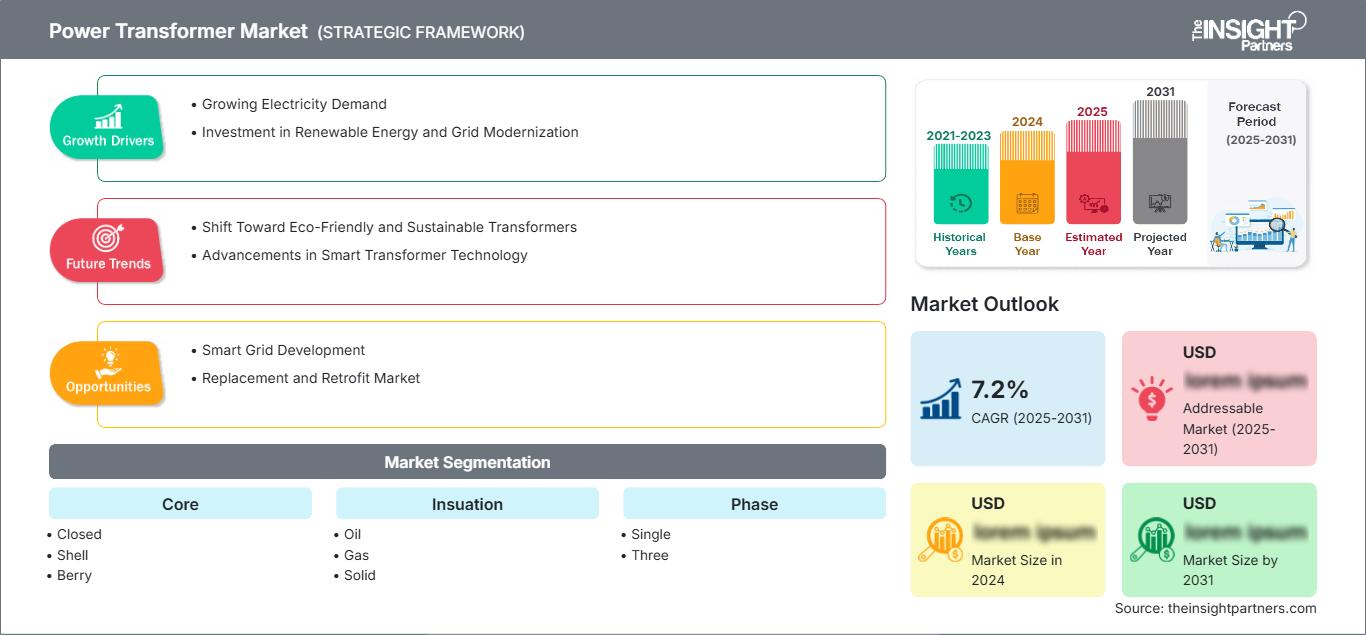
Power Transformer Market: Strategic Insights
Regional Insights
North America Power Transformer Market
It is projected that North America will account for around 24-28% of the market in 2025, aided by aging transmission infrastructure, renewable energy integration, industrial reshoring, and rapid growth in data centers. The regional market will be expanding at a CAGR of 5.8-6.8% till 2034. Replacement activities and upgradation to high-capacity transformers are gaining preference among the utilities due to increased peak loads due to electrification.
The US accounts for most of the regional demand, whereas Canada adds demand through utility upgrading projects, renewable energy penetration, and electrification of resources sector. It is becoming essential for utilities to develop localized supply sources for transformers due to long procurement cycles. Eaton, ABB Ltd., Schneider Electric SE, Siemens AG, Hammond Power Solutions Inc., Hyosung HICO, and others have manufacturing/commercial footprint in the region.
U.S. Power Transformer Market
The US makes up 70–74% of North America’s share in 2025 and is expected to grow at a 6.0–7.0% CAGR during 2023-2034. Data centers are a specific area of importance where according to IEA’s figures they accounted for almost half of the growth of US’ electricity consumption in 2025. Manufacturing plants, semiconductors, electrification, and utility replacements further fuel demands from transformers at various voltages.
ABB Ltd., Eaton Corporation plc, Emerson Electric Co., Hammond Power Solutions Inc., Hyosung HICO, and Schneider Electric SE have proven their presence on the market through production, engineering, distribution, or electrical infrastructure expertise. Applications include utilities, industrial plants, and large commercial properties. Eaton made a statement about its plan to invest $340 million into the South Carolina facility for transformers production in 2025.
Europe Power Transformer Market
Europe is expected to represent 22–26% share in 2025, with a 5.5–6.5% CAGR through 2034. Germany remains a leading market because industrial electrification, renewable generation, and transmission reinforcement require additional substation capacity. The UK is investing in grid infrastructure to connect renewable generation and accommodate electrified transport and new industrial loads. France continues to require network reinforcement around nuclear generation, renewables, and electrification.
Italy and Spain are building up networks to encourage renewable power generation, interconnection, and industry power demand. Grid investments in Europe will surpass US$70 billion in 2025, and transformer imports and supply chain challenges add more justification for resilient sourcing processes. ABB Ltd., Siemens AG, Schneider Electric SE, Eaton Corporation plc, and Emerson Electric Co. are among the key players. Germany acts as a prominent country owing to the concentration of industries and massive transmission grid modernization needs.
APAC Power Transformer Market
The APAC region is estimated to account for 38% to 42% Power Transformer Market share in 2025 with a CAGR of 7.0% to 8.0% until 2034. China will be the largest demand driver, followed by India, Japan, South Korea, and Australia. Industrialization, incorporation of renewable energy, urbanization, and network development ensure constant equipment demand.
China and India will drive regional demand, while Japan and South Korea focus on network reliability and manufacturing technology. Network upgrades are required in Australia for incorporation of renewable energy sources and long distance transmission of power.
Middle East & Africa Power Transformer Market
The Middle East & Africa market is expected to expand at a 5.5–6.5% CAGR through 2034, supported by energy infrastructure development, urbanization, industrial diversification, and renewable projects. Saudi Arabia and the UAE are major investment centers, while South Africa requires network reinforcement and replacement of aging equipment.
While Saudi Arabia has big infrastructure and diversification plans, the UAE is increasing the power generation capacity with respect to urban, commercial, and industrial development. South Africa, on the other hand, is concentrating on the reliability of the grid system. RoMEA demand is connected with electrification, transmission, renewables, and infrastructure.
Segmentation Analysis
Core
The Core segment covers Closed, Shell, and Berry configurations and remains fundamental to transformer efficiency, magnetic performance, thermal behavior, and manufacturing economics. Demand is influenced by voltage class, application requirements, loss specifications, and equipment footprint. The segment is projected to expand at a 5.8–6.8% CAGR from 2026–2034, with engineering optimization supporting improved lifecycle performance.
- Closed: Closed cores provide a compact magnetic circuit and are widely considered where efficiency, controlled magnetic flux, and established manufacturing processes are important. Their established engineering profile supports dependable procurement across utility and industrial installations.
- Shell: Shell cores offer strong mechanical support around windings and can be suited to applications requiring robust short-circuit performance. Their structural characteristics make them strategically relevant for specialized transformer designs and demanding operating environments.
- Berry: Berry cores provide an alternative magnetic configuration emphasizing efficient flux paths and compact construction. Their application remains specialized, with demand influenced by equipment design requirements, manufacturing capabilities, and performance considerations.
Insuation
The Insuation segment includes Oil, Gas, Solid, Air, Liquid, and Others and is central to thermal management, dielectric strength, safety, and transformer operating life. The segment is expected to grow at a 6.2–7.2% CAGR from 2026–2034 as operators balance reliability, environmental requirements, fire safety, and efficiency.
- Oil: Oil insulation remains widely established in high-capacity power applications because of effective dielectric and heat-transfer characteristics. Demand remains closely connected to utility transmission, large substations, and installations where proven operating performance is prioritized.
- Gas: Gas insulation supports applications requiring compact designs and controlled dielectric environments. Its strategic relevance increases where land constraints, environmental conditions, and substation architecture favor enclosed equipment with specialized insulation arrangements.
- Solid: Solid insulation is gaining attention for compact, fire-resistant, and environmentally conscious transformer designs. Its strategic importance is increasing in commercial, industrial, renewable, and data center applications where reduced maintenance and installation flexibility matter.
- Air: Air insulation supports dry-type transformer configurations and applications where fire safety, indoor installation, and simplified maintenance are priorities. Adoption is associated with commercial buildings, industrial facilities, and locations where liquid insulation presents operational constraints.
- Liquid: Liquid insulation technologies provide thermal and dielectric performance for specialized equipment. Demand is influenced by efficiency objectives, environmental considerations, cooling requirements, and the need for alternatives to conventional mineral-oil-based transformer systems.
- Others: Other insulation approaches serve specialized requirements where conventional technologies may not provide an optimal balance of thermal, dielectric, environmental, or safety characteristics. Adoption remains application-specific and dependent on technical qualification.
Phase
The Phase segment comprises Single and Three configurations and is shaped by voltage requirements, load characteristics, installation architecture, and application scale. The segment is expected to register a 6.0–7.0% CAGR from 2026–2034, supported by utility modernization and industrial electrification.
- Single: Single phase transformers are strategically important for selected residential, commercial, specialized industrial, and distribution requirements. Their simpler configuration supports applications where load characteristics and installation economics favor dedicated single-phase equipment.
- Three: Three phase transformers dominate high-capacity applications because they efficiently support balanced industrial and utility loads. Their importance is reinforced by manufacturing, data centers, transmission networks, renewable projects, and large commercial infrastructure.
Application
The Application segment comprises Residential and Commercial, Industrial, and Utilities. Utilities represent the largest demand pool because transmission and distribution networks require substantial transformer capacity. The application segment is projected to expand at a 6.5–7.3% CAGR from 2026–2034, supported by grid reinforcement and electrification.
- Residential and Commercial: Residential and Commercial applications require dependable voltage transformation for buildings, offices, retail facilities, and distributed loads. Demand is increasingly influenced by electrification, cooling, electric vehicle charging, and commercial digital infrastructure.
- Industrial: Industrial applications require transformers capable of supporting continuous, high-load operations across manufacturing, mining, processing, and heavy industry. Procurement increasingly emphasizes efficiency, reliability, harmonic tolerance, customized engineering, and serviceability.
- Utilities: Utilities remain the largest application category because transformers are essential to transmission, substations, renewable interconnection, and grid reliability. Replacement cycles, new generation connections, and rising peak loads sustain long-term procurement requirements.
Opportunity Snapshot
| Application | Revenue Contribution (High/Medium/Low) | Trend Tag (MAX 2 words) | Adoption Stage (Emerging/Scaling/Mature) |
| Residential and Commercial | Medium | Building Electrification | Scaling |
| Industrial | High | Factory Electrification | Scaling |
| Utilities | High | Grid Reinforcement | Mature |
Power Transformer Market Growth Drivers and Impact Analysis
Accelerating grid modernization and replacement of aging assets
One significant structural reason is the necessity for updating outdated electric grids in the face of increasing power consumption requirements and new types of generation sources. According to IEA, yearly investments into electric grids amount to roughly US$400 billion, however, investments should be increased significantly in order to match the growth of electrification and generation capacity. One of the main constrained assets are transformers since their procurement, production, inspection and installation take significant amounts of time. Therefore, utilities companies tend to develop multi-year procurement processes, use different suppliers and maintain spare capacities. The move enhances demand predictability for producers, and stimulates investments in plants, testing labs and engineers.
Data center expansion is creating concentrated high-load requirements
Rapid data center deployment is changing transformer demand by concentrating very large electricity loads within specific geographic clusters. IEA data shows data center electricity consumption increased 17% in 2025, while US data centers accounted for around half of the country's electricity demand growth. These facilities require dependable power conversion, redundancy, high availability, and rapid connection to constrained networks. The impact extends beyond data center operators because utilities must upgrade substations and transmission infrastructure around new load centers. Transformer suppliers therefore benefit from both direct commercial demand and utility-led infrastructure spending. The requirement for compact, high-efficiency, digitally monitored equipment also creates differentiation opportunities for manufacturers offering customized designs, accelerated engineering, condition monitoring, and integrated power-management capabilities.
Industrial electrification is broadening transformer demand across applications
Industrial electrification is expanding the addressable customer base beyond traditional utility procurement. Manufacturing, semiconductor production, mining, chemical processing, logistics, and electrified transport infrastructure increasingly require dependable high-capacity electrical systems. The IEA expects global electricity demand to remain robust as industry, transport, cooling, and digital infrastructure expand. For transformer suppliers, this translates into greater demand for equipment designed around specific load profiles, operating environments, and power-quality requirements. Industrial customers are also more focused on production continuity, making reliability and maintenance support important purchasing criteria. Suppliers that provide engineering customization, testing, installation assistance, spare-parts availability, and lifecycle diagnostics can strengthen customer retention while capturing higher-value projects. This driver supports demand across both conventional and advanced transformer configurations.
Power Transformer Market Future Trends
Digital condition monitoring will become embedded in transformer procurement
Power Transformer Market trends are moving toward equipment that combines electrical conversion with continuous condition visibility. Sensors, dissolved-gas analysis, thermal monitoring, bushing diagnostics, load tracking, and digital asset platforms are increasingly being considered as part of transformer lifecycle strategies. Over the coming years, utilities are likely to prioritize systems capable of identifying insulation deterioration, overheating, abnormal loading, and component degradation before failures occur. Digital monitoring should therefore shift procurement discussions from equipment price toward asset availability and lifecycle economics. Cloud connectivity and analytics can also enable centralized fleet management across geographically dispersed substations. Suppliers that integrate monitoring architecture into transformer design will be better positioned to address utilities seeking predictive maintenance, reduced outage exposure, and improved utilization of existing grid capacity.
Higher-efficiency and lower-impact insulation architectures will expand
Future transformer development is expected to place greater emphasis on efficiency, fire safety, environmental performance, and reduced maintenance requirements. Solid and advanced liquid insulation technologies can become increasingly relevant where customers require compact equipment, lower fire risk, or improved environmental characteristics. At the same time, conventional oil-filled transformers will remain important for large utility applications because of established engineering practices and high-capacity performance. Manufacturers are therefore likely to pursue portfolio diversification rather than a single replacement technology. Design improvements in magnetic materials, cooling systems, winding configurations, and insulation systems should progressively reduce losses while supporting higher operating loads. Procurement specifications are expected to increasingly incorporate lifecycle efficiency and environmental criteria alongside voltage, capacity, footprint, and reliability requirements.
Power Transformer Market Opportunities
Local manufacturing can address strategic supply-chain constraints
Power Transformer Market Forecasts indicate meaningful opportunities for manufacturers that establish or expand production closer to major demand centers. Transformer shortages, extended lead times, and dependence on specialized components have increased the strategic value of domestic manufacturing capacity. Investors can target facilities serving North American utilities, European grid reinforcement projects, Indian transmission expansion, and renewable-heavy markets across Asia Pacific. Opportunities extend beyond final assembly into electrical steel processing, insulation materials, bushings, monitoring systems, and testing services. Local production can also improve qualification responsiveness, engineering customization, spare-parts availability, and service coverage. Companies pursuing this strategy should prioritize markets with sustained utility capital programs, industrial electrification, and data center development rather than relying solely on short-term capacity shortages.
Lifecycle services can create recurring value beyond equipment sales
Manufacturers can broaden revenue opportunities by developing lifecycle service models around transformer diagnostics, maintenance, refurbishment, replacement planning, and digital monitoring. Many utility and industrial assets operate for decades, creating a substantial installed base that requires periodic testing, component replacement, oil management, condition assessment, and performance optimization. Service-led strategies can provide recurring revenue while strengthening relationships with asset owners and improving visibility into future replacement requirements. Digital monitoring can further connect equipment sales with long-term maintenance contracts and fleet analytics. Suppliers should prioritize interoperable systems, cybersecurity, skilled field-service teams, and regional spare-parts networks. Such capabilities can differentiate manufacturers where transformer specifications are increasingly standardized and customers evaluate suppliers on total lifecycle value rather than initial purchase price.
Frequently Asked Questions

- Comprehensive Market Sizing and Forecast Analysis
- Detailed Segmentation Analysis
- In-Depth Market Dynamics Assessment
- Regional and Country-Level Insights
- Competitive Landscape and Company Benchmarking
- Strategic Business Intelligence
Recent Reports
Testimonials

The Insight Partners provided valuable market intelligence that supported our global go-to-market strategy. Their team was professional, responsive, and attentive to our feedback, providing thoughtful analysis and helpful methodological clarifications throughout the project.
Junmo Kim Chief Financial Officer (CFO), Enertech Co., Ltd.
The Insight Partners' SCADA System Market report is comprehensive, with valuable insights on current trends and future forecasts. The team was highly professional, responsive, and supportive throughout. We are very satisfied and highly recommend their services.
RAN KEDEM Partner, Reali Technologies LTDs
I requested a report on a very specific software market and the team produced the report in a few days. The information was very relevant and well presented. I then requested some changes and additions to the report. The team was again very responsive and I got the final report in less than a week.
JEAN-HERVE JENN Chairman, Future Analytica
We worked with The Insight Partners for an important market study and forecast. They gave us clear insights into opportunities and risks, which helped shape our plans. Their research was easy to use and based on solid data. It helped us make smart, confident decisions. We highly recommend them.
PIYUSH NAGPAL Sr. Vice President, High Beam Global
The Insight Partners delivered insightful, well-structured market research with strong domain expertise. Their team was professional and responsive throughout. The user-friendly website made accessing industry reports seamless. We highly recommend them for reliable, high-quality research services
YUKIHIKO ADACHI CEO, Deep Blue, LLC.
This is the first time I have purchased a market report from The Insight Partners.While I was unsure at first, I visited their web site and felt more comfortable to take the risk and purchase a market report.I am completely satisfied with the quality of the report and customer service. I had several questions and comments with the initial report, but after a couple of dialogs over email with their analyst I believe I have a report that I can use as input to our strategic planning process.Thank you so much for taking the extra time and making this a positive experience.I will definitely recommend your service to others and you will be my first call when we need further market data.
JOHN SUZUKI President and Chief Executive Officer, Board Director, BK Technologies
I wish to appreciate your support and the professionalism you displayed in the course of attending to my request for information regarding to infectious disease IVD market in Nigeria. I appreciate your patience, your guidance, and the fact that you were willing to offer a discount, which eventually made it possible for us to close a deal. I look forward to engaging The Insight Partners in the future, all thanks to the impression you have created in me as a result of this first encounter.
DR CHIJIOKE ONYIA MANAGING DIRECTOR, PineCrest Healthcare Ltd.Reason to Buy
- Informed Decision-Making
- Understanding Market Dynamics
- Competitive Analysis
- Identifying Emerging Markets
- Customer Insights
- Market Forecasts
- Risk Mitigation
- Boosting Operational Efficiency
- Strategic Planning
- Investment Justification
- Tracking Industry Innovations
- Aligning with Regulatory Trends





 Get Free Sample for