SATA Cable Market Size & Overview
The sata cable market was valued at US$ 1.32 Billion in 2025 and is projected to reach US$ 2.15 Billion by 2034, growing at a CAGR of 5.24% during 2026–2034. Demand is supported by internal storage connectivity across desktops, workstations, embedded systems, industrial PCs, gaming hardware, and replacement channels where reliable, low-cost data transfer remains important.
North America remains a meaningful contributor to sata cable market size because system builders, data recovery service providers, industrial automation users, and commercial repair networks continue to replace and upgrade internal storage infrastructure. The region is estimated to hold 29–32% share in 2025 and grow at a CAGR of 4.8–5.2% between 2026–2034.
The growth in this market will be driven by the continued adoption of SATA HDDs, SATA SSDs, optical drives, and embedded storage cards. The replacement opportunities will remain constant as the cables are low-cost but failure-prone parts of storage systems. Standardization is important for assemblers, whereas frequent small volume purchases are a boon for distributors. The supply chain includes copper wire suppliers, insulation material suppliers, connector suppliers, cable assemblers, distributors, motherboard suppliers, storage device suppliers, and system manufacturers. Supply considerations include availability of connectors, adherence to SATA standards, flexibility in tooling, and local electronics manufacturing capacity. The low margins drive competition via reliability, SKU availability, packaging, and quick delivery.
Market Analysis reveals a highly fragmented but technologically advanced market structure. Products from Amphenol Corporation, TE Connectivity Ltd., Molex LLC, Hirose Electric Co., Ltd., and Samtec, Inc. offer broad interconnect portfolios, while products from EDAC Inc., Cvilux Corporation, Foxconn Interconnect Technology Limited, 3M Company, and L-com, Inc. offer catalog, OEM, and customized assembly needs. Capital is invested in reliability of connectors, low-profile routing solutions, EMI-sensitive designs, and distribution presence rather than in revolutionary interface development. Companies position their SATA products as part of a broader portfolio of storage interconnects, including SAS, Mini-SAS, PCIe and board-level connectors.
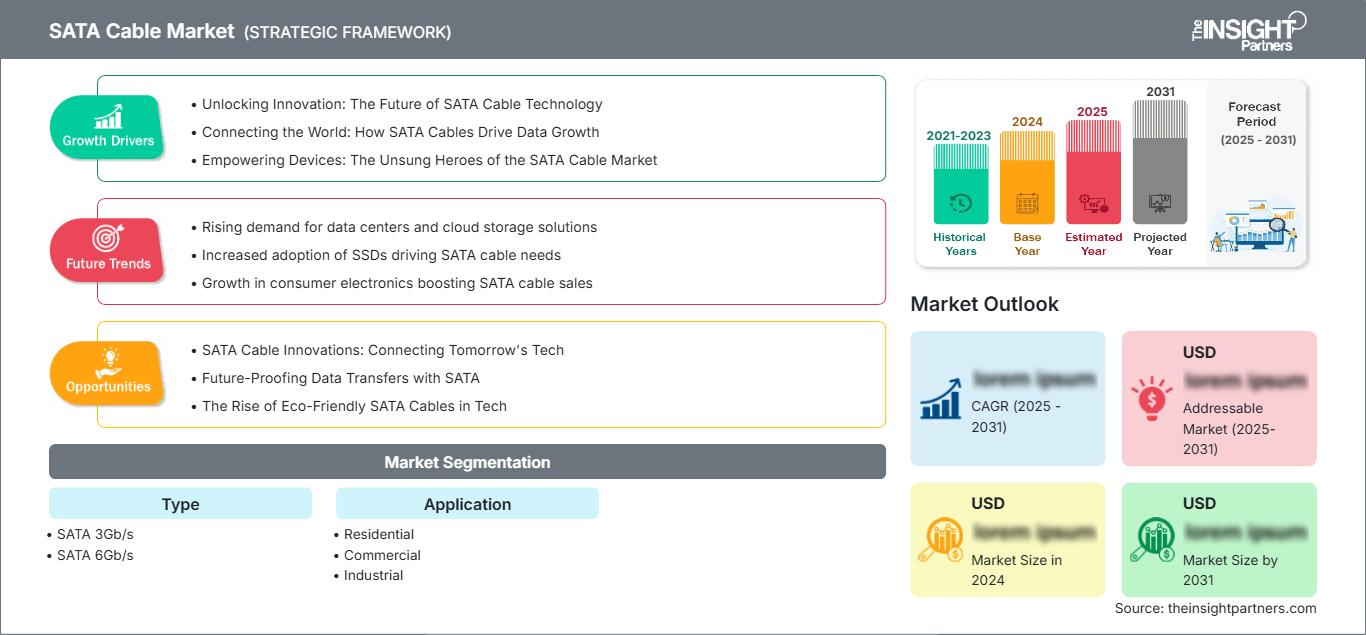
SATA Cable Market Assessment and Insights
- North America is estimated at 29–32% share in 2025 and is growing at a CAGR of 4.8–5.2% between 2026–2034, supported by PC upgrades, embedded computing, and repair-led replacement demand.
- US accounts for 74–78% of North America in 2025 and is growing at a CAGR of 4.9–5.3% during 2026–2034 due to enterprise maintenance and enthusiast PC demand.
- Europe holds 24–27% share in 2025 and is growing at a CAGR of 4.5–5.0% during 2026–2034, led by Germany, the UK, France, Italy, and Spain.
- Asia Pacific represents 34–37% share in 2025 and is growing at a CAGR of 5.8–6.4% during 2026–2034, with China, Japan, South Korea, India, and Australia supporting volume demand.
- Largest Segment SATA 6Gb/s holds 68–72% share in 2025 and is growing at a CAGR of 5.5–6.0% during 2026–2034 due to compatibility with mainstream HDDs and SATA SSDs.
- High Growth Segment Industrial applications hold 18–21% share in 2025 and are growing at a CAGR of 6.0–6.6% during 2026–2034 as rugged computers and automation systems expand.
- Key companies analyzed in detail: Amphenol Corporation, TE Connectivity Ltd., Molex LLC, Hirose Electric Co., Ltd., Samtec, Inc., EDAC Inc., Cvilux Corporation, Foxconn Interconnect Technology Limited, 3M Company, and L-com, Inc.
Source: The Insight Partners' analysis based on proprietary research, government publications, company annual reports, investor presentations, industry databases, and expert interviews.
SATA Cable Market Trends
Shift Toward Reliability-Focused Cable Assemblies
The sata cable market trends will increasingly focus on reliability rather than speed differentiation. The buyer would want to have cables that have latches, shielding, are low profile, and even right-angle cables to avoid accidental disconnections, better airflow, and to be able to fit into smaller enclosures. Such demand would be seen more in industrial applications, surveillance equipment, and also small workstations because of the high costs of being down for too long.
SATA as a Long-Tail Interface in Hybrid Storage
SATA will live on as a long tail interface along with NVMe and PCIe storage interfaces without going out of existence suddenly. Most systems will be using NVMe drives for their boot and performance purposes but having SATA drives to store large amounts of data, for backup, archival, etc. Such a configuration helps to ensure a stable requirement for cables in mixed systems. It is possible that SATA cables may be supplied by vendors along with other kits.
SATA Cable Market Growth Factors
Large Installed Base of SATA Storage Devices
The primary factor that drives it is the huge number of existing SATA hard disk drives, SATA SSDs, and optical drives. Despite the growing popularity of new interfaces among premium products, there are millions of desktops, workstations, DVRs, industrial computers, and legacy servers that still need to be equipped with SATA connections for data transfer and powering. It is especially noticeable in repair services, refurbishing computer sales, and small business environments where a storage upgrade is performed without a full system replacement.
Cost Advantage in Mainstream Storage Connectivity
SATA cables continue to be popular due to their simplicity, reliability, and affordability for connecting storage devices. For most domestic, business, and industry purposes, the use of SATA cables is aimed not at achieving the maximum interface speed but rather at obtaining reliable connections cheaply. This is why the market will continue to experience purchases of SATA cables from system integrators, value server manufacturers, and maintenance suppliers. Moreover, the driver helps preserve demand for SATA cables in the developing countries' markets.
Industrial and Embedded Computing Refresh Cycles
Industrial systems tend to be operational for extended periods and employ storage interfaces that have been selected based on their reliability rather than the latest interface technology. SATA cables are required in industrial controls, automation, surveillance, test systems, and embedded computer applications. A need for replacement comes up when the operator extends the useful life of his system, adds additional storage capacity or upgrades his control equipment. This creates demand for robust assemblies, latching features, and customized cable routing.
SATA Cable Market Opportunities
Aftermarket Upgrade and Repair Bundles
The sata cable market forecasts indicate a clear opportunity in aftermarket kits that combine data cables, power adapters, screws, drive brackets, and installation guidance. Repair shops, small businesses, and consumers often purchase components separately, creating friction and compatibility risk. Suppliers can improve value capture by offering reliable bundled solutions for SSD upgrades, HDD replacements, DVR storage expansion, and refurbished desktops. Distribution partners can use these bundles to raise order value while improving user convenience.
Customized Industrial Cable Assemblies
Cables that are required by industrial users often require some special characteristics like precise length, secure latching, heat resistance, low-profile connectors, and routing capabilities that are not available in normal consumer cables. This provides an opportunity for assembly houses and connector companies to get away from price competition. Suppliers should approach embedded computer makers, automation companies, security camera makers, and testing system makers with proven custom cable assemblies.
Segmentation Analysis
Type
Type segmentation in the market scope is expected to grow at a CAGR of 5.1–5.7% during 2026–2034. SATA 6Gb/s dominates procurement because it supports modern storage performance while remaining backward compatible. SATA 3Gb/s persists in older systems, embedded equipment, and cost-sensitive maintenance where full 6Gb/s throughput is not necessary.
- SATA 3Gb/s cables remain relevant for legacy desktops, embedded systems, optical drives, and maintenance channels where installed equipment prioritizes compatibility over maximum transfer speed.
- SATA 6Gb/s cables dominate new purchases because they support SATA III devices, mainstream SSDs, hard drives, and system builds that require stable internal storage connectivity.
Application
Application demand is projected to grow at a CAGR of 5.3–5.9% during 2026–2034. Residential demand is driven by PC upgrades and repair, commercial demand by office hardware maintenance and small servers, and industrial demand by rugged computing, control systems, and surveillance infrastructure that require dependable storage connections.
- Residential purchases are supported by do-it-yourself PC building, hard drive replacement, gaming upgrades, and home media systems, where affordability and compatibility are key.
- Commercial users buy SATA cables for office desktops, local storage servers, point-of-sale devices, repair benches, and managed IT maintenance across distributed facilities.
- Industrial applications require durable cable assemblies for embedded controllers, machine vision, surveillance recorders, test systems, and rugged computers operating in longer equipment lifecycles.
Opportunity Snapshot
| Application | Revenue Contribution | Trend Tag | Adoption Stage |
| Residential | Medium | PC Upgrades | Mature |
| Commercial | High | IT Maintenance | Mature |
| Industrial | Medium | Rugged Storage | Scaling |
Regional Insights
North America sata cable market
North America accounts for 29–32% sata cable market share in 2025 and is expected to grow at a CAGR of 4.8–5.2% during 2026–2034. The demand depends on desktop upgrades, small business storage solutions, industrial computing, test rigs, and post-sales replacements. The region takes advantage of a well-developed system for the delivery via e-commerce and component supply.
System integrators and repairs produce steady demand, as SATA cables are frequently changed during installation, debugging, and reconditioning of the drives. Commercial applications include surveillance recording, point-of-sale terminals, and laboratories. Despite the growing popularity of high-end computers using PCIe storage devices, there are enough SATA drives used to ensure purchasing activity.
U.S. sata cable Market
The U.S. represents 74–78% of North America in 2025 and is forecast to grow at a CAGR of 4.9–5.3% between 2026–2034. Demand is supported by enterprise IT maintenance, workstation refurbishment, gaming PC upgrades, and component retail channels. Cable demand follows storage replacement cycles rather than new PC shipments alone.
Company presence is strong through authorized distributors, catalog suppliers, OEM design channels, and online component platforms. Application trends favor SATA 6Gb/s cables with latch connectors, shorter lengths for compact chassis, and right-angle designs for airflow management. Industrial buyers also specify cables for embedded controllers, surveillance storage, and long-life automation systems.
Europe sata cable Market
Europe holds 24–27% share in 2025 and is projected to grow at a CAGR of 4.5–5.0% from 2026–2034. Germany leads regional consumption because of industrial PCs, automation equipment, and electronics manufacturing. The UK contributes through refurbishment and commercial IT channels, while France, Italy, and Spain support volume through consumer repair and small business infrastructure.
European demand is shaped by durability expectations, product compliance, and dependable distribution. Germany and the UK favor industrial and professional applications, while Southern Europe adds replacement-led consumer demand. The region’s slower growth compared with Asia Pacific reflects a mature PC base, but long equipment life and industrial modernization sustain steady market demand.
APAC sata cable Market
APAC holds 34–37% share in 2025 and is growing at a CAGR of 5.8–6.4% during 2026–2034. China leads due to electronics manufacturing, component assembly, and local computer hardware supply chains. Japan and South Korea support higher-specification demand, while India and Australia add replacement and commercial installation growth.
Regional expansion is linked to industrial digitization, cost-sensitive PC assembly, surveillance infrastructure, and growth in repair ecosystems. Local manufacturers compete aggressively on price, while global suppliers retain positions in branded assemblies and higher-reliability designs. Demand benefits from Asia Pacific’s ability to combine production scale with rising domestic electronics consumption.
Middle East & Africa sata cable Market
The Middle East and Africa are expected to grow at a CAGR of 4.6–5.1% during 2026–2034. Saudi Arabia and the UAE lead commercial demand through data infrastructure, surveillance, retail technology, and public sector hardware maintenance. South Africa supports regional replacement demand through business IT services and electronics distribution.
Demand is more project-led than in mature regions, but storage maintenance remains constant across offices, security systems, industrial sites, and educational hardware. Import dependency increases the importance of distributors with stocked SKUs. Growth is supported by digitization programs, smart building deployment, and broader use of low-cost storage systems.
SATA Cable Market Report Scope
| Report Attribute | Details |
|---|---|
| Market size in 2025 | US$ 1.32 Billion |
| Market Size by 2034 | US$ 2.15 Billion |
| Global CAGR (2026 - 2034) | 5.24% |
| Historical Data | 2021-2024 |
| Forecast period | 2026-2034 |
| Segments Covered | Type, Application |
| Region scope | North America, Europe, Asia-Pacific, South and Central America, Middle East and Africa |
Frequently Asked Questions

Recent Reports






