
Smart Thermostat Market Share, Demand & Growth by 2034
Coverage: By Technology (Wired, Wireless - Wi-Fi, ZigBee, Others); Application (Residential, Commercial, Others) , and Geography (North America, Europe, Asia Pacific, and South and Central America)
- Status : Data Released
- Report Code : TIPRE00015824
- Category : Electronics and Semiconductor
- No. of Pages : 150
- Available Report Formats :


- Last update date : August 27, 2026


2025 Market Size
US$ 5.79 Bn
Base year value
2034 Forecast
US$ 26.37 Bn
Projected by 2034
CAGR 2026-2034
18.35 %
Growth rate
Addressable Market
US$ 132.77 Bn
(2026-2034)
The Smart Thermostat Market size was valued at US$ 5.79 billion in 2025 and is projected to reach US$ 26.37 billion by 2034, registering a CAGR of 18.35% from 2026 to 2034. This growth reflects the increasing consumer preference for energy-efficient solutions and the rapid expansion of smart home ecosystems worldwide .
North America is estimated to account for approximately 33-37% of the Smart Thermostat Market share in 2025, growing at a CAGR of 11-14% over the forecast period. Key structural drivers include high smart home penetration rates exceeding 50% of households and strong utility rebate programs across the United States that incentivize smart thermostat adoption .
Smart Thermostat Market Assessment and Insights
- North America: Held approximately 33-37% share in 2025, growing at a CAGR of 11-14% during 2026-2034. The region leads due to high smart home adoption, advanced HVAC infrastructure, and strong utility-led demand response programs .
- U.S.: Accounted for approximately 65-70% of North America's Smart Thermostat Market in 2025, growing at a CAGR of 12-15% through 2034. High consumer awareness and extensive smart home ecosystems drive adoption across residential and commercial sectors .
- Europe: Represented around 26-30% market share in 2025, expanding at a CAGR of 12-15% during 2026-2034. Leading countries include Germany, the UK, and France, where stringent energy efficiency regulations and green building initiatives drive adoption .
- Asia Pacific: Held approximately 28-32% market share in 2025, growing at the highest regional CAGR of 13-16% through 2034. China, Japan, and South Korea lead the region, supported by rapid urbanization and commercial construction growth .
- Largest Segment: The Residential application accounted for approximately 54-58% market share in 2025, growing at a CAGR of 17-20% during 2026-2034. Growing smart home adoption and energy awareness drive residential demand .
- High Growth Segment: The Commercial application, capturing approximately 30-34% market share in 2025, projected to grow at a CAGR of 19-22% through 2034. Demand for building management systems and operational efficiency fuels commercial adoption .
- Key companies analyzed in detail: Carrier Global Corporation, Centralite Systems Inc., Control4 Corporation, Ecobee Inc., Energate Inc., Fidure Inc., Honeywell International Inc., Leviton Manufacturing Co., LUX Products Corporation, and Nest Labs (Google LLC).
Source: The Insight Partners' analysis based on proprietary research, government publications, company annual reports, investor presentations, industry databases, and expert interviews.
From the initial stage of programmable thermostats, smart thermostat manufacturers have developed into highly advanced AI-powered thermostats which can sense users' behaviors and integrate with other elements of the smart home ecosystem as well as save on energy. Thanks to machine learning algorithms and sensor technology, today's thermostats are able to predict temperature changes, detect occupants, and automatically adjust schedules. In terms of production, wireless thermostats have become the norm in the industry, with Wi-Fi and Zigbee protocols leading in the market, while IoT capabilities have started being incorporated into production processes.
As for future prospects, the newly emerging territories, especially those in the Asia Pacific region, will be crucial for market expansion owing to fast urbanization, growing incomes, and building more smart homes. Investments into AI-powered thermostats are expected to grow rapidly because of regulatory policies in Europe and North America that encourage efficient energy usage in buildings.
Smart Thermostat Market Report Scope
| Report Attribute | Details |
|---|---|
| Market size in 2025 | US$ 5.79 Billion |
| Market Size by 2034 | US$ 26.37 Billion |
| Global CAGR (2026 - 2034) | 18.35% |
| Historical Data | 2021-2024 |
| Forecast period | 2026-2034 |
Smart Thermostat Market Analysis
Demand for smart thermostats essentially emanates from the need for energy efficiency and savings. The factors driving growth include the rising number of smart homes across the world, as there will be close to 670 million of them by 2025. The Smart Thermostat Market value chain includes semiconductor suppliers, manufacturers, software developers, and distribution channels that include HVAC contractors, retailers, and utilities. The supply chain is impacted by semiconductors and electronics costs, as well as investments in automation to cut costs.
The competition in the Smart Thermostat Market includes HVAC companies as well as tech firms. Honeywell International Inc. and Nest Labs (Google) are market leaders due to their brands and extensive distribution networks, whereas Ecobee Inc. offers competitive products with advanced energy management features. The other players include Carrier Global Corporation, Leviton Manufacturing Co., and Control4 Corporation that have distinctive solutions. In terms of investments, there is a rising trend towards venture capital funding and partnerships with corporations in order to incorporate AI technologies and enable demand response capabilities.
● REPORT CUSTOMIZATION
Tailor This Report To Align With Your Specific Business Requirements
This report can be customized to align precisely with your business objectives, scope, and target markets. Customization options include tailored segmentation, geography, competitive analysis, and strategic insights to support informed decision-making.
Customize This Report →WHAT YOU CAN ADJUST
- ● Segmentations
- ● Geography
- ● Competitive Analysis
- ● Language Preferences
Smart Thermostat Market: Strategic Insights
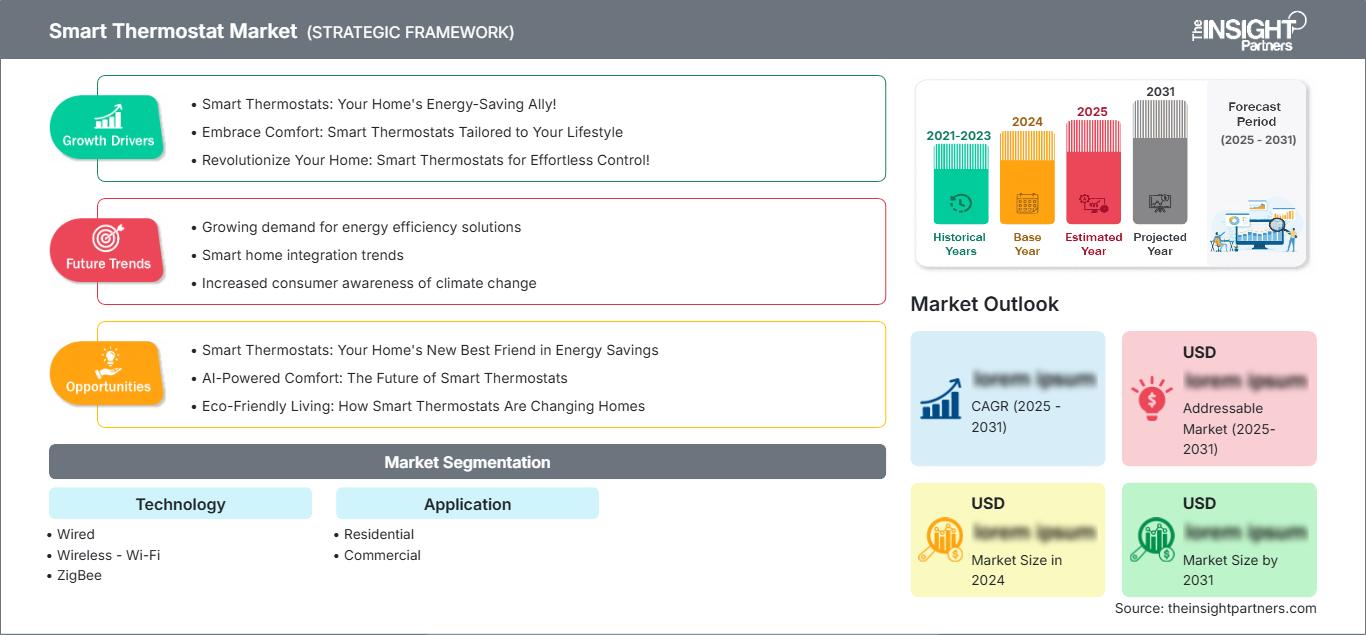
Regional Insights
North America Smart Thermostat Market
North America is estimated to hold the largest market share of 33-37% in 2025, growing at a CAGR of 11-14% through 2034. The region's leadership is anchored by advanced smart home infrastructure and widespread consumer awareness of energy efficiency benefits. The United States dominates with 16-17% adoption among internet households and utility rebate programs covering 15-20% of households . Canada contributes significantly with high per capita adoption driven by colder climates and strong utility partnerships like Ontario's Save on Energy program. The expansion of IoT infrastructure and high internet penetration rates continue to support adoption of advanced thermostat systems equipped with cloud connectivity and mobile application control . Commercial sector growth is supported by building energy benchmarking regulations and predictive maintenance technologies.
U.S. Smart Thermostat Market
The Smart Thermostat Market forecast indicates that the U.S. accounts for approximately 65-70% of the North American Market in 2025, growing at a CAGR of 12-15% during the forecast period. Strong consumer adoption of smart home technologies, with 57 million households currently using smart devices, underpins market growth . Utility rebate programs and demand-response initiatives in states like California, New York, and Massachusetts drive adoption rates 1.5-2 times higher than the national average . Companies such as Honeywell International Inc., Nest Labs, Ecobee Inc., and Carrier Global Corporation maintain strong domestic operations. The market benefits from mature distribution channels including HVAC contractors, home improvement retailers, and utility partnerships, while AI-powered features and voice integration continue to attract consumers.
Europe Smart Thermostat Market
Europe accounted for approximately 26-30% of the global market in 2025, expanding at a CAGR of 12-15% from 2026 to 2034. The region benefits from strong environmental regulations and advanced construction standards promoting energy efficiency. Germany leads the market with approximately 35% of European revenue, supported by engineering excellence and strong government focus on sustainable infrastructure . The UK contributes through research excellence and green building certification programs. France, Italy, and Spain are emerging as significant players with growing residential and commercial adoption of intelligent climate control technologies. European Union regulations promoting green building practices and low-carbon construction are shaping production approaches and driving innovation. Rising consumer preference for connected living environments and automated home management systems continues to support market growth .
APAC Smart Thermostat Market
The Asia Pacific region is estimated to hold approximately 28-32% market share in 2025, expanding at a regional CAGR of 13-16%. China leads the regional market, followed by Japan, South Korea, and India, with significant growth in Australia. China's dominance stems from its rapid urbanization and large-scale commercial construction projects . Japan contributes through expertise in electronics integration and advanced building automation. India is emerging as a growth market with increasing middle-class households and government smart city initiatives. The region's growth is propelled by rapid industrialization, rising disposable incomes, and increasing awareness of energy efficiency benefits across residential and commercial sectors.
Middle East & Africa Smart Thermostat Market
The Middle East and Africa region is growing at a CAGR of 10-13% during 2026-2034, driven by investments in smart city developments and energy-efficient infrastructure. Saudi Arabia and UAE lead regional adoption with substantial smart city projects and high cooling demand. South Africa is building capabilities in commercial and industrial smart building applications. The region's growth is supported by economic diversification initiatives, while infrastructure projects in the Gulf Cooperation Council countries present opportunities for smart thermostat integration .
Segmentation Analysis
Technology
The global market by technology is segmented into Wired and Wireless (Wi-Fi, ZigBee). The Wireless segment is anticipated to exhibit a CAGR of 19-22% during 2026-2034, driven by increasing demand for remote access and seamless integration with smart home ecosystems. Wireless technology dominates due to easy installation and flexibility eliminating complex wiring requirements. The Smart Thermostat Market scope encompasses both wired solutions for new construction and wireless retrofits with Wi-Fi representing the most widely adopted sub-segment.
- Wired: Traditional hardwired installations offering reliable connectivity, primarily used in new construction projects with pre-installed infrastructure and commercial applications requiring stable connections.
- Wireless - Wi-Fi: Dominates wireless category with widespread residential adoption, enabling remote access, voice assistant integration, and cloud-based features through existing home networks .
- Wireless - ZigBee: Provides low-power mesh networking for comprehensive smart home integration, gaining traction among consumers seeking interoperability across smart home devices.
Application
The Smart Thermostat Market by application includes Residential and Commercial segments. The Residential segment is projected to grow at a CAGR of 17-20% during 2026-2034, driven by increasing smart home adoption and energy awareness among homeowners. Commercial applications are gaining traction as businesses invest in energy-efficient building management. Leading players like Honeywell International Inc. and Carrier Global Corporation are expanding commercial offerings for office buildings, hospitals, and retail centers.
- Residential: Largest application segment driven by demand for energy savings, remote access, and voice assistant integration in homes, apartments, and multi-family developments .
- Commercial: Fastest-growing application serving office buildings, healthcare facilities, educational institutions, and retail centers requiring centralized HVAC management and predictive maintenance technologies .
Opportunity Snapshot
| Application | Revenue Contribution | Trend Tag | Adoption Stage |
|---|---|---|---|
| Residential | High | Smart Home | Mature |
| Commercial | High | Building Mgmt | Scaling |
Smart Thermostat Market Growth Drivers and Impact Analysis
Rising Trend of Smart Homes and Connected Living
The proliferation of smart home devices and increasing consumer demand for connected living environments are driving smart thermostat adoption globally. Smart homes surpassed 308 million worldwide in 2022 and are projected to reach nearly 670 million by 2025, creating substantial market opportunities . Smart thermostats serve as foundational components of home automation systems, enabling energy optimization and central control of HVAC operations. Consumers increasingly prefer intelligent thermostat technologies capable of remote temperature control, voice assistant integration, and automated climate management. The growing popularity of voice-controlled home automation ecosystems and cross-platform compatibility continues to expand the addressable market.
Drastic Global Climate Change and Energy Efficiency Awareness
Rising global temperatures and unpredictability of weather patterns have accelerated demand for smart thermostats as essential utility devices. The National Oceanic and Atmospheric Administration reports temperature increases at an average rate of 0.14 degrees Fahrenheit per decade since 1880 . Consumers and commercial building operators increasingly deploy AI-powered thermostat systems to improve indoor climate management and reduce electricity consumption. Government initiatives promoting sustainable buildings and electricity conservation, including building energy codes, appliance efficiency standards, and carbon reduction mandates, positively influence product adoption globally. Manufacturers are introducing intelligent thermostat systems with predictive features, renewable energy integration, and smart grid compatibility to address climate concerns .
Emergence of IoT-Enabled and AI-Powered Thermostat Solutions
Technological advancements in IoT connectivity and artificial intelligence have transformed smart thermostats from basic programmable devices to intelligent systems capable of learning user preferences, occupancy patterns, and environmental conditions. IoT-integrated thermostats automatically modify temperature settings after monitoring user behavior, while AI algorithms optimize settings for maximum energy efficiency and comfort . Integration of geofencing technology, voice assistants, and cloud analytics enables convenient hands-free operation and data-driven energy management. Predictive maintenance capabilities and real-time monitoring alerts provide valuable insights on temperature trends and equipment performance. These innovations are driving consumer adoption and expanding the growth trajectory .
Smart Thermostat Market Future Trends
Demand Response and Grid Integration Capabilities
The Smart Thermostat Market trends will be shaped by increasing integration with utility demand-response programs and smart grid platforms. Smart thermostats enable automated peak load reduction through utility-controlled temperature adjustments, helping grid operators maintain stability during high-demand periods . This demand-response capability can reduce peak electricity consumption by 15-20%, providing economic benefits to utilities and consumers alike. Thermostat-as-a-service models are gaining traction in North America, where utilities own and manage devices in exchange for demand-response rights. Expansion of smart grid projects and connected residential developments continues to create opportunities for thermostat-grid integration across multiple regions.
AI-Enabled Predictive Optimization and Occupancy Sensing
Artificial intelligence and machine learning capabilities are emerging as transformative trends enabling advanced predictive optimization and occupancy-based climate control. New generation smart thermostats employ AI algorithms that learn user preferences, analyze occupancy patterns, and adjust temperature settings automatically without manual intervention . Predictive occupancy sensing and weather-adaptive temperature optimization can reduce building energy consumption by 18-25% while improving occupant comfort. Manufacturers are introducing features such as self-learning control algorithms and edge computing capabilities that process data locally for faster response times. These AI-driven innovations are positioning smart thermostats as essential components of intelligent building automation systems.
Smart Thermostat Market Opportunities
Commercial Building Energy Management Expansion
Significant opportunities exist for smart thermostat adoption across commercial buildings, where energy costs represent substantial operational expenses. The Smart Thermostat Market report indicates that commercial applications will grow at a faster rate than residential through 2034 . Office buildings, hospitals, educational institutions, and retail centers are increasingly implementing cloud-based thermostat management platforms, predictive maintenance technologies, and occupancy-based automation systems to optimize energy utilization and reduce operational expenses. Commercial facility managers seek centralized HVAC control systems that provide detailed analytics, real-time monitoring, and automated optimization. Building energy benchmarking regulations and green building certification requirements are further accelerating commercial adoption.
Energy Service Company and Utility Partnership Models
Emerging partnership models between smart thermostat manufacturers and energy service companies (ESCOs) or utilities present substantial opportunities for market expansion. These partnerships enable thermostat-as-a-service offerings where utilities own and manage smart thermostat deployments in exchange for demand-response participation rights . This model reduces upfront costs for consumers while providing utilities with grid-stabilizing capabilities. Subscription-enabled services including energy reports, remote diagnostics, and predictive maintenance offer recurring revenue streams for manufacturers. Government initiatives supporting sustainable housing and connected energy management technologies continue driving partnerships throughout developed regions, creating long-term growth opportunities for market participants.
Recent Developments
- August 2026: Trane and American Standard Heating and Air Conditioning have introduced the next generation of connected 24-volt smart thermostats, designed to transform the thermostat from a simple control device into a whole-home comfort platform. The new Trane Priority Smart Thermostat and American Standard Gold Smart Thermostat are compatible with most 24-volt HVAC systems, offering homeowners enhanced comfort, energy efficiency, and remote control while helping HVAC dealers streamline installation and service.
- December 2025: Resideo Technologies, a leading global provider of solutions for home comfort, security and safety, launched a new style of smart comfort: the Honeywell Home X8S smart thermostat. From America's No. 1 most trusted thermostat brand,1 the Honeywell Home X8S smart thermostat conveniently streams live video from compatible doorbells on the largest touchscreen in its class. It offers a combination of precision sensing and control, intuitive touchscreen interface and premium design, delivering the brand's smartest thermostat yet.
- July 2025: Alarm.com announces the release of its latest Smart Thermostat—the ADC-T25. Building on the proven reliability of Alarm.com’s suite of thermostats, the T25 is compatible with most common HVAC systems, offering the easiest installation yet, a streamlined design, and advanced sensing capabilities, all at a market-expanding, affordable price point. Designed by Building36 with easy installation in mind, the T25 has flexible wiring options that allow it to operate on battery power if no C-wire is present. This eliminates the need to run wires or use a retrofit kit. It also includes auto-configuration with wire detection. Full integration with the Alarm.com platform enables remote control of the thermostat and customizable automation options. Enrolled customers receive monthly reports featuring personalized efficiency tips, key metrics like overall run time, and updates on any system issues.
Frequently Asked Questions

- Comprehensive Market Sizing and Forecast Analysis
- Detailed Segmentation Analysis
- In-Depth Market Dynamics Assessment
- Regional and Country-Level Insights
- Competitive Landscape and Company Benchmarking
- Strategic Business Intelligence
Recent Reports
Testimonials

The Insight Partners' SCADA System Market report is comprehensive, with valuable insights on current trends and future forecasts. The team was highly professional, responsive, and supportive throughout. We are very satisfied and highly recommend their services.
RAN KEDEM Partner, Reali Technologies LTDs
I requested a report on a very specific software market and the team produced the report in a few days. The information was very relevant and well presented. I then requested some changes and additions to the report. The team was again very responsive and I got the final report in less than a week.
JEAN-HERVE JENN Chairman, Future Analytica
We worked with The Insight Partners for an important market study and forecast. They gave us clear insights into opportunities and risks, which helped shape our plans. Their research was easy to use and based on solid data. It helped us make smart, confident decisions. We highly recommend them.
PIYUSH NAGPAL Sr. Vice President, High Beam Global
The Insight Partners delivered insightful, well-structured market research with strong domain expertise. Their team was professional and responsive throughout. The user-friendly website made accessing industry reports seamless. We highly recommend them for reliable, high-quality research services
YUKIHIKO ADACHI CEO, Deep Blue, LLC.
This is the first time I have purchased a market report from The Insight Partners.While I was unsure at first, I visited their web site and felt more comfortable to take the risk and purchase a market report.I am completely satisfied with the quality of the report and customer service. I had several questions and comments with the initial report, but after a couple of dialogs over email with their analyst I believe I have a report that I can use as input to our strategic planning process.Thank you so much for taking the extra time and making this a positive experience.I will definitely recommend your service to others and you will be my first call when we need further market data.
JOHN SUZUKI President and Chief Executive Officer, Board Director, BK Technologies
I wish to appreciate your support and the professionalism you displayed in the course of attending to my request for information regarding to infectious disease IVD market in Nigeria. I appreciate your patience, your guidance, and the fact that you were willing to offer a discount, which eventually made it possible for us to close a deal. I look forward to engaging The Insight Partners in the future, all thanks to the impression you have created in me as a result of this first encounter.
DR CHIJIOKE ONYIA MANAGING DIRECTOR, PineCrest Healthcare Ltd.Reason to Buy
- Informed Decision-Making
- Understanding Market Dynamics
- Competitive Analysis
- Identifying Emerging Markets
- Customer Insights
- Market Forecasts
- Risk Mitigation
- Boosting Operational Efficiency
- Strategic Planning
- Investment Justification
- Tracking Industry Innovations
- Aligning with Regulatory Trends





 Get Free Sample for