
Space Electronics Market Demand, Share & Growth by 2034
Coverage: By Platform (Satellites, Launch Vehicles, Others); Component (Optoelectronics, Integrated Circuits, Discrete Semiconductors, Others); Subsystem (Structural Subsystem, Tracking and Command Subsystem, Thermal Control Subsystem, Attitude and Velocity Control Subsystem, Electric Power and Distribution Subsystem, Telemetry Subsystem, Others) , and Geography (North America, Europe, Asia Pacific, and South and Central America)
- Status : Data Released
- Report Code : TIPRE00006368
- Category : Electronics and Semiconductor
- No. of Pages : 150
- Available Report Formats :


- Last update date : November 02, 2026


2025 Market Size
US$ 22.59 Bn
Base year value
2034 Forecast
US$ 32.8 Bn
Projected by 2034
CAGR 2026-2034
4.23 %
Growth rate
Addressable Market
US$ 251.54 Bn
(2026-2034)
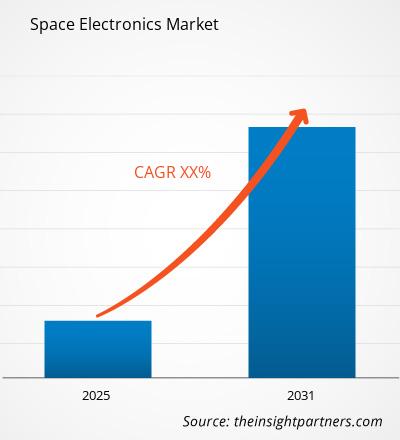
The Space Electronics Market is projected to expand from US$ 22.59 Billion in 2025 to US$ 32.8 Billion by 2034, representing a CAGR of 4.23% during 2026–2034. The demand is based on the payload of the satellites, launch vehicle avionics, power management systems, communication capabilities, navigation, thermal control, and radiation-resistant computing. The market is built on qualified electronics components and integrated subsystems capable of functioning through vibration, cycling temperatures, vacuum, and ionizing radiation.
In North America, the Space Electronics Market Size is driven by a forecasted ~4% CAGR until 2034. In this region, there is a reliable US government procurement, satellite production infrastructure, semiconductor programs, and constellation replenishment. Increased computing needs for the payload and better supply chain assurance are contributing to local qualification, packaging, and testing efforts.
Space Electronics Market Assessment and Insights
Regional Outlook
- North America: ~42% of the global market in 2025 | ~4% CAGR through 2034. Market position: The region ranks first because US defense, civil, and commercial missions combine high launch cadence with established radiation-hardened design, trusted foundry, qualification, and spacecraft integration capabilities.
- US: ~87% of North American market revenue in 2025 | ~4% CAGR through 2034. Market position: The US leads North America through national-security constellations, NASA programs, commercial broadband spacecraft, launch activity, and a concentrated supplier base spanning processors, power devices, sensors, and avionics.
- Europe: ~24% of the global market in 2025 | ~4% CAGR through 2034. Market position: A mature institutional and commercial base supports demand, with France leading Europe and the UK, Germany, Italy, and Spain contributing specialized payload, platform, and launch electronics capabilities.
- Asia Pacific: ~27% of the global market in 2025 | ~6% CAGR through 2034. Market position: Asia Pacific is the fastest-growing region as China, Japan, India, and South Korea expand sovereign constellations, launch capacity, navigation systems, and domestic electronic-component ecosystems.
Segment Outlook
- Satellites: ~81% Share in 2025 | ~5% CAGR through 2034. Market position: Satellites lead because every spacecraft requires distributed power, command, telemetry, processing, sensing, attitude control, and thermal electronics, while constellation replacement sustains recurring unit demand.
- Integrated Circuits: ~44% Share in 2025 | ~6% CAGR through 2034. Market position: Integrated circuits gain through higher onboard processing, software-defined payloads, advanced power management, artificial intelligence at the edge, and selective adoption of radiation-tolerant commercial architectures.
Competitive Coverage
BAE Systems plc, Eaton Corporation plc, HEICO Corporation, Honeywell International Inc., Microchip Technology Incorporated, STMicroelectronics N.V., Teledyne e2v Limited, Texas Instruments Incorporated, TT Electronics plc, Advanced Micro Devices, Inc.
Methodology
The Insight Partners follows Data Collection & Secondary Research, Primary Research, Data Analysis, and Data Triangulation & Final Review to validate market estimates and insights.
Source: The Insight Partners' analysis based on proprietary research, government publications, company annual reports, investor presentations, industry databases, and expert interviews.
Spacecraft architectures are transitioning from few custom-made spacecraft to hybrid constellations that use high-reliability systems and relatively lower life-cycle commercial satellites. The effect on electronics manufacturing is that electronics manufacturers have to keep the radiation tolerance and traceability intact while minimizing the mass, power consumption, lead time, and costs per unit. Advanced packaging, silicon-on-insulator, fault-tolerant architectures, reconfigurable logic, and modular avionics will be more common. Simultaneously, the rising spacecraft mass and increased militarization will increase the need for efficient power conversion electronics, data handling, telemetry, and thermal control electronics.
The next ten years will see the geographic expansion of investment as India, South Korea, the Gulf states, and emerging launcher nations develop their spacecraft manufacturing capability. Procurement policy favoring trusted sources, export control compliance, debris tracking, and communications resiliency will influence procurement decision making. Instead of delivering equal volume growth, these factors will benefit electronics suppliers that deliver scalable qualification capabilities, longer product availability, radiation data, and interoperable reference designs.
Space Electronics Market Report Scope
| Report Attribute | Details |
|---|---|
| Market size in 2025 | US$ 22.59 Billion |
| Market Size by 2034 | US$ 32.8 Billion |
| Global CAGR (2026 - 2034) | 4.23% |
| Historical Data | 2021-2024 |
| Forecast period | 2026-2034 |
Space Electronics Market Analysis
Space Electronics Market growth is driven by an increasing number of orbital missions and their complexity, rather than by launches alone. Communications constellations demand repeatable and low-cost electronics, while missile warning, navigation, weather, science, and deep space missions call for electronics with long life and higher assurance. Customers will consider the processing performance per watt, radiation hardness, thermal properties, and life of the components in combination. The market environment consists of wafers, design IP, packaging, testing, test facilities, boards, payloads, satellites, launchers, and government qualification agencies.
Supply limitations are the result of lengthy qualification periods, absence of radiometry, packaging requirements, and dependence on mature technology foundry nodes. The use of off-the-shelf commercial components can cut down costs and shorten the time-to-market, but transfer the problem of protection and error correction to systems. Therefore, electronics manufacturers who can offer components and other services have better chances than component suppliers alone.
Space Electronics Market Report suggests that there is competition amongst diversified aerospace companies as well as semiconductor companies. BAE Systems plc and Honeywell International Inc. provide for high-reliability processing and avionics, whereas Microchip Technology Incorporated, STMicroelectronics N.V., Texas Instruments Incorporated, and Advanced Micro Devices, Inc. provide processing, analog, power, and programmable solutions. Teledyne e2v Limited, TT Electronics plc, HEICO Corporation, and Eaton Corporation plc enhance sensing, power, interconnect, and subsystems capabilities.
Investments are focused on reliable manufacturing processes, design radiation hardened library, small node size, gallium nitride power components, advanced packaging, and reusable software environment. Competitive position depends on the capability to support multiple missions without affecting reliability. Suppliers who develop pin-compatible product lines, publish radiation characterization data, and provide dual sourcing have the potential to lower the redesign cost of the customers.
● REPORT CUSTOMIZATION
Tailor This Report To Align With Your Specific Business Requirements
This report can be customized to align precisely with your business objectives, scope, and target markets. Customization options include tailored segmentation, geography, competitive analysis, and strategic insights to support informed decision-making.
Customize This Report →WHAT YOU CAN ADJUST
- ● Segmentations
- ● Geography
- ● Competitive Analysis
- ● Language Preferences
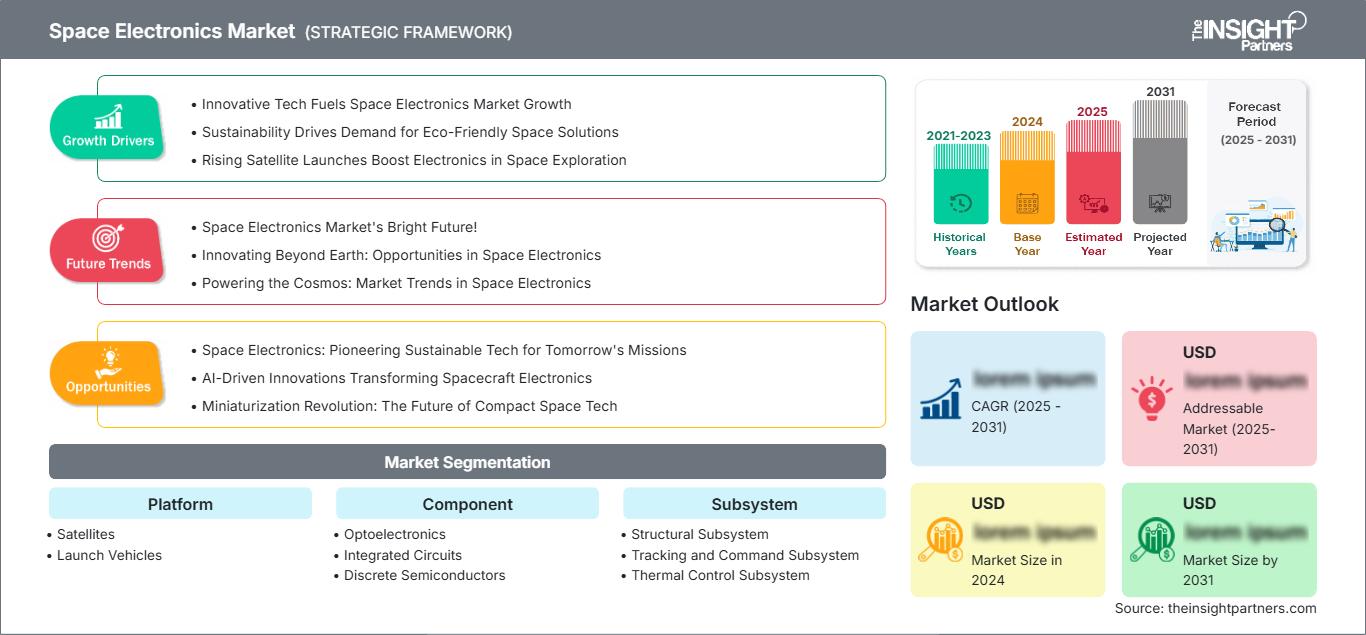
Space Electronics Market: Strategic Insights
Regional Insights
North America Space Electronics Market
North America is modeled to expand at ~4% CAGR through 2034, supported by a deep base of spacecraft primes, component designers, trusted foundries, test laboratories, launch operators, and government customers. The Space Electronics Market share held by the region reflects repeated procurement for missile warning, protected communications, Earth observation, navigation, science, and commercial broadband systems.
The demand is moving towards resilient proliferation architectures which require more processors, FPGAs, power converters, sensors, memory, and telemetry equipment. In-source requirements and secure manufacturing efforts encourage suppliers who have traceable manufacturing and long-term availability. Canada provides robotics, small satellite platforms, and earth observation technology, but the US programs contribute the most volume and highest levels of confidence.
U.S. Space Electronics Market
The US holds about 87% Space Electronics Market share of North America revenues in 2025 and is estimated to achieve about 4% CAGR between 2025 and 2034. The US is bolstered by NASA exploration programs, national security satellites, commercial constellations, and global launch frequency. Electronics meeting both Class A requirements and faster commercial requirements while maintaining good radiation characteristics are required.
Key companies providing wide domestic design and qualification presence are BAE Systems plc, Honeywell International Inc., Microchip Technology Incorporated, Texas Instruments Incorporated, HEICO Corporation, and Advanced Micro Devices, Inc. Application demand is shifting towards on-board analytics, secure communications, autonomous fault management, digital beamforming, and electric power distribution. The architecture selection and supplier qualification are further impacted by trusted sourcing and export controls.
Europe Space Electronics Market
The European Space Electronics Market represents ~24% of total global revenue in 2025, growing at ~4% CAGR to 2034. Institutional projects, sovereign communications, Earth observation, navigation, launch enhancement, and scientific exploration drive a solid demand base. The European electronics supply chain focuses on radiation hardening, longevity, sovereignty of procurement, and collaboration of agencies, prime contractors, semiconductor companies, and research institutions.
France is the leading country in Europe because of its capability in terms of satellite and launch systems and participation in both civilian and defense programs. The United Kingdom offers payload electronics, imaging sensor equipment, small satellites, and other specialized equipment. Germany combines space craft integration along with optical, power and scientific instruments. Italy’s specialty includes Earth Observation, Telecommunications and exploration electronics. Spain engages more in small satellites, ground segment and subsystems.
The European suppliers are under pressure to reconcile their heritage qualification with fast commercial cycle. STMicroelectronics N.V., Teledyne e2v Limited, TT Electronics plc, and Eaton Corporation plc provide semiconductor, sensing, power, and interconnect capabilities. Regional policy aimed to increase strategic autonomy may result in further design and manufacturing localization, but fragmented procurement process and lower launch rate compared to the US hinder scale economy.
APAC Space Electronics Market
Asia Pacific comprises roughly 27% of world revenues in 2025 and is the fastest-growing region with a CAGR of ~6% through 2034. Leading in the Asia Pacific region is China with its vertically-integrated launch, satellite, navigation, and remote sensing programs. Japan contributes to high-reliability components and exploration capabilities, and India is ramping up launch, communication, navigation, and earth observation capabilities.
South Korea is working on their sovereign launch and satellite capacity, while Australia is improving their space domain awareness and communications and ground systems capability. There are many sourcing opportunities through industrial policy, semiconductor capability, government procurement, and expanded commercial platforms, but there are also major sourcing constraints through qualification consistency and export control.
Middle East & Africa Space Electronics Market
The Middle East & Africa region is modeled to grow at ~5% CAGR through 2034 as governments invest in communications, Earth observation, navigation augmentation, climate monitoring, and space-domain awareness. The UAE is the leading country in the Middle East & Africa based on mission breadth, satellite programs, exploration activity, and international technology partnerships.
Space investments have been incorporated with the digital and diversification strategies in Saudi Arabia. South Africa’s strengths lie in its contributions in terms of astronomy, ground systems, engineering expertise, and regional earth observation applications. In the Rest of MEA region, the low manufacturing capacity ensures that imports remain relevant, although there is a growing need for satellite platforms and electronics.
Segmentation Analysis
Platform
Platform demand is modeled at ~5% CAGR during 2026–2034. The Space Electronics Market scope covers electronics installed in satellites and launch vehicles, with requirements differentiated by mission duration, radiation exposure, vibration, redundancy, and allowable cost. Satellite fleets generate recurring volume, while launch vehicles require deterministic control, telemetry, sequencing, and power electronics capable of surviving severe ascent environments.
- Satellites: Satellites represent the dominant platform demand pool because communications, observation, navigation, science, and defense spacecraft each distribute electronics across payload and bus functions. Constellation replenishment supports repeat orders, whereas flagship missions favor premium assurance.
- Launch Vehicles: Launch-vehicle electronics support guidance, navigation, flight control, engine monitoring, telemetry, separation, and safety. Reusability and higher launch cadence increase attention to robust sensors, rapid diagnostics, production repeatability, and components qualified for vibration and thermal extremes.
Component
Component revenue is projected to rise at ~6% CAGR through 2034 as spacecraft carry more processing, sensing, memory, networking, and power-management content. Selection balances radiation tolerance, performance, availability, and qualification cost. Suppliers increasingly offer families spanning radiation-hardened and radiation-tolerant grades, allowing integrators to align assurance with orbit, shielding, lifetime, and redundancy strategy.
- Optoelectronics: Imaging sensors, photodetectors, laser-related devices, and optical interfaces are essential to Earth observation, astronomy, navigation, and intersatellite communications. Demand favors low-noise performance, radiation stability, thermal control compatibility, and precise calibration over long missions.
- Integrated Circuits: Integrated circuits provide processing, memory, timing, interfaces, and power control. Their strategic importance is increasing as payloads become software defined and generate more data, driving adoption of FPGAs, ASICs, microcontrollers, converters, and high-speed mixed-signal devices.
- Discrete Semiconductors: Diodes, transistors, rectifiers, and power switches remain critical for conversion, protection, switching, and redundancy. Wide-bandgap materials can improve efficiency and thermal performance, but mission adoption depends on radiation evidence, packaging reliability, and stable supply.
Subsystem
Subsystem demand is modeled to expand at ~4% CAGR during 2026–2034. Integrators increasingly procure modular, tested assemblies to reduce interface risk and schedule pressure. Growth varies by power needs, onboard autonomy, propulsion architecture, payload data volume, and mission assurance, making verification evidence and interoperability central purchasing criteria.
- Structural Subsystem: Embedded sensors and electronics monitor loads, vibration, deployment, and structural health. Lightweight platforms require compact, low-power devices that tolerate launch shock and provide reliable condition data without adding excessive harness mass.
- Tracking and Command Subsystem: Command receivers, decoders, timing devices, and secure interfaces maintain spacecraft control. Proliferated constellations increase emphasis on autonomous scheduling, cybersecurity, interoperable protocols, and resilient links capable of supporting distributed operations.
- Thermal Control Subsystem: Controllers, sensors, heaters, and drive electronics regulate component temperatures across orbital cycles. Higher computing density raises localized heat loads, increasing the value of accurate sensing, fault isolation, efficient control loops, and coordinated thermal design.
- Attitude and Velocity Control Subsystem: Star trackers, inertial sensors, actuator electronics, and control processors enable pointing and maneuvering. Imaging, optical communications, and formation flying require precise, low-latency control with robust fault detection and radiation-aware processing.
- Electric Power and Distribution Subsystem: Solar-array regulation, battery management, conversion, switching, and protection electronics distribute energy safely. Growing payload power and electric propulsion favor efficient converters, wide-bandgap devices, intelligent protection, telemetry, and reconfigurable power architectures.
- Telemetry Subsystem: Telemetry electronics acquire, condition, encode, and transmit spacecraft health and payload data. Higher data rates and more autonomous fleets increase demand for compression, secure links, radiation-tolerant memory, and onboard prioritization.
Opportunity Snapshot
| Subsystem | Revenue Contribution | Trend Tag | Adoption Stage |
| Structural Subsystem | Low | Health Sensing | Scaling |
| Tracking and Command Subsystem | Medium | Secure Control | Mature |
| Thermal Control Subsystem | Medium | Thermal Density | Scaling |
| Attitude and Velocity Control Subsystem | High | Precision Pointing | Mature |
| Electric Power and Distribution Subsystem | High | Smart Power | Scaling |
| Telemetry Subsystem | High | Data Throughput | Scaling |
Space Electronics Market Growth Drivers and Impact Analysis
Constellation replenishment increases recurring electronic demand
Large communications and observation constellations change purchasing from occasional project orders to repeat production programs. Satellites in low Earth orbit generally operate under shorter replacement cycles than traditional geostationary platforms, so operators need stable component road maps, repeatable screening, and rapid board-level integration. This mechanism expands demand for processors, power devices, telemetry electronics, sensors, and attitude-control hardware across successive fleet tranches. It also changes supplier economics: reliability remains essential, but yield, test automation, configuration control, and delivery predictability become stronger differentiators. Manufacturers that reuse qualified architectures across buses can spread engineering costs over more units, while component vendors gain opportunities to secure multiyear design positions.
Higher onboard processing reshapes payload architecture
Earth-observation, signals intelligence, weather, and broadband spacecraft produce growing data volumes that cannot always be transmitted economically in raw form. More processing at the edge allows filtering, compression, encryption, beamforming, and autonomous prioritization before downlink. The result is higher semiconductor content per satellite and tighter constraints on power, thermal dissipation, memory integrity, and radiation resilience. Demand therefore shifts toward multicore processors, FPGAs, ASICs, high-speed converters, radiation-tolerant memory, and efficient power management. System designers also need validated software tools and fault-management frameworks, enabling suppliers with hardware-software ecosystems to strengthen customer lock-in without relying solely on component performance.
Resilience mandates reinforce trusted supply chains
National-security and critical-infrastructure missions increasingly prioritize assured access to components, transparent provenance, and continuity of supply. Export controls, restricted foundry capacity, long qualification cycles, and obsolescence can delay entire spacecraft programs even when individual parts are low in value. Governments and primes are responding through domestic manufacturing incentives, trusted-source requirements, second-source strategies, and investments in radiation testing and advanced packaging. This elevates the commercial value of lifecycle management, traceability, and qualification data. It also encourages selective redesign around available process nodes and modular components, supporting suppliers that can demonstrate secure fabrication, stable packaging, and predictable availability throughout long procurement cycles.
Space Electronics Market Future Trends
Radiation-tolerant commercial architectures move up the assurance ladder
Space Electronics Market trends increasingly favor a graded assurance model rather than a binary choice between commercial and fully radiation-hardened parts. Designers are combining commercial-derived processors with shielding, redundancy, error correction, watchdogs, and system-level fault recovery. Better in-orbit data and standardized testing should make component selection more evidence based through 2034. The shift will not displace high-assurance devices in strategic or deep-space missions, but it can expand addressable volume for lower-cost product families. Vendors that publish transparent radiation characterization and offer compatible grades will be positioned to serve prototypes, constellations, and long-life missions with a common development environment.
Power density and optical links redefine subsystem design
More capable payload processors, digital beamforming, electric propulsion, and optical communications will raise localized power demand while spacecraft remain constrained by mass and thermal rejection. Future electronics architectures will therefore integrate efficient conversion, intelligent distribution, health telemetry, and wide-bandgap switching more tightly with thermal design. Optical intersatellite and downlink systems will also increase demand for precision drivers, detectors, timing, and control electronics. The commercial implication is a shift from isolated part selection toward co-optimized power, processing, photonics, and thermal solutions. Qualification methods must evolve accordingly because interactions between packaging, radiation, heat, and high-speed signals can determine mission reliability.
Space Electronics Market Opportunities
Build scalable product families for multiple mission classes
Suppliers can address Space Electronics Market Forecasts by creating pin-compatible families that span engineering samples, radiation-tolerant production devices, and fully qualified high-assurance versions. This approach reduces redesign effort for customers moving from demonstration satellites to operational constellations or from low Earth orbit to harsher missions. Investment priorities include reusable reference boards, common software tools, radiation data, long-term availability commitments, and packaging options aligned with different thermal and reliability requirements. A tiered portfolio can improve manufacturing scale while preserving premium margins in demanding programs, provided every assurance level is clearly documented and independently testable.
Localize qualification and application engineering in emerging hubs
India, the Gulf states, South Korea, Australia, and selected European clusters are expanding spacecraft programs but often rely on imported high-reliability components and distant test infrastructure. Component vendors and specialist laboratories can invest in regional application engineering, screening partnerships, radiation-test access, and design support. The opportunity is not limited to local sales: earlier technical engagement can influence architecture, reduce qualification delays, and embed products across recurring platform families. Partnerships with universities, agencies, and satellite integrators can also develop engineering talent and mission-specific evidence while maintaining centralized process control and export-compliance governance.
Recent Developments
- September 2026: TakeMe2Space - is preparing to launch its MOI-1A orbital computing satellite aboard SpaceX’s Transporter-18 rideshare mission. The sub-50 kg satellite will use NVIDIA Orin NX processors to process Earth-observation data in orbit rather than transmitting raw data to Earth. The mission is intended to demonstrate AI-enabled onboard processing and reduce data-transfer requirements.
- September 2026: Google - plans to conduct the first in-orbit test of its AI chips under Project Suncatcher using a prototype satellite carrying Google Tensor Processing Units (TPUs). The mission will evaluate chip performance under radiation, launch forces, extreme temperatures, and the challenges of cooling high-power processors in space. Google also plans further testing in 2027 focused on high-bandwidth laser links between orbital computing satellites.
- July 2026: Mercury Systems - advanced AI/ML-enabled electronic warfare capabilities for space applications through radiation-tolerant processing platforms designed for LEO, GEO, and deep-space missions. Its approach combines GPUs, NPUs, and heterogeneous processors with SpaceVPX, SOSA, and OpenVPX architectures. The technology supports onboard jamming detection, spectrum awareness, threat response, sensor fusion, and autonomous processing while reducing reliance on ground stations.
Frequently Asked Questions

- Comprehensive Market Sizing and Forecast Analysis
- Detailed Segmentation Analysis
- In-Depth Market Dynamics Assessment
- Regional and Country-Level Insights
- Competitive Landscape and Company Benchmarking
- Strategic Business Intelligence
Recent Reports
Testimonials

The Insight Partners provided valuable market intelligence that supported our global go-to-market strategy. Their team was professional, responsive, and attentive to our feedback, providing thoughtful analysis and helpful methodological clarifications throughout the project.
Junmo Kim Chief Financial Officer (CFO), Enertech Co., Ltd.
The Insight Partners' SCADA System Market report is comprehensive, with valuable insights on current trends and future forecasts. The team was highly professional, responsive, and supportive throughout. We are very satisfied and highly recommend their services.
RAN KEDEM Partner, Reali Technologies LTDs
I requested a report on a very specific software market and the team produced the report in a few days. The information was very relevant and well presented. I then requested some changes and additions to the report. The team was again very responsive and I got the final report in less than a week.
JEAN-HERVE JENN Chairman, Future Analytica
We worked with The Insight Partners for an important market study and forecast. They gave us clear insights into opportunities and risks, which helped shape our plans. Their research was easy to use and based on solid data. It helped us make smart, confident decisions. We highly recommend them.
PIYUSH NAGPAL Sr. Vice President, High Beam Global
The Insight Partners delivered insightful, well-structured market research with strong domain expertise. Their team was professional and responsive throughout. The user-friendly website made accessing industry reports seamless. We highly recommend them for reliable, high-quality research services
YUKIHIKO ADACHI CEO, Deep Blue, LLC.
This is the first time I have purchased a market report from The Insight Partners.While I was unsure at first, I visited their web site and felt more comfortable to take the risk and purchase a market report.I am completely satisfied with the quality of the report and customer service. I had several questions and comments with the initial report, but after a couple of dialogs over email with their analyst I believe I have a report that I can use as input to our strategic planning process.Thank you so much for taking the extra time and making this a positive experience.I will definitely recommend your service to others and you will be my first call when we need further market data.
JOHN SUZUKI President and Chief Executive Officer, Board Director, BK Technologies
I wish to appreciate your support and the professionalism you displayed in the course of attending to my request for information regarding to infectious disease IVD market in Nigeria. I appreciate your patience, your guidance, and the fact that you were willing to offer a discount, which eventually made it possible for us to close a deal. I look forward to engaging The Insight Partners in the future, all thanks to the impression you have created in me as a result of this first encounter.
DR CHIJIOKE ONYIA MANAGING DIRECTOR, PineCrest Healthcare Ltd.Reason to Buy
- Informed Decision-Making
- Understanding Market Dynamics
- Competitive Analysis
- Identifying Emerging Markets
- Customer Insights
- Market Forecasts
- Risk Mitigation
- Boosting Operational Efficiency
- Strategic Planning
- Investment Justification
- Tracking Industry Innovations
- Aligning with Regulatory Trends





 Get Free Sample for