
Spatial Light Modulator Market Size, Growth & Trends by 2034
Coverage: by Type (Optically Addressed, Electrically Addressed); Application (Display Application, Laser Beam Steering, Beam Shaping (Pulse Shaping), Optical Application, Holographic Data Storage, Other) , and Geography (North America, Europe, Asia Pacific, and South and Central America)
- Status : Data Released
- Report Code : TIPRE00012264
- Category : Electronics and Semiconductor
- No. of Pages : 150
- Available Report Formats :


- Last update date : October 30, 2026


2025 Market Size
US$ 533.37 Mn
Base year value
2034 Forecast
US$ 1,480.62 Mn
Projected by 2034
CAGR 2026-2034
12.01 %
Growth rate
Addressable Market
US$ 8,831.13 Mn
(2026-2034)
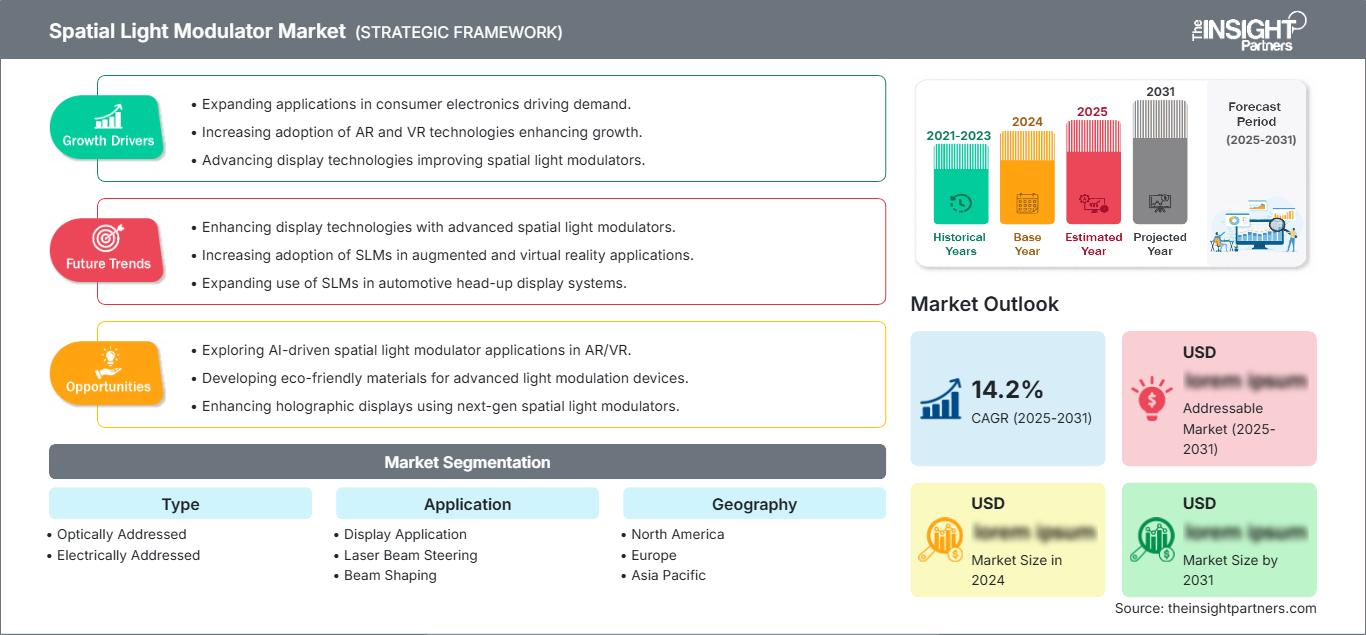
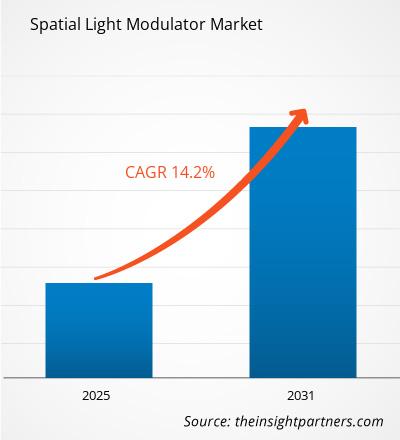
The Spatial Light Modulator Market is undergoing rapid expansion as programmable control of light becomes increasingly important across advanced optics, laser processing, microscopy, holography, and emerging computing architectures. The market was valued at US$ 533.37 Million in 2025 and is projected to reach US$ 1,480.62 Million by 2034, registering a 12.01% CAGR from 2026 to 2034. The market encompasses technologies that dynamically modify the amplitude, phase, polarization, or direction of incident light through electronically or optically controlled modulation.
Demand for Spatial Light Modulator Market size solutions is increasingly linked to precision photonics rather than conventional display applications alone. Industrial laser processing, adaptive optics, advanced microscopy, optical communications, holographic imaging, semiconductor manufacturing, and quantum technologies are creating requirements for higher resolution, faster modulation, greater optical efficiency, and improved power handling. North American demand is supported by research-intensive photonics ecosystems and expanding deployment of programmable optical systems in scientific, industrial, and defense-related applications.
Spatial Light Modulator Market Assessment and Insights
Regional Outlook
- North America: ~31% of the global Spatial Light Modulator Market share in 2025 | ~10% CAGR through 2034. Market position: North America remains a major regional market, supported by advanced photonics research, semiconductor activity, aerospace and defense programs, laser manufacturing, and strong adoption of programmable optical systems across research institutions and industrial technology developers.
- US: ~79% of North American market revenue in 2025 | ~10% CAGR through 2034. Market position: The US represents the principal market within North America, with demand spanning microscopy, optical computing, laser processing, aerospace applications, and advanced displays. Its research infrastructure and concentration of photonics technology developers support continued adoption.
- Europe: ~29% of the global market in 2025 | ~11% CAGR through 2034. Market position: Europe has a mature photonics ecosystem anchored by Germany, the UK, France, Italy, and Spain. Germany leads the region through strong industrial optics, semiconductor, research, and laser-processing capabilities, while collaborative R&D supports advanced SLM commercialization.
- Asia Pacific: ~30% of the global market in 2025 | ~15% CAGR through 2034. Market position: Asia Pacific is the fastest-growing region, supported by electronics manufacturing, semiconductor investment, precision manufacturing, optical research, and expanding laser-processing capacity. China leads the region, followed by established technology bases in Japan and South Korea.
Segment Outlook
- Electrically Addressed: ~65% Share in 2025 | ~11% CAGR through 2034. Market position: Electrically addressed devices lead because direct electronic control provides programmable and repeatable modulation suited to modern optical systems. LCOS architectures are particularly relevant to beam shaping, microscopy, holography, and optical experimentation requiring flexible digital control.
- Laser Beam Steering: ~22% Share in 2025 | ~16% CAGR through 2034. Market position: Laser Beam Steering is positioned as the high-growth application as programmable wavefront control expands the ability to redirect, split, and dynamically position laser energy. Industrial processing, optical trapping, sensing, and emerging autonomous optical systems reinforce adoption.
Competitive Coverage
Forth Dimension Displays Limited, Fraunhofer Institute for Photonic Microsystems, Hamamatsu Photonics K.K., HOLOEYE Photonics AG, JENOPTIK Optical Systems GmbH, LASER COMPONENTS GmbH, Meadowlark Optics, Inc., SANTEC CORPORATION, Texas Instruments Incorporated, Thorlabs, Inc.
Methodology
The Insight Partners follows Data Collection & Secondary Research, Primary Research, Data Analysis, and Data Triangulation & Final Review to validate market estimates and insights.
Source: The Insight Partners' analysis based on proprietary research, government publications, company annual reports, investor presentations, industry databases, and expert interviews.
The Spatial Light Modulator Market has developed from components for optical research applications to programmable optical devices that are built into industrial and scientific systems. Innovations in liquid crystal materials, LCOS technology, MEMS mirrors, driver circuitry, optical coatings, and software controls have broadened wavelength range, modulation, response, and power capabilities. The production process has become reliant on semiconductor manufacturing, precision optical engineering, special liquid crystal materials, MEMS manufacturing, and custom electronics. These innovations allow SLMs to execute functions which previously required several fixed optical components.
Trends in the future will be based on investments in semiconductor fabrication, laser processing, quantum technology, advanced microscopes, and holographic techniques. For Asia Pacific adoption will be based on electronics competency and fabrication; for Europe adoption will be based on precision photonics and research commercialization. For North America investment will continue to drive scientific instruments, military optics, and computing advancements. The energy efficiency and precision processing aspects of manufacturing and industry will drive programmable optical control through beam manipulation.
Spatial Light Modulator Market Report Scope
| Report Attribute | Details |
|---|---|
| Market size in 2025 | US$ 533.37 Million |
| Market Size by 2034 | US$ 1,480.62 Million |
| Global CAGR (2026 - 2034) | 12.01% |
| Historical Data | 2021-2024 |
| Forecast period | 2026-2034 |
Spatial Light Modulator Market Analysis
Spatial Light Modulators market growth is driven by the shift from static optical components to computer-programmable light manipulation technology. The demand will be driven by laser processing, microscopy, lithography, adaptive optics, optical tweezers, holography, and optical communication. SLMs can manipulate the wavefronts, divide beams, correct aberrations and create arbitrary pattern; hence there is no need to redesign optics for each set of conditions. The value chain comprises semiconductors and MEMS production, the use of liquid crystal or micro mirrors technologies, drivers, optics, control software, system integration, and end-users.
The supply factors are determined by the technological challenge associated with the manufacturing of the high-pixel devices with consistent phase response, optical uniformity, temperature stability, and defects. The electrically addressable LCOS devices rely on the special backplane and liquid crystal cell technology, whereas the optically addressable and MEMS technologies are completely different in their fabrication and control techniques. High power applications impose additional thermal management issues. Thus, the product differentiation will occur by wavelength, resolution, phase stability, response time, aperture, power handling, and software.
The Spatial Light Modulator Market report shows that competition includes both optical component makers, suppliers of the specific SLM, researchers, and semiconductor technology companies. Hamamatsu Photonics K.K. is included because of the use of LCOS-SLM technologies in the fields of microscopy, optical trapping, holography, and laser applications. HOLOEYE Photonics AG concentrates on SLM in such fields as holography, microscopy, optical computing, materials processing, and optical trapping. Meadowlark Optics, Inc. specializes in programmable optical modulation. SANTEC CORPORATION is developing high-power industrial applications. Finally, Texas Instruments Incorporated provides MEMS-based digital micromirror technology useful for programmable light control.
More and more often the strategic positioning involves application-specific performance along with the device availability. The Fraunhofer Institute for Photonic Microsystems produces customized MEMS SLM platforms. The other companies participating in the optical ecosystem include JENOPTIK Optical Systems GmbH, LASER COMPONENTS GmbH, Thorlabs, Inc., and Forth Dimension Displays Limited. More attention is paid to such factors as the high optical power, high resolution, fast modulation, wide wavelength range compatibility, and control integration. It helps to satisfy industrial and research special needs and provide performance-based solution.
● REPORT CUSTOMIZATION
Tailor This Report To Align With Your Specific Business Requirements
This report can be customized to align precisely with your business objectives, scope, and target markets. Customization options include tailored segmentation, geography, competitive analysis, and strategic insights to support informed decision-making.
Customize This Report →WHAT YOU CAN ADJUST
- ● Segmentations
- ● Geography
- ● Competitive Analysis
- ● Language Preferences
Spatial Light Modulator Market: Strategic Insights
Regional Insights
North America Spatial Light Modulator Market
North America accounted for ~31% of the global Spatial Light Modulator Market in 2025 and is projected to expand at ~10% CAGR through 2034. A large number of photonics research institutes, laser producers, semiconductor manufacturers, academic institutions, and advanced instrumentation developers make up the region's resources. The US constitutes the main consumer base, with its research efforts being related to the study of quantum technologies, adaptive optics, microscopy, and optical computing. The use of programmable light control in industrial applications for laser processing and manufacturing purposes also plays a part.
The regional market is driven by the ability of SLMs to perform several optical tasks using software-defined patterns. For research purposes, high-quality phase modulation is needed for optical trapping, beam shaping, and holography studies, while industrial consumers are now considering their options with regard to the use of SLMs for optimizing processes and dynamic beam management. The country of Canada makes its contribution in terms of photonics research and optical communication technologies. North American manufacturers and system integrators represent a channel for transferring lab-based SLM technologies into commercial products.
U.S. Spatial Light Modulator Market
The US represented ~79% of North American revenue in 2025 and is expected to register ~10% CAGR through 2034. Its location indicates significant innovation in areas such as scientific instruments, aerospace and defense optics, semiconductors, lasers, biomedical imaging, and computing. Application of SLM technology is highly pertinent where flexibility from programmable wavefront shaping is superior to the use of fixed optical components. The need for resolution in research applications drives the demand for the technology, while its use in industry requires robustness and integration with other optical equipment.
Businesses and institutions that work within the United States are engaged in various areas of the value chain. For example, Texas Instruments Incorporation supplies MEMS digital micromirrors, whereas Thorlabs, Inc. offers optical control technology and related instrumentation for research and photonic laboratories. Applications in the field include adaptive optics, multiphoton microscopy, structured illumination, holographic optics, optical trapping, and laser beam shaping. The presence of university research, government technology initiatives, and photonics businesses ensures diverse demand as opposed to being reliant on one application.
Europe Spatial Light Modulator Market
According to the Spatial Light Modulator Market forecast, Europe represented ~29% of the global market in 2025 and is expected to expand at ~11% CAGR through 2034. Germany is the leading country in Europe, supported by industrial laser processing, optical engineering, semiconductor research, and specialized photonics development. Fraunhofer Institute for Photonic Microsystems has developed MEMS-based SLM technologies for beam shaping, holography, microscopy, optical metrology, and semiconductor applications. Germany's manufacturing base also creates opportunities for integrating SLMs into precision production equipment.
The UK maintains a strong research ecosystem involving photonics, quantum technologies, imaging, and optical communications. France supports demand through aerospace, defense, research instrumentation, and precision optics, while Italy has opportunities in manufacturing, biomedical imaging, and laser systems. Spain contributes through photonics research, industrial laser applications, and optical instrumentation. Across these countries, adoption is increasingly connected to programmable optical systems that can support several process configurations through software. European technology programs and collaboration between research institutes, component suppliers, and industrial users also facilitate movement from experimental platforms toward specialized commercial systems.
The European competitive environment favors high-performance and application-specific SLMs. Suppliers must address optical efficiency, wavelength compatibility, reliability, thermal management, and integration requirements rather than compete only on pixel count. This supports continued demand for both LCOS and MEMS approaches. Germany's combination of research infrastructure and industrial customers gives it a strong regional position, while other European countries contribute specialized demand in scientific and advanced manufacturing applications.
APAC Spatial Light Modulator Market
APAC accounted for ~30% of the global market in 2025 and is projected to grow at ~15% CAGR through 2034, making it the fastest-growing regional market. China is the leading country in Asia Pacific, supported by semiconductor manufacturing, electronics production, industrial laser systems, and expanding precision-manufacturing capabilities. Japan has a highly developed optical technology ecosystem, while South Korea combines semiconductor and display expertise with advanced manufacturing infrastructure.
India is developing opportunities through photonics research, semiconductor investment, defense-related technology, and industrial modernization. Australia contributes through research institutions, astronomy, imaging, and scientific instrumentation. Regional demand is increasingly driven by laser processing, optical research, display technologies, and semiconductor applications. Japan-based suppliers such as Hamamatsu Photonics K.K. and SANTEC CORPORATION illustrate the region's depth in specialized optical technologies, while broader manufacturing investment provides a pathway for increased SLM adoption.
Middle East & Africa Spatial Light Modulator Market
Middle East and Africa is developing from a smaller installed base, with demand supported by precision manufacturing, scientific research, energy-sector technology, defense applications, and infrastructure modernization. Saudi Arabia represents an important Middle Eastern market because investment in advanced industrial capabilities and technology diversification can create requirements for photonics-enabled manufacturing and sensing. The UAE also supports demand through advanced technology initiatives and specialized research infrastructure.
South Africa provides a research-oriented base for optical science, astronomy, and scientific instrumentation, while the Rest of MEA remains more project-driven. The regional market is expected to expand at ~9% CAGR through 2034. Adoption is likely to remain concentrated in specialized applications where programmable optical control provides measurable process or research benefits. Industrial laser processing, optical metrology, imaging, and research systems offer the most relevant routes for market development as local technical capabilities and advanced manufacturing infrastructure expand.
Segmentation Analysis
Type
Type segmentation comprises Optically Addressed and Electrically Addressed technologies. Electrically addressed devices represent the largest main segment and are projected to register ~11% CAGR from 2026 to 2034. Their position reflects direct electronic programmability, compatibility with digital control architectures, and broad use in LCOS-based phase modulation. Optically addressed devices remain relevant in specialized optical systems where the addressing method can provide particular system-level advantages.
- Optically Addressed: Optically addressed SLMs use incident optical information to control modulation and remain relevant to specialized high-speed and optical-processing architectures. Their strategic role is strongest where optical addressing can simplify system configurations or support specialized modulation requirements.
- Electrically Addressed: Electrically addressed SLMs dominate applications requiring direct computer-controlled patterns, phase maps, and programmable optical functions. Their flexibility supports microscopy, holography, beam shaping, optical trapping, and research systems, making them central to commercial and laboratory adoption.
Application
Application includes Display Application, Laser Beam Steering, Beam Shaping, Optical Application, and Holographic Data Storage. The application segment is diversified, with Laser Beam Steering expected to register ~16% CAGR through 2034. Dynamic steering provides a strong industrial rationale because one programmable device can redirect or divide optical energy without mechanically replacing fixed components.
- Display Application: SLMs support advanced projection, holographic display, structured illumination, and emerging AR, VR, and MR architectures. Demand depends on optical efficiency, resolution, refresh performance, and compact integration, with research programs continuing to improve real-time holographic image generation.
- Laser Beam Steering: Beam steering enables dynamic redirection and positioning of laser energy for industrial processing, sensing, optical trapping, and experimental systems. Its strategic importance is increasing as users seek programmable alternatives to mechanically scanned or fixed optical arrangements.
- Beam Shaping: Beam shaping modifies the spatial distribution and wavefront of laser energy to suit particular processes. Industrial applications value programmable beam profiles because they can improve process control, support multipoint irradiation, and reduce thermal effects during precision material processing.
- Optical Application: Optical applications include microscopy, adaptive optics, optical trapping, communications, metrology, and research systems. The category benefits from the ability to reproduce functions associated with lenses, prisms, apertures, and other fixed optical elements through programmable wavefront control.
- Holographic Data Storage: Holographic data storage uses spatially modulated optical patterns to encode information within recording media. Although specialized, the application remains strategically relevant to optical information technologies and contributes to demand for high-resolution modulation and precise phase control.
Opportunity Snapshot
| Application | Revenue Contribution | Trend Tag | Adoption Stage |
| Display Application | Medium | Holographic Displays | Scaling |
| Laser Beam Steering | High | Dynamic Steering | Scaling |
| Beam Shaping | High | Process Optimization | Scaling |
| Optical Application | High | Adaptive Optics | Mature |
| Holographic Data Storage | Low | Optical Storage | Emerging |
Spatial Light Modulator Market Growth Drivers and Impact Analysis
Industrial laser processing is increasing demand for programmable beam control
Industrial laser systems increasingly require precise control of beam position, shape, intensity distribution, and multipoint irradiation. SLMs provide a programmable mechanism for modifying these characteristics without physically replacing optical components. This capability is particularly relevant to welding, drilling, cutting, surface treatment, and metal additive manufacturing, where process conditions can vary with material geometry and production requirements. High-power SLM development is expanding the addressable industrial use case by improving thermal management and optical durability. As manufacturing systems become more automated, programmable beam control can also support recipe-based process optimization and rapid changes between production conditions. The resulting impact extends beyond component demand to system integration, software development, cooling solutions, and application engineering, strengthening the wider photonics value chain.
Expansion of advanced microscopy is broadening scientific SLM adoption
Advanced microscopy increasingly relies on precise manipulation of excitation light, aberration correction, multipoint illumination, and dynamically controlled optical patterns. SLMs can generate these functions through programmable phase or amplitude control, supporting techniques such as multiphoton microscopy, structured illumination, light-sheet microscopy, and optical trapping. The technology can selectively direct illumination toward regions of interest, improve optical correction, and enable simultaneous manipulation of multiple optical paths. This creates a growing requirement for stable, high-resolution devices with accurate phase response and compatibility with sophisticated imaging software. The impact is particularly relevant to research institutions, biomedical instrumentation developers, and microscopy-system manufacturers. As imaging systems become more computational, SLMs increasingly function as programmable optical processors within a broader hardware-software architecture.
Quantum and photonic computing applications are creating new requirements
Quantum technology research is opening additional applications for programmable light modulation. SLMs can generate configurable optical patterns used for neutral-atom trapping, beam steering, wavefront correction, and other experimental functions. These requirements favor high spatial resolution, precise phase control, fast reconfiguration, and stable operation across demanding optical environments. Photonic computing and optical information processing similarly benefit from programmable control over light propagation and interference. The impact on the market is likely to be strongest in specialized, research-driven applications where technical performance is more important than high-volume component production. Suppliers capable of combining optical performance with flexible control electronics and software can address research platforms while also creating technology transfer opportunities into industrial imaging, sensing, and communications systems.
Spatial Light Modulator Market Future Trends
Higher-power SLM architectures will move deeper into industrial processing
The Spatial Light Modulator Market trends indicate that future SLM development is expected to increasingly focus on power handling, thermal stability, and optical durability as programmable modulation moves into higher-energy laser systems. Conventional SLM limitations associated with optical damage and thermal distortion can restrict industrial deployment, particularly in metal processing. Advances in liquid-crystal materials, reflective coatings, cooling architectures, packaging, and device-level thermal management can expand operating envelopes. Higher-power products can enable beam shaping, multipoint processing, and dynamic correction within industrial laser systems. This trend can also shift competitive differentiation toward application-specific engineering, because a high-power SLM must be evaluated as part of a complete optical and thermal system. The broader implication is an expansion of SLM use from laboratory environments into production equipment where reliability, throughput, and repeatability are critical.
MEMS and programmable holography will expand beyond conventional displays
MEMS-based modulation and advanced holographic techniques are expected to broaden the role of SLMs across adaptive optics, medical imaging, metrology, semiconductor processing, and emerging mixed-reality systems. High-speed micromirror arrays can provide modulation characteristics that complement liquid-crystal technologies, particularly where rapid optical reconfiguration is required. Meanwhile, holographic architectures can create dynamic three-dimensional optical patterns rather than relying exclusively on conventional image projection. These developments encourage collaboration among MEMS foundries, optical designers, software developers, research institutes, and system integrators. The resulting market evolution is likely to favor platforms that combine hardware programmability with application software, enabling the same underlying modulation technology to support multiple optical functions.
Spatial Light Modulator Market Opportunities
Application-specific SLM platforms can accelerate industrial commercialization
An opportunity exists to develop SLM platforms optimized for specific industrial workflows rather than selling generic modulation components. Laser processing customers, for example, require combinations of power handling, beam-shaping software, cooling, optical integration, and process-control interfaces. Suppliers that package these capabilities can reduce the engineering burden for equipment manufacturers and accelerate qualification. Similar opportunities exist in microscopy, semiconductor processing, adaptive optics, and optical metrology. Application-specific platforms can also support recurring revenue through software, calibration, technical services, and customized device configurations. The commercial opportunity therefore extends beyond the SLM panel itself and includes system-level integration. Partnerships between component manufacturers, laser companies, research institutions, and equipment builders can shorten the path from laboratory validation to production deployment.
Asia Pacific manufacturing ecosystems can support localized SLM supply chains
Asia Pacific provides an opportunity for localized SLM manufacturing and system integration because the region combines semiconductor production, electronics manufacturing, precision engineering, laser processing, and display technology capabilities. Establishing stronger regional supply chains can reduce dependence on imported optical components while improving customization for local equipment manufacturers. Japan already has established expertise in optical devices and SLM technologies, while China and South Korea provide large downstream manufacturing ecosystems. India offers a developing opportunity through semiconductor and photonics investment. Suppliers can target localized driver electronics, optical packaging, cooling systems, and application software alongside SLM devices. This approach can create a broader regional ecosystem and improve responsiveness to application-specific requirements in industrial processing, scientific instrumentation, and advanced optical systems.
Recent Developments
- January 2026: Santec AOC Corporation is pleased to announce a limited-time special offer on selected standard Spatial Light Modulator (SLM) products, which are widely used in both research and industrial applications.
- June 2025: Kopin Corporation (NASDAQ: KOPN), a leading provider of application-specific optical systems and high-performance microdisplays for defense, training, enterprise, industrial, consumer and medical products, today announced will be presenting its range of cutting-edge spatial light modulators (SLMs) and microdisplays at this year’s Laser World of Photonics, taking place from June 24-27 at the Munich Trade Fair Center. Attendees can explore the latest advancements at Hall B2, Booth 137.
- May 2025: Santec AOC Corporation (Komaki City, Aichi Prefecture; hereinafter “Santec AOC”) has announced the development of a new product, the SLM-310. The SLM-310 is a liquid crystal on silicon (LCOS)-based spatial light modulator capable of withstanding 1kW class laser sources and covering the near infrared (1 µm band) spectrum. Designed for advanced industrial applications such as metal 3D printing and precision laser processing, this product combines highly reliable LCOS technology with a newly developed liquid crystal material with excellent power-handling performance.
Frequently Asked Questions

- Comprehensive Market Sizing and Forecast Analysis
- Detailed Segmentation Analysis
- In-Depth Market Dynamics Assessment
- Regional and Country-Level Insights
- Competitive Landscape and Company Benchmarking
- Strategic Business Intelligence
Recent Reports
Testimonials

The Insight Partners provided valuable market intelligence that supported our global go-to-market strategy. Their team was professional, responsive, and attentive to our feedback, providing thoughtful analysis and helpful methodological clarifications throughout the project.
Junmo Kim Chief Financial Officer (CFO), Enertech Co., Ltd.
The Insight Partners' SCADA System Market report is comprehensive, with valuable insights on current trends and future forecasts. The team was highly professional, responsive, and supportive throughout. We are very satisfied and highly recommend their services.
RAN KEDEM Partner, Reali Technologies LTDs
I requested a report on a very specific software market and the team produced the report in a few days. The information was very relevant and well presented. I then requested some changes and additions to the report. The team was again very responsive and I got the final report in less than a week.
JEAN-HERVE JENN Chairman, Future Analytica
We worked with The Insight Partners for an important market study and forecast. They gave us clear insights into opportunities and risks, which helped shape our plans. Their research was easy to use and based on solid data. It helped us make smart, confident decisions. We highly recommend them.
PIYUSH NAGPAL Sr. Vice President, High Beam Global
The Insight Partners delivered insightful, well-structured market research with strong domain expertise. Their team was professional and responsive throughout. The user-friendly website made accessing industry reports seamless. We highly recommend them for reliable, high-quality research services
YUKIHIKO ADACHI CEO, Deep Blue, LLC.
This is the first time I have purchased a market report from The Insight Partners.While I was unsure at first, I visited their web site and felt more comfortable to take the risk and purchase a market report.I am completely satisfied with the quality of the report and customer service. I had several questions and comments with the initial report, but after a couple of dialogs over email with their analyst I believe I have a report that I can use as input to our strategic planning process.Thank you so much for taking the extra time and making this a positive experience.I will definitely recommend your service to others and you will be my first call when we need further market data.
JOHN SUZUKI President and Chief Executive Officer, Board Director, BK Technologies
I wish to appreciate your support and the professionalism you displayed in the course of attending to my request for information regarding to infectious disease IVD market in Nigeria. I appreciate your patience, your guidance, and the fact that you were willing to offer a discount, which eventually made it possible for us to close a deal. I look forward to engaging The Insight Partners in the future, all thanks to the impression you have created in me as a result of this first encounter.
DR CHIJIOKE ONYIA MANAGING DIRECTOR, PineCrest Healthcare Ltd.Reason to Buy
- Informed Decision-Making
- Understanding Market Dynamics
- Competitive Analysis
- Identifying Emerging Markets
- Customer Insights
- Market Forecasts
- Risk Mitigation
- Boosting Operational Efficiency
- Strategic Planning
- Investment Justification
- Tracking Industry Innovations
- Aligning with Regulatory Trends





 Get Free Sample for