
Substation Automation Market Size, Growth & Trends by 2034
Coverage: By Module (Intelligent Electronic Devices, Communication Networks, SCADA Systems); Offering (Hardware, Software, Services); Type (Transmission substation, Distribution substation); Installation Type (Retrofit Installation, New Installation); End-Users (Utility, Steel, Mining, Oil and Gas, Transportation, Others) , and Geography (North America, Europe, Asia Pacific, and South and Central America)
- Status : Data Released
- Report Code : TIPTE100000582
- Category : Electronics and Semiconductor
- No. of Pages : 150
- Available Report Formats :


- Last update date : October 30, 2026


2025 Market Size
US$ 52.09 Bn
Base year value
2034 Forecast
US$ 87.47 Bn
Projected by 2034
CAGR 2026-2034
5.93 %
Growth rate
Addressable Market
US$ 632.24 Bn
(2026-2034)
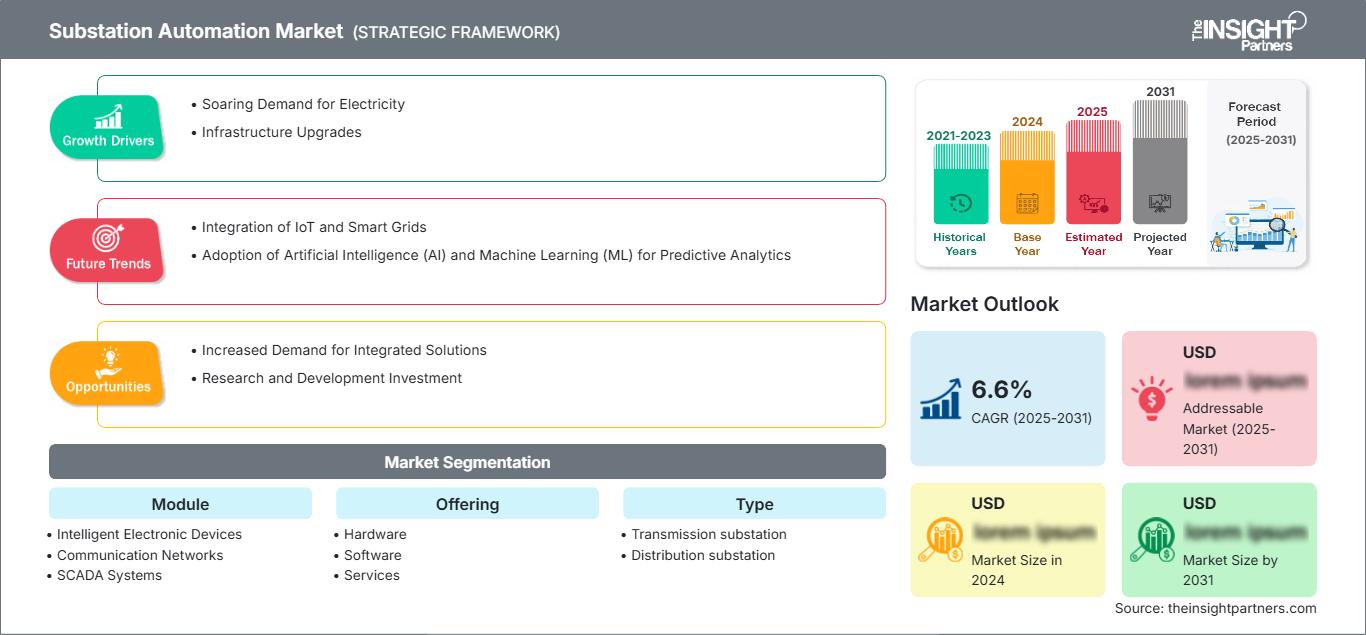
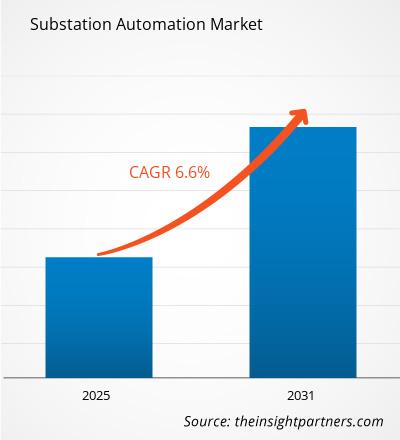
The Substation Automation Market was valued at US$ 52.09 Billion in 2025 and is projected to reach US$ 87.47 Billion by 2034, expanding at a CAGR of 5.93% during 2026–2034. The market encompasses technologies that automate monitoring, protection, communication, control, and operational decision-making within transmission and distribution substations. Demand is being shaped by grid modernization, renewable-energy integration, aging electrical infrastructure, cybersecurity requirements, and the need for more responsive power-system operations.
The Substation Automation Market size is being supported by investments in intelligent electronic devices, communication networks, supervisory control and data acquisition platforms, and integrated engineering and maintenance services. North America remains an important installed-base market because utilities are upgrading aging assets and strengthening grid resilience, while Asia Pacific is adding automation capacity alongside transmission expansion, industrial electrification, renewable integration, and urban load growth.
Substation Automation Market Assessment and Insights
Regional Outlook
- North America: ~31% of the global Substation Automation Market share in 2025 | ~5% CAGR through 2034. Market position: North America maintains a mature installed base supported by utility modernization, replacement of legacy protection systems, grid-resilience programs, and increasing automation requirements associated with distributed generation and large electricity loads.
- US: ~82% of North American market revenue in 2025 | ~5% CAGR through 2034. Market position: The US represents the principal demand center in North America, with utilities investing in protection upgrades, digital communications, SCADA modernization, and automated control to improve reliability and accommodate changing generation and load patterns.
- Europe: ~27% of the global market in 2025 | ~5% CAGR through 2034. Market position: Europe combines a mature substation base with extensive replacement requirements and renewable integration. Germany, the UK, France, Italy, and Spain are important national markets, with transmission reinforcement and distribution digitalization supporting sustained demand.
- Asia Pacific: ~32% of the global market in 2025 | ~8% CAGR through 2034. Market position: Asia Pacific is the fastest-growing regional market, driven by transmission additions, urban electricity demand, renewable deployment, industrial expansion, and grid-digitalization programs. China represents the largest regional demand center, followed by Japan, South Korea, India, and Australia.
Segment Outlook
- Intelligent Electronic Devices: ~45% Share in 2025 | ~6% CAGR through 2034. Market position: Intelligent Electronic Devices represent the largest module category because protection, measurement, control, and automation functions increasingly depend on multifunctional digital equipment capable of communicating across modern substation architectures.
- SCADA Systems: ~25% Share in 2025 | ~9% CAGR through 2034. Market position: SCADA Systems are positioned as the high-growth module category as utilities require centralized visibility, remote operation, real-time data processing, and integration with increasingly distributed and digitally connected grid assets.
Competitive Coverage
Novatech LLC, Intel, Schweitzer Engineering Laboratories, Inc., ABB Ltd., Siemens AG, General Electric, Cisco Systems Inc., Schneider Electric SE, Eaton Corporation PLC, Honeywell International Inc.
Methodology
The Insight Partners follows Data Collection & Secondary Research, Primary Research, Data Analysis, and Data Triangulation & Final Review to validate market estimates and insights.
Source: The Insight Partners' analysis based on proprietary research, government publications, company annual reports, investor presentations, industry databases, and expert interviews.
The evolution of Substation Automation market is characterized by the shift from electromechanical protection and manual-operated system towards comprehensive digital control environment. The early automation systems were highly dependent on hardware components, point-to-point connectivity and communication. Now there is an increase in integration of protection, measuring, controlling, networking, visualization and data management capabilities. IEC 61850 communication becomes essential due to the need of interoperability and increased information exchange capabilities among intelligent devices. Virtualization, centralization of protection systems, edge computing and software-defined architectures transform the way of implementing automation functions.
The next stage of development will be focused on interoperability, cybersecurity, distributed intelligence and flexibility over lifecycle. The utilities need automation platforms which could be implemented for renewable generation, battery energy storage systems, electric vehicles, data center loads, bi-directional power flow with no need of full replacement of existing primary devices. It opens up opportunities both for retrofit and digital substation solutions. Software engineering, remote diagnostics, digital testing and condition-based maintenance could also decrease the efforts in implementation and maximize the installed equipment efficiency.
Substation Automation Market Report Scope
| Report Attribute | Details |
|---|---|
| Market size in 2025 | US$ 52.09 Billion |
| Market Size by 2034 | US$ 87.47 Billion |
| Global CAGR (2026 - 2034) | 5.93% |
| Historical Data | 2021-2024 |
| Forecast period | 2026-2034 |
Substation Automation Market Analysis
Demands within the substation automation market growth framework are directly tied to electricity grid modernization. There is a need for increased visibility concerning voltage, current, protection state, device conditions, and grid disturbances given increased variability of the power generation process. Automation plays a role of an operational level between the field devices and control centers. The supply chain includes IED and relays suppliers, networking vendors, SCADA development companies, system integrators, engineering contractors, commissioning services, and lifecycle services providers. Hardware has retained its importance, although software, communication, cybersecurity, and engineering play a growing role in the value of a system.
The trends within the supply dynamics framework are associated with modularity and platform approach. Suppliers that are able to provide the whole package including protection, automation, communications, visualization, and cybersecurity decrease the integration challenges for their clients. ABB Ltd. and Siemens AG provide extensive range of solutions within the domains of protection and automation. Schweitzer Engineering Laboratories, Inc. specializes in protection, control, and automation. Cisco Systems Inc. provides networking solutions for the industry, while Schneider Electric SE, Eaton Corporation PLC, Honeywell International Inc., and General Electric provide participation via other electrical, control, and automation portfolios.
Increasingly, the competitive environment reflects the importance of the installed base, interoperability, cyber security capabilities, engineering expertise, and lifecycle support, rather than specific hardware solutions. Novatech LLC provides customized automation and utility solutions, whereas Intel provides processing solutions that may help realize increasingly computing-intensive automation solutions. ABB Ltd. and Siemens AG increase their reliance on software-centric and digital solutions, whereas General Electric develops software-based protection and control. The importance of strategic position will depend on the company's ability to ensure support for legacy integration and future digital solutions while preserving protection performance.
Investments are being allocated for incremental improvements. Suppliers who have the capability of implementing new communications and software into the existing substation are at an advantage. The commercial case is not limited to the sales of the equipment; it covers engineering, implementation, cyber security update, remote monitoring, training, upgrade, and maintenance. As utilities are looking for consistent lifecycle costs, services and upgrades are becoming an increasingly important part of the supplier relationship.
● REPORT CUSTOMIZATION
Tailor This Report To Align With Your Specific Business Requirements
This report can be customized to align precisely with your business objectives, scope, and target markets. Customization options include tailored segmentation, geography, competitive analysis, and strategic insights to support informed decision-making.
Customize This Report →WHAT YOU CAN ADJUST
- ● Segmentations
- ● Geography
- ● Competitive Analysis
- ● Language Preferences
Substation Automation Market: Strategic Insights
Regional Insights
North America Substation Automation Market
North America represents a mature but steadily expanding market, with an estimated ~5% CAGR through 2034. Replacement of aging electrical equipment, reliability requirements, cybersecurity concerns, and increasing power-system complexity are encouraging utilities to modernize protection and automation systems. The region also has a large installed base of substations that require phased upgrades rather than complete reconstruction.
The US accounts for ~82% of North American revenue and remains the central demand market. Utilities are deploying advanced IEDs, communication networks, SCADA platforms, and remote monitoring systems to improve situational awareness and reduce operational dependence on manual processes. Growing electricity requirements from industrial facilities, data centers, electrification, and distributed resources further increase the need for responsive substation control. Canada contributes additional demand through transmission modernization, renewable integration, and remote-grid requirements. The regional Substation Automation Market share is therefore supported by both replacement demand and the progressive digitalization of existing infrastructure.
U.S. Substation Automation Market
The U.S. market is expected to expand at ~5% CAGR through 2034 and represents ~82% of North American market revenue. Utility investment is increasingly directed toward automated protection, advanced communications, remote monitoring, and control architectures that can improve resilience while supporting changing generation and load patterns. The installed base creates a substantial retrofit opportunity because many substations require modernization without disrupting continuous power delivery.
Supplier presence spans specialized protection providers and diversified electrical technology companies. Schweitzer Engineering Laboratories, Inc. has an established position in protection and control, while ABB Ltd., Siemens AG, Schneider Electric SE, Eaton Corporation PLC, Cisco Systems Inc., and General Electric address broader automation, electrical, networking, and grid-management requirements. Application demand extends across transmission and distribution substations, with distribution systems gaining importance as utilities integrate distributed energy resources, storage, flexible loads, and advanced fault-management functions.
Europe Substation Automation Market
Europe accounts for ~27% of the global market in 2025 and is projected to grow at ~5% CAGR through 2034. The region combines high automation maturity with substantial modernization requirements. Grid operators are upgrading aging infrastructure while integrating renewable generation, improving interconnection capacity, and meeting increasingly stringent requirements for resilience and cybersecurity. Digital substations can reduce wiring complexity, improve data availability, and support more efficient lifecycle management.
Germany represents a leading country in Europe because of its large industrial base, transmission requirements, renewable integration needs, and extensive grid modernization activity. The UK is investing in network reinforcement associated with renewable generation and changing electricity demand. France benefits from a large transmission and distribution infrastructure and increasing digitalization requirements. Italy is upgrading networks to manage distributed generation and improve system flexibility, while Spain is strengthening grid infrastructure as renewable penetration expands. These national markets create demand for IEDs, communication networks, SCADA systems, and integrated engineering services.
European vendors also influence technology development through broad portfolios spanning automation, protection, networking, and software. Siemens AG supports digital substation architectures through its SICAM and SIPROTEC platforms, while ABB Ltd. provides IEC 61850-enabled automation and protection technologies. Schneider Electric SE contributes automation and control platforms for electrical networks. The resulting competitive environment places strong emphasis on interoperability, cybersecurity, engineering efficiency, and long-term asset management.
APAC Substation Automation Market
Asia Pacific represents ~32% of the global market and is expected to expand at ~8% CAGR through 2034, making it the fastest-growing regional market. China is the leading country in Asia Pacific, supported by large-scale grid investment, industrial electricity demand, renewable generation, and continued transmission development. Japan and South Korea contribute through technologically advanced utility networks, while India is expanding transmission and distribution infrastructure alongside electrification and renewable deployment.
Australia also provides demand through renewable integration, long-distance transmission requirements, and modernization of regional electricity networks. Across the region, automation adoption is increasingly linked with the need to manage variable renewable generation and more complex power flows. Distribution substations represent an expanding opportunity as utilities seek better visibility and automated fault management at the grid edge.
Middle East & Africa Substation Automation Market
The Middle East & Africa market is expected to grow at ~6% CAGR through 2034. Saudi Arabia represents a leading country in the Middle East & Africa region where supported by large power-system investments, industrial development, and renewable-energy integration. The UAE also contributes through grid modernization associated with urban expansion, infrastructure projects, and digital utility initiatives.
South Africa remains an important African market because of its large electricity infrastructure and need for reliability improvements and network modernization. Other Middle Eastern markets are investing in transmission infrastructure to support industrialization and new generation capacity, while African markets increasingly require automation for system reliability, remote monitoring, and efficient operation of expanding networks. The regional opportunity is consequently split between advanced new-build projects and modernization of installed substations.
Segmentation Analysis
Module
The Module segment is expected to expand at ~6% CAGR through 2034. The Substation Automation Market scope within this category covers Intelligent Electronic Devices, Communication Networks, and SCADA Systems. Demand is shifting toward integrated digital architectures in which protection, monitoring, control, communications, and data management operate as coordinated layers. IEDs remain foundational, while communication and supervisory platforms increasingly determine interoperability and operational visibility.
- Intelligent Electronic Devices: IEDs form the core protection and control layer of automated substations. Their role is expanding from standalone protection toward multifunctional monitoring, event recording, communication, automation, and diagnostics, supporting utilities that require greater information density from each installed device.
- Communication Networks: Communication Networks connect protection devices, controllers, SCADA systems, control centers, and enterprise applications. Ethernet-based architectures, fiber connectivity, redundancy, and secure communications are strategically important as utilities increase the amount of operational data exchanged across substations.
- SCADA Systems: SCADA Systems provide centralized visualization, supervisory control, alarms, historical data, and operational coordination. Their importance is increasing as utilities manage distributed generation, remote substations, variable loads, and geographically dispersed assets through centralized and increasingly software-defined environments.
Offering
The Offering segment is projected to grow at ~6% CAGR through 2034. Hardware continues to provide the physical foundation for automation, while software and services capture increasing value as utilities seek flexible engineering, cybersecurity, analytics, upgrades, and lifecycle support. The Substation Automation Market analysis indicates that recurring service requirements can become increasingly important as digital platforms require continuous maintenance and updating.
- Hardware: Hardware includes IEDs, communication equipment, controllers, gateways, and associated automation equipment. Replacement of aging devices and installation of digital systems in new substations sustain demand, while multifunctional hardware can reduce equipment footprints and simplify integration.
- Software: Software supports SCADA, visualization, engineering, asset monitoring, analytics, cybersecurity, and increasingly virtualized control functions. Demand is moving toward platforms capable of integrating heterogeneous devices and providing secure access to operational information across utility environments.
- Services: Services encompass engineering, installation, commissioning, testing, maintenance, upgrades, cybersecurity support, and lifecycle management. Retrofit complexity makes specialized services particularly relevant because utilities must modernize automation while maintaining system availability and coordinating with legacy equipment.
Type
The Type segment is expected to expand at ~6% CAGR through 2034. Transmission substations continue to represent the largest installed-value opportunity because of their role in high-voltage power transfer and system stability. Distribution substations, however, are becoming more digitally intensive as utilities manage distributed generation, storage, electric vehicles, and increasingly dynamic loads.
- Transmission substation: Transmission substations require high-performance protection, control, communications, and monitoring because failures can affect large geographic areas. Automation supports system stability, fault isolation, remote operation, and coordination across interconnected transmission networks.
- Distribution substation: Distribution substations are gaining strategic importance as power systems become more decentralized. Automation enables fault detection, isolation, restoration, voltage management, and improved visibility into distributed resources, helping utilities operate increasingly complex grid-edge environments.
Installation Type
The installation type segment plays a crucial role in shaping demand across the Substation Automation Market as utilities and industrial operators modernize power infrastructure to improve grid reliability, operational efficiency, and real-time monitoring capabilities. The adoption of intelligent electronic devices (IEDs), digital communication protocols, and advanced control systems is driving investment in both existing and newly developed substations. Growing grid modernization initiatives, renewable energy integration projects, and smart grid deployments continue to support market expansion. Among installation types, New Installation is expected to register a CAGR of ~8% during 2026–2034, driven by expanding transmission and distribution networks and increasing investments in power infrastructure worldwide.
- Retrofit Installation: Retrofit installations involve upgrading existing substations with modern automation technologies, intelligent control systems, and digital monitoring solutions. Utilities and industrial operators increasingly adopt retrofit projects to enhance asset performance, improve grid visibility, reduce operational disruptions, and extend the service life of aging infrastructure.
- New Installation: New installations are primarily driven by power grid expansion, renewable energy integration, urbanization, and industrial development projects. These substations are typically designed with advanced automation architectures from inception, enabling enhanced operational efficiency, cybersecurity readiness, and seamless integration with smart grid ecosystems.
End-Users
The end-user segment reflects the broad adoption of substation automation technologies across power-intensive industries seeking greater operational reliability, safety, and energy management capabilities. Automation solutions provide real-time monitoring, fault detection, remote control, and predictive maintenance functions that improve network performance and reduce downtime. Increasing electricity demand, digital transformation initiatives, and investments in resilient power infrastructure continue to accelerate adoption across various sectors. Among end-users, the Utility segment is anticipated to record a CAGR of ~8% during 2026–2034, supported by large-scale grid modernization programs and growing smart grid deployments.
- Utility: Utilities represent the largest adopters of substation automation systems due to extensive transmission and distribution networks. These solutions support grid stability, outage management, renewable energy integration, asset monitoring, and efficient power delivery, making them essential to modern electricity networks.
- Steel: Steel manufacturers utilize substation automation to ensure reliable power supply for energy-intensive production processes. Automated substations help improve power quality, minimize operational disruptions, and support efficient energy management across integrated steel facilities.
- Mining: Mining operations rely on substation automation to manage power distribution across extraction sites, processing facilities, and remote operations. Advanced monitoring and control capabilities enhance operational continuity, safety, and equipment reliability in demanding mining environments.
- Oil and Gas: The oil and gas sector deploys substation automation systems to support upstream, midstream, and downstream facilities requiring uninterrupted power supply. Automation technologies help optimize energy consumption, improve network visibility, and ensure operational safety across critical assets.
- Transportation: Transportation infrastructure, including rail networks, metro systems, airports, and ports, increasingly utilizes automated substations to maintain reliable electrical systems. These solutions support operational efficiency, enhance system resilience, and facilitate uninterrupted transportation services.
Opportunity Snapshot
| Type | Revenue Contribution | Trend Tag | Adoption Stage |
| Transmission substation | High | Grid Stability | Mature |
| Distribution substation | Medium | Grid Edge | Scaling |
Substation Automation Market Growth Drivers and Impact Analysis
Grid Modernization and Replacement of Aging Infrastructure
A major driver of the Substation Automation Market is the need to replace aging protection, control, and communication equipment while improving the operational performance of existing substations. Many utilities cannot economically rebuild complete facilities, creating demand for phased modernization that preserves primary equipment while upgrading secondary systems. Digital IEDs, modern communication networks, and updated SCADA platforms allow operators to improve monitoring and control without requiring an entirely new site. Replacement cycles also create opportunities for standardized engineering and modular architectures. The commercial impact extends beyond hardware because retrofit projects require configuration, testing, commissioning, cybersecurity validation, and ongoing maintenance. Suppliers that can manage multi-vendor environments and minimize outage windows are therefore positioned to address a significant portion of modernization spending.
Renewable Integration and Increasing Grid Operating Complexity
Renewable generation introduces more variable power flows and requires substations to process information from a broader range of assets. Solar, wind, storage, distributed generation, and flexible loads can alter conventional operating patterns, increasing the importance of real-time visibility and automated response. Substation automation provides the protection, communication, and control layer needed to coordinate these changing conditions. For transmission operators, automation supports system stability and rapid fault response. For distribution operators, it enables greater visibility into bidirectional flows and supports automated restoration. The market impact is strongest where renewable capacity additions coincide with network reinforcement and grid-edge modernization. This combination encourages utilities to specify more interoperable equipment, stronger communications, cybersecurity functions, and software capabilities in both new-build and retrofit projects.
Cybersecurity and Operational Resilience Requirements
Cybersecurity is becoming an integral design requirement because substations increasingly depend on connected digital equipment, remote access, and software-based control. Utilities need automation architectures that can authenticate users, protect communications, segment networks, manage firmware, and maintain operational continuity during security events. Resilience also requires redundancy and rapid recovery capabilities so that critical protection and control functions remain available when communications or individual devices fail. These requirements increase the technical content of automation projects and encourage customers to evaluate suppliers on lifecycle capabilities rather than initial equipment price alone. The resulting demand supports secure communication infrastructure, hardened automation units, cybersecurity services, continuous monitoring, and periodic system upgrades. This driver also favors vendors able to integrate electrical engineering with information technology and operational technology security.
Substation Automation Market Future Trends
Virtualized and Software-Defined Substation Architectures
One of the most important Substation Automation Market trends is the gradual separation of automation functionality from dedicated hardware. Virtualized protection and control can allow multiple software applications to operate on shared computing infrastructure, potentially reducing device duplication and improving update flexibility. This architecture changes procurement from a collection of fixed-purpose devices toward a combination of computing platforms, software functions, communications, and cybersecurity controls. It can also support more frequent software upgrades without replacing physical equipment. Adoption will remain dependent on utility protection philosophies, regulatory acceptance, cybersecurity requirements, and demonstrated reliability. Over time, the approach could encourage standardized computing environments and expand the role of software engineering in substation projects.
Digital Twins, Remote Engineering, and Data-Centric Operations
Digital engineering is expected to become more deeply embedded in substation design and lifecycle management. Digital twins can support testing, configuration validation, operator training, troubleshooting, and maintenance planning before changes are implemented in the physical environment. Remote engineering can reduce site visits and accelerate commissioning by allowing specialists to diagnose configuration issues from centralized locations. Data-centric architectures can also connect substation information with asset-management, planning, and grid-operations systems. The value proposition is not limited to automation itself; it lies in improving the quality and usability of operational data throughout the asset lifecycle. Suppliers that combine automation with engineering tools, analytics, secure connectivity, and lifecycle services can therefore address a broader portion of utility digitalization requirements.
Substation Automation Market Opportunities
Retrofit Platforms for Multi-Vendor Legacy Substations
A significant commercial opportunity exists in retrofit platforms designed to connect modern automation equipment with legacy protection, control, and communication systems. Utilities often operate substations containing equipment from different generations and manufacturers, making complete replacement costly and operationally disruptive. Vendors can address this challenge through protocol gateways, modular controllers, modern IEDs, secure networking, and engineering services that enable staged modernization. The Substation Automation Market Forecasts can therefore be linked to the installed base as much as to new substation construction. Suppliers that simplify migration, maintain interoperability, and reduce outage requirements can build recurring relationships through upgrades, cybersecurity services, configuration management, and lifecycle support. Regional manufacturing and local engineering capabilities can further improve responsiveness in large retrofit programs.
Integrated Automation Services for Distributed and Renewable Grids
Another opportunity is the development of integrated services for utilities managing increasingly distributed generation and flexible loads. These projects require more than individual devices because operators need coordinated protection, communications, SCADA, analytics, cybersecurity, and field support. Suppliers can develop project models that combine equipment with engineering, commissioning, remote monitoring, software updates, and lifecycle services. Such approaches are particularly relevant to distribution networks where automation requirements are expanding beyond traditional fault detection toward active management of distributed resources. Partnerships between equipment manufacturers, software providers, networking specialists, and system integrators can reduce implementation complexity. Service-led models can also provide utilities with predictable support costs while enabling vendors to remain involved throughout the operational life of the automation system.
Recent Developments
- September 2026: ABB Ltd. announced continued expansion of its digital-substation and electrification capabilities, with its 2026 activities emphasizing IEC 61850-enabled solutions, distribution automation, and digital monitoring. ABB's portfolio includes ZEE600 substation automation capabilities integrating protection relays, controllers, SCADA functionality, and third-party equipment.
- February 2026: General Electric launched GridBeats APS, a software-defined automation and protection platform designed to support modernization of substations. The solution allows multiple protection and control applications to operate on a common platform, reducing hardware requirements and supporting remote software updates.
- February 2026: Siemens AG continued advancing virtualized protection and control through its SIPROTEC V and SICAM portfolio, with a 2026 workshop series covering virtualized transformer-bay deployment, configuration, testing, and scaling. The initiative reflects the industry's movement toward software-defined substation architectures.
Frequently Asked Questions

- Comprehensive Market Sizing and Forecast Analysis
- Detailed Segmentation Analysis
- In-Depth Market Dynamics Assessment
- Regional and Country-Level Insights
- Competitive Landscape and Company Benchmarking
- Strategic Business Intelligence
Recent Reports
Testimonials

The Insight Partners provided valuable market intelligence that supported our global go-to-market strategy. Their team was professional, responsive, and attentive to our feedback, providing thoughtful analysis and helpful methodological clarifications throughout the project.
Junmo Kim Chief Financial Officer (CFO), Enertech Co., Ltd.
The Insight Partners' SCADA System Market report is comprehensive, with valuable insights on current trends and future forecasts. The team was highly professional, responsive, and supportive throughout. We are very satisfied and highly recommend their services.
RAN KEDEM Partner, Reali Technologies LTDs
I requested a report on a very specific software market and the team produced the report in a few days. The information was very relevant and well presented. I then requested some changes and additions to the report. The team was again very responsive and I got the final report in less than a week.
JEAN-HERVE JENN Chairman, Future Analytica
We worked with The Insight Partners for an important market study and forecast. They gave us clear insights into opportunities and risks, which helped shape our plans. Their research was easy to use and based on solid data. It helped us make smart, confident decisions. We highly recommend them.
PIYUSH NAGPAL Sr. Vice President, High Beam Global
The Insight Partners delivered insightful, well-structured market research with strong domain expertise. Their team was professional and responsive throughout. The user-friendly website made accessing industry reports seamless. We highly recommend them for reliable, high-quality research services
YUKIHIKO ADACHI CEO, Deep Blue, LLC.
This is the first time I have purchased a market report from The Insight Partners.While I was unsure at first, I visited their web site and felt more comfortable to take the risk and purchase a market report.I am completely satisfied with the quality of the report and customer service. I had several questions and comments with the initial report, but after a couple of dialogs over email with their analyst I believe I have a report that I can use as input to our strategic planning process.Thank you so much for taking the extra time and making this a positive experience.I will definitely recommend your service to others and you will be my first call when we need further market data.
JOHN SUZUKI President and Chief Executive Officer, Board Director, BK Technologies
I wish to appreciate your support and the professionalism you displayed in the course of attending to my request for information regarding to infectious disease IVD market in Nigeria. I appreciate your patience, your guidance, and the fact that you were willing to offer a discount, which eventually made it possible for us to close a deal. I look forward to engaging The Insight Partners in the future, all thanks to the impression you have created in me as a result of this first encounter.
DR CHIJIOKE ONYIA MANAGING DIRECTOR, PineCrest Healthcare Ltd.Reason to Buy
- Informed Decision-Making
- Understanding Market Dynamics
- Competitive Analysis
- Identifying Emerging Markets
- Customer Insights
- Market Forecasts
- Risk Mitigation
- Boosting Operational Efficiency
- Strategic Planning
- Investment Justification
- Tracking Industry Innovations
- Aligning with Regulatory Trends





 Get Free Sample for