
Train Contactor Market Demand, Trends & Forecast by 2034
Coverage: by Type (AC Train Contactors, DC Train Contactors); Application (Passenger Trains, Freight Trains) , and Geography (North America, Europe, Asia Pacific, and South and Central America)
- Status : Data Released
- Report Code : TIPRE00010131
- Category : Electronics and Semiconductor
- No. of Pages : 150
- Available Report Formats :


- Last update date : November 05, 2026


2025 Market Size
US$ 1.28 Bn
Base year value
2034 Forecast
US$ 2.18 Bn
Projected by 2034
CAGR 2026-2034
6.07 %
Growth rate
Addressable Market
US$ 15.65 Bn
(2026-2034)
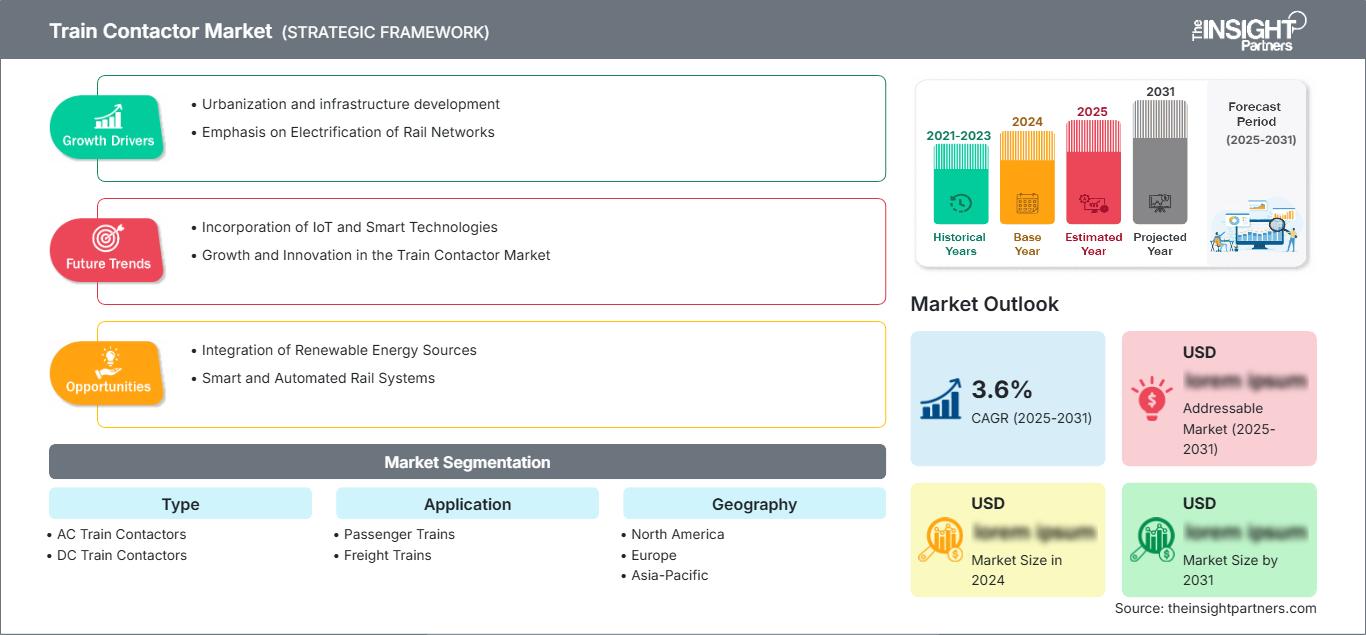
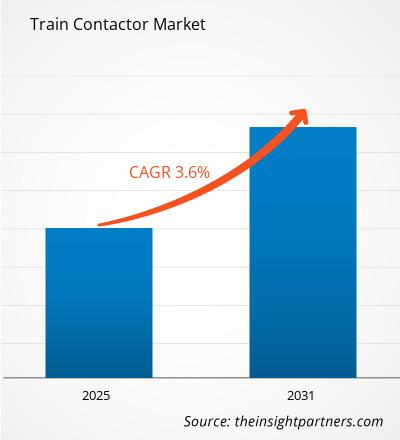
The Train Contactor Market is valued at US$ 1.28 Billion in 2025 and is projected to reach US$ 2.18 Billion by 2034, expanding at a CAGR of 6.07% from 2026 to 2034. Demand is supported by continued railway electrification, rolling-stock modernization, replacement of aging electrical switching equipment, and expansion of passenger and freight rail networks. The market covers AC Train Contactors and DC Train Contactors across Passenger Trains and Freight Trains, with procurement increasingly influenced by electrical safety, reliability, lifecycle performance, and compatibility with modern traction architectures.
Across North America, the Train Contactor Market size is supported by investment in passenger rail modernization, corridor development, fleet renewal, and upgrades to traction-power infrastructure. The region is expected to expand at a modeled ~5% CAGR through 2034. Aging rolling-stock assets and the introduction of battery, hybrid, and other lower-emission propulsion configurations are creating additional requirements for dependable switching and protection components.
Train Contactor Market Assessment and Insights
Regional Outlook
- North America: ~22% of the global Train Contactor Market share in 2025 | ~5% CAGR through 2034. Market position: North America represents a mature rail-equipment market supported by passenger-rail modernization, fleet replacement, infrastructure rehabilitation, and increasing deployment of alternative propulsion technologies requiring reliable onboard electrical switching.
- US: ~82% of North American market revenue in 2025 | ~5% CAGR through 2034. Market position: The US accounts for the majority of North American demand, supported by passenger-rail fleet modernization, intercity corridor investment, metropolitan rail expansion, and replacement of aging electrical and traction equipment.
- Europe: ~31% of the global market in 2025 | ~5% CAGR through 2034. Market position: Europe has a mature electrified railway ecosystem, with Germany representing a leading country in Europe. Network modernization, cross-border rail development, fleet renewal, and stringent technical requirements sustain replacement and new-build demand.
- Asia Pacific: ~38% of the global market in 2025 | ~7% CAGR through 2034. Market position: Asia Pacific is the fastest-growing region, driven by extensive railway construction, metro expansion, high-speed rail development, electrification programs, and large-scale rolling-stock production in China, India, Japan, South Korea, and Australia.
Segment Outlook
- AC Train Contactors: ~62% Share in 2025 | ~6% CAGR through 2034. Market position: AC Train Contactors lead because modern electric rolling stock increasingly relies on AC traction architectures and auxiliary electrical systems. Their use spans high-speed, passenger, metro, and electric freight applications.
- Freight Trains: ~32% Share in 2025 | ~7% CAGR through 2034. Market position: Freight Trains represent the higher-growth main application as railway operators expand electric freight capacity, modernize locomotive fleets, and improve energy efficiency across heavily utilized routes and industrial corridors.
Competitive Coverage
ABB Group, Alstom SA, Crouzet Automatismes, Legrand Pvt Ltd, Lionel Train Contactor, Schneider Electric SE, Sécheron Hasler Group, Sensata Technologies, Inc., Siemens AG, Telema SpA
Methodology
The Insight Partners follows Data Collection & Secondary Research, Primary Research, Data Analysis, and Data Triangulation & Final Review to validate market estimates and insights.
Source: The Insight Partners' analysis based on proprietary research, government publications, company annual reports, investor presentations, industry databases, and expert interviews.
The development of rail transport electricity supply systems has been towards more complex systems comprising traction power supply, auxiliary power supplies, control and protection of these systems. This process has elevated the role of robust contactors able to function under the effect of vibration, temperature changes, electrical transients, and heavy duty cycles. Thus, the Train Contactor Market growth depends not only on the quantity of trains being built, but also on their electrical complexity and replacement needs of existing trains. The development of AC traction systems became very important for new electric trains, whereas DC switching is still needed in auxiliary systems, old fleets, metro systems, and some traction systems.
Future investments will be increasingly directed to long-haul passenger railways, urban rail systems, electrified freight lines, and replacement of older equipment. There will be many opportunities for Train Contactor Market in the Asia Pacific due to development of railway transportation and building of new rolling stock. Europe and North America will present replacement market because of the presence of old installed equipment. Moreover, there are many regulatory initiatives aimed at safety, interoperability, energy efficiency, and reliability of railway equipment.
Train Contactor Market Report Scope
| Report Attribute | Details |
|---|---|
| Market size in 2025 | US$ 1.28 Billion |
| Market Size by 2034 | US$ 2.18 Billion |
| Global CAGR (2026 - 2034) | 6.07% |
| Historical Data | 2021-2024 |
| Forecast period | 2026-2034 |
Train Contactor Market Analysis
Contactors are necessary for switching, isolation, protection, and control in traction as well as auxiliary electric systems in trains. The demand is thus dependent on new train production and retrofit and maintenance cycles. Significant demand is created by passenger trains since metro, commuter, regional, and high-speed trains feature several electrically controlled subsystems. Freight locomotives contribute to demand creation owing to the electrification of routes and upgrading of propulsion units. Suppliers have to meet railway-specific qualification, insulation, current ratings, vibration, temperature, and reliability requirements.
Value chain covers the electrical materials and components suppliers up to the contactor manufacturers, system integrators, OEM of rolling stock and railway operators. Design specifications for contactors will mostly be embedded within broader power systems of traction or auxiliary power, while qualifications would be one of the key factors at the early stages. Localization and long term spares supply also would impact the dynamics of supply. Hence, the manufacturer that has engineering capabilities, certifications, knowledge of application and manufacturing facilities in the region will have competitive advantages in both OE and aftermarkets.
According to Train Contactor Market Report, the competitive environment of the market is characterized by diversified electrical equipment manufacturers and also specialized railway component manufacturers. The diversified electrical equipment manufacturers include ABB Group, Alstom SA, Schneider Electric SE, Siemens AG and Sécheron Hasler Group. They have competencies in the areas of traction, electrification, automation and railway electrical systems. Crouzet Automatismes provides competencies in the field of switches and mechatronics for railway applications, while Sensata Technologies, Inc. provides sensing, electrical protection and switching technologies. Telema SpA and Legrand Pvt Ltd are other specialized electrical equipment providers.
Strategic positioning today increasingly involves product qualification, customization,size/compactness, thermal management, diagnostics and lifecycle support rather than merely component cost. There is also increasing investment in localized manufacturing and engineering for rapidly growing railway sectors. Suppliers who can integrate contactors with traction converters, circuit breakers, monitoring systems, and broader electrical architectures may improve their position in relation to rolling stock OEMs and systems integrators.
● REPORT CUSTOMIZATION
Tailor This Report To Align With Your Specific Business Requirements
This report can be customized to align precisely with your business objectives, scope, and target markets. Customization options include tailored segmentation, geography, competitive analysis, and strategic insights to support informed decision-making.
Customize This Report →WHAT YOU CAN ADJUST
- ● Segmentations
- ● Geography
- ● Competitive Analysis
- ● Language Preferences
Train Contactor Market: Strategic Insights
Regional Insights
North America Train Contactor Market
North America contributed around 22% of the Train Contactor Market share in 2025 and is estimated to grow at a rate of approximately 5% from 2026 to 2034. Factors driving growth include modernization of passenger rail systems, rehabilitation of infrastructure, fleet renewal, and development of intercity and urban rail networks. USA is the key demand source in the region, while demand drivers from Canada and Mexico include commuter rail systems, freight rail modernization, and urban transit systems.
The region has a strong relationship with replacing old trains and electrical systems in order to drive demand. Innovations related to new propulsion systems, such as battery and hybrid train sets, are also responsible for the creation of demand for switching technologies. Demand drivers emphasize safety, reliability, maintenance, and adherence to existing railway electrical standards. The presence of large installed base, along with investments in passenger rail systems, allows for opportunities in OEM and aftermarket segments.
U.S. Train Contactor Market
The US accounted for roughly ~82% of the North American Train Contactor Market in 2025 and is expected to grow at ~5% CAGR until 2034. Demand drivers include passenger-rail modernization, investment in commuter networks, locomotive replacement, and corridor development. Original equipment manufacturers and system suppliers are becoming more involved in initiatives with high-performance traction systems, batteries, and new control system architecture.
Competitors in this market comprise foreign and domestic electrical and railway technology vendors with local production, design, and support operations. Potential applications range from legacy electric rail products to new low-emissions train types. The replacement market is especially significant since older trains need electrical contactors that meet current requirements for safety and reliability and fit existing railcar designs.
Europe Train Contactor Market
Europe represented a modeled ~31% of the global Train Contactor Market in 2025 and is projected to register a ~5% CAGR through 2034. Germany is a leading country in Europe, supported by a substantial rail network, strong industrial base, extensive electrification, and significant rolling-stock manufacturing capabilities. The UK, France, Italy, and Spain also contribute materially through passenger rail, high-speed networks, metro systems, and fleet modernization.
The demand for equipment in Europe is affected by the drive for increased rail interoperability, capacity, energy efficiency, and train control technology. Modernization projects result in replacement possibilities for components employed in the traction and auxiliary systems; high-speed and regional trains need parts that are capable of functioning within more complex electrical architecture. High-speed passenger applications remain relevant in France and Spain, while Italy has high-speed, regional, and freight applications, and the United Kingdom continues to upgrade its rolling stock and railways. The focus of the European market on standards and reliability benefits qualified manufacturers with railway experience.
APAC Train Contactor Market
Asia Pacific represented a modeled ~38% of the global Train Contactor Market in 2025 and is expected to grow at a ~7% CAGR, making it the fastest-growing region. China is the leading country in Asia Pacific, supported by its extensive high-speed and conventional railway network and continued investment in railway capacity. India, Japan, South Korea, and Australia provide additional demand through metro expansion, electrification, fleet modernization, and freight applications.
China's large-scale railway construction and rolling-stock production create significant new-equipment demand, while India's railway electrification and metro expansion support both domestic manufacturing and imported technology requirements. Japan and South Korea provide mature technology-driven demand, whereas Australia offers opportunities in freight and long-distance rail modernization.
Middle East & Africa Train Contactor Market
The Middle East and Africa market is developing from a smaller installed base but offers opportunities linked to new railway construction, metro systems, intercity connectivity, and industrial transport. Saudi Arabia represents an important demand center in the Middle East & Africa region because of continuing investment in transportation infrastructure, while the UAE and South Africa provide additional opportunities across passenger and freight applications.
The region's demand profile is project-driven, making supplier qualification, local service, harsh-environment performance, and long-term maintenance support important purchasing considerations. Expansion of urban transit networks and development of new rail corridors can increase requirements for electrical switching equipment, while freight modernization provides a parallel opportunity.
Segmentation Analysis
Type
The Type segment covers the primary electrical configurations used in railway traction and auxiliary power systems, comprising AC train contactors and DC train contactors. Product selection is influenced by operating voltage, current-handling capacity, switching frequency, electrical endurance, arc suppression, insulation requirements, and the specific traction architecture of the train. AC contactors are primarily designed to manage alternating-current circuits and are relevant to modern electric railway systems, while DC contactors are widely used in traction circuits, battery systems, auxiliary equipment, and other high-current applications. The Train Contactor Market scope therefore includes contactor technologies designed to provide reliable switching, isolation, and protection across different railway electrical systems.
- AC Train Contactors: AC train contactors are designed for switching and controlling alternating-current circuits within railway traction and auxiliary electrical systems. Demand is supported by electrified rail networks, electric multiple units, locomotives, and high-speed trains, where contactors must provide reliable switching under demanding voltage, current, vibration, and temperature conditions. Increasing railway electrification and modernization of traction systems support the adoption of compact, high-performance AC contactors with improved electrical endurance and switching reliability.
- DC Train Contactors: DC train contactors are used for high-current switching and isolation in DC traction circuits, auxiliary power systems, battery systems, and electrical control applications. Their design emphasizes high current capacity, arc management, contact durability, insulation performance, and reliable operation under frequent switching conditions. Demand is supported by electric locomotives, metro systems, light rail, battery-electric trains, and hybrid railway platforms, particularly as rail operators adopt more electrified and energy-efficient propulsion architectures.
Application
The Application segment covers passenger trains and freight trains, reflecting differences in operating conditions, traction requirements, power ratings, duty cycles, and reliability expectations. Passenger trains typically place greater emphasis on frequent acceleration and braking, compact electrical systems, passenger safety, and high equipment availability, while freight trains require robust switching components capable of operating under high loads and demanding duty cycles. Increasing railway electrification, fleet modernization, and deployment of advanced propulsion systems are creating demand for train contactors with higher switching reliability, longer service life, and improved electrical performance.
- Passenger Trains: Passenger train applications include high-speed trains, metro systems, commuter rail, regional trains, and electric multiple units. Demand for train contactors is influenced by railway electrification, increasing passenger mobility, fleet modernization, and the adoption of energy-efficient traction systems. Contactors are required for traction control, auxiliary power, battery isolation, and other electrical switching functions, with increasing emphasis on compact design, low maintenance, high reliability, and compatibility with modern propulsion architectures.
- Freight Trains: Freight train applications include electric locomotives and other rail vehicles used for transporting bulk and general cargo. Contactors in these applications must withstand high electrical loads, repeated switching, vibration, temperature variation, and extended operating cycles. Demand is supported by railway electrification, expansion of freight corridors, locomotive modernization, and efforts to improve the efficiency and reliability of rail-based transportation. Higher-power propulsion systems and increasing adoption of advanced electric locomotives are also supporting demand for durable high-current contactors.
Opportunity Snapshot
| Application | Revenue Contribution | Trend Tag | Adoption Stage |
| Passenger Trains | High | Fleet Renewal | Mature |
| Freight Trains | Medium | Freight Electrification | Scaling |
Train Contactor Market Growth Drivers and Impact Analysis
Railway Electrification and Rolling-Stock Modernization
Expansion of electrified rail networks increases the addressable base for electrical switching equipment because electric trains require coordinated control of traction, auxiliary, protection, and isolation circuits. Modernization also creates replacement demand when older locomotives and passenger vehicles are upgraded with new traction converters, auxiliary converters, battery systems, and control electronics. The resulting requirement is not limited to completely new trainsets. Retrofit programs can introduce new contactor specifications while retaining other portions of an existing vehicle architecture. For suppliers, this creates a dual demand pathway through original equipment and refurbishment. Railway operators increasingly evaluate reliability over the complete service life of a train, making electrical endurance, resistance to vibration, maintenance requirements, and availability of replacement components important elements of procurement.
Expansion of High-Capacity Passenger and Urban Rail Networks
Metro systems, commuter railways, regional services, and high-speed networks require large fleets with extensive electrical content. New lines therefore generate contactor demand both through vehicle procurement and supporting maintenance ecosystems. The effect is especially pronounced in countries where rail networks are expanding rapidly and domestic rolling-stock production is increasing. Urbanization adds another structural mechanism because cities need higher-capacity transportation without proportionally increasing road infrastructure. Train manufacturers consequently seek compact, dependable electrical components that can be integrated into increasingly dense equipment layouts. For contactor suppliers, growth in urban rail also expands the importance of customization, qualification support, local service, and rapid replacement. These requirements can favor vendors able to participate early in train-platform design and maintain support throughout the vehicle lifecycle.
Higher Reliability Requirements and Advanced Propulsion Architectures
New propulsion architectures are increasing the technical requirements placed on electrical switching components. Battery, hybrid, hydrogen, and advanced electric trains introduce different voltage, current, isolation, and protection requirements compared with conventional platforms. Contactors must operate predictably while supporting safe switching and fault management within compact onboard systems. This creates opportunities for manufacturers to differentiate through electrical endurance, thermal management, diagnostics, sealing, weight reduction, and integration with broader protection systems. Reliability requirements also become more important as operators seek to reduce unplanned downtime and maintenance interventions. Suppliers that combine component engineering with railway qualification expertise can address these needs across multiple propulsion technologies rather than depending on one train architecture.
Train Contactor Market Future Trends
Integration of Smart Monitoring and Condition-Based Maintenance
The Train Contactor Market trends are increasingly connected with the broader digitization of rolling stock. Future electrical systems are expected to place greater emphasis on monitoring operating conditions, detecting abnormal switching behavior, and identifying component degradation before failures affect train availability. Contactors themselves may remain relatively simple electromechanical devices, but their surrounding control and diagnostic architecture can become more sophisticated. Integration with onboard monitoring systems can provide information about switching cycles, electrical loads, temperature, and fault events. This supports condition-based maintenance and helps operators move from fixed replacement intervals toward maintenance decisions based on actual equipment condition. For suppliers, the opportunity extends beyond the contactor itself toward sensors, auxiliary contacts, diagnostics, and digital interfaces that can improve lifecycle visibility.
Compact, High-Durability Components for Next-Generation Trains
Future rolling-stock platforms will continue to emphasize lower weight, higher energy efficiency, improved thermal management, and greater equipment density. These requirements are likely to encourage development of smaller contactors with higher electrical endurance and stronger resistance to vibration, temperature variation, and environmental exposure. Battery-electric and hybrid trains may further increase demand for compact switching components capable of handling high DC currents and frequent switching cycles. At the same time, high-speed and urban trains require components that can operate reliably in confined equipment spaces over long service periods. Manufacturers are therefore likely to invest in materials, contact technologies, insulation systems, thermal designs, and application-specific packaging that improve performance without increasing vehicle weight or maintenance complexity.
Train Contactor Market Opportunities
Localized Manufacturing and Railway Supply-Chain Development
The Train Contactor Market Forecasts indicate that geographic expansion of railway manufacturing can create opportunities for suppliers that establish regional engineering, production, testing, and service capabilities. Localization reduces lead times and can improve alignment with domestic-content requirements, particularly in countries pursuing local railway manufacturing ecosystems. India and other Asia Pacific markets offer opportunities because rolling-stock production and railway infrastructure development are expanding simultaneously. Suppliers can capture value by qualifying products with local OEMs, establishing application-engineering teams, and developing regionally supported spare-parts channels. Localization can also improve resilience against transportation disruptions and reduce the operational risks associated with long-distance component sourcing. The most relevant opportunity is therefore not simply adding production capacity, but creating a regional supply structure aligned with the procurement and maintenance cycles of railway operators.
Aftermarket, Retrofit, and Fleet-Life Extension Programs
A substantial commercial opportunity exists in extending the useful life of existing locomotives and passenger trains. Retrofit projects can replace obsolete contactors while upgrading traction converters, auxiliary systems, protection equipment, and monitoring technologies. This creates demand that is less dependent on new train production and can remain active even when railway capital budgets fluctuate. Suppliers with compatible replacement products can also benefit from long service intervals, recurring spare-parts requirements, and technical support contracts. Fleet-life extension is particularly relevant in mature markets where operators have large installed bases and seek improved reliability without immediately purchasing completely new vehicles. Developing drop-in or application-compatible contactors, qualification packages, and engineering support can therefore open aftermarket channels alongside conventional OEM sales.
Recent Developments
- September 2026: ABB announced a collaboration with Romanian contractor Reloc to retrofit 19 electric locomotives operated by CFR Călători with modern traction equipment. The project includes traction transformers, converters, and electric motors and is intended to improve energy efficiency, reliability, maintenance performance, and service life. The retrofit demonstrates the continuing role of modernization programs in extending the useful life of existing railway fleets.
- July 2026: Siemens Limited received an order from Rail Vikas Nigam Limited for railway electrification technologies for the Rishikesh–Karnaprayag rail line in India. The approximately 102.5-track-kilometer project includes rigid and flexible overhead catenary systems across tunnels, bridges, open routes, and yards, reinforcing the expansion of electrified railway infrastructure.
- January 2025: Alstom secured a €144 million contract to supply Mitrac traction components and other electrical equipment for 17 Vande Bharat Sleeper trainsets in India. The program covers 408 cars, with components engineered and manufactured through Alstom's Indian operations, highlighting the increasing role of localized production in India's expanding passenger-rail ecosystem.
Frequently Asked Questions

- Comprehensive Market Sizing and Forecast Analysis
- Detailed Segmentation Analysis
- In-Depth Market Dynamics Assessment
- Regional and Country-Level Insights
- Competitive Landscape and Company Benchmarking
- Strategic Business Intelligence
Recent Reports
Testimonials

The Insight Partners provided valuable market intelligence that supported our global go-to-market strategy. Their team was professional, responsive, and attentive to our feedback, providing thoughtful analysis and helpful methodological clarifications throughout the project.
Junmo Kim Chief Financial Officer (CFO), Enertech Co., Ltd.
The Insight Partners' SCADA System Market report is comprehensive, with valuable insights on current trends and future forecasts. The team was highly professional, responsive, and supportive throughout. We are very satisfied and highly recommend their services.
RAN KEDEM Partner, Reali Technologies LTDs
I requested a report on a very specific software market and the team produced the report in a few days. The information was very relevant and well presented. I then requested some changes and additions to the report. The team was again very responsive and I got the final report in less than a week.
JEAN-HERVE JENN Chairman, Future Analytica
We worked with The Insight Partners for an important market study and forecast. They gave us clear insights into opportunities and risks, which helped shape our plans. Their research was easy to use and based on solid data. It helped us make smart, confident decisions. We highly recommend them.
PIYUSH NAGPAL Sr. Vice President, High Beam Global
The Insight Partners delivered insightful, well-structured market research with strong domain expertise. Their team was professional and responsive throughout. The user-friendly website made accessing industry reports seamless. We highly recommend them for reliable, high-quality research services
YUKIHIKO ADACHI CEO, Deep Blue, LLC.
This is the first time I have purchased a market report from The Insight Partners.While I was unsure at first, I visited their web site and felt more comfortable to take the risk and purchase a market report.I am completely satisfied with the quality of the report and customer service. I had several questions and comments with the initial report, but after a couple of dialogs over email with their analyst I believe I have a report that I can use as input to our strategic planning process.Thank you so much for taking the extra time and making this a positive experience.I will definitely recommend your service to others and you will be my first call when we need further market data.
JOHN SUZUKI President and Chief Executive Officer, Board Director, BK Technologies
I wish to appreciate your support and the professionalism you displayed in the course of attending to my request for information regarding to infectious disease IVD market in Nigeria. I appreciate your patience, your guidance, and the fact that you were willing to offer a discount, which eventually made it possible for us to close a deal. I look forward to engaging The Insight Partners in the future, all thanks to the impression you have created in me as a result of this first encounter.
DR CHIJIOKE ONYIA MANAGING DIRECTOR, PineCrest Healthcare Ltd.Reason to Buy
- Informed Decision-Making
- Understanding Market Dynamics
- Competitive Analysis
- Identifying Emerging Markets
- Customer Insights
- Market Forecasts
- Risk Mitigation
- Boosting Operational Efficiency
- Strategic Planning
- Investment Justification
- Tracking Industry Innovations
- Aligning with Regulatory Trends





 Get Free Sample for