
Turbocharger Market Size, Trends & Growth by 2034
Coverage: By Vehicle Type (Passenger Vehicles, Light Commercial Vehicles, and Heavy Commercial Vehicles), Fuel Type (Gasoline, Diesel, and Others), Material (Cast Iron, Aluminum and Others), Technology (Twin Turbo Technology, Wastegate Technology, Variable Geometry Technology, and Others)
- Status : Data Released
- Report Code : TIPRE00011332
- Category : Electronics and Semiconductor
- No. of Pages : 150
- Available Report Formats :


- Last update date : October 30, 2026


2025 Market Size
US$ 16.03 Bn
Base year value
2034 Forecast
US$ 30.85 Bn
Projected by 2034
CAGR 2026-2034
7.54 %
Growth rate
Addressable Market
US$ 211.18 Bn
(2026-2034)
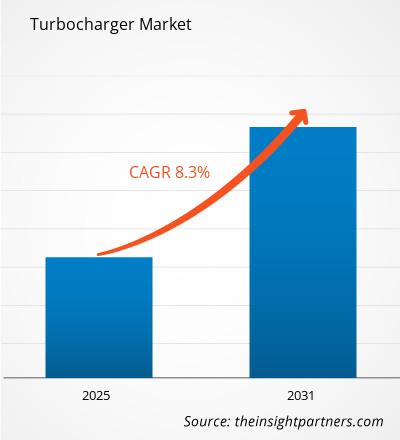
The Turbocharger Market is entering a sustained expansion cycle as automakers and commercial-vehicle manufacturers balance power density, fuel economy, and regulated emissions. The market was valued at US$ 16.03 Billion in 2025 and is projected to reach US$ 30.85 Billion by 2034, advancing at a CAGR of 7.54% during 2026–2034. Demand spans passenger vehicles, light commercial vehicles, and heavy commercial vehicles, supported by gasoline, diesel, and alternative-fuel powertrains using increasingly precise boost-control architectures.
North America remains a high-value production and replacement hub, with an estimated ~7% CAGR through 2034. The Turbocharger Market size in the region is supported by broad turbo penetration in pickups, SUVs, and light commercial fleets, while tighter efficiency requirements sustain engine downsizing. Localized manufacturing, USMCA-aligned sourcing, and continued hybrid gasoline-platform investment shorten lead times and reinforce demand for durable wastegate and variable-geometry systems.
Turbocharger Market Assessment and Insights
Regional Outlook
- North America: ~27% of the global market in 2025 | ~7% CAGR through 2034. Market position: The region ranks second by revenue, supported by high-value pickup and SUV applications, established aftermarket channels, and localized turbocharger production serving gasoline and light-commercial platforms.
- US: ~82% of North American market revenue in 2025 | ~7% CAGR through 2034. Market position: The US leads North America through concentrated vehicle assembly, supplier engineering, and persistent demand for turbocharged pickups, SUVs, performance cars, and hybrid gasoline platforms.
- Europe: ~25% of the global market in 2025 | ~6% CAGR through 2034. Market position: A mature installed base and strict emissions engineering sustain replacement and advanced-technology demand, with Germany leading Europe and the UK, France, Italy, and Spain contributing diversified vehicle production.
- Asia Pacific: ~41% of the global market in 2025 | ~9% CAGR through 2034. Market position: Asia Pacific is the largest and fastest-growing region, led by China, with India, Japan, and South Korea adding scale through vehicle production, localization, and efficiency-focused powertrain investment.
Segment Outlook
- Vehicle Type: ~58% Share in 2025 | ~7% CAGR through 2034. Market position: Vehicle Type leads because turbochargers are factory-integrated across high-volume passenger platforms and increasingly specified in compact engines that must preserve torque while reducing displacement.
- Technology: ~29% Share in 2025 | ~9% CAGR through 2034. Market position: Technology has the strongest growth outlook as electronically controlled wastegates, variable geometry, twin-turbo systems, and electric assistance improve transient response and emissions performance.
Competitive Coverage
BorgWarner Inc., BMTS Technology GmbH & Co. KG, Continental AG, Eaton Corporation plc, Garrett Motion Inc., Mitsubishi Heavy Industries Engine & Turbocharger, Ltd., Precision Turbo & Engine, Rotomaster International, Turbo Energy Private Limited, ZOLLERN GmbH & Co. KG
Methodology
The Insight Partners follows Data Collection & Secondary Research, Primary Research, Data Analysis, and Data Triangulation & Final Review to validate market estimates and insights.
Source: The Insight Partners' analysis based on proprietary research, government publications, company annual reports, investor presentations, industry databases, and expert interviews.
It has developed from a performance attribute to a powertrain efficiency enabler. With downsizing in gasoline engines, there has been an increase in the use of turbochargers in passenger vehicles, but diesel technology still prevailed in high torque applications. On the other hand, manufacturing has advanced in the direction of modular bearing assemblies, electronically controlled actuators, and local assembly tailored for OEM calibration. The current suppliers provide an air path package of compressors, turbines, housing, and controls. Aluminum housings are used to reduce weight in certain gasoline applications, but cast iron housing is critical when exhaust temperatures are very high.
For the next decade up until 2034, growth will continue mainly within the Asia-Pacific manufacturing corridors and North America gasoline and hybrid program segments. The investments will target flexible manufacturing facilities that can cover the needs of both combustion engine, hybrid engine, hydrogen engine, and the aftermarket segments without being limited by the number of platforms that require platform-specific equipment. The need for higher fleet efficiency through regulations will drive the development of advanced boosting, but rapid growth of battery electric vehicles will limit light vehicle addressable volumes in some developed markets.
Turbocharger Market Report Scope
| Report Attribute | Details |
|---|---|
| Market size in 2025 | US$ 16.03 Billion |
| Market Size by 2034 | US$ 30.85 Billion |
| Global CAGR (2026 - 2034) | 7.54% |
| Historical Data | 2021-2024 |
| Forecast period | 2026-2034 |
Turbocharger Market Analysis
Turbocharger Market Growth is fueled by an immediate engineering requirement for generating higher torque and horsepower output from compact engines and managing fuel economy and emissions. OEMs in the passenger-car industry provide volumes; commercial trucks generate durability requirements; and performance/aftermarket outlets generate the higher margin models. The value chain includes suppliers of alloy materials and castings, precision machining companies, suppliers of actuators and sensors, turbo assemblers, engine makers, automobile makers, distributors, and remanufacturers.
Supply chain attributes are decided based on the need for high precision components, heat resistance components, quality assured bearings, and long qualification times with OEMs. Production close to the site is risk free from logistics and provides quick tuning. Casting and electronics still matter, but balance, machining, and testing at the line end define success.
Turbocharger market report reveals competition that is split between Tier 1 suppliers and application specialists. BorgWarner Inc., Garrett Motion Inc., BMTS Technology GmbH & Co. KG, and Mitsubishi Heavy Industries Engine & Turbocharger, Ltd. compete for global OEM projects, while Precision Turbo & Engine and Rotomaster International serve specialist and replacement needs. Continental AG, Eaton Corporation plc, Turbo Energy Private Limited, and ZOLLERN GmbH & Co. KG provide complementary boosting technology, material science or precision manufacturing capability.
Key investments should be made in electronic control, variable geometry, electrical assist, local production, and aftermarkets. The new strategic position for suppliers becomes the capacity to serve several paths of propulsion instead of a particular engine design. Suppliers with reusable engineering platforms and regional application groups and disciplined manufacturing footprint will be able to spread validation cost over gasoline, diesel, hybrid and new low carbon combustion programs.
● REPORT CUSTOMIZATION
Tailor This Report To Align With Your Specific Business Requirements
This report can be customized to align precisely with your business objectives, scope, and target markets. Customization options include tailored segmentation, geography, competitive analysis, and strategic insights to support informed decision-making.
Customize This Report →WHAT YOU CAN ADJUST
- ● Segmentations
- ● Geography
- ● Competitive Analysis
- ● Language Preferences
Turbocharger Market: Strategic Insights

Regional Insights
North America Turbocharger Market
The North American region is estimated to grow at CAGR of ~7% till 2034. The demand driver in North America is the turbochargers used in turbo-charged gasoline trucks, SUVs, performance cars, and light commercial vehicle fleets, which need efficient engines that have towing torque. The market share of the region is attributed to the high component cost, proven OEM testing capabilities, and well-established aftermarket segment.
Local sourcing is getting increasingly relevant for reducing lead times and tariffs, along with compatibility with USMCA sourcing. Electric wastegates and fast-acting turbochargers are getting relevant in hybrid gasoline platforms, while diesel trucks and medium- and heavy-duty diesel truck fleets maintain the demand for robust VGT systems. The Canadian and Mexican markets supplement the US engineering and assembly with powertrains.
U.S. Turbocharger Market
In 2025, the US constitutes about 82% of North American revenues, and it is anticipated to record a ~7% CAGR up until 2034. The dominance of the US in North America can be attributed to the magnitude of its local pickup, SUVs, and commercial-vehicle manufacturing together with its huge aftermarket. Turbochargers are designed for low-speed torque, high thermal tolerance, and calibration under various load conditions.
Companies like BorgWarner Inc., Garrett Motion Inc., Mitsubishi Heavy Industries Engine & Turbocharger, Ltd. amongst others, have engineering, manufacturing or distribution facilities within the region. Hybrid gasoline engines have increased the significance of boosted systems, while performance-oriented engines are still important in small quantities. Fleet owners benefit from remanufactured and replacement turbochargers because they save time.
Europe Turbocharger Market
Europe is projected to represent ~25% of Turbocharger Market Share in 2025 and will be growing at a CAGR of ~6% to 2034. The region has a mature turbocharged vehicle parc and expertise in diesel, gasoline, hybrid, and precision actuation. Emissions legislation in the region drives efficient boosting solutions, but electrification of passenger car segments limits growth of new turbochargers.
Germany dominates Europe with its luxury and commercial vehicles engineering, presence of suppliers, and export-focused powertrain manufacturing. The UK is providing engineering for performance-oriented segments and aftermarket services. France and Italy are generating demand through their production of passenger cars and light commercial vehicles. Spain is benefitting from its vehicle production and export activity.
Technology preferences are different depending on the duty cycle – wastegates are affordable technology choice for small gasoline engines, variable geometry plays an important role for diesel and advanced gasoline engines, and twin-turbos for high performance applications. Large vehicle parc in Europe also provides opportunities for replacement, remanufacturing and service segment.
APAC Turbocharger Market
Asia Pacific accounted for about 41% of the global revenue in 2025 and is expected to be the fastest-growing region with a CAGR of ~9% between 2025 and 2034. China remains dominant in Asia Pacific due to high vehicle production volumes, supplier localization, and applications in both passenger and commercial fleets. India provides fast production growth rates and higher efficiency standards.
Japan and South Korea offer technical sophistication and exports of their product lines. Australia provides replacement and heavy duty markets. Policy, localized components and increased commercial transport applications create regional advantages. Hybrid vehicles and small displacement engines drive higher levels of boosting.
Middle East & Africa Turbocharger Market
The Middle East & Africa market is projected to advance at ~6% CAGR through 2034. Saudi Arabia is the leading country in the Middle East & Africa where energy, construction, logistics, and industrial projects sustain fleets with high torque and durability requirements. The UAE supports distribution, re-export, and premium-vehicle servicing.
While South Africa provides assembly and aftermarket expertise, the Rest of MEA relies more on imports, both of vehicles, replacement components, and refurbished ones. The climate and dusty conditions increase the requirement for durable bearings, effective cooling, and strong services in the Turbocharger Market of the region.
Segmentation Analysis
Vehicle Type
Vehicle Type is expected to expand at ~7% CAGR during 2026–2034 and represented ~58% of 2025 revenue, making it the largest main segment. The Turbocharger Market scope across vehicle classes reflects different torque, thermal, packaging, and lifecycle requirements. Passenger platforms deliver scale, while commercial vehicles require higher durability and create recurring replacement demand.
- Passenger Vehicles: High-volume adoption is supported by downsized gasoline engines, diesel applications in selected regions, premium performance models, and hybrid powertrains requiring rapid boost response without materially increasing engine displacement.
- Light Commercial Vehicles: Delivery vans and utility vehicles value low-speed torque, fuel efficiency, and payload capability. Urban logistics and fleet renewal make this category strategically important for durable, cost-controlled wastegate and variable-geometry systems.
- Heavy Commercial Vehicles: Long-haul trucks, buses, and vocational equipment require high-temperature durability and sustained boost under load. Replacement intensity, emissions compliance, and uptime economics support robust variable-geometry and two-stage designs.
Fuel Type
Fuel Type is forecast to grow at ~8% CAGR during 2026–2034. Gasoline gains from smaller turbocharged engines and hybrid integration, while diesel remains central to heavy-duty torque and efficiency. Alternative fuels broaden engineering requirements for combustion stability, material compatibility, and air-management control.
- Gasoline: Downsized engines in passenger vehicles and light trucks favor compact turbochargers, electronic wastegate actuation, and low-inertia turbines. Hybrid systems add opportunities to optimize response across changing engine loads.
- Diesel: Commercial transport, off-highway duty, and selected passenger markets sustain demand. Variable geometry improves low-speed torque and air management, making diesel strategically important for durable, high-utilization applications.
Material
Material is projected to post ~7% CAGR during 2026–2034. Selection balances temperature resistance, mass, corrosion, machinability, and cost. Turbine-side components require heat tolerance, whereas compressor-side and cooled housing designs create opportunities for lighter aluminum solutions.
- Cast Iron: Thermal strength, dimensional stability, and cost effectiveness keep cast iron central to turbine housings and heavy-duty applications, particularly where sustained exhaust temperatures and long service intervals outweigh mass reduction.
- Aluminum: Lower weight and good manufacturability support compressor housings and selected water-cooled turbine concepts. Strategic value rises where packaging, thermal control, and vehicle mass reduction are integrated early in powertrain design.
Technology
Technology is expected to achieve ~9% CAGR during 2026–2034 and accounted for ~29% of 2025 revenue, making it the high-growth main segment. Electronic actuation, variable vanes, staged boosting, and electric assistance improve response, calibration precision, and operating efficiency, although added complexity requires stronger controls integration.
- Twin Turbo Technology: Sequential or parallel architectures support broad torque delivery in performance and high-output engines. Adoption is strategically concentrated where responsiveness and power density justify greater packaging and control complexity.
- Wastegate Technology: Proven economics, durability, and simpler calibration make wastegate systems widely relevant to small gasoline engines. Electrically actuated variants improve boost precision and support emissions management across transient conditions.
- Variable Geometry Technology: Adjustable turbine flow expands the efficient operating range and enhances low-speed torque. It remains important in diesel applications and is gaining selective gasoline use as temperature-capable materials and controls improve.
Opportunity Snapshot
| Vehicle Type | Revenue Contribution | Trend Tag | Adoption Stage |
| Passenger Vehicles | High | Hybrid Boost | Mature |
| Light Commercial Vehicles | Medium | Fleet Downsizing | Scaling |
| Heavy Commercial Vehicles | High | Variable Geometry | Mature |
Turbocharger Market Growth Drivers and Impact Analysis
Engine Downsizing and Higher Power Density
Turbochargers make it possible for automobile companies to continue delivering torque and acceleration from smaller displacements in order to generate a requirement as opposed to discretionary demand. It works best in gasoline-powered vehicles, trucks, sport utility vehicles (SUVs), and light commercial trucks which have to meet certain criteria in terms of drivability and fuel economy considerations. The smaller engine makes it necessary to improve on thermal efficiency and transient capability and favors low inertia turbines, precise wastegate actuation, and modern bearings. This impacts the economics of suppliers due to the increased engineering value of each unit and the level of cooperation in OEM calibration.
Commercial Fleet Efficiency and Replacement Cycles
Commercial trucks, both large and small, rely heavily on high utilization, high sensitivity to fuel prices, and reliability. Turbocharger technology offers a solution that helps deliver effective torque for freight hauling, construction work, city transportation, and last mile delivery, whereas difficult working conditions result in demand for replacement and remanufacturing. Variable nozzles help make diesel engine more responsive and improve air flow, hence the performance and compliance with emission requirements. Fleet growth in Asia Pacific region and development of infrastructure in emerging markets result in increased installed base, while developed markets generate recurring revenues through service offerings.
Localized Production and Supply-Chain Resilience
Automotive companies are becoming more and more partial to the production of turbochargers located near the engine and car manufacturing plants. This is important for reducing transportation risk, fast engineering response, and adherence to regional content requirements. Moreover, this helps ensure that there is greater consistency for parts that are complex and need considerable efforts to verify and replace them. The development of capacity in North America, China, India, and already existing European locations demonstrates how suppliers are trying to harmonize global platform economy with customer proximity. Flexible assembly lines, traceability system and common component family make the plant able to support gasoline, diesel, hybrid, and aftermarket programs.
Turbocharger Market Future Trends
Electrically Assisted Boosting and Integrated Controls
Turbocharger Market trends are moving toward electrically assisted compressors, faster electronic actuators, and software-coordinated air management. These systems can reduce lag, improve transient torque, and manage boost around hybrid operating cycles. Adoption will depend on voltage architecture, thermal durability, package space, and the ability to justify higher system cost. Suppliers are likely to integrate sensors, power electronics, and control algorithms more closely with the rotating hardware. This favors companies with mechatronics and calibration capability, while creating partnership opportunities between turbo specialists, semiconductor providers, and engine-control developers. Commercialization should begin with premium, performance, hybrid, and demanding commercial applications before broader cost reduction supports higher-volume platforms.
Multi-Fuel Combustion and Thermal Material Innovation
Through 2034, turbocharger design will increasingly accommodate engines using hydrogen, renewable fuels, and other lower-carbon combustion pathways. Different exhaust chemistry, mass flow, ignition behavior, and temperature profiles require revised compressor maps, sealing, materials, and controls. At the same time, lightweight cooled housings and improved high-temperature alloys can reduce mass without compromising durability. The transition will be application specific rather than uniform: stationary engines, heavy transport, and specialized fleets may adopt multi-fuel solutions earlier than mainstream passenger cars. Suppliers that validate reusable component families across fuels can protect engineering returns and serve customers seeking decarbonization options without abandoning established engine assets.
Turbocharger Market Opportunities
Localized Programs in Asia Pacific and North America
Turbocharger Market Forecasts point to attractive investment in plants that combine regional manufacturing with local application engineering. Asia Pacific offers vehicle-production scale and supplier localization, while North America rewards proximity to pickup, SUV, light-commercial, and hybrid gasoline programs. Investors should prioritize flexible machining and assembly, digital traceability, and modular product families rather than single-platform facilities. Partnerships with casting suppliers and actuator manufacturers can reduce launch risk. Commercial returns will depend on winning multi-year OEM programs, maintaining cost competitiveness, and preserving capacity for replacement demand. A balanced footprint also reduces transport exposure and improves responsiveness when customers change calibration, sourcing, or content requirements.
Aftermarket, Remanufacturing, and Lifecycle Services
The expanding installed base creates opportunity beyond original equipment. Distributors, remanufacturers, and specialist workshops need traceable components, accurate fitment data, diagnostic capability, and reliable core-return systems. Suppliers can capture value by offering validated replacement units, actuator service, training, and digital catalog integration. Commercial fleets are especially attractive because downtime economics favor dependable availability and predictable quality. Investment should focus on regional stocking, counterfeit prevention, and standardized remanufacturing processes that protect turbine balance and emissions performance. This channel can diversify revenue as new combustion-platform launches slow in selected mature passenger markets, while continuing to serve long-lived commercial and performance vehicles.
Recent Developments
- August 2026: Cooper Machinery Services acquired Alamo Industries Ltd. and Alamo Turbocharger Services, expanding its Turbocharger Solutions International (TSI) division across western Canada and the U.S. The acquisition also broadened Cooper’s capabilities in marine and small-frame natural gas turbocharger applications.
- May 2025: Garrett Motion unveiled a new range of turbochargers and e-powertrain technologies, including advanced turbocharging solutions and electrified powertrain technologies aimed at improving vehicle efficiency, performance, and emissions. The portfolio supports the transition toward hybrid and electric mobility.
- May 2026: BorgWarner secured a supply contract with a major European commercial vehicle OEM for a variable turbine geometry (VTG) turbocharger and EGR cooler for a Euro 7-compliant, six-cylinder heavy-duty diesel engine platform. The components are intended for long-haul trucks, with production expected to begin in late 2028.
Frequently Asked Questions

- Comprehensive Market Sizing and Forecast Analysis
- Detailed Segmentation Analysis
- In-Depth Market Dynamics Assessment
- Regional and Country-Level Insights
- Competitive Landscape and Company Benchmarking
- Strategic Business Intelligence
Recent Reports
Testimonials

The Insight Partners provided valuable market intelligence that supported our global go-to-market strategy. Their team was professional, responsive, and attentive to our feedback, providing thoughtful analysis and helpful methodological clarifications throughout the project.
Junmo Kim Chief Financial Officer (CFO), Enertech Co., Ltd.
The Insight Partners' SCADA System Market report is comprehensive, with valuable insights on current trends and future forecasts. The team was highly professional, responsive, and supportive throughout. We are very satisfied and highly recommend their services.
RAN KEDEM Partner, Reali Technologies LTDs
I requested a report on a very specific software market and the team produced the report in a few days. The information was very relevant and well presented. I then requested some changes and additions to the report. The team was again very responsive and I got the final report in less than a week.
JEAN-HERVE JENN Chairman, Future Analytica
We worked with The Insight Partners for an important market study and forecast. They gave us clear insights into opportunities and risks, which helped shape our plans. Their research was easy to use and based on solid data. It helped us make smart, confident decisions. We highly recommend them.
PIYUSH NAGPAL Sr. Vice President, High Beam Global
The Insight Partners delivered insightful, well-structured market research with strong domain expertise. Their team was professional and responsive throughout. The user-friendly website made accessing industry reports seamless. We highly recommend them for reliable, high-quality research services
YUKIHIKO ADACHI CEO, Deep Blue, LLC.
This is the first time I have purchased a market report from The Insight Partners.While I was unsure at first, I visited their web site and felt more comfortable to take the risk and purchase a market report.I am completely satisfied with the quality of the report and customer service. I had several questions and comments with the initial report, but after a couple of dialogs over email with their analyst I believe I have a report that I can use as input to our strategic planning process.Thank you so much for taking the extra time and making this a positive experience.I will definitely recommend your service to others and you will be my first call when we need further market data.
JOHN SUZUKI President and Chief Executive Officer, Board Director, BK Technologies
I wish to appreciate your support and the professionalism you displayed in the course of attending to my request for information regarding to infectious disease IVD market in Nigeria. I appreciate your patience, your guidance, and the fact that you were willing to offer a discount, which eventually made it possible for us to close a deal. I look forward to engaging The Insight Partners in the future, all thanks to the impression you have created in me as a result of this first encounter.
DR CHIJIOKE ONYIA MANAGING DIRECTOR, PineCrest Healthcare Ltd.Reason to Buy
- Informed Decision-Making
- Understanding Market Dynamics
- Competitive Analysis
- Identifying Emerging Markets
- Customer Insights
- Market Forecasts
- Risk Mitigation
- Boosting Operational Efficiency
- Strategic Planning
- Investment Justification
- Tracking Industry Innovations
- Aligning with Regulatory Trends





 Get Free Sample for