
Vision Transformers Market Growth, Trends & Demand by 2034
Vision Transformers Market Size and Forecasts (2021 - 2034), Global and Regional Share, Trends, and Growth Opportunity Analysis Report Coverage : By Offering (Solutions, Professional Services), Application (Image Segmentation, Object Detection, Image Captioning), Vertical (Media & Entertainment, Retail & eCommerce, Automotive)
- Status : Data Released
- Report Code : TIPRE00039672
- Category : Electronics and Semiconductor
- No. of Pages : 150
- Available Report Formats :


- Last update date : September 22, 2026


2025 Market Size
US$ 393.57 Mn
Base year value
2034 Forecast
US$ 4,881.04 Mn
Projected by 2034
CAGR 2026-2034
32.28 %
Growth rate
Addressable Market
US$ 18,387.21 Mn
(2026-2034)
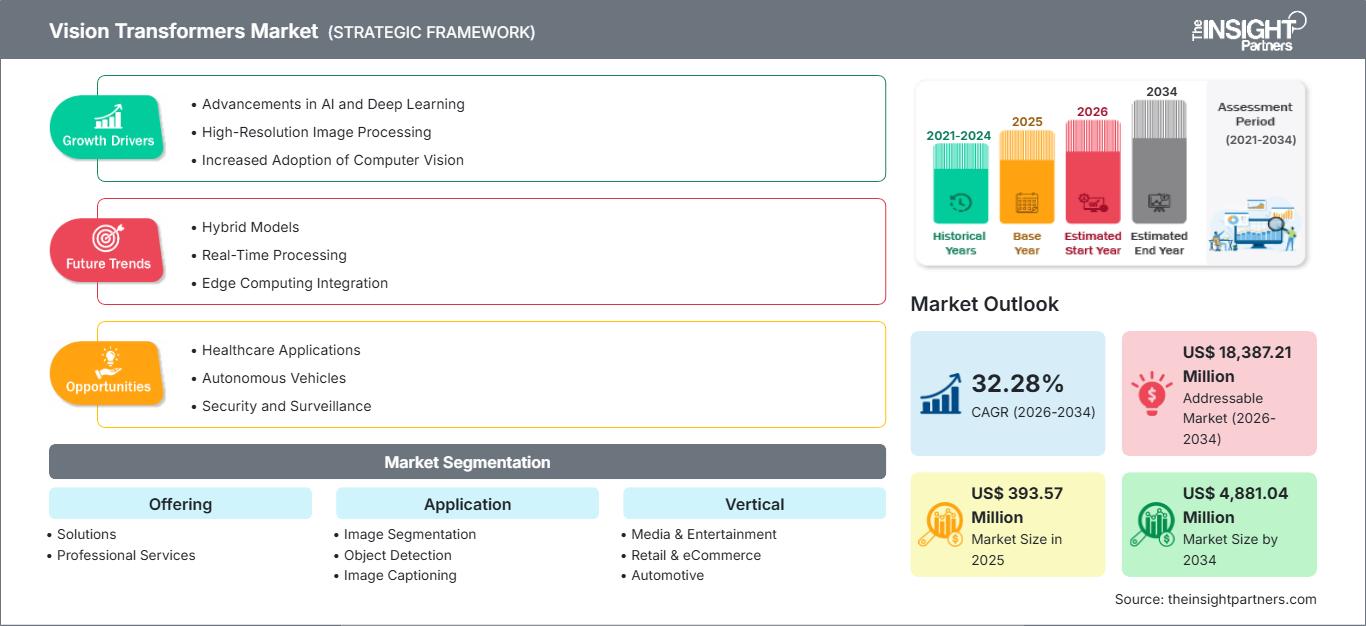
The vision transformers market is projected to grow from US$ 393.57 million in 2025 to US$ 4,881.04 million by 2034, registering a CAGR of 32.28% during 2026–2034. Adoption is expanding as transformer-based vision models improve image understanding, object localization, contextual recognition, and multimodal inference across enterprise computer vision workflows.
North America remains a major demand center as cloud AI infrastructure, autonomous systems research, enterprise visual analytics, and model optimization ecosystems mature. The region is expected to account for 39–42% of revenue in 2025 and grow at a CAGR of 31–34% through 2034, supported by GPU availability, large AI laboratories, and commercial adoption of advanced vision pipelines, contributing significantly to the overall Vision Transformers Market size.
Vision Transformers Market Assessment and Insights
- North America: The region held an estimated 39–42% share in 2025 and is likely to grow at a CAGR of 31–34% during 2026–2034, driven by AI infrastructure and enterprise computer vision deployments.
- US: The US represented about 78–82% of North America revenue in 2025 and is expected to grow at a CAGR of 31–33% through 2034.
- Europe: Europe accounted for 22–25% share in 2025 and is projected to grow at a CAGR of 29–32%, led by Germany, the UK, France, and the Netherlands.
- Asia Pacific: Asia Pacific captured 27–30% share in 2025 and is expected to record a CAGR of 34–37%, supported by China, Japan, South Korea, India, and Singapore.
- Largest Segment: Solutions held 68–72% market share in 2025 and is expected to grow at a CAGR of 31–34% as pre-trained models, software platforms, and AI accelerators dominate spending.
- High Growth Segment: Image segmentation held 26–29% share in 2025 and is expected to grow at a CAGR of 34–37% on demand for pixel-level visual intelligence.
- Key companies analyzed in detail: OpenAI, Meta Platforms, Inc., NVIDIA Corporation, LeewayHertz Technologies Pvt. Ltd., Synopsys, Inc., Hugging Face, Inc., Qualcomm Incorporated, Intel Corporation, Clarifai, Inc., and Quadric.io, Inc.
Source: The Insight Partners' analysis based on proprietary research, government publications, company annual reports, investor presentations, industry databases, and expert interviews.
Commercial evolution has shifted from convolution-heavy architectures toward attention-based models that evaluate relationships across full image contexts. The market growth is being shaped by better GPU memory bandwidth, open-source model hubs, enterprise AI platforms, and growing demand for explainable visual intelligence in retail automation, autonomous mobility, media workflows, and industrial inspection.
Future adoption will depend on efficient model compression, edge deployment, data governance, and application-specific fine-tuning. As organizations move from experimentation to production, deployment choices will increasingly balance accuracy, inference cost, latency, and integration with broader multimodal AI systems.
Vision Transformers Market Report Scope
| Report Attribute | Details |
|---|---|
| Market size in 2025 | US$ 393.57 Million |
| Market Size by 2034 | US$ 4,881.04 Million |
| Global CAGR (2026 - 2034) | 32.28% |
| Historical Data | 2021-2024 |
| Forecast period | 2026-2034 |
Vision Transformers Market Analysis
Market growth drivers are increased amounts of visual data, higher requirements for accuracy of image recognition, and enterprises' interest in transformer technology that enables long-range image dependencies to be taken into account. Application solutions are advancing in areas such as image segmentation, object detection, image captioning, automated inspection, visual search, and content moderation. In addition, adoption is growing in industries like healthcare imaging, intelligent surveillance, autonomy, retail analytics, and industrial quality assurance, which benefit from more advanced visual information processing capabilities that provide tangible performance benefits. As companies extend their AI operations, vision transformers are increasingly incorporated into their end-to-end workflow processes.
Value chain consists of model developers, cloud providers, hardware manufacturers, annotation services, system integrators, and application experts. Hardware acceleration is important because vision transformers require substantial computational resources to train and run in both training and inference modes, especially when working with high-resolution images or video streams. Cloud deployment models become increasingly relevant as organizations look for scalable infrastructure to develop and deploy their models. Simultaneously, advancements in GPUs, AI accelerators, edge processors, and distributed computing systems help enhance the efficiency of deployments. Growing adoption of hybrid cloud and edge architectures is further expanding commercial opportunities across industries, according to the Vision Transformers Market report.
Market analysis indicates the presence of a competitive environment split between foundation models’ developers, semiconductor firms, open-source platforms, and vertical AI solutions’ vendors. Compute and deployment layers’ development by NVIDIA Corporation, Intel Corporation, Qualcomm Incorporated, Synopsys, Inc., and Quadric.io, Inc.; whereas model, platform, and integration by Meta Platforms, Inc., OpenAI, Hugging Face, Inc., Clarifai, Inc., and LeewayHertz Technologies Pvt. Ltd. Increasing competition is observed for model efficiency, inference optimization, multimodal capabilities, training cost reduction, and enterprise deployment support. Partnerships among software vendors, cloud providers, and semiconductor firms will form ecosystems that help implement AI more efficiently.
Current investments are being directed at model efficiency, multimodal learning, domain adaptation, and edge inference. The buyers prefer companies that can prove their models’ performance, provide deployment assistance, data security and tangible business outcomes instead of computer vision toolkits. The forecast sees further investment towards explainable AI, privacy-preserving training, synthetic data generation, and sector-specific foundation models. Adoption is forecast to start in Asia-Pacific, North America, and Europe for automation and visual intelligence purposes. Further development of model compression, efficiency, and interoperability is likely to favor market growth during the forecast period.
● REPORT CUSTOMIZATION
Tailor This Report To Align With Your Specific Business Requirements
This report can be customized to align precisely with your business objectives, scope, and target markets. Customization options include tailored segmentation, geography, competitive analysis, and strategic insights to support informed decision-making.
Customize This Report →WHAT YOU CAN ADJUST
- ● Segmentations
- ● Geography
- ● Competitive Analysis
- ● Language Preferences
Vision Transformers Market: Strategic Insights
Regional Insights
North America vision transformers market
North America is expected to hold 39–42% vision transformers market share in 2025 and grow at a CAGR of 31–34% during 2026–2034. Application of AI in clouds, latest GPU clusters, laboratories, R&D in defense areas, and enterprises’ visual analytics encourages the use of AI in the sectors of retail, automobile, media, and healthcare.
The USA makes profits at the regional level while Canada contributes through its AI clusters and machine learning start-ups. Demand for AI is driven by the shift from classical image recognition to multimodal perception and segmentation of content.
U.S. vision transformers Market
The US accounted for 78–82% of North America revenue in 2025 and is expected to grow at a CAGR of 31–33%. Innovation from enterprises, hyperscaling of clouds, availability of accelerators, and massive numbers of AI developers make the area a hub for commercialization.
Some examples of application areas include self-driving perception, media tagging, warehouse analysis, medical imaging workflow, and smart retail solutions. Some companies that confirm the regional scale are OpenAI, Meta Platforms, Inc., NVIDIA Corporation, Intel Corporation, Qualcomm Incorporated, Hugging Face, Inc., Clarifai, Inc., and Quadric.io, Inc.
Europe vision transformers Market
Europe held 22–25% share in 2025 and is forecast to grow at a CAGR of 29–32%. Germany creates demand using engineering for vehicles, robotics, and industrial inspection, while the UK enables AI, analytics for financial services, and media technologies.
Use cases have been changing in France, Italy, and Spain for sectors such as smart manufacturing, public safety analytics, visual commerce, and mobility. There is growing regulatory pressure on AI transparency, driving demand for explainability and governance of the AI system.
APAC vision transformers Market
APAC accounted for 27–30% share in 2025 and is expected to grow at a CAGR of 34–37%, making it the fastest-growing region. Some examples of the countries involved in building AI-based industries include China, Japan, South Korea, India, and Australia. China leads on a regional level by developing infrastructure for AI and computer vision technology, while India provides talent for software engineering and enterprise AI solutions. Japan and South Korea back robotics, imaging devices, and embedded AI.
Middle East & Africa vision transformers Market
The Middle East and Africa are projected to grow at a CAGR of 28–31% during 2026–2034. Both Saudi Arabia and the UAE have started implementing advanced AI in the creation of smart cities, transportation analysis, infrastructure inspection, and media analysis as per their respective digital transformation initiatives.
The growth in South Africa, as well as the rest of the MEA region, has been slower due to the use of AI in security analytics, mining inspection, and public infrastructure analysis.

Segmentation Analysis
Offering
Offering is expected to grow at a CAGR of 31–34% during 2026–2034. The market scope across offerings includes solutions and professional services, with solutions leading due to software platforms, model libraries, pre-trained architectures, hardware-aware optimization, and cloud deployment tools.
- Solutions: Solutions dominate spending because enterprises need reusable models, inference tools, APIs, and deployment environments that reduce development time while improving accuracy across commercial computer vision workloads.
- Professional Services: Professional services support data preparation, model fine-tuning, integration, governance, and workflow redesign, especially for enterprises lacking specialized AI engineering capacity.
Application
Application is expected to grow at a CAGR of 33–36% during 2026–2034. Demand is strongest where visual context, accuracy, and semantic understanding are central to operational performance and customer experience.
- Image Segmentation: Image segmentation is strategically important for autonomous systems, medical imaging support, quality inspection, content editing, and geospatial analysis requiring pixel-level object boundaries.
- Object Detection: Object detection supports safety monitoring, inventory automation, traffic analytics, retail intelligence, and robotics by identifying and localizing relevant objects in images or video.
- Image Captioning: Image captioning is gaining relevance in accessibility, media management, search, insurance documentation, and multimodal AI applications that convert visual content into structured language.
Vertical
Vertical is expected to grow at a CAGR of 32–35% during 2026–2034. Media and entertainment, retail and eCommerce, and automotive are early adopters because each requires scalable visual interpretation, classification, and contextual analysis.
- Media & Entertainment: Media companies use vision transformer models for content indexing, moderation, asset discovery, video editing support, and personalized recommendation workflows based on visual context.
- Retail & eCommerce: Retailers apply these models to visual search, product recognition, inventory monitoring, shelf analytics, and personalized shopping journeys across digital and physical channels.
- Automotive: Automotive deployment focuses on perception systems, driver assistance, synthetic data workflows, in-cabin monitoring, and quality inspection across vehicle manufacturing environments.
Opportunity Snapshot
| Application | Revenue Contribution | Trend Tag | Adoption Stage |
| Image Segmentation | High | Pixel Intelligence | Scaling |
| Object Detection | High | Real-Time Perception | Scaling |
| Image Captioning | Medium | Visual Language | Emerging |
Vision Transformers Market Growth Drivers and Impact Analysis
Rising Enterprise Demand for High-Accuracy Visual Intelligence
Organizations have been making advancements not just in the identification but in the creation of more sophisticated methods, which will enable them to have a semantic understanding of the visual scene in more contexts. Vision transformers play a critical role in this process by taking into account relationships between various elements of the whole image, rather than individual elements. This is especially useful in tasks such as visual search, defect detection, autonomous navigation, and content recognition. It is even more advantageous when the decisions are made based on object boundaries, contextual information, or semantic knowledge of vision language relationships.
Expansion of AI Compute and Optimized Deployment Frameworks
The emergence of GPU clusters, AI accelerators, model compression, quantization, and edge inference frameworks makes the transformer vision applications possible. The market benefit is obvious because vendors improve throughput, decrease inference costs, and simplify the process of implementation in clouds, on-premises, and edge environments. It is very important to optimize both hardware and software for applications in the automotive, industrial, and retail sectors due to the necessity of high speed and reliability. Better infrastructure makes it possible for small firms to utilize pre-trained models instead of creating computer vision systems on their own.
Growth of Multimodal AI Applications Across Industries
Visual Transformers have come to be more and more related to language models, audio algorithms, and enterprise data in order to enable applications for multimodal AI. This paves the way for image captioning, content moderation, product discovery, digital asset management, and interactions between human beings and machines. Practically speaking, this means the expansion of the target market since vision models can now be used for applications beyond image recognition.
Vision Transformers Market Future Trends
Lightweight Vision Transformers for Edge AI
The vision transformers market trends indicate a shift toward compact architectures that run efficiently on edge devices, embedded processors, and mobile systems. This is going to become very relevant for automotive perception, industrial inspection, smart cameras, and retail automation, where the problems of latency, privacy, and bandwidth limit reliance on cloud inference. The vendors will be required to focus on pruning, distillation, quantization, and architecture optimized for hardware. Edge deployment will lead to increased use of AI in the center to operational environments.
Open-Vocabulary Segmentation and Visual Foundation Models
In the future, more and more systems will recognize entities and concepts through natural language prompting rather than through a set of fixed labels. Open vocabulary segmentations and promptable visual foundation models will enable lighter annotation and greater adaptability to new situations. This approach will help accelerate model adaptation in areas like media, robotics, e-commerce, and analysis of public infrastructure. It will create a need for governance mechanisms that measure bias, robustness, and domain performance before deploying them commercially.
Vision Transformers Market Opportunities
Vertical-Specific Model Fine-Tuning and Managed Services
The vision transformers market forecasts point to a strong opportunity for vendors offering fine-tuned models for industry-specific workflows. There is an obvious need for accuracy and latency control in certain domains, such as automotive, retail, media, and manufacturing. Managed services can solve the problem of a shortage of skills, offering capabilities in the form of data engineering, model validation, deployment, and monitoring, and governance support. Suppliers that offer pre-packaged templates with performance metrics lower the buyer's risks.
Computer Vision Platforms for Visual Commerce and Media Automation
Visual content production from retail and media companies creates a need for tagging, searching, moderating, personalizing, and editing of images. Vision transformers could automate these processes through the use of object recognition, segmentation, caption generation, and recommendation algorithms. It is an appealing solution because customers are able to trace the effectiveness of AI performance in terms of conversion, productivity, compliance, or customer engagement.
Frequently Asked Questions

- Comprehensive Market Sizing and Forecast Analysis
- Detailed Segmentation Analysis
- In-Depth Market Dynamics Assessment
- Regional and Country-Level Insights
- Competitive Landscape and Company Benchmarking
- Strategic Business Intelligence
Recent Reports
Testimonials

The Insight Partners provided valuable market intelligence that supported our global go-to-market strategy. Their team was professional, responsive, and attentive to our feedback, providing thoughtful analysis and helpful methodological clarifications throughout the project.
Junmo Kim Chief Financial Officer (CFO), Enertech Co., Ltd.
The Insight Partners' SCADA System Market report is comprehensive, with valuable insights on current trends and future forecasts. The team was highly professional, responsive, and supportive throughout. We are very satisfied and highly recommend their services.
RAN KEDEM Partner, Reali Technologies LTDs
I requested a report on a very specific software market and the team produced the report in a few days. The information was very relevant and well presented. I then requested some changes and additions to the report. The team was again very responsive and I got the final report in less than a week.
JEAN-HERVE JENN Chairman, Future Analytica
We worked with The Insight Partners for an important market study and forecast. They gave us clear insights into opportunities and risks, which helped shape our plans. Their research was easy to use and based on solid data. It helped us make smart, confident decisions. We highly recommend them.
PIYUSH NAGPAL Sr. Vice President, High Beam Global
The Insight Partners delivered insightful, well-structured market research with strong domain expertise. Their team was professional and responsive throughout. The user-friendly website made accessing industry reports seamless. We highly recommend them for reliable, high-quality research services
YUKIHIKO ADACHI CEO, Deep Blue, LLC.
This is the first time I have purchased a market report from The Insight Partners.While I was unsure at first, I visited their web site and felt more comfortable to take the risk and purchase a market report.I am completely satisfied with the quality of the report and customer service. I had several questions and comments with the initial report, but after a couple of dialogs over email with their analyst I believe I have a report that I can use as input to our strategic planning process.Thank you so much for taking the extra time and making this a positive experience.I will definitely recommend your service to others and you will be my first call when we need further market data.
JOHN SUZUKI President and Chief Executive Officer, Board Director, BK Technologies
I wish to appreciate your support and the professionalism you displayed in the course of attending to my request for information regarding to infectious disease IVD market in Nigeria. I appreciate your patience, your guidance, and the fact that you were willing to offer a discount, which eventually made it possible for us to close a deal. I look forward to engaging The Insight Partners in the future, all thanks to the impression you have created in me as a result of this first encounter.
DR CHIJIOKE ONYIA MANAGING DIRECTOR, PineCrest Healthcare Ltd.Reason to Buy
- Informed Decision-Making
- Understanding Market Dynamics
- Competitive Analysis
- Identifying Emerging Markets
- Customer Insights
- Market Forecasts
- Risk Mitigation
- Boosting Operational Efficiency
- Strategic Planning
- Investment Justification
- Tracking Industry Innovations
- Aligning with Regulatory Trends





 Get Free Sample for