
Watering Timers Market Size, Growth & Trends by 2034
Coverage: By Type (Digital Water Timers, Analog Water Timers); Application (Indoor, Outdoor), and Geography (North America, Europe, Asia Pacific, and South and Central America)
- Status : Data Released
- Report Code : TIPRE00015335
- Category : Electronics and Semiconductor
- No. of Pages : 150
- Available Report Formats :


- Last update date : September 28, 2026


2025 Market Size
US$ 2.49 Bn
Base year value
2034 Forecast
US$ 5.04 Bn
Projected by 2034
CAGR 2026-2034
8.16 %
Growth rate
Addressable Market
US$ 33.86 Bn
(2026-2034)
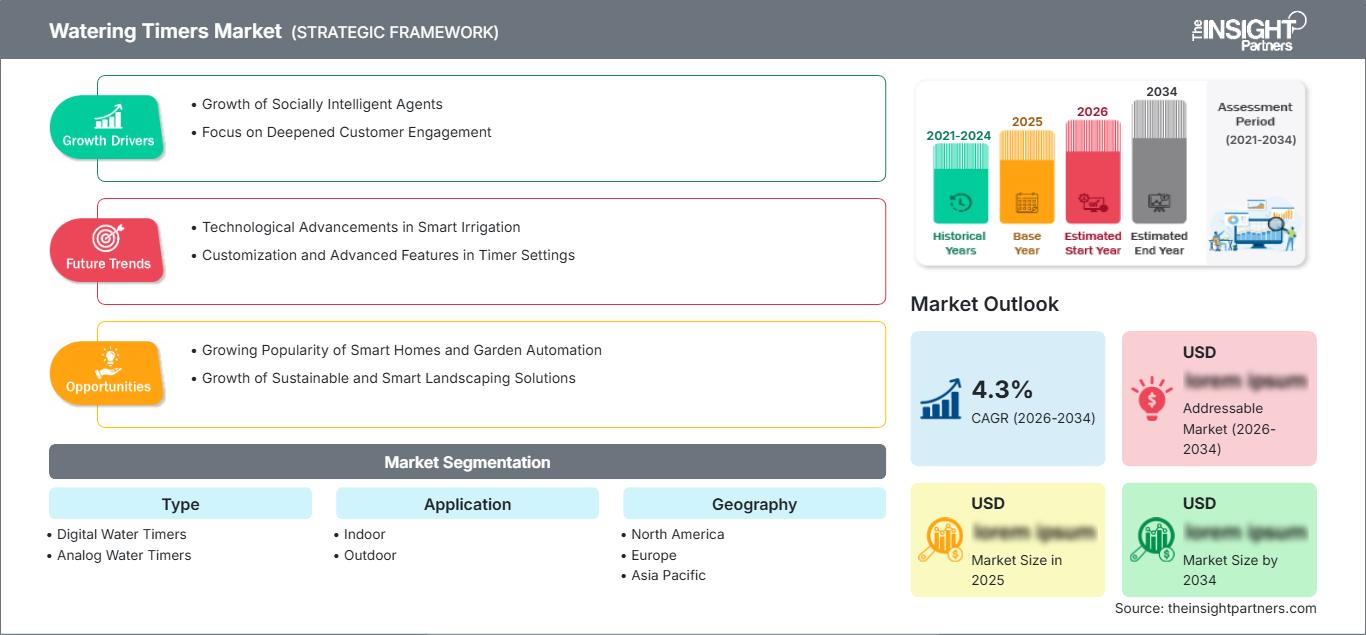
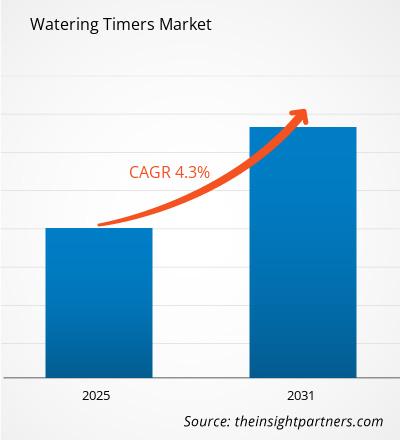
The Watering timers market was valued at US$ 2.49 Billion in 2025 and is projected to reach US$ 5.04 Billion by 2034, registering a CAGR of 8.16% during 2026–2034. Expansion stems from the increasing desire among consumers to automate watering systems for gardens, lawns, balconies, and landscaping purposes. Product development now involves incorporating simple programmable features, tough valve constructions, scheduling capabilities, and digital controls to enhance convenience, as well as efficient water use.
North America is expected to register an estimated CAGR of 7.5–8.5% during 2026–2034. Structural growth is supported by residential landscape automation, replacement of manually operated hose watering equipment, and stronger consumer attention to water-efficient gardening. Established irrigation distribution networks, broad smart-home adoption, and recurring demand from homeowners and landscape maintenance providers provide a stable foundation for the Watering Timers Market size across the region.
Watering Timers Market Assessment and Insights
- North America: North America held a 37–40% share in 2025 and is expected to grow at a CAGR of 7.5–8.5% between 2026–2034, supported by established irrigation infrastructure and automated landscape maintenance.
- US: The US represented 70–74% of North American demand in 2025 and is projected to expand at a CAGR of 7.6–8.6%, supported by residential landscaping and replacement demand.
- Europe: Europe accounted for a 24–27% share in 2025 and is expected to grow at a CAGR of 7.0–8.0%. Germany, the UK, France, Italy, and Spain provide strong demand through gardening and water-efficiency priorities.
- Asia Pacific: Asia Pacific represented a 26–29% share in 2025 and is projected to register the fastest CAGR of 9.0–10.0%. China, India, Japan, South Korea, and Australia are important markets.
- Largest Segment: Outdoor applications held a 72–76% market share in 2025 and are projected to expand at a CAGR of 8.4–8.9%, supported by lawn and landscape watering.
- High Growth Segment: Digital water timers represented a 58–62% market share in 2025 and are expected to grow at a CAGR of 9.0–9.5%, driven by programmable functionality.
- Key companies analyzed in detail: Alfred Kärcher SE & Co. KG, Fiskars Brands, Inc., Gilmour, Gui Yo Industrial Co., Ltd., Instapark, Irritrol Systems, Melnor, Inc., Omen Corporation, Orbit Irrigation Products, LLC, Rain Bird Corporation.
Source: The Insight Partners' analysis based on proprietary research, government publications, company annual reports, investor presentations, industry databases, and expert interviews.
The watering timers market has evolved from basic mechanical scheduling devices toward electronically controlled products capable of supporting multiple start times, adjustable durations, rain delays, and zone-based watering. Increasingly, manufacturers’ focus includes weather-tight housing, solenoid valve reliability, efficient batteries, simplicity in display, and compatibility with either drip irrigation or sprinkler systems. Connectivity and remote operation facilitated through digital designs are becoming possible, where consumers are ready to shell out extra money.
In the future, the development of the market will depend on smart home integration, water conservation programs, and growth in organized gardening stores in developing countries. At the same time, manufacturers are developing user-friendly interfaces and hose-end designs while maintaining the inexpensive analog devices. The Watering Timers Market report indicates that the industry should also benefit from landscape modernization in cities where automated scheduling can help households maintain plants while reducing dependence on manual watering routines.
Watering Timers Market Report Scope
| Report Attribute | Details |
|---|---|
| Market size in 2025 | US$ 2.49 Billion |
| Market Size by 2034 | US$ 5.04 Billion |
| Global CAGR (2026 - 2034) | 8.16% |
| Historical Data | 2021-2024 |
| Forecast period | 2026-2034 |
Watering Timers Market Analysis
Demand is supported by a combination of convenience, water management, and changing household gardening behavior. Residential users increasingly prefer automated schedules that operate while they are working or traveling, while professional landscapers value predictable watering cycles across multiple planting areas. The ecosystem includes timer manufacturers, valve and electronics suppliers, irrigation component producers, distributors, garden centers, online retailers, installers, and end users.
The Watering Timers Market forecast is closely linked to replacement cycles because timers operate in outdoor environments exposed to moisture, sunlight, temperature variation, and mineral deposits. More electronics, display devices, sensors, and battery units are incorporated in digital devices, leading to an increase in the complexity of their components relative to analog products. This involves making choices between less expensive mechanical devices and electronic platforms with more value, while regional distributors play key roles in ensuring product availability and after-sales services, as described in the Market forecast.
The competitive landscape is characterized by product quality, ease of programming, connectivity, reach in terms of distribution, and the ability to be integrated into current irrigation systems. Alfred Kärcher SE & Co. KG and Fiskars Brands, Inc. are leaders in the gardening product industry, whereas Gilmour and Melnor, Inc., and Instapark offer products that satisfy the water needs of consumers.
The watering timers market analysis also points to increasing investment in connected functionality without eliminating demand for simpler products. Orbit Irrigation Products, LLC promotes B-hyve devices that combine app control with weather-responsive scheduling, while Rain Bird offers hose-end timers alongside Wi-Fi-enabled controllers. Companies including Gui Yo Industrial Co., Ltd., Omen Corporation, and other specialists can compete through cost-efficient manufacturing, private-label supply, differentiated hardware, or regional distribution relationships.
● REPORT CUSTOMIZATION
Tailor This Report To Align With Your Specific Business Requirements
This report can be customized to align precisely with your business objectives, scope, and target markets. Customization options include tailored segmentation, geography, competitive analysis, and strategic insights to support informed decision-making.
Customize This Report →WHAT YOU CAN ADJUST
- ● Segmentations
- ● Geography
- ● Competitive Analysis
- ● Language Preferences
Watering Timers Market: Strategic Insights
Regional Insights
North America Watering Timers Market
North America accounted for a 37–40% share in 2025 and is projected to grow at a CAGR of 7.5–8.5% through 2034. The US remains the dominant regional market because of extensive residential lawns, established irrigation contractors, and strong availability of automated garden equipment. Canada contributes through residential gardening and seasonal landscape maintenance, while Mexico offers opportunities as organized retail and water-efficiency awareness develop.
The watering timers market share in North America benefits from replacement demand and growing interest in scheduled irrigation. Digital timers are gaining preference where users require several watering cycles, rain-delay functions, or more precise duration settings. Smart-home ecosystems further support premium products, although analog devices retain relevance among consumers prioritizing low purchase prices and simple operation. Regional demand is therefore characterized by coexistence between mature mechanical products and expanding digitally enabled systems.
U.S. Watering Timers Market
The US represented 70–74% of North American demand in 2025 and is expected to expand at a CAGR of 7.6–8.6%. High household adoption of automated landscape equipment, established home-improvement retail, and recurring replacement requirements support continued consumption. Drought-prone western states also encourage products that can delay watering and improve schedule precision.
Companies including Orbit Irrigation Products, LLC, Rain Bird Corporation, Gilmour, Melnor, Inc., and Instapark have product exposure across hose-end and irrigation-control applications. Demand increasingly spans outdoor lawns, vegetable gardens, ornamental landscaping, and container plants. The Watering Timers Market trends are also influenced by connected-home adoption in the U.S., where app-enabled scheduling can complement broader household automation. Product selection remains sensitive to installation complexity, battery life, connectivity, and compatibility with existing hose or sprinkler infrastructure.
Europe Watering Timers Market
Europe held a 24–27% share in 2025 and is forecast to grow at a CAGR of 7.0–8.0%, with Germany leading regional demand. The UK, Germany, France, Italy, and Spain represent important markets because residential gardening, commercial landscaping, and water-efficiency considerations sustain demand for programmable irrigation equipment. Mature distribution channels support replacement as well as incremental installations.
The UK combines extensive residential gardening with growing interest in automated maintenance. Germany has a strong gardening equipment ecosystem and established presence from manufacturers such as Alfred Kärcher SE & Co. KG and Fiskars Brands, Inc. France and Italy benefit from household gardening, horticulture, and landscape applications, while Spain faces stronger water-management considerations because of comparatively dry climatic conditions. The watering timers market therefore combines convenience-driven demand in northern Europe with water-efficiency priorities in southern markets.
APAC Watering Timers Market
APAC represented a 26–29% share in 2025 and is projected to record a CAGR of 9.0–10.0%, making it the fastest-growing major region. China and India provide substantial volume potential, while Japan, South Korea, and Australia support higher-value applications involving efficient irrigation and controlled gardening.
China and India benefit from expanding urban gardening, landscaping, and agricultural modernization. Japan emphasizes compact, reliable, and user-friendly gardening equipment, while South Korea supports technology-oriented household applications. Australia presents particularly strong relevance for water-efficient irrigation because of climatic variability and established gardening practices. The watering timers market in APAC is consequently shaped by both industrial-scale irrigation modernization and consumer adoption of convenient automated watering products.
Middle East & Africa Watering Timers Market
The Middle East and Africa accounted for a 4–6% share in 2025 and are expected to expand at a CAGR of 8.5–9.5%. The lead market for the region is Saudi Arabia with support from landscape irrigation, controlled-environment agriculture, and investments in infrastructure. The United Arab Emirates also offers some potential in terms of commercial landscaping, whereas South Africa contributes to the market via residential and agricultural requirements.
Lack of water availability and expensive maintenance of irrigated landscapes drive the implementation of automated scheduling within selected projects. In Saudi Arabia and the UAE, efficient management of planted lands related to residential development, hospitality sites, and public places has become more popular. South Africa uses both residential gardening and agricultural requirements, whereas other parts of MEA are fragmented markets.
Segmentation Analysis
Type
Type segmentation distinguishes Digital Water Timers and Analog Water Timers. Digital products are expected to grow at a CAGR of 9.0–9.5% during 2026–2034 as consumers seek greater scheduling precision and multiple programmable functions. Analog products remain relevant because of simple controls, lower acquisition costs, and limited installation requirements.
- Digital Water Timers: Digital models provide programmable start times, adjustable durations, repeat schedules, and, in selected products, rain-delay or connectivity functions. Their stronger functionality supports the replacement of basic mechanical devices where users prioritize control and convenience.
- Analog Water Timers: Analog models remain attractive for straightforward hose-based watering because users can configure basic timing without complex interfaces. Their affordability and ease of installation support demand among occasional gardeners and price-sensitive households.
Application
Application segmentation covers Indoor and Outdoor uses. Outdoor applications are expected to grow at a CAGR of 8.4–8.9% during 2026–2034 because lawns, gardens, landscape beds, and hose-fed irrigation require recurring scheduled watering. Indoor demand remains specialized but relevant for container gardening and controlled plant care.
- Indoor: Indoor use centers on potted plants, greenhouse-like household environments, and specialized plant-care routines. Compact designs, low flow requirements, and simple programming are strategically important where users need consistent watering during travel or irregular schedules.
- Outdoor: Outdoor applications represent the principal demand base because irrigation equipment must manage lawns, gardens, shrubs, and landscape areas. Weather resistance, multiple schedules, rain delay, battery performance, and hose compatibility are key purchasing considerations.
Opportunity Snapshot
| Segment Name | Revenue Contribution | Trend Tag | Adoption Stage |
| Indoor | Low | Plant Care | Scaling |
| Outdoor | High | Lawn Automation | Mature |
Watering Timers Market Growth Drivers and Impact Analysis
Water Conservation and Schedule Precision
Water savings will motivate people and landscape professionals to move from manual irrigation methods to timed systems. Timers will be able to control the start time and duration of irrigation cycles, thereby minimizing risks of extended watering through hoses or sprinklers due to the distraction of users. This factor is especially important for areas prone to drought and communities whose outdoor watering schedules will be increasingly dictated by regulations or programs. The use of digital technology will enhance its impact via repetitive programming and rain delays. For producers, this means switching from simple timer hardware to more advanced solutions. The watering timers market, therefore, benefits when conservation becomes a practical household behavior rather than solely an institutional objective, increasing replacement demand for products that combine simple operation with more precise watering management.
Growth of Residential Landscape Automation
The automation of residential landscaping is an emerging trend in the industry as people are looking for ways of enjoying convenience without necessarily forsaking their lawns, gardens, ornamental plants, or farming activities. In this way, timers can be installed in homes, allowing the sprinkling systems to water the gardens on a preset schedule even when the homeowner is away from home, working, or traveling. It is not exclusive to the owners of the luxury smart homes since even analog or affordable digital devices can help people start automating their watering. Retail availability of such products through garden centers, hardware stores, and e-commerce sites will make it even easier. Different devices that could cater to the needs of different families can include one-zone hose timers, multi-outlet timers, and irrigation controllers.
Expansion of Digital and Connected Gardening Products
The increasing blurring of boundaries between gardening equipment and consumer electronics has resulted in the increasing scope of possibilities for automated irrigation. Digital timers have more flexibility compared to mechanical models, while connected timers will be able to make use of weather data, remote control, notifications, and adaptive irrigation. The combination of these factors presents a new market opportunity for providers of sensors, displays, wireless technology, software, and hardware as well as of timers themselves. The change in competitive advantage is also due to the fact that ecosystems can create engagement beyond the first sale of the hardware. The ability of companies to provide good mechanics as well as a convenient user experience digitally can allow differentiation while not leaving conventional sales channels. Eventually, digital features are going to spread from premium segments towards wider adoption due to decreasing costs and consumers' increased comfort with managing devices outdoors via mobile.
Watering Timers Market Future Trends
Weather-Responsive Scheduling Becomes More Accessible
Future products are expected to make weather-sensitive scheduling more accessible to typical consumers as opposed to using advanced irrigation controllers for this purpose. The timers could integrate the weather data, needs of plants based on the settings by the user, seasonal modifications, and rain delay function into a simple programmatic process flow. The goal would be to minimize manual interventions needed after installation without compromising the transparency of control. Differentiation by manufacturers could arise from having better interfaces explaining the reasons for delaying or changing the watering schedule to alleviate trust issues of automated systems. Cheaper connectivity options could also facilitate functionalities that were limited to advanced controllers only before.
Integration With Broader Smart-Home and Garden Ecosystems
The next phase in product innovation will see more interoperability between irrigation clocks and overall household and landscape management ecosystems. Consumers may expect waterers to function along with home automation systems, weather forecasts, leak detectors, flow metering, and voice commands. Interoperability will bring the opportunity to benefit from irrigation in concert with weather occurrences and to detect anything unusual about water use. For the companies, interoperability with the ecosystem will offer opportunities to make their product unique and keep the customers within one technological ecosystem. However, interoperability will still be necessary since many families have products of various brands in their irrigation systems. Those who provide easy installation, secure connection, and reliable local operation will be able to get an upper hand over purely internet-dependent systems.
Watering Timers Market Opportunities
Affordable Digitalization for Emerging Gardening Markets
There exists a considerable business potential to modify the use of timer technology in those economies where mechanical devices are predominant, yet gardening and landscaping are becoming more popular among households. It is possible to design user-friendly electronic controls, energy-efficient electronics, a smaller valve assembly, and multilingual instructions to make it easier to use. Cooperation with regional distribution companies and DIY stores would help to increase penetration without building the much-needed infrastructure directly. The product range must retain all necessary capabilities, such as scheduling and control overrides, but not include additional expensive options. Using regional vendors for selected parts may help to become competitive in price and decrease sensitivity to logistics issues. This business potential is especially topical for Asia Pacific, South/Central America, and MEA countries.
Premium Water Management for Landscape Professionals
The professional landscapers form a lucrative niche in which the time and monitoring of operations, together with product control, make the perfect combination for value-added products. Multizone programming, enhanced protection from the elements for the outdoors, flow sensing, remote accessibility, and maintenance alerts might assist the contractor in looking after many properties using less physical presence. The manufacturers might develop this niche by forming alliances with the irrigation system installers, property management organizations, gardening maintenance companies, and commercial facilities. The watering timers market can therefore expand beyond individual household purchases into recurring professional replacement and upgrade cycles. Suppliers that offer standardized platforms across different property sizes can create scalable solutions while reducing training requirements for contractors and maintenance personnel.
Frequently Asked Questions

- Comprehensive Market Sizing and Forecast Analysis
- Detailed Segmentation Analysis
- In-Depth Market Dynamics Assessment
- Regional and Country-Level Insights
- Competitive Landscape and Company Benchmarking
- Strategic Business Intelligence
Recent Reports
Testimonials

The Insight Partners provided valuable market intelligence that supported our global go-to-market strategy. Their team was professional, responsive, and attentive to our feedback, providing thoughtful analysis and helpful methodological clarifications throughout the project.
Junmo Kim Chief Financial Officer (CFO), Enertech Co., Ltd.
The Insight Partners' SCADA System Market report is comprehensive, with valuable insights on current trends and future forecasts. The team was highly professional, responsive, and supportive throughout. We are very satisfied and highly recommend their services.
RAN KEDEM Partner, Reali Technologies LTDs
I requested a report on a very specific software market and the team produced the report in a few days. The information was very relevant and well presented. I then requested some changes and additions to the report. The team was again very responsive and I got the final report in less than a week.
JEAN-HERVE JENN Chairman, Future Analytica
We worked with The Insight Partners for an important market study and forecast. They gave us clear insights into opportunities and risks, which helped shape our plans. Their research was easy to use and based on solid data. It helped us make smart, confident decisions. We highly recommend them.
PIYUSH NAGPAL Sr. Vice President, High Beam Global
The Insight Partners delivered insightful, well-structured market research with strong domain expertise. Their team was professional and responsive throughout. The user-friendly website made accessing industry reports seamless. We highly recommend them for reliable, high-quality research services
YUKIHIKO ADACHI CEO, Deep Blue, LLC.
This is the first time I have purchased a market report from The Insight Partners.While I was unsure at first, I visited their web site and felt more comfortable to take the risk and purchase a market report.I am completely satisfied with the quality of the report and customer service. I had several questions and comments with the initial report, but after a couple of dialogs over email with their analyst I believe I have a report that I can use as input to our strategic planning process.Thank you so much for taking the extra time and making this a positive experience.I will definitely recommend your service to others and you will be my first call when we need further market data.
JOHN SUZUKI President and Chief Executive Officer, Board Director, BK Technologies
I wish to appreciate your support and the professionalism you displayed in the course of attending to my request for information regarding to infectious disease IVD market in Nigeria. I appreciate your patience, your guidance, and the fact that you were willing to offer a discount, which eventually made it possible for us to close a deal. I look forward to engaging The Insight Partners in the future, all thanks to the impression you have created in me as a result of this first encounter.
DR CHIJIOKE ONYIA MANAGING DIRECTOR, PineCrest Healthcare Ltd.Reason to Buy
- Informed Decision-Making
- Understanding Market Dynamics
- Competitive Analysis
- Identifying Emerging Markets
- Customer Insights
- Market Forecasts
- Risk Mitigation
- Boosting Operational Efficiency
- Strategic Planning
- Investment Justification
- Tracking Industry Innovations
- Aligning with Regulatory Trends





 Get Free Sample for