
Haptic Touchscreen Market Size, Trends, and Forecast 2034
Coverage: By Component (Hardware and Software); Device (Telerobotic Device and Feedback Device); Interaction Type (Tactile Feedback and Forced Feedback) and Application (Consumer Electronics, Healthcare, Automotive, Digital Advertisement and Entertainment) - Global Analysis and Forecast
- Status : Data Released
- Report Code : TIPTE100000286
- Category : Electronics and Semiconductor
- No. of Pages : 150
- Available Report Formats :


- Last update date : August 19, 2026


2025 Market Size
US$ 12.75 Bn
Base year value
2034 Forecast
US$ 40.20 Bn
Projected by 2034
CAGR 2026-2034
15.44 %
Growth rate
Addressable Market
US$ 251.75 Bn
(2026-2034)
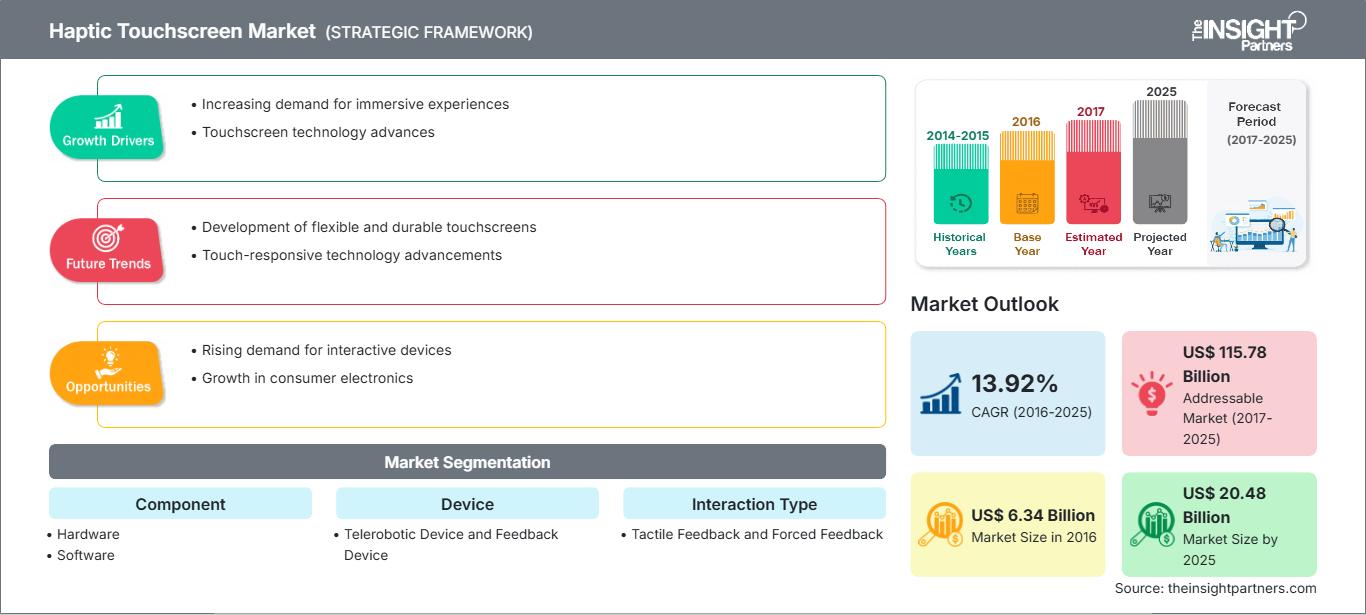
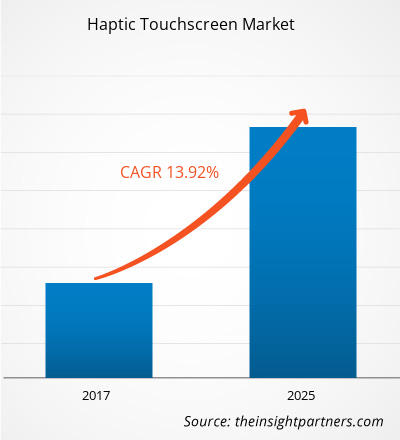
The Haptic Touchscreen market was valued at US$ 12.75 Billion in 2025 and is projected to reach US$ 40.20 Billion by 2034, registering a CAGR of 15.44% from 2026 to 2034. The above-mentioned development path can be attributed to the rising need for more immersive and interactive UIs in many different industries. The development of the market is also due to the increased usage of tactile feedback technologies in consumer electronics, automotive infotainment, medical equipment, and digital advertising platforms.
North America had a considerable portion of the Haptic Touchscreen market size in 2025, with the forecast showing the CAGR reaching around 14.0% – 16.0%. Such performance of the region is underpinned by its early adoption of the latest haptic interface technologies, high demand from the consumer electronics industry, and major investments in automotive HMI systems.
Haptic Touchscreen Market Assessment and Insights
- North America: Estimated to hold approximately 28–32% share in 2025, growing at a CAGR of 14.0–16.0% from 2026 to 2034. Growth is driven by high smartphone penetration, advanced automotive infotainment adoption, and a strong technology supplier base.
- United States: Representing nearly 85–90% of the North American market in 2025, expanding at a CAGR of 13.5–15.5%. The market is supported by rapid advancements in automotive technology, healthcare innovations, and strong demand for consumer electronics with enhanced user interfaces.
- Europe: Accounting for approximately 22–26% of the global market in 2025, with a CAGR of 14.0–16.0%. Leading countries include the United Kingdom, Germany, and France, driven by automotive HMI innovations and stringent human-machine interface regulations.
- Asia Pacific: Representing roughly 32–36% of the global market in 2025, growing at the highest CAGR of 17.0–19.0%. Key contributors include China, Japan, India, and South Korea, fueled by robust electronics manufacturing ecosystems and high consumer demand for feature-rich devices.
- Largest Segment: Component segment dominates with a market share of approximately 60–65% in 2025, growing at a CAGR of 14.5–16.5%. This is driven by the extensive deployment of hardware components including actuators, sensors, and drivers supporting haptic feedback modules in touchscreens.
- High Growth Segment: Application segment projected to expand at a CAGR of 16.0–18.0%, driven by the rising adoption of haptic touchscreens in automotive, healthcare, and digital advertisement applications beyond traditional consumer electronics.
- Key companies analyzed in detail: Cypress Semiconductor Corporation, Immersion Corporation, Johnson Electric Group, Microchip Technology, Inc., ON Semiconductor, Precision Microdrives Limited, SMK Corporation, Senseg Ltd., Texas Instruments Incorporated, Ultrahaptics.
Source: The Insight Partners' analysis based on proprietary research, government publications, company annual reports, investor presentations, industry databases, and expert interviews.
The Haptic Touchscreen industry is witnessing the transition from vibration based feedback system towards the implementation of complex systems that use force feedback, texture simulation, and AI-based adaptive response systems. Dynamics within production are changing as producers diversify the portfolio of haptic modules used for a variety of applications including automotive control panels, medical simulators, and interactive digital signages. Advancements in technology include the development of smaller actuators, piezo and electrostatic actuators, and software control algorithms allowing embedding haptic systems in thinner and difficult to embed devices.
On the outlook, the Haptic Touchscreen industry will experience continued growth due to heavy investments made by developing countries into consumer electronics and smart infrastructure development. High growth of AR/VR industry and increase in human interaction through digital interfaces combined with significant investments in human machine interfaces creates positive environment for market penetration.
Haptic Touchscreen Market Report Scope
| Report Attribute | Details |
|---|---|
| Market size in 2025 | US$ 12.75 Billion |
| Market Size by 2034 | US$ 40.20 Billion |
| Global CAGR (2026 - 2034) | 15.44% |
| Historical Data | 2021-2024 |
| Forecast period | 2026-2034 |
Haptic Touchscreen Market Analysis
The key demand driver in the Haptic Touchscreen industry is the tremendous increase in the demand for immersive and interactive user interfaces in consumer electronics, automotive and industrial applications. With devices increasingly being designed for use by people through touch screens, there is increased demand for tactile feedback and user engagement. The expansion of the market is made possible by the development in piezoelectric and electrostatic actuator technology that facilitates the creation of more sensitive and accurate feedback systems.
Haptic Touchscreen market competition is observed through the participation of existing semiconductor firms and manufacturers of haptic technology. For example, Immersion Corporation, Texas Instruments Incorporated, and Microchip Technology, Inc., concentrate on innovations, strategic alliances, and licensing to reinforce their market position. According to Haptic Touchscreen market report, the tendency of providing combined hardware and software products for creating unique haptic experience is traced. Moreover, the R&D investment is made to improve the force and texture feedback technologies by overcoming the limitation of vibration and concentrating on high-end segments in the automotive and healthcare industries.
● REPORT CUSTOMIZATION
Tailor This Report To Align With Your Specific Business Requirements
This report can be customized to align precisely with your business objectives, scope, and target markets. Customization options include tailored segmentation, geography, competitive analysis, and strategic insights to support informed decision-making.
Customize This Report →WHAT YOU CAN ADJUST
- ● Segmentations
- ● Geography
- ● Competitive Analysis
- ● Language Preferences
Haptic Touchscreen Market: Strategic Insights
Regional Insights
North America Haptic Touchscreen Market
North America has an established but fast-evolving market for Haptic Touchscreens, accounting for a considerable market share of around 28-32% of global revenue by 2025. North America will be driven by early adaptation of haptic interface technology, robust consumer electronics demand, and sophisticated infotainment systems in automobiles. The key drivers in North America are high market penetration of smartphones and wearables, significant investment in automotive HMI system, and strong suppliers of technology. North America's market will see more deployment in healthcare applications such as medical displays and surgical simulation. The CAGR in North America is expected to range from 14.0% to 16.0% from 2026 to 2034.
U.S. Haptic Touchscreen Market
The US holds the leading position in the North America Haptic Touchscreen market share, of 85% to 90% in 2025 and growing at a CAGR of 13.5% to 15.5%. The reasons for US dominance are a higher number of haptic technology providers, development in automotive technology, and the growing demand for consumer electronics with improved interface. Some significant developments seen in this market include the adoption of automotive dashboards, infotainment systems, and health care simulation devices. Important market players, including companies such as Immersion Corporation and Texas Instruments Incorporated, have been developing their position via collaborations with OEMs and automotive Tier-1s.
Europe Haptic Touchscreen Market
The share of Europe in the Global market is expected to be around 22% - 26%, with a CAGR of 14% - 16%. The major markets in this region include the UK and Germany due to the dominant automotive OEMs and strict HMI regulations. France, Italy, and Spain are making significant contributions as well due to the increasing demand for high-end interfaces in consumer electronics and industrial HMIs. It should also be noted that the European Union focuses on user experience and safety standards in automotive applications which promote haptic feedback.
APAC Haptic Touchscreen Market
The Asia Pacific is one of the fastest growing regions for Haptic Touchscreens, having a share of around 32% to 36% by 2025, with a strong CAGR of 17.0% to 19.0%. China and Japan are the dominant nations because of the presence of highly developed manufacturing ecosystem for electronics, high penetration of smartphones and wearables, and investments in automotive components. There is also significant growth witnessed by India and South Korea due to high demand among consumers for sophisticated interfaces and advanced products. Policies favoring local manufacturing and innovation in technology are driving the adoption rate of haptic solutions in the region.
Middle East & Africa Haptic Touchscreen Market
There are opportunities available in the Middle East & Africa region for haptic touchscreens. With huge investments made on the part of Saudi Arabia and UAE for luxury automobiles, digital infrastructure, and consumer electronic products, the market is seeing growth at a rate of around 15.0% – 17.0%. This growth is mainly because of the need for providing a premium experience in high-end automobiles and interactive displays. South Africa is another major market where there is a growing demand from the retail and hospitality industries for interactive kiosks.
Segmentation Analysis
Component
The Component segment encompasses hardware and software elements. This segment is projected to grow at a CAGR of 14.5–16.5% from 2026 to 2034, driven by the expanding range of applications requiring sophisticated haptic solutions. Market dynamics are shaped by continuous innovations in actuator technologies, sensor design, and control algorithms aimed at enhancing feedback precision, reducing power consumption, and enabling miniaturization. The segment's growth is further propelled by the rising demand for integrated hardware-software solutions that deliver differentiated user experiences.
- Hardware: Encompasses actuators, sensors, drivers, and controllers that form the physical foundation of haptic feedback systems. The strategic importance of hardware components is growing with the development of advanced piezoelectric and electrostatic actuators for more precise and energy-efficient feedback.
- Software: Includes control drivers, firmware, and haptic effect libraries that enable sophisticated feedback experiences. The software component is increasingly important as feedback experience becomes more sophisticated, with AI integration enabling context-aware and personalized haptic responses.
Device
The Device segment is growing at a CAGR of 14.5–16.5% from 2026 to 2034. This growth is underpinned by the increasing need for haptic feedback across diverse device categories. The adoption of haptic technology in telerobotic devices is accelerating, driven by the need for enhanced remote operation capabilities in healthcare and industrial applications. Feedback devices are gaining popularity in gaming, simulation, and training applications where realistic tactile sensations are critical for user engagement.
- Telerobotic Device: Utilizes haptic touchscreens for remote operation in healthcare, industrial, and defense applications. The growing adoption of telemedicine and remote surgery is driving demand for telerobotic devices with advanced haptic feedback capabilities.
- Feedback Device: Includes gaming controllers, simulation systems, and training devices that provide tactile feedback to enhance user experience. The strategic importance of this sub-segment is growing with the expansion of AR/VR ecosystems and immersive digital interactions.
Interaction Type
The Interaction Type segment is a high-growth area of the market, growing at a CAGR of 16.0–18.0% from 2026 to 2034. This growth is underpinned by the increasing demand for sophisticated haptic experiences beyond simple vibration. Tactile feedback is becoming standard in consumer electronics, while force feedback is gaining traction in automotive and industrial applications where precise control and safety are critical.
- Tactile Feedback: Provides vibration and texture sensations to enhance user interaction with touchscreens. The widespread adoption of tactile feedback in smartphones, tablets, and wearables is driving significant demand in this sub-segment.
- Force Feedback: Delivers resistance and force sensations, enabling more immersive and precise interactions. The strategic importance of force feedback is growing with the increasing deployment in automotive control panels, medical simulation, and industrial HMIs.
Application
The Application segment is a cornerstone of the Haptic Touchscreen market, growing at a CAGR of 16.0–18.0% from 2026 to 2034. This growth is driven by the expanding adoption of haptic touchscreens across diverse end-user sectors. Consumer electronics remains the largest application area, while automotive, healthcare, and digital advertisement are emerging as high-growth segments where haptic technology delivers significant user experience improvements.
- Consumer Electronics: Represents the largest application segment, including smartphones, tablets, wearables, and gaming devices. The high penetration of touch-based devices and consumer demand for enhanced interfaces are driving significant adoption.
- Healthcare: Utilizes haptic touchscreens for medical displays, surgical devices, and training simulators. The need for precise tactile feedback in medical procedures and training is a significant driver for this sub-segment.
- Automotive: Employs haptic touchscreens in infotainment systems, dashboards, and control panels. The automotive industry's push for enhanced driver interaction, safety, and differentiation is accelerating adoption.
- Digital Advertisement: Uses haptic touchscreens in interactive kiosks, digital signage, and public displays. The demand for engaging and immersive advertising experiences is fueling growth in this sub-segment.
- Entertainment: Incorporates haptic touchscreens in gaming, VR/AR systems, and simulation experiences. The rapid growth of immersive entertainment technologies is a significant driver for haptic adoption.
Opportunity Snapshot
| Application | Revenue Contribution | Trend Tag | Adoption Stage |
|---|---|---|---|
| Consumer Electronics | High | Smart Interface | Mature |
| Automotive | High | HMI Innovation | Scaling |
| Healthcare | Medium | Medical Simulation | Scaling |
| Digital Advertisement | Medium | Interactive Display | Emerging |
| Entertainment | High | Immersive Tech | Scaling |
Haptic Touchscreen Market Growth Drivers and Impact Analysis
Rising Demand for Immersive and Interactive User Interfaces
The rise in the need for immersive and interactive user interfaces in consumer electronics, automobiles, and industries is one of the main drivers of the market. With the increase in touch interfaces in devices, there is a rising need for tactile feedback and user interaction. The effect is most significant in the consumer electronics and automotive segments where haptic feedback improves usability, reduces errors, and increases accessibility. This driver will play an important role in increasing the demand for advanced haptic systems.
Growing Integration in Automotive Human-Machine Interfaces
Growing demands for interaction and safety among other things in the automotive sector through the use of haptic technology have been leading factors driving the market demand for haptic technologies in the sector. Companies in the sector are increasingly adopting haptic technologies which help drivers receive tactile feedback from their controls and alarms, hence eliminating the need for visual confirmation. This particular consumer is very significant in Europe and North America regions whereby automobile Original Equipment Manufacturers (OEMs) aim at competitive advantage through advanced HMI experiences.
Rapid Growth of AR/VR and Immersive Technologies
The development of ecosystems based on augmented reality and virtual reality is generating considerable demand for haptic touch screens. Immersive technologies need real-life sensations to improve user engagement and generate a virtual experience. The above driver is affecting the industries of entertainment, games, and simulations, which are showing an increased interest in using haptic solutions in virtual training and gaming scenarios.
Haptic Touchscreen Market Future Trends
Integration of Artificial Intelligence for Personalized Haptic Feedback
The Haptic Touchscreen market trends indicate a significant shift towards AI-driven haptic systems capable of delivering context-aware and personalized touch feedback. Machine learning algorithms are being integrated into haptic software to analyze user interactions, adapt feedback responses, and provide rich, personalized experiences across digital platforms. This trend is expected to accelerate as AI becomes more accessible and as security requirements become more demanding. The integration of AI capabilities is making haptic solutions more intelligent and intuitive, enhancing user engagement and satisfaction.
Adoption of Advanced Force Feedback and Texture Simulation
An emerging trend is the increasing adoption of force feedback and texture simulation haptics beyond simple vibration. Manufacturers are developing high-fidelity haptic modules that deliver realistic tactile sensations, including resistance, texture, and temperature feedback. This trend is expected to accelerate as applications in automotive controls, medical simulation, and industrial HMIs demand more sophisticated feedback experiences. The development of advanced haptic technologies is reshaping consumer expectations and fueling market growth.
Haptic Touchscreen Market Opportunities
Expansion in Emerging Asia Pacific Markets
There is a significant opportunity in the Haptic Touchscreen Market Forecast to penetrate the rapidly expanding Asia Pacific markets with cost-effective haptic solutions for mid-tier devices. As consumer electronics adoption accelerates in countries such as India, Indonesia, and Vietnam, the demand for enhanced user interfaces is increasing. This opportunity is particularly relevant for manufacturers offering scalable, miniaturized haptic modules tailored to mobile devices and automotive displays. The Haptic Touchscreen forecasts indicate significant growth potential in this segment.
Developing Multi-Modal Interface Solutions
Developing integrated solutions combining haptic feedback with other modalities such as gesture and voice recognition presents a substantial growth opportunity. Multi-modal interfaces deliver enriched user experiences and enhanced accessibility, making them attractive for automotive, healthcare, and smart home applications. This focused approach allows vendors to address specific industry needs, fostering deeper market penetration in high-value application areas. Haptic Touchscreen opportunities are particularly strong in the automotive and healthcare sectors where differentiated user experiences command premium pricing.
Recent Developments
- April 2025: Cirque Corporation and Sensel announced a technology collaboration under which Cirque licensed Sensel’s haptic forcepad technology and assumed direct customer support and development responsibilities for the notebook PC market. The collaboration combines Sensel’s force-sensing and haptic technology with Cirque’s expertise in capacitive touch solutions, supporting the development of advanced touch interfaces that provide both touch sensing and tactile feedback.
- November 2025: Sensetics raised $1.75 million in funding to advance its next-generation touch-sensing and haptic technology platform. The company is developing solutions capable of capturing and transmitting high-fidelity touch information, including force and tactile data, with applications across transportation and logistics, manufacturing, medical robotics, and VR/AR touch controllers for professional training and simulation. The investment will support the development and commercialization of technologies designed to enable machines and digital interfaces to sense and reproduce realistic touch interactions.
- November 2024: Vishay Intertechnology announced that its IHPT series of haptic feedback actuators, incorporating licenses from Immersion Corporation, was selected as a finalist for the 2024 Elektra Awards in the “Passive and Electromechanical Product of the Year” category. Designed for LCD displays, touchscreens, touch switches, and button control panels in automotive and commercial human-machine interfaces, the solenoid-based actuators provide high-definition tactile feedback with fast response times of approximately 5 ms.
Frequently Asked Questions

- Comprehensive Market Sizing and Forecast Analysis
- Detailed Segmentation Analysis
- In-Depth Market Dynamics Assessment
- Regional and Country-Level Insights
- Competitive Landscape and Company Benchmarking
- Strategic Business Intelligence
Recent Reports
Testimonials

The Insight Partners provided valuable market intelligence that supported our global go-to-market strategy. Their team was professional, responsive, and attentive to our feedback, providing thoughtful analysis and helpful methodological clarifications throughout the project.
Junmo Kim Chief Financial Officer (CFO), Enertech Co., Ltd.
The Insight Partners' SCADA System Market report is comprehensive, with valuable insights on current trends and future forecasts. The team was highly professional, responsive, and supportive throughout. We are very satisfied and highly recommend their services.
RAN KEDEM Partner, Reali Technologies LTDs
I requested a report on a very specific software market and the team produced the report in a few days. The information was very relevant and well presented. I then requested some changes and additions to the report. The team was again very responsive and I got the final report in less than a week.
JEAN-HERVE JENN Chairman, Future Analytica
We worked with The Insight Partners for an important market study and forecast. They gave us clear insights into opportunities and risks, which helped shape our plans. Their research was easy to use and based on solid data. It helped us make smart, confident decisions. We highly recommend them.
PIYUSH NAGPAL Sr. Vice President, High Beam Global
The Insight Partners delivered insightful, well-structured market research with strong domain expertise. Their team was professional and responsive throughout. The user-friendly website made accessing industry reports seamless. We highly recommend them for reliable, high-quality research services
YUKIHIKO ADACHI CEO, Deep Blue, LLC.
This is the first time I have purchased a market report from The Insight Partners.While I was unsure at first, I visited their web site and felt more comfortable to take the risk and purchase a market report.I am completely satisfied with the quality of the report and customer service. I had several questions and comments with the initial report, but after a couple of dialogs over email with their analyst I believe I have a report that I can use as input to our strategic planning process.Thank you so much for taking the extra time and making this a positive experience.I will definitely recommend your service to others and you will be my first call when we need further market data.
JOHN SUZUKI President and Chief Executive Officer, Board Director, BK Technologies
I wish to appreciate your support and the professionalism you displayed in the course of attending to my request for information regarding to infectious disease IVD market in Nigeria. I appreciate your patience, your guidance, and the fact that you were willing to offer a discount, which eventually made it possible for us to close a deal. I look forward to engaging The Insight Partners in the future, all thanks to the impression you have created in me as a result of this first encounter.
DR CHIJIOKE ONYIA MANAGING DIRECTOR, PineCrest Healthcare Ltd.Reason to Buy
- Informed Decision-Making
- Understanding Market Dynamics
- Competitive Analysis
- Identifying Emerging Markets
- Customer Insights
- Market Forecasts
- Risk Mitigation
- Boosting Operational Efficiency
- Strategic Planning
- Investment Justification
- Tracking Industry Innovations
- Aligning with Regulatory Trends






 Get Free Sample for