Modern agriculture is entering a new era driven by innovation, sustainability, and scientific advancements. As global food demand continues to rise alongside challenges such as climate change, shrinking arable land, and resource constraints, farmers are increasingly adopting advanced agricultural technologies to improve productivity and crop quality. Among these innovations, plant growth regulators (PGRs) have emerged as an essential tool for optimizing plant development, increasing yields, and supporting sustainable farming practices.
Advanced crop science combines biotechnology, plant physiology, precision agriculture, and digital farming technologies to help growers maximize crop performance while minimizing environmental impact. This scientific progress is significantly accelerating the adoption of plant growth regulators across cereals, grains, fruits, vegetables, oilseeds, ornamentals, and other high-value crops.
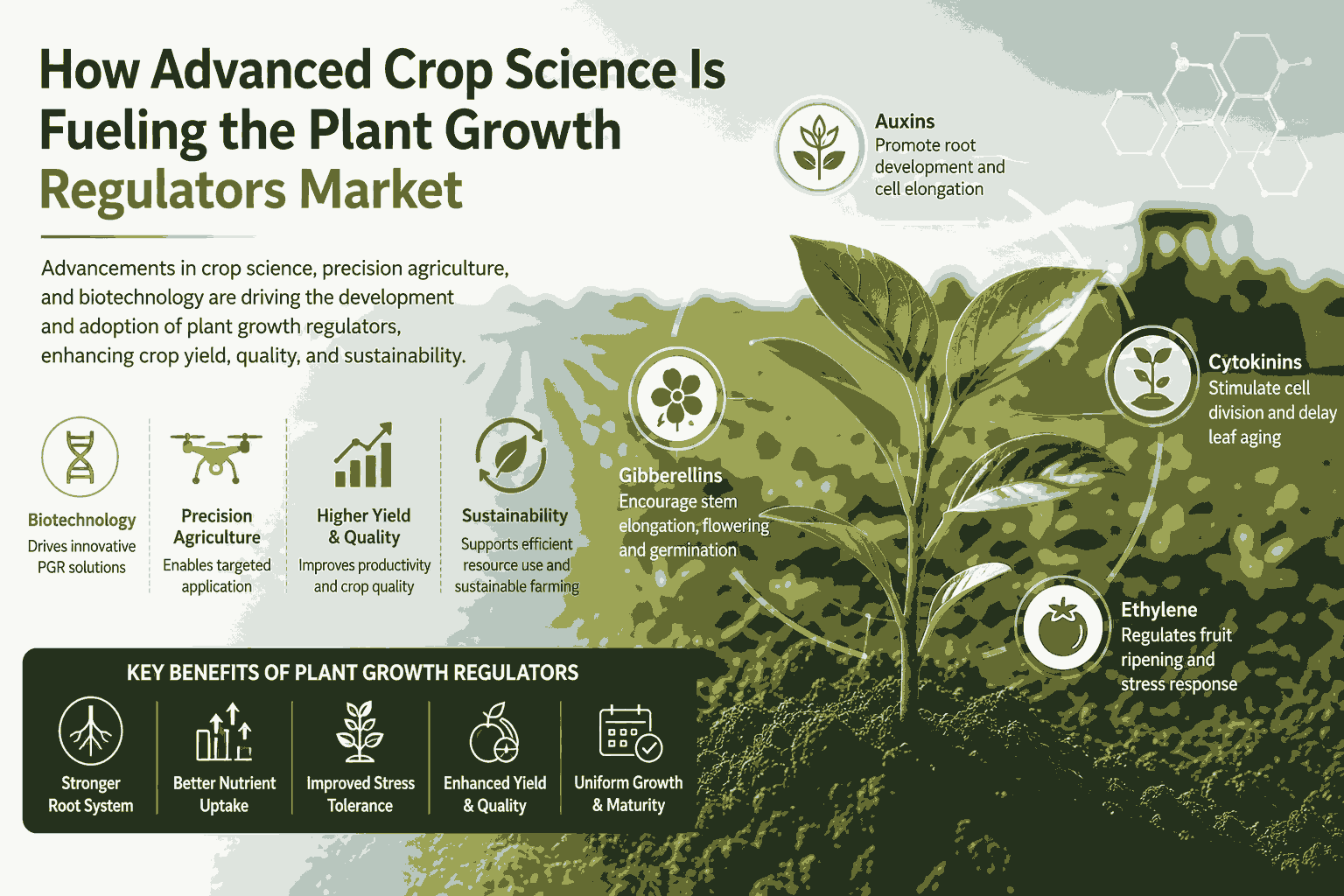
According to The Insight Partners, the Plant Growth Regulators Market is projected to grow from US$ 4.95 billion in 2025 to US$ 14.25 billion by 2034, registering a CAGR of 12.47% during 2026-2034. The increasing focus on sustainable agriculture, precision farming, and crop productivity continues to create significant growth opportunities for the market.
Understanding Plant Growth Regulators
Plant growth regulators are naturally occurring or synthetic compounds that influence various physiological processes in plants. Unlike fertilizers, which primarily supply nutrients, plant growth regulators control plant development by regulating growth, flowering, fruit formation, ripening, and stress responses.
The major categories of plant growth regulators include:
- Auxins, which promote root development and cell elongation.
- Cytokinins, which stimulate cell division and delay leaf aging.
- Gibberellins, which encourage stem elongation, flowering, and seed germination.
- Ethylene, which regulates fruit ripening and stress responses.
- Other specialized regulators designed for specific crop requirements.
These products are widely used across cereals and grains, oilseeds and pulses, fruits and vegetables, turf and ornamentals, helping growers improve both crop yield and overall quality.
Advanced Crop Science Is Transforming Modern Agriculture
Traditional farming methods are rapidly evolving with the integration of scientific research and digital technologies. Advanced crop science focuses on understanding plant biology and applying innovative solutions to maximize agricultural productivity while reducing resource consumption.
Modern farming now incorporates technologies such as:
- Precision agriculture
- Biotechnology
- Digital crop monitoring
- Remote sensing
- Smart irrigation systems
- Data-driven farm management
These technologies enable farmers to make informed decisions throughout the crop cycle. Plant growth regulators complement these innovations by allowing precise control over plant development at critical growth stages, resulting in healthier crops and more consistent harvests.
Precision Agriculture Is Driving Greater Adoption of Plant Growth Regulators
The Precision agriculture has become one of the strongest growth drivers for the Plant Growth Regulators Market. Farmers now have access to advanced tools including GPS-guided machinery, drones, satellite imagery, IoT-enabled sensors, and field monitoring software that provide real-time insights into crop health.
Using these technologies, growers can identify specific areas within fields that require treatment rather than applying products uniformly across entire farms. This targeted approach increases the effectiveness of plant growth regulators while reducing unnecessary applications.
Modern application techniques such as fertigation and foliar spraying further improve efficiency by delivering plant growth regulators directly to crops during critical developmental stages. The combination of precision agriculture and advanced crop science helps farmers increase productivity while lowering production costs and reducing environmental impact.
Biotechnology Is Creating More Effective Growth Solutions
Biotechnology continues to reshape agricultural practices by improving scientists' understanding of plant hormones and physiological processes. Ongoing research is leading to the development of more efficient and crop-specific plant growth regulator formulations that deliver consistent performance under diverse growing conditions.
These advanced formulations help improve:
- Root development
- Nutrient absorption
- Photosynthetic efficiency
- Flower initiation
- Fruit setting
- Crop uniformity
- Yield quality
Rather than replacing fertilizers or crop protection products, plant growth regulators work alongside them to optimize overall crop management. This integrated approach enables farmers to achieve higher productivity while maintaining crop health throughout the growing season.
Addressing Climate Change Through Advanced Crop Science
Climate change is creating significant challenges for agriculture worldwide. Rising temperatures, unpredictable rainfall, drought, flooding, and soil degradation continue to affect crop productivity and farm profitability.
Advanced crop science is helping farmers adapt by developing innovative solutions that strengthen crop resilience. Plant growth regulators assist plants in coping with environmental stress by supporting healthier physiological functions throughout the growth cycle.
Their benefits include:
- Enhanced root growth
- Improved water-use efficiency
- Better nutrient uptake
- Increased tolerance to environmental stress
- Improved flowering and fruit development under challenging conditions
As governments and agricultural organizations promote climate-smart farming practices, plant growth regulators are becoming increasingly important for maintaining stable agricultural production under changing climatic conditions.
Expanding Applications Across High-Value Crops
Although plant growth regulators have traditionally been used in cereals and grains, their application is rapidly expanding across high-value crops where quality plays a critical role in market success.
Fruit growers, vegetable producers, greenhouse operators, and ornamental plant cultivators increasingly rely on plant growth regulators to improve:
- Fruit size
- Color development
- Flowering consistency
- Uniform ripening
- Shelf life
- Overall crop appearance
Advanced crop science has enabled manufacturers to develop specialized formulations tailored to specific crops and growth stages, allowing farmers to maximize both yield and product quality.
Sustainability Is Strengthening Market Growth
Sustainable agriculture has become a major priority for farmers, food companies, and policymakers worldwide. Increasing environmental awareness is encouraging growers to adopt farming practices that improve productivity while conserving natural resources.
Plant growth regulators contribute to sustainable agriculture by:
- Improving fertilizer efficiency
- Enhancing nutrient utilization
- Supporting efficient water management
- Reducing unnecessary chemical applications
- Improving productivity on existing farmland
When integrated with precision farming systems, these products help growers produce higher yields while minimizing environmental impact. Their role in sustainable crop management is expected to become even more significant as agriculture continues transitioning toward resource-efficient production systems.
Digital Farming Is Revolutionizing Crop Management
Digital agriculture is transforming the way farmers monitor and manage their crops. Advanced technologies now provide continuous information about crop health, soil conditions, weather patterns, and growth stages.
Using real-time agricultural data, growers can determine the ideal timing and dosage for plant growth regulator applications, improving treatment effectiveness while reducing product waste.
Modern digital farming technologies include:
- Artificial intelligence-based crop analysis
- Remote sensing
- Drone surveillance
- IoT-enabled field monitoring
- GPS-guided application equipment
- Farm management software
The integration of these technologies with plant growth regulators enables more precise crop management and supports higher agricultural productivity.
Regional Growth Opportunities
The demand for plant growth regulators continues to grow across major agricultural regions worldwide.
North America remains an important market due to widespread adoption of precision agriculture and advanced farming technologies. Europe continues to emphasize sustainable crop production and environmentally responsible agricultural practices. Meanwhile, Asia Pacific is expected to witness significant growth driven by expanding agricultural modernization, increasing food demand, and rising awareness of advanced crop management solutions.
Emerging economies in South and Central America and the Middle East & Africa are also increasing investments in agricultural innovation to improve productivity and strengthen food security.
Future Outlook of the Plant Growth Regulators Market
The future of the Plant Growth Regulators Market will be shaped by continuous innovation in crop science, biotechnology, and precision agriculture. Research efforts are increasingly focused on developing more effective formulations that improve crop performance while supporting sustainable farming objectives.
Key trends expected to influence the market through 2034 include:
- Greater adoption of precision agriculture technologies
- Development of bio-based plant growth regulators
- Increased use of digital crop monitoring systems
- Expansion of fertigation and foliar application methods
- Growing demand for climate-resilient agricultural solutions
- Rising investments in agricultural biotechnology
These developments will continue to strengthen the role of plant growth regulators in modern farming systems worldwide.
Future Outlook
Advanced crop science is redefining the future of agriculture by enabling farmers to improve productivity, enhance crop quality, and adopt more sustainable farming practices. Plant growth regulators have become an integral part of this transformation, offering precise control over plant development while helping crops perform better under changing environmental conditions.